Saturday, April 8, 2023

Bio of Luftwaffe Bomber Ace Ernst Kühl


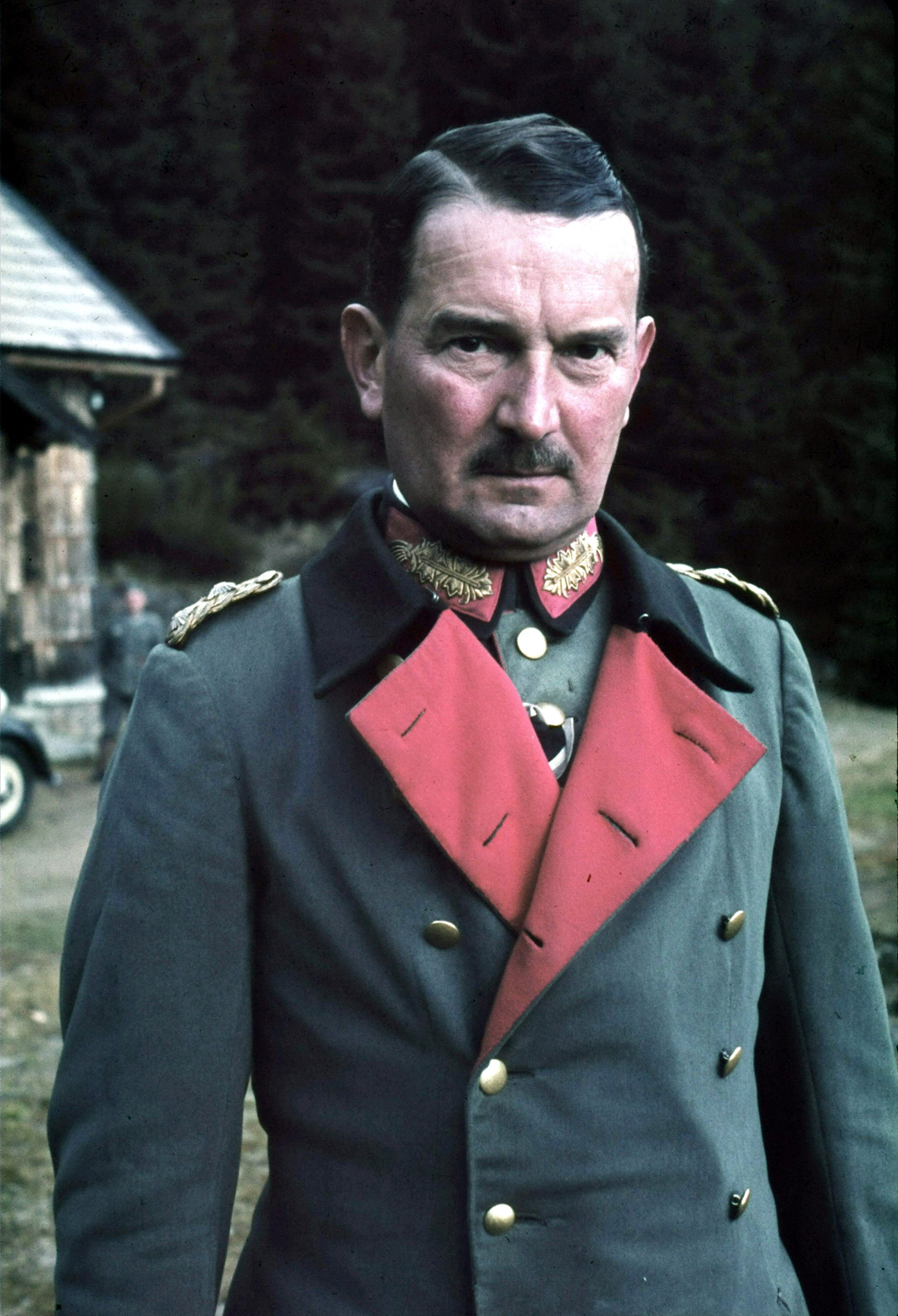
Oberst der Reserve Dr.jur. Ernst Kühl (Fliegerführer Nord) after the presentation of the Eichenlaub award ceremony with Adolf Hitler at Führerhauptquartier Wolfsschanze. Kühl received the Eichenlaub #356 for his Ritterkreuz on 18 December 1943 for his achievement as Geschwaderkommodore Kampfgeschwader 55 (KG 55) "Greif". The medal was awarded for the continued successes of his Geschwader up until he gave up command of the unit on 8 August 1943. In this time he and his men had flown transport missions to Stalingrad, attacked the tank factory at Gorki and the refineries at Saratov, and participated in support of Operation Citadel in July 1943. Particularly noteworthy was the Geschwader’s support of the II. SS-Panzerkorps on 7 July 1943 near Gremutschi and Krassaja, where his pilots flew 178 missions against targets as close as 200 metres away from friendly lines. By the time of his reception of the Eichenlaub Kühl had also reached a personal mission count of 314, a remarkable achievement given his age!

Ernst Kühl (March 28, 1888 in Breslau; February 2, 1972 in Münster) was a German legal scholar, doctorate in administrative law and head of the cultural department of the Westphalian Provincial Association under Governor Kolbow, as well as an officer in the German Army and the Wehrmacht, most recently Oberst der Reserve der Luftwaffe, bomber pilot and Eichenlaubträger in World War II. At the end of the war he was commander of the 5. Flieger-Division. With between 315 and 400 enemy flights. Alongside Werner Baumbach, Joachim Helbig, Dietrich Peltz and Hermann Hogeback, he was considered the most successful bomber pilot in the Luftwaffe.

Ernst Kühl studied law in Königsberg and Berlin and, after graduating, worked as a government trainee in the Prussian administration. In 1910 and 1911 he served as a one-year volunteer in the cavalry department of the 1st Kurhessian Field Artillery Regiment No. 11 and was discharged as a reserve lieutenant.

As Leutnant d.R. drafted again, he fought in the First World War in the Foot Artillery Regiment No. 22. After the end of the war he was released from the Provisional Reichswehr in 1919 and became District Administrator in Münster in 1928. After acquiring his private pilot's license in 1932 (he completed three Germany flights as a sports pilot and took part in various flying competitions), he was accepted into the new Luftwaffe as a reserve officer in 1936. On August 1, 1939, after a military exercise, he was promoted to Hauptmann d. R. promoted. At the beginning of the war he was transferred to Kampfgeschwader 55, with which he took part in the Polish and western campaigns.

In September 1940 Major Dr. Kühl wounded during Operation "Adlerangriff" (Eagle Attack) when his He 111 P-2 was shot down by the Royal Air Force. He landed in the English Channel, he and his crew were finally rescued by the pilots of the Seenotdienst. Kühl was taken to the hospital in Cherbourg. In March 1941, after more than 100 enemy flights, he was appointed commander of II. Gruppe of the squadron and in August 1942 he was appointed commander of KG 55.

After 230 enemy flights, he was awarded the Ritterkreuz on October 17, 1942. In November 1942 he was also "Lufttransportfuhrer Morosowskaja" (Transport Pilot 2), from where he led the subordinate He 111 to supply supplies to Stalingrad. After the fall of Stalingrad, the remainder of the fighter squadron flew missions on the Don. On August 8, 1943, he relinquished command of the squadron to become Fliegerführer "Nord" (Fliegerführer Nordmeer) on the Arctic Ocean. On December 18, 1943 he was awarded the Eichenlaub. In February 1944 he took over the 3. Flieger-Division, in July 1944 he was appointed Fliegerführer Drontheim (Fliegerführer 4).

On December 19, 1944 he finally became commander of the 5. Flieger-Division in Bardufoss-Heggeli or Narvik, on February 1, 1945 he was replaced by Major General Walter Storp. In March 1945 he was appointed commander of the 14. Flieger-Division in Westphalia, but he was no longer able to take up his post due to the disruption in air communications from Norway. At the end of the war he was taken prisoner by the British.

In September 1947, Kühl, who had been taken prisoner by the British at the end of the war, returned to Germany and wrote several works and was a member of the expert committee for the reorganization of the federal territory. He also drew up a memorandum on the reorganization of the federal territory for the Prime Minister at the time, Karl Arnold. In 1955 he was delegated to the expert committee for the reorganization of the federal territory under the former Reich Chancellor Hans Luther.

Furthermore, during this time, Dr. Kühl manned the Aero-Club Münster, of which he was appointed 1st chairman. Later, the Bundestag delegated him as a representative of the newly founded Luftwaffe of the Federal Republic of Germany to the personnel expert committee for the review and recruitment of generals and colonels in the Bundeswehr armed forces, e.g. also Pöschl, Westhoven and many more.

For his work in the post-war period, Oberst d.R. a.D Dr.jur. Ernst Kühl received the Grand Cross of Merit of the Federal Republic of Germany.

Ernst Kühl achieved a total of about 400 operational sorties during the Second World War.


Source :
http://alifrafikkhan.blogspot.com/2011/07/album-foto-berwarna-perwira-dan_5529.html
https://de.metapedia.org/wiki/K%C3%BChl,_Ernst
https://de.wikipedia.org/wiki/Ernst_K%C3%BChl_(Pilot)
https://en.wikipedia.org/wiki/Ernst_K%C3%BChl
https://forum.axishistory.com/viewtopic.php?p=2466737#p2466737
https://www.lexikon-der-wehrmacht.de/Personenregister/K/KuehlE.htm
https://www.tracesofwar.com/persons/24261/K%C3%BChl-Drjur-Ernst.htm

Sunday, April 2, 2023

Pilots of North American A-36 Apaches

Pilots of North American A-36 'Apaches' (dive-bomber version of the P-51) return from a gunnery training mission in Louisiana, 1943. This aircraft - listed in some sources as "Apache" or "Invader", but generally called Mustang - was the ground-attack/dive bomber version of the North American P-51 Mustang, from which it could be distinguished by the presence of rectangular, slatted dive brakes above and below the wings. A total of 500 A-36 dive bombers served in the Mediterranean and Southeast Asia theaters during World War II before being withdrawn from operational use in 1944. The A-36 project was a stopgap measure intended to keep North American Aviation (NAA) assembly lines running during the first half of 1942 despite the US having exhausted its funds earmarked for fighter aircraft. When the order came for more P-51s in June 1942, the NAA workforce was thoroughly experienced.

Source :
National Archives and Records Administration, 342-C-K-1039
Smithsonian National Air and Space Museum
https://en.wikipedia.org/wiki/North_American_A-36
https://www.flickr.com/photos/airandspace/albums/72157715574200936

Eighth Air Force Losses during World War II

Replacement Boeing B-17G Flying Fortresses lined up on an English airfield to replace squadron losses for the U.S. Eighth Air Force.

The 8th Air Force’s success during World War II came at a high price. Its losses – of both men and machine – were by far the most significant of any branch of the military at that time. The drawback of precision bombing was that it was necessary to bomb by day. Without night vision goggles, or radar technology, sunlight and clear skies were needed to find the targets. Unfortunately, if the bombers could see the targets, then the enemy could see the bombers. Initially the 8th Air Force took staggering losses – up to 86% of fliers were killed, MIA or POW. Although the Flying Fortress had twelve machine guns to defend itself, heavy attacks by German fighters and anti-aircraft ground cannons soon proved that a single squadron was too small of a combat unit. In fact, the Bombardment Group, with the combined force of four squadrons, was also too small. In total, the 8th Air Force lost over 26,000 men. An additional 28,000 men became prisoners of war. Aircraft losses were also grim: 10, 561 planes of varying types were shot down, 4754 of those were B-17 heavy bombers. The 390th Bomb Group lost 176 of its 275 assigned aircrafts.


Source :
National Archives and Records Administration, 342-C-K-2418
Smithsonian National Air and Space Museum
https://390th.org/learn-about-390th/wwii-air-war-over-europe/
https://www.flickr.com/photos/airandspace/albums/72157715574200936

Sunday, March 26, 2023

Heldengedenktag (Heroes' Remembrance Day) 1943

On 21 March 1943, all of Germany commemorates 'Heldengedenktag' (Heroes' Remembrance Day). On this occasion, a state ceremony took place in the Berliner Zeughaus (Berlin armory), in which Hitler also took part. Seated in the front-left row, from left to right: Reichskriegsopferführer Hanns Oberlindober, Generalfeldmarschall Fedor von Bock (Führerreserve), Generalfeldmarschall Erhard Milch (Generalinspekteur der Luftwaffe), Reichsführer-SS Heinrich Himmler (Chef der SS und deutschen Polizei), Großadmiral Karl Dönitz (Oberbefehlshaber der Kriegsmarine), Generalfeldmarschall Wilhelm Keitel (Chef Oberkommando der Wehrmacht), Reichsmarschall Hermann Göring (Oberbefehlshaber der Luftwaffe), and Adolf Hitler (Führer und Oberster Befehlshaber der Wehrmacht). Seated in the front-right row, from left to right: Reichsminister Joachim von Ribbentrop, Reichsminister Dr. Joseph Goebbels, Reichsminister Dr. Wilhelm Frick, SS-Oberstgruppenführer und Generaloberst der Polizei Kurt Daluege, unknown, Reichsleiter Robert Ley, and SS-Obergruppenführer Dr. Philipp Bouhler.

Source :
Bundesarchiv Bild 146-1983-0117-06
https://www.gettyimages.com/detail/news-photo/german-military-officers-including-hermann-goering-wilhelm-news-photo/493272171
https://ww2db.com/image.php?image_id=11336

Monday, March 20, 2023

The crew of a Martin PBM-5 Mariner flying boat

The crew of a U.S. Martin PBM-5 Mariner flying boat used for patrol missions and anti-submarine warfare pose on top of their aircraft in April 1945 at Tanapag Harbor in Saipan.

Source :
National Archives and Records Administration, 80-G-K-16192
Smithsonian National Air and Space Museum
https://www.flickr.com/photos/airandspace/albums/72157715574200936

Free French air force formally receives a Curtiss P-40Fs

The newly reconstituted Free French air force formally receives its first frontline combat aircraft, Curtiss P-40Fs, on January 8, 1943, at Casablanca from the U.S. Army Air Forces. This was the first of 1,000 combat aircraft promised by President Roosevelt to General de Gaulle. This is Groupe de Chasse GC II/5, which had just adopted the designation Lafayette Escadrille as a reciprocal tribute to the World War I French squadron of American recruits that had fought the Germans before the U.S. entered WWI in 1917. Less than two months earlier, these P-40s had been catapult launched from a U.S. carrier with U.S. Army Air Forces pilots during Operation Torch, the U.S. invasion of North Africa, while the French pilots of GC II/5 were fighting U.S. Navy Grumman F4F Wildcats under the flag of Vichy France, allied to Germany. The hostilities lasted for only three days, when, on November 11, 1942, the Vichy French forces in North Africa swore allegiance to Free French commander General Charles de Gaulle, resulting in Germany occupying all of Vichy France.

Source :
National Archives and Records Administration, 342-C-K-91
Smithsonian National Air and Space Museum
https://www.flickr.com/photos/airandspace/albums/72157715574200936

Sunday, March 12, 2023

Mussolini in SIGNAL Magazine


Benito Mussolini, Italian dictator and leader of the National Fascist Party (29 July 1883 - 28 April 1945) - 'L'homme d'Etat' (The Statesman). From 'Signal', December 1940, French language news magazine published by the Nazis. Original caption: "Avec un calme parfait et un sureté de vues qui ne l'abandonment jamais, sachent constamment attendre l'heure exacte ou il agira, et animé d'un ardent amour pour son peiple, le Duce préside avec une calirvoyance géniale aux destinées de son pays" (With a perfect calm and a certainty of views which never abandon him, knowing how to constantly wait for the exact hour when he will act, and animated by an ardent love for his people, the Duce presides with a brilliant clairvoyance over the destinies of his country).

Source :
https://www.gettyimages.com/detail/news-photo/mussolini-lhomme-detat-from-signal-december-1940-french-news-photo/171081970?phrase=benito%20mussolini
https://original.newsbreak.com/@anita-durairaj-561241/2774092996081-the-gift-that-italian-dictator-mussolini-gave-to-cincinnati-in-1929-was-stolen-decades-later

Friday, March 3, 2023

Bio of Ritterkreuzträger Ekkehard Kylling-Schmidt

Ekkehard Kylling-Schmidt

Date of Birth: 21.06.1918 - Flensburg, Schleswig (German Empire)
Date of Death: 28.08.2000 - Koblenz, Rhein (Germany)

Promotions:
25.06.1940 Leutnant
01.11.1941 Oberleutnant
04.12.1942 Hauptmann
00.00.194_ Major
00.00.194_ Oberstleutnant im Generalstab

Career:
10.10.1938 Infanterie-Regiment 26
00.00.19__ Führer 3.Kompanie / Infanterie-Regiment 26
00.00.19__ Chef 4.Kompanie / Infanterie-Regiment 26
00.01.1943 Kommandeur I.Bataillon / Fusilier-Regiment 26
00.05.1944 7. Infanterie-Division
00.06.1944 Kriegsakademie
00.00.194_ Adjutant
00.05.1945 - 00.08.1945 POW

Awards and Decorations:
09.11.1940 Eisernes Kreuz II.Klasse
22.07.1941 Eisernes Kreuz I.Klasse
00.00.19__ Infanterie-Sturmabzeichen in Silber
00.00.19__ Verwundetenabzeichen in Schwarz
00.00.194_ Verwundetenabzeichen in Silber
20.10.1941 Ritterkreuz des Eisernen Kreuzes, as Leutnant and Führer 3.Kompanie / I.Bataillon / Infanterie-Regiment 26 / 30.Infanterie-Division
15.07.1942 Panzervernichtungsabzeichen in Silber, Received for the destruction of a Soviet tank in August 1941
15.07.1942 Panzervernichtungsabzeichen in Silber, Received for the destruction of a Soviet tank in October 1941
00.00.1942 Medaille "Winterschlacht im Osten 1941/42" (Ostmedaille)
00.00.194_ Demjankschild
00.00.194_ Nahkampfspange in Bronze
04.12.1942 Ritterkreuz des Eisernen Kreuzes mit Eichenlaub #150, as Oberleutnant and Chef 4.Kompanie / I.Bataillon / Füsilier-Regiment 26 / 30.Infanterie-Division


Source :
https://www.alamy.com/stock-photo/ekkehard-kylling-schmidt.html
https://de.metapedia.org/wiki/Kylling-Schmidt,_Ekkehard
https://www.ebay.co.uk/itm/151261670212
https://www.gettyimages.com/detail/news-photo/german-world-war-two-postcard-showing-ekkehard-kylling-news-photo/500839327?phrase=Kylling-Schmidt
https://www.lexikon-der-wehrmacht.de/Personenregister/K/KyllingE.htm
http://pantorijn.blogspot.com/2013/06/tita-binz.html
http://www.pvoller.net/new_stamps/germany/military/ww2/ritterkreuztrager.php
http://www.ritterkreuztraeger.info/rk/k.html
https://www.tracesofwar.com/persons/39319/Kylling-Schmidt-Ekkehardt-InfReg-26.htm
https://www.weitze.com/cgi-bin/suche/suche.pl?q=Kylling-Schmidt#s=alle

Wednesday, March 1, 2023

US Navy L-ships at Naval Air Station Moffett Field

US Navy L-ships at Naval Air Station Moffett Field were used for training patrol crews that operated K and M class blimps equipped with radar and depth bombs to hunt surfaced submarines.

Source :
National Archives and Records Administration, 80-G-K-1472
Smithsonian National Air and Space Museum
https://www.flickr.com/photos/airandspace/albums/72157715574200936

Chaplain Michael Ragan blesses the crew of the Boeing B-17G “Fifinella”

Captain Michael Ragan, the Catholic chaplain of the 91st Bomb Group, blesses the crew of the Boeing B-17G “Fifinella” before a mission in mid-1944. The plane was lost on a mission on August 13, 1944. The “Fifinella” was the female gremlin cartoon created by Walt Disney and adopted by the Women Air Service Pilots (WASP) as their mascot.

Source :
National Archives and Records Administration, 342-C-K-2105
Smithsonian National Air and Space Museum
https://www.flickr.com/photos/airandspace/albums/72157715574200936

Tuesday, February 28, 2023

Divisionskommandeur Richard John with 292. Infanterie-Division


Generalleutnant Richard John, the divisional commander of 292. Infanterie-Division, in Poljanka, central sector of the Eastern Front, probably in the summer of 1944. John received the Ritterkreuz des Eisernen Kreuzes in this capacity on 20 December 1943. He also got the Deutsches Kreuz in Gold previously, on 26 May 1943. He became the commander of 292. Infanterie-Division from 20 July 1943 to 1 July 1944.


Source :
Akira Takiguchi photo collection


Saturday, February 18, 2023

Ritterkreuzträger Heinz-Georg Haase

Heinz-Georg Haase (16 April 1914 - 25 November 1943) received the Ritterkreuz des Eisernen Kreuzes on 2 September 1943 as Oberfeldwebel and Zugführer in 11.Kompanie / III.Bataillon / Grenadier-Regiment 122 / 50.Infanterie-Division.


Source :
Hill60 photo collection
https://www.google.com/url?sa=t&rct=j&q=&esrc=s&source=web&cd=&cad=rja&uact=8&ved=2ahUKEwjY_o2JmJ_9AhWMzXMBHdorAk04ChAWegQIGRAB&url=https%3A%2F%2Fwww.deutsches-wehrkundearchiv.de%2Fapp%2Fdownload%2F5805611892%2FA0064.pdf&usg=AOvVaw1dUKVlCJnXYyXYgbe4kkLh
https://www.tracesofwar.com/persons/87034/Haase%C2%A0Heinz-Georg.htm

Thursday, February 9, 2023

German Soldiers Set Up Film Camera in Krakow

Two German soldiers set up an Askania model R 35mm, a very expensive film camera, while a few more soldiers and passers-by observe what is happening. They are most likely from propaganda unit of the Wehrmacht. The picture was taken in Krakow, Poland, during the Nazi occupation, 1940. In the background we can see the headquarters of Commerzbank in the main square.

Source :
https://digit.wdr.de/entries/75882
https://www.facebook.com/krakow.ciekawostki.tajemnice.stare.zdjecia/posts/2639386526326076/
https://niemieckikrakowblog.wordpress.com/2017/04/05/dlaczego-krakow-jest-niemiecki-wedlug-mieszkanca-generalnego-gubernatorstwa/

Sunday, February 5, 2023

Hiawatha Mohawk Getting Ready for a Mission in Italy

Lieutenant Hiawatha Mohawk, one of the few Native American fighter pilots of World War II, flew with the 319th Fighter Squadron, 325th Fighter Group. Here, he straps into his Republic P-47 for a mission in Italy supporting ground troops of the Fifth Army. Mohawk had two aerial victories during the war and went on to a long career flying fast jets in the Air Force.

Source :
National Archives and Records Administration, 342-C-K-2128
Smithsonian National Air and Space Museum
https://artsandculture.google.com/asset/lt-hiawatha-mohawk-one-of-the-few-native-american-fighter-pilots-of-world-war-ii-flew-with-the-319th-fighter-squadron-325th-fighter-group/3wFm8uSy_UEDSg?hl=en
https://www.flickr.com/photos/airandspace/albums/72157715574200936

Norden Bombsight

U.S. Bombardier trainers are readied for instruction. The motorized units would simulate the track across the ground that the bombardier used to synchronize the optics in the Norden bombsight.

The Norden Mk. XV, known as the Norden M series in U.S. Army service, is a bombsight that was used by the United States Army Air Forces (USAAF) and the United States Navy during World War II, and the United States Air Force in the Korean and the Vietnam Wars. It was an early tachometric design that directly measured the aircraft's ground speed and direction, which older bombsights could only estimate with lengthy manual procedures. The Norden further improved on older designs by using an analog computer that continuously recalculated the bomb's impact point based on changing flight conditions, and an autopilot that reacted quickly and accurately to changes in the wind or other effects.

Together, these features promised unprecedented accuracy for daytime bombing from high altitudes. During prewar testing the Norden demonstrated a circular error probable (CEP)[a] of 75 feet (23 m),[b] an astonishing performance for that period. This precision would enable direct attacks on ships, factories, and other point targets. Both the Navy and the USAAF saw it as a means to conduct successful high-altitude bombing. For example, an invasion fleet could be destroyed long before it could reach U.S. shores.

To protect these advantages, the Norden was granted the utmost secrecy well into the war, and was part of a production effort on a similar scale to the Manhattan Project: the overall cost (both R&D and production) was $1.1 billion, as much as 2/3 of the latter or over a quarter of the production cost of all B-17 bombers.[1] The Norden was not as secret as believed; both the British SABS and German Lotfernrohr 7 worked on similar principles, and details of the Norden had been passed to Germany even before the war started.[citation needed]

Under combat conditions the Norden did not achieve its expected precision, yielding an average CEP in 1943 of 1,200 feet (370 m) (a CEP of 1200 feet means 16% of all bombs dropped land within 1000 feet of the target), similar to other Allied and German results. Both the Navy and Air Forces had to give up using pinpoint attacks. The Navy turned to dive bombing and skip bombing to attack ships, while the Air Forces developed the lead bomber procedure to improve accuracy, and adopted area bombing techniques for ever-larger groups of aircraft. Nevertheless, the Norden's reputation as a pin-point device endured, due in no small part to Norden's own advertising of the device after secrecy was reduced late in the war.

The Norden saw reduced use in the post–World War II period after radar-based targeting was introduced, but the need for accurate daytime attacks kept it in service, especially during the Korean War. The last combat use of the Norden was in the U.S. Navy's VO-67 squadron, which used it to drop sensors onto the Ho Chi Minh Trail in 1967. The Norden remains one of the best-known bombsights.


Source :
National Archives and Records Administration, 342-C-K-885
Smithsonian National Air and Space Museum
https://en.wikipedia.org/wiki/Norden_bombsight
https://www.flickr.com/photos/airandspace/albums/72157715574200936

German Soldiers and the Snow Wall

German soldiers and the wall of snow. No information about when and where this pic was taken.


Source :
https://www.wehrmacht-awards.com/forums/forum/wehrmacht-era-militaria/photos-and-paper-items-forum/77941-post-your-exciting-winter-photos/page81

Captured Russian Tanks under German Command

Two captured Russian T-34 tanks with camo under german command. It was captured and used by Panzer-Regiment 35 / 4.Panzer-Division, as can be seen by the blue bear in the turret (bears are supposed to have been painted in company colors).


In the May-June 1950 issue of the Armored Cavalry Journal, Mr. Garrett Underhill, in Part IV of "The Story of Soviet Armor," writes that the poor quality of Russian tanks is demonstrated by the fact that Germany made no use of the large numbers of Russian tanks (T 34 and KV) which it had captured, although it used Czech tanks and, in the Balkans, in the fighting against the Partisans, French tanks.

This gives a false idea of the situation. In order to clear up this matter, I should like to make the following points:

It is undoubtedly true that from time to time the armor used for Russian tanks was of very poor quality and often did not have the resistance to penetration normally required.

But there are other reasons for the fact that Russian tanks, especially the T 34, were not used by the German Army:

Mere possession of a captured tank is not enough. It is useless unless continuous maintenance of the vehicles is possible, and this depends on the availability of spare parts. Aside from technical difficulties, manufacture of spare parts for the T 34 in German factories would have been possible only at the expense of a reduction in the number of German tanks turned out. For this reason the use of T 34 tanks could not be considered.

In isolated instances the German Army organized captured-tank companies using captured T 34 tanks and tried to get the needed spare parts from captured matériel. But the method was unsuccessful, and these captured-tank units were dissolved very soon. In was impossible to get enough spare parts from the matériel captured. The method also involved an irrational expenditure of effort, which was increased by the fact that maintenance itself required special experts thoroughly trained in the work and the manufacture of special repair tools.

As far as the Czech and French tanks were concerned the situation was different. Factories and repair installations for these types of tanks were available. However, the French tanks were at best useful only to frighten peasants; they were altogether inferior to the T 34 regardless of the poor materials used in the latter's construction.

The fact that in the East the captured T 34 was not used except in a few cases had a second and equally important reason:

From a tactical viewpoint the T 34 was inferior to the German tank types (Pz III and Pz IV with long barreled 75 mm gun) because it combined the functions of commander and gunner in one person. As soon as the commander began firing, he lost his overall viewpoint and was unable to direct his tank. Even as gunner, however, he was unable to fulfill his mission because when functioning as such he had no commander from which to receive directions. As a result, the T 34 was in most cases hopelessly inferior to the German tanks, especially after German tank were armed with a long gun, in the spring of 1942. I often saw Russian tank attacks in which the T 34's charged like a herd of wild bulls and continuously fired their guns, obviously without aiming, while driving forward. While the limited training given tank crews as a result of the high losses incurred may have been one of the reasons for adopting such tactics, it is certain that the union of the functions of commander and gunner in one person was a contributing factor.

Partly as a result of this tactical inferiority, in the Ukraine my Panzer regiment, from the end of October to the middle of December 1943, destroyed 356 Russian tanks, most of them T 34's, with a total loss of only 12 German tanks. The regiment was equipped with a little more than 100 tanks, half of them Pz IV and the rest Sturmgeschuetz III (self-propelled assault gun), both equipped with the long-barreled 75 mm gun model L 48.

Signed: B. Mueller-Hillebrand


Source :
https://panzerworld.com/german-opinion-of-captured-t-34s
https://www.wehrmacht-awards.com/forums/forum/wehrmacht-era-militaria/photos-and-paper-items-forum/586209-original-ww2-color-photo-slides/page111

Wednesday, February 1, 2023

Bio of General der Panzertruppe Traugott Herr

Traugott Herr (16 September 1890 – 13 April 1976) was a German general during World War II who commanded the 14th Army and the 10th Army of the Wehrmacht. He was a recipient of the Knight's Cross of the Iron Cross with Oak Leaves and Swords.

Born in 1890, Herr joined the army of Imperial Germany in 1911 as an Fahnen-junker (officer cadet) in the infantry. Serving in the Wehrmacht of Nazi Germany in the late 1930s, he commanded the 3rd Battalion of the 33rd Infantry Regiment.

Herr commanded an infantry regiment, part of the 13th Motorized Infantry Division, from 8 September 1939 to 14 October 1940, taking part in the Invasion of Poland (September 1939) and France (May 1940 to October 1940). In October 1940, the division was reformed in Vienna as 13th Panzer Division. Herr was given command of 13th Rifle Brigade, which controlled the division's two infantry regiments, on 14 October 1940.

In the invasion of Poland, the division used civilians as human shields in the battle with the retreating Polish Prusy Army and on 8 September 1939 attacked a medical column marked with the Red Cross signs near Odrzywół. A day later, soldiers from the division took part in the revenge killing of 11 civilians and two Polish priests including Dean Stanisław Klimecki in the nearby town of Drzewica in retaliation for their own military losses. Killings have also been reported in nearby settlements of Gielniów, Kamienna Wola, Klwów, Ossa, Przysucha, Potok, Rozwady and Zarzęcin.

In May 1941 the regiment returned to Germany to take part in Operation Barbarossa, the invasion of the Soviet Union, as part of 1st Panzergruppe under Paul Ludwig Ewald von Kleist in Army Group South. In December 1941, Herr was given acting command of 13th Panzer Division.

On 31 October 1942, on the Terek River deep in the Caucasus, Herr suffered a serious head wound, being struck by shrapnel, and was repatriated to Germany to recuperate. He was later appointed commander of the LXXVI Panzer Corps stationed in France; in August 1943 it was sent to Italy. In Italy, his unit faced the British Eighth Army in Calabria, and the U.S. Fifth Army in Salerno.

Herr commanded the corps in the Italian Campaign until 24 November 1944. He also temporarily took command of 14th Army for a brief period from late November to mid-December 1944. On 18 December 1944, he was awarded the Swords to the Knight's Cross. On 15 February 1945 he took command of 10th Army. The Allies final and decisive spring 1945 offensive in Italy opened in early April, Herr was defending the Adriatic sector with orders to hold the lines. On 2 May 1945 the 14th army was overrun by British forces, and Herr was taken prisoner. He was never charged for the war crimes committed in the east and was released in April 1948.

Awards and Decorations:
Wound Badge in Black
Iron Cross (1914) 2nd Class (14 September 1914) & 1st Class (21 October 1915)
House Order of Hohenzollern with Swords
Bavarian Military Merit Cross (3rd Class)
Panzer Badge in Silver
Clasp to the Iron Cross (1939) 2nd Class (24 September 1939) 1st Class (12 May 1940)
Knight's Cross on 2 October 1941 as Oberst and commander of 13. Schützen-Brigade
110th Oak Leaves on 9 August 1942 as Generalmajor and commander of 13. Panzer-Division
117th Swords on 18 December 1944 as General der Panzertruppe and commanding general of LXXVI Panzer Corps (LXXVI. Panzerkorps)


Source :
https://en.wikipedia.org/wiki/Traugott_Herr

Sunday, January 29, 2023

Four Soldiers of Feldherrnhalle


Four members of the Panzergrenadier-Division "Feldherrnhalle" in a color photograph taken by Hitler's personal photographer Hugo Jaeger, July 1944. From top to bottom: Major der Reserve Wilhelm Schöning from the Füsilier-Regiment Feldherrnhalle, Leutnant der Reserve Herbert Berger from Grenadier-Regiment Feldherrnhalle, Unknown DKiGträger (recipient of Deutsches Kreuz in Gold) Hauptmann, and a young soldier.

Source :
https://artsandculture.google.com/entity/m064km4b?hl=en

Herbert Berger of Feldherrnhalle Division


Leutnant der Reserve Herbert Berger in a picture taken by Hitler's personal photographer Hugo Jaeger, possibly in July 1944. He received the Ritterkreuz des Eisernen Kreuzes on 12 March 1944 as Oberfeldwebel and Zugführer in 10.Kompanie / III.Bataillon / Grenadier-Regiment (motorisiert) "Feldherrnhalle" / Panzergrenadier-Division "Feldherrnhalle".

Source :
https://artsandculture.google.com/entity/m064km4b?hl=en

Wednesday, January 25, 2023

Bio of Generaloberst Eugen Ritter von Schobert

Eugen Siegfried Erich Ritter von Schobert (13 March 1883 – 12 September 1941) was a German general during World War II. He commanded the 11th Army during Operation Barbarossa, the invasion of the Soviet Union. Schobert died when his observation plane crashed in a Soviet minefield.

Schobert was born as Eugen Schobert in Würzburg in the Kingdom of Bavaria, a member state of the German Empire. He was the son of Major Karl Schobert and Anna née Michaely. Schobert entered the Royal Bavarian Army in July 1902. He served primarily in the 1st Bavarian Infantry Regiment "König" and underwent pilot training in 1911.

During World War I, Schobert remained a Bavarian infantry officer, serving the entire war on the Western Front. During the German spring offensive of 1918, he led the 3rd Battalion of the 1st Bavarian Infantry Regiment. For his actions on 23 March 1918, when he personally and successfully led his battalion in the crossing of a canal near Jussy against stiff British resistance, he was awarded the Knight's Cross of the Military Order of Max Joseph. This was Bavaria's highest military honor, comparable to the Prussian Pour le Mérite, and conferred a patent of nobility on a recipient who was a commoner. Hence Eugen Schobert became Eugen Ritter von Schobert.

After World War I, Schobert remained in the Reichswehr and then the Wehrmacht, steadily rising up the ranks. He was Inspector of Infantry from December 1933 to September 1934 and then commanded the 17th Infantry Division from 1935 to 1936 and the 33rd Infantry Division from 1936 to 1938. He took command of the VII Army Corps (VII. Armeekorps) on 4 February 1938.

In September 1939, Schobert led his VII Army Corps in the invasion of Poland as part of the reserve of Army Group South. In May–June 1940, his corps, part of General Ernst Busch's Sixteenth Army of Army Group A, participated in the invasion of Belgium and Luxembourg and the Battle of France. He received the Knight's Cross of the Iron Cross for his leadership of the VII Corps in the breakthrough of the Maginot Line and the capture of Nancy and Toul. He remained in command of the corps during preparations for the invasion of Great Britain.

In September 1940, Schobert was given command of the Eleventh Army. The army was assigned to Army Group South for Operation Barbarossa, the invasion of the Soviet Union. During combat operations in the southern Soviet Union, Schobert was killed when his Fieseler Storch observation aircraft crashed in a Soviet minefield. He was succeeded by Erich von Manstein. A German war correspondent, Leo Leixner, wrote Schobert's biography.

Schobert married Alice Rieder-Gollwitzer in 1921. They had three children: two sons and one daughter. His younger son was killed in combat in 1944 while serving as a fighter pilot for the Luftwaffe.


Source :
https://artsandculture.google.com/entity/m064km4b?hl=en
https://en.wikipedia.org/wiki/Eugen_Ritter_von_Schobert

Bio of Luftwaffe Ace Bruno Stolle


Hauptmann
Stolle, Bruno
* 13.04.1915 Münster/Westfalen
+ 22.01.2004 Rheinbach
Awarded Knights Cross: 17.03.1943 as: Hauptmann Staffelkapitän 8./JG 2 "Richthofen"

Bruno Stolle was born on 13 April 1915 at Münster in Westfalen. Stolle was a blind flying instructor with I./LG 1 at the beginning of the war but was then transferred to 3./JG 51. On 15 March 1940, Stolle was transferred to 8./JG 2. He took part in the Battle for France. He also participated in the Battle of Britain, where he gained his first aerial victories on 11 August when shot down two RAF fighters. Stolle was appointed Staffelkapitän of 8./JG 2 on 7 September 1940. He had three victories to his credit at this time. His scoring rate increased in 1941 with 11 Spitfires and a single Blenheim recorded. Bruno Stolle was awarded the Ehrenpokal on 12 September 1941 and the Deutsches Kreuz in Gold on 29 October 1942. After 32 victories he received the Ritterkreuz on 17 March 1943.

On 1 July 1943, Stolle was appointed Gruppenkommandeur of III./JG 2. He led the Gruppe until 7 December 1943 when he was relieved by Hauptmann Herbert Huppertz (78 victories, RK-EL, KIA 8 June 1944). In February 1944, Stolle was transferred to Schiessschule der Luftwaffe at Vaerlöse in Denmark, where he undertook an instructing role until July 1944. In the middle of August 1944, he was transferred to Erprobungskommando Ta 152 at Rechlin. From October until 25 November he was acting Gruppenkomandeur I./JG 11, following which he returned to EKdo Ta 152 at Rechlin.
Bruno Stolle flew 271 combat missions and shot down 35 enemy aircraft on the Western Front including three four-engine bombers and 19 Spitfires.


Source :
https://militaryautographs.com/item.php?itemnum=2433

Sunday, January 15, 2023

Bio of Franz Ritter von Epp

Franz Ritter von Epp (born Franz Epp; from 1918 as Ritter von Epp; 16 October 1868 – 31 January 1947) was a German general and politician who started his military career in the Bavarian Army. Successful wartime military service earned him a knighthood in 1916. After the end of World War I and the dissolution of the German Empire, von Epp was a commanding officer in the Freikorps and the Reichswehr. He was a member of Bavarian People's Party, before joining the Nazi Party in 1928, when he was elected as a member of the German parliament or Reichstag, a position he held until the fall of Nazi Germany. He was the Reichskommissar, later Reichsstatthalter, for Bavaria, and a Reichsleiter of the Nazi Party.

Franz Epp was born in Munich in 1868, the son of the painter Rudolph Epp and Katharina Streibel. He spent his school years in Augsburg and after this joined the military academy in Munich. He served as a volunteer in East Asia during the Boxer Rebellion in 1900–01 and then became a company commander in the colony of German South-West Africa (now Namibia), where he took part in the bloody Herero and Namaqua Genocide. During the First World War, he served as the commanding officer of the Royal Bavarian Infantry Lifeguards Regiment in France, Serbia, Romania, and at the Isonzo front.

For his war service, Epp received numerous medals, of which the Pour le Mérite (29 May 1918) was the most significant. He was also knighted, being made Ritter von Epp on 25 February 1918, and received the Bavarian Military Order of Max Joseph (23 June 1916).

After the end of the war, Epp formed the Freikorps Epp, a right-wing paramilitary unit mostly made up of war veterans, of which the future leader of the SA Ernst Röhm was a member. This unit took part in the crushing of the Bavarian Soviet Republic in Munich, being responsible for various massacres. Epp joined the Reichswehr and was promoted to Generalmajor in 1922. He took his leave from the German Army after getting involved with right-wing associations in 1923.

When it became necessary for the Nazi Party to purchase a newspaper to publicize its political creed, Epp made available some 60,000 Reichsmarks from secret army funds to acquire the Völkischer Beobachter, which became the daily mouthpiece of the party.

As the Sturmabteilung (SA) expanded, it became an armed band of several hundred thousand men, whose function was to guard Nazi rallies and disrupt those of other political parties. Some of its leaders, particularly Ernst Röhm, visualized the SA as supplanting the regular army when Adolf Hitler came to national power. To this end, a department was set up under Epp called the Wehrpolitisches Amt (Army political office). Nothing came of this, as a distrustful Hitler had the SA crushed and many of its leaders killed in the Night of the Long Knives in the summer of 1934.

After leaving the Bavarian People's Party, Epp on 20 May 1928 was elected from electoral constituency 26 (Franconia) as one of the first 12 Nazi Party deputies to the Reichstag. He would continue to be elected to the Reichstag in each subsequent election throughout the Weimar and Nazi regimes to 1945. He served as the Nazi Party's head of its Military-Political Office from 1928 to 1945, and later as leader of the German Colonial Society, an organization devoted to regaining Germany's lost colonies. On 31 August 1933 he was made a Reichsleiter, the second highest political rank in the Nazi Party. On 3 October 1933, he was also made a member of the Academy for German Law. In May 1934 he became head of the NSDAP Office of Colonial Policy until its dissolution in February 1943.

Epp's final notable historical action occurred on 9 March 1933, two weeks before the Reichstag passed the enabling act, which granted Hitler dictatorial powers. On the orders of Hitler and Wilhelm Frick, he abolished the Government of Bavaria and set up a Nazi regime, with himself as Reichskommissar. On 10 April Hitler appointed him Reichsstatthalter for Bavaria. In this position he often clashed with Bavaria's Nazi Minister-President Ludwig Siebert. Epp's attempt to limit the influence of the central government on Bavarian politics failed. He, however, retained his post as Reichsstatthalter until the end of the war, although by then he was politically insignificant.

On 8 May 1933, von Epp's DO X crashed at the Passau Kachlet. The city named one of its streets Ritter-von-Epp-Straße.

He was arrested on Paul Giesler's orders in 1945, for being associated with the Freiheitsaktion Bayern, an anti-Nazi group led by Rupprecht Gerngroß. However, Epp had not wanted to be directly involved with the group, as he considered their goal—surrender to the Allies—a form of backstabbing of the German Army.

Suffering from a heart condition, he was hospitalised at Bad Nauheim at the end of the war. On 9 May 1945, a clerk at the hospital alerted agents from the US Counterintelligence Corps that Epp was a patient there, and he was arrested and sent to a prison camp in Munich to await trial at Nuremberg. He died in detention on 31 January 1947.

Decorations and awards
    Order of the Red Eagle, 4th class (German Empire)
    Order of the Crown, 4th class with swords (Prussia)
    Military Merit Order, 3rd and 4th class with Swords (Bavaria)
    1914 Iron Cross 2nd Class, 1914
    1914 Iron Cross 1st Class, 1915
    Knights Cross of the Military Order of Max Joseph (Kingdom of Bavaria), 1917
    Pour le Mérite, 1918
    Knight of the Princely House Order of Hohenzollern with swords (Hohenzollern-Sigmaringen)
    Knight 2nd class of the House and Merit Order of Peter Frederick Louis (Oldenburg)
    Knight of the Order of Saint John (Bailiwick of Brandenburg)
    Honour Chevron for the Old Guard, February 1934
    Honour Cross of the World War 1914/1918, 1934
    Golden Party Badge
    Sudetenland Medal, 1938
    Anschluss Medal, 1939
    War Merit Cross 2nd Class and 1st Class with Swords
    Knights Cross of the War Merit Cross with Swords, 1943
    Military Merit Cross, 2nd class (Grand Duchy of Mecklenburg-Schwerin)
    Nazi Party Long Service Award (10 and 15 years)
    Order of the Iron Crown, 3rd class (Austria)
    On 18 May 1933, the city of Passau decided to make von Epp a Citizen of Honor.


Source :
https://artsandculture.google.com/entity/m064km4b?hl=en
https://en.wikipedia.org/wiki/Franz_Ritter_von_Epp

Thursday, January 12, 2023

Bio of Oberstleutnant d.R. Wilhelm Schöning

Georg Wilhelm Schöning

Date of birth: 8 June 1908 (Gumbinnen an der Pissa, Ostpreußen, German Empire)
Date of death: 2 November 1987 (Bochum, Westfalen, West Germany)

Promotions:
01.10.1937 Leutnant der Reserve
00.00.1940 Oberleutnant der Reserve
01.03.1942 Hauptmann der Reserve
01.10.1943 Major der Reserve
21.01.1945 Oberstleutnant der Reserve

Career:
00.00.1937 Reserveoffizier in Infanterie-Regiment 23
26.08.1939 Drafted to Infanterie-Regiment 23 during mobilization
00.11.1939 Chef 10.Kompanie / Infanterie-Regiment 244
00.00.1940 Chef 10.Kompanie / Infanterie-Regiment 120
00.05.1942 Ordonannzoffizier in Infanterie-Regiment 120
01.06.1942 Führer III.Bataillon / Infanterie-Regiment 120
16.10.1942 Seriously wounded near Kalatsch
00.03.1943 Kommandeur I.Bataillon / Grenadier-Regiment "Feldherrnhalle"
08.02.1944 Führer Füsilier-Regiment "Feldherrnhalle"
26.07.1944 Kommandeur Panzer-Brigade 110
00.09.1944 Führer Panzergrenadier-Regiment 66
00.05.1945 POW of the Soviet
00.10.1945 Released from the POW camp

Awards and Decorations:
00.00.19__ Wehrmacht-Dienstauszeichnungen
11.07.1940 1939 Eisernes Kreuz II.Klasse
12.08.1941 1939 Eisernes Kreuz I.Klasse
00.00.194_ Infanterie-Sturmabzeichen in Silber
00.00.194_ Nahkampfspange in Bronze
00.00.194_ Verwundetenabzeichen in Bronze und Silber
14.02.1942 Deutsches Kreuz in Gold
00.00.1942 Medaille “Winterschlacht im Osten 1941/42”
00.00.194_ Order of Bravery 4th Class (Bulgaria)
00.00.194_ Ordinul Mihai Viteazul 3rd Class (Rumania)
00.00.194_ Krimschild
16.10.1942 Ehrenblattspange des Heeres und Waffen-SS
07.02.1944 Ritterkreuz des Eisernen Kreuzes, as Major der Reserve and Kommandeur I.Bataillon / Füsilier-Regiment (motorisiert) “Feldherrnhalle” / 246.Infanterie-Division
21.01.1945 Ritterkreuz des Eisernen Kreuzes mit Eichenlaub #707, as Major der Reserve and Führer Panzergrenadier-Regiment 66 / 13.Panzer-Division

----------------------------------------------------------------------

Wilhelm Schöning (8 June 1908 – 2 November 1987) served as commander of the 66th Panzergrenadier Regiment of the 13th Panzer Division during the Siege of Budapest.

Most of the division was encircled and destroyed in Budapest between December 1944 and February 1945. Those who escaped, consisting of 200-300 men, were reformed under Schöning. Wounded during the battle, Schöning broke through Soviet lines and reached the German 3rd Cavalry Brigade on the Buda side. Schöning remembered it thus:

"Suddenly I had the feeling that my leg was being torn off. (...) As my pistol was empty I ordered my lieutenant to finish me off because I didn't want to be taken prisoner. He was himself wounded in the arm. He then called to me: “Only another 2,000 metres, Lieutenant Colonel. We have to make it!'” I crept through the snow up a hill with the major...Two wounded grenadiers from our battle group picked us up under the arms under the heaviest fire and stood us upright and I dragged myself with several wounds to the feet the two kilometres to the German position."

Source :
https://artsandculture.google.com/entity/m064km4b?hl=en
https://de.metapedia.org/wiki/Sch%C3%B6ning,_Wilhelm
https://en.wikipedia.org/wiki/Wilhelm_Sch%C3%B6ning
https://forum.axishistory.com/viewtopic.php?t=96192
https://www.lexikon-der-wehrmacht.de/Personenregister/S/SchoeningW-R.htm
https://www.tracesofwar.com/persons/18011/Sch%F6ning-Wilhelm.htm?c=aw

Monday, January 9, 2023

General der Flakartillerie Job Odebrecht with His Staff Officer


General der Flakartillerie Job Odebrecht (left, Kommandierender General II. Flakkorps) with one of his staff officer (which can be recognized by his carmine-red stripes on his breeches). The picture was probably taken in 1943 or 1944. Odebrecht himself would receive the Ritterkreuz des Eisernen Kreuzes on 5 September 1944.

Source :
https://forum.axishistory.com/viewtopic.php?p=2450088#p2450088

Sunday, January 8, 2023

Swedish Captain with World War I Veteran

Swedish Army Captain Viggo Olson (right) posed with a decorated World War I veteran, probably from Germany. One of the nice medal in his uniform is a Turkish one, Gallipoli Star. The picture was taken by Carl-Erik Suneson on 18 May 1941.

Source :
https://digitaltmuseum.se/021018855515/olson-viggo-kapten-a-3-langst-till-hoger

Monday, December 26, 2022

Panzer IVs Before Operation Barbarossa

Two German Panzer IVs moving towards the German-Soviet demarcation line on 21 June 1941, less than 24 hours away before the start of Unternehmen Barbarossa, German invasion of Russia. In the foreground road sign "Grenze 1 km". For the campaign against the Soviet Union, the Germans allotted almost 150 divisions containing a total of about three million men. Among those units were 19 panzer divisions, and in total the Barbarossa force had about 3,000 tanks, 7,000 artillery pieces, and 2,500 aircraft.

Source :
https://9gag.com/gag/ajgVB0Q
https://en.topwar.ru/188854-21-ijunja-stalin-dilemma-prinjatija-reshenija.html
https://en.wikipedia.org/wiki/Operation_Barbarossa

Sunday, December 25, 2022

German Soldiers Visiting Cemetery in Channel Islands

Channel Islands, German officers visiting the graveyard of their comrades, circa 1940. The military occupation of the Channel Islands by Nazi Germany lasted for most of the Second World War, from 30 June 1940 until liberation on 9 May 1945. The Bailiwick of Jersey and Bailiwick of Guernsey are two island countries and British Crown dependencies in the English Channel, near the coast of Normandy. The Channel Islands were the only de jure part of the British Empire to be occupied by Nazi Germany during the war. However, Germany's allies, Italy and Japan also occupied British territories in Africa and Asia, respectively. Anticipating a swift victory over Britain, the occupying German forces initially experimented by using a moderate approach to the non-Jewish population, supported by local collaborators. However, as time progressed the situation grew gradually worse and ended in near starvation for both occupied and occupiers during the winter of 1944-45. Armed resistance by islanders to the German occupation was nearly non-existent. Many islanders were employed by the Germans, and Germany imported thousands of captive workers to build extensive defensive works on the islands. Island leaders maintained some authority, independence, and freedom of decision from the German occupiers.

Source :
https://en.wikipedia.org/wiki/German_occupation_of_the_Channel_Islands
https://forum.axishistory.com/index.php

Heer and Luftwaffe Officers

Officers of the Wehrmacht (German Armed Forces) in coats with luggage, including two officers of the army (left and 3rd from left) and the air force (2nd from left and 4th from left).

Source :
https://forum.axishistory.com/index.php

German Soldiers Observe the Coast

German soldiers observe the coast during the occupation of Normandy by German forces in the spring of 1944. The Germans expected the Allies to come ashore at Calais on the French coast, as this is the narrowest point along the Strait of Dover between England and France, and had heavily reinforced the Atlantic seawall with a vast network of shore batteries, beach obstacles, and minefields. The Allies instead chose to invade the European continent along the Normandy region coastline in the Bay of the Seine, roughly between Le Havre in the north and Cherbourg on the Cotentin Peninsula in the south.

Source :
https://rarehistoricalphotos.com/d-day-rare-photographs/