Showing posts with label US Navy. Show all posts

Tuesday, January 20, 2026

USS Missouri & Houston Launch (1944)


Witness the historic launch of the USS Missouri (BB-63) and USS Houston (CL-81) on January 29, 1944. Fully restored, colorized, and upscaled to 4K 60fps.

Travel back to the height of World War II at the Brooklyn Navy Yard. This rare footage captures the christening and launching of two legendary ships. The "Mighty Mo" (USS Missouri) would go on to host the surrender of Japan, ending the war. Beside her, the "Ghost of the Java Coast" (USS Houston) rises again to join the fight.

This footage has been digitally restored to bring history to life:
Visuals: Denoised and sharpened. Resolution: Upscaled to Ultra HD 4K. Fluidity: Frame interpolation to 60fps for smooth motion. Audio: Sound design and period-accurate music. 🎙️ Voiceover: AI-recreated 1940s newsreel narration.

Narration Script: "America answers the call! Here at the Navy Yard, the industrial heart of the nation beats with a thunderous rhythm... But behold the titan of the seas — the U.S.S. Missouri! The 'Mighty Mo' herself... The shoring is removed... The grease is laid... And there she goes! ...But she is not alone! Look out on the water — the U.S.S. Houston is already afloat!"

Original footage provided by the US National Archives:
Restoration & Edit by: The Colors of Our History

Monday, September 11, 2023

Wounded Japanese POWs in Guam


Japanese prisoners of war (POWs) resting in a quonset hut infirmary in a stockade, Guam, 1945. Except for one, they all appear to be turning away from camera or hiding their face. A Navy corpsman is tending to one POW in the right background.

Source :
https://www.facebook.com/photo/?fbid=9124816540938411&set=gm.2359832834202126&idorvanity=237076659811098

Monday, July 10, 2023

Erwin Niebling receives a Distinguished Flying Cross with gold star


Lieutenant Erwin W. Niebling receives a Distinguished Flying Cross with gold star from Rear Admiral Osborne B. Hardison ( Chief of Naval Air Primary Training) on May 17, 1945, at Naval Air Station New Orleans for his actions as a pilot in the Philippines.

Source :
National Archives and Records Administration, 80-G-K-5302
Smithsonian National Air and Space Museum
https://www.flickr.com/photos/airandspace/albums/72157715574200936
https://www.history.navy.mil/our-collections/photography/numerical-list-of-images/nhhc-series/nh-series/80-G-K-05000/80-G-K-5302.html

Wednesday, July 5, 2023

U.S. Navy Officers Review a Line of Brazilian PBY-5A Amphibians


U.S. Navy officers review a line of Brazilian PBY-5A amphibians with Brazilian naval aviators at Galeão International, Rio de Janeiro, Brazil, October 1944. In the background is PBY-5A "Bettye Jayne". The PBY-5A was handed over by VP-94. A second batch of PBY-5As was delivered to Brazil in late 1944. One of the earlier batch, FAB 02, sank a German U-boat on 31 July 1943. Ex BuNo 46524, FAB 14 shows a painted-out US roundel underwing. Later FAB 6513. Redesignated as a PA-10 in 1945. Converted to CA-10A transport aircraft in 1958, but retired in 1959. Brazil, as the United States’ principal South American ally during World War II, engaged in active combat operations against Germany, including deploying forces to the Italian campaign. During the Battle of the Atlantic, Brazilian Consolidated PBYs, like these, participated in anti-submarine operations, and in the case of U-199, one successfully sunk the U-boat off the coast of Rio de Janeiro on July 31, 1943. Here, U.S. Navy officers review a line of Brazilian PBY-5A amphibians with senior Brazilian naval aviators.

Source :
National Archives and Records Administration, 80-G-K-5258
Smithsonian National Air and Space Museum
https://www.flickr.com/photos/airandspace/albums/72157715574200936
https://laststandonzombieisland.com/2021/04/08/catalinas-of-rio/u-s-navy-officers-review-a-line-of-brazilian-pby-5a-amphibians-handed-over-by-vp-94-oct-1944-at-rio/

Monday, March 20, 2023

The crew of a Martin PBM-5 Mariner flying boat

The crew of a U.S. Martin PBM-5 Mariner flying boat used for patrol missions and anti-submarine warfare pose on top of their aircraft in April 1945 at Tanapag Harbor in Saipan.

Source :
National Archives and Records Administration, 80-G-K-16192
Smithsonian National Air and Space Museum
https://www.flickr.com/photos/airandspace/albums/72157715574200936

Wednesday, March 1, 2023

US Navy L-ships at Naval Air Station Moffett Field

US Navy L-ships at Naval Air Station Moffett Field were used for training patrol crews that operated K and M class blimps equipped with radar and depth bombs to hunt surfaced submarines.

Source :
National Archives and Records Administration, 80-G-K-1472
Smithsonian National Air and Space Museum
https://www.flickr.com/photos/airandspace/albums/72157715574200936

Wednesday, December 21, 2022

Height and Weight Measurements for Diver


Standard height and weight measurements are made on a U.S. Navy candidate during the deep sea diving physical examination, circa 1944. Photo taken prior to July 1944. Weight, height, and other anthropometric measurements were obtained on a cohort of 194 U.S. Navy divers 20-42 years old. Percent body fat was computed for each man using an established prediction equation derived from a population of U.S. Marine Corps personnel whose age, height, and weight characteristics were comparable to those of the divers. Among the divers, weight, weight-height indices, and percent body fat increased across age strata. The body mass index (W/H2) was the best predictor of adiposity, as it had the highest correlation with percent body fat and the lowest correlation with height. Regression analysis quantified this relationship. The relative obesity of the divers (18.2% body fat) and the implications for using the body mass index as a measure of adiposity in the medical examination of divers are discussed.

Source :
https://www.history.navy.mil/our-collections/photography/underwater-activities/1940-1949.html
https://pubmed.ncbi.nlm.nih.gov/6732694/

Tuesday, December 20, 2022

PBM-3D Mariner Prepares to Launch from a Coastal Naval Air Station

A Martin PBM-3D Mariner prepares to launch from a coastal Naval Air Station to patrol for German submarines, probably in late spring 1943. The landing gear had to be manually removed before takeoff and reinstalled before exiting the water. Mariners were one of the most effective of the Navy’s long-range flying boats.

Source :
National Archives and Records Administration, 80-G-K-16065
Smithsonian National Air and Space Museum
https://www.flickr.com/photos/airandspace/albums/72157715574200936

Sunday, December 4, 2022

The carrier USS Franklin (CV-13) Prepares to Dock at the Brooklyn Navy Yard

The carrier USS Franklin (CV-13) approaches Manhattan as it prepares to dock at the Brooklyn Navy Yard on April 28, 1945. The Franklin’s deck shows the melted and burned decking and aircraft parts resulting from a March 19, 1945, dive bomber attack while the carrier was involved in attacks on the Japanese home islands. Over 800 crewmembers lost their lives in the explosion and fires that resulted. When Japan surrendered on 15 August 1945, USS Franklin was still undergoing repairs. A few months later on Navy Day, 13 October 1945, she was opened up to the public and inspected by thousands of visitors. Her extensive repairs were finally completed on 15 June 1946, and two days later, she reported to the Atlantic Reserve Fleet for inactivation. On 17 February 1947, the carrier was placed out of commission at Bayonne, New Jersey.

Source :
National Archives and Records Administration, 80-G-K-4761
Smithsonian National Air and Space Museum
https://www.flickr.com/photos/airandspace/albums/72157715574200936
https://www.history.navy.mil/our-collections/photography/us-navy-ships/alphabetical-listing/f/uss-franklin--cv-13-0.html

Monday, November 14, 2022

Bio of Top US Naval Ace David McCampbell

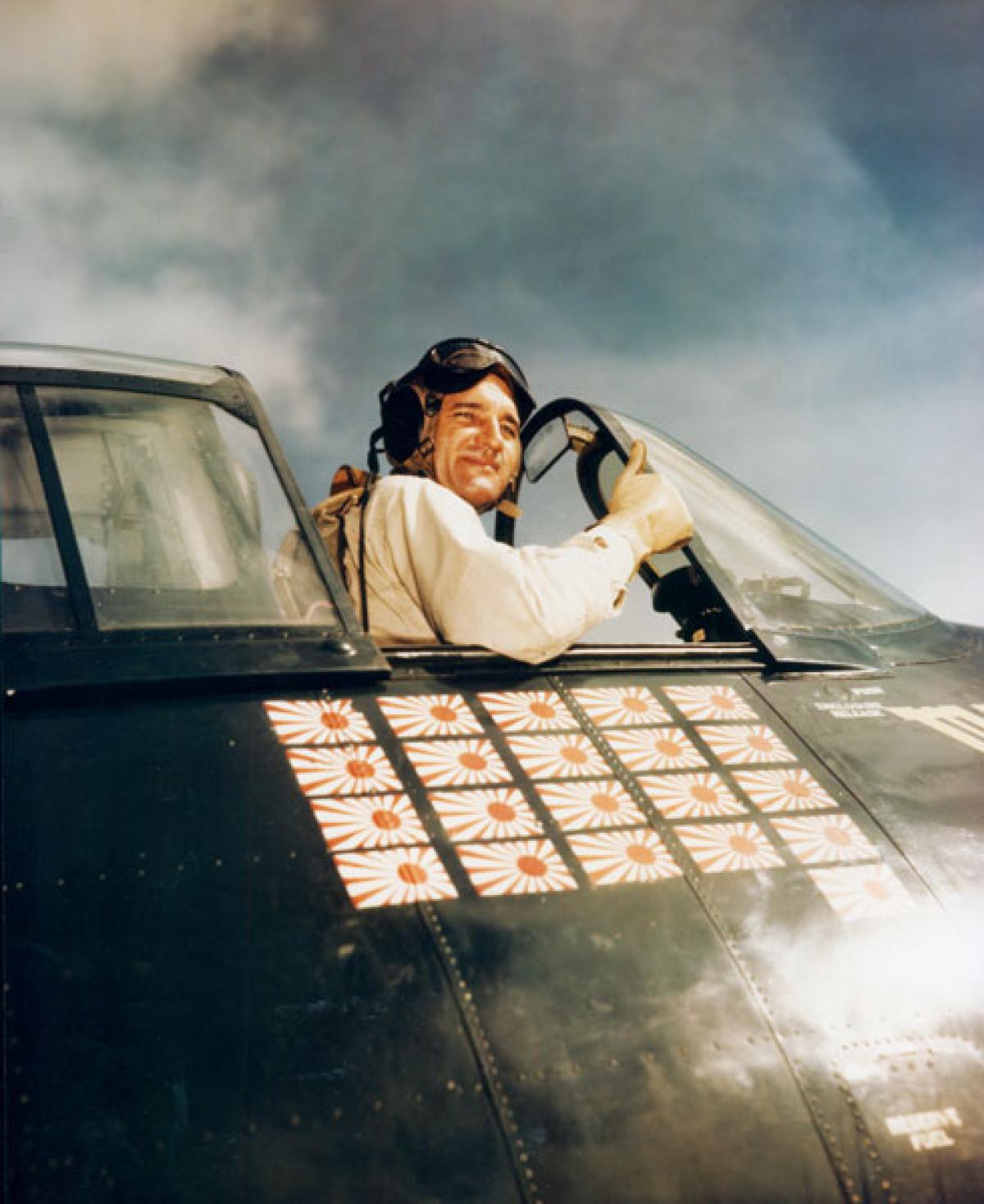
US Navy Capt. David McCampbell wasn't just the top naval ace of World War II — he's considered the service's all-time leader in aerial combat. His spirit and leadership are what made his air group one of the war's most decorated, and they earned him the Medal of Honor.

McCampbell was born Jan. 16, 1910, in Bessemer, Alabama, to parents Andrew and Elizabeth McCampbell. When he was about 12, the family moved him and his older sister, Frances, to West Palm Beach, Florida.

As a teen, McCampbell moved north to attend the Staunton Military Academy in Virginia. His graduation in 1928 earned him an Army commission, according to the Army University Press. Instead, he chose to attend the Georgia Institute of Technology, where he played football and was on the swim team. He also joined Navy ROTC, which led to his appointment to the Naval Academy. While in Annapolis, McCampbell became an accomplished swimmer and diver, competing in and winning various NCAA regional championships.

McCampbell graduated in June of 1933, but since Great Depression-related economic issues had affected the number of commissions that were available, he immediately went into the Naval Reserve. He returned to Alabama to work in construction and at an aircraft assembly plant for a year before finally receiving orders in June 1934 to report for active duty.

The young ensign's first duty station was aboard the USS Portland. By May 1937, he'd worked his way up in the ranks and began flight school in Pensacola, Florida, earning his wings in April 1938. His first few years as an aviator were spent serving on the USS Ranger and the USS Wasp.

World War II began while McCampbell was on the Wasp. The aircraft carrier spent the first half of 1942 in the European theater before being transferred to the Pacific. On Sept. 15, 1942, the ship was sunk during the Guadalcanal campaign. McCampbell, surviving its demise, was promoted to lieutenant commander and brought back to the U.S.

By late 1943, McCampbell was in command of a fighter squadron attached to the USS Essex. He was promoted to commander in January 1944 and put in charge of the ship's Air Group 15 — one of the war's most decorated air groups.  It was in this position that McCampbell became one of World War II's great aces.

McCampbell took out his first Japanese aircraft on June 11, 1944. About a week later, during the First Battle of the Philippine Sea, he led several F6F Hellcat fighter aircraft against 80 Japanese carrier-based planes that were headed toward the U.S. fleet. McCampbell personally destroyed seven of those hostile aircraft — five bombers and two fighters — which helped his outnumbered men virtually annihilate the enemy. According to the Encyclopedia of Alabama, McCampbell's team accounted for about 68 of the 600 Japanese downed aircraft.

On Oct. 24, 1944, during the infamous Battle of Leyte Gulf, McCampbell and a fellow pilot, Ensign Roy Rushing, took on 60 hostile Japanese aircraft that were approaching U.S. ships. Despite the overwhelming airpower against them, McCampbell shot down nine Japanese aircraft, setting a U.S. single mission aerial combat record. Rushing took out another six enemy warplanes. Their successes completely threw off the Japanese air group; the remaining aircraft abandoned their mission before any of them reached the U.S. fleet.

In a 1987 U.S. Naval Institute interview, McCampbell explained how he nearly didn't make it back to his ship after that engagement.

"When I got over the ship, I found they had a flight deck full of planes, and I knew that to launch all those planes would take a good 20 minutes, and I didn't have that much gas left," he said.

When the ship did make room for him to land, he said, "I ran out of gas on the deck. They had to push me out of the landing gear area. I found out from the mechanic that re-ammunitioned the guns that I had exactly six rounds left in the starboard outboard gun, and they were all jammed."

"But it worked out all right," he added nonchalantly.

McCampbell returned to the U.S. in December 1944. By then, he had become the Navy's all-time leading ace and top F6F Hellcat ace, having downed 34 Japanese aircraft during his months of aerial combat. His impressive tally made him the third-highest American scoring ace of World War II, behind only Army Maj. Richard Bong and Army Maj. Thomas B. McGuire, neither of whom survived the war.

For his bravery in the skies, McCampbell received the Medal of Honor on Jan. 10, 1945, from President Franklin D. Roosevelt during a ceremony at the White House.

After the war, McCampbell served in various positions, including as a senior naval aviation advisor to the Argentine Navy. After becoming a captain in July 1952, he also notably served as the captain of the aircraft carrier USS Bonhomme Richard and as a member of the Joint Staff in Washington, D.C. In the latter position, McCampbell helped draw up contingency invasion plans during the 1962 Cuban Missile Crisis, according to a 1996 Palm Beach Post article.

McCampbell was married a few times and had three children, Frances, David and John. He finally retired from the Navy in 1964 after 31 years of service.

According to the Palm Beach Post, McCampbell "dabbled in real estate in the Bahamas" before setting back down near West Palm Beach, where he lived for the rest of his life.  

McCampbell died on June 30, 1996, at a veteran's home he'd been living at for about a year. He was buried in Arlington National Cemetery.


Source :
https://www.defense.gov/News/Feature-Stories/Story/Article/3192422/medal-of-honor-monday-navy-capt-david-mccampbell/
https://www.thesun.ie/news/4108824/amazing-pics-of-us-navys-top-gun-inspiring-fighter-jet-unit-released-on-50th-anniversary-of-its-founding/
https://www.usni.org/magazines/naval-history-magazine/2022/august/brief-illustrated-history-navy-victory-markings

Air Defense Drill of PT Boat Crew

A U.S. PT boat crew runs through an air defense drill. During World War II, PT boats engaged enemy warships, transports, tankers, barges, and sampans. Some were converted into gunboats, which could be effective against enemy small craft, especially armored barges used by the Japanese for inter-island transport. Several saw service with the Philippine Navy, where they were named "Q-boats". Nicknamed "the mosquito fleet" and "devil boats" by the Japanese, the PT boat squadrons were hailed for their daring and earned a durable place in the public imagination that remains strong into the 21st century. Their role was replaced in the U.S. Navy by fast attack craft.

Source :
National Archives and Records Administration, 80-G-K-14517
Smithsonian National Air and Space Museum
https://en.wikipedia.org/wiki/PT_boat
https://www.flickr.com/photos/airandspace/albums/72157715574200936

Sunday, April 4, 2021

U.S. Navy JRF Goose over Alaska

 
A U.S. Navy Grumman JRF Goose amphibian in flight over mountains in Alaska (USA), winter 1942/43

Source :
National Archives and Records Administration 80-G-K-5178
Smithsonian National Air and Space Museum
https://www.flickr.com/photos/airandspace/albums/72157715574200936
https://www.history.navy.mil/content/history/nhhc/our-collections/photography/numerical-list-of-images/nhhc-series/nh-series/80-G-K-05000/80-G-K-5178.html

A Martin PBM-3R Receives Dual Navy and Pan American Airways Markings


In January 1943, a Martin PBM-3R receives dual Navy and Pan American Airways markings. Pan American operated Navy PBMs on regular transport runs between San Francisco and Pearl Harbor. Just to add to the story: a PBM 3R Mariner flown by PAA Captain Bill Moss rescued 48 survivors of the sinking of the Cape San Juan by a Japanese sub. This involved a dangerous open sea landing.

Source :
https://www.facebook.com/panam.org/photos/10158682026890219
National Archives and Records Administration 80-G-K-1142
Smithsonian National Air and Space Museum
https://www.flickr.com/photos/airandspace/albums/72157715574200936

Thursday, December 24, 2020

A U.S. Navy Vought F4U-4 Corsair at Deck

A U.S. Navy Vought F4U-4 Corsair of Bombing Fighter Squadron 82 (VBF-82) "Checkmates", piloted by Bud Geer, is preparing to take off from the deck of the aircraft carrier USS Randolph (CV-15). VBF-82 was assigned to Carrier Air Group 82 (CVG-82) for a deployment to the Mediterranean Sea from 22 October to 21 December 1946. During that cruise, VBF-82 was redesignated VF-18A and CVG-82 was redesignated CVAG-17 on 15 November 1946.


Source :
https://www.facebook.com/photo/?fbid=10221692457132054&set=gm.1634623866723030

Sunday, September 20, 2020

USS Pennsylvania Drydocked in the Pacific

USS Pennsylvania (BB-38, originally Battleship # 38), 1916-1948, drydocked in an Advanced Base Sectional Dock (ABSD) at the Pacific, 1944. Note the extensive anti-torpedo blister built into her hull side and paravane streaming chains running from her forefoot to her foredeck.


USS Pennsylvania, lead ship of a class of two 31,400-ton battleships, was built at Newport News, Virginia. Commissioned in June 1916, she served as the Atlantic Fleet's flagship into the early "Twenties". Though her operations during this time were primarily off the U.S. east coast and in the Caribbean area, Pennsylvania briefly cruised to France in December 1918. Transiting the Panama Canal to the Pacific early in 1921, she became flagship of the newly-organized Battle Fleet. During the next eight years, she led the Navy's battleships in maneuvers in the Atlantic, Caribbean and in the Pacific, including a cruise to Australia and New Zealand in mid-1925.


From June 1929 to May 1931, Pennsylvania received an extensive modernization at the Philadelphia Navy Yard, Pennsylvania. She emerged with new "tripod" masts, improved combat systems, and an enlarged armored conning tower to better support her mission as fleet flagship. Through the following decade, Pennsylvania continued her pattern of drills, at-sea exercises and periodic major "Fleet Problems" conducted to refine the Navy's war plans.


When Japan attacked on 7 December 1941, Pennsylvania, flagship of the United States Fleet, was in drydock at the Pearl Harbor Navy Yard. Her relatively light damage was repaired over the next few months, and she operated along the U.S. west coast and off Hawaii until October 1942. Following an overhaul that significantly updated her secondary battery of 5" guns and added many anti-aircraft machine guns, Pennsylvania went to Alaskan waters, where she participated in the recapture of Attu in May 1943 and Kiska in August.


In November 1943, Pennsylvania bombarded Makin during the amphibious assault on the Gilbert Islands. She repeated this role a few months later at Kwajalein and Eniwetok, and in June and July 1944 at Saipan, Tinian and Guam. Her guns supported landings in the Palaus in September 1944 and at Leyte in October. When the Japanese Navy responded vigorously to the latter operation, Pennsylvania helped to destroy part of the enemy fleet in the Battle of Surigao Strait.


In January 1945, Pennsylvania took part in the Lingayen Gulf invasion. Freshly returned to the combat zone after another overhaul, she was seriously damaged by a Japanese aerial torpedo off Okinawa on 12 August 1945, the last major Navy ship to be hit during the Second World War. Too old for retention in the post-war fleet, Pennsylvania was repaired only enough to fit her for target duty. She served in that capacity during the July 1946 Bikini atomic bomb tests. Subsequently moored at Kwajalein for studies of residual radioactivity, USS Pennsylvania was scuttled at sea on 19 February 1948.


Source :

https://www.facebook.com/groups/237076659811098/permalink/1551937918324959/?__cft__[0]=AZUDzQiyLPz2bweHE1SUCwl2L7gKl3yP0seWajeueHjH4iQwNasmezrrCQTSh9W2rRTpk-MEW7HPrk8pn1b1arFSu4LeKPI9TlRdRW0KMrxq5x2HSN0k3j_fRQcZzuQ0sHCy_P69XKM29nnmlxd4O26maDWbm5_ZBqUk9MNW4mLtCw&__tn__=%2CO%2CP-R

Sunday, August 30, 2020

Bio of Admiral William Halsey


William Frederick Halsey Jr. (October 30, 1882 – August 16, 1959) was a fleet admiral in the United States Navy during World War II. He is one of four individuals to have attained the rank of fleet admiral of the United States Navy, the others being Ernest King, William Leahy, and Chester W. Nimitz. Born in Elizabeth, New Jersey, Halsey graduated from the United States Naval Academy in 1904. He served in the Great White Fleet and, during World War I, commanded the destroyer USS Shaw. He took command of the aircraft carrier USS Saratoga in 1935 after completing a course in naval aviation, and was promoted to the rank of rear admiral in 1938. At the start of the War in the Pacific (1941–1945), Halsey commanded the task force centered on the carrier USS Enterprise in a series of raids against Japanese-held targets. Halsey was made commander, South Pacific Area, and led the Allied forces over the course of the Battle for Guadalcanal (1942–1943) and the fighting up the Solomon chain (1942–1945).[2] In 1943 he was made commander of the Third Fleet, the post he held through the rest of the war.[3] He took part in the Battle for Leyte Gulf, the largest naval battle of the Second World War and, by some criteria, the largest naval battle in history. He was promoted to fleet admiral in December 1945 and retired from active service in March 1947.

Source :
https://en.wikipedia.org/wiki/William_Halsey_Jr.
https://www.historynet.com/william-bull-halsey-legendary-world-war-ii-admiral.htm

Sunday, August 23, 2020

The US Naval Battleship USS Iowa


The US Naval Battleship USS Iowa (BB-61) known as 'The Big Stick' in 1943 somewhere in the Atlantic Ocean. / Photos by Ivan Dmitri/Michael Ochs Archives.

USS Iowa (BB-61) is a retired battleship, the lead ship of her class, and the fourth in the United States Navy to be named after the state of Iowa. Owing to the cancellation of the Montana-class battleships, Iowa is the last lead ship of any class of United States battleships and was the only ship of her class to have served in the Atlantic Ocean during World War II.

During World War II, she carried President Franklin D. Roosevelt across the Atlantic to Mers El Kébir, Algeria, en route to a meeting of vital importance in 1943 in Tehran with Prime Minister Winston Churchill of Britain andJoseph Stalin, leader of the Soviet Union. When transferred to the Pacific Fleet in 1944, Iowa shelled beachheads at Kwajalein and Eniwetok in advance of Allied amphibious landings and screened aircraft carriersoperating in the Marshall Islands. She also served as the Third Fleet flagship, flying Admiral William F. Halsey's flag at the Japanese surrender in Tokyo Bay. During the Korean War, Iowa was involved in raids on the North Korean coast, after which she was decommissioned into the United States Navy reserve fleets, better known as the "mothball fleet." She was reactivated in 1984 as part of the 600-ship Navy plan and operated in both the Atlantic and Pacific Fleets to counter the recently expanded Soviet Navy. In April 1989, an explosion of undetermined origin wrecked its No. 2 gun turret, killing 47 sailors.

Iowa was decommissioned for the last time in October 1990 after 19 total years of active service, and was initially stricken from the Naval Vessel Register (NVR) in 1995, before being reinstated from 1999 to 2006 to comply with federal laws that required retention and maintenance of two Iowa-class battleships. In 2011 Iowa was donated to the Los Angeles–based non-profit Pacific Battleship Center and was permanently moved to Berth 87 at the Port of Los Angeles in 2012, where she was opened to the public as the USS Iowa Museum.


Source :
Michael Ochs Archives, courtesy of Tobi Moll
https://en.wikipedia.org/wiki/USS_Iowa_Museum
https://www.facebook.com/photo/?fbid=316981769570654&set=pcb.1527108590807892

Sunday, July 26, 2020

Chester W. Nimitz Sitting in a Bamboo Chair


Fleet Admiral Chester W. Nimitz, Commander in Chief, Pacific Fleet and Pacific Ocean Areas, in his office at CinCPac / CinCPOA Advanced Headquarters at Guam, in July 1945. Note Bent bamboo chair, and green stockings worn with his tropical khaki uniform.

Chester William Nimitz, Sr. (February 24, 1885 - February 20, 1966) was a fleet admiral of the United States Navy. He played a major role in the naval history of World War II as Commander in Chief, U.S. Pacific Fleet and Commander in Chief, Pacific Ocean Areas, commanding Allied air, land, and sea forces duringWorld War II. Nimitz was the leading US Navy authority on submarines. Qualified in submarines during his early years, he later oversaw the conversion of these vessels' propulsion from gasoline to diesel, and then later was key in acquiring approval to build the world's first nuclear-powered submarine, USS Nautilus, whose propulsion system later completely superseded diesel-powered submarines in the US. He also, beginning in 1917, was the Navy's leading developer of underway replenishment techniques, the tool which during the Pacific war would allow the US fleet to operate away from port almost indefinitely. The chief of the Navy's Bureau of Navigation in 1939, Nimitz served as Chief of Naval Operations from 1945 until 1947. He was the United States' last surviving officer who served in the rank of fleet admiral.


Source :
NHHC (Naval History and Heritage Command), courtesy of Tobi Moll
https://www.facebook.com/photo.php?fbid=296158311653000&set=pcb.1502070179978400&type=3&theater&ifg=1
https://en.wikipedia.org/wiki/Chester_W._Nimitz

Saturday, April 18, 2020

Escort Carrier "Fly Control" Scene

Escort Carrier "Fly Control" Scene. The aircraft carrier's Air Officer surveys flight deck operations as his "talker" stands by, circa 1944. Note Signalman using a blinker lamp at right and a lookout at work at left. Photographed prior to October 1944.


Source :
US Navy photo
Courtesy of Tobi Moll at:
https://www.facebook.com/photo.php?fbid=230534774882021&set=gm.1418437475008338&type=3&theater&ifg=1

Sunday, March 6, 2016

Charles de Gaulle Met with American High Ranking Officers

6 July 1944: French military commander and head of the French Provisional Government (and later President), General Charles de Gaulle (left), is met at Washington National Airport (later renamed Ronald Reagan Washington National Airport) by Chief of Staff of the United States Army, General George C. Marshall (right), accompanied by Commanding General of the U.S. Army Air Forces, General Henry H. Arnold (behind de Gaulle) and Commander in Chief of United States Fleet (COMINCH) and Chief of Naval Operations (CNO), Admiral Ernest J. King (behind Marshall). General de Gaulle visits President Franklin D. Roosevelt at the White House, and while in New York City he addresses the American people. During World War II, de Gaulle made two official visits to the United States (July 1944 and August 1945). He also went to Moscow in December 1944 and signed a pact of alliance and mutual assistance with Stalin.


Source :
http://www.gettyimages.com/detail/news-photo/french-military-commander-and-head-of-the-french-news-photo/103371909
http://www.marshallfilms.org/filminfo.asp?enlarge=1&id=44.07.06A