Showing posts with label Before the War. Show all posts

Sunday, October 25, 2026

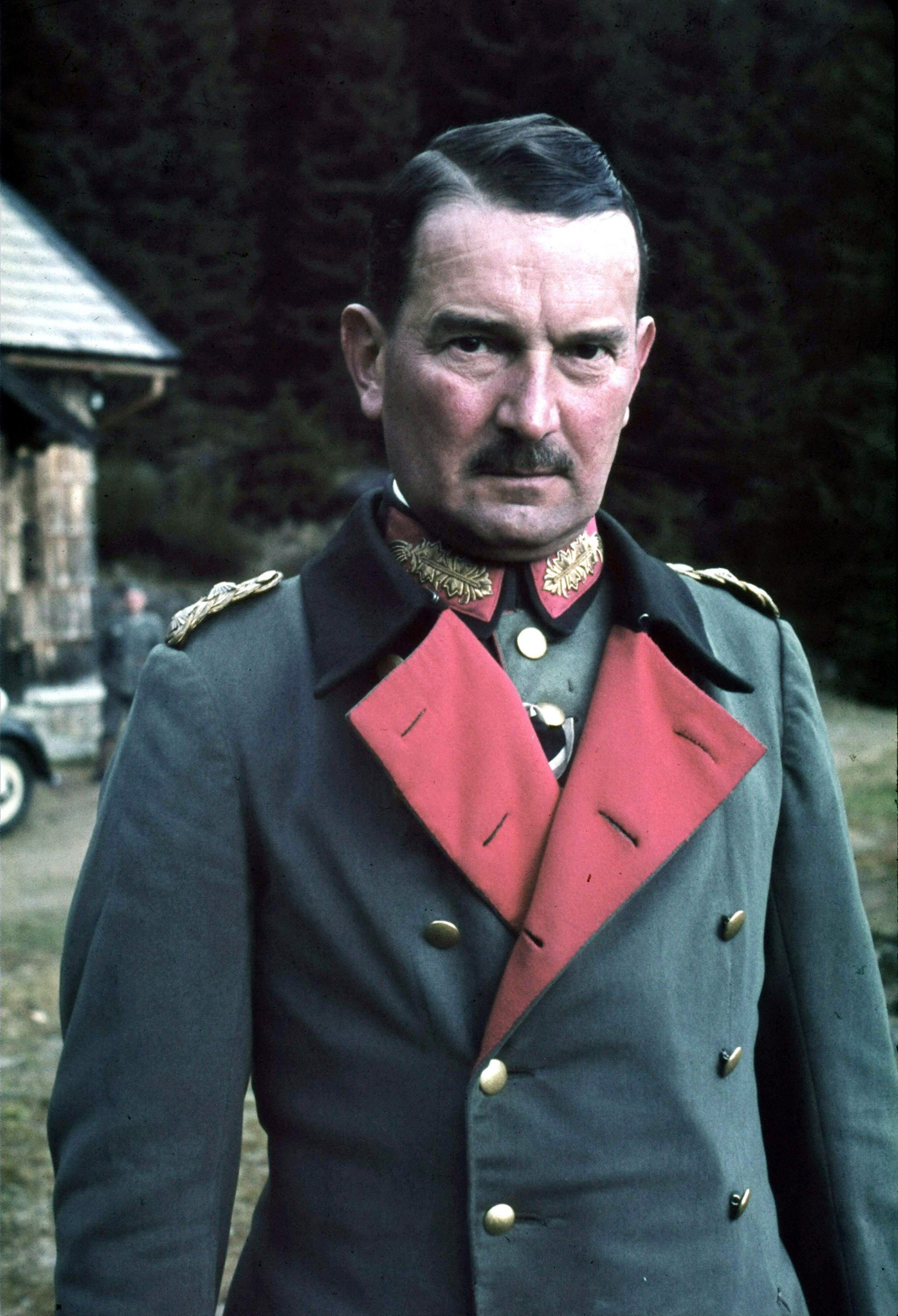
Walther von Brauchitsch during Heldengedenktag


Generaloberst Walther von Brauchitsch (Oberbefehlshaber des Heeres) salutes during the event of Heldengedenktag (Reich Heroes' Day) which were held in Kassel on June 4, 1939. Note that beneath the medal bars he is wearing the Goldenes Parteiabzeichen der NSDAP pin, which he received a few months earlier, on March 20, 1939. The photo was taken by Hitler's personal photographer, Hugo Jaeger. Established by the National Socialist regime in 1934 to replace the earlier Weimar-era Volkstrauertag, Heldengedenktag, or Heroes Memorial Day, served as an elaborate and tightly controlled state propaganda holiday in Nazi Germany, meticulously designed to honor fallen soldiers of the First World War and, as the conflict expanded, casualties from the Wehrmacht during the Second World War. Observed annually on the second Sunday of Lent, known as Reminiscere, the commemoration was jointly organized by the Nazi party and the armed forces, transforming solemn remembrance into a powerful ideological tool that glorified militarism, sacrifice, and the concept of the Volksgemeinschaft. High-ranking military figures, including Generalfeldmarschall and various Oberst commanders, alongside senior party officials, participated in elaborate national ceremonies held in Berlin and across occupied Europe, featuring solemn addresses, wreath-laying rituals at memorials like the Neue Wache, and synchronized tributes broadcast across public radio networks. As the war progressed and mounting casualties devastated formations such as the Heer, Luftwaffe, and Kriegsmarine, Heldengedenktag became increasingly somber and desperate, serving less as a traditional memorial and more as a psychological mobilization mechanism to steel the German populace for total war. The most infamous observance occurred on March 21, 1943, when Adolf Hitler, accompanied by high-ranking military commanders, made a public tour of an exhibition of captured Soviet weaponry in Berlin, an event famously captured in historical photography shortly before an unsuccessful assassination attempt was planned against him during a similar ceremony the following year by officers associated with the German resistance. Following the unconditional surrender of Nazi Germany in May 1945, the term and specific holiday of Heldengedenktag were permanently abandoned due to their heavy association with National Socialist militarism, eventually paving the way for the re-establishment of the more neutral and sorrowful Volkstrauertag in West Germany during the postwar era.


Source :
https://alifrafikkhan.blogspot.com/2010/10/koleksi-ratusan-foto-berwarna-dari-life.html
https://artsandculture.google.com/asset/hitler-jaeger-file/AgHqWBrCXwmIxg?hl=en&ms=%7B%22x%22%3A0.7036358691921009%2C%22y%22%3A0.9019915066397572%2C%22z%22%3A10.960664328682489%2C%22size%22%3A%7B%22width%22%3A0.501103344405948%2C%22height%22%3A0.18948479603129995%7D%7D

Sunday, September 6, 2026

Hitler's 50th Birthday Celebration (20 April 1939)


Adolf Hitler’s fiftieth birthday on 20 April 1939 was marked throughout the German Reich as a national holiday, the only occasion on which the date was officially designated a public holiday by the government. The celebrations, carefully orchestrated under the direction of Reichsminister für Volksaufklärung und Propaganda Joseph Goebbels, were designed as a grand demonstration of national unity, the cult of the Führer, and the military strength of the rearmed Wehrmacht. Berlin served as the principal stage for the most elaborate of these observances, while similar festivities, including military parades and party ceremonies, took place in cities and towns across the Reich and in annexed territories.

Preparations had been underway for weeks. Public buildings, streets, and private houses were ordered to display flags bearing the Hakenkreuz. The newly completed Ost-West-Achse, a broad ceremonial boulevard designed by Albert Speer as a central element of the planned transformation of Berlin into Welthauptstadt Germania, was prepared as the main route for processions and the principal parade. On the afternoon of 19 April, Hitler led a motorcade of fifty white limousines along this thoroughfare. Crowds lined the route, and the occasion was used to inaugurate the avenue formally. In the evening, Goebbels delivered a nationwide radio address praising Hitler as a man of historic stature who had achieved bloodless territorial gains and restored German power. Later that night, members of the “old guard” of the NSDAP from the various Gaue staged a torchlight procession. At midnight, within the Neue Reichskanzlei, leading figures of the regime offered formal congratulations and presented gifts. These included works of art, porcelain from Meissen, statues, tapestries, models of architectural projects and military equipment, rare coins, antique weapons, and numerous other items. Speer offered a large model of a planned triumphal arch. Heinrich Himmler presented a painting of Frederick the Great. Ferdinand Porsche and representatives of the Deutsche Arbeitsfront delivered a convertible Volkswagen. Hitler also inspected a model of the Westwall fortifications and a model of his personal Focke-Wulf Fw 200 Condor aircraft. Contemporary accounts note that he examined some gifts with interest, mocked others, and largely ignored the rest.

On the morning of 20 April itself, the band of the Leibstandarte SS Adolf Hitler performed a short concert in the garden of the Reichskanzlei, playing the national anthem and the Horst-Wessel-Lied. Hitler appeared briefly to acknowledge the musicians before returning indoors to view the accumulated presents. Shortly after 10:00, he departed the Reichskanzlei in an open Mercedes, travelling via the Stadtkommandantur to the reviewing stand erected opposite the Technische Hochschule in Charlottenburg along the Ost-West-Achse. There he took his place on a raised dais under a canopy decorated with eagles and Iron Crosses, seated on a gilded chair covered in red plush. Surrounding him on the grandstand were senior officers of the Wehrmacht, party leaders, and approximately 20,000 official guests, including foreign diplomats and military attachés.

The military parade that followed was the largest yet staged by the German armed forces. It lasted more than four hours and involved between 40,000 and 50,000 troops drawn from all branches. Units of the Heer, Luftwaffe, and Kriegsmarine each contributed twelve companies, supplemented by formations of the Schutzstaffel. Marching contingents were interspersed with motorised columns that included roughly 600 Panzer vehicles of various types (among them PzKpfw II, III, and IV), heavy artillery pieces, anti-aircraft guns such as the 8.8 cm Flak, searchlights, motorcycle units, engineer equipment, and other specialised vehicles. Overhead, 162 aircraft of the Luftwaffe flew in formation. The parade route stretched along the Ost-West-Achse, with troops forming up over a considerable distance beforehand so that the flow past the reviewing stand remained continuous and precise. Contemporary film and photographic records show infantry, cavalry, sailors, airmen, Fallschirmjäger, and SS men marching in close order, dipping their standards as they passed Hitler. The event was intended both as a birthday homage and as a public display of the Wehrmacht’s recovered strength and modern equipment, directed as much at domestic audiences as at foreign observers.

Hundreds of thousands of spectators lined the route and filled side streets. Security was provided by large contingents of the SA, NSKK, regular police, and several hundred men of the SS positioned near the reviewing stand. Similar, though smaller, military parades and ceremonial assemblies took place the same day in garrisons throughout the Reich. In many locations, the day began with a Großer Wecken by military bands, followed by formal appeals, promotions, and the presentation of gifts from local populations. Evening events often featured party rallies at which the Führer’s achievements were praised and the national anthems sung.

The scale of the Berlin parade and the accompanying nationwide observances reflected the high point of the pre-war cult of the Führer. Propaganda emphasised national recovery, territorial expansion achieved without major bloodshed, and the restoration of military power. Gifts and messages arrived not only from within Germany but also from German communities abroad. Foreign military attachés present in Berlin noted the emphasis on motorised and anti-aircraft units, even if little entirely new equipment was displayed. The celebrations concluded without incident, leaving a carefully constructed image of unity, discipline, and strength that the regime sought to project both at home and abroad in the months preceding the outbreak of war later that year.

-------------------------------------------------------------------------------------------------------------

RECEPTION AND GIFTS


Some of Hitler's 50th birthday gifts, including vases with swastikas and paintings, in the Neue Reichskanzlei (New Reich Chancellery). The picture was taken by Hugo Jaeger. On 20 April 1939, Adolf Hitler celebrated his 50th birthday amid elaborate festivities in Berlin, during which he received a vast array of gifts from Nazi officials, military leaders, organizations, and citizens that filled rooms in the Reich Chancellery. Albert Speer presented a detailed scale model of the planned gigantic triumphal arch intended for the reconstruction of Berlin as Welthauptstadt Germania. His personal pilot Hans Baur offered a model of the four-engined Focke-Wulf Fw 200 Condor, known as the Führer plane that later entered service as his official aircraft. Ferdinand Porsche, accompanied by Robert Ley of the Deutsche Arbeitsfront, delivered a black convertible prototype of the KdF-Wagen, the forerunner of the Volkswagen. Hermann Göring, head of the Luftwaffe, gave a solid gold model of the Haus der Deutschen Kunst in Munich. Reichsführer-SS Heinrich Himmler presented a prized portrait of Frederick the Great, which Hitler kept until the final days in the bunker. Other presents included statues, bronze casts, Meissen porcelain, oil paintings, tapestries, rare coins, antique weapons, and numerous kitsch items such as swastika-embellished vases and embroidered textiles. The Free City of Danzig conferred honorary citizenship upon him through Albert Forster. A Munich brewery specially produced low-alcohol beer suited to his digestive preferences. Additional offerings comprised silver architectural models, porcelain from the Allach factory associated with the SS, handcrafted clocks from the Sudetenland, food items like hop salad and apples from grateful regions, and even thousands of pairs of soldiers’ socks along with a living eagle!


Source :
Hugo Jaeger photo collection
https://alifrafikkhan.blogspot.com/2010/10/koleksi-ratusan-foto-berwarna-dari-life.html
https://artsandculture.google.com/search/asset?q=hugo%20jaeger&hl=en

Wednesday, January 25, 2023

Bio of Generaloberst Eugen Ritter von Schobert

Eugen Siegfried Erich Ritter von Schobert (13 March 1883 – 12 September 1941) was a German general during World War II. He commanded the 11th Army during Operation Barbarossa, the invasion of the Soviet Union. Schobert died when his observation plane crashed in a Soviet minefield.

Schobert was born as Eugen Schobert in Würzburg in the Kingdom of Bavaria, a member state of the German Empire. He was the son of Major Karl Schobert and Anna née Michaely. Schobert entered the Royal Bavarian Army in July 1902. He served primarily in the 1st Bavarian Infantry Regiment "König" and underwent pilot training in 1911.

During World War I, Schobert remained a Bavarian infantry officer, serving the entire war on the Western Front. During the German spring offensive of 1918, he led the 3rd Battalion of the 1st Bavarian Infantry Regiment. For his actions on 23 March 1918, when he personally and successfully led his battalion in the crossing of a canal near Jussy against stiff British resistance, he was awarded the Knight's Cross of the Military Order of Max Joseph. This was Bavaria's highest military honor, comparable to the Prussian Pour le Mérite, and conferred a patent of nobility on a recipient who was a commoner. Hence Eugen Schobert became Eugen Ritter von Schobert.

After World War I, Schobert remained in the Reichswehr and then the Wehrmacht, steadily rising up the ranks. He was Inspector of Infantry from December 1933 to September 1934 and then commanded the 17th Infantry Division from 1935 to 1936 and the 33rd Infantry Division from 1936 to 1938. He took command of the VII Army Corps (VII. Armeekorps) on 4 February 1938.

In September 1939, Schobert led his VII Army Corps in the invasion of Poland as part of the reserve of Army Group South. In May–June 1940, his corps, part of General Ernst Busch's Sixteenth Army of Army Group A, participated in the invasion of Belgium and Luxembourg and the Battle of France. He received the Knight's Cross of the Iron Cross for his leadership of the VII Corps in the breakthrough of the Maginot Line and the capture of Nancy and Toul. He remained in command of the corps during preparations for the invasion of Great Britain.

In September 1940, Schobert was given command of the Eleventh Army. The army was assigned to Army Group South for Operation Barbarossa, the invasion of the Soviet Union. During combat operations in the southern Soviet Union, Schobert was killed when his Fieseler Storch observation aircraft crashed in a Soviet minefield. He was succeeded by Erich von Manstein. A German war correspondent, Leo Leixner, wrote Schobert's biography.

Schobert married Alice Rieder-Gollwitzer in 1921. They had three children: two sons and one daughter. His younger son was killed in combat in 1944 while serving as a fighter pilot for the Luftwaffe.


Source :
https://artsandculture.google.com/entity/m064km4b?hl=en
https://en.wikipedia.org/wiki/Eugen_Ritter_von_Schobert

Sunday, January 15, 2023

Bio of Franz Ritter von Epp

Franz Ritter von Epp (born Franz Epp; from 1918 as Ritter von Epp; 16 October 1868 – 31 January 1947) was a German general and politician who started his military career in the Bavarian Army. Successful wartime military service earned him a knighthood in 1916. After the end of World War I and the dissolution of the German Empire, von Epp was a commanding officer in the Freikorps and the Reichswehr. He was a member of Bavarian People's Party, before joining the Nazi Party in 1928, when he was elected as a member of the German parliament or Reichstag, a position he held until the fall of Nazi Germany. He was the Reichskommissar, later Reichsstatthalter, for Bavaria, and a Reichsleiter of the Nazi Party.

Franz Epp was born in Munich in 1868, the son of the painter Rudolph Epp and Katharina Streibel. He spent his school years in Augsburg and after this joined the military academy in Munich. He served as a volunteer in East Asia during the Boxer Rebellion in 1900–01 and then became a company commander in the colony of German South-West Africa (now Namibia), where he took part in the bloody Herero and Namaqua Genocide. During the First World War, he served as the commanding officer of the Royal Bavarian Infantry Lifeguards Regiment in France, Serbia, Romania, and at the Isonzo front.

For his war service, Epp received numerous medals, of which the Pour le Mérite (29 May 1918) was the most significant. He was also knighted, being made Ritter von Epp on 25 February 1918, and received the Bavarian Military Order of Max Joseph (23 June 1916).

After the end of the war, Epp formed the Freikorps Epp, a right-wing paramilitary unit mostly made up of war veterans, of which the future leader of the SA Ernst Röhm was a member. This unit took part in the crushing of the Bavarian Soviet Republic in Munich, being responsible for various massacres. Epp joined the Reichswehr and was promoted to Generalmajor in 1922. He took his leave from the German Army after getting involved with right-wing associations in 1923.

When it became necessary for the Nazi Party to purchase a newspaper to publicize its political creed, Epp made available some 60,000 Reichsmarks from secret army funds to acquire the Völkischer Beobachter, which became the daily mouthpiece of the party.

As the Sturmabteilung (SA) expanded, it became an armed band of several hundred thousand men, whose function was to guard Nazi rallies and disrupt those of other political parties. Some of its leaders, particularly Ernst Röhm, visualized the SA as supplanting the regular army when Adolf Hitler came to national power. To this end, a department was set up under Epp called the Wehrpolitisches Amt (Army political office). Nothing came of this, as a distrustful Hitler had the SA crushed and many of its leaders killed in the Night of the Long Knives in the summer of 1934.

After leaving the Bavarian People's Party, Epp on 20 May 1928 was elected from electoral constituency 26 (Franconia) as one of the first 12 Nazi Party deputies to the Reichstag. He would continue to be elected to the Reichstag in each subsequent election throughout the Weimar and Nazi regimes to 1945. He served as the Nazi Party's head of its Military-Political Office from 1928 to 1945, and later as leader of the German Colonial Society, an organization devoted to regaining Germany's lost colonies. On 31 August 1933 he was made a Reichsleiter, the second highest political rank in the Nazi Party. On 3 October 1933, he was also made a member of the Academy for German Law. In May 1934 he became head of the NSDAP Office of Colonial Policy until its dissolution in February 1943.

Epp's final notable historical action occurred on 9 March 1933, two weeks before the Reichstag passed the enabling act, which granted Hitler dictatorial powers. On the orders of Hitler and Wilhelm Frick, he abolished the Government of Bavaria and set up a Nazi regime, with himself as Reichskommissar. On 10 April Hitler appointed him Reichsstatthalter for Bavaria. In this position he often clashed with Bavaria's Nazi Minister-President Ludwig Siebert. Epp's attempt to limit the influence of the central government on Bavarian politics failed. He, however, retained his post as Reichsstatthalter until the end of the war, although by then he was politically insignificant.

On 8 May 1933, von Epp's DO X crashed at the Passau Kachlet. The city named one of its streets Ritter-von-Epp-Straße.

He was arrested on Paul Giesler's orders in 1945, for being associated with the Freiheitsaktion Bayern, an anti-Nazi group led by Rupprecht Gerngroß. However, Epp had not wanted to be directly involved with the group, as he considered their goal—surrender to the Allies—a form of backstabbing of the German Army.

Suffering from a heart condition, he was hospitalised at Bad Nauheim at the end of the war. On 9 May 1945, a clerk at the hospital alerted agents from the US Counterintelligence Corps that Epp was a patient there, and he was arrested and sent to a prison camp in Munich to await trial at Nuremberg. He died in detention on 31 January 1947.

Decorations and awards
    Order of the Red Eagle, 4th class (German Empire)
    Order of the Crown, 4th class with swords (Prussia)
    Military Merit Order, 3rd and 4th class with Swords (Bavaria)
    1914 Iron Cross 2nd Class, 1914
    1914 Iron Cross 1st Class, 1915
    Knights Cross of the Military Order of Max Joseph (Kingdom of Bavaria), 1917
    Pour le Mérite, 1918
    Knight of the Princely House Order of Hohenzollern with swords (Hohenzollern-Sigmaringen)
    Knight 2nd class of the House and Merit Order of Peter Frederick Louis (Oldenburg)
    Knight of the Order of Saint John (Bailiwick of Brandenburg)
    Honour Chevron for the Old Guard, February 1934
    Honour Cross of the World War 1914/1918, 1934
    Golden Party Badge
    Sudetenland Medal, 1938
    Anschluss Medal, 1939
    War Merit Cross 2nd Class and 1st Class with Swords
    Knights Cross of the War Merit Cross with Swords, 1943
    Military Merit Cross, 2nd class (Grand Duchy of Mecklenburg-Schwerin)
    Nazi Party Long Service Award (10 and 15 years)
    Order of the Iron Crown, 3rd class (Austria)
    On 18 May 1933, the city of Passau decided to make von Epp a Citizen of Honor.


Source :
https://artsandculture.google.com/entity/m064km4b?hl=en
https://en.wikipedia.org/wiki/Franz_Ritter_von_Epp

Wednesday, December 14, 2022

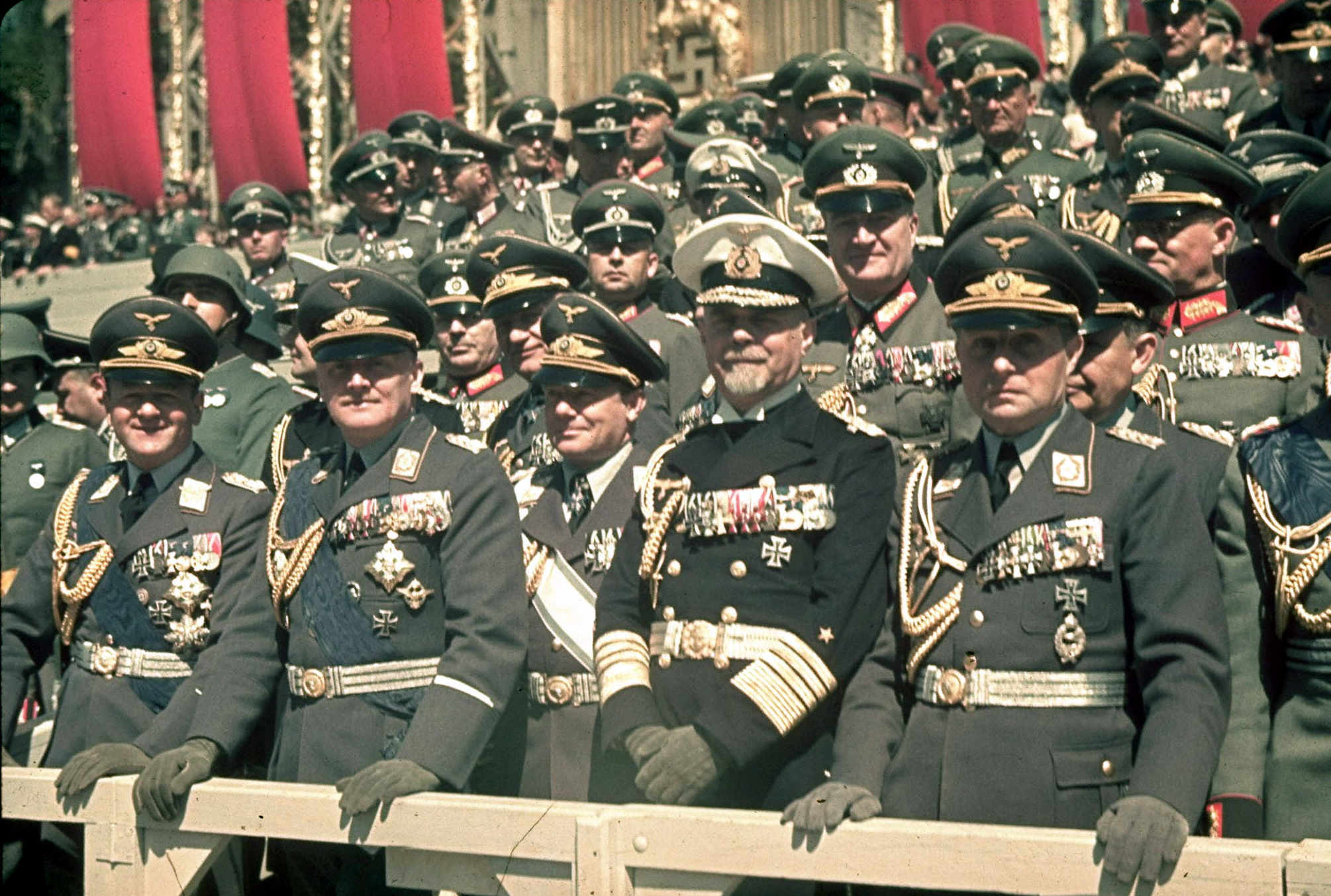
German Generals and Admirals at Führergeburtstag


Generals and admirals of the Wehrmacht stood in the stands of honor at the culmination of Adolf Hitler's 50th birthday celebration, which was held in Berlin on April 20, 1939. They all wore paradeanzug (parade uniform), complete with feldbinde (brocade belt), auszeichnungen (medal bars) and schnurr (lanyard). Front row from left to right: Generaloberst Erhard Milch (Generalinspekteur der Luftwaffe), General der Flieger Hans-Jürgen Stumpff (Chef der Luftwehr), Generalleutnant Ernst Udet (Generalluftzeugmeister und Chef Planungsamts der Luftwaffe), Admiral Max Bastian (Präsident Reichsfürsorge- und Versorgungsgerichts der Wehrmacht), and Generalmajor Friedrich Fahnert (Höheren Kommandeur Luftnachrichtenschule Berlin). For additional identification: Generalleutnant Walter Petzel (Inspekteur der Artillerie) is the bespectacled man standing behind Fahnert; Generalmajor Hermann von Hanneken (Bevollmächtigter für Eisen- und Stahl auch zum Leiter der Hauptabteilung II Industrie) stood between Bastian and Fahnert, Generaloberst Wilhelm List (Oberbefehlshaber Heeres-Gruppenkommando 5) between Udet and Bastian, and General der Flieger Friedrich Christiansen (Korpsführer NSFK) between Stumpff and Udet. This photo itself was made by Hitler's personal photographer, Hugo Jaeger. Note that Milch and Stumpff both wear the Star of the Yugoslav Order of the Crown on their chests!

Source :
http://alifrafikkhan.blogspot.com/2010/10/koleksi-ratusan-foto-berwarna-dari-life.html
https://artsandculture.google.com/entity/m064km4b?hl=en

Thursday, November 10, 2022

German Gebirgsjäger Climbing the Mountain


A Heeresbergführer (Army Mountain Leader) of German Gebirgsjäger displaying his climbing equipment (carabiner, pegs, climbing shoes, cords, and ropes). All the hardware needed for climbing and roping had to be carried with the soldier; it was issued as required, and then returned to stores. Several Italian-issue and many civilian items found their way into German use.

Source :
"German Mountain Troops" by Yves Beraud
https://www.2ndgebirgsjager.com/photos-of-approved-kit.html

Friday, June 24, 2022

German Soldiers in Front of Brandenburg Gate

 
The Ost-West-Achse (East-West-Axis) in Berlin, site of a massive rally and military demonstration in celebration of Adolf Hitler’s 50th birthday, 20 April 1939. The display was intended in part as a warning to the Western powers. The parade, which lasted for more than four hours, included 12 companies of the Luftwaffe, 12 companies of the army, and 12 companies of the navy and units of the Schutzstaffel (SS). In total, 40,000 to 50,000 German troops took part. 162 warplanes flew over Berlin. The grandstand comprised 20,000 official guests, and the parade was watched by several hundred thousand spectators. Features of the parade were large long-range air-defence artillery guns, emphasis on motorized artillery and development of air-defence units. Joseph Goebbels declared in a broadcast address to the German people. The picture was taken by Hugo Jaeger.

Source :
https://artsandculture.google.com/asset/hitler-jaeger-file/EgHmP3BzbacCzQ?hl=en
https://en.wikipedia.org/wiki/Adolf_Hitler%27s_50th_birthday

Monday, June 20, 2022

March through Münich in Remembrance of the Beer Hall Putsch

Commemoration of Hitler's failed coup in 1923 (Münich Putsch or Beer Hall Putsch), which held in Münich on 9 November 1938. Front row: Dr. Friedrich Weber, Hermann Göring, Adolf Hitler, Ulrich Graf and Hermann Kriebel. Back row: Max Sasselmann, Dr. Walter Schultze, Alfred Rosenberg, Arno Schickdanz, Philipp Bouhler and Max Amann. Please note that these brown uniforms are not SA uniforms but Alte Kampfer (Blutorden holders). Ulrich Graf even wears an SS sleeve band! The picture was taken by Hugo Jaeger.

Source :
https://artsandculture.google.com/asset/hitler-jaeger-file/9gGpSgMuLTw72w?hl=en

Sunday, February 28, 2021

Legion Condor


Photo of a German Condor Legion Volunteer in Spain

On 27th July, 1936, Adolf Hitler sent the the Spanish Nationalists 26 German fighter aircraft. He also sent 30 Junkers 52s from Berlin and Stuttgart to Morocco. Over the next couple of weeks the aircraft transported over 15,000 troops to Spain. The fighter aircraft soon went into action and the Germans suffered their first losses when airmen Helmut Schulze and Herbert Zeck were killed on 15th August.

In September 1936, Lieutenant Colonel Walther Warlimont of the German General Staff arrived as the German commander and military adviser to General Francisco Franco. The following month Warlimont suggested that a German Condor Legion should be formed to fight in the Spanish Civil War.

The initial force consisted a Bomber Group of three squadrons of Ju-52 bombers; a Fighter Group with three squadrons of He-51 fighters; a Reconnaissance Group with two squadrons of He-99 and He-70 reconnaissance bombers; and a Seaplane Squadron of He-59 and He-60 floatplanes.

Adolf Hitler hoped this would not be necessary as General Francisco Franco claimed he was on the verge of victory. This prediction proved to be wrong and in November the International Brigades and aircraft and tanks from the Soviet Union began arriving in Madrid.

Hitler now gave permission for the formation of the Condor Legion. The initial force consisted a Bomber Group of three squadrons of Ju-52 bombers; a Fighter Group with three squadrons of He-51 fighters; a Reconnaissance Group with two squadrons of He-99 and He-70 reconnaissance bombers; and a Seaplane Squadron of He-59 and He-60 floatplanes.

The Condor Legion, under the command of General Hugo Sperrle, was an autonomous unit responsible only to Franco. It was initially equipped with around 100 aircraft and 5,136 men. The legion would eventually total nearly 12,000 men. Sperrle demanded higher performance aircraft from Germany and he eventually received the Heinkel He111, Junkers Stuka and the Messerschmitt Bf109. It participated in all the major engagements including Brunete, Teruel, Aragon and Ebro.

The Condor Legion participated in all the major engagements including Brunete, Teruel, Aragon and Ebro. During the war Werner Moelders was credited with fourteen kills, more than any other German pilot.

In the Asturias campaign in September 1937, Adolf Galland experimented with new bombing tactics. This became known as carpet bombing (dropping all bombs on the enemy from every aircraft at one time for maximum damage). German aircraft dropped 16,953,700 kilos of bombs during the war and air units expended 4,327,949 rounds of machine-gun ammunition.

A total of 19,000 Germans served in the Spanish Civil War. Of these, 298 were lost, with 173 being killed by the enemy. This included 102 aircrew, 27 fighter pilots and 21 anti-aircraft crew. A large number were killed in accidents and others died of illness. The Condor Legion lost 72 aircraft to enemy action. Another 160 were lost in flying accidents.

Source :
https://www.passionmilitaria.com/t51197-la-legion-condor
https://spartacus-educational.com/SPcondor.htm

Thursday, February 11, 2021

Interior of the KDF Ship Robert Ley

Interior of the KDF Ship Robert Ley on its maiden voyage in the North Sea, 1939. Photos by Hugo Jaeger.


The Robert Ley was a cruise ship of the Nazi Party leisure organization Kraft durch Freude (Strength Through Joy). It was considered the flagship of the KdF fleet. The ship, which was named after the Nazi politician Robert Ley, was designed exclusively for cruises. The keel was laid on behalf of the Nazi organisation Deutsche Arbeitsfront (German Labour Front) at Howaldtswerke Hamburg. The Robert Ley was owned by the DAF and was managed, crewed and maintained by the Hamburg-Amerikanische Packetfahrt-Actien-Gesellschaft (HAPAG). The interior design was commissioned by architect Woldemar Brinkmann. The launch took place on 29 March 1938 in the presence of Adolf Hitler. The commissioning took place on 24 March 1939. The ship was designed for about 1750 passengers in addition to the crew members.

 Source :
https://en.wikipedia.org/wiki/Robert_Ley_(ship)
https://www.facebook.com/groups/237076659811098/permalink/1670742463111170/?__cft__[0]=AZWqpDSKpasqmAIqYSXZFXGpnYM50iHfZlXg3NPYmf-F4HwKuUgYttPeoXVWgAGovFVxwTJ-a2zmWTPkAc4ryMvXw8BkbwQjWToo62ezEAZxr1oprOarBZzCjwd-ouHnIdELjY1dlRqzXFWiZtN8LC3dt0QVFagi9hQlKjTiTbqPmxcZc2Y5Xw1BRQLhEgx2iHY&__tn__=%2CO%2CP-R

Monday, December 21, 2020

M.S. Hansestadt Danzig


M.S. Hansestadt Danzig in service for Seedienst Ostpreußen. This color slide has unfortunately been heavily infected with mold, still showing nice color of this beautiful ship. Cloud-looking darker spots on the sky is the degradation of color. So the sky was actually very clean with little cloud. Also, the ship is entirely in white, cream-looking places are degraded colors.


M.S. Hansestadt Danzig built in the Oderwerke Stettin. Maximum speed 15 knots, 2431 GRT after conversion capacity: 1158-2061 passengers (depending on route) plus motor vehicles and bicycles.
Launched on 17 March 1926, the ship was operated by Norddeutscher Lloyd for the Seedienst Ostpreußen from 14 July 1926 to August 1939 as a passenger and car ferry, then used as a minesweeper for the navy with a crew of 83. It was sunk on 9 July 1941 near Öland, Sweden (by running into a Swedish-German mine barrier. The German captain as well as the OKM disregarded the Swedish warnings).


Source :
Akira Takiguchi photo collection
https://www.facebook.com/photo/?fbid=10222657066008798&set=gm.1632475266937890
https://sites.google.com/site/seedienstostpreussen/die-schiffe?fbclid=IwAR0LqWjg2tUZhkV10e9NGPTAcyYskHzlw7vhg4_gD9aqPL_2XiT5d_QUtc8

Thursday, December 17, 2020

Wilhelm Gustloff

Wilhelm Gustloff, 1938/1939 Italian cruise. From the slide group of the Wilhelm Gustloff's 1938/1939 cruise in Mediterranean sea.


The MV Wilhelm Gustloff was a German armed military transport ship which was sunk on 30 January 1945 by Soviet submarine S-13 in the Baltic Sea while evacuating German civilian refugees from East Prussia, Lithuania, Latvia, Poland and Estonia and military personnel from Gotenhafen (Gdynia) as the Red Army advanced. By one estimate, 9,400 people died, which makes it the largest loss of life in a single ship sinking in history. Originally constructed as a cruise ship for the Nazi Kraft durch Freude (Strength Through Joy) organisation in 1937, she had been requisitioned by the Kriegsmarine (German navy) in 1939. She served as a hospital ship in 1939 and 1940. She was then assigned as a floating barracks for naval personnel in Gdynia (Gotenhafen) before being armed and put into service to transport evacuees in 1945.

Almost all Gustloff friends believe that the Gustloff was always painted white. but that is wrong. Color photos are often processed until the paint is white. In fact, in 1938/39 the paint was cream-colored. Axel Urbanke have a few slides on which this can be seen exactly. He told the Gustloff Museum about this, who previously believed that white was correct. Cream was new information to them. To show the diffrence he post here a zoom from one of his slides which show a ship of Seedienst Ostpreußen (white) and in the background the Gustloff (cream). The slide was taken in August 1939 in Swinemünde.


Source :
Akira Takiguchi photo collection
https://en.wikipedia.org/wiki/MV_Wilhelm_Gustloff
https://www.facebook.com/photo/?fbid=10222606779271661&set=gm.1627323930786357

Saturday, August 22, 2020

Gathering of Marine-NSKK


NSKK Truppführers gathering


 A Marine-NSKK Hauptsturmführer and his medal bar (he looks like the Gestapo guy from Indiana Jones Raiders of the lost Ark!). You can see an Olympic cross 2nd class.  The German Olympic Decoration (German: Deutsche Olympia-Ehrenzeichen or Deutsches Olympiaehrenzeichen) was a civil decoration of Nazi Germany awarded to administrators of the IV Olympic Winter Games in Garmisch-Partenkirchen and the Games of the XI Olympiad in Berlin 1936. The award was not intended for actual participants in the Olympic Games, but rather in recognition of those who had orchestrated the "behind the scenes" preparations and work for the events.


 These slides were taken on the corner "Zimmerstraße/Wilhelmstraße", Berlin. This is a comparison photo from today, presented by Axel Urbanke. In the time of the Cold War there was the Berlin wall. At this place Peter Fechner was shoot in May 1962 by DDR bordertroops. This incident is well known in germany.


Source :
Akira Takiguchi photo collection
https://www.facebook.com/photo/?fbid=10221679579932257&set=gm.1520268968158521

Marine-NSKK Hauptsturmführer

 A Marine-NSKK Hauptsturmführer and his medal bar (he looks like the Gestapo guy from Indiana Jones Raiders of the lost Ark!). You can see an Olympic cross 2nd class.  The German Olympic Decoration (German: Deutsche Olympia-Ehrenzeichen or Deutsches Olympiaehrenzeichen) was a civil decoration of Nazi Germany awarded to administrators of the IV Olympic Winter Games in Garmisch-Partenkirchen and the Games of the XI Olympiad in Berlin 1936. The award was not intended for actual participants in the Olympic Games, but rather in recognition of those who had orchestrated the "behind the scenes" preparations and work for the events.


Source :
Akira Takiguchi photo collection
https://www.facebook.com/photo?fbid=10221719898300191&set=pcb.1523339197851498