Showing posts with label 1939. Show all posts

Sunday, October 25, 2026

Walther von Brauchitsch during Heldengedenktag


Generaloberst Walther von Brauchitsch (Oberbefehlshaber des Heeres) salutes during the event of Heldengedenktag (Reich Heroes' Day) which were held in Kassel on June 4, 1939. Note that beneath the medal bars he is wearing the Goldenes Parteiabzeichen der NSDAP pin, which he received a few months earlier, on March 20, 1939. The photo was taken by Hitler's personal photographer, Hugo Jaeger. Established by the National Socialist regime in 1934 to replace the earlier Weimar-era Volkstrauertag, Heldengedenktag, or Heroes Memorial Day, served as an elaborate and tightly controlled state propaganda holiday in Nazi Germany, meticulously designed to honor fallen soldiers of the First World War and, as the conflict expanded, casualties from the Wehrmacht during the Second World War. Observed annually on the second Sunday of Lent, known as Reminiscere, the commemoration was jointly organized by the Nazi party and the armed forces, transforming solemn remembrance into a powerful ideological tool that glorified militarism, sacrifice, and the concept of the Volksgemeinschaft. High-ranking military figures, including Generalfeldmarschall and various Oberst commanders, alongside senior party officials, participated in elaborate national ceremonies held in Berlin and across occupied Europe, featuring solemn addresses, wreath-laying rituals at memorials like the Neue Wache, and synchronized tributes broadcast across public radio networks. As the war progressed and mounting casualties devastated formations such as the Heer, Luftwaffe, and Kriegsmarine, Heldengedenktag became increasingly somber and desperate, serving less as a traditional memorial and more as a psychological mobilization mechanism to steel the German populace for total war. The most infamous observance occurred on March 21, 1943, when Adolf Hitler, accompanied by high-ranking military commanders, made a public tour of an exhibition of captured Soviet weaponry in Berlin, an event famously captured in historical photography shortly before an unsuccessful assassination attempt was planned against him during a similar ceremony the following year by officers associated with the German resistance. Following the unconditional surrender of Nazi Germany in May 1945, the term and specific holiday of Heldengedenktag were permanently abandoned due to their heavy association with National Socialist militarism, eventually paving the way for the re-establishment of the more neutral and sorrowful Volkstrauertag in West Germany during the postwar era.


Source :
https://alifrafikkhan.blogspot.com/2010/10/koleksi-ratusan-foto-berwarna-dari-life.html
https://artsandculture.google.com/asset/hitler-jaeger-file/AgHqWBrCXwmIxg?hl=en&ms=%7B%22x%22%3A0.7036358691921009%2C%22y%22%3A0.9019915066397572%2C%22z%22%3A10.960664328682489%2C%22size%22%3A%7B%22width%22%3A0.501103344405948%2C%22height%22%3A0.18948479603129995%7D%7D

Sunday, September 6, 2026

Hitler's 50th Birthday Celebration (20 April 1939)


Adolf Hitler’s fiftieth birthday on 20 April 1939 was marked throughout the German Reich as a national holiday, the only occasion on which the date was officially designated a public holiday by the government. The celebrations, carefully orchestrated under the direction of Reichsminister für Volksaufklärung und Propaganda Joseph Goebbels, were designed as a grand demonstration of national unity, the cult of the Führer, and the military strength of the rearmed Wehrmacht. Berlin served as the principal stage for the most elaborate of these observances, while similar festivities, including military parades and party ceremonies, took place in cities and towns across the Reich and in annexed territories.

Preparations had been underway for weeks. Public buildings, streets, and private houses were ordered to display flags bearing the Hakenkreuz. The newly completed Ost-West-Achse, a broad ceremonial boulevard designed by Albert Speer as a central element of the planned transformation of Berlin into Welthauptstadt Germania, was prepared as the main route for processions and the principal parade. On the afternoon of 19 April, Hitler led a motorcade of fifty white limousines along this thoroughfare. Crowds lined the route, and the occasion was used to inaugurate the avenue formally. In the evening, Goebbels delivered a nationwide radio address praising Hitler as a man of historic stature who had achieved bloodless territorial gains and restored German power. Later that night, members of the “old guard” of the NSDAP from the various Gaue staged a torchlight procession. At midnight, within the Neue Reichskanzlei, leading figures of the regime offered formal congratulations and presented gifts. These included works of art, porcelain from Meissen, statues, tapestries, models of architectural projects and military equipment, rare coins, antique weapons, and numerous other items. Speer offered a large model of a planned triumphal arch. Heinrich Himmler presented a painting of Frederick the Great. Ferdinand Porsche and representatives of the Deutsche Arbeitsfront delivered a convertible Volkswagen. Hitler also inspected a model of the Westwall fortifications and a model of his personal Focke-Wulf Fw 200 Condor aircraft. Contemporary accounts note that he examined some gifts with interest, mocked others, and largely ignored the rest.

On the morning of 20 April itself, the band of the Leibstandarte SS Adolf Hitler performed a short concert in the garden of the Reichskanzlei, playing the national anthem and the Horst-Wessel-Lied. Hitler appeared briefly to acknowledge the musicians before returning indoors to view the accumulated presents. Shortly after 10:00, he departed the Reichskanzlei in an open Mercedes, travelling via the Stadtkommandantur to the reviewing stand erected opposite the Technische Hochschule in Charlottenburg along the Ost-West-Achse. There he took his place on a raised dais under a canopy decorated with eagles and Iron Crosses, seated on a gilded chair covered in red plush. Surrounding him on the grandstand were senior officers of the Wehrmacht, party leaders, and approximately 20,000 official guests, including foreign diplomats and military attachés.

The military parade that followed was the largest yet staged by the German armed forces. It lasted more than four hours and involved between 40,000 and 50,000 troops drawn from all branches. Units of the Heer, Luftwaffe, and Kriegsmarine each contributed twelve companies, supplemented by formations of the Schutzstaffel. Marching contingents were interspersed with motorised columns that included roughly 600 Panzer vehicles of various types (among them PzKpfw II, III, and IV), heavy artillery pieces, anti-aircraft guns such as the 8.8 cm Flak, searchlights, motorcycle units, engineer equipment, and other specialised vehicles. Overhead, 162 aircraft of the Luftwaffe flew in formation. The parade route stretched along the Ost-West-Achse, with troops forming up over a considerable distance beforehand so that the flow past the reviewing stand remained continuous and precise. Contemporary film and photographic records show infantry, cavalry, sailors, airmen, Fallschirmjäger, and SS men marching in close order, dipping their standards as they passed Hitler. The event was intended both as a birthday homage and as a public display of the Wehrmacht’s recovered strength and modern equipment, directed as much at domestic audiences as at foreign observers.

Hundreds of thousands of spectators lined the route and filled side streets. Security was provided by large contingents of the SA, NSKK, regular police, and several hundred men of the SS positioned near the reviewing stand. Similar, though smaller, military parades and ceremonial assemblies took place the same day in garrisons throughout the Reich. In many locations, the day began with a Großer Wecken by military bands, followed by formal appeals, promotions, and the presentation of gifts from local populations. Evening events often featured party rallies at which the Führer’s achievements were praised and the national anthems sung.

The scale of the Berlin parade and the accompanying nationwide observances reflected the high point of the pre-war cult of the Führer. Propaganda emphasised national recovery, territorial expansion achieved without major bloodshed, and the restoration of military power. Gifts and messages arrived not only from within Germany but also from German communities abroad. Foreign military attachés present in Berlin noted the emphasis on motorised and anti-aircraft units, even if little entirely new equipment was displayed. The celebrations concluded without incident, leaving a carefully constructed image of unity, discipline, and strength that the regime sought to project both at home and abroad in the months preceding the outbreak of war later that year.

-------------------------------------------------------------------------------------------------------------

RECEPTION AND GIFTS


Some of Hitler's 50th birthday gifts, including vases with swastikas and paintings, in the Neue Reichskanzlei (New Reich Chancellery). The picture was taken by Hugo Jaeger. On 20 April 1939, Adolf Hitler celebrated his 50th birthday amid elaborate festivities in Berlin, during which he received a vast array of gifts from Nazi officials, military leaders, organizations, and citizens that filled rooms in the Reich Chancellery. Albert Speer presented a detailed scale model of the planned gigantic triumphal arch intended for the reconstruction of Berlin as Welthauptstadt Germania. His personal pilot Hans Baur offered a model of the four-engined Focke-Wulf Fw 200 Condor, known as the Führer plane that later entered service as his official aircraft. Ferdinand Porsche, accompanied by Robert Ley of the Deutsche Arbeitsfront, delivered a black convertible prototype of the KdF-Wagen, the forerunner of the Volkswagen. Hermann Göring, head of the Luftwaffe, gave a solid gold model of the Haus der Deutschen Kunst in Munich. Reichsführer-SS Heinrich Himmler presented a prized portrait of Frederick the Great, which Hitler kept until the final days in the bunker. Other presents included statues, bronze casts, Meissen porcelain, oil paintings, tapestries, rare coins, antique weapons, and numerous kitsch items such as swastika-embellished vases and embroidered textiles. The Free City of Danzig conferred honorary citizenship upon him through Albert Forster. A Munich brewery specially produced low-alcohol beer suited to his digestive preferences. Additional offerings comprised silver architectural models, porcelain from the Allach factory associated with the SS, handcrafted clocks from the Sudetenland, food items like hop salad and apples from grateful regions, and even thousands of pairs of soldiers’ socks along with a living eagle!


Source :
Hugo Jaeger photo collection
https://alifrafikkhan.blogspot.com/2010/10/koleksi-ratusan-foto-berwarna-dari-life.html
https://artsandculture.google.com/search/asset?q=hugo%20jaeger&hl=en

Sunday, July 12, 2026

German Victory Parade in Warsaw (1939)


Victory Parade of the German 8th Army in Warsaw, held on 5 October 1939. From left to right: Adolf Hitler (Führer und Oberster Befehlshaber der Wehrmacht), Generalmajor Friedrich-Carl Cranz (Commander of the 18th Infantry Division), General der Artillerie Emil Leeb (Commanding General of XI Army Corps), Generaloberst Wilhelm Keitel (Chief of the Oberkommando der Wehrmacht), General der Kavallerie Maximilian Reichsfreiherr von Weichs (wearing glasses, partially obscured by Blaskowitz, Commanding General of XIII Army Corps), Generaloberst Johannes Blaskowitz (Commander-in-Chief of the 8th Army), Generaloberst Walther von Reichenau (behind Blaskowitz, only his cap is visible; Commander-in-Chief of the 10th Army), and General der Flieger Albert Kesselring (Chief of Luftflotte 1). BTW, standing directly below Hitler is Erwin Rommel, who at that time was still a Generalmajor and served as commander of the Führer-Begleit-Bataillon (Führer’s Escort Battalion). Photo by Hugo Jaeger, one of Hitler’s personal photographers.


Source :
https://alifrafikkhan.blogspot.com/2010/10/koleksi-ratusan-foto-berwarna-dari-life.html
https://artsandculture.google.com/entity/hugo-jaeger/m064km4b?categoryid=artist

Sunday, June 21, 2026

Messerschmitt Technician with BF108B 'Taifun'

Original color picture of Messerschmitt technician with BF108B 'Taifun', Ausburg 1939. Notice factory RLM 24 Dunkelblau paint. 


Source :
https://www.facebook.com/photo/?fbid=122244891608128644&set=gm.1029289953004637&idorvanity=399005652699740

Wednesday, October 4, 2023

Hitler Walking with Entourages at the Legion Condor Ceremony


Adolf Hitler (Führer und Oberster Befehlshaber der Wehrmacht) at the welcoming ceremony for the Condor Legion personnel, which were held in Lustgarten, Berlin, on 6 June 1939. Behind Hitler is his Chief Adjutant, SA-Obergruppenführer Wilhelm Brückner; slightly to the right (wearing a brown shirt facing the camera) is one of the commander of Condor Legion, Hellmuth Volkmann (last rank General der Flieger); three men in the center is, from left to right: Großadmiral Erich Raeder (Oberbefehlshaber der Kriegsmarine), Generaloberst Walther von Brauchitsch (Oberbefehlshaber des Heeres) and Generalfeldmarschall Hermann Göring (Oberbefehlshaber der Luftwaffe); the officer walking on the far right wearing a brown shirt and his face covered with a flag is the last commander of the Condor Legion, Generalmajor Wolfram Freiherr von Richthofen (last rank Generalfeldmarschall); behind von Richthofen in a black Allgemeine-SS uniform - you will surely know - is Reichsführer-SS Heinrich Himmler (Chef der SS und deutschen Polizei), while the Luftwaffe general next to him is Generalmajor Otto Deßloch (Kommandeur 6. Flieger-Division). The nameplates in the background contain those from the Condor Legion personnel who had fallen in the battlefields of Spain during Spanish Civil War (1936-1939). The picture was taken by Hugo Jaeger.
 
Source :
http://alifrafikkhan.blogspot.com/2017/10/upacara-penerimaan-legion-condor-di.html
https://artsandculture.google.com/search?q=hugo%20jaeger&hl=en

Tuesday, April 18, 2023

German Officials during Legion Condor Welcoming Ceremony


German high ranking officials stands during the welcoming ceremonies for the Legion Condor, which were held at the Lustgarten Square, Berlin, June 6, 1939. For the identification:

1.Unidentified SS General,
2.SA-Obergruppenführer Wilhelm Brückner (Chefadjutant Führer und Reichskanzler),
3.Großadmiral Erich Raeder (Oberbefehlshaber der Kriegsmarine),
4.Generaloberst Walther von Brauchitsch (Oberbefehlshaber des Heeres),
4a.Generaloberst Wilhelm Keitel (Chef Oberkommando der Wehrmacht),
5.General der Flieger Bernhard Kühl (Offizier z.b.V. des Reichsluftfahrtministerium und Obersluftfahrtministerium und der Luftwaffe),
5a.Generalmajor Karl-Heinrich Bodenschatz (Chef Ministeramts im Reichsluftfahrtministerium und Verbindungsoffizier Görings zu Hitler),
5b.Oberst Walter Warlimont (Stellvertreter Chef Wehrmachtsführungsamt),
6.General der Flieger Hugo Sperrle (former 1st Commander of the Legion Condor),
7.SS-Gruppenführer Karl Wolff (Chefadjutant Reichsführer-SS),
8.Generalleutnant Hubert Weise (Kommandierender General Luftgau-Kommando III),
9.Oberstleutnant Rudolf Schmundt (Chefadjutant des Heeres beim Führer und Oberbefehlshaber der Wehrmacht),
10.Reichsführer-SS Heinrich Himmler (Chef der SS und Polizei),
11.SS-Gruppenführer Dr.rer.pol. Otto Dietrich (Staatssekretär im Reichsministerium für Volksaufklärung und Propaganda),
12.SS-Obergruppenführer Josef "Sepp" Dietrich (Kommandeur "Leibstandarte SS Adolf Hitler").


Source :
https://artsandculture.google.com/entity/m064km4b?hl=en

Wednesday, December 14, 2022

German Generals and Admirals at Führergeburtstag


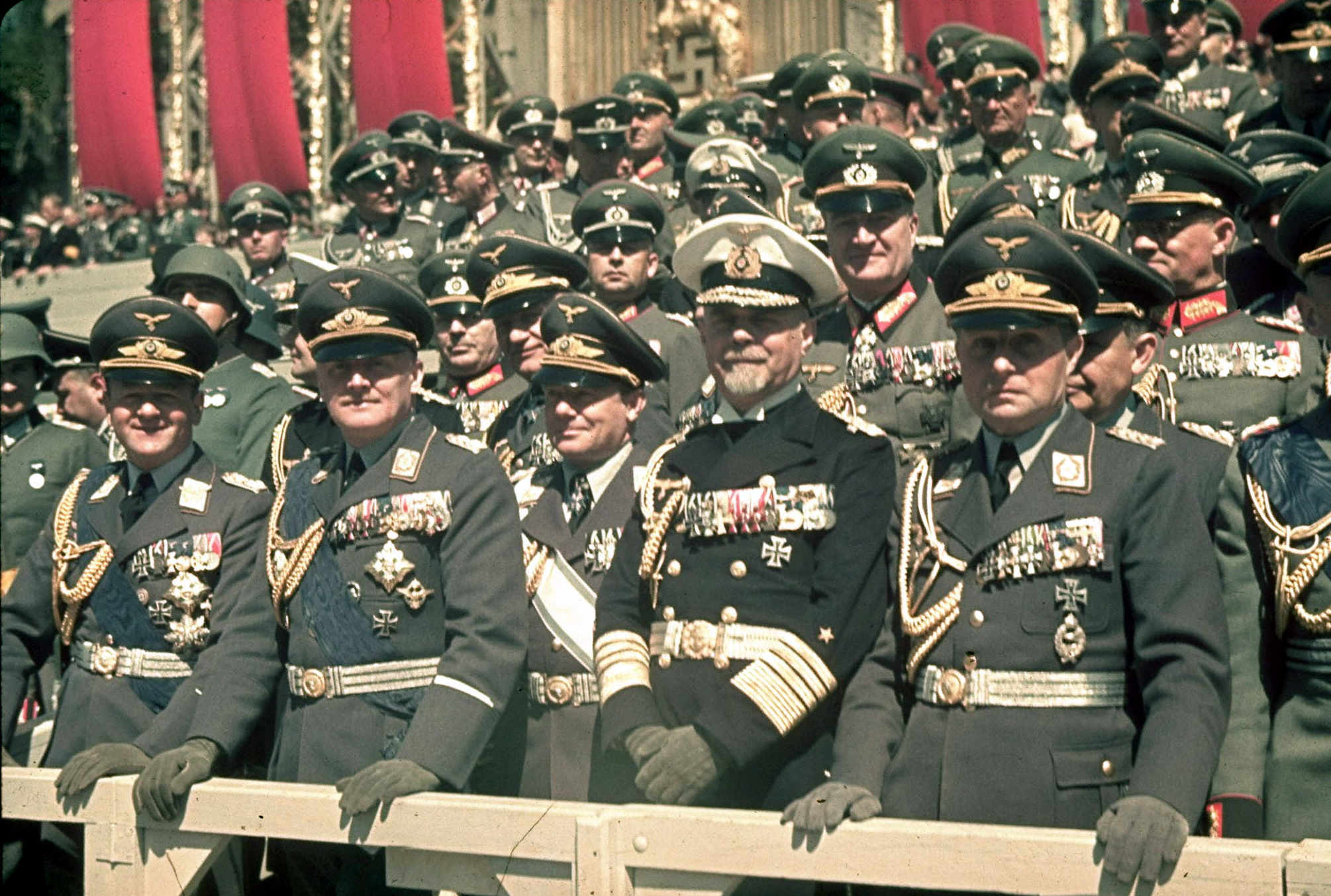
Generals and admirals of the Wehrmacht stood in the stands of honor at the culmination of Adolf Hitler's 50th birthday celebration, which was held in Berlin on April 20, 1939. They all wore paradeanzug (parade uniform), complete with feldbinde (brocade belt), auszeichnungen (medal bars) and schnurr (lanyard). Front row from left to right: Generaloberst Erhard Milch (Generalinspekteur der Luftwaffe), General der Flieger Hans-Jürgen Stumpff (Chef der Luftwehr), Generalleutnant Ernst Udet (Generalluftzeugmeister und Chef Planungsamts der Luftwaffe), Admiral Max Bastian (Präsident Reichsfürsorge- und Versorgungsgerichts der Wehrmacht), and Generalmajor Friedrich Fahnert (Höheren Kommandeur Luftnachrichtenschule Berlin). For additional identification: Generalleutnant Walter Petzel (Inspekteur der Artillerie) is the bespectacled man standing behind Fahnert; Generalmajor Hermann von Hanneken (Bevollmächtigter für Eisen- und Stahl auch zum Leiter der Hauptabteilung II Industrie) stood between Bastian and Fahnert, Generaloberst Wilhelm List (Oberbefehlshaber Heeres-Gruppenkommando 5) between Udet and Bastian, and General der Flieger Friedrich Christiansen (Korpsführer NSFK) between Stumpff and Udet. This photo itself was made by Hitler's personal photographer, Hugo Jaeger. Note that Milch and Stumpff both wear the Star of the Yugoslav Order of the Crown on their chests!

Source :
http://alifrafikkhan.blogspot.com/2010/10/koleksi-ratusan-foto-berwarna-dari-life.html
https://artsandculture.google.com/entity/m064km4b?hl=en

Sunday, November 20, 2022

Himmler Chats with Polizei Officer in Warsaw


This picture was taken by Hugo Jaeger on 5 October 1939, and it shows Heinrich Himmler (Reichsführer-SS und Chef der deutschen Polizei) chats with unknown Orpo (Ordnungspolizei) officer - possibly with the rank of Major - during the German victory parade at Warsaw, Poland. In the background is a column of Mercedes-Benz W31 type G4 cars. There seems to be a confusion which Polizeibataillonen were actually in Warsaw at that time. According to NARA T 312 R 39 (AOK 8), five of them - under command of Oberst Rietzler (or Ritzer) - were sent to Warsaw right after capitulation. Polish IPN report has these: Pol.Btl. 2 (Major Küster), 5 (Major Jenke), 6 (Major Wenzel) and 7 (Major Vollmar). Wolfgang Curilla's book also mentions: 3 (Major Höcke) and 4 (Major Kasten) as being moved to Warsaw right before a parade.. It's possible Pol.Btl. 6 had not arrived until mid-October, so it was not in Warsaw during the parade. The interesting thing about this photo is the mark left by Himmler's spectacles which he has obviously removed in favour of his pince nez for the parade. To leave a mark such as this, the spectacles must have been worn tight to his head. Did they give him a headache? He was known to suffer from headaches and stomach cramps. He put his headaches down to his poor eyesight and pouring over numerous files, plus sinus problems (maybe better fitting spectacles could have solved one of his problems?). Just by looking at other photos from that parade, there was on Orpo (Ordnungspolizei) unit facing main tribune on the other side of the street. So possibly Himmler was having a chat with Orpo commander, with his back to the street and main tribune on the other side. Those nice cars (with Hitler and others) were arriving from the city centre (in the opposite direction to later parade traffic). When parade started a military band arrived first and took stand in front of the Orpo unit, facing main tribune.

Source :
https://artsandculture.google.com/asset/hitler-jaeger-file/NgHd0PG7VPbm6Q?hl=en
https://forum.axishistory.com/viewtopic.php?f=38&t=229080&hilit=warsaw&start=15

Thursday, November 3, 2022

Gebirgsjäger on Ski


This young German Gebirgsjäger (mountain soldier) photographed during the winter of 1938/9 is wearing a typical uniform of the period: a Bergmütze (mountain cap) with the first version of national insignia (white on light grey); a Feldbluse M33 (jacket) with the bluish dark green Schulterklappen (shoulder straps) with a light green distinctive and the first version of white on a light grey national eagle; stone-grey trousers, or Skihose—the quality of the photograph, one of the first slides ever used in Germany, highlights the difference between the jacket and the trousers—with buttoned pocket flaps; and Wickelgamaschen (puttees) made of feldgrau cloth. The ash skis and duralumin sticks likely come from the resort where he is spending his leave.


Source :
"German Mountain Troops" by Yves Beraud

Sunday, October 16, 2022

German Victory Parade in Warsaw (1939)


Hitler's Motorcade Crosses Warsaw

On the threshold of Hitler’s visit to Warsaw on 5 October 1939, the center of the city, a maiden part of the upcoming motorcade route, had been practically sealed from the locals, abandoning the presence of any polish citizens in proximity to the event. A number of buildings along the planned route were now covered with the Nazi banners and a good few special security squads, armed with machine guns, were disposed within the windows and roofs across the city center. The local population of the occupied Warsaw was now forbidden (at least on October 5), under penalty of death, to leave their accommodation across the route or to open windows facing the chosen streets. the day before, Hitler personally alleviate the concerns of some SS soldiers and officers, who had already participated in mass killings in Poland. On October 4 he issued a secret order on amnesty, an act of oblivion for the Germans soldiers, who were now beyond the law in committing crimes within occupied territories.

For this once on October 5, 1939, Adolf Hitler made it to Poland from Berlin by means of a plane. As early as 11:30 a.m. the air cortege under the masterful lead of Hans Baur came down to the airfield of Okecie (The modern Warsaw Chopin Airport. Some sources state that they landed at the Kielce airport). As befits the supreme commander and the conqueror, Hitler was awaited and welcomed by his generals. Gerd von Rundstedt, the triumphal commander of ‘Heeresgruppe Süd’ (Army Group South); Walther von Brauchitsch, Commander-in-Chief of the German army; Erhard Milch, the future Field Marshal of aviation and Goering’s deputy; Johannes Blaskowitz, the commander of the triumphal 8th army; Walter von Reichenau, the commander of the 10th army at that time; Friedrich von Cochenhausen, the future general of artillery. The planned VIP-like motorcade was to enter Warsaw from the East and proceed towards the initial point, which was the set of the military parade.

Hitler’s automobile cortege cross the Vistula river across the Most Poniatowskiego (Poniatowski Bridge), named after the Polish military leader of the 17-18 centuries. The bridge was rebuilt after the demolition during the ‘Great War (WWI) and would be totally devastated by Germans five years later in the midst of the Warsaw Uprising. Hereafter, the motorcade proceeded to an avenue, historically praised as ‘Aleje Jerozolimskie’ (The Jerusalem alley), now hastily renamed into Bahnhofstrasse (later one, in the course of the occupation, into ‘Reichsstraße’ and finally ‘Ostlandstrasse’). Subsequently, the cars turned into Nowy Swiat, the famous fashionable arteria of Warsaw, and finally to Ujazdów Avenue. All arrangements were made to orchestrate a parade of victory, thus paying tribute both to the German army and Hitler himself as a supreme commander and a Fuhrer.

The Two-Hour Military Parade

The long-drawn automobile column, which had been proceeding its way from the airfield, now eased down and entered the wide avenue. Hitler was the key figure of the cortege, all while standing and greeting the German soldiers (who had been carefully ranked by the side of the road hours before) from his Mercedes-Benz W31 type G4 of improved cross-country performance. The route was not accidental as for a while now his cortege had been moving forward across the so-called ‘King’s route’ the king’s road with a two-century history behind. The German dictator was known for his disdain toward the monarchy. Hitler was even much less concerned with the history of the independent Polish state and its kings, who had used this route to reach their royal residences in the South of Warsaw. ‘Ujazdów Avenue’ would later (May 1940) be renamed Lindenallee (Linde Avenue) with a barefaced parallel to the berlin Unter-den-Linden. A year from the day of Hitler’s visit it would be once again renamed (in the course of the orchestrated parade viewed by Hans Frank) to ‘Siegenallee’ (The avenue of Victory).

As far back in Warsaw’s history as the end of the XIX century, a broad street with an elite status of the former king’s road was settled on by rich aristocrats of the Austro-Hungarian Empire. With the acquisition of independence and the fall of the Habsburgs at the back of the Great War, the spacious villas and adjoining green gardens were mainly turned into embassies. That very afternoon minutes of October 5 1939 Hitler’s cortege made a stop next to Ujazdowski Park and Pałacyk ‘Rembielińskiego’, a luxurious palace of 1840, hit by a German air bomb in the course of the recent raids. A large grandstand, ornamented with Nazi symbolics was erected prior to the event to accommodate Hitler and his close military entourage during the so-called ‘Siegesparade’ (Parade of victory).

Apart from Hitler himself, the made tribune was now to welcome and place forgoing Walther von Brauchitsch, Gerd von Rundstedt, and Friedrich von Cochenhausen. The attentive attendees of the parade had a glimpse to identify the future Feldmarschall of aviation Albert Kesselring, who had been recently (September 30) awarded with Knight’s Cross of the Iron Cross (Ritterkreuz des Eisernen Kreuzes) by Hitler personally. General Colonel Wilhelm Keitel, the chief of the OKW, had been disdainfully called ‘Lakeitel’ by some of the high-ranking officers of the army. He caught the sight of the battlefields in Poland only from the perspective of Hitler’s personal train, a fact, which had not get in the way of being awarded the ‘Knight’s Cross’ for the Polish campaign. It would take him seven years to get from the parade in Warsaw to the gallow in Nuremberg. Erwin Rommel, the chief of the ‘Führerbegleitbataillon’ was another prominent figure, summoned to Warsaw after a short stay at home and now present within the grandstand.

Among the others present, Johannes Albrecht Blaskowitz, the commander of the 8th army was now filled with a mix of pride and doubts watching his soldiers (the 8th army was the privileged regime of the parade) marching the conquered city. Following the Polish campaign, Blaskowitz was promoted to colonel-general, awarder with ‘Knight’s Cross’ and assigned as the Commander in Chief in the East. In under two subsequent months, the general would fall out of favor of Hitler after his deprecation towards the mass killings, performed by the SS in Poland with the extermination of the city citizens, the prelude to mass killing actions in the USSR such as Babi yar massacre in 1941. On that October afternoon, Blaskowitz could see Heinrich Himmler nearby, an architecture of the ‘Sonderauftrag’ (special tasks) against Polish and Jews, who had come purposively from Berlin to join the parade after a ten-day ‘vacation’.

As for Adolf Hitler, he was now making the most of the moment, while playing the role of the warlord, a colonizer who reviewed his self-made triumphant army for more than two hours in the heart of Warsaw downtown. October 5, 1939, was a warm and sunny day, yet the German Fuhrer favored a leather coat to appear in front of his army. The bloody war would demand another day until the shatters of the devastated Polish army would capitulate on October 6 (on that day Hitler would voice a triumphant speech in Berlin). In the meantime, waiting for such ‘formality’, Hitler addressed the foreign journalists next to the grandstand, who had been craving his commentaries for a few hours. He made emotional stress on the ruins of Warsaw and proclaimed a verbose statement, that Warsaw suffered so much because of the ‘criminal’ perseverance of its leaders and defenders. Hitler voiced the idea, that the Western powers should pay extreme attention to the possible aftermath of war. Subsequent to a two-hour orchestrated parade, Hitler was now to proceed with a short ride across Warsaw.


Siegesparade (Victory Parade) of German troops from 8. Armee in Warsaw, Poland, which were held on October 5, 1939. Hitler specifically flew to Warsaw on a Focke-Wulf Fw 200 A-0 (S-8) AC+VH "Grenzmark" aircraft to watch the parade. He landed at Okecie airport in Aleja Krakowska, and armed convoy went to the central part of the city where the main event was taking place. After that, he made brief visits to various parts of Warsaw. In addition with Hitler, the main podium was filled by the commanders of the Wehrmacht, while at the bottom left were other generals of lower rank. Also, the bottom right is filled by aides. For identification of the people standing on the podium is, from left to right: Generaloberst Walther von Brauchitsch (Oberbefehlshaber des Heeres), Adolf Hitler (Führer und Oberster Befehlshaber der Wehrmacht), Generaloberst Gerd von Rundstedt (Oberbefehlshaber Heeresgruppe Süd), General der Infanterie Werner Kienitz (Kommandierender General XVII. Armeekorps), General der Kavallerie Maximilian Reichsfreiherr von Weichs (Kommandierender General XIII. Armeekorps), Generaloberst Walther von Reichenau (Oberbefehlshaber 10. Armee), Generaloberst Johannes Blaskowitz (Oberbefehlshaber 8. Armee), General der Flieger Alexander Löhr (Chef Luftflotte 4), General der Flieger Albert Kesselring (Chef Luftflotte 1), and SA-Obergruppenführer Wilhelm Brückner (Chefadjutant des Führers und Reichskanzler). Photo by Hugo Jaeger, one of Hitler's personal photographer.


Siegesparade (Victory Parade) of German troops from 8. Armee in Warsaw, Poland, which were held on October 5, 1939. Standing in the podium, from left to right: Generaloberst Walther von Brauchitsch (Oberbefehlshaber des Heeres), Adolf Hitler (Führer und Oberster Befehlshaber der Wehrmacht), Generalmajor Friedrich-Carl Cranz (Kommandeur 18. Infanterie-Division), General der Artillerie Emil Leeb (Kommandierender General XI. Armeekorps), Generaloberst Wilhelm Keitel (Chef der Oberkommando der Wehrmacht), General der Kavallerie Maximilian Reichsfreiherr von Weichs (with glasses, Kommandierender General XIII. Armeekorps), Generaloberst Johannes Blaskowitz (Oberbefehlshaber 8. Armee), Generaloberst Walther von Reichenau (blocked by Blaskowitz, Oberbefehlshaber 10. Armee), and General der Flieger Albert Kesselring (Chef Luftflotte 1). Standing directly below Hitler is Generalmajor Erwin Rommel (Kommandeur Führer-Begleit-Bataillon). Photo by Hugo Jaeger, one of Hitler's personal photographer.


Siegesparade (Victory Parade) of German troops from 8. Armee in Warsaw, Poland, which were held on October 5, 1939. Standing in the podium, from left to right: Adolf Hitler (Führer und Oberster Befehlshaber der Wehrmacht), Generalmajor Friedrich-Carl Cranz (Kommandeur 18. Infanterie-Division), General der Artillerie Emil Leeb (Kommandierender General XI. Armeekorps), Generaloberst Wilhelm Keitel (Chef der Oberkommando der Wehrmacht), and Generaloberst Walther von Reichenau (Oberbefehlshaber 10. Armee). In the invasion of Poland, 18. Infanterie-Division (Cranz) was under the command of XI. Armekorps (Leeb), which itself is a part of the 10. Armee (Reichenau). Standing directly below Hitler is Generalmajor Erwin Rommel (Kommandeur Führer-Begleit-Bataillon). Photo by Hugo Jaeger, one of Hitler's personal photographer.


Siegesparade (Victory Parade) of German troops from 8. Armee in Warsaw, Poland, which were held on October 5, 1939. From left to right: Generaloberst Johannes Blaskowitz (Oberbefehlshaber 8. Armee), General der Flieger Albert Kesselring (Chef Luftflotte 1), Generalleutnant Conrad von Cochenhausen (with stahlhelm, Kommandeur 10. Infanterie-Division), General der Flieger Alexander Löhr (Chef Luftflotte 4), Generalmajor Karl-Heinrich Bodenschatz (Verbindungsoffizier zwischen dem Oberbefehlshaber der Luftwaffe und dem Führerhauptquartier), and SA-Obergruppenführer Wilhelm Brückner (Chefadjutant des "Führers und Reichskanzlers“). In this photo, Brückner is wearing a rare wartime SA schirmmütze (visor hat) reserved only for Adolf Hitler's personal staff. This type of hat can be identified from the dark brown center with the Reichsadler SA emblem on the top center which resembles the Reichsadler Heer / Kriegsmarine. Photo by Hugo Jaeger, one of Hitler's personal photographer.


Siegesparade (Victory Parade) of German troops from 8. Armee in Warsaw, Poland, which were held on October 5, 1939. This picture shows Panzerkampfwagen IIs passing Adolf Hitler and other Wehrmacht officials who were standing on the podium. Since the only armored formation belonging to the 8. Armee under the siege of Warsaw was I.Abteilung / Panzer-Regiment 23, it is likely that the tanks is from that unit. Standing on the podium is, from left to right: General der Kavallerie Erich Hoepner (Kommandierender General XVI. Armeekorps [motorisiert]), Generaloberst Walther von Brauchitsch (Oberbefehlshaber des Heeres), Adolf Hitler (Führer und Oberster Befehlshaber der Wehrmacht), Generaloberst Gerd von Rundstedt (Oberbefehlshaber Heeresgruppe Süd), Generaloberst Wilhelm Keitel (Chef der Oberkommando der Wehrmacht), General der Kavallerie Maximilian Reichsfreiherr von Weichs (Kommandierender General XIII. Armeekorps), Korvettenkapitän Karl-Jesko von Puttkamer (Adjutant der Kriegsmarine beim Führer und Oberster Befehlshaber der Wehrmacht), Generaloberst Walther von Reichenau (Oberbefehlshaber 10. Armee), Generaloberst Johannes Blaskowitz (Oberbefehlshaber 8. Armee), General der Flieger Alexander Löhr (Chef Luftflotte 4), and General der Flieger Albert Kesselring (Chef Luftflotte 1).


PaK (Panzerabwehrkanone) 35/36 37mm caliber belonging to a Wehrmacht anti-tank unit passing through the podium during the victory parade of the German troops from 8. Armee in Warsaw, Poland, which were held on October 5, 1939 in the presence of Adolf Hitler (Führer und Oberster Befehlshaber der Wehrmacht) and other high-ranking Wehrmacht officials. The PaK 35/36 itself was the standard German anti-tank weapon early in the war, before being replaced by the larger caliber as Allies and Soviet armored vehicles increased in thickness. Note that these anti-tank guns are painted with field gray color so they will "blend" with the color of the tires! The picture was taken by Hugo Jaeger, one of Adolf Hitler's personal photographer.


This photo was taken by Hugo Jaeger and shows the Siegesparade (Victory Parade) of the German troops from 8. Armee in Warsaw, Poland, which were held on October 5, 1939. The Einheits-PKW (standard passenger car) marching past Adolf Hitler and other dignitaries of the Wehrmacht, standing on the podium . The vehicle on the left is the Stoewer Typ M 12 RW, while the one in the center and right is the Horch 830 R Kübelwagen. Those standing in the podium is, from left to right: General der Kavallerie Erich Hoepner (Kommandierender General XVI. Armeekorps [motorisiert]), Generaloberst Walther von Brauchitsch (Oberbefehlshaber des Heeres), Adolf Hitler (Führer und Oberster Befehlshaber der Wehrmacht), Generaloberst Gerd von Rundstedt (Oberbefehlshaber Heeresgruppe Süd), General der Infanterie Werner Kienitz (Kommandierender General XVII. Armeekorps), General der Kavallerie Maximilian Reichsfreiherr von Weichs (Kommandierender General XIII. Armeekorps), Generaloberst Walther von Reichenau (Oberbefehlshaber 10. Armee), Generaloberst Johannes Blaskowitz (Oberbefehlshaber 8. Armee), General der Flieger Alexander Löhr (Chef Luftflotte 4), General der Flieger Albert Kesselring (Chef Luftflotte 1), and SA-Obergruppenführer Wilhelm Brückner (Chefadjutant des Führers und Reichskanzler). The aides are watching below the podium and - in this photo - they can be seen at far right.


This photo was taken by Hugo Jaeger and shows the Siegesparade (Victory Parade) of the German troops from 8. Armee in Warsaw, Poland, which were held on October 5, 1939. A line of military trucks passes Adolf Hitler and other high-ranking Wehrmacht officials, followed by the Einheits-PKW (standard passenger cars). It seems that these vehicles have been added with a two-tone gray-brown camouflage paint, and they also have a glossy shine as if they were fresh from the factory (the order to use all-grey camouflage only came into effect after the end of French campaign in 1940). Here, too, we can see that the generals around Hitler changing according to their unit's turn to parade. From left to right: Generaloberst Walther von Brauchitsch (Oberbefehlshaber des Heeres), Adolf Hitler (Führer und Oberster Befehlshaber der Wehrmacht), Generaloberst Gerd von Rundstedt (Oberbefehlshaber Heeresgruppe Süd), General der Infanterie Werner Kienitz (Kommandierender General XVII. Armeekorps), and General der Kavallerie Maximilian Reichsfreiherr von Weichs (Kommandierender General XIII. Armeekorps)


Source :
http://alifrafikkhan.blogspot.com/2010/10/koleksi-ratusan-foto-berwarna-dari-life.html
https://artsandculture.google.com/entity/m064km4b?hl=en
https://www.life.com/history/world-war-ii-erupts-color-photos-from-the-invasion-of-poland-1939/
https://war-documentary.info/hitler-goes-warsaw/

Tuesday, September 27, 2022

Hitler and German-Italian Officials during "Day of the German Art"


Adolf Hitler follows the procession on the "Tag der deutschen Kunst" from the VIP stand, which were held in Münich on 16 July 1939. Standing in the podium, from left to right: unknown, Joseph Goebbels, Italian Minister of National Culture Dino Alfieri, Hitler (Führer und Reichskanzler), and Gauleiter Adolf Wagner.

Source :
https://imgbb.com/DG3fKGs

Wednesday, August 24, 2022

Polish Railway in World War II

Destroyed / damaged Polish State Railways PKP train on collapsed bridge with German soldiers waiting in the bottom. The picture was taken in September-October 1939, not long after the end of the German invasion in Poland.

In 1939, Polish State Railways had 220 thousand employees. It was a well-organised occupational group. 85% of railwaymen were members of trade unions. Most of them were also members of the Railway Military Training Organisation who had done compulsory military service.

As part of mobilisation activities, some railwaymen were summoned to join the army. In the last weeks before the outbreak of war numerous cases of German sabotage against railway facilities were recorded. Some acts of sabotage were prevented thanks to vigilant railway workers. The most tragic act of terror was an explosion of a time bomb on 28 August at 11:18 PM in the waiting room of the railway station in Tarnów. The lethal device was planted by Antoni Guz from Bielsko. 20 people were killed under the ruins of the destroyed railway station and 35 were injured.

When war broke out railways were handling emergency and general mobilisation transports. Also, the first evacuation trains pulled out on the route. Germans carried out bombing raids and airborne fire attacks on railway stations, echelons but also on evacuation trains carrying civilians and identification-bearing sanitary trains. Large railway stations such as those in Bydgoszcz, Grudziądz, Inowrocław, Toruń, Łowicz, Piotrków Trybunalski, Skierniewice, Kraków, Lublin and the stations of the Warsaw railway junction were bombed – some of them even more than once. Despite this fact, railwaymen and sappers were able to restore traffic on the damaged lines within 3–4 hours.

The first military transports were put into operation before mobilisation was declared; 5 large troops were transferred at that time. Subsequent echelons were transported under a mobilisation plan which provided that 32 out of 56 large troops would be transported by rail, as a whole or in part, to build-up points. In total they were to account for 3/5 of Polish forces. This task required 3 thousand trains. In addition, railways had an obligation to deliver 700 thousand reservists from emergency mobilisation and 400 thousand from general mobilisation and 100 thousand soldiers withdrawn from the west to reserve centres situated in the east. Railway troops were supposed to remove damages to railroads.

The attack of Nazi Germany on Poland on 1 September 1939 was also aimed at main junction stations and railway lines. Bombing raids on the stations in Tczew and Kutno started at dawn. Also, the bridge on the Bugonarew in Modlin was bombed. To prevent the progress of the German army, Polish sappers blew up some railway structures e.g. viaducts, tunnels in Żegiestów (on the line Muszyna– –state border) and in Łupków (on the Łupków–Medzilaborce line), bridges in Tczew, Grudziądz, Bydgoszcz-Fordon, on the Bydgoszcz Canal, in Toruń and in Płock.

The events in Szymankowo became a symbol of the heroism of railwaymen. Here, Polish railwaymen prevented an insidious seizure of the bridge in Tczew by the Germans. The scheduled transit train was followed by an armoured train which was sent to a sidetrack and derailed. In retaliation Germans murdered the railwaymen from Szymankowo. In Chojnice, instead of the scheduled train, a German armoured draisine pulled into the station followed by an armoured train. Polish railwaymen and soldiers had been able to take control of the draisine and destroy the bridge before the armoured train reached it. Two railway companies took part in the defence of Warsaw.

Armoured trains were used in the defensive war, including “Danuta” (No. 11) and “Poznańczyk” (No. 12) which took part in the Battle of the Bzura and were destroyed. “Generał Sosnkowski” (No. 13) was derailed and damaged after a bombing raid near Łochów. “Paderewski” (No. 14) was destroyed near Łowicz, and “Śmierć” (No. 15) suffered damage during fighting near Modlin. “Pierwszy Marszałek” (No. 51) fought both against Germans and the Red Army and was damaged in combat with Soviet airplanes. “Piłsudczyk” (No. 52), “Śmiały” (No. 53) and “Bartosz Głowacki” (No. 55) were seized by the Soviets in Lviv (Podzamcze), and “Groźny” (No. 54), fighting in Silesia, was destroyed by the crew when they reached a blown-up bridge on the Dunajec.

As a result of the warfare, 11 large bridges were destroyed, 8,000 smaller structures were damaged and 25,000 damages to stations and tracks were recorded. Some trains and evacuated rolling stock – the exact number is difficult to estimate – reached the eastern parts of the Republic of Poland that on 17 September were occupied by the Red Army.

Both occupying forces introduced their own order. The Germans divided the conquered territory. In the area of the General Government (95 thousand sq. km), on 19.11.1939 the General Directorate of Eastern Railways (Ostbahn) (GEDOB) was established in Kraków. District directorates were set up in Kraków, Warsaw, Radom and Lublin. The general organisation of divisions in the new general directorate was not changed compared to the organisation before the war. German identification symbols were applied on the rolling stock. At the beginning of 1940 the German railway police, called the Bahnschutz, was established as another element of the system of repression. Poles could travel by all trains except fast trains. Also, they could not sit in carriages for Germans. On the other hand, Jews were not allowed to travel without pass cards. In the territories incorporated into the Reich Poles could use the train service only if they were issued special pass cards. Polish railwaymen, and in particular members of the Silesian uprising, plebiscite activists, members of the Greater Poland uprising, and activists involved in social activity before the war were subject to repressions including executions by firing squads and imprisonment in concentration camps. Managerial and other functions were handled by the Germans.

Railway transport was a very important element of the German war machine, therefore, when the fighting ceased in September 1939, the occupying power commenced the reconstruction of the destroyed railway network. Railwaymen were called to work. Work on railways offered protection against being taken away to Germany and forced to work and railway passes enabled travelling after curfew. The war production required efficient technical back-up. Thus, some workshops (e.g. in Nowy Sącz) and factories (Chrzanów) were expanded. The steam locomotives and wagons were marked with vainglorious slogans: “Alles Rädern mussen rollen für den Sieg! (Wheels must roll for victory!)” and “V” signs painted on locomotive smoke-boxes.

In the meantime, Polish railwaymen organised acts of sabotage spontaneously or under emerging conspirators’ organisations, to make operation of the railway difficult to a varying degree and extent. Among other things, they poured sand into wagon grease tanks, falsified transport documents, replaced address stickers on wagons, or assigned double numbers to wagons after repairs. The official gazette of Ostbahn of September 1943 listed the numbers of 500 wagons and 200 tankers which were lost while carrying cargo. 25% of tankers of the former Polish State Railways’ network were sabotaged. In 1942 every fifth steam locomotive was out of order. Railwaymen provided enormous support in organising illegal deliveries of foodstuffs to cities, in conspiracy carriage of mail and courier mail or hiders and in warning against round-ups at railway stations and in intelligence operations. They were at a risk of severe repressions for such activities.

Prior to the attack on the Soviet Union, railway transport in Poland became particularly significant to the Reich. In the territory of the occupied country the Germans gathered 102 divisions of the Wehrmacht, i.e. nearly 3 million soldiers! Following the outbreak of the war between the Germans and Soviets on 22 June 1941 the Commander-in-Chief of the Polish Armed Forces, General Władysław Sikorski, ordered the chief commander of the Union of Armed Struggle, General Stefan Grot-Rowecki to intensify the sabotage and subversion activities in the Reich and in the direct vicinity of the German army. At that time 420 military transports passed through Poland every day. During sabotage and subversion actions in the second half of 1941 as many as 1935 steam locomotives were damaged and 91 were held in repair workshops, 91 railway transports were derailed and 237 were set on fire. In addition, 2,851 wagons were damaged. At that time Ostbahn employed 150 thousand Polish railwaymen, 60 thousand Polish railway workers, 8.3 thousand Germans and 3.5 thousand rail guards.

Sabotage on railway lines passing near the frontline was further intensified in 1942. The largest achievement of the Warsaw District Union of Retaliation was Operation Wieniec (lit. Operation Corona) in the night of 7/8 October 1942, in which the rails surrounding Warsaw were blown up at the same time. Operation Bariera (Barrier) interrupted railway traffic at 92 points simultaneously. Actions at German rail transports were also carried out by partisan groups of any political orientation, including Soviet groups.

At the second stage of the war the retreating Germans purposefully destroyed railway lines on their way. They blew up tunnels, bridges, water towers and pump stations. The occupying forces burnt down and demolished railway station buildings and engine houses, and sappers blew up the poles of teletechnical networks. The Germans took machines, tools and rolling stock away to the Reich. 4 out of 11 main workshops were completely destroyed (Warsaw Chmielna, Warsaw-Praga, Eastern Warsaw and Łapy). 80–90% of machines and equipment was lost by the workshops in Pruszków, Tarnów and Nowy Sącz. Smaller losses were suffered in Radom, Gdańsk, Poznań and Bydgoszcz. The The Germans stole all equipment and machine tools from the regained territories, from, among other places, Opole, Oleśnica, Świdnica, Ostróda and Stargard Szczeciński. They also took away most machines from Wrocław and from 2 steam locomotive and wagon workshops in Gliwice. Only in Piła was complete equipment saved.

The total losses suffered by Polish railways, also calculated taking into account territories allocated after 1945, amounted to 16 billion zlotys (in pre-war currency). 38% of railway lines, 46% of bridges (including all major bridges), 50% of tunnels, 37% of railway buildings, 6 thousand steam locomotives and 60 thousand wagons were destroyed.


Source :
https://kolejnictwopolskie.pl/baza-wiedzy/kolejowa-ii-wojna?article_lang=en

Tuesday, August 23, 2022

German Soldiers Crossing a Wooden Bridge in Poland

German soldiers crossing a wooden bridge over a river in Poland, September-October 1939. They are most likely from 213. Infanterie-Division. During the Invasion of Poland, the 213th Infantry Division served in the reserves of Army Group South (Gerd von Rundstedt). It did not play a significant role in the Poland campaign. After the campaign, the division served under XXXV Army Corps.

Source :
https://en.wikipedia.org/wiki/213th_Security_Division

General René de l'Homme de Courbière in Poland

German soldiers and officers in an unnamed town square in Poland, September-October 1939. The one in the middle is Generalmajor René de l'Homme de Courbière (Kommandeur 213. Infanterie-Division). During the Invasion of Poland, the 213th Infantry Division served in the reserves of Army Group South (Gerd von Rundstedt). It did not play a significant role in the Poland campaign. After the campaign, the division served under XXXV Army Corps.

Source :
https://en.wikipedia.org/wiki/213th_Security_Division
https://forum.axishistory.com/index.php

Sunday, August 14, 2022

257. Infanterie-Division in Mörsbach


Scenes filmed by Leutnant Edgar Forsberg of the German 257. Infanterie-Division following the collapse of the Polish army on October 6, 1939. “Am Divisions-Gefechtsstrand in Morsbach.” Soldier on a motorcycle, camera pans to the trees and hill beyond. A car moves along a dirt road, tree-covered hills in the distance. WS of a building at the base of a hill. “Morsbach und Umgebung” Morsbach and the surrounding area. Houses at the top of a hill. “Zugang zum Divisions-Gefechtsstand.” Soldiers at the Division Command Post. Two soldiers help a man get his motorcycle started by running and pushing it from the back. A guard paces at the entrance. Cars drive. “Beim Schauertal.” Animals in a field. “Es hat wieder einmal in Morsbach geregnet.” It rains. Men ride their bikes along the road.

10:10:24 “Alt-Hornbach an der Brucke” Houses along a small river in Hornbach. “Seitenstrasse in Hornbach” side-street in Hornbach. “Posten in Hornbach,” A soldier speaks to a civilian. “Reinlichkeit ist das halbe Leben” Man cleans off the back of another man’s clothes. “Hornbach am Wasser” A bridge over the main waterway in Hornbach, soldiers talk on the side. “Ia mit Gefolge in der Widerstandslinie.” People in uniform along a dirt road. “Hornbacher Strassenbilder.” A soldier walks along the street and steps through a gate. He continues to walk towards the camera. A car drives on the street. View from a higher elevation of the town and the lake. Soldiers push a cart of supplies past a building with bundles of wrapped wire sitting outside. Horse-drawn carts move through the town. The town appears deserted aside from the soldiers. 10:13:35 "Tarnung einer leichte Feldhaubitz-Stellung bei Alt-Hornbach.” A field howlitzer camouflaged in a hill. A soldier breaks off the top of a pine tree. A soldier emerges from a building.


Source :
https://collections.ushmm.org/search/catalog/irn555308

257. Infanterie-Division in Poland 1939


Scenes filmed by Leutnant Edgar Forsberg of the German 257. Infanterie-Division following the collapse of the Polish army on October 6, 1939. "Mit dem Stab der 257. Inf. Div. im Krieg (schwarzweiss film)” “Tankabwehr an der Strasse Einod-Gersheim nordl. Von Webenheim” Trucks driving. A tank is buried into the side of a hill. “Offene Feuerstellung einer 10 cm Kanonenbatterie Nordausgang Herbitzheim.” A cannon at the base of a tree in a field. “Auf der landstrasse im Bliestal.” A soldier gets into a car on the road. “Gesprengte Eisenbahnbrucke bei Breitfurt.” A soldier walks across a destroyed railway bridge collapsed into the water, near Breitfurt, Germany. Water flows through the blasted bridge. A soldier uses a stick to see how deep the water is.

10:16:32 “Tankabwehrbunker auf der Truppacher-Hohe.” A tank gun or cannon points out of a bunker. Soldiers walk around, some look at the camera. “Artilleriebeobachtung auf dem husarenberg bei Medelsheim. Im Hinterfrund der ttt schlosshube.” Soldiers dig through rubble. “Bilder aus Medelsheim” Medelsheim buildings and streets. Two soldiers carry a large jar. “Gutgetarnte Stellung zweier SFH 18 bei Seyweiler.” Open fields in Seyweiler, Germany with two camouflaged sFH 18 howitzers. “Bilder aus walsheim.” Rubble in Walsheim. “Von der Walsheimer Brauerei wird ‘Freibier’ geholt.” Free beer from a local brewery is wheeled in by soldiers. Other soldier bring in weapon parts. “Eine reifenpanne in Walsheim.” A soldier attempts to fix a flat tire in Walsheim, Germany. 10:19:10 “Gesprengte Brucke bei Herbitzheim.” A river in Herbitzheim. “M.-G.-Stand am Bahndamm Sudausgang Gersheim, getarnt durch ein Bretterhauschen.” Something camouflaged on a railway embankment. “Gesprengte Bliesbrucke bei Gersheim” Bombed bridge in Gersheim, Germany. “Am Bahnhof Gersheim” “Bilder aus Seyweiler” Buildings in Seyweiler, a district of Gersheim, Germany. A soldier walks towards the camera on a cobblestone street. “Oberauerbach von der Schnecken-Hohe aus.”


Source :
https://collections.ushmm.org/search/catalog/irn555309

Friday, June 24, 2022

German Soldiers in Front of Brandenburg Gate

 
The Ost-West-Achse (East-West-Axis) in Berlin, site of a massive rally and military demonstration in celebration of Adolf Hitler’s 50th birthday, 20 April 1939. The display was intended in part as a warning to the Western powers. The parade, which lasted for more than four hours, included 12 companies of the Luftwaffe, 12 companies of the army, and 12 companies of the navy and units of the Schutzstaffel (SS). In total, 40,000 to 50,000 German troops took part. 162 warplanes flew over Berlin. The grandstand comprised 20,000 official guests, and the parade was watched by several hundred thousand spectators. Features of the parade were large long-range air-defence artillery guns, emphasis on motorized artillery and development of air-defence units. Joseph Goebbels declared in a broadcast address to the German people. The picture was taken by Hugo Jaeger.

Source :
https://artsandculture.google.com/asset/hitler-jaeger-file/EgHmP3BzbacCzQ?hl=en
https://en.wikipedia.org/wiki/Adolf_Hitler%27s_50th_birthday

Thursday, June 23, 2022

Hitler's 50th Birthday Gifts

Some of Adolf Hitler's 50th birthday gifts - including flower vases emblazoned with swastikas and paintings - stored in a room at the New Reich Chancellery. The painting at left shows the figure of Helmuth von Moltke the Elder (1800-1891), a Prussian field marshal who is regarded as the creator of a new, more modern method of directing armies in the field. The picture was taken by Hugo Jaeger on 20 April 1939.

Source :
https://www.life.com/history/adolf-hitler-at-50-color-photos-from-a-despots-birthday-april-1939/

Sunday, June 19, 2022

Hitler Arrived at Legion Condor Ceremony

Welcoming ceremony for the Legion Condor which was held in Lustgarten square, Berlin, June 6, 1939. Adolf Hitler (Führer und Oberster Befehlshaber der Wehrmacht) had just arrived at the location of the ceremony and was immediately greeted by the Wehrmacht high officials. They are, from left to right: SS-Gruppenführer Karl Wolff (Chef der Hauptamt Persönlicher Stab Reichsführer-SS), Generaloberst Erhard Milch (Generalinspekteur der Luftwaffe als Vertreter des Oberbefehlshaber Göring), Generalmajor Wolfram Freiherr von Richthofen (Befehlshaber der Legion Condor), Generalfeldmarschall Hermann Göring (Oberbefehlshaber der Luftwaffe), and General der Flieger Hugo Sperrle (Chef der Luftflotte 3). The driver next to Hitler is SS-Sturmbannführer Erich Kempka. The Condor Legion (German: Legion Condor) was a unit composed of military personnel[1] from the air force and army of Nazi Germany, which served with the Nationalist faction during the Spanish Civil War of July 1936 to March 1939. The picture was taken by Hugo Jaeger.

Source ;
https://artsandculture.google.com/asset/hitler-jaeger-file/8QHKQnn68ciWaQ?hl=en

Monday, May 9, 2022

Spanish Tank Troops during Parade

A Russian T-26 with a machine gun installed in the turret.

Tank troops of the Spanish army during a parade in the ruins of Madrid, 1939-1940. Soviet-made T-26, German Panzer.I and Italian L-3/33 tanks were demonstrated at the parade, passing the Carretera de La Coruña, Moncloa. The Pz.I and L-3/33 tanks were handed over to the Spanish nationalists (Francos) during the Spanish Civil War (1936-1939), while Soviet-made tanks were captured in battles with the Republicans. The picture was made by German photographer Otto Wunderlich.


The same previous tank with another on its side. In the background the Clinic.


Photograph similar to the previous ones.

A T-26 passes in front of the ruins of the Pérez Galdos school, in the background the buildings of the Plaza de la Mopncloa can be distinguished.


Source :
https://477768.livejournal.com/6484593.html?utm_source=3userpost
http://florentinoareneros.blogspot.com/2017/03/wunderlich-acorazados.html