Showing posts with label 1938. Show all posts

Wednesday, January 25, 2023

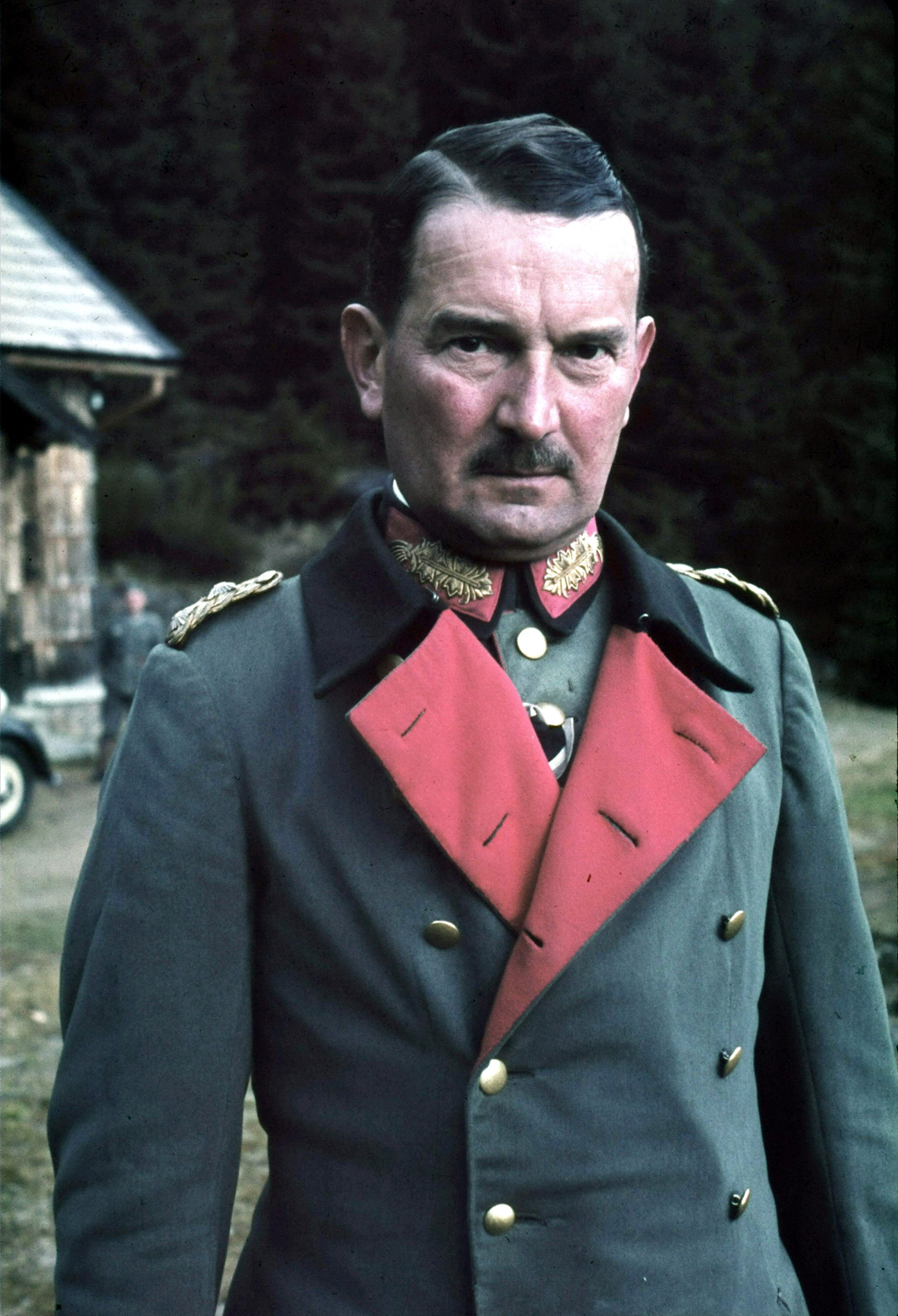
Bio of Generaloberst Eugen Ritter von Schobert

Eugen Siegfried Erich Ritter von Schobert (13 March 1883 – 12 September 1941) was a German general during World War II. He commanded the 11th Army during Operation Barbarossa, the invasion of the Soviet Union. Schobert died when his observation plane crashed in a Soviet minefield.

Schobert was born as Eugen Schobert in Würzburg in the Kingdom of Bavaria, a member state of the German Empire. He was the son of Major Karl Schobert and Anna née Michaely. Schobert entered the Royal Bavarian Army in July 1902. He served primarily in the 1st Bavarian Infantry Regiment "König" and underwent pilot training in 1911.

During World War I, Schobert remained a Bavarian infantry officer, serving the entire war on the Western Front. During the German spring offensive of 1918, he led the 3rd Battalion of the 1st Bavarian Infantry Regiment. For his actions on 23 March 1918, when he personally and successfully led his battalion in the crossing of a canal near Jussy against stiff British resistance, he was awarded the Knight's Cross of the Military Order of Max Joseph. This was Bavaria's highest military honor, comparable to the Prussian Pour le Mérite, and conferred a patent of nobility on a recipient who was a commoner. Hence Eugen Schobert became Eugen Ritter von Schobert.

After World War I, Schobert remained in the Reichswehr and then the Wehrmacht, steadily rising up the ranks. He was Inspector of Infantry from December 1933 to September 1934 and then commanded the 17th Infantry Division from 1935 to 1936 and the 33rd Infantry Division from 1936 to 1938. He took command of the VII Army Corps (VII. Armeekorps) on 4 February 1938.

In September 1939, Schobert led his VII Army Corps in the invasion of Poland as part of the reserve of Army Group South. In May–June 1940, his corps, part of General Ernst Busch's Sixteenth Army of Army Group A, participated in the invasion of Belgium and Luxembourg and the Battle of France. He received the Knight's Cross of the Iron Cross for his leadership of the VII Corps in the breakthrough of the Maginot Line and the capture of Nancy and Toul. He remained in command of the corps during preparations for the invasion of Great Britain.

In September 1940, Schobert was given command of the Eleventh Army. The army was assigned to Army Group South for Operation Barbarossa, the invasion of the Soviet Union. During combat operations in the southern Soviet Union, Schobert was killed when his Fieseler Storch observation aircraft crashed in a Soviet minefield. He was succeeded by Erich von Manstein. A German war correspondent, Leo Leixner, wrote Schobert's biography.

Schobert married Alice Rieder-Gollwitzer in 1921. They had three children: two sons and one daughter. His younger son was killed in combat in 1944 while serving as a fighter pilot for the Luftwaffe.


Source :
https://artsandculture.google.com/entity/m064km4b?hl=en
https://en.wikipedia.org/wiki/Eugen_Ritter_von_Schobert

Sunday, January 15, 2023

Bio of Franz Ritter von Epp

Franz Ritter von Epp (born Franz Epp; from 1918 as Ritter von Epp; 16 October 1868 – 31 January 1947) was a German general and politician who started his military career in the Bavarian Army. Successful wartime military service earned him a knighthood in 1916. After the end of World War I and the dissolution of the German Empire, von Epp was a commanding officer in the Freikorps and the Reichswehr. He was a member of Bavarian People's Party, before joining the Nazi Party in 1928, when he was elected as a member of the German parliament or Reichstag, a position he held until the fall of Nazi Germany. He was the Reichskommissar, later Reichsstatthalter, for Bavaria, and a Reichsleiter of the Nazi Party.

Franz Epp was born in Munich in 1868, the son of the painter Rudolph Epp and Katharina Streibel. He spent his school years in Augsburg and after this joined the military academy in Munich. He served as a volunteer in East Asia during the Boxer Rebellion in 1900–01 and then became a company commander in the colony of German South-West Africa (now Namibia), where he took part in the bloody Herero and Namaqua Genocide. During the First World War, he served as the commanding officer of the Royal Bavarian Infantry Lifeguards Regiment in France, Serbia, Romania, and at the Isonzo front.

For his war service, Epp received numerous medals, of which the Pour le Mérite (29 May 1918) was the most significant. He was also knighted, being made Ritter von Epp on 25 February 1918, and received the Bavarian Military Order of Max Joseph (23 June 1916).

After the end of the war, Epp formed the Freikorps Epp, a right-wing paramilitary unit mostly made up of war veterans, of which the future leader of the SA Ernst Röhm was a member. This unit took part in the crushing of the Bavarian Soviet Republic in Munich, being responsible for various massacres. Epp joined the Reichswehr and was promoted to Generalmajor in 1922. He took his leave from the German Army after getting involved with right-wing associations in 1923.

When it became necessary for the Nazi Party to purchase a newspaper to publicize its political creed, Epp made available some 60,000 Reichsmarks from secret army funds to acquire the Völkischer Beobachter, which became the daily mouthpiece of the party.

As the Sturmabteilung (SA) expanded, it became an armed band of several hundred thousand men, whose function was to guard Nazi rallies and disrupt those of other political parties. Some of its leaders, particularly Ernst Röhm, visualized the SA as supplanting the regular army when Adolf Hitler came to national power. To this end, a department was set up under Epp called the Wehrpolitisches Amt (Army political office). Nothing came of this, as a distrustful Hitler had the SA crushed and many of its leaders killed in the Night of the Long Knives in the summer of 1934.

After leaving the Bavarian People's Party, Epp on 20 May 1928 was elected from electoral constituency 26 (Franconia) as one of the first 12 Nazi Party deputies to the Reichstag. He would continue to be elected to the Reichstag in each subsequent election throughout the Weimar and Nazi regimes to 1945. He served as the Nazi Party's head of its Military-Political Office from 1928 to 1945, and later as leader of the German Colonial Society, an organization devoted to regaining Germany's lost colonies. On 31 August 1933 he was made a Reichsleiter, the second highest political rank in the Nazi Party. On 3 October 1933, he was also made a member of the Academy for German Law. In May 1934 he became head of the NSDAP Office of Colonial Policy until its dissolution in February 1943.

Epp's final notable historical action occurred on 9 March 1933, two weeks before the Reichstag passed the enabling act, which granted Hitler dictatorial powers. On the orders of Hitler and Wilhelm Frick, he abolished the Government of Bavaria and set up a Nazi regime, with himself as Reichskommissar. On 10 April Hitler appointed him Reichsstatthalter for Bavaria. In this position he often clashed with Bavaria's Nazi Minister-President Ludwig Siebert. Epp's attempt to limit the influence of the central government on Bavarian politics failed. He, however, retained his post as Reichsstatthalter until the end of the war, although by then he was politically insignificant.

On 8 May 1933, von Epp's DO X crashed at the Passau Kachlet. The city named one of its streets Ritter-von-Epp-Straße.

He was arrested on Paul Giesler's orders in 1945, for being associated with the Freiheitsaktion Bayern, an anti-Nazi group led by Rupprecht Gerngroß. However, Epp had not wanted to be directly involved with the group, as he considered their goal—surrender to the Allies—a form of backstabbing of the German Army.

Suffering from a heart condition, he was hospitalised at Bad Nauheim at the end of the war. On 9 May 1945, a clerk at the hospital alerted agents from the US Counterintelligence Corps that Epp was a patient there, and he was arrested and sent to a prison camp in Munich to await trial at Nuremberg. He died in detention on 31 January 1947.

Decorations and awards
    Order of the Red Eagle, 4th class (German Empire)
    Order of the Crown, 4th class with swords (Prussia)
    Military Merit Order, 3rd and 4th class with Swords (Bavaria)
    1914 Iron Cross 2nd Class, 1914
    1914 Iron Cross 1st Class, 1915
    Knights Cross of the Military Order of Max Joseph (Kingdom of Bavaria), 1917
    Pour le Mérite, 1918
    Knight of the Princely House Order of Hohenzollern with swords (Hohenzollern-Sigmaringen)
    Knight 2nd class of the House and Merit Order of Peter Frederick Louis (Oldenburg)
    Knight of the Order of Saint John (Bailiwick of Brandenburg)
    Honour Chevron for the Old Guard, February 1934
    Honour Cross of the World War 1914/1918, 1934
    Golden Party Badge
    Sudetenland Medal, 1938
    Anschluss Medal, 1939
    War Merit Cross 2nd Class and 1st Class with Swords
    Knights Cross of the War Merit Cross with Swords, 1943
    Military Merit Cross, 2nd class (Grand Duchy of Mecklenburg-Schwerin)
    Nazi Party Long Service Award (10 and 15 years)
    Order of the Iron Crown, 3rd class (Austria)
    On 18 May 1933, the city of Passau decided to make von Epp a Citizen of Honor.


Source :
https://artsandculture.google.com/entity/m064km4b?hl=en
https://en.wikipedia.org/wiki/Franz_Ritter_von_Epp
Thursday, November 3, 2022

Gebirgsjäger on Ski


This young German Gebirgsjäger (mountain soldier) photographed during the winter of 1938/9 is wearing a typical uniform of the period: a Bergmütze (mountain cap) with the first version of national insignia (white on light grey); a Feldbluse M33 (jacket) with the bluish dark green Schulterklappen (shoulder straps) with a light green distinctive and the first version of white on a light grey national eagle; stone-grey trousers, or Skihose—the quality of the photograph, one of the first slides ever used in Germany, highlights the difference between the jacket and the trousers—with buttoned pocket flaps; and Wickelgamaschen (puttees) made of feldgrau cloth. The ash skis and duralumin sticks likely come from the resort where he is spending his leave.


Source :
"German Mountain Troops" by Yves Beraud

Tuesday, June 21, 2022

Reichsparteitag in Nürnberg

Party and military officials in the Reichsparteitag (Reichs Party Congress) in Nürnberg, November 1938. Nearest to the camera, from left to right: SS-Gruppenführer Paul Körner (Staatssekretär Preußischen Staatsministerium), NSKK-Obergruppenführer Dr.Ing. e.h. Karl-Wilhelm Ohnesorge (Reichspostminister), Großadmiral Erich Raeder (Oberbefehlshaber der Kriegsmarine), Dr.jur. h.c. Konrad Henlein (saluting, Gauleiter Sudetengau), Generalmajor der Luftwaffe Bruno Loerzer (Inspekteur der Jagdflieger), and SS-Obergruppenführer Dr. Philipp Bouhler (Chef der Kanzlei des Führers). The picture was taken by Hugo Jaeger.

Source :
https://artsandculture.google.com/asset/hitler-jaeger-file/wAH6G5KafXPhKg?hl=en

Monday, June 20, 2022

March through Münich in Remembrance of the Beer Hall Putsch

Commemoration of Hitler's failed coup in 1923 (Münich Putsch or Beer Hall Putsch), which held in Münich on 9 November 1938. Front row: Dr. Friedrich Weber, Hermann Göring, Adolf Hitler, Ulrich Graf and Hermann Kriebel. Back row: Max Sasselmann, Dr. Walter Schultze, Alfred Rosenberg, Arno Schickdanz, Philipp Bouhler and Max Amann. Please note that these brown uniforms are not SA uniforms but Alte Kampfer (Blutorden holders). Ulrich Graf even wears an SS sleeve band! The picture was taken by Hugo Jaeger.

Source :
https://artsandculture.google.com/asset/hitler-jaeger-file/9gGpSgMuLTw72w?hl=en

Sunday, December 27, 2020

Grave of Alois Hitler, Hitler's Father


Grave of Alois Hitler, Adolf's father in the Leonding cemetery, Austria, 1938. Photos by Hugo Jaeger.


Alois Hitler Sr. (born Alois Schicklgruber; 7 June 1837 - 3 January 1903) was an Austrian civil servant and the father of the dictator of Nazi Germany, Adolf Hitler. Alois Hitler was born illegitimately, and his paternity was never established. This led to claims that his wife Klara (Adolf's mother) may have been his cousin. It also meant that Adolf Hitler could not prove who his grandfather was and thus prove his own "Aryan descent". When Alois was promoted in the Customs service, he applied to be legitimised in the name of his stepfather Hiedler, which was entered in the register as 'Hitler', for unknown reasons.

In February 1895, Alois Hitler purchased a house on a 3.6-hectare (9-acre) plot in Hafeld near Lambach, approximately 50 kilometres (30 mi) southwest of Linz. The farm was called the Rauscher Gut. He moved his family to the farm and retired on 25 June 1895 at the age of 58, after 40 years in the customs service. He found farming difficult; he lost money, and the value of the property declined.

On the morning of 3 January 1903, Alois went to the Gasthaus Wiesinger (no. 1 Michaelsbergstrasse, Leonding) as usual to drink his morning glass of wine. He was offered the newspaper and promptly collapsed. He was taken to an adjoining room and a doctor was summoned, but he died at the inn, probably from a pleural hemorrhage. Adolf Hitler, who was 13 when his father died, wrote in Mein Kampf that he died of a "stroke of apoplexy". In his book, The Young Hitler I Knew, Hitler's childhood friend August Kubizek recalled, "When the fourteen-year-old son saw his dead father he burst out into uncontrollable weeping."

On 28 March 2012, by the account of Kurt Pittertschatscher, the pastor of the parish, the tombstone marking Alois Hitler's grave and that of his wife Klara, in Town Cemetery in Leonding, was removed by a descendant. The descendant is said to be an elderly female relative of Alois Hitler's first wife, Anna, who has also given up any rights to the rented burial plot. The plot was covered in white gravel and a tree which has since been removed. It is not known whether the remains of Adolf Hitler's parents are still interred there.


Source :
https://en.wikipedia.org/wiki/Alois_Hitler?fbclid=IwAR1N_77NDrlQcUmdbhaU-Rkf7mY--krsa6D3rSOTTjA73UwlHRBjhqm2jwc
https://www.facebook.com/groups/237076659811098/permalink/1636903149828435/?__cft__[0]=AZU5q1b3O7oRHekJaIminlikQ6YJGb5IrYgRf9Uw-Hm9dPwhhc8eB5FCshZjIT7AelUXxp62dnsdtkAXMiXzvHV9zehH56-8nVcMvPzZLzcfflaR0c8RhsBiaIVbvc228Jt67CsBLo_5HXYS6g3qKaG9yRZLQRc-30LNcisWAWc8CmbrOf12BPiYNq6R9p_q2mI&__tn__=%2CO%2CP-R

Monday, July 13, 2020

Two Luftwaffe Officers and a Bird

Two Luftwaffe Flak officers looking at a bird at peacetime. Well, just after Anschulß but before Sudetenland, March 30, 1938.

Source :
Akira Takiguchi photo collection
https://www.facebook.com/photo.php?fbid=10221356274329819&set=gm.1491259877726097&type=3&theater&ifg=1