Showing posts with label Welcoming Ceremony. Show all posts

Saturday, September 2, 2023

German Exchange POWs after Returning from England


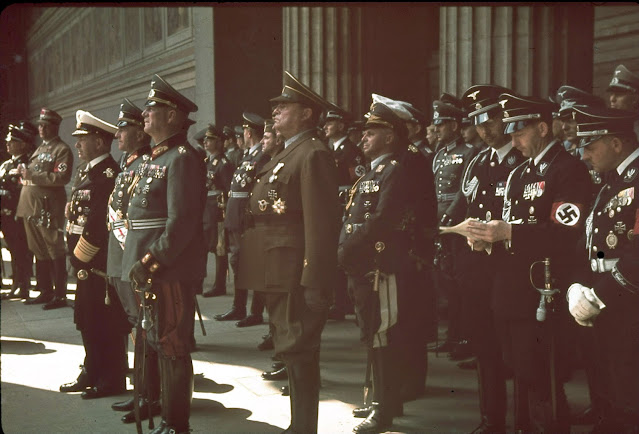
Welcoming ceremony in Stuttgart for the German exchange POWs (mostly Afrikakorps) who just returned from England. The picture was taken by Hugo Jaeger in the summer of 1944. Other pictures from this series can be seen HERE.
 

Source :
https://artsandculture.google.com/search?q=hugo%20jaeger&hl=en

Tuesday, April 25, 2023

Legion Condor by Hugo Jaeger

NATIONALIST VICTORY PARADE IN MADRID

Members of a Falangist youth band prepare for a victory parade in honour of Franco’s forces in 19 May 1939. The Falange developed youth organizations, with members known as Flechas and Pelayos, under the umbrella of the Spanish Youths Organization. Most of these young members wore red berets. Photo by Hugo Jaeger.

Spanish Soldiers march past the reviewing stand during the Nationalist victory parade in honour of General Francisco Franco in Madrid, 19 May 1939. The Madrid Victory Parade was held over a month after the victory of the Nationalists in the Spanish Civil War (1936–1939). It was the first of a yearly series held from then on in April the First, named Día de la Victoria (Victory Day). The parade was commanded by General Andrés Saliquet, Commander of the Madrid Military Region, and was presided by the Head of State Generalísimo Franco.


More than 120.000 men and 1.000 vehicles took part in the parade, including small contingents of the German Condor Legion, the Italian Corpo Truppe Volontarie and the Portuguese Viriatos. The forces went along Paseo de la Castellana, the main Madrid avenue, in a North to South direction and in total spent around 4 hours in marching past the full path. Around 400.000 people attended the event. The environment was spectacularly fitted out with countless patriotic, triumphal and Franco`s Cult of personality slogans.


Spanish Phalangist soldiers march past the podium in the Nationalist victory parade held in Madrid on May 19, 1939. "Falange Española" was the official name of the anti-Communist, anti-liberal and anti-democratic movement of the Spanish extreme right. During the Spanish Civil War (1936-1939), this group was embraced by the Nationalist leader Francisco Franco, who wanted all right-wing parties and groups to unite in one place. No less than 150,000 Phalangist militia fought alongside the Spanish Armed Forces in a life and death war against the leftist Republicans. Photo by Hugo Jaeger.


Local spectators at the Nationalist Victory Parade held in Madrid on May 19, 1939. These people wore traditional Spanish clothing worn by the common people, most of whom were peasants. The woman at the front wears a special scarf called "mantoncillos" or "picos". Photo by Hugo Jaeger.

---------------------------------------------------------------------------------------------

WELCOMING CEREMONY IN BERLIN


Adolf Hitler (Führer und Oberster Befehlshaber der Wehrmacht) at the welcoming ceremony for the Condor Legion personnel, which were held in Lustgarten, Berlin, on 6 June 1939. Behind Hitler is his Chief Adjutant, SA-Obergruppenführer Wilhelm Brückner; slightly to the right (wearing a brown shirt facing the camera) is one of the commander of Condor Legion, Hellmuth Volkmann (last rank General der Flieger); three men in the center is, from left to right: Großadmiral Erich Raeder (Oberbefehlshaber der Kriegsmarine), Generaloberst Walther von Brauchitsch (Oberbefehlshaber des Heeres) and Generalfeldmarschall Hermann Göring (Oberbefehlshaber der Luftwaffe); the officer walking on the far right wearing a brown shirt and his face covered with a flag is the last commander of the Condor Legion, Generalmajor Wolfram Freiherr von Richthofen (last rank Generalfeldmarschall); behind von Richthofen in a black Allgemeine-SS uniform - you will surely know - is Reichsführer-SS Heinrich Himmler (Chef der SS und deutschen Polizei), while the Luftwaffe general next to him is Generalmajor Otto Deßloch (Kommandeur 6. Flieger-Division). The nameplates in the background contain those from the Condor Legion personnel who had fallen in the battlefields of Spain during Spanish Civil War (1936-1939). The picture was taken by Hugo Jaeger.


Source :
http://alifrafikkhan.blogspot.com/2010/10/koleksi-ratusan-foto-berwarna-dari-life.html
https://artsandculture.google.com/entity/m064km4b?hl=en
https://en.wikipedia.org/wiki/1939_Madrid_Victory_Parade
https://visualhistory.livejournal.com/85241.html?noscroll&utm_medium=endless_scroll

Tuesday, April 18, 2023

German Officials during Legion Condor Welcoming Ceremony


German high ranking officials stands during the welcoming ceremonies for the Legion Condor, which were held at the Lustgarten Square, Berlin, June 6, 1939. For the identification:

1.Unidentified SS General,
2.SA-Obergruppenführer Wilhelm Brückner (Chefadjutant Führer und Reichskanzler),
3.Großadmiral Erich Raeder (Oberbefehlshaber der Kriegsmarine),
4.Generaloberst Walther von Brauchitsch (Oberbefehlshaber des Heeres),
4a.Generaloberst Wilhelm Keitel (Chef Oberkommando der Wehrmacht),
5.General der Flieger Bernhard Kühl (Offizier z.b.V. des Reichsluftfahrtministerium und Obersluftfahrtministerium und der Luftwaffe),
5a.Generalmajor Karl-Heinrich Bodenschatz (Chef Ministeramts im Reichsluftfahrtministerium und Verbindungsoffizier Görings zu Hitler),
5b.Oberst Walter Warlimont (Stellvertreter Chef Wehrmachtsführungsamt),
6.General der Flieger Hugo Sperrle (former 1st Commander of the Legion Condor),
7.SS-Gruppenführer Karl Wolff (Chefadjutant Reichsführer-SS),
8.Generalleutnant Hubert Weise (Kommandierender General Luftgau-Kommando III),
9.Oberstleutnant Rudolf Schmundt (Chefadjutant des Heeres beim Führer und Oberbefehlshaber der Wehrmacht),
10.Reichsführer-SS Heinrich Himmler (Chef der SS und Polizei),
11.SS-Gruppenführer Dr.rer.pol. Otto Dietrich (Staatssekretär im Reichsministerium für Volksaufklärung und Propaganda),
12.SS-Obergruppenführer Josef "Sepp" Dietrich (Kommandeur "Leibstandarte SS Adolf Hitler").


Source :
https://artsandculture.google.com/entity/m064km4b?hl=en

Sunday, June 19, 2022

Hitler Arrived at Legion Condor Ceremony

Welcoming ceremony for the Legion Condor which was held in Lustgarten square, Berlin, June 6, 1939. Adolf Hitler (Führer und Oberster Befehlshaber der Wehrmacht) had just arrived at the location of the ceremony and was immediately greeted by the Wehrmacht high officials. They are, from left to right: SS-Gruppenführer Karl Wolff (Chef der Hauptamt Persönlicher Stab Reichsführer-SS), Generaloberst Erhard Milch (Generalinspekteur der Luftwaffe als Vertreter des Oberbefehlshaber Göring), Generalmajor Wolfram Freiherr von Richthofen (Befehlshaber der Legion Condor), Generalfeldmarschall Hermann Göring (Oberbefehlshaber der Luftwaffe), and General der Flieger Hugo Sperrle (Chef der Luftflotte 3). The driver next to Hitler is SS-Sturmbannführer Erich Kempka. The Condor Legion (German: Legion Condor) was a unit composed of military personnel[1] from the air force and army of Nazi Germany, which served with the Nationalist faction during the Spanish Civil War of July 1936 to March 1939. The picture was taken by Hugo Jaeger.

Source ;
https://artsandculture.google.com/asset/hitler-jaeger-file/8QHKQnn68ciWaQ?hl=en

Sunday, December 20, 2020

U-Boat Ace Reinhard Suhren Returning from Patrol


Kapitänleutnant Reinhard Suhren, commander of U-564, after returning from a patrol, 1942. Photo by Photographer Bonnemann.


Reinhard Johann Heinz Paul Anton Suhren (16 April 1916 - 25 August 1984) was a German U-boat commander in World War II and younger brother of Korvettenkapitän (Ing.) and Knight's Cross of the Iron Cross recipient Gerd Suhren.

Suhren was born in Langenschwalbach, the second of three children, and grew up in the Weimar Republic and Third Reich. He joined the navy in 1935 and began his U-boat career in March 1938. He spent a year as 1st watch officer on U-48 where he received the Knights Cross of the Iron Cross for his contribution in the sinking of 200,000 gross register tons (GRT) of merchant shipping. In April 1941 he took command of U-564. As a commander, he is credited with the sinking of 18 merchant vessels of 95,544 GRT, 1 warship of 900 long tons (910 tonnes) and damaged four merchant vessels of 28,907 GRT for which he was awarded the Knight's Cross of the Iron Cross with Oak Leaves and Swords.
Suhren left the boat and became an instructor in October 1942. He then served in the 27th U-boat Flotilla along with Korvettenkapitän Erich Topp. During the last year of the war Fregattenkapitän Suhren was the Führer der Unterseeboote Norwegen (Leader of U-boats in Norwegian waters) and from September 1944 the Commander-in-Chief of U-boats of the North Sea. After the war he worked in the petroleum industry and died of stomach canceron 25 August 1984.


Source :
https://www.facebook.com/photo/?fbid=405108927424604&set=gm.1632605800258170
https://en.wikipedia.org/wiki/Reinhard_Suhren?fbclid=IwAR34bkhXQwU0JKghcGT0XHtrHT8Po6MfGCCEW1U8rKbMgMi-UYLsrwKsRC0

Thursday, May 5, 2016

British PM Chamberlain Waves to Spectators in Münich

British Prime Minister Neville Chamberlain waves to spectators from an open-top car, shortly after leaving Oberwiesenfeld airport on the way to a meeting with Adolf Hitler over the latter's threats to invade Czechoslovakia, Münich, Germany, 28 September 1938. Sensing a looming catastrophe, Chamberlain flew to Münich to meet with Hitler and other European leaders – to try to work out a 'peaceful' settlement to the growing 'crisis' (which was completely a fabrication of Hitler's). Ultimately Chamberlain signed an agreement in which Hitler promised that he had no more territorial ambitions towards Czechoslovakia beyond the Sudetenland (a complete lie), and in which Chamberlain promised that he would lean on the Czech president Beneš to peacefully deliver the Sudetenland to Germany. Chamberlain congratulated himself on this supposedly brilliant piece of statesmanship because he understood that through this agreement between Hitler and himself he had saved Europe from falling into another horrible shooting match and indeed had secured “peace in our time.”


Source :
http://www.gettyimages.co.uk/detail/news-photo/british-prime-minister-neville-chamberlain-waves-to-news-photo/50537963
http://images.google.com/hosted/life/6de48dcd04bd124a.html
http://www.kingsacademy.com/mhodges/03_The-World-since-1900/06_Dictatorship/06d_Steps-toward-War.htm

Saturday, January 9, 2016

Stuka Ace Helmut Benkendorff in Front of his Aircraft

In August 1943 Oberfeldwebel Helmut Benkendorff, a pilot in 5.Staffel / II.Gruppe / Sturzkampfgeschwader 1 (StG 1), reached a significant milestone, completing his 500th combat mission. In this photo, Benkendorff can be seen in front of the aircraft in which he flew the milestone mission. The machine is a Junkers Ju 87 "Stuka" D-5, which can be identified by the wing-mounted MG 151/20 cannon and the absence of a siren on the mainwheel fairing. The aircraft code is A5+MN. The aircraft letter is repeated on the left mainwheel fairing in the Staffel color red. Apparently the aircraft was prepared for another sortie immediately after landing. Behind Benkendorff members of the ground crew can be seen loading a bomb onto the aircraft with the help of an hydraulic bomb trolley. At that time II./StG 1 was active over the central sector of the Eastern Front. This photo itself was taken by an unidentified Hauptmann of the Gruppenstab who was taken prisoner in southern Germany in May 1945. There American soldiers took from him several rolls of exposed, but undeveloped, film. The film was later developed by Kodak in the USA, and decades after that a collector discovered the collection by chance. The photographs were subsequently returned to Germany, albeit in poor condition. Another pictures from the same event: 1, 2, 3.


Source :
"Luftwaffe im Focus", Spezial No.1 - 2003

Helmut Benkendorff Welcoming Ceremony

 In August 1943 Oberfeldwebel Helmut Benkendorff, a pilot in 5.Staffel / II.Gruppe / Sturzkampfgeschwader 2 (StG 2), reached a significant milestone, completing his 500th combat mission. The photo shows Oberfeldwebel Benkendorff - "Mucki" to his friends - immediately after landing. With the flowers in hand, he receives the congratulations from the Staffelkapitän of 7./StG 1, Leutnant Willi Viertel (left), for the benefit of the photographers. The four wings on Benkendorff's left sleeve identify him as an Oberfeldwebel. Only a few days later, on 31 August 1943, Willi Viertel was shot down by ground fire while attacking enemy tanks near Glukhov. His aircraft (Junkers Ju 87 "Stuka" D-3, Werknummer 2279) sustained a direct hit and crashed from a height of 300 meters. Viertel and his gunner, Oberfeldwebel Heinrich Hippe, were both killed. Helmut Benkendorff was later promoted to the rank of Leutnant and on 26 March 1944 was awarded the Ritterkreuz des Eisernen Kreuzes (Knight's Cross of the Iron Cross) after more than 600 feindflügen (combat missions). He would completed 666 feindflüge by the end of the war. This photo itself was taken by an unidentified Hauptmann of the Gruppenstab who was taken prisoner in southern Germany in May 1945. There American soldiers took from him several rolls of exposed, but undeveloped, film. The film was later developed by Kodak in the USA, and decades after that a collector discovered the collection by chance. The photographs were subsequently returned to Germany, albeit in poor condition. Another pictures from the same event: 1, 2, 3.


Source :
"Luftwaffe im Focus", Spezial No.1 - 2003

Friday, January 8, 2016

Helmut Benkendorff Greeted by Willi Viertel in the Welcoming Ceremony

In August 1943 Oberfeldwebel Helmut Benkendorff, a pilot in 5.Staffel / II.Gruppe / Sturzkampfgeschwader 2 (StG 2), reached a significant milestone, completing his 500th combat mission. The photo shows Oberfeldwebel Benkendorff - "Mucki" to his friends - immediately after landing. With the flowers in hand, he receives the congratulations from the Staffelkapitän of 7./StG 1, Leutnant Willi Viertel (left), for the benefit of the photographers. Only a few days later, on 31 August 1943, Viertel was shot down by ground fire while attacking enemy tanks near Glukhov. His aircraft (Junkers Ju 87 "Stuka" D-3, Werknummer 2279) sustained a direct hit and crashed from a height of 300 meters. Viertel and his gunner, Oberfeldwebel Heinrich Hippe, were both killed. Helmut Benkendorff was later promoted to the rank of Leutnant and on 26 March 1944 was awarded the Ritterkreuz des Eisernen Kreuzes (Knight's Cross of the Iron Cross) after more than 600 feindflügen (combat missions). He would completed 666 feindflüge by the end of the war. This photo itself was taken by an unidentified Hauptmann of the Gruppenstab who was taken prisoner in southern Germany in May 1945. There American soldiers took from him several rolls of exposed, but undeveloped, film. The film was later developed by Kodak in the USA, and decades after that a collector discovered the collection by chance. The photographs were subsequently returned to Germany, albeit in poor condition. Another pictures from the same event: 1, 2, 3.


Source :
"Luftwaffe im Focus", Spezial No.1 - 2003

A Gift Basket and Bouquet for Helmut Benkendorff's Welcoming Ceremony

In August 1943 Oberfeldwebel Helmut Benkendorff, a pilot in 5.Staffel / II.Gruppe / Sturzkampfgeschwader 2 (StG 2), reached a significant milestone, completing his 500th combat mission. This photograph, taken shortly before his return from the milestone mission, shows a staffel vehicle (Mercedes-Benz 170V saloon) adorned with a wreath and the number "500", along with a gift basket and bouquet. In the basket is the Gruppe's "Adler" (Eagle) emblem. This photo itself was taken by an unidentified Hauptmann of the Gruppenstab who was taken prisoner in southern Germany in May 1945. There American soldiers took from him several rolls of exposed, but undeveloped, film. The film was later developed by Kodak in the USA, and decades after that a collector discovered the collection by chance. The photographs were subsequently returned to Germany, albeit in poor condition. Another pictures from the same event: 1, 2, 3.


Source :
"Luftwaffe im Focus", Spezial No.1 - 2003
http://forum.axishistory.com/viewtopic.php?f=47&t=73232&p=1988977#p1988977