Showing posts with label Fall Gelb. Show all posts

Sunday, August 14, 2022

257. Infanterie-Division in Poland 1939


Scenes filmed by Leutnant Edgar Forsberg of the German 257. Infanterie-Division following the collapse of the Polish army on October 6, 1939. "Mit dem Stab der 257. Inf. Div. im Krieg (schwarzweiss film)” “Tankabwehr an der Strasse Einod-Gersheim nordl. Von Webenheim” Trucks driving. A tank is buried into the side of a hill. “Offene Feuerstellung einer 10 cm Kanonenbatterie Nordausgang Herbitzheim.” A cannon at the base of a tree in a field. “Auf der landstrasse im Bliestal.” A soldier gets into a car on the road. “Gesprengte Eisenbahnbrucke bei Breitfurt.” A soldier walks across a destroyed railway bridge collapsed into the water, near Breitfurt, Germany. Water flows through the blasted bridge. A soldier uses a stick to see how deep the water is.

10:16:32 “Tankabwehrbunker auf der Truppacher-Hohe.” A tank gun or cannon points out of a bunker. Soldiers walk around, some look at the camera. “Artilleriebeobachtung auf dem husarenberg bei Medelsheim. Im Hinterfrund der ttt schlosshube.” Soldiers dig through rubble. “Bilder aus Medelsheim” Medelsheim buildings and streets. Two soldiers carry a large jar. “Gutgetarnte Stellung zweier SFH 18 bei Seyweiler.” Open fields in Seyweiler, Germany with two camouflaged sFH 18 howitzers. “Bilder aus walsheim.” Rubble in Walsheim. “Von der Walsheimer Brauerei wird ‘Freibier’ geholt.” Free beer from a local brewery is wheeled in by soldiers. Other soldier bring in weapon parts. “Eine reifenpanne in Walsheim.” A soldier attempts to fix a flat tire in Walsheim, Germany. 10:19:10 “Gesprengte Brucke bei Herbitzheim.” A river in Herbitzheim. “M.-G.-Stand am Bahndamm Sudausgang Gersheim, getarnt durch ein Bretterhauschen.” Something camouflaged on a railway embankment. “Gesprengte Bliesbrucke bei Gersheim” Bombed bridge in Gersheim, Germany. “Am Bahnhof Gersheim” “Bilder aus Seyweiler” Buildings in Seyweiler, a district of Gersheim, Germany. A soldier walks towards the camera on a cobblestone street. “Oberauerbach von der Schnecken-Hohe aus.”


Source :
https://collections.ushmm.org/search/catalog/irn555309
Sunday, June 19, 2022

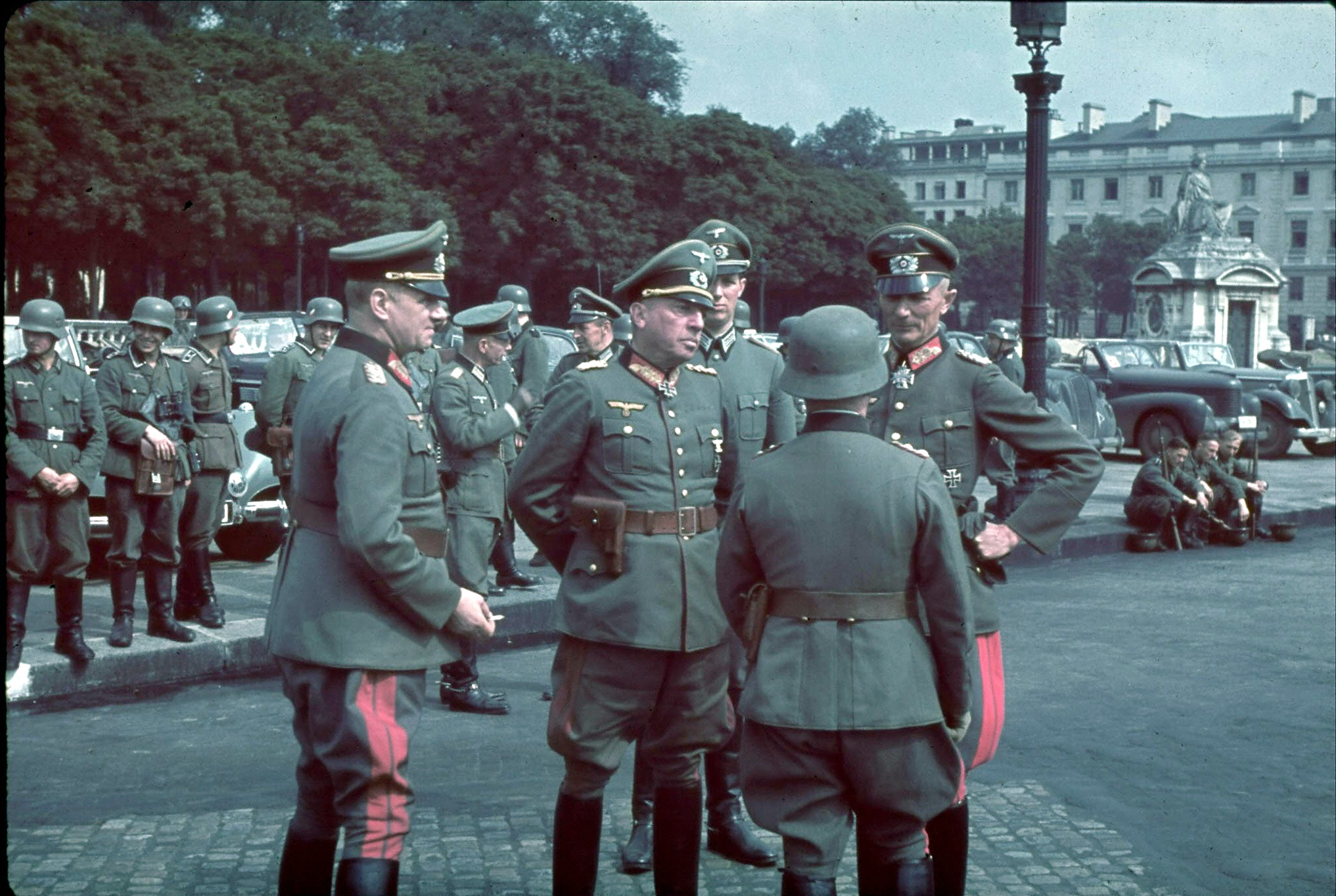
German Generals in the Paris Parade 1940


Wehrmacht high ranking officers gathered at the victory parade of the German troops at the Place de la Concorde, Paris, which held on Friday, June 14, 1940. On that day the French capital fell to the Nazis, while 2,000,000 of its citizens had already fled. In preparation for the parade, the new authorities forbade local residents to approach the vicinity of the Place de la Concorde from 08:00 AM until the afternoon. Front row from left to right: Generalleutnant Hans von Salmuth (Chef des Generalstabes Heeresgruppe B), General der Artillerie Georg von Küchler (Oberbefehlshaber 18. Armee), Oberleutnant der Reserve Heinrich Graf von Lehndorff-Steinort (Adjutant Oberbefehlshaber Heeresgruppe B), General der Kavallerie Georg Stumme (with his back to the camera, Kommandierender General XXXX. Panzerkorps), and Generaloberst Fedor von Bock (Oberbefehlshaber Heeresgruppe B). In the background were rows of parked luxury cars, which were most likely the special rides of the high-ranking German officers who attended the event. The three cars on the right are, in order from left to right: Opel Admiral, Opel Kapitän, and Horch 830 BL. This original color photo was taken by one of Hitler's personal photographers, Hugo Jaeger, who "toured" together with Heeresgruppe B in the invasion of the Low Countries (Netherlands Belgium Luxemburg) and France in the summer of 1940.

Source :
https://artsandculture.google.com/search?q=kuechler&hl=en

Wednesday, March 23, 2016

French POWs Clearing the Blocked Road in Dunkirk

German forces arrive in Dunkirk after the completion of the evacuation of the British Expeditionary Force earlier in the day. Under the direction of their German captors, French troops push away an immobilised British Universal Carrier tracked vehicle, clearing the blocked road into Dunkirk. This picture was taken by Hermann Weper, an officer serving with Maschinengewehr-Bataillon 52, on 4 June 1940 following the seizure of Dunkirk


Source :
http://www.iwm.org.uk/collections/listing/object-205012729

French Heavy Tank Char B1 'Madagascar'

French heavy tank Char B1 bis №206 'Madagascar', crewed by Lieutenant Dumontier (Chef de char/tank commander), Sergeant Vergez (pilote/driver), Corporal Faucet (aide pilote/co driver), and Corporal Narbonne (radio operator). This tank was lost on 19 May 1940 after the fighting at Ham while part of 2e DCR outside Guiscard, abandoned by its crew after being immobilised due to damage to the drive train. In order to deal with the increasingly tense situation leading up to the outbreak of World War II, a decision was made to modify and improve the existing B1 tank, giving rise to the B1 bis. Distinctive features included the large 75mm gun turret and strengthened front armor. The engine was also upgraded to bring the tank up to contemporary standards. The French government tasked individual suppliers with producing key parts, which caused problems and greatly reduced the number of tanks that were built. Although these and other strategic failures inhibited the B1 bis tank ability on the battlefield, it was greatly feared by German soldiers who encountered it. Featuring strong firepower and defense, the B1 bis could more that hold its own against the tanks of the Wehrmacht during individual combat.


Source :
http://www.chars-francais.net/2015/index.php/classement-individuel/chars-b1-et-b1-bis?task=view&id=301
http://www.luckymodel.com/scale.aspx?item_no=TA%2035282
http://www.ww2incolor.com/french/aae.html

Tuesday, March 22, 2016

Wehrmacht Traffic Jam in the West 1940

An early World War II traffic jam of Wehrmacht vehicles on the road to Belgium through Koningshoeven, Netherlands, 12 May 1940. Interestingly there is not a horse in sight, and note the bright fluoro yellow recognition panels (even though all the vehicles are in dark gray and brown color) as an identification to friendly aircrafts. The second car from the front is an Opel Olympia, followed by a Büssing-NAG Type 350/400 truck. Left bus is a Ford V8-51 and the one in the background is a Mercedes. The picture was taken by Hugo Jaeger. As with all of their procurement efforts, Germany established a program to control manufacturing and application of camouflage paints. Specifications were sent to the paint suppliers detailing the exact method for preparing test specimens to send in for examination and approval. In addition, the inspectors at the assembly plants were provided with color swatches to use in accepting products painted in accordance with orders specified in contracts. This strictly controlled and enforced program ensured uniformity in both the paint and the final assembled product. These camouflage paints were used for the entire range of military equipment and vehicles intended for frontline use - not just panzers. At the start of the war, all panzers and military vehicles were painted in a two-tone scheme of Dunklegrau (dark grey) and Dunklebraun (dark brown). Dunklegrau RAL 46 (later renumbered RAL 7021) was the base coat. Irregularly shaped patches of Dunklebraun RAL 45 (later renumbered RAL 7017) were to be spray painted onto 1/3rd of the surface. In June 1940, a general order was issued to stop applying patches of Dunklebraun and only use Dunklegrau RAL 46 for the entire surface.


Source :
http://forum.axishistory.com/viewtopic.php?f=47&t=73232&start=8055
https://smallsagas.wordpress.com/2013/04/29/fifty-shades-of-panzer-grey/
http://www.twenot-forums.nl/viewtopic.php?t=31063&p=283388

Monday, October 5, 2015

German Soldiers Milking a Cow

This picture was taken by Hugo Jaeger, one of Hitler's personal photographer, and showing German Heer (Army) soldiers milking a rather docile Friesian cow during a break in the drive through Netherlands, summer 1940. Apart from the ordinary water, Wehrmacht soldiers may also fill their canteens with milk (or coffee), and drink it when it's still fresh. Especially when the water may be flavoured. There's also 'Klim', a German canned milk (dry powder? condensed? This seems to be "milk" spelled backwards, or 'milch' close enough likewise). Some photos show German troops using it, and others show it used by Allied POWs in Luftwaffen Stalag. The need for fresh milk sometimes unbearable. Rumour has it that during the war, a U-boat put to shore in New Zealand with one aim - to milk a cow. Having snuck ashore, they successfully milked several cows before returning to their U-Boat, leaving confused farmers the next morning wondering why their cows didn't need milking!


Source :
http://forum.axishistory.com/viewtopic.php?f=76&t=52223&sid=95a344844c608d2c9f9bb27fa43bd45a
http://www.gettyimages.com/detail/news-photo/portrait-of-two-elderly-jewish-men-in-the-kutno-ghetto-news-photo/50408855

Wednesday, July 29, 2015

Walther von Reichenau and his Staff in Belgium, May 1940

This picture was taken in Belgium in May 1940 and showing Generaloberst Walther von Reichenau (3rd from right, front row) listen intently with his staff officers while Oberstleutnant Hans Mikosch explaining the unit operation with his map. Front row, from left to right: Mikosch (Kommandeur Pionier-Bataillon 51), Generalleutnant z.V. Siegfried Haenicke (Kommandeur 61. Infanterie-Division), Reichenau (Oberbefehlshaber 6. Armee), General der Infanterie Viktor von Schwedler (Kommandierender General IV. Armeekorps), and Generalmajor (Luftwaffe) Otto Deßloch (Kommandierender General II. Flakkorps). During the invasion of the Low Countries the 6. Armee saw active service linking up with paratroopers and destroying fortifications at Eben Emael, Liège, and Namur during the Battle of Belgium. 6. Armee was then involved in the breakthrough of the Paris defences on 12 June 1940, before acting as a northern flank for German forces along the Normandy coast during the closing stages of the Battle of France


Sources :
https://en.wikipedia.org/wiki/6th_Army_%28Wehrmacht%29
http://forum.axishistory.com/viewtopic.php?f=5&t=14230&sid=d17dd501e98182712ff02a24d2686c7d&start=6450#p1958761

Thursday, April 2, 2015

German Soldiers Posing with Captured French Tractors

The always popular photo, 'posing with captured war material', in this case French tractors and trucks, summer 1940. In the foreground, Renault UE 2 Chenillette tractors. During the Fall of France, about 3000 UE and UE2s had been captured by the German Wehrmacht. Most were employed unmodified, after an overhaul by the AMX (Atelier de Construction d'Issy-les-Moulineaux) factory under guidance of the German MAN-company, as tractors for the 37 mm, 50 mm and, ultimately, 75 mm and 76.2 mm anti-tank guns: the Infanterie UE-Schlepper 630(f), which also was used to tow light and even heavy infantry guns. They might also function in their original primary role of munition carrier, as Munitionsschlepper Renault UE(f), some of these had an armoured roof fitted above the bin, to protect the ammunition load against overhead shell airbursts. Chenillettes were however also modified into self-propelled guns: a German 37 mm PAK was fitted just in front of the bin. There was no room for the crew in such a small vehicle: the gun had to be operated while standing behind it. Nevertheless of this Selbstfahrlafette für 3.7 cm Pak36 auf Renault UE(f) about 700 would be built in 1941. A late modification from 1943 was the UE fitted with four Wurfrahmen 40 launchers for 28/32 cm rockets: the Selbstfahrlafette für 28/32 cm Wurfrahmen auf Infanterie-Schlepper UE(f), forty of which would be built in two versions, one with the launch frames at the sides of the hull, the other with a raised platform on the back. Other modifications included: the Mannschaftstransportwagen Renault UE(f), a personnel carrier produced in two versions; the Gepanzerte-MG-Träger Renault UE(f), simply a Renault UE fitted with a machine-gun in a superstructure above the commander's seat; the Schneeschleuder auf Renault UE(f), a snow plough, fifty of which were modified in 1942; the Schneefräser auf Renault UE(f), also a vehicle intended to combat heavy snow conditions on the Eastern Front, but in the form of a snow miller; the Fernmeldekabel-Kraftwagen Renault UE(f), a telephone cable-laying vehicle and the Panzerkampfwagen-Attrappe auf UE(f), a dummy tank for training purposes, resembling a Soviet T-34. More complicated rebuilds were the Sicherungsfahrzeug UE(f), an airfield security vehicle produced for the Luftwaffe which, besides the 7.92 mm MG 34 casemate on the right, had a special high armoured superstructure fitted on the left back in which a guard could sit armed with a 13 mm machine-gun and the Kleiner Funk- und Beobachtungspanzer auf Infanterie-Schlepper UE(f), a special radio and artillery observation vehicle, forty of which would be modified by the Beck-Baukommando in France to eventually serve with the 21. Panzer-Division.


Source :
http://en.wikipedia.org/wiki/Renault_UE_Chenillette
http://www.ww2incolor.com/german/france_40.html

Sunday, November 16, 2014

Panzer 38(t) and Panzer II on the Move in France 1940

Panzerkampfwagen 38(t) (SdKfz 140), extreme left, and Panzerkampfwagen II (SdKfz 121) climbing a grade, right, on the move. This is a rare color shot, which may be staged for the German war photographer. Please note that these two tanks have a clean rear deck and the helmets hanging over the side and rear of the Panzer II! It was taken in 1-10 June 1940 during the breakout of 7. Panzer-Division (Generalmajor Erwin Rommel) out of a valley near the Somme river. Originally the picture was published in the book "Entscheidende Stunden", a German propaganda book printed in 1941


Sources:
http://www.worldwar2database.com/gallery/wwii0116
http://www.ww2incolor.com/german-armor/ajr.jpg.html

Thursday, November 6, 2014

German Soldiers Enjoying Ice Cream

German Heer soldiers enjoying ice cream in the middle of summer heat near the Charleroi–Brussels–Willebroeck Canal (Belgium), 17 May 1940. On this day Brussels - the capital of Belgium - was occupied by German forces after British Expeditionary Force commander General Lord Gort, fearful of being surrounded, ordered his troops to fall back to the Scheldt River; this move allowed German General Walther von Reichenau to capture Brussels. Meanwhile, Dutch resistance to the German invasion comes to an end with the evacuation, by French destroyers, of the survivors of the Franco-Dutch forces in Zeeland and on the islands of Walcheren and Beverland


Source:
http://joanerges.livejournal.com/1792809.html

Friday, January 24, 2014

General Kurt von Briesen Reviewing His Troops in Paris Parade

Generalleutnant Kurt von Briesen (Kommandeur 30. Infanterie-Division) reviewing his troops in a parade at Avenue Foch, Paris, 14 June 1940. The German 30. Infanterie-Division was approaching Paris from the north, but its original intention was to by-pass the city and continue its pursuit of the French forces retreating southward. When the commander of the division, Kurt von Briesen, heard that Paris had been declared an "open city", he decided to send units into the city outskirts to test whether the declaration was genuine. Those units reported back that there was no French resistance, and that all French forces had left the city. At that point, von Briesen decided to change the 6th Army's line of advance, and route through the city centre.When the advancing German units had reached the Champs Elysees, von Briesen decided to hold an extempore parade, so the 6th Army marched down the Champs Eysees accompanied by a band, with von Briesen taking the salute. The film footage of that parade is well known, but is usually mistakenly presented as the German victory march after the French surrender. In fact, after the parade the 6th Army kept on moving, exiting Paris from the south and continuing its pursuit of French forces.

Thursday, December 26, 2013

Oberleutnant Karl Hanke in a Panzerkampfwagen IV

Panzerkampfwagen IV ausf.D (turmnummer 432) commanded by Oberleutnant (1st Lieutenant) Karl Hanke and assigned to the Panzer Regiment 25/7.Panzer Division under Generalmajor Erwin Rommel during the Battle of France. This propaganda photo appeared in Signal magazine in 1940

Source:
Signal magazine 1940

Friday, December 20, 2013

Disarmed French soldiers file pass German officers on the outskirts of Dunkirk

German forces move into Dunkirk. Disarmed French soldiers file pass German officers on the outskirts of Dunkirk. The evacuation of the British Expeditionary Force had been completed a few hours earlier

Source:
http://www.iwm.org.uk/collections/listing/object-205012729?items_per_page=10&page=1

A beached French coastal patrol craft at low tide at Dunkirk

German forces move into Dunkirk hours after the evacuation of the British Expeditionary Force was completed. A beached French coastal patrol craft at low tide at Dunkirk. The ship is armed with a 75mm canon on its foredeck and probably dates from the First World War. A British Universal Carrier and a bicycle lie abandoned half buried in the sand

Source:
http://www.iwm.org.uk/collections/listing/object-205012729

German officers inspect the Louis Bleriot memorial

German forces move into Dunkirk hours after the evacuation of the British Expeditionary Force. Curious German officers inspect the memorial to the French aviation pioneer, Louis Bleriot on the sea front at Dunkirk. It is surrounded by German vehicles and the litter of the British evacuation

Source:
http://www.iwm.org.uk/collections/listing/object-205012729

German officer interrogates two captured French officers

On the outskirts of Dunkirk, a German officer interrogates two captured French officers who sit under guard near a roadside table laden with wine bottles. A German inflatable rubber dinghy is visible behind the table

Source:
http://www.iwm.org.uk/collections/listing/object-205012729

German officers confer by their vehicles at Dunkirk roadside

On the outskirts of Dunkirk, German officers confer by their vehicles at the roadside before moving into the town

Source:
http://www.iwm.org.uk/collections/listing/object-205012729

Thursday, December 19, 2013

German troops pulling a 37mm anti-tank gun along a road near Dunkirk

German troops pulling a 37mm anti-tank gun along a road near Dunkirk. Immobilised British Scout carriers are parked at the side of the road

Source:
http://www.iwm.org.uk/collections/listing/object-205012729

Vehicles and troops of the German mobile assault unit Motorensturm 13

German forces arrive in Dunkirk. The sea front at Dunkirk photographed immediately after the completion of the evacuation of the British Expeditionary Force earlier in the day. Vehicles and troops of the German mobile assault unit Motorensturm 13, drawn up on the sea front at Dunkirk near one of the unit's light anti-tank guns

Source:
http://www.iwm.org.uk/collections/listing/object-205012729

Crew of a German Light Anti-Aircraft Gun at Dunkirk

A photo taken by Hermann Weper, an officer serving with Maschinengewehr-Bataillon 52, on 4 June 1940 following the seizure of Dunkirk: German forces arrive in Dunkirk. The sea front at Dunkirk photographed immediately after the completion of the evacuation of the British Expeditionary Force earlier in the day. The crew of a 20mm Flak 38 gun of the German mobile assault unit Motorensturm 13 stand guard on the seafront. The gun is covered with a camouflage shelter quarter. Debris left by the evacuating British forces is visible in the background.

Source:
http://www.iwm.org.uk/collections/listing/object-205012729