Showing posts with label Ruins of War. Show all posts

Tuesday, January 20, 2026

The Ruins of Bastogne (1944)


Witness the devastating aftermath of the Battle of the Bulge in rare original color. Filmed in the winter of 1944-1945 by Hollywood director George Stevens' unit (US Army Signal Corps), this footage captures the heavy destruction of Bastogne, Belgium.

Restored and upscaled to 4K 60fps by The Colors of Our History.

[Historical Context] Bastogne was the epicenter of the legendary siege. This raw footage shows a city reduced to rubble, with US troops and civilians attempting to recover amidst the ruins. It features striking images of local children, American vehicles (like the "TOLUCA" jeep), and the immense scale of destruction left by the artillery shelling.

[Restoration Process] This footage was originally shot on 16mm Kodachrome film. We have digitally enhanced it for modern screens:
✨ Visuals: Denoised and stabilized using advanced AI models (Proteus) for a natural film look.
🎨 Color: Deep color grading to restore the faded Kodachrome film stock (Original Color, NOT Colorized).
🎞️ Fluidity: Frame interpolation to 60fps for smooth motion.
🔊 Audio: Immersive cinematic ambient score composed in the style of Hans Zimmer, reflecting the weight and tragedy of the scene.

[Credits & Source] Original footage provided by the Library of Congress (George Stevens Collection). Filmed by: U.S. Army Signal Corps / Special Coverage Unit. Restoration & Edit by: The Colors of Our History

Sunday, October 26, 2025

Mopping-Up Operation by the U.S. 6th Marine Division in Okinawa (1945)

In the final phase of the Battle of Okinawa in June 1945, the U.S. 6th Marine Division undertook a series of intensive mopping-up operations to eliminate the last pockets of Japanese resistance scattered across the island’s southern terrain. Following the collapse of the main Japanese defensive line around Shuri and the death of General Mitsuru Ushijima, the remaining defenders—many entrenched in caves and ravines—continued to resist with desperate ferocity. Color film footage shot by U.S. combat cameramen vividly captured these final operations: Marines advancing cautiously through the devastated hills, using flamethrowers, demolition charges, and grenades to clear fortified cave positions, while medical teams tended to the wounded amid the smoke and debris. The scenes reveal the grim reality of the battle’s aftermath—burned-out vehicles, shattered villages, and the somber burial of fallen comrades. By late June, the 6th Marine Division had secured the island’s northern and southern sectors, marking the end of organized resistance and the completion of one of the Pacific War’s bloodiest campaigns.


Source :
https://www.youtube.com/watch?v=uDT16kJgH1M

Sunday, December 4, 2022

The carrier USS Franklin (CV-13) Prepares to Dock at the Brooklyn Navy Yard

The carrier USS Franklin (CV-13) approaches Manhattan as it prepares to dock at the Brooklyn Navy Yard on April 28, 1945. The Franklin’s deck shows the melted and burned decking and aircraft parts resulting from a March 19, 1945, dive bomber attack while the carrier was involved in attacks on the Japanese home islands. Over 800 crewmembers lost their lives in the explosion and fires that resulted. When Japan surrendered on 15 August 1945, USS Franklin was still undergoing repairs. A few months later on Navy Day, 13 October 1945, she was opened up to the public and inspected by thousands of visitors. Her extensive repairs were finally completed on 15 June 1946, and two days later, she reported to the Atlantic Reserve Fleet for inactivation. On 17 February 1947, the carrier was placed out of commission at Bayonne, New Jersey.

Source :
National Archives and Records Administration, 80-G-K-4761
Smithsonian National Air and Space Museum
https://www.flickr.com/photos/airandspace/albums/72157715574200936
https://www.history.navy.mil/our-collections/photography/us-navy-ships/alphabetical-listing/f/uss-franklin--cv-13-0.html

Wednesday, November 30, 2022

USMC Trucks in Agana City Guam

Guam Operation, 1944. U.S. Marine Corps trucks on a road into Agana City, July 1944. The town was heavily damaged during the bombardment. The Battle of Guam (21 July–10 August 1944) was the American recapture of the Japanese-held island of Guam, a U.S. territory in the Mariana Islands captured by the Japanese from the United States in the First Battle of Guam in 1941 during the Pacific campaign of World War II. The battle was a critical component of Operation Forager. The recapture of Guam and the broader Mariana and Palau Islands campaign resulted in the destruction of much of Japan's naval air power and allowed the United States to establish large airbases from which it could bomb the Japanese home islands with its new strategic bomber, the Boeing B-29 Superfortress.

Source :
https://en.wikipedia.org/wiki/Battle_of_Guam_(1944)
https://www.facebook.com/photo/?fbid=7516063455147069&set=gm.2159681720883906&idorvanity=237076659811098
https://wiadomosci.onet.pl/swiat/bitwa-o-guam-wyspa-w-ostatnich-latach-ii-wojny-swiatowej/z19cq39

Sunday, October 2, 2022

French Foreign Volunteers on the Advance to Moscow


Soldiers of the 'Legion des volontaires francais' (LVF) passing through a destroyed town on their advance towards Moscow, autumn 1941. The LVF was deployed to Smolensk and sent as reinforcements to the fighting near Moscow in November and December 1941 where it became the only foreign unit to fight alongside the Germans. By the time of its arrival at the front, the unit "was on its last legs". Many collaborators had feared that the unit might arrive too late at the front to see action, and its training had been cut short for this reason. The LVF was first deployed in combat near the village of Vygliadovka and participated in a successful frontal assault against Soviet positions on 1 December, but was hit by a large Soviet counterattack several days later, suffering extremely high casualties. Within months, the LVF had lost around half its manpower in action or through frostbite; there was also a serious outbreak of dysentery. Some individual soldiers deserted to the Red Army or committed suicide. After two weeks, they were withdrawn from the front line in Djukovo (40 kilometres (25 mi) from Moscow) and returned to Smolensk. Afterwards, the LVF was used only behind the front-line. Photographer: Artur Grimm.

Source :
https://en.wikipedia.org/wiki/Legion_of_French_Volunteers_Against_Bolshevism
https://humus.livejournal.com/6575779.html

Wednesday, August 24, 2022

War Damage in France

Bridge after destruction and houses bombed in the background. Ville de Mouzon, France, June-July 1940.

France suffered staggering manpower losses and much property damage in the war of 1914-1918. She had not fully recovered from the effects of the war when she was plunged into a second conflict in which she sustained more terrible wounds than ever before. Her manpower losses were not as severe in World War II as they had been from 1914 to 1918, but the damage to her cities and towns was far more severe from 1940 to 1945 than it had been during World War I. France's structure of wages and prices, already threatened with inflation as a result of the prolonged period of hostilities from 1914 to 1918, was further weakened during World War II. Living conditions in France are so bad today that only the very wealthy are able to secure sufficient food, clothing, and fuel to maintain a healthful standard of living.

The German armies and air forces inflicted considerable damage upon France during their successful offensive in the spring and summer of 1940. The damage grew more extensive each year thereafter became of systematic German looting and Anglo-American aerial bombardment. Then, on June 6, 1944, the armies of the Western Allies landed in Normandy and commenced to fight their way across France into the Hitler Reich. The German armies resisted furiously, and countless towns and villages were destroyed in the bat-tles which ensued. Unfortunately for France, the invasion which liberated her brought about more destruction than she had suffered during the victorious onslaught of Hitler's armies in 1940.

Many cities, such as Brest, Caen, Dunkerque, Falaise, and St. L6 were almost completely destroyed. Hundreds of towns, villages, and farms suffered the same fate. All told, over 1,200,000 buildings were demolished or sustained major damage, and more than 1,000,000 people were made homeless! Several thousand kilometers of mainline railroad track were torn up, 2,300 railroad bridges were destroyed, and France lost about half of the railroad cars and nearly 8o percent of the locomotives which she had possessed in 1939! Tremendous damage was inflicted upon industrial plants. Many thousands of acres of the best arable land were rendered unproductive because of the war.


Source :
"War Damage and Problems od Reconstruction in France 1940-1945" by George W. Kyte

Monday, May 9, 2022

Spanish Tank Troops during Parade

A Russian T-26 with a machine gun installed in the turret.

Tank troops of the Spanish army during a parade in the ruins of Madrid, 1939-1940. Soviet-made T-26, German Panzer.I and Italian L-3/33 tanks were demonstrated at the parade, passing the Carretera de La Coruña, Moncloa. The Pz.I and L-3/33 tanks were handed over to the Spanish nationalists (Francos) during the Spanish Civil War (1936-1939), while Soviet-made tanks were captured in battles with the Republicans. The picture was made by German photographer Otto Wunderlich.


The same previous tank with another on its side. In the background the Clinic.


Photograph similar to the previous ones.

A T-26 passes in front of the ruins of the Pérez Galdos school, in the background the buildings of the Plaza de la Mopncloa can be distinguished.


Source :
https://477768.livejournal.com/6484593.html?utm_source=3userpost
http://florentinoareneros.blogspot.com/2017/03/wunderlich-acorazados.html

Sunday, September 5, 2021

Wreckage of Ju 52 and Fallschirmjäger Graves

The wreck of a crash-landed Junkers Ju 52 on the Maleme airfield with the grave of two Fallschirmjäger. At 08:00 on 20 May 1941, German paratroopers, jumping out of dozens of Junkers Ju 52 aircraft, landed near Maleme Airfield and the town of Chania. The 21st, 22nd and 23rd New Zealand battalions held Maleme Airfield and the vicinity. The Germans suffered many casualties in the first hours of the invasion: a company of III Battalion, 1st Assault Regiment lost 112 killed out of 126 men, and 400 of 600 men in III Battalion were killed on the first day. Most of the parachutists were engaged by New Zealanders defending the airfield and by Greek forces near Chania. Many gliders following the paratroops were hit by mortar fire seconds after landing, and the New Zealand and Greek defenders almost annihilated the glider troops who landed safely. Some paratroopers and gliders missed their objectives near both airfields and set up defensive positions to the west of Maleme Airfield and in "Prison Valley" near Chania. Both forces were contained and failed to take the airfields, but the defenders had to deploy to face them. Towards the evening of 20 May, the Germans slowly pushed the New Zealanders back from Hill 107, which overlooked the airfield.

Source :
https://en.wikipedia.org/wiki/Battle_of_Crete

Friday, August 27, 2021

A Naval Air Station Boneyard Shortly After World War II

A Naval Air Station boneyard shortly after the end of the war contains numerous catapult-launched OS2U Kingfishers (foreground), along with JM-1 (B-26) target tugs in yellow, and a R4D (C-47) transport.

Source :
National Archives and Records Administration 80-G-K-14588
Smithsonian National Air and Space Museum
https://www.flickr.com/photos/airandspace/albums/72157715574200936
http://www.warbirdinformationexchange.org/phpBB3/viewtopic.php?f=3&t=71258

Friday, July 16, 2021

US Army Combat Engineers Salvaging Steel

 
Combat Engineers of the US Army salvage steel to be used in building bridges for Allied armies from the Fallersleben Factory, which has been turned from a "peoples' car" factory to V-1 production. The VW factory had Cellars originally to be used for support equipment and storage. After allied bombing the undamaged areas were used to manufacture the Wing assemblers for the Fi156 V-1s ("repurposing" is what we call it nowadays!).

Source :
https://www.facebook.com/photo/?fbid=4369889033097876&set=gm.1781015942083821

Monday, April 19, 2021

US Soldier Examine Huge Tanks at Dollbergen


A US soldier and Alex Barneknox, who worked at the refinery for two years as a slave laborer, examine huge tanks at Dollbergen, Germany.

Source :
US AIR FORCE photo collection
https://www.facebook.com/photo/?fbid=4020239064729543&set=gm.1719141338271282

Sunday, March 28, 2021

Berlin After the Surrender of Germany


German civilians salvaging their possessions in bombed-out Berlin after the surrender of Germany, 1946.

Source :
National Archives and Records Administration 342-C-K-3560
Smithsonian National Air and Space Museum
https://www.flickr.com/photos/airandspace/albums/72157715574200936

Friday, March 19, 2021

Barakoma Airfield in the Solomon Islands


Wreckage burns from two Marine F4U Corsairs that collided at what appears to be Barakoma airfield on Vella Lavella Island in the Solomons, late 1943 or early 1944.

Barakoma Airfield was a former World War II airfield on Vella Lavella in the Solomon Islands archipelago. On August 15, 1943 American forces landed at Barakoma and immediately U. S. Navy (USN) 58th Naval Construction Battalion (NCB) "Seabees" began clearing a swampy area of jungle for development into a fighter strip parallel to the southeast coast of Vella Lavella Island.

Between August 19-28, 1943 Japanese aircraft attacked Allied forces in the Barakoma area losing a considerable number of aircraft of which Allied fighters and anti-aircraft claimed about 50 attackers. None of the raids did considerable damage. The last recorded Japanese raid was January 16, 1944 when four bombs were dropped three miles wide of the airfield. At night, harassment raids by Japanese interfered with, but did not stop the construction.

By October 25, 1943 the single runway measured 3,600 x 150' and was oriented 322° x 142° with taxiways and revetments along the inland southwest edge of the runway. Also a road was constructed from the airfield northward passing Gill's Plantation up to Lambu Lambu Cove and Horoniu.

Wartime History:
On September 24, 1943 the first official landing on the newly built runway was by VMF-214 "Black Sheep" F4U Corsairs piloted by Major Gregory "Pappy" Boyington and Mo Fisher. Many Marine F4U aces flew from Barakoma during its height. During late 1943 until early 1944, Barakoma Airfield was used by U. S. Marine Corps (USMC) fighter aircraft and bombers. Afterwards, squadrons moved northward to Bougainville and Nissan Airfield (Green Island).

US Navy units based at Barakoma included:
VF-40 operating Grumman F6F Hellcats.

USMC units based at Barakoma included:
VMF-212 operating Grumman F4F Wildcats
VMF-214 operating Vought F4U Corsairs
VMF-215 operating Vought F4U Corsairs
VMF-221 operating Vought F4U Corsairs
VMF-321 operating Vought F4U Corsairs
VMF(N)-531 operating Lockheed PV-1 Ventura's

Source :
National Archives and Records Administration 80-G-K-5909
Smithsonian National Air and Space Museum
https://www.flickr.com/photos/airandspace/albums/72157715574200936
http://www.warbirdinformationexchange.org/phpBB3/viewtopic.php?f=3&t=72167

Sunday, February 7, 2021

U.S. MP Direct Traffic at Münich

1945 - U.S. Military Police Direct Traffic On Zweibrucken Strasse, Main Street Of Münich. The Street Is Heaped With Rubble From Allied Bombing Attacks. When you go to Münich today, you can see many of the buildings have been rebuilt on what was left of the original foundations.


Source :
https://www.facebook.com/photo/?fbid=3813000945453357&set=gm.1667242673461149

Saturday, January 30, 2021

Aerial view of Hiroshima Bomb Damage

View from above of atomic bomb damage to the city of Hiroshima in the Chugoku region of Honshu, Japan in June 1946. On 6th August 1945, during World War II, the atomic bomb 'Little Boy' was dropped on Hiroshima and detonated 600 metres above the city centre causing enormous damage to the city's infrastructure.
 

Source :
https://www.facebook.com/photo/?fbid=428755015059995&set=gm.1663022240549859

Wednesday, December 9, 2020

The Destruction of Catherine Palace


The destruction of Catherine Palace in winter 1941/1942.

The Catherine Palace (Russian: Екатерининский дворец, Yekaterininskiy dvorets) is a Rococo palace located in the town of Tsarskoye Selo (Pushkin), 30 km south of St. Petersburg, Russia. It was the summer residence of the Russian Tsars. A member of ZKO (Zentra Kraft Ost, see HERE) made a trip in the Heeresgruppe Nord area and took these photographs. The Catherine Palace was bombarded by the Russians to harass the Germans who had captured the old and beautiful palace (and stole a lot of treasures off it, including the famous amber room). At this time, the outside of the palace appears still more or less intact, but internally some serious damage, as shown in the photo.


Source :
Akira Takiguchi photo collection
https://www.facebook.com/groups/237076659811098/permalink/1576760329176051/?__cft__[0]=AZWgPbA1u64Ibm10g0LwBW7Z6C4mapsoPyOIAo4HIoZK20oMKZpm8l1fC9iNoAmcHDyYDxJXixlWKQvDxz0rGiMJr309HaDNRoCiiOMtvUALDoj56SJdXdPyCD_cizd5_4rl0CWwZvmwzah2PnMqPQlF&__tn__=%2CO%2CP-R

Wednesday, December 2, 2020

SS Normandie Capsized

French ocean liner SS Normandie (USS Lafayette) lies capsized at Pier 88 in New York City, after a fire broke out while she was being converted into a troopship on 9 February. 1942. The SS Normandie was a French ocean liner built in Saint-Nazaire, France, for the French Line Compagnie Générale Transatlantique (CGT). She entered service in 1935 as the largest and fastest passenger ship afloat, crossing the Atlantic in a record 4.14 days, and remains the most powerful steam turbo-electric-propelled passenger ship ever built. During World War II, Normandie was seized by U.S. authorities at New York and renamed USS Lafayette. In 1942, the liner caught fire while being converted to a troopship, capsized onto her port side and came to rest on the mud of the Hudson River at Pier 88, the site of the current New York Passenger Ship Terminal. Although salvaged at great expense, restoration was deemed too costly and she was scrapped in October 1946.


Source :

https://www.facebook.com/photo/?fbid=3414543215311583&set=gm.1619026891616061

Sunday, September 13, 2020

Bus Trapped in the Crater at Balham Station

On 14 October 1940 at 8.02pm, a 1400 kilo semi armour piercing bomb from Luftwaffe bombers penetrated 32 feet underground and exploded just above the cross passage between the two platforms at Balham Underground station, London. Above ground a No.88 London double decker bus, travelling in blackout conditions, plunged into the crater created by the bomb. The dramatic spectacle of the trapped bus was to become emblematic of the dangers of the Blitz, a series of pictures of it appeared in publications around the world. The water and gas mains, along with the sewage pipes, had been broken: water poured down, flooding the tunnels below, and gas hampered rescue efforts. Almost all of the casualties would have resulted from the blast and debris. Yet stories soon developed of trapped people drowning in the flood waters and of miraculous escapes by people swimming along the tunnels to the next station. In total sixty six people died, although over the years there has been confusion over the exact number and only recently Transport for London has agreed to revise the memorial plaque at the station. The recovery of bodies was to take almost until Christmas yet remarkably the damage was repaired and trains were running through the station on 8th January 1941, and the station itself reopened on the 19th January.


For the collection of color photographs during the London Blitz, please see HERE.


Source :
https://www.facebook.com/photo/?fbid=3334514389935729&set=gm.1545682382283846
http://ww2today.com/14th-october-1940-disaster-at-balham-tube-station?fbclid=IwAR3glFnTFkJsTblkhY5a8a3B1xxHSjgn5OQT4QMp1jP5j0rdrcd6Xnz_kYA

The London Blitz (1940-1941)

 Workers wielding pick-axes and shovels are tasked with clearing away the remains of bombed building that would have once stood next to this Central London church.


The appearance of German bombers in the skies over London during the afternoon of September 7, 1940 heralded a tactical shift in Hitler's attempt to subdue Great Britain. During the previous two months, the Luftwaffe had targeted RAF airfields and radar stations for destruction in preparation for the German invasion of the island. With invasion plans put on hold and eventually scrapped, Hitler turned his attention to destroying London in an attempt to demoralize the population and force the British to come to terms. At around 4:00 PM on that September day, 348 German bombers escorted by 617 fighters blasted London until 6:00 PM. Two hours later, guided by the fires set by the first assault, a second group of raiders commenced another attack that lasted until 4:30 the following morning.

This was the beginning of the Blitz - a period of intense bombing of London and other cities that continued until the following May. For the next consecutive 57 days, London was bombed either during the day or night. Fires consumed many portions of the city. Residents sought shelter wherever they could find it - many fleeing to the Underground stations that sheltered as many as 177,000 people during the night. In the worst single incident, 450 were killed when a bomb destroyed a school being used as an air raid shelter. Londoners and the world were introduced to a new weapon of terror and destruction in the arsenal of twentieth century warfare. The Blitz ended on May 11, 1941 when Hitler called off the raids in order to move his bombers east in preparation for Germany's invasion of Russia.


On the night of 14 October 1940, a bomb penetrated the road and exploded in Balham Underground station, killing 68 people. A No 88 bus travelling in black-out conditions then fell into the crater. In this extraordinary picture, the double-decker bus is still visible amid crumbling tarmac and bent girders left in an enormous crater.


The spire of the Central Criminal Court – better known as the Old Bailey – rises defiantly while all around it buildings have become jagged shells in a landscape scarred by the relentless German bombings.


Workers remove rubble from a building decimated in a heavy German air raid during the Blitz. Wallpaper inside the shattered bedrooms can be seen in the gap left in the row of houses.


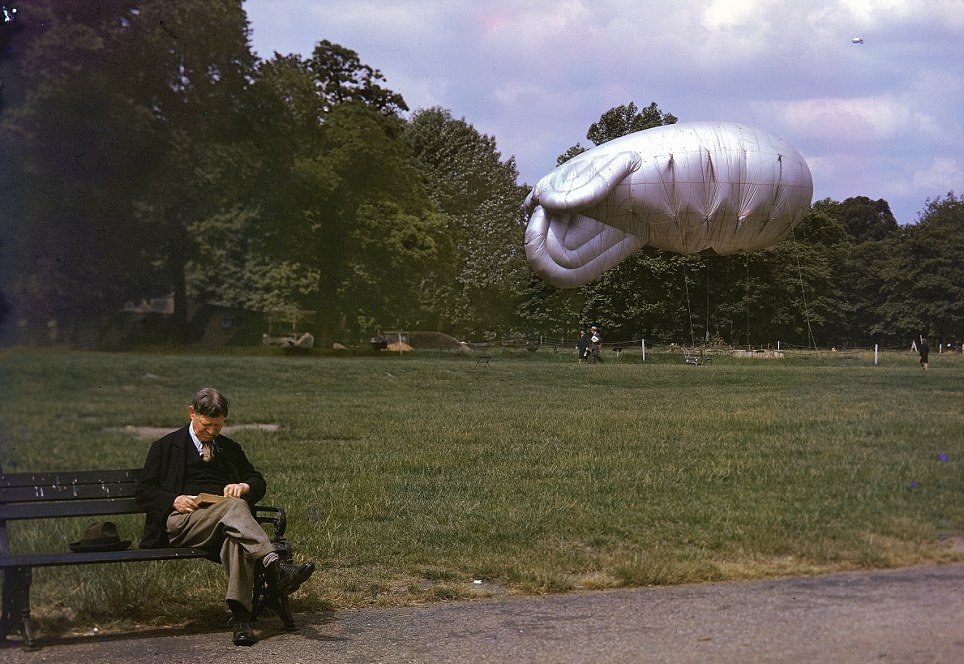
Despite the terrifying raids by the Luftwaffe, they attacks failed to breaks the spirit of the British people. People pressed on with their lives and in one of these extraordinary images a man can be seen in a park calmly reading a book while a barrage balloon hovers close by and a second, right, soars above.


The random nature of the bombing is clearly demonstrated here as a church, right, remains untouched while a vast swathe of buildings close by were reduced to rubble.


The Houses of Parliament with part of them covered in scaffolding are seen across the River Thames on a sunny day in 1941.


Source :
http://www.eyewitnesstohistory.com/blitz.htm
https://www.theundergroundmap.com/wp/the-london-blitz-in-colour/

Monday, August 10, 2020

Ruins in Balham After German Air Raid

A bus lies in a large crater in Balham, London, the morning after a German air raid on 15 October 1940. During the raid, a bomb exploded on Balham high street, destroying part of the tube station beneath. From July to October 1940, Nazi Germany laid siege to the United Kingdom in what is now known as the Battle of Britain. Before the 122-day conflict ceased, over 500 air force pilots and more than 40,000 civilians were killed.

Source :
https://www.buzzfeednews.com/article/gabrielsanchez/harrowing-pictures-from-the-battle-of-britain