Showing posts with label Celebration. Show all posts

Tuesday, March 12, 2024

500th Combat Mission of Stuka Ace Ernst Kupfer


Major Dr.jur. Ernst Kupfer (Gruppenkommandeur II.Gruppe / Schlachtgeschwader 2 "Immelmann") is congratulated after returning from his 500th combat mission, 30 October 1942. Behind him is a Junkers Ju-87D "Stuka" dive-bomber. The picture was taken by Kriegsberichter Klaus Niermann.

Source :
https://www.reddit.com/r/WW2info/comments/199jemb/the_commander_of_ii_stg2_major_ernst_kupfer_is/

Wednesday, December 14, 2022

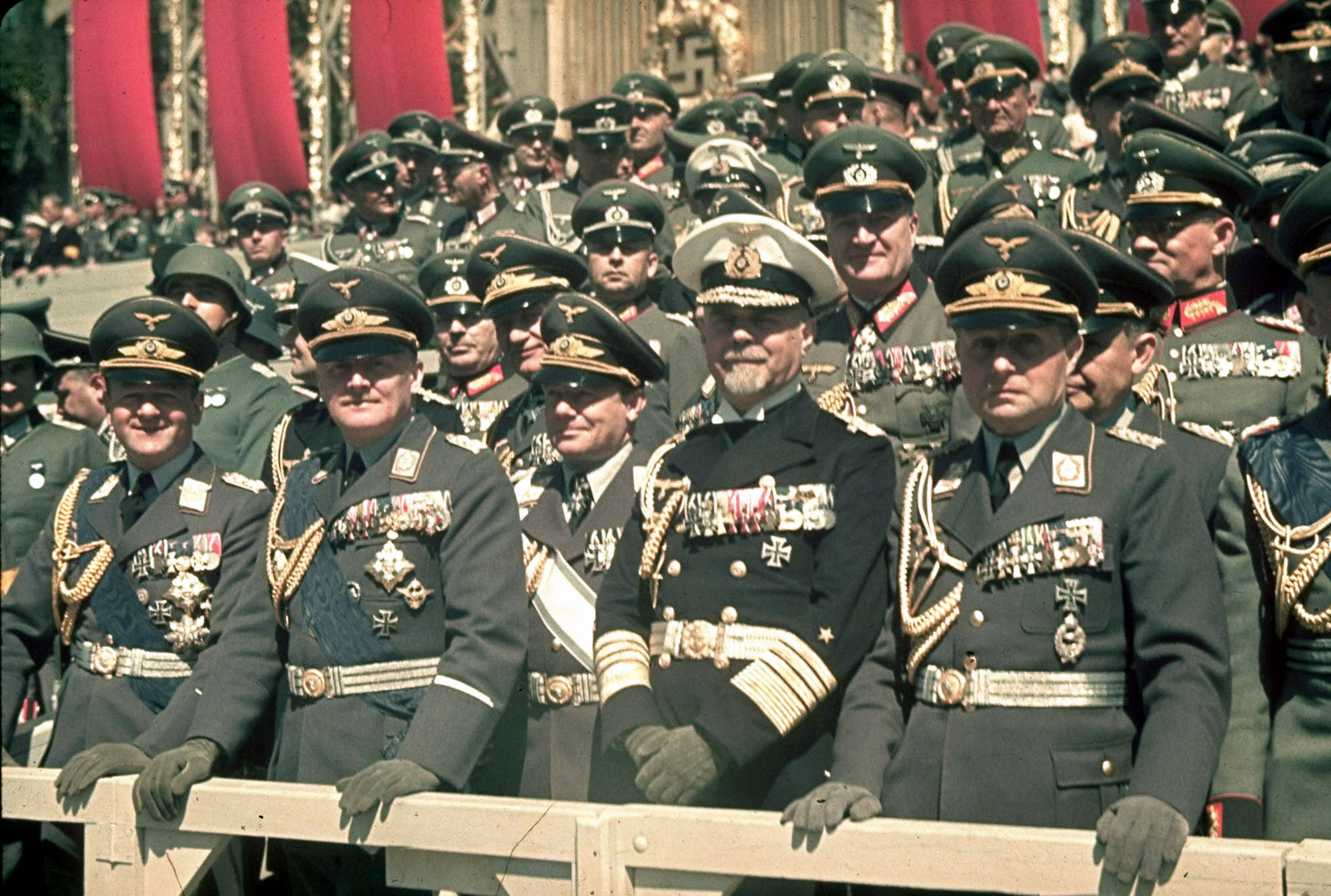
German Generals and Admirals at Führergeburtstag


Generals and admirals of the Wehrmacht stood in the stands of honor at the culmination of Adolf Hitler's 50th birthday celebration, which was held in Berlin on April 20, 1939. They all wore paradeanzug (parade uniform), complete with feldbinde (brocade belt), auszeichnungen (medal bars) and schnurr (lanyard). Front row from left to right: Generaloberst Erhard Milch (Generalinspekteur der Luftwaffe), General der Flieger Hans-Jürgen Stumpff (Chef der Luftwehr), Generalleutnant Ernst Udet (Generalluftzeugmeister und Chef Planungsamts der Luftwaffe), Admiral Max Bastian (Präsident Reichsfürsorge- und Versorgungsgerichts der Wehrmacht), and Generalmajor Friedrich Fahnert (Höheren Kommandeur Luftnachrichtenschule Berlin). For additional identification: Generalleutnant Walter Petzel (Inspekteur der Artillerie) is the bespectacled man standing behind Fahnert; Generalmajor Hermann von Hanneken (Bevollmächtigter für Eisen- und Stahl auch zum Leiter der Hauptabteilung II Industrie) stood between Bastian and Fahnert, Generaloberst Wilhelm List (Oberbefehlshaber Heeres-Gruppenkommando 5) between Udet and Bastian, and General der Flieger Friedrich Christiansen (Korpsführer NSFK) between Stumpff and Udet. This photo itself was made by Hitler's personal photographer, Hugo Jaeger. Note that Milch and Stumpff both wear the Star of the Yugoslav Order of the Crown on their chests!

Source :
http://alifrafikkhan.blogspot.com/2010/10/koleksi-ratusan-foto-berwarna-dari-life.html
https://artsandculture.google.com/entity/m064km4b?hl=en

Friday, June 24, 2022

German Soldiers in Front of Brandenburg Gate

 
The Ost-West-Achse (East-West-Axis) in Berlin, site of a massive rally and military demonstration in celebration of Adolf Hitler’s 50th birthday, 20 April 1939. The display was intended in part as a warning to the Western powers. The parade, which lasted for more than four hours, included 12 companies of the Luftwaffe, 12 companies of the army, and 12 companies of the navy and units of the Schutzstaffel (SS). In total, 40,000 to 50,000 German troops took part. 162 warplanes flew over Berlin. The grandstand comprised 20,000 official guests, and the parade was watched by several hundred thousand spectators. Features of the parade were large long-range air-defence artillery guns, emphasis on motorized artillery and development of air-defence units. Joseph Goebbels declared in a broadcast address to the German people. The picture was taken by Hugo Jaeger.

Source :
https://artsandculture.google.com/asset/hitler-jaeger-file/EgHmP3BzbacCzQ?hl=en
https://en.wikipedia.org/wiki/Adolf_Hitler%27s_50th_birthday

Thursday, June 23, 2022

Hitler's 50th Birthday Gifts

Some of Adolf Hitler's 50th birthday gifts - including flower vases emblazoned with swastikas and paintings - stored in a room at the New Reich Chancellery. The painting at left shows the figure of Helmuth von Moltke the Elder (1800-1891), a Prussian field marshal who is regarded as the creator of a new, more modern method of directing armies in the field. The picture was taken by Hugo Jaeger on 20 April 1939.

Source :
https://www.life.com/history/adolf-hitler-at-50-color-photos-from-a-despots-birthday-april-1939/

Sunday, February 14, 2021

North American P-82 Twin Mustang


North American P-82 Twin Mustang, 1947. Photos by Rudy Arnold. View of the U.S. Army Air Forces North American P-82B Mustang "Betty Jo" (s/n 44-65168) with Lt. Col. Robert Thacker and Lt. John Ard in the cockpits upon arrival at LaGuardia Field, New York after making its record setting flight from Honolulu, Hawaii to New York, February 28, 1947.

The North American F-82 Twin Mustang is the last American piston-engine fighter ordered into production by the United States Air Force. Based on the North American P-51 Mustang, the F-82 was originally designed as a long-range escort fighter for the Boeing B-29 Superfortress in World War II. The war ended well before the first production units were operational.

In the postwar era, Strategic Air Command used the planes as a long-range escort fighter. Radar-equipped F-82s were used extensively by the Air Defense Command as replacements for the Northrop P-61 Black Widow as all-weather day/night interceptors. During the Korean War, Japan-based F-82s were among the first USAF aircraft to operate over Korea. The first three North Korean aircraft destroyed by U.S. forces were shot down by F-82s, the first being a North-Korean Yak-11 downed over Gimpo Airfield by the USAF 68th Fighter Squadron.


Source :
https://www.facebook.com/groups/237076659811098/permalink/1671343026384447/?__cft__[0]=AZUMKFJegfM2uXwkONX_ChQShF8unbQSeeyoDEDkt-TUmpF502xYDAZz1q4Q34WH_tb7BpRipR0hTK1ItJt-DO6I15yLPfTbK1n4f_Ya3zKLb5QDzWPQnDtMVp74dGWkA1Dfd22z2GCD2Wj5Eh9QjWp4Ajhme61nv0jkNVgjaoHaX1lWUGWmlvg5JpsPd9I3P5g&__tn__=%2CO%2CP-R

The 15,000th Curtiss P-40 Warhawk Fighter


The 15,000th Curtiss P-40 Warhawk Fighter in flight. Photos by Hans Groenhoff. This was the 15,000th Curtiss fighter built. The P-40N was given a special paint scheme during November of 1944, with the national insignia of all the countries which used Curtiss aircraft, although not necessarily the P-40. Some of the countries visible are Cuba, China, France, England, Netherlands, Norway, New Zealand, Guatemala, Nicaragua, Turkey, Columbia, Netherlands East Indies, Free French, Portugal and Columbia, with several repeated.


Source :
https://www.facebook.com/groups/237076659811098/permalink/1671647593020657/?__cft__[0]=AZVZ-Oa1E-AgBiBrfn3DAVS1NHnekRfcCxnQ6C2qxAnb80xUgFX-rqbv-glpkW3N4aUC-i8y4BeC675bqmKq679e8esD9HcE6EDJXQgoQ4uNCjvxZGe0PcVsE4vxBPMQS9UsNVVpRbysTxWiIw7HKKXNDj-i1oXO_OIi1VfiREj9VVeSgts0smhzr8ye_gGp9Ks&__tn__=%2CO%2CP-R

Tuesday, January 1, 2019

Christmas with the British Liberation Army in Holland 1944

Christmas with the British Liberation Army in Holland, November 1944. A unit postman from 4th Armoured Brigade with a sack of Christmas parcels decorated with holly near Weert, Limburg, Netherlands. The picture was taken by Captain E.G. Malindine from No. 5 Army Film and Photographic Unit.


Source :
https://commons.wikimedia.org/wiki/File:Christmas_With_the_British_Liberation_Army_in_Holland,_November_1944_TR2567.jpg
http://www.desertrats.org.uk/bde/4thABartefacts2.htm

Wednesday, December 26, 2018

Christmas with the British Tank Crew in Holland

Christmas with the British Liberation Army in Holland, November 1944: A tank crew of the 4th Battalion, the Royal Tank Regiment, 4th Armoured Division, unpack a Christmas parcel near Weert in Holland. The crew - who are shown with their camouflaged tank looking like a 'travelling Christmas tree' - had been together for three years. They had seen action in Libya and Italy before coming to Holland. Left to right: Trooper R Buckley; Trooper J Round; and Sergeant H Kirk. The picture was taken by Captain E.G. Malindine from No. 5 Army Film and Photographic Unit.


Source :
https://www.iwm.org.uk/collections/item/object/205189095

Monday, April 2, 2018

Captured German Kübelwagen in the Liberation of Paris

Paris, France, 26 August 1944: Car carrying journalists and photographers of YANK magazine give a ride to French partisan and unidentified woman during parade held the day after the liberation of Paris by Allied troops. They are using a captured VW Kübelwagen Typ 82, a light military vehicle designed by Ferdinand Porsche and built by Volkswagen during World War II for use by the German military (both Wehrmacht and Waffen-SS). Based heavily on the Volkswagen Beetle, it was prototyped as the Type 62, but eventually became known internally as the Type 82. Kübelwagen is an abbreviation of Kübelsitzwagen, meaning "bucket-seat car" because all German light military vehicles that had no doors were fitted with bucket seats to prevent passengers from falling out. The first VW test vehicles had no doors and were therefore fitted with bucket seats, so acquiring the name VW Kübelsitzwagen that was later shortened to Kübelwagen. Mercedes, Opel and Tatra also built Kübel(sitz)wagens. The picture was taken by Frank Scherschel from LIFE magazine.


Source :
http://www.dailymail.co.uk/news/article-2100326/Stunning-rare-colour-images-World-War-II.html
https://en.wikipedia.org/wiki/Volkswagen_K%C3%BCbelwagen
https://www.gettyimages.com/license/72430265

Monday, January 9, 2017

U-403 in Zoppoter Woche in Danzig


After the successes of the early war years and the extensive propaganda coverage given by the radio and newspapers, public interest in the U-boat service and its men was tremendous. The National-Socialist regime used this interest and the enthusiasm of German youth to attract volunteers. Whenever possible, the U-Bootwaffe made itself accessible, so that young men in particular could see it up close. Successful crews visited their sponsor cities, and U-boat captains spoke at schools and addressed members of the Jungvolk and Hitlerjugend in addition. The Kriegsmarine took every opportunitiy to put its submarines on public display. Zoppoter Woche (Zoppot Week) in the summer of 1941 was one such opportunity. Situated on Danzig Bay not far from Danzig, Zoppot was a beach and spa resort. Zoppoter Woche, held every year in mid to late July, was a major sporting event with regattas, horse races and swim competitions. For the whole week the city's spa promenade was crammed with visitors. One attraction was the pier, which extended more than 500 meters into Danzig Bay, offering visitors a wonderful view of the shore promenade and the large Grand Hotel. Hitler had recently spent a week there during the opening phase of the campaign in Poland (1939). It was precisely there, during Zoppoter Woche in July 1941, that U-403 tied up to attract the attention of visitors.


U-403 (The Type VIIC boat) had been commissioned a short time earlier on 25 June 1941. Attached to the 5. U-Flottille and commanded by Kapitänleutnant Heinz-Ehlert Clausen, the boat had just completed UAK-Abnahme (UAK Acceptance Trials) on 8 July 1941. It was subsequently sent to the shipyard in Danzig for remaining work, including the fitting of a conning tower wind deflector. The color photo reproduced here provide an excellent view of the ship's emblem. It is the Wappen (Coat of Arms) of the boat's sponsor city, Halle an der Saale, with stylized representations of the sun, moon and stars. The emblem had been present on both sides of the conning tower since the boat's commissioning in Danzig-Neufahrwasser. The emblem was painted on metal shields which were then affixed to the conning tower. The crew also wore the emblem as a cap badge. In October 1941, U-403 added its own emblem. Then in the spring of 1942 Halle's Wappen was deleted on both sides of the tower, leaving just the ship's emblem. By the end of October, U-403 had completed its training phase at the AGRU-Front, as well as armament and tactical training. Much to the captain's displeasure, the boat was retained as a training vessel with the 27. U-Flottille in the Baltic. It was used to train U-boat commander trainees in Pillau and Memel. Not until 23 February 1942 did U-403 move from Kiel to Helgoland, from where it carried out its first operational sortie on 1 March 1942. Kapitänleutnant Clausen tied up his boat in Narvik 19 days later. By the spring of 1943 U-403 had completed five more patrols from Norway. On 1 July 1942 it was attached to the recently established 11. U-Flottille in Bergen. On 1 March 1943 the boat was attached to the 9. U-Flottille in Brest. One day later U-403 arrived at the Atlantic Coast base from Trondheim. Under Kapitänleutnant Clausen the boat made another patrol in April-May 1943. Despite the heavy U-boat losses in May 1943, Clausen brought his boat safely back to Brest. There followed a change of command, possibly because Clausen had not been particularly successful, sinking just two enemy ships totaling12,946 GRT in seven patrols. Under its new commander Kapitänleutnant Karl-Franz Heine, U-403 sailed from Brest on its 8th patrol on 13 July 1943. The last message from the boat was received 10 days later, when it reported it was under air attack at position 46 N 10 W. No further message was received, and the Befehlshaber der Unterseeboote (BdU) concluded that U-403 had been sunk by air attack on 23 July. On 27 August 1943, therefore, the boat was listed as "x" (probably sunk), and on 18 May 1944 as "xx" (lost). In fact U-403 had survived the attack. The absence of any further radio messages suggests that its radios were damaged in the attack. The boat was sunk, but not until four weeks later on 18 August 1943 near the Westafrican coast, after an attack by a French-flown Wellington of Nr. 344 Squadron. There were no survivors from the crew of 50. The new commander had brought the crew no luck.


The commander of U-403, Kapitänleutnant Heinz-Ehlert Clausen, photographed on the pier of Danzig Bay during Zoppoter Woche (Zoppot Week) in July 1941. His submarine is in the right background. That same day Clausen used his own camera to shoot the two color photos of U-403 reproduced here. Kapitänleutnant Clausen (born in 12 July 1909) survived the war and died in 24 March 1987. His only war patrols was with U-403 (7 patrols and 191 days at sea), with two ships sunk and total tonnage 12,946 GRT. The medals and decorations received by Clausen: Eisernes Kreuz II.Klasse (26 May 1940) und I.Klasse (4 October 1942); Kriegsabzeichen für Minensuch-, U-Boot-Jagd- und Sicherungsverbände (23 October 1941); U-Boots-Kriegsabzeichen (26 February 1942); and Kriegsverdienstkreuz II.Klasse mit Schwertern (1 September 1944)


Source :
 "U-Boot Im Focus" magazine, edition nr.5 - 2009

Friday, June 3, 2016

German Actress Hannelore Schroth

German actress Hannelore Schroth posed in a chair in the Reich Chancellery (Reichskanzlei) during an artists reception for the 4th "Große Deutsche Kunstausstellung" (Great German Art Exhibition), Berlin, 27 July 1940. Schroth (10 January 1922 – 7 July 1987), was a German film, stage and television actress whose career spanned over five decades. Born Hannelore Emilie Käte Grete Schroth in Berlin in 1922, she was the daughter of popular stage and film actors Heinrich Schroth and Käthe Haack. Her older half-brother was actor and film director Carl-Heinz Schroth (1902-1989), who was the product of Schroth's father's earlier marriage to Else Ruttersheim. Schroth began her career as a child actress, and made her film debut at the age of nine in 1931's Max Ophüls' comedy "Dann schon lieber Lebertran" opposite her mother. Until age sixteen she attended drama school in Lausanne, Switzerland. Her early film successes include Spiel im Sommerwind (1938), Weisser Flieder (1939) and Kitty und die Weltkonferenz (1939) - the latter of which was her first leading role. During World War II, Hannelore Schroth continued performing in films. Unlike her father, Heinrich Schroth, who was by then appearing in Nazi propaganda films such as the notorious 1940 anti-Semitic "Jud Süß", Hannelore avoided overtly political films, such as her appearance in 1945's romantic drama Unter den Brücken (English: Under the Bridges). After the war, she continued her work extensively in film and returned to the theatre, with engagements in Vienna, Düsseldorf, Hamburg, Berlin and Munich. In addition to theatre and appearing in German films as an actress, in the 1950s Schroth began a career as a voice actress, dubbing many English language films into German. Some of which include Jane Wyman's character of Carolina Hill in "Just for You" (1952), Shirley MacLaine in "Irma La Douce" (1963), Elizabeth Taylor's role as Martha in "Who's Afraid of Virginia Woolf?" (1966) and Ingrid Bergman's role as Golda Meir in "A Woman Called Golda" (1982). In her later years, Schroth began appearing on West German television, as well as appearing on stage and in film. The picture was taken by Hugo Jaeger.


Source :
https://en.wikipedia.org/wiki/Hannelore_Schroth
https://picasaweb.google.com/105415329396662777221/HugoJaegerExposition

Thursday, May 5, 2016

Miniature Castle as Hitler's Birthday Gift

Hand-worked castle inlaid with precious stones given to Hitler as an extravagant gifts for his 50th birthday, 20 April 1939. The picture was taken by German photographer Hugo Jaeger. In the late 1930s, very few photographers were using color film. Jaeger was an early adopter, and when Adolf Hitler was introduced to Jaeger’s work, he liked what he saw. “The future,” Hitler reportedly told Jaeger, “belongs to color photography.” Between 1936 and 1945, Jaeger was granted unprecedented access to Hitler, traveling and chronicling, in color, the Führer and his confidants at small gatherings, public events and, quite often, in private moments.


Source :
http://amazingdata.com/hitler-color-photographs-from-life-com/
http://www.gettyimages.com/galleries/photographers/hugo_jaeger
http://www.i-am-bored.com/2015/02/hitlers-50th-birthday-in-color-april-1939-pix.html
http://time.com/3881059/adolf-hitler-color-photos-his-inner-circle-and-hangers-on/

Sunday, March 20, 2016

Kriegsweihnachten, Christmas in War Time

Wehrmacht soldiers from XXXXVI. Armeekorps (based in germany) reading book in their barrack during Christmas of 1940. The first German Christmas of World War II was celebrated in December of 1939 while the front was for the most part silent; the Western Allies and Germany were in the midst of the so-called "phoney war" between the period after the Invasion of Poland in September of 1939, and the Invasion in Norway later in April of 1940. In bunkers and trenches, pillboxes and depots, private homes and unit bases, all along the border, across Germany, and in occupied Poland, those German soldiers unlucky enough to not be with family and loved ones, spent time together amongst their comrades and exchanged simple gifts of fruit and drink, laughed and played, and sang traditional German Christmas songs such as "O Tannenbaum" - a timeless song of Christmas. Christmas 1940 was also a relatively quiet period, the Western Allies, minus Great Britain, were now occupied by German troops and the Eastern Front had not yet erupted - that would come in June of 1941 with the Invasion of the Soviet Union. The Battle of Britian was also over, leaving the vaunted Luftwaffe bloodied and although not defeated by any means, unable to achieve air superiority over the British Isles. Troops once again spent Christmas in bunkers and foriegn cities, now in a front stretching from the most northern arctic tip of Norway to the most southern tip of France in the Mediterranean.


Source :
http://www.feldgrau.com/weihnachten.html
http://historicalsocietyofgermanmilitaryhistory.com/wehrmacht-armed-forces-of-world-war-two/german-heer-army-photos/

Friday, February 26, 2016

Ritterkreuzträger Josef Luxenberger Back from a Successful Mission

Hauptmann Josef Luxenburger (2 April 1915 - 5 September 2009) just back from a successful mission. He received the coveted Ritterkreuz des Eisernen Kreuzes (Knight's Cross of the Iron Crosses) on 3 April 1943 as Oberleutnant and Beobachter (Observer) of 4.Staffel / II.Gruppe / Kampfgeschwader 55 (KG 55) "Greif". He also received Eisernes Kreuz II.Klasse und I.Klasse; and Deutsches Kreuz in Gold (2 January 1942). The wing of the aircraft in the background is from a Heinkel He 111 medium bomber, the standard bomber for KG 55 from its conception through to the last days of the war.


Source :
http://das-ritterkreuz.de/index_search_db.php4?modul=search_result_det&wert1=3935&searchword=luxenburger

Saturday, January 9, 2016

Helmut Benkendorff Welcoming Ceremony

 In August 1943 Oberfeldwebel Helmut Benkendorff, a pilot in 5.Staffel / II.Gruppe / Sturzkampfgeschwader 2 (StG 2), reached a significant milestone, completing his 500th combat mission. The photo shows Oberfeldwebel Benkendorff - "Mucki" to his friends - immediately after landing. With the flowers in hand, he receives the congratulations from the Staffelkapitän of 7./StG 1, Leutnant Willi Viertel (left), for the benefit of the photographers. The four wings on Benkendorff's left sleeve identify him as an Oberfeldwebel. Only a few days later, on 31 August 1943, Willi Viertel was shot down by ground fire while attacking enemy tanks near Glukhov. His aircraft (Junkers Ju 87 "Stuka" D-3, Werknummer 2279) sustained a direct hit and crashed from a height of 300 meters. Viertel and his gunner, Oberfeldwebel Heinrich Hippe, were both killed. Helmut Benkendorff was later promoted to the rank of Leutnant and on 26 March 1944 was awarded the Ritterkreuz des Eisernen Kreuzes (Knight's Cross of the Iron Cross) after more than 600 feindflügen (combat missions). He would completed 666 feindflüge by the end of the war. This photo itself was taken by an unidentified Hauptmann of the Gruppenstab who was taken prisoner in southern Germany in May 1945. There American soldiers took from him several rolls of exposed, but undeveloped, film. The film was later developed by Kodak in the USA, and decades after that a collector discovered the collection by chance. The photographs were subsequently returned to Germany, albeit in poor condition. Another pictures from the same event: 1, 2, 3.


Source :
"Luftwaffe im Focus", Spezial No.1 - 2003

Friday, January 8, 2016

Helmut Benkendorff Greeted by Willi Viertel in the Welcoming Ceremony

In August 1943 Oberfeldwebel Helmut Benkendorff, a pilot in 5.Staffel / II.Gruppe / Sturzkampfgeschwader 2 (StG 2), reached a significant milestone, completing his 500th combat mission. The photo shows Oberfeldwebel Benkendorff - "Mucki" to his friends - immediately after landing. With the flowers in hand, he receives the congratulations from the Staffelkapitän of 7./StG 1, Leutnant Willi Viertel (left), for the benefit of the photographers. Only a few days later, on 31 August 1943, Viertel was shot down by ground fire while attacking enemy tanks near Glukhov. His aircraft (Junkers Ju 87 "Stuka" D-3, Werknummer 2279) sustained a direct hit and crashed from a height of 300 meters. Viertel and his gunner, Oberfeldwebel Heinrich Hippe, were both killed. Helmut Benkendorff was later promoted to the rank of Leutnant and on 26 March 1944 was awarded the Ritterkreuz des Eisernen Kreuzes (Knight's Cross of the Iron Cross) after more than 600 feindflügen (combat missions). He would completed 666 feindflüge by the end of the war. This photo itself was taken by an unidentified Hauptmann of the Gruppenstab who was taken prisoner in southern Germany in May 1945. There American soldiers took from him several rolls of exposed, but undeveloped, film. The film was later developed by Kodak in the USA, and decades after that a collector discovered the collection by chance. The photographs were subsequently returned to Germany, albeit in poor condition. Another pictures from the same event: 1, 2, 3.


Source :
"Luftwaffe im Focus", Spezial No.1 - 2003

A Gift Basket and Bouquet for Helmut Benkendorff's Welcoming Ceremony

In August 1943 Oberfeldwebel Helmut Benkendorff, a pilot in 5.Staffel / II.Gruppe / Sturzkampfgeschwader 2 (StG 2), reached a significant milestone, completing his 500th combat mission. This photograph, taken shortly before his return from the milestone mission, shows a staffel vehicle (Mercedes-Benz 170V saloon) adorned with a wreath and the number "500", along with a gift basket and bouquet. In the basket is the Gruppe's "Adler" (Eagle) emblem. This photo itself was taken by an unidentified Hauptmann of the Gruppenstab who was taken prisoner in southern Germany in May 1945. There American soldiers took from him several rolls of exposed, but undeveloped, film. The film was later developed by Kodak in the USA, and decades after that a collector discovered the collection by chance. The photographs were subsequently returned to Germany, albeit in poor condition. Another pictures from the same event: 1, 2, 3.


Source :
"Luftwaffe im Focus", Spezial No.1 - 2003
http://forum.axishistory.com/viewtopic.php?f=47&t=73232&p=1988977#p1988977

Wednesday, October 7, 2015

George Stevens with a Present from his Son

Christmas 1944, near Bastogne. George Stevens with a present from his son. He left his former job as a film director in Hollywood in 1942 to serve overseas in the American Army for three years in North Africa and Europe. General Dwight D. Eisenhower had been disappointed with the film record of the war so far, so Major - later Lieutenant-Colonel - Stevens was given orders to organize high-quality motion picture coverage of the forthcoming campaigns to free Europe from the Nazis. In 1943 he began assembling SPECOU, the Special Coverage Unit of the U.S. Army Signal Corps. It became known variously as 'the Stevens Unit' or 'the Hollywood Irregulars'. Its members included crack cameramen, sound men, assistant directors and writers from the film industry. SPECOU was attached directly to SHAEF, the Supreme Headquarters Allied Expeditionary Force. The unit had official orders that enabled Major Stevens to assign small camera teams to move from army to army covering the major events of the war. Novelist Irwin Shaw, playwright William Saroyan and future screenwriter Ivan Moffat were responsible for writing captions and descriptions for the 35mm black-and-white film that the unit shot across Europe. Army producers called for all official motion picture coverage to be photographed in 35mm black-and-white, presumably because this was the standard for newsreels shown in movie theatres around the world, and because 35mm color film existed only in the costly Technicolor process which called for three strips of film running simultaneously through a huge camera - not a likely device for a mobile army unit covering combat! That is why, today, when we envision the Second World War, we see a black-and-white war.


Source :
"Victory in Europe: D-Day to VE-Day in Full Color" by Max Hastings and George Stevens

Monday, October 5, 2015

First Official Link-up Ceremony near the Elbe River

26 April 1945: Major General Emil F. Reinhardt (Commander of the US 69th Infantry Division of Courtney Hodges' First Army) and Major General Vladimir V. Rusakov (Commander of the Soviet 58th Guards Rifle Division of Aleksei Zhadov's Fifth Guard Army) lead the celebrations as the Western Allies and the Red Armies link on the River Elbe near the town of Torgau (Southwest of Berlin, Germany). This was an important propaganda event for both sides, Soviet and American. Every American unit along the Elbe-Mulde line was anxious to be the first to meet the Red Army. By the last week of April it was well known that the Soviets were close, and dozens of American patrols were probing beyond the east bank of the Mulde, hoping to meet them. Elements of the First Army’s V Corps made first contact. At 11:30 on 25 April a small patrol from the 69th Infantry Division met a lone Russian horseman in the village of Leckwitz. Several other patrols from the 69th had similar encounters later that day, and on 26 April the division commander met General Rusakov in the first official link-up ceremony. Photo by George Stevens


Source :
"Victory in Europe: D-Day to VE-Day in Full Color" by Max Hastings and George Stevens
http://9thinfantrydivision.net/battle-history/central-europe/

Wednesday, August 5, 2015

SS General Fritz Witt

SS-Brigadeführer und Generalmajor der Waffen-SS Fritz Witt (27 May 1908 – 14 June 1944), commander of 12. SS-Panzer-Division "Hitlerjugend", photographed by SS-Kriegsberichter Wilfried Woscidlo on his 36th birthday celebration which held at Tillierès-sur-Avre, France, on May 27, 1944. Witt first joined the SS in 1933, serving in the SS-Stabswache Berlin, an élite guard formation of only 117 men. In 1938, as commander of the 3rd SS-Standarte Deutschland, he took part in the annexation of Austria, marching into that country with his unit. In March 1939, Witt served with the SS Standarte during the bloodless annexation of Bohemia and Moravia. During the Polish campaign, Fall Weiss, Witt’s SS-Standarte Deutschland was subordinated to Panzerverband Kempf, based in East Prussia. Witt's company saw some heavy fighting and he served well during this campaign. For personal bravery in combat, he was awarded both the first and second classes of the Iron Cross within. In October 1939, with the rank of SS-Hauptsturmführer, Witt was appointed commander of the 1st Battalion of the Deutschland. He fought with bravery during the Invasion of France, again showing skill commanding his unit. For example, On 27 May 1940, 20 British Matilda tanks attacked Witt’s battalion. Despite the fact that his unit had no anti-tank weapons, Witt rallied his battalion and they held, destroying nine of the British tanks with grenades and other improvised methods. Witt was the model of the young leader, never retreating in the face of anything. In April, 1941, he participated with his unit in Operation Marita, which was the invasion of the Greece. His unit saw ferocious fighting, playing an important role. The 1st Battalion had been tasked with clearing resistance from the Klidi Pass, just south of Vevi and opening the way to the heart of Greece. Clashing with a hastily-assembled Australian-British-New Zealand-Greek force, under an Australian, Major General, Iven Giffard Mackay, Witt and his men were engaged in heavy fighting for three days before the pass fell. Witt’s brother, SS-Untersturmführer Franz Witt, died during the battle. Witt’s battalion itself had wreaked havoc on their enemy, causing a high number of casualties and capturing over 520 prisoners for the loss of only 37 dead and 95 wounded. From 22 June 1941, Fritz Witt and his unit fought in Operation Barbarossa, participating in the encirclement of 600.000 men near Kiev. Then his unit now moved south, to join the German 14. Armeekorps. Witt’s battalion fought fiercely for the town of Perekop, later advancing across the Perekop Isthmus and launching the assaults on the Soviet defensive positions near the Tarter Ditch. In spring 1943, after being engaged in heavy fighting on the Eastern Front, Witt was transferred to the newly created 12. SS-Panzer-Division "Hitlerjugend". he continued training exercises for his division, allowing his troops to familiarise themselves with the terrain around Caen. This training would later prove vital.  On 6 June 1944, the Western Allies landed on the Normandy beaches. Witt ordered his division to form up north of Caen, defending the city and the Carpiquet Aerodrome. Over the next weeks, Witt’s division managed to hold the line above Caen despite incessant Allied attacks and constant air, artillery and naval bombardments. The Hitler Youth inflicted devastating losses on the British and Canadian forces, the training which Witt had developed maintaining his unit’s morale and fighting ability. On 14 June 1944, a British naval bombardment hit the divisional command post in Venoix. Fritz Witt, age 36, was hit in the face by shrapnel and killed instantly. He was buried on the war cemetery St André Champigny (France)


Source :
http://ww2gravestone.com/people/witt-fritz/