Showing posts with label Pacific Front. Show all posts

Sunday, October 26, 2025

Mopping-Up Operation by the U.S. 6th Marine Division in Okinawa (1945)

In the final phase of the Battle of Okinawa in June 1945, the U.S. 6th Marine Division undertook a series of intensive mopping-up operations to eliminate the last pockets of Japanese resistance scattered across the island’s southern terrain. Following the collapse of the main Japanese defensive line around Shuri and the death of General Mitsuru Ushijima, the remaining defenders—many entrenched in caves and ravines—continued to resist with desperate ferocity. Color film footage shot by U.S. combat cameramen vividly captured these final operations: Marines advancing cautiously through the devastated hills, using flamethrowers, demolition charges, and grenades to clear fortified cave positions, while medical teams tended to the wounded amid the smoke and debris. The scenes reveal the grim reality of the battle’s aftermath—burned-out vehicles, shattered villages, and the somber burial of fallen comrades. By late June, the 6th Marine Division had secured the island’s northern and southern sectors, marking the end of organized resistance and the completion of one of the Pacific War’s bloodiest campaigns.


Source :
https://www.youtube.com/watch?v=uDT16kJgH1M

Saturday, October 11, 2025

Battle of Naha, Okinawa (May 1945)


The color footage of the Battle of Okinawa filmed in May 1945 by Marine Corps combat cameraman Norman T. Spangler captures the brutal final stages of the Pacific War with striking realism, particularly around the ruined city of Naha. His vivid Kodachrome reels reveal the devastated urban landscape, shattered by relentless bombardment, as U.S. Marines and Army troops push through mud, rubble, and smoke under torrential rain and fierce Japanese resistance. The rare color imagery provides a haunting visual record of the campaign’s ferocity — from tanks advancing past smoldering wreckage to exhausted soldiers sheltering in foxholes — transforming what might otherwise seem like distant history into a vivid and deeply human document of war’s cost at the doorstep of Japan.


Source:
https://www.youtube.com/watch?v=Cgl-sfzgff8

Monday, September 11, 2023

Wounded Japanese POWs in Guam


Japanese prisoners of war (POWs) resting in a quonset hut infirmary in a stockade, Guam, 1945. Except for one, they all appear to be turning away from camera or hiding their face. A Navy corpsman is tending to one POW in the right background.

Source :
https://www.facebook.com/photo/?fbid=9124816540938411&set=gm.2359832834202126&idorvanity=237076659811098

Monday, March 20, 2023

The crew of a Martin PBM-5 Mariner flying boat

The crew of a U.S. Martin PBM-5 Mariner flying boat used for patrol missions and anti-submarine warfare pose on top of their aircraft in April 1945 at Tanapag Harbor in Saipan.

Source :
National Archives and Records Administration, 80-G-K-16192
Smithsonian National Air and Space Museum
https://www.flickr.com/photos/airandspace/albums/72157715574200936

Thursday, December 15, 2022

Two Marines on USS Randolph

USS Randolph -CV-15 Two of the ship's Marines standing lookout watch beneath 40mm gun barrels. They are PFC H.J. Zukowski -left- and PFC Sam Paladins. On February 10, 1945 USS Randolph departed Ulithi Lagoon with Task Force 58 (TF-58). On February 16, 1945 and February 17, 1945 her aircraft participated in attacks against Tokyo area airfields and the Tachikawa factory. On February 18, 1945 her aircraft attacked Chi Chi Jima. On February 20, 1945 launched three sorties to provide ground support for the U.S. Marines on Iwo Jima plus two strikes against Haha Jima. Over the next four days attacked targets on Iwo Jima and Combat Air Patrols (CAP) were flown over the invasion force. On February 25, 1945 launched aircraft for strikes against Tokyo area airfields and Hachijo Jima then returned to Ulithi Lagoon.

Source :
https://www.facebook.com/photo/?fbid=7632619293491484&set=gm.2175342095984535&idorvanity=237076659811098
https://pacificwrecks.com/ships/usn/CV-15.html

Japanese Yokosuka MXY7 Ohka (Baka) Piloted Flying Bomb

Japanese Yokosuka MXY7 Ohka (Baka) piloted flying bomb which had been captured intact by Marines on Okinawa. Photographed 26 June 1945. During the Okinawa Campaign, the Japanese utilized the Yokosuka MXY-7 Okha "Baka Bomb" against U.S. Navy warships. USS West Virginia (BB-48) is believed to be the first ship damaged by a Baka Bomb on April 1. USS Mannert L. Able (DD-733) was the first ship to be sunk by the weapon on April 12. Other ships damaged by these weapons during Operation Ten-Go were: USS Gayety (AM-239), USS Hugy W. Hadley (DD-744), and USS Shea (DD-750).Usually carried and transported by a Japanese Mitsubishi G4M2 "Betty" aircraft, the "glider weapon" would be released when close enough to its target, then aimed to subsequently destroy it.

Source :
https://www.facebook.com/photo/?fbid=7632613603492053&set=gm.2175341095984635&idorvanity=237076659811098
https://www.history.navy.mil/content/history/museums/nmusn/explore/photography/wwii/wwii-pacific/okinawa/yokosuka-mxy-7-ohka.html

Wednesday, November 30, 2022

USMC Trucks in Agana City Guam

Guam Operation, 1944. U.S. Marine Corps trucks on a road into Agana City, July 1944. The town was heavily damaged during the bombardment. The Battle of Guam (21 July–10 August 1944) was the American recapture of the Japanese-held island of Guam, a U.S. territory in the Mariana Islands captured by the Japanese from the United States in the First Battle of Guam in 1941 during the Pacific campaign of World War II. The battle was a critical component of Operation Forager. The recapture of Guam and the broader Mariana and Palau Islands campaign resulted in the destruction of much of Japan's naval air power and allowed the United States to establish large airbases from which it could bomb the Japanese home islands with its new strategic bomber, the Boeing B-29 Superfortress.

Source :
https://en.wikipedia.org/wiki/Battle_of_Guam_(1944)
https://www.facebook.com/photo/?fbid=7516063455147069&set=gm.2159681720883906&idorvanity=237076659811098
https://wiadomosci.onet.pl/swiat/bitwa-o-guam-wyspa-w-ostatnich-latach-ii-wojny-swiatowej/z19cq39

Monday, November 14, 2022

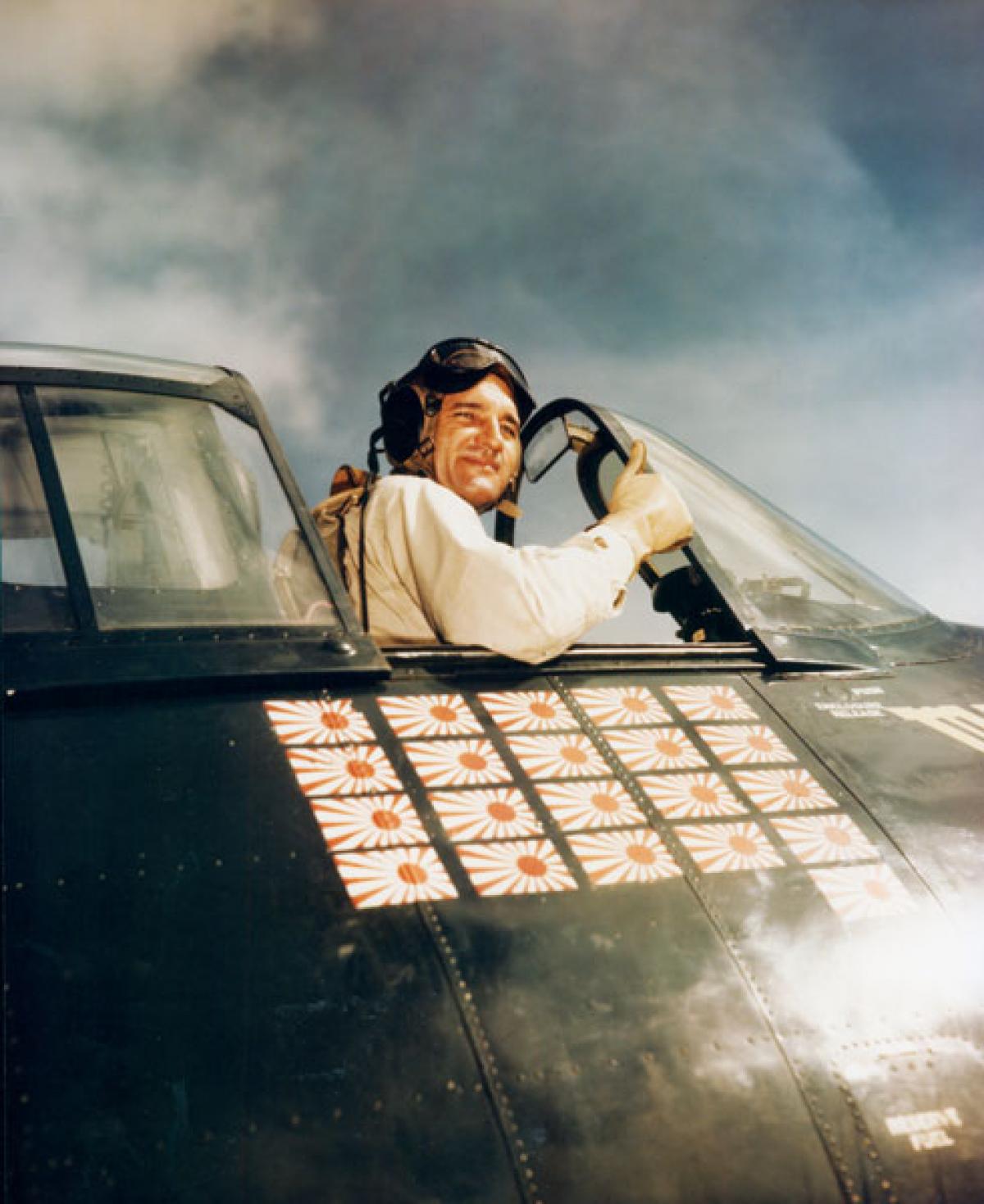
Bio of Top US Naval Ace David McCampbell

US Navy Capt. David McCampbell wasn't just the top naval ace of World War II — he's considered the service's all-time leader in aerial combat. His spirit and leadership are what made his air group one of the war's most decorated, and they earned him the Medal of Honor.

McCampbell was born Jan. 16, 1910, in Bessemer, Alabama, to parents Andrew and Elizabeth McCampbell. When he was about 12, the family moved him and his older sister, Frances, to West Palm Beach, Florida.

As a teen, McCampbell moved north to attend the Staunton Military Academy in Virginia. His graduation in 1928 earned him an Army commission, according to the Army University Press. Instead, he chose to attend the Georgia Institute of Technology, where he played football and was on the swim team. He also joined Navy ROTC, which led to his appointment to the Naval Academy. While in Annapolis, McCampbell became an accomplished swimmer and diver, competing in and winning various NCAA regional championships.

McCampbell graduated in June of 1933, but since Great Depression-related economic issues had affected the number of commissions that were available, he immediately went into the Naval Reserve. He returned to Alabama to work in construction and at an aircraft assembly plant for a year before finally receiving orders in June 1934 to report for active duty.

The young ensign's first duty station was aboard the USS Portland. By May 1937, he'd worked his way up in the ranks and began flight school in Pensacola, Florida, earning his wings in April 1938. His first few years as an aviator were spent serving on the USS Ranger and the USS Wasp.

World War II began while McCampbell was on the Wasp. The aircraft carrier spent the first half of 1942 in the European theater before being transferred to the Pacific. On Sept. 15, 1942, the ship was sunk during the Guadalcanal campaign. McCampbell, surviving its demise, was promoted to lieutenant commander and brought back to the U.S.

By late 1943, McCampbell was in command of a fighter squadron attached to the USS Essex. He was promoted to commander in January 1944 and put in charge of the ship's Air Group 15 — one of the war's most decorated air groups.  It was in this position that McCampbell became one of World War II's great aces.

McCampbell took out his first Japanese aircraft on June 11, 1944. About a week later, during the First Battle of the Philippine Sea, he led several F6F Hellcat fighter aircraft against 80 Japanese carrier-based planes that were headed toward the U.S. fleet. McCampbell personally destroyed seven of those hostile aircraft — five bombers and two fighters — which helped his outnumbered men virtually annihilate the enemy. According to the Encyclopedia of Alabama, McCampbell's team accounted for about 68 of the 600 Japanese downed aircraft.

On Oct. 24, 1944, during the infamous Battle of Leyte Gulf, McCampbell and a fellow pilot, Ensign Roy Rushing, took on 60 hostile Japanese aircraft that were approaching U.S. ships. Despite the overwhelming airpower against them, McCampbell shot down nine Japanese aircraft, setting a U.S. single mission aerial combat record. Rushing took out another six enemy warplanes. Their successes completely threw off the Japanese air group; the remaining aircraft abandoned their mission before any of them reached the U.S. fleet.

In a 1987 U.S. Naval Institute interview, McCampbell explained how he nearly didn't make it back to his ship after that engagement.

"When I got over the ship, I found they had a flight deck full of planes, and I knew that to launch all those planes would take a good 20 minutes, and I didn't have that much gas left," he said.

When the ship did make room for him to land, he said, "I ran out of gas on the deck. They had to push me out of the landing gear area. I found out from the mechanic that re-ammunitioned the guns that I had exactly six rounds left in the starboard outboard gun, and they were all jammed."

"But it worked out all right," he added nonchalantly.

McCampbell returned to the U.S. in December 1944. By then, he had become the Navy's all-time leading ace and top F6F Hellcat ace, having downed 34 Japanese aircraft during his months of aerial combat. His impressive tally made him the third-highest American scoring ace of World War II, behind only Army Maj. Richard Bong and Army Maj. Thomas B. McGuire, neither of whom survived the war.

For his bravery in the skies, McCampbell received the Medal of Honor on Jan. 10, 1945, from President Franklin D. Roosevelt during a ceremony at the White House.

After the war, McCampbell served in various positions, including as a senior naval aviation advisor to the Argentine Navy. After becoming a captain in July 1952, he also notably served as the captain of the aircraft carrier USS Bonhomme Richard and as a member of the Joint Staff in Washington, D.C. In the latter position, McCampbell helped draw up contingency invasion plans during the 1962 Cuban Missile Crisis, according to a 1996 Palm Beach Post article.

McCampbell was married a few times and had three children, Frances, David and John. He finally retired from the Navy in 1964 after 31 years of service.

According to the Palm Beach Post, McCampbell "dabbled in real estate in the Bahamas" before setting back down near West Palm Beach, where he lived for the rest of his life.  

McCampbell died on June 30, 1996, at a veteran's home he'd been living at for about a year. He was buried in Arlington National Cemetery.


Source :
https://www.defense.gov/News/Feature-Stories/Story/Article/3192422/medal-of-honor-monday-navy-capt-david-mccampbell/
https://www.thesun.ie/news/4108824/amazing-pics-of-us-navys-top-gun-inspiring-fighter-jet-unit-released-on-50th-anniversary-of-its-founding/
https://www.usni.org/magazines/naval-history-magazine/2022/august/brief-illustrated-history-navy-victory-markings

Friday, September 24, 2021

Ace Pilot Jeremiah O’Keefe

On April 22, 1945, 1st Lt. Jeremiah O’Keefe shot down five Japanese kamikaze aircraft off Okinawa in his F4U Corsair and then brought down another two six days later. When Japan attacked Pearl Harbor, Jerry enlisted, hoping to become a pilot. He received his wings from the U.S. Marines in May, 1943. In 1944, before leaving for his assignment with the Pacific Fleet, he married his childhood sweetheart, Annette Saxon, and started what would be a family of thirteen children. During combat, Jerry earned the status of 'ace' fighter pilot and was later awarded the US Navy Cross, the Distinguished Flying Cross, the Air Medal, Gold Star and, in 2015, the Congressional Gold Medal for American Aces.   Jeremiah J. O’Keefe, shot down seven Japanese pilots in one week in World War II.

Source :
National Archives and Records Administration 127-GW-120703
Smithsonian National Air and Space Museum
https://www.flickr.com/photos/airandspace/albums/72157715574200936

Monday, May 3, 2021

Sherman Tanks Set Fire to Japanese Aircraft

Marine flamethrowing Sherman tanks set fire to Japanese aircraft in Sasebo, Japan, on November 2, 1945. Sasebo is a core city located in Nagasaki Prefecture, Japan. It is also the second largest city in Nagasaki Prefecture, after its capital, Nagasaki. The city which had 206,000 inhabitants in 1945 suffered severe damage by bombing on June 29, 1945 during World War II and was destroyed by 48%. Sasebo was one of the original 17 targets selected for the dropping of the atomic bomb. After the end of the war, part of the base facilities were taken over by the United States Navy, forming U.S. Fleet Activities Sasebo.

Source :
National Archives and Records Administration 127-GW-137979
Smithsonian National Air and Space Museum
https://en.wikipedia.org/wiki/Sasebo
https://www.flickr.com/photos/airandspace/albums/72157715574200936

Sunday, April 18, 2021

U.S. Marines Look Over Abandoned Japanese Kawasaki Ki-61


U.S. Marines on Okinawa look over an abandoned Japanese Kawasaki Ki-61 “Tony” on April 9, 1945. The Kawasaki Ki-61 Hien (飛燕, "flying swallow") is a Japanese World War II fighter aircraft used by the Imperial Japanese Army Air Service. The Japanese Army designation was "Army Type 3 Fighter" (三式戦闘機). Allied intelligence initially believed Ki-61s were Messerschmitt Bf 109s and later an Italian Macchi C.202, which led to the Allied reporting name of "Tony", assigned by the United States War Department. It was the only mass-produced Japanese fighter of the war to use a liquid-cooled inline V engine. Over 3,000 Ki-61s were produced. Initial prototypes saw action over Yokohama during the Doolittle Raid on 18 April 1942, and continued to fly combat missions throughout the war.

Source :
National Archives and Records Administration 127-GW-119179
Smithsonian National Air and Space Museum
https://en.wikipedia.org/wiki/Kawasaki_Ki-61
https://www.flickr.com/photos/airandspace/albums/72157715574200936

Friday, March 19, 2021

Barakoma Airfield in the Solomon Islands


Wreckage burns from two Marine F4U Corsairs that collided at what appears to be Barakoma airfield on Vella Lavella Island in the Solomons, late 1943 or early 1944.

Barakoma Airfield was a former World War II airfield on Vella Lavella in the Solomon Islands archipelago. On August 15, 1943 American forces landed at Barakoma and immediately U. S. Navy (USN) 58th Naval Construction Battalion (NCB) "Seabees" began clearing a swampy area of jungle for development into a fighter strip parallel to the southeast coast of Vella Lavella Island.

Between August 19-28, 1943 Japanese aircraft attacked Allied forces in the Barakoma area losing a considerable number of aircraft of which Allied fighters and anti-aircraft claimed about 50 attackers. None of the raids did considerable damage. The last recorded Japanese raid was January 16, 1944 when four bombs were dropped three miles wide of the airfield. At night, harassment raids by Japanese interfered with, but did not stop the construction.

By October 25, 1943 the single runway measured 3,600 x 150' and was oriented 322° x 142° with taxiways and revetments along the inland southwest edge of the runway. Also a road was constructed from the airfield northward passing Gill's Plantation up to Lambu Lambu Cove and Horoniu.

Wartime History:
On September 24, 1943 the first official landing on the newly built runway was by VMF-214 "Black Sheep" F4U Corsairs piloted by Major Gregory "Pappy" Boyington and Mo Fisher. Many Marine F4U aces flew from Barakoma during its height. During late 1943 until early 1944, Barakoma Airfield was used by U. S. Marine Corps (USMC) fighter aircraft and bombers. Afterwards, squadrons moved northward to Bougainville and Nissan Airfield (Green Island).

US Navy units based at Barakoma included:
VF-40 operating Grumman F6F Hellcats.

USMC units based at Barakoma included:
VMF-212 operating Grumman F4F Wildcats
VMF-214 operating Vought F4U Corsairs
VMF-215 operating Vought F4U Corsairs
VMF-221 operating Vought F4U Corsairs
VMF-321 operating Vought F4U Corsairs
VMF(N)-531 operating Lockheed PV-1 Ventura's

Source :
National Archives and Records Administration 80-G-K-5909
Smithsonian National Air and Space Museum
https://www.flickr.com/photos/airandspace/albums/72157715574200936
http://www.warbirdinformationexchange.org/phpBB3/viewtopic.php?f=3&t=72167

Pilots of Marine Torpedo Bombing Squadron 232


Three pilots stand by the squadron scoreboard at an advanced South Pacific base, circa 1943-44. As VMSB-232, this unit was active and played an important role in the Guadalcanal Campaign in 1942 and was redesignated as VMTB-232 in 1943 and participated in the Solomons and Admiralities in 1943-44.

Source :
National Archives and Records Administration 80-G-K-3997
Smithsonian National Air and Space Museum
https://www.flickr.com/photos/airandspace/albums/72157715574200936

Sunday, March 14, 2021

Scrappy, the Yorktown Ship's Mascot


ARM3C (Aviation Radioman Third Class) Robert L. Brown of Denver, Colorado, poses in the cockpit of a Grumman F6F Hellcat fighter plane aboard the USS Yorktown (CV-10) with “Scrappy,” the ship’s mascot, November-December 1943. The story goes that Scrappy was found roaming the docks of Pearl Harbor in 1943. Yorktown sailors spotted the Airedale and smuggled him aboard, knowing their captain wouldn’t approve. Once aboard, the spirited little dog was officially named "Scrapper Shrapnel". He earned his nickname, Scrappy, challenging the roaring planes on the flight deck. Quickly a crew favorite, Scrappy eased stress and filled the hearts of hardworking sailors. In true mascot style, he even wore a custom-made life jacket and helmet!

Source :
National Archives and Records Administration 80-G-K-1704
Smithsonian National Air and Space Museum
https://www.flickr.com/photos/airandspace/albums/72157715574200936
https://www.patriotspoint.org/scrappy/?__cf_chl_jschl_tk__=d69c3145fb4b99e14d9acbf844f9cca4d59d149c-1615728787-0-AfVn_n0_uIilihmHT3V-5cDYjUJlOGWkHKY32UHZTnhSK4wtiqgZwA5Y2yGMOk6RrK84KbL9KpXWskC4MAzvP43Ab2GEzuieJtLC9K7ryZ45FyVqyL_fNqF_IPOG2IDJwjkfFzfcllMVLufcwb5VqqPa6WEniRxVBui9eCbG9beikkd96S8GZA7PAdKBOiIXpgDjLDMyZx_xiiZv98oV_VRQDRanLEZQQMLJHbIkUrKtj4lY-ucIqiRe-Tpw52OzV6Cm3WRkC2RdDzXuKpQzVdgvCwOKcoih2_8K9XLu1rGbp0sNX490X8irNdpjKvtsTm8hWLSRfyswDSWNkhmSrF0HisvcevOOydRsRRF9-Q9cKDDgp3LDhj3HgOIwdWP5GmVyrl9Vtr7eQA-cOS8Vw0s

Lt. Clifford Allen of 555th Parachute Infantry Battalion


Lieutenant Clifford Allen of Chicago, Illinois, stands in front of a C-47 preparing to drop the 555th Parachute Infantry Battalion. The 555th was the only African American parachute unit and was not ready in time to deploy to Europe. Instead, as incendiary Japanese balloon bombs were launched towards the U.S. in mid-1945 in hopes of starting large fires in the Pacific Northwest, the 555th was assigned to jump on fires to extinguish them as part of “Operation Fire Fly.” The unit made 15 such jumps. Note the 150-foot rope for descending from tall trees; the plastic helmet and catcher's mask were protection against branches and brambles.

Source :
National Archives and Records Administration 342-C-K-3746
Smithsonian National Air and Space Museum
https://www.flickr.com/photos/airandspace/albums/72157715574200936

Wednesday, February 17, 2021

No. 5 Squadron Sunderland NZ4113 'M' in Flight


Some nice air to air views of a No. 5 Squadron Sunderland NZ4113 'M' in flight over the Waitemata Harbour and the Auckland harbour bridge in 1944.

No. 5 Squadron RNZAF is a squadron of the Royal New Zealand Air Force formed during November 1941 in Fiji. It remains on active duty and logged 2,300 hours flight time in 2007.

Initially, the squadron was equipped with Vickers Vincents. From the outbreak of hostilities with Japan, the squadron operated the Short Singapore Mk.IIIs (transferred in October 1941 from No. 205 Squadron RAF) mainly on maritime patrol and anti-submarine duties, rescuing more than fifty survivors of ditched aircraft and successfully attacking a Japanese submarine in the process with the elderly Singapores. These types were superseded by Consolidated PBY Catalinas, which aided the air-sea rescue capability. The squadron moved from Fiji in late 1944 to operate between Espiritu Santo and the Admiralty Islands. During this time the later conqueror of Mount Everest, Edmund Hillary, served with the squadron. In November 1944, the squadron moved to Luganville Seaplane Base on Espiritu Santo to carry out anti-submarine patrols and escort duty. In August 1945, the squadron was withdrawn to Fiji.


Source :
https://www.facebook.com/groups/237076659811098/permalink/1675710325947717/?__cft__[0]=AZV6AaZA39GQ6sgMEarWLAWJyAEAXlLunSv1LPgYwPT7wJlD1HX72gjhxaYaAHdKusJJ-oQQaOP_3i0NaLdWlD6HP0I54NAaKO-JhTuc2zU3OlfRYkk5Pm48GLpGVgl1XFHYbktB2zVXtKqv0a9dhm29Y8tCgIBLqMKxXGdESjfMhgeWu0TJQncjLUWHbiR3qt4&__tn__=%2CO%2CP-R

Saturday, January 30, 2021

Aerial view of Hiroshima Bomb Damage

View from above of atomic bomb damage to the city of Hiroshima in the Chugoku region of Honshu, Japan in June 1946. On 6th August 1945, during World War II, the atomic bomb 'Little Boy' was dropped on Hiroshima and detonated 600 metres above the city centre causing enormous damage to the city's infrastructure.
 

Source :
https://www.facebook.com/photo/?fbid=428755015059995&set=gm.1663022240549859

Sunday, January 3, 2021

Nikko Toscho-gu Shrine in Japan


Nikko Toscho-gu, a color slide from a doctor on a eastern Asian trip, 1941

A german doctor enjoyed a trip to eastern Asia (Japan - Korea - China) in 1941. No color photography was available in Japan at the time (except for rare imported Kodak), so thanks to these travelers we can view Japan of the time in the original color. The doctor used Kodachrome instead of Agfacolor. Nikko has long been one of the top sightseeing places in Japan, like Kyoto, Hakone and Karuizawa. This shrine, Tosho-gu, is dedicated to Tokugawa Ieyasu, the founder of the Tokugawa shogunate. It was initially built in 1617, during the Edo period, while Ieyasu's son Hidetada was shōgun. For more information, read on from Wikipedia.


Source :
Akira Takiguchi photo collection
https://www.facebook.com/photo/?fbid=10222753561341121&set=gm.1642516192600464

Sunday, September 20, 2020

USS Pennsylvania Drydocked in the Pacific

USS Pennsylvania (BB-38, originally Battleship # 38), 1916-1948, drydocked in an Advanced Base Sectional Dock (ABSD) at the Pacific, 1944. Note the extensive anti-torpedo blister built into her hull side and paravane streaming chains running from her forefoot to her foredeck.


USS Pennsylvania, lead ship of a class of two 31,400-ton battleships, was built at Newport News, Virginia. Commissioned in June 1916, she served as the Atlantic Fleet's flagship into the early "Twenties". Though her operations during this time were primarily off the U.S. east coast and in the Caribbean area, Pennsylvania briefly cruised to France in December 1918. Transiting the Panama Canal to the Pacific early in 1921, she became flagship of the newly-organized Battle Fleet. During the next eight years, she led the Navy's battleships in maneuvers in the Atlantic, Caribbean and in the Pacific, including a cruise to Australia and New Zealand in mid-1925.


From June 1929 to May 1931, Pennsylvania received an extensive modernization at the Philadelphia Navy Yard, Pennsylvania. She emerged with new "tripod" masts, improved combat systems, and an enlarged armored conning tower to better support her mission as fleet flagship. Through the following decade, Pennsylvania continued her pattern of drills, at-sea exercises and periodic major "Fleet Problems" conducted to refine the Navy's war plans.


When Japan attacked on 7 December 1941, Pennsylvania, flagship of the United States Fleet, was in drydock at the Pearl Harbor Navy Yard. Her relatively light damage was repaired over the next few months, and she operated along the U.S. west coast and off Hawaii until October 1942. Following an overhaul that significantly updated her secondary battery of 5" guns and added many anti-aircraft machine guns, Pennsylvania went to Alaskan waters, where she participated in the recapture of Attu in May 1943 and Kiska in August.


In November 1943, Pennsylvania bombarded Makin during the amphibious assault on the Gilbert Islands. She repeated this role a few months later at Kwajalein and Eniwetok, and in June and July 1944 at Saipan, Tinian and Guam. Her guns supported landings in the Palaus in September 1944 and at Leyte in October. When the Japanese Navy responded vigorously to the latter operation, Pennsylvania helped to destroy part of the enemy fleet in the Battle of Surigao Strait.


In January 1945, Pennsylvania took part in the Lingayen Gulf invasion. Freshly returned to the combat zone after another overhaul, she was seriously damaged by a Japanese aerial torpedo off Okinawa on 12 August 1945, the last major Navy ship to be hit during the Second World War. Too old for retention in the post-war fleet, Pennsylvania was repaired only enough to fit her for target duty. She served in that capacity during the July 1946 Bikini atomic bomb tests. Subsequently moored at Kwajalein for studies of residual radioactivity, USS Pennsylvania was scuttled at sea on 19 February 1948.


Source :

https://www.facebook.com/groups/237076659811098/permalink/1551937918324959/?__cft__[0]=AZUDzQiyLPz2bweHE1SUCwl2L7gKl3yP0seWajeueHjH4iQwNasmezrrCQTSh9W2rRTpk-MEW7HPrk8pn1b1arFSu4LeKPI9TlRdRW0KMrxq5x2HSN0k3j_fRQcZzuQ0sHCy_P69XKM29nnmlxd4O26maDWbm5_ZBqUk9MNW4mLtCw&__tn__=%2CO%2CP-R

Saturday, August 22, 2020

The 51st Fighter Group at the U.S Airfield base in Dinjan, India (1943)

The 51st Fighter Group spent most of the Second World War defending the two ends of the "Hump", the air supply route between India and China. The unit had been activated in January 1941, nearly a year before American entered the war. It was one of the first groups dispatched from the United States after Pearl Harbor, traveling west to India via Australia and Ceylon.

In 1942 the Tenth Air Force was responsible for both India and China. The first 51st FG unit to actually see service was the 16th Fighter Squadron, which was detached to serve with the 23rd FG.

The rest of the group moved forward to Dinjan, in Assam, in September 1942, beginning operations in October. Dinjan was well within range of Japanese aircraft, and so the 51st spent part of its time defending the "Hump" and part defending its own bases. It also took part in the fighting during the Japanese offensive in northern Burma in 1943.

In October 1943 the 51st FG was transferred to the Fourteenth Air Force, and to China. Its duties now involved defending the Chinese end of the "Hump" as well as supporting the Chinese army. It also carried out attacks on Japanese shipping. The unit returned to India in September 1945, and then to the United States in November.


Photos by Ivan Dmitri/Michael Ochs Archives

Source :
Courtesy of Tobi Moll at https://www.facebook.com/photo?fbid=316019803000184&set=pcb.1525990300919721