Showing posts with label German Car. Show all posts

Sunday, November 20, 2022

Himmler Chats with Polizei Officer in Warsaw


This picture was taken by Hugo Jaeger on 5 October 1939, and it shows Heinrich Himmler (Reichsführer-SS und Chef der deutschen Polizei) chats with unknown Orpo (Ordnungspolizei) officer - possibly with the rank of Major - during the German victory parade at Warsaw, Poland. In the background is a column of Mercedes-Benz W31 type G4 cars. There seems to be a confusion which Polizeibataillonen were actually in Warsaw at that time. According to NARA T 312 R 39 (AOK 8), five of them - under command of Oberst Rietzler (or Ritzer) - were sent to Warsaw right after capitulation. Polish IPN report has these: Pol.Btl. 2 (Major Küster), 5 (Major Jenke), 6 (Major Wenzel) and 7 (Major Vollmar). Wolfgang Curilla's book also mentions: 3 (Major Höcke) and 4 (Major Kasten) as being moved to Warsaw right before a parade.. It's possible Pol.Btl. 6 had not arrived until mid-October, so it was not in Warsaw during the parade. The interesting thing about this photo is the mark left by Himmler's spectacles which he has obviously removed in favour of his pince nez for the parade. To leave a mark such as this, the spectacles must have been worn tight to his head. Did they give him a headache? He was known to suffer from headaches and stomach cramps. He put his headaches down to his poor eyesight and pouring over numerous files, plus sinus problems (maybe better fitting spectacles could have solved one of his problems?). Just by looking at other photos from that parade, there was on Orpo (Ordnungspolizei) unit facing main tribune on the other side of the street. So possibly Himmler was having a chat with Orpo commander, with his back to the street and main tribune on the other side. Those nice cars (with Hitler and others) were arriving from the city centre (in the opposite direction to later parade traffic). When parade started a military band arrived first and took stand in front of the Orpo unit, facing main tribune.

Source :
https://artsandculture.google.com/asset/hitler-jaeger-file/NgHd0PG7VPbm6Q?hl=en
https://forum.axishistory.com/viewtopic.php?f=38&t=229080&hilit=warsaw&start=15

Monday, July 18, 2022

Horst Grund with a Ford Eifel

Kriegsberichter Horst Grund, Member of a naval propaganda company, with a Ford Eifel car on the land route to Konstanza (Constanta), Romania, after taking a break on a country road, 1941.

Source :
https://e-artis-contemporary.com/en/Rumaenien-N-1603-Bild-017-Horst-Grund-1941/29778

Sunday, June 19, 2022

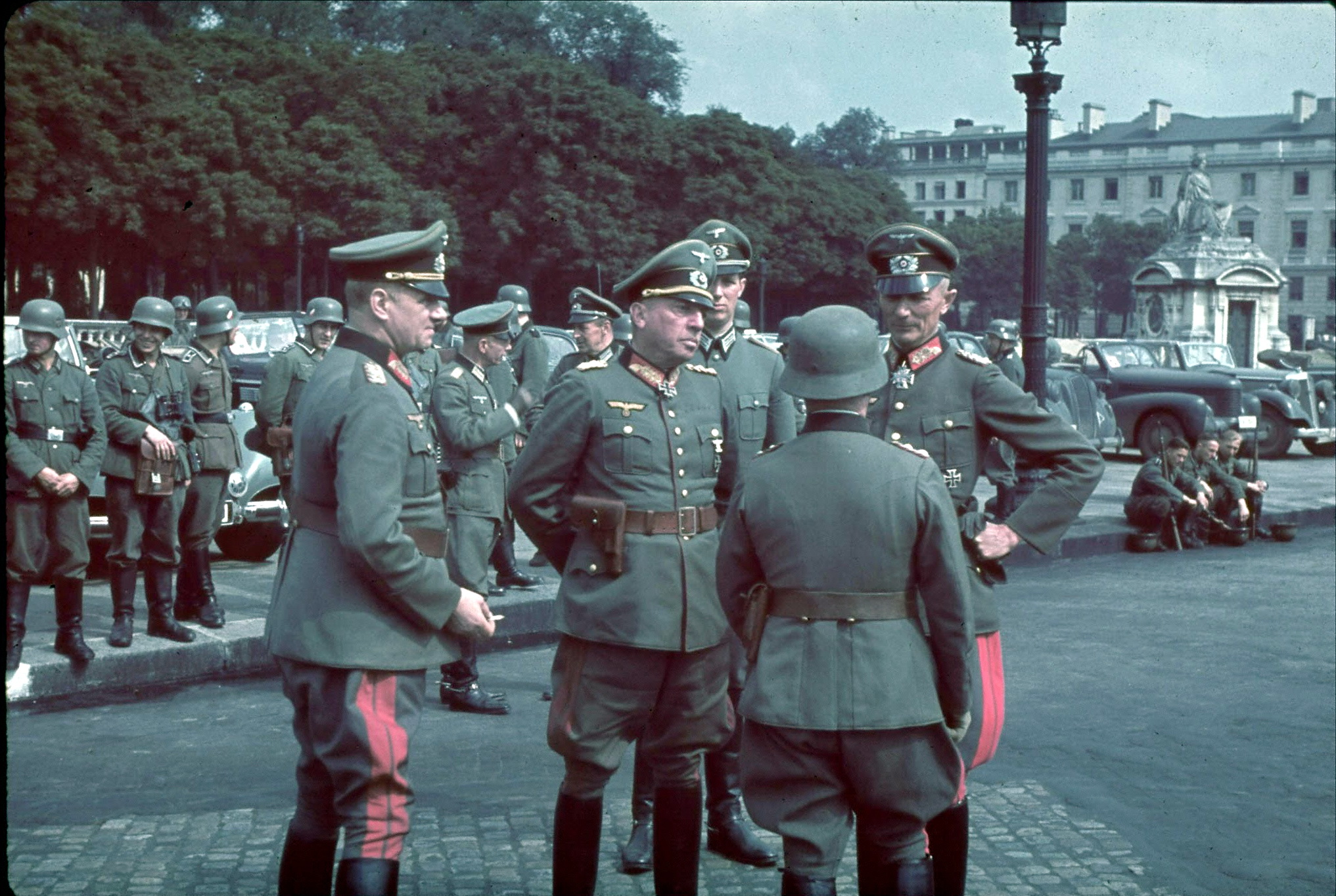
German Generals in the Paris Parade 1940


Wehrmacht high ranking officers gathered at the victory parade of the German troops at the Place de la Concorde, Paris, which held on Friday, June 14, 1940. On that day the French capital fell to the Nazis, while 2,000,000 of its citizens had already fled. In preparation for the parade, the new authorities forbade local residents to approach the vicinity of the Place de la Concorde from 08:00 AM until the afternoon. Front row from left to right: Generalleutnant Hans von Salmuth (Chef des Generalstabes Heeresgruppe B), General der Artillerie Georg von Küchler (Oberbefehlshaber 18. Armee), Oberleutnant der Reserve Heinrich Graf von Lehndorff-Steinort (Adjutant Oberbefehlshaber Heeresgruppe B), General der Kavallerie Georg Stumme (with his back to the camera, Kommandierender General XXXX. Panzerkorps), and Generaloberst Fedor von Bock (Oberbefehlshaber Heeresgruppe B). In the background were rows of parked luxury cars, which were most likely the special rides of the high-ranking German officers who attended the event. The three cars on the right are, in order from left to right: Opel Admiral, Opel Kapitän, and Horch 830 BL. This original color photo was taken by one of Hitler's personal photographers, Hugo Jaeger, who "toured" together with Heeresgruppe B in the invasion of the Low Countries (Netherlands Belgium Luxemburg) and France in the summer of 1940.

Source :
https://artsandculture.google.com/search?q=kuechler&hl=en

Friday, February 5, 2021

Car Maintenance Units at Work


From a color slide group of 16.Panzer-Division, presumably summer 1941 in southern Russia. A PKW (Personenkraftwagen) Kfz.15 is being fixed.

Source :
Akira Takiguchi photo collection
https://www.facebook.com/photo/?fbid=10222761487619273&set=gm.1643526635832753

Sunday, January 17, 2021

Kübelwagen in the Mud


An unknown German photographer from Wolff & Tritschler captured the adventures of his Kubelwagen (type 82) on the eastern front in Ukraine during the Second World War, early March 1944. Volkswagen Type 82 (Kübelwagen) – a German military all-terrain vehicle, manufactured from 1939 to 1945, the most massive car in Germany during the Second World War. It went into serial production in November 1940 and was standardized in the Wehrmacht as Kfz.1. Produced for both the Wafen SS and the Wehrmacht.

Source :
https://www.facebook.com/groups/237076659811098/permalink/1653292204856196/?__cft__[0]=AZXVbR-ov97tjXfW9zk4mYHF4ga0e1_E2XXLpRZ5lTxcrzqaGdgmfR6RLyeoAeYbR1z9F3WcYJT9qUaJTRhDlCwvA4Z9B69BQCEqfQSEUfku00_bKTcu8opbtFy5wcpXqItcjkKkTeFmUhz2oDMR2LnHs02DyB_7jMZC7LwkBWQF3Lnp9zZLQ5_KcfduSE3_xY0&__tn__=%2CO%2CP-R
https://forummg.info/viewtopic.php?t=626&start=60
https://www.gettyimages.ca/detail/news-photo/world-war-ii-army-group-south-german-soldiers-in-a-jeep-on-news-photo/548167783
https://www.relicsww2.net/the-volkswagen-kubelwagen-in-russia-6-photos-color/

Wednesday, December 9, 2020

Robert Ritter von Greim in the Eastern Front


General der Flieger (later Generalfeldmarschall der Luftwaffe) Robert Ritter von Greim, Befehlshaber des Luftwaffen-Kommandos Ost, on a PKW in the Eastern front, 1942. Well known for his action during the Berlin encirclement - he flew into Berlin with the famous female test pilot (and his mistress), Hanna Reitsch to fight with Hitler. They were ordered to fly away to arrest Himmler for his "treason", and left Berlin on an Arado 96 aircraft running from the Tiergarten air strip.


Source :
Akira Takiguchi photo collection
https://en.wikipedia.org/wiki/Robert_Ritter_von_Greim?fbclid=IwAR2cBo17RDBRHAdDqjjioPQGKniGuH4rHWWWIR9Bxw8fAJ9rAyEv22vL5tw
https://www.facebook.com/photo/?fbid=10222578406642363&set=gm.1624149901103760

Monday, August 17, 2020

Walter Model and Hans Zorn at Rzhev

Generaloberst Walter Model (Oberbefehlshaber 9. Armee) walks during his inspection tour, followed by General der Infanterie Hans Zorn (Kommandierender General XXXXVI. Panzerkorps). In the summer of 1942, XXXXVI. Panzerkorps were under the command of 9. Armee and operates in and around the Rzhev region. Rzhev lies 140 miles (230 kilometres) west of Moscow and was captured by the German Wehrmacht in Operation Typhoon in the autumn of 1941, which took them to the gates of Moscow. When the Soviet counteroffensive drove them back, Rzhev became a cornerstone of the Germans' defense. By mid-1942, the city stood at the apogee of a salient that protruded from the front lines, pointing in the general direction of Moscow. In July and August 1942, Stalin tasked two of his front commanders, General Georgy Zhukov (commanding Western Front) and General Ivan Konev (commanding Kalinin Front), to conduct an offensive to recapture Rzhev and strike a blow against Heeresgruppe Mitte that would push them away from Moscow. The attack would fall upon one of their main opponents of the winter battles, General Walter Model's 9. Armee, which occupied the majority of the Rzhev salient. The high losses and few gains made during the two-month struggle left a lasting impression on the Soviet soldiers who took part. The Red Army suffered massive casualties for little gain during the fighting, giving the battle a notoriety reflected in its sobriquet: "The Rzhev Meat Grinder". In October, the strategic balance in the centre of the Eastern Front remained essentially unchanged. However, the German army had also suffered grievous losses, and whilst its defence had been tactically successful, it had achieved little more than maintaining the status quo. And although the offensive failed, Zhukov was given another chance to crush the Rzhev salient soon afterwards.

Source :
Akira Takiguchi photo collection
https://www.facebook.com/photo.php?fbid=10217084776665047&set=pcb.1119730698212352&type=3&theater

Saturday, August 1, 2020

Russian KV-2 Tank Knocked-Out

This photo came from a Color slide group of II.Abteilung / Artillerie-Regiment 63 / 27.Infanterie-Division. The owner of the group drove on this Morris Commercial CS8 in the Russian front. Multiple Russian KV-2 heavy tanks were lost near this place, since in frame 5 (this is frame 8) another completely destoyed KV-2 is pictured. More pictures from this group can be seen in my earlier postings, including the recent burnt out BT-7. This scan is unfortunately in 8-bits, so subtle colors are lost during the processing.  I (Akira) should rescan it in 16-bits some time in the future.

Source :
Akira Takiguchi photo collection
https://www.facebook.com/photo.php?fbid=10220735149802094&set=gm.1439929659525786&type=3&theater&ifg=1

Heinrich von Vietinghoff and Günther von Kluge

From the color slide group of XXXXVI. Armeekorps (motorisiert): Generalfeldmarschall Günther von Kluge (rightmost, Oberbefehlshaber 4. Armee) and Generaloberst Heinrich von Vietinghoff-Scheel (shaking hands with Kluge, Kommandierender General XXXXVI. Armeekorps), autumn of 1941. The PKW vehicle is Vietinghoff's with a commander pennant.


Source :
Akira Takiguchi photo collection
https://www.facebook.com/photo.php?fbid=10221550568907062&set=gm.1508064192712332&type=3&theater&ifg=1

Monday, July 20, 2020

Interesting Red Cross Flag

Interesting Red Cross flag found in color slide group of 16. Panzer-Division. The sign says:  "Vorgeschobene Verwundeten-Hilfe" (advanced casualty assistance).

Source :
Akira Takiguchi photo collection
https://www.facebook.com/photo.php?fbid=10221014698350633&set=gm.1461844117334340&type=3&theater&ifg=1

Thursday, April 23, 2020

Soviet Driver with German Car

This wonderful photo was shot with a Contax Carl Zeiss camera on Agfacolor color film, somewhere in Berlin. Germany, 1949. The photo shows the personal driver of the commandant of Berlin, Major General Pyotr Akibovich Dibrov, at the Horch 853A Sport Cabriolet official car.


Source :
Tobi Moll photo collection
https://www.facebook.com/photo.php?fbid=233507697918062&set=gm.1422290471289705&type=3&theater&ifg=1

Sunday, January 13, 2019

Gerhard Barkhorn and Karl-Heinz Plücker

Summer of 1943: Oberleutnant Gerhard Barkhorn (left) - initially commanding officer of 4.Staffel / II.Gruppe / Jagdgeschwader 52 (JG 52), and subsequently of II. Gruppe itself - and Leutnant Karl-Heinz Plücker, photographed on the airfield at Kharkov-Roganj in the Eastern Front. Barkhorn was awarded the Ritterkreuz des Eisernen Kreuzes on 23 August 1942, plus Eichenlaub on 12 January 1943 and Schwerter on 2 March 1944. Although when this picture was taken Barkhorn had won Eichenlaub for 120 victories, he was wearing no decoration at the time.


Source :
Book "Luftwaffe at War: Fighters over Russia" by Manfred Griehl

Monday, May 16, 2016

Adolf Hitler on a Ride Through Münich

People enthusiastically greet Hitler on a ride through Münich in a Mercedes-Benz 770 open car, 1942. Standing in the back seat is his personal Adjutant, SS-Untersturmführer Otto Günsche. The picture was taken by Walter Frentz, one of Hitler's personal photographer. On 8 November 1942 - the eve of the anniversary of the 1923 Nazi Putsch - Hitler addresses his party members in Münich. He repeatedly declared that Germany would make no more offers of peace. He dismissed the North African campaign in a few words, but devoted much time to justifying his troops' lack of progress in Russia. In his concluding words he begged his audience to make their every deed and thought a prayer "for our Germany". The quotations are taken from the speech: "People say it is a strategic blunder that the Germans have gone to Stalingrad. Just let us wait and see whether that was a strategic blunder..."


Source :
http://www.iwm.org.uk/collections/item/object/205055625
https://www.ullsteinbild.de/ullstein-webshop/workbench.html?queryWord=otto+g%C3%BCnsche&newTitle=ullstein+bild+|+Search%3A+otto+g%C3%BCnsche&qwAction=searchQueryWord&viewMode=tile

Thursday, May 5, 2016

British PM Chamberlain Waves to Spectators in Münich

British Prime Minister Neville Chamberlain waves to spectators from an open-top car, shortly after leaving Oberwiesenfeld airport on the way to a meeting with Adolf Hitler over the latter's threats to invade Czechoslovakia, Münich, Germany, 28 September 1938. Sensing a looming catastrophe, Chamberlain flew to Münich to meet with Hitler and other European leaders – to try to work out a 'peaceful' settlement to the growing 'crisis' (which was completely a fabrication of Hitler's). Ultimately Chamberlain signed an agreement in which Hitler promised that he had no more territorial ambitions towards Czechoslovakia beyond the Sudetenland (a complete lie), and in which Chamberlain promised that he would lean on the Czech president Beneš to peacefully deliver the Sudetenland to Germany. Chamberlain congratulated himself on this supposedly brilliant piece of statesmanship because he understood that through this agreement between Hitler and himself he had saved Europe from falling into another horrible shooting match and indeed had secured “peace in our time.”


Source :
http://www.gettyimages.co.uk/detail/news-photo/british-prime-minister-neville-chamberlain-waves-to-news-photo/50537963
http://images.google.com/hosted/life/6de48dcd04bd124a.html
http://www.kingsacademy.com/mhodges/03_The-World-since-1900/06_Dictatorship/06d_Steps-toward-War.htm

Tuesday, March 22, 2016

Wehrmacht Traffic Jam in the West 1940

An early World War II traffic jam of Wehrmacht vehicles on the road to Belgium through Koningshoeven, Netherlands, 12 May 1940. Interestingly there is not a horse in sight, and note the bright fluoro yellow recognition panels (even though all the vehicles are in dark gray and brown color) as an identification to friendly aircrafts. The second car from the front is an Opel Olympia, followed by a Büssing-NAG Type 350/400 truck. Left bus is a Ford V8-51 and the one in the background is a Mercedes. The picture was taken by Hugo Jaeger. As with all of their procurement efforts, Germany established a program to control manufacturing and application of camouflage paints. Specifications were sent to the paint suppliers detailing the exact method for preparing test specimens to send in for examination and approval. In addition, the inspectors at the assembly plants were provided with color swatches to use in accepting products painted in accordance with orders specified in contracts. This strictly controlled and enforced program ensured uniformity in both the paint and the final assembled product. These camouflage paints were used for the entire range of military equipment and vehicles intended for frontline use - not just panzers. At the start of the war, all panzers and military vehicles were painted in a two-tone scheme of Dunklegrau (dark grey) and Dunklebraun (dark brown). Dunklegrau RAL 46 (later renumbered RAL 7021) was the base coat. Irregularly shaped patches of Dunklebraun RAL 45 (later renumbered RAL 7017) were to be spray painted onto 1/3rd of the surface. In June 1940, a general order was issued to stop applying patches of Dunklebraun and only use Dunklegrau RAL 46 for the entire surface.


Source :
http://forum.axishistory.com/viewtopic.php?f=47&t=73232&start=8055
https://smallsagas.wordpress.com/2013/04/29/fifty-shades-of-panzer-grey/
http://www.twenot-forums.nl/viewtopic.php?t=31063&p=283388

Sunday, March 20, 2016

Afrikakorps Soldiers Reading Magazines

German Afrikakorps soldiers reading "Deutsche Illustrierte" and "Die Woche" magazines in their staff car that parked in the barren North African desert, while a Kar98k rifle protruding in the back seat. "Deutsche Illustrierte" was a large-format weekly magazine, while "Die Woche" was a weekly issued family magazine. These magazines are packed with photos and home front activities. It also depicts news, art, culture etc.


Source :
Book "Afrikakorps: Rommel’s Tropical Army in Original Color" by Bernd Peitz and Gary Wilkins

Saturday, March 19, 2016

Tropical Kübelwagen in the Mediterranean Theater of War

A German VW Typ 82 leichter geländegängiger Personenkraftwagen (Kfz. 1) "Kübelwagen" in front of the backdrop of a mountain village in San Piero Patti, Messina (Sicily/Italy), with the castle-like structure of Convento dei Carmelitani, 1943. This Kübel is equipped with the mounting for an additional gas jerrycan that is affixed to the left mudguard. The Wehrmacht-Einheitskanister, as it was known in Germany, was first developed in 1937 by the Müller engineering firm in Schwelm to a design by their chief engineer Vinzenz Grünvogel. A similar design was used in 1936 during the Spanish Civil War, where they had a company logo for Ambi-Budd Presswerk G.m.b.H. By 1939 the German military had thousands of such cans stockpiled in anticipation of war. Motorised troops were issued the cans with lengths of rubber hose in order to siphon fuel from any available source, as a way to aid their rapid advance through Poland at the start of the Second World War.  The British quickly discovered the benefits of the German 20 L Wehrmachtskanister and copied them. The British nickname for Germans was "Gerries" - hence "Gerry cans" or as better known Jerry cans.


Source :
Book "Afrikakorps: Rommel’s Tropical Army in Original Color" by Bernd Peitz and Gary Wilkins
https://en.wikipedia.org/wiki/Jerrycan
http://www.missing-lynx.com/reference/german/feuergefahrlichdm_1.html
http://sdkfz7.free.fr/update_book.htm

Saturday, March 12, 2016

Kübelwagen with Flat Tire at Sicily

A German driver operating a jack in changing a flat tire on a Kübelwagen Typ 82 (with engine visible) in Sicily, Italy, 1943. This picture was taken by Kriegsberichter from Kriegsmarine, Horst Grund. It reproduces the waterfront of Messina (over the sea coast of Calabria) in the afternoon (the sun from the west) summer. Kübelwagen is an abbreviation of Kübelsitzwagen, meaning "bucket-seat car" because all German light military vehicles that had no doors were fitted with bucket seats to prevent passengers from falling out! The first VW test vehicles had no doors and were therefore fitted with bucket seats, so acquiring the name VW Kübelsitzwagen that was later shortened to Kübelwagen. Mercedes, Opel and Tatra also built Kübel(sitz)wagens.


Source :
https://commons.wikimedia.org/wiki/File:Bundesarchiv_N_1603_Bild-192,_Sizilien,_Reifenpanne_mit_VW-K%C3%BCbelwagen.jpg
http://www.wikiwand.com/en/Volkswagen_K%C3%BCbelwagen
http://ww2db.com/image.php?image_id=11977

Tuesday, March 8, 2016

Kübelwagen in Sicily

VW Typ 82 leichter geländegängiger Personenkraftwagen (Kfz. 1) "Kübelwagen" in Sicily, Italy, ready to cross the strait of Messina using Siebel ferry (Siebelfähre), 1943. The first picture from above showing the vehicle with camouflage net clearly visible from the front. A cloth cover is mounted over the headlights, leaving only a narrow opening for the light. The name "Otto" is painted below the headlight - giving names to vehicles was a common practice in many armies! Notice the tropical colors of the vehicle and uniforms of the men, all belonging to the DAK (Deutsches Afrikakorps). Some Afrikakorps troops crossed from Tunisia to Sicily and fought the Allies there during Operation Husky (9 July - 17 August 1943). The Volkswagen Kübelwagen (literally, "bucket car"), previously mostly used for rail, industrial or agricultural hopper cars) was a light military vehicle designed by Ferdinand Porsche and built by Volkswagen during World War II for use by the German military (both Wehrmacht and Waffen-SS). Based heavily on the Volkswagen Beetle, it was prototyped as the Type 62, but eventually became known internally as the Type 82.


Source :
Book "Afrikakorps: Rommel’s Tropical Army in Original Color" by Bernd Peitz and Gary Wilkins
http://research.omicsgroup.org/index.php/Volkswagen_K%C3%BCbelwagen

Monday, March 7, 2016

Tiger and Vehicle of sPz.Abt.508 in Italy

A Panzerkampfwagen VI Tiger Ausf.E and battalion vehicle belonging to schwere Panzer-Abteilung 508 (508th Heavy Panzer Battalion), taking a rest at the Italian front. Notice the hasty camouflage on the Mercedes-Benz 170V staff car and the carefully applied camouflage on the Tiger. This color slide is one of a series of color images of the Werkstattkompanie taken by Hans Becker. In the mid-1970s Becker's son loaned the slides to a model maker, who displayed them in the booklet "Modell Magazin - Foto Archiv". Since then the photos have appeared regularly in publications about the Tiger. Unfortunately the slides have not been returned to the son! Hans Becker himself was attached to the headquarters staff of the Panzer-Regiment 8 in North Africa in 1942-43, and he extensively photographed front line operations there. After he was wounded, he was flown home, and after recovering from his wounds, in autumn 1943 he joined the sPz.Abt.508 during its formation. Soon afterwards, the battalion commander tasked him with “recording the battalion’s path photographically, to illustrate the war diary”. His experiences in France in a Werkstattkompanie (Work Company) and his thoughts on those who preferred the comfortable life over soldiering, to his experiences during the low level flight across the Mediterranean and the pranks of the Luftwaffe crew of his aircraft is well documented in the book "Als Panzermann in Afrika und Italien 1942-45" by Axel Urbanke. His trek across North Africa was well detailed. In the book, we even glimpse at life recuperating in Germany after being injured. Finally the action in Italy showing not only the war but the good and bad interaction with the civilians. The book ends with a short sojourn as an American POW. His photographs show him, his friends, units, and life on the front. He was an accomplished amateur photographer and this shows with the quality of his work.


Source :
Book "Als Panzermann in Afrika und Italien 1942-45: Panzer Regiment 8 und schwere Panzer-Abt. 508" by Axel Urbanke and Hans Becker
http://ftr.wot-news.com/2015/02/24/german-camouflage-and-tactical-markings-part-i-by-agarestretiak/