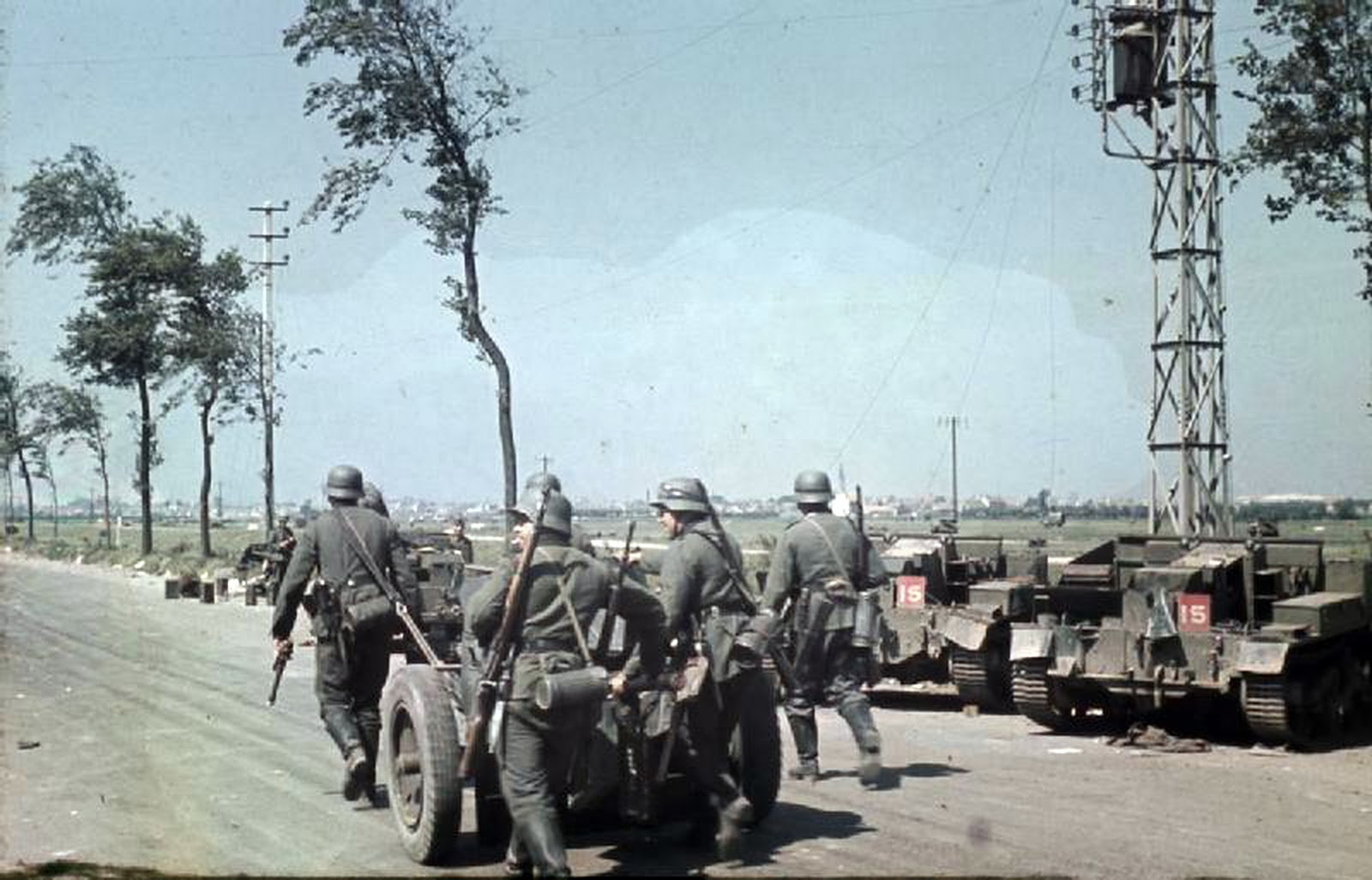
German forces arrive in Dunkirk. The sea front at Dunkirk photographed immediately after the completion of the evacuation of the British Expeditionary Force earlier in the day. Vehicles and troops of the German mobile assault unit Motorensturm 13, drawn up on the sea front at Dunkirk near one of the unit's light anti-tank guns.
Battle of France. German troops in Dunkirk beach immediately after the evacuation of the British Expeditionary Force. These photo in color were taken on June 4, 1940 by an officer of Maschinengewehr-Bataillon 52 (52nd machine gun battalion) of the Wehrmacht, Hermann Weper. These photos capture the initial stage of World War II. The beginning of the history of the great war.
These color photos show the aftermath of the Battle of Dunkirk (Battle of France) – the battle of WW2 between the Allied forces and Germany, which took place on May 26 – June 4, 1940 during the French campaign of the Wehrmacht.
Winston Churchill, in his famous speech “We Will Fight on the Beaches” in 1940, called the events in Dunkirk “a miraculous deliverance” , a good fortune for the allies. Churchill’s accolades were intended for a rescue operation in which 338,226 French and British soldiers were evacuated from the beach and harbor of Dunkirk, France.
Initially, it was assumed that the German troops occupying France would reach the coast where the military was stationed within two days.
In this case, it would be possible to ensure the safety of only 43 thousand soldiers. Nevertheless, thanks to the confusion of the Germans and the courageous actions of the members of the Coalition, the British and military soldiers were saved. The French-German border was almost entirely fortified by the so-called “Maginot Line”, but its northern section was protected only by the Ardennes forest. The Allies assumed that it was too thick and did not require serious protection, but the German troops managed to pave a road through the thicket.
As a result, the Germans actually ended up in the rear of the Allies, forcing them to move into Belgium, where they faced even more enemy soldiers. The only option was to enter the coastal city of Dunkirk, from where the military could be evacuated to England.

German forces arrive in Dunkirk after the completion of the evacuation of the British Expeditionary Force earlier in the day. Under the direction of their German captors, French troops push away an immobilised British Universal Carrier tracked vehicle, clearing the blocked road into Dunkirk. This picture was taken by Hermann Weper, an officer serving with Maschinengewehr-Bataillon 52, on 4 June 1940 following the seizure of Dunkirk.

German forces move into Dunkirk. Disarmed French soldiers file pass German officers on the outskirts of Dunkirk. The evacuation of the British Expeditionary Force had been completed a few hours earlier.

German forces move into Dunkirk hours after the evacuation of the British Expeditionary Force. Curious German officers inspect the memorial to the French aviation pioneer, Louis Bleriot on the sea front at Dunkirk. It is surrounded by German vehicles and the litter of the British evacuation.

On the outskirts of Dunkirk, German officers confer by their vehicles at the roadside before moving into the town.

On the outskirts of Dunkirk, a German officer interrogates two captured French officers who sit under guard near a roadside table laden with wine bottles. A German inflatable rubber dinghy is visible behind the table.

German forces move into Dunkirk hours after the evacuation of the British Expeditionary Force was completed. A beached French coastal patrol craft at low tide at Dunkirk. The ship is armed with a 75mm canon on its foredeck and probably dates from the First World War. A British Universal Carrier and a bicycle lie abandoned half buried in the sand.

A photo taken by Hermann Weper, an officer serving with Maschinengewehr-Bataillon 52, on 4 June 1940 following the seizure of Dunkirk: German forces arrive in Dunkirk. The sea front at Dunkirk photographed immediately after the completion of the evacuation of the British Expeditionary Force earlier in the day. The crew of a 20mm Flak 38 gun of the German mobile assault unit Motorensturm 13 stand guard on the seafront. The gun is covered with a camouflage shelter quarter. Debris left by the evacuating British forces is visible in the background.

German troops pulling a 37mm anti-tank gun along a road near Dunkirk. Immobilised British Scout carriers are parked at the side of the road
Source :
https://www.relicsww2.net/the-wehrmacht-in-dunkirk-june-1940-8-photo-in-color/
 Pictures from Walter Nödinger's estate (arrow point). In World War II he served as a sailor on the German submarine U-952, a Type VIIC U-boat whose career began with training at 5th U-boat Flotilla on 10 December 1942, followed by active service on 1 May 1943 as part of the 3rd Flotilla for the next seven months. On 1 February 1944 she transferred to serve with 29th Flotilla, based in La Spezia, for Mediterranean operations. In five patrols she sank two merchant ships, for a total of 13,374 gross register tons (GRT), plus one warship sunk and a further merchant ship damaged. U-952 was decommissioned on 12 July 1944 after being badly damaged on 5 July 1944 by US air raid. Her wreck was captured by French and broken up in 1946. The veteran crews met regularly for many years. Walter Nödinger passed away in May 2014.