Showing posts with label Terrain - Rural. Show all posts

Tuesday, October 10, 2023

Panzer IV of Panzer-Regiment 31


Agfa color slide showing Panzerkampfwagen IV Ausf.F1 of Panzer-Regiment 31 / 5.Panzer-Division. At the time of delivery to the 31st Tank Regiment, it was painted tropical and was overcoated with RAL7021 (almost completely on the front and in a fine pattern on the other side), but the antenna deflector had shifted and the base was exposed.

Source :
Akira Takiguchi photo collection
https://twitter.com/atakiguchi/status/1709787643675119922/photo/1

Thursday, October 5, 2023

Gotthard Heinrici and Heinrich von Vietinghoff


From left to right: General der Infanterie Gotthard Heinrici (Kommandierender General XXXXIII. Armeekorps) and General der Panzertruppe Heinrich von Vietinghoff (Kommandierender General XXXXVI. Armeekorps). The picture was probably taken in the autumn of 1941 when both Army Corps were under the command of 4. Armee (Hans-Günther von Kluge). The picture was taken from the photo album of XXXXVI. Panzerkorps, courtesy of Akira Takiguchi.


Source :
Akira Takiguchi photo collection
https://twitter.com/atakiguchi?lang=en

Monday, September 11, 2023

Luftwaffe Soldiers Inspecting T-34 Tank


Members of the Luftwaffe inspects a captured Russian T-34/76 medium tank. The enemy's vehicles were always of great interest. This tank in particular was a nasty surprise, as it was initially superior to the German combat vehicles. However, the open commander's hatch shown in the picture was a disadvantage because it was difficult to open and close and therefore did not have a good overview of the battle.

Source :
https://www.zinnfigur.com/en/Books-Media/Others/Calendars/Zweiter-Weltkrieg-in-Farbe-2023.html

Monday, July 10, 2023

A U.S. Army cavalry squadron trots past a Piper Cub


A mounted U.S. Army cavalry squadron trots past a fuels up J-3 Piper Cub and civilian onlookers being evaluated for aerial observation during the 1941 "Louisiana Maneuvers", the war game that were designed to evaluate the U.S. Army for World War II. The success of this demonstration led to the Army acquiring civilian lightplanes to be flown by Army artillery officers. These planes were known as “grasshoppers” – as can be seen with the yellow insignia – for their ability to get in and out of tight landing areas. Photo by Hans Groenhoff.

Source :
From the collection of the National Air and Space Museum Archives, Hans Groenhoff Photographic Collection, NASM 2004-51346
Smithsonian National Air and Space Museum
https://www.flickr.com/photos/airandspace/albums/72157715574200936
https://twitter.com/Erikhistorian/status/1300554071091425280

Sunday, December 25, 2022

German Soldiers and Civilian in the Eastern Front

German officers in front of a shed on the Eastern front, where women work with hay. The war inflicted huge losses and suffering upon the civilian populations of the affected countries. Behind the front lines, atrocities against civilians in German-occupied areas were routine, including those carried out as part of the Holocaust. German and German-allied forces treated civilian populations with exceptional brutality, massacring whole village populations and routinely killing civilian hostages (see German war crimes). Both sides practised widespread scorched earth tactics, but the loss of civilian lives in the case of Germany was incomparably smaller than that of the Soviet Union, in which at least 20 million were killed.
 

Source :
https://en.wikipedia.org/wiki/Eastern_Front_(World_War_II)
https://forum.axishistory.com/index.php

Sunday, December 18, 2022

German Bicycle Soldiers Before Barbarossa

German soldiers on bicycles (Radfahrtruppen) driving towards the German-Soviet demarcation line to their deployments before the attack on the USSR a.k.a. "Unternehmen Barbarossa" (Operation Barbarossa), June 1941. The Wehrmacht did invest in bicycle troops for Barbarossa, but the soviet road system was bad enough that most bike columns looked like this and mobility was effectively foot mobile with perhaps slightly greater combat load per soldier. As well, German bike troops frequently lacked organic artillery and engineers that the giant kessels that Barbarossa created forced the infantry to use to grind them down, and this further limited bike troop’s utility.

Source :
https://en.wikipedia.org/wiki/Bicycle_infantry
https://www.feldgrau.net/forum/viewtopic.php?t=22483
https://www.reddit.com/r/WarCollege/comments/h0afzb/why_no_bikes_in_barbarossa/
https://www.themodellingnews.com/2015/05/build-review-135th-german-military.html

Tuesday, October 25, 2022

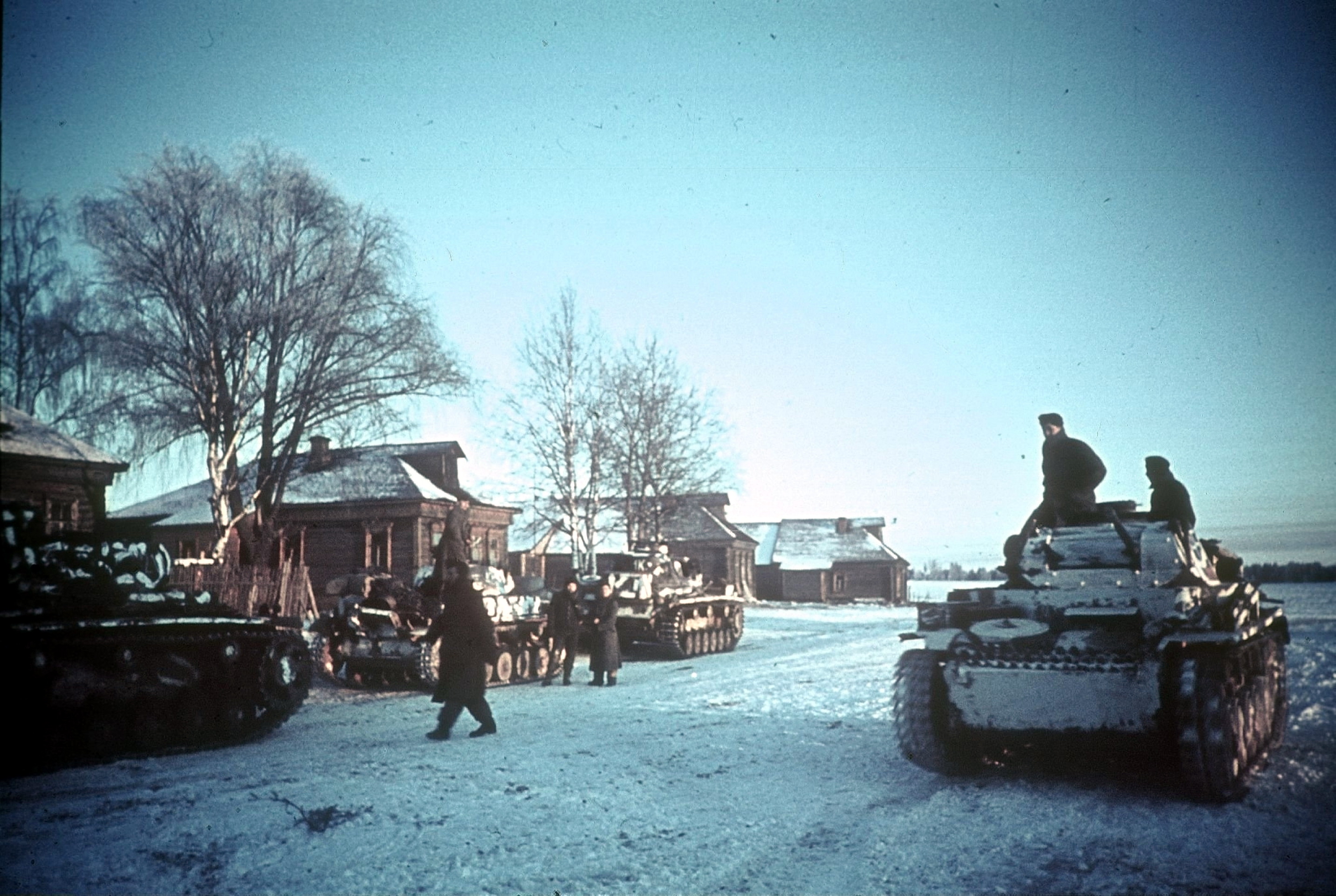
German Tanks Near Moscow

White winter camouflaged tanks of the 11. Panzer-Division in the village of Matronino near Volokolamsk. On the left, the first and third are Panzer III tanks, while between them and on the right is Panzer II tanks. The picture was taken by Kriegsberichter Artur Grimm in Moscow area, November 1941. From 31 October to 13–15 November 1941, the Wehrmacht high command stood down while preparing to launch a second offensive towards Moscow. Although Heeresgruppe Mitte (Army Group Centre) still possessed considerable nominal strength, its fighting capabilities had thoroughly diminished because of wear and fatigue. While the Germans were aware of the continuous influx of Soviet reinforcements from the east as well as the presence of large reserves, given the tremendous Soviet casualties, they did not expect the Soviets to be able to mount a determined defense.

Source :
https://en.topwar.ru/189069-tanki-shli-naprolom-podvigu-geroev-panfilovcev-80-let.html
https://en.wikipedia.org/wiki/Battle_of_Moscow

Tuesday, October 11, 2022

German Soldiers Take Cover in the Bush

Fightings on the southern section of the Eastern Front (Ukraine), probably summer 1941 or 1942. German soldiers take cover in the bush. Photographer: Artur Grimm.

Source :
https://www.pinterest.cl/pin/629026272928634347/

Sunday, October 9, 2022

Russian POW Collecting Wood in Norway

Russian prisoners fetch wood for heating. In the background POW camp in Rønvik which located in Bodø Municipality in Nordland county, Norway. The picture was taken by Martin Hennig in 1944.

Source :
https://www.tekniskmuseum.no/grossraum-bildegalleri/39-nettutstillinger/grossraum/569-grossraum-korsnes-sorfold-morsvik-leirfjord

Thursday, October 6, 2022

German Soldiers in the Ukrainian Cornfields


German soldiers taking cover in a cornfield on their advance to an ukrainian village, summer 1941. The picture was taken by photographer Artur Grimm during Unternehmen Barbarossa, German invasion of Soviet Union. The great plain of Europe stretches from the coast of the English Channel across the Low
Countries, Germany, Poland, and the Soviet Union to the foothills of the Urals. Occasionally, as
if about to change its character, it gathers into the folds of undulating hills, but always it subsides
again into monotonous flatness. Bounded on the north by the sea, and on the south, at least until
the Ukraine, by mountains, it has for centuries been the stage on which first the tribes of Europe,
Celt, Teuton, and Slav, then the fanatics of religion, and finally the more formalised, but no less
warlike, armies of the national states which succeeded them, have enacted the gory dramas in
which European history so deplorably abounds.

Source :
http://losgrandesfotografos.blogspot.com/2018/02/arthur-grimm-1908-1990.html
https://www.stalingrad.net/introduction/introduction.html
https://waralbum.ru/371741/

Sunday, October 2, 2022

German Halftrack Towing Artillery during Barbarossa

German artillery on the advance in the Ukraine: Sd.Kfz.7 KM m8 half-track pulling a field gun, summer 1941. The use of half-tracked prime movers for artillery was common in the German forces but not elsewhere. Compared to wheeled vehicles, half-tracks are more difficult to maintain, they often suffer track breakages, and are slower on roads. However, they have better off-road mobility compared to wheeled vehicles. Photographer: Artur Grimm.

Source :
https://en.wikipedia.org/wiki/Sd.Kfz._7
https://www.gettyimages.com/detail/news-photo/soviet-union-ukrainian-ssr-world-war-ii-german-artillery-on-news-photo/548129269

Thursday, September 9, 2021

Burial of Russian Civilian

Funeral of a Russian civilian. The body was taken from the coffin and placed in a blanket of the earth. The picture was taken by an unknown German photographer in the period of 1941-1943.


Source :
Bundesarchiv Bild 169-0339

Sunday, January 17, 2021

Severe Winter in Russia 1941-42

Winter in the Eastern Front, 1941-42. The winter of 1941–42 is known as the coldest European winter of the 20th Century. The temperature was much below normal from the beginning of January until the end of March 1942. Blockings and cut-off lows were frequent, particularly during January and February 1942. The role of quasi-stationary waves during this winter has been studied by decomposing the 500-mb geopotential height data in a low-pass, filtered, quasi-stationary part and a traveling part. The phase of the quasi-stationary wave was such that a ridge was present over the eastern Atlantic and a trough over western Russia throughout most of the winter. As a result, the majority of migratory cyclones that approached Europe from the west were steered either south toward the Mediterranian or north of Scandinavia. Photos by Dr. Paul Wolff and Alfred Tritschler.


Source :
https://www.facebook.com/groups/237076659811098/permalink/1653292204856196/?__cft__[0]=AZXVbR-ov97tjXfW9zk4mYHF4ga0e1_E2XXLpRZ5lTxcrzqaGdgmfR6RLyeoAeYbR1z9F3WcYJT9qUaJTRhDlCwvA4Z9B69BQCEqfQSEUfku00_bKTcu8opbtFy5wcpXqItcjkKkTeFmUhz2oDMR2LnHs02DyB_7jMZC7LwkBWQF3Lnp9zZLQ5_KcfduSE3_xY0&__tn__=%2CO%2CP-R
https://journals.ametsoc.org/view/journals/bams/70/3/1520-0477_1989_070_0271_tswiet_2_0_co_2.xml

Friday, January 1, 2021

Erasing the Winter Camo on Halftrack


1943. Winter is over. Time to "clean the white": German soldiers wash off winter camouflage from the Sd.Kfz half-track armored personnel carrier. 251/1 Ausf.C Hanomag at a hut in Ukraine.


Source :
https://www.facebook.com/photo/?fbid=3794601307258767&set=gm.2749314025335825

Sunday, December 20, 2020

Panzergrenadiers Driving through Burning Village


Panzergrenadiers of the German Wehrmacht driving through a burning village somewhere on the Eastern Front. 1944. Propaganda photo by SS-Kriegsberichter (war reporter) Grönert. Taken from “Signal” magazine, 5th year, issue 18, 1944.


Source :
https://www.facebook.com/groups/237076659811098/permalink/1630505800468170/?__cft__[0]=AZUc7whqFkzd07ifDVuONGhje1Yk965FgCPGWG8exXHdRwSpRCFcD07Jw8rZe8jAJ_ni5KEP9r7HGjrmxxErk988cX01Pg-Q4_Vd-RO3cdG0MkYyix22l7DHO8kZLJYL4cY16KllMghhaNOpW8_TtfXgb3wsnwGsprC9LuiQj_nwWTJezhiaWZ0fpWEnGrONQSQ&__tn__=%2CO%2CP-R

Wednesday, December 9, 2020

Villagers of the Eastern Europe


Villagers photographed while Organization Todt works in a village in eastern Europe, 1943. From the estate of Dr. Grögl. Peugeot DMA truck in the background.


Villagers photographed while Organization Todt works in a village in eastern Europe, 1943. Another slide (a few frames back) added - dance time. Mostly women and children, a few young lads and one older man from the village.


Source :
Akira Takiguchi photo collection
https://www.facebook.com/groups/237076659811098/permalink/1621195738065843/?__cft__[0]=AZVh0Uofo_RtYTAlS3_Z3kmliBbdIPBwud9ehnXi75oZyM-Od-41rELEu1jamMrM0UJ10dB2sKT5y8rLpGo-4sJf92YcN1zdElXqa4lnLj0SwyGOM0jcLPnBKibk8XiuziLH4Vv5sc-R7gmM9frZxTCK&__tn__=%2CO%2CP-R

Friday, June 12, 2020

German Prisoners in the Last Day of the War

May 8th 1945...the war is over.

Source :
Courtesy of Markus Hawranke at https://www.facebook.com/photo.php?fbid=642184269841443&set=gm.1464638437054908&type=3&theater&ifg=1

Sunday, April 26, 2020

The photographer Franz Grasser posed as a Wehrmacht soldier with a machine gun in a foxhole. The picture was taken in the Russian front, 1943-1944.


Source :
http://www.deutschefotothek.de/documents/obj/89006233

Monday, April 20, 2020

MG Squad of SS Wiking Division

MG squad of SS-Infanterie-Division "Wiking" (motorisiert) in a village in the area of ​​Heeresgruppe Süd (Army Group South), 1942.


Source :
Archiv für Zeitgeschichte, Stuttgart
Courtesy Franz-Paul Peterka at https://www.facebook.com/photo.php?fbid=2928069343898573&set=gm.1420020851516667&type=3&theater&ifg=1

Sunday, March 22, 2020

Panzer III of LSSAH

This beautiful color photograph on Agfacolor Farbdia paper shows a Panzerkampfwagen III Ausf.J #556 from Stab II.Abteilung (company 5,6,7,8) of SS-Panzer-Regiment 1 / SS-Panzergrenadier-Division "Leibstandarte SS Adolf Hitler", near Belgorod, spring (April or May) in 1943. The panzer was equipped with schürzen (which had just been officially used!) And transported Waffen-SS members. From the three antennas attached to his body and the officers hanging around the front, we can tell that this is Panzerbefehlswagen (commander's tank). When it was transferred to Italy at the end of 1943, LSSAH left part of its panzer to be used by the SS Division "Das Reich" and "Totenkopf". This photo was made by Kriegsberichter Franz Grasser.


Source:
https://www.flickr.com/photos/81723459@N04/16756403676/