Showing posts with label US Truck. Show all posts

Wednesday, November 30, 2022

USMC Trucks in Agana City Guam

Guam Operation, 1944. U.S. Marine Corps trucks on a road into Agana City, July 1944. The town was heavily damaged during the bombardment. The Battle of Guam (21 July–10 August 1944) was the American recapture of the Japanese-held island of Guam, a U.S. territory in the Mariana Islands captured by the Japanese from the United States in the First Battle of Guam in 1941 during the Pacific campaign of World War II. The battle was a critical component of Operation Forager. The recapture of Guam and the broader Mariana and Palau Islands campaign resulted in the destruction of much of Japan's naval air power and allowed the United States to establish large airbases from which it could bomb the Japanese home islands with its new strategic bomber, the Boeing B-29 Superfortress.

Source :
https://en.wikipedia.org/wiki/Battle_of_Guam_(1944)
https://www.facebook.com/photo/?fbid=7516063455147069&set=gm.2159681720883906&idorvanity=237076659811098
https://wiadomosci.onet.pl/swiat/bitwa-o-guam-wyspa-w-ostatnich-latach-ii-wojny-swiatowej/z19cq39

Tuesday, January 5, 2021

Free French Rest in a Poppy Field


In the Fields where the Poppies Grow... Free French soldiers rest in a poppy field near the M4 'Sherman' tanks. Between the tanks worth army truck 'Chevrolet' G7107. Italy, August, 1944. Parking in the open instead of near the trees in the background only shows the total allied air supremacy in Europe!


Source :
https://www.facebook.com/photo/?fbid=2896136927341279&set=gm.1644674452384638

Thursday, December 31, 2020

A Captured US Truck belong to the Wehrmacht


A Studebaker US6 2½-ton 6×6 truck. Probably a lend lease truck captured from the Russians. This US truck is captured with WH numberplates and washed white winter chalk camopaint. In the convoy you can see also in the background an Opel Blitz 3,6 3ton. This picture, which was probably taken in 1944, come from a color slide estate of a Hungarian doctor.


Source :
Akira Takiguchi photo collection
https://www.facebook.com/photo/?fbid=10222729821307635&set=gm.1640137202838363

Monday, April 9, 2018

US Troops Marching in Saint-Lô

United States Army trucks and jeeps drive through the ruins of Saint-Lô, Normandy (France), in July of 1944. A group of American soldiers is walking along the street. The town was almost totally destroyed by 2,000 Allied bombers when they attacked German troops stationed there during Operation Overlord. The Battle of Saint-Lô is one of the three conflicts in the Battle of the Hedgerows (fr), which took place between July 9–24, 1944, just before Operation Cobra. Saint-Lô had fallen to Germany in 1940, and, after the Invasion of Normandy, the Americans targeted the city, as it served as a strategic crossroads. American bombardments caused heavy damage (up to 95% of the city was destroyed) and a high number of casualties, which resulted in the martyr city being called "The Capital of Ruins", popularized in a report by Samuel Beckett. The picture was taken by Reinhard Schultz from PRISMA magazine


Source :
http://www.alamy.com/stock-photo-world-war-ii-normandy-saint-lo-july-1944-second-world-war-ww2-war-30511322.html
https://www.gettyimages.com/articles/news/see-rare-color-pictures-of-d-day
http://historyinphotos.blogspot.co.id/2016/01/world-war-ii-in-color.html
https://www.theatlantic.com/photo/2014/06/scenes-from-d-day-then-and-now/100752/
https://www.turkishnews.com/en/content/2015/12/20/d-day-in-color-photographs-from-the-normandy-invasion/

Monday, March 28, 2016

Build-Up of US Army Vehicles Before D-Day

Castletown Road Slipway, Portland, Dorset (England), 5 June 1944. Trucks and Willys MB jeeps which will carry men and supplies of the U.S. 32nd Field Artillery Regiment / 1st Infantry Division "The Big Red One" to the front lines of the invasion in Normandy on D-Day are loaded onto an American Landing Craft. The Divisional HQ jeep at right (with Divisional HQ tactical insignia in the bumper: black star on dark yellow circle; 1-X: indication of the Division Headquarters; Star in center bumper; HQ-19: 19th vehicle of the Division Headquarters; and Barcode with five-digit number of the DivHQ) has an 15'x15' vehicle camouflage net (this type of net with interwoven twine came in different sizes) above the white star on a yellow background marking. The yellowy green (or greeny yellow) background between star and circle was a kind of gas detecting paint that was supposed to change colour during a chemical attack. Presumably these jeeps are an example of the stuff. Might also be worth noting that a yellow or white star in black and white photos would show up the same tone. Closer analysis of even quite familiar black and white pictures recently seems to be turning up even camo schemes that have been almost lost in the monochrome process. In the dust and confusion of the battles in the North Africa previously, the US star could be mistaken for a German Cross at long range (greater then 1000 yards). Tankers and armored units began painting out the stars to avoid becoming a casualty of ‘friendly fire’. The addition of the circle around the star helped to resolve this problem, though some of the more experienced units (like the 2nd Armored) stayed with the painted out stars until the Normandy landings. There they painted the vehicle number on the sides of the turret in yellow. This was painted out by D-Day + 14. After Normandy several armored divisions were sent into Europe but kept their stateside markings, except the bar, and that is why one sees so many variations in pictures.


Source :
http://historylink101.com/ww2_color/WorldWarIIAmphibiousUnit3/PICT0442.html
http://www.usmilitariaforum.com/forums/index.php?/topic/57160-the-liberator-collection/page-18
http://ww2talk.com/forums/topic/6397-yellow-circles-white-stars/

Thursday, February 18, 2016

Italian Partisans gave up Their Arms to American MPs

Every 25 April, Italian people celebrate the liberation from the Nazi-Fascist Forces and the Resistance’s fight against the same forces side by side of the Allies. This photo show the U.S. MPs (Military Police) disarming the Italian partisans, dressed with worker coverall and white band over the left hand, at Bologna, Piazza Vittorio Emanuele, late April 1945. They were disarmed after the end of the fights and the formal disbandment of their organization ordered by the Allies Authorities. During the Second World War, the campaign in Italy was one of the most destructive fought in Europe – a long, bitter and highly attritional conflict that raged up the country’s mountainous leg. For frontline troops, casualty rates at Cassino and along the notorious Gothic Line were as high as they had been on the Western Front in the First World War. There were further similarities too: blasted landscapes, rain and mud, and months on end with the front line barely moving. And while the Allies and Germans were fighting it out through the mountains, the Italians were engaging in bitter battles too. Partisans were carrying out a crippling resistance campaign against the German troops but also battling the Fascists forces as well in what soon became a bloody civil war. Around them, innocent civilians tried to live through the carnage, terror and anarchy.


Source :
http://historylink101.com/ww2_color/WorldWarIIParade1/IMG_1099.html
http://stukasoverstalingrad.blogspot.co.id/2013/02/italian-partisans.html

Tuesday, February 16, 2016

Earl Clark from US 10th Mountain Division

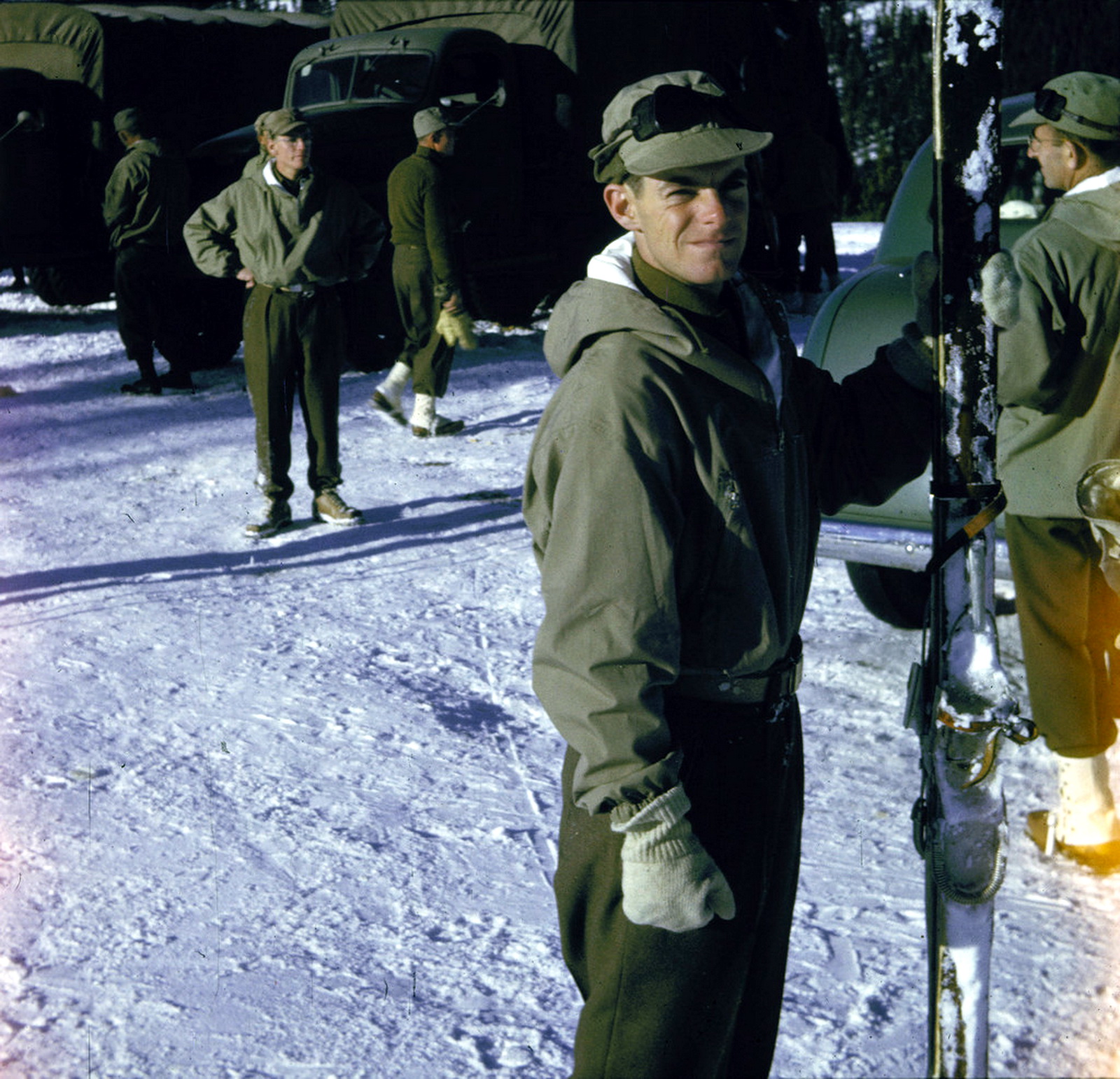
Earl Ervin Clark, a member of the 1st Battalion / 87th Headquarters Regiment / 10th Mountain Division (US Army), poses with a pair of skis at Camp Hale (Eagle County), Colorado, 1943 or 1944. Other soldiers and trucks are nearby. Clark served in the US army's elite 10th Mountain Division from its inception. The division played a key role in breaking down Nazi defences in the Spring Offensive of 1945, helping force the Italian surrender and the fall of the Third Reich.

A skilled skier since his teens, Clark took part in the vital battles for Riva Ridge and Monte Belvedere in Italy's Northern Apennines. His company scaled Belvedere, covered in ice and snow, on 19 February 1945, their hickory skis strapped to their shoulders and bayonets fixed on their M1 rifles. The German defenders, a battalion of highly-trained mountain soldiers, had assumed that the mountain, at points almost vertical, was insurmountable from the south-west and were watching for allied movements in the valley below.

They had laid mines on the steep slopes but the Americans caught them unawares. The 10th Mountain's commander, General George P Hays, had told his men: "until first light, no small arms fire, only hand grenades and bayonets." Clark recalled the last words before the silent assault. "Fix bayonets. Move out!" The next voices he heard, at the peak, were cries and screams in German.

The 10th Mountain Division soldiers, having dismantled the mines, overran the enemy and, after heavy gunfire and bayonet-to-bayonet fighting, captured the peak. Clark always gave credit to the infantrymen of the Brazilian Expeditionary Force, who flanked the Americans.

"Fog had helped in the initial assault on Riva Ridge," Clark recalled. "That gave us a bit of leeway to attack Mount Belvedere." A comrade added: "We usually had a medic with us. This time they gave us five or six. We got the message. We went up in single file. Had they spotted us, there would have been no room for us to deploy. The Germans were either having breakfast or sleeping. Our grenades were their alarm clock."

In the first three days of intense combat for Belvedere, and after several German counter-attacks, the American "mountain warriors" lost 195 dead and 850 wounded or captured. But they took around 1,000 German prisoners and pushed on towards the vital river Po. At noon on 23 April 1945 Clark was among the first allied troops to cross the Po, in 50 light canvas assault boats and under heavy fire.

Spearheading the US Fifth Army, they pushed forward to Lake Garda and cut off the Germans' main escape route to the Brenner Pass. It was one of the fastest forward movements of the war and, in the lowlands, the "Mountain Warriors" ditched their skis, swapped their snow uniforms for olive drabs and hitched rides on army trucks, tanks or their own snow-hardy M-29 Weasel assault vehicles. Hitler surrendered two weeks later.

By the end of the war the 10th Mountain Division had lost 1,000 men, with 4,000 wounded. One of Clark's comrades was 2nd-Lt Bob Dole, whose arm wound left him partially disabled but did not stop him from becoming a US Senator for Kansas and a Republican presidential candidate against Bill Clinton!

In retirement, Clark and many of his former comrades helped create a fledgling ski industry back home, based on what they had seen in the Alps and Apennines, building ski lifts, chalets and resorts and turning the US into a major skiing attraction. To this day, the "10th Mountain" are considered the fathers of the modern American ski industry and a Vail restaurant called The 10th is a paparazzo's dream, favoured by film stars and Michelle Obama as an après-ski stopover.

Clark helped found the 10th Mountain Division National (Veterans') Association and later the International Federation of Mountain Soldiers. The few surviving men who fought each other in the mountains 70 years ago still meet annually to share their common bond.

Earl Ervin Clark was born in Londonderry, Vermont in 1919. Moving with his family to Wisconsin, he learned to ski on Wilmot Hills near Chicago at the age of 13. It was as a mountaineering and ski instructor, that he caught the notice of the US National Ski Patrol, entrusted to pick out an elite unit. The US had also been impressed by white-clad Finnish mountain soldiers who had fought against the Soviet invasion early in the war.

Clark joined up on St Patrick's Day, 1942, and was assigned to 1st Battalion 87th Infantry Regiment, later to form part of the 10th Mountain Division, America's first specific mountain warfare unit. Clark trained at Camp Hale, Colorado at altitudes of around 9,000 feet and even as high as the 14,410ft Mount Rainier in Washington state. Their marching or drinking song was "90 Pounds of Rucksack", which the Division sing to this day.

After the German surrender 10th Mountain were on stand-by to invade Japan but were stood down after the Japanese surrender. Clark was on the USS Mount Vernon when the news came through that an atomic bomb had been dropped on Hiroshima. The 10th Mountain Division took part in Operation Uphold Democracy in Haiti in 1994, helicoptering in to Port-au-Prince airport in scenes reminiscent of Apocalypse Now, and went on to serve in Afghanistan.

Clark enrolled in the University of Denver under the GI Bill, got a business degree and went on to make the mountains and skiing his life. He and other 10th Mountain vets helped design pistes, became ski coaches, guides, patrollers, magazine founders, filmmakers, ski shop owners and even professional downhill and slalom racers. Clark became a volunteer for the US National Ski Patrol as a guide and instructor. He became an office manager for an ice cream distributor and later an insurance agent.

He kept skiing, remained in the Army reserve and retired in 1981 as a Lieutenant-Colonel. He set up a group of 10th Mountain vets called the Pando Commandos, who, wearing their old combat whites, give ski demonstrations in Rocky Mountain resorts and he helped run the Over-The-Hill Gang, initially a US club for older skiers and now running ski tours worldwide.

Earl Ervin Clark, mountain soldier: born Londonderry, Vermont 3 July 1919; married 1948 Betty Grunwald (deceased, one son); died Littleton, Colorado 28 December 2014


Source :
http://amyatishkin.livejournal.com/287245.html
http://www.independent.co.uk/news/people/news/lt-colonel-earl-clark-mountain-warfare-veteran-who-helped-establish-the-leisure-skiing-industry-in-10114601.html

Friday, January 15, 2016

US Paratroopers of the 82nd Airborne Preparing for a Jump in Italy

US Paratroopers of the 82nd Airborne preparing for a jump on Salerno (Italy) in September 1943. The distinctive color of the parachutist's utilities and the brown jump boots are clearly seen. Note also the CCKW 2 1/2-ton 6x6 transport truck with color bar marking on the door. These color bar coding used as a representation of army unit numbers used for shipping vehicles on a sea voyage (probably because it would be easier to put the vehicles of a certain unit together on the same boat that way, but you see different versions of the bars, with and without a letter next to it).


Source :
Book "US Special Forces of World War II" by Leroy Thompson
http://cckw.org/forum/viewtopic.php?f=1&t=2683

Wednesday, January 13, 2016

US Gunners Prepare their Howitzers for Shipment

At the end of the war in Europe, gunners of the U.S. 87th Infantry Division prepare their M2A1 105mm howitzers for shipment back to the United States. The 105mm was the standard field piece of American infantry divisions during World War II. Each infantry division would have been equipped with 36 of these guns. In armored divisions, the 105mm was mounted on a Sherman tank chassis and operated as self-propelled artillery. At the left of the picture are the two-and-a-half-ton trucks that towed the 105mms.


Source :
Book "Patton's Third Army" by Christopher J. Anderson

Tuesday, January 5, 2016

Soldiers of the U.S. 734th Field Artillery Battalion with truck

Soldiers of the U.S. 734th Field Artillery Battalion with truck. The battalion were equipped with the M1 155mm gun, known as a "Long Tom" (an appellation with a long and glorious tradition in the U.S. artillery.) It combined long range, accuracy, and hitting power with a well designed, mobile carriage. Nearly all US artillery battalions were organized with three firing batteries and a total of twelve tubes. The exception was the eighteen-tube armored field artillery battalion and the six-tube 8" gun and 240mm howitzer battalions. A major advantage for the American artillery was that it was fully motorized and highly mobile. All 105mm and 155mm howitzer battalions in the ETO were truck-drawn, although a Table of Equipment (TE) for a tractor-drawn 155mm battalion existed. The 155mm gun battalions were almost all tractor-drawn, although a few evidently were also truck-drawn. The 4.5" gun, 8" gun, 8" howitzer, and 240mm howitzer battalions were all tractor-drawn, although, again, a TE for truck drawn battalions existed. The standard prime mover was a two-and-one-half ton truck for the 105mm and a 4-ton Diamond T truck for the 155mm howitzers. Tractors included the M5 thirteen-ton prime movers, which were utilized for the 105mm M2 howitzer, the 4.5" gun, and 155mm M1 howitzer, and the M4 eighteen-ton hi-speed, full-track, heavy prime mover, which was utilized for the 3" AA gun, the 90mm AA gun, the 155mm Long Tom gun, 8" howitzer, 8" gun, and 240mm howitzer. Redundant M3 medium tank chassis, without armament, and M31 and M32 armored recovery vehicles were also utilized as prime movers for the heavier artillery pieces. Non-divisional artillery battalions were normally subordinated to field artillery groups. The groups were formed in 1943 from the headquarters battery of the broken up field artillery regiments. The field artillery group consisted of an H&H Battery, with a command element and a fire-direction center element, and a Service Battery. A group was usually assigned from two to six battalions, although one or more of the battalions might be attached for direct support of an individual division. Usually, the groups were assigned howitzer and gun battalions of companion caliber, that is, 155mm howitzers were grouped with 4.5" guns, 8" howitzers with 155mm guns, and 8" guns with 240mm howitzers. The normal ratio was one gun battalion for every two howitzer battalions, although this was not always firmly adhered to. Separate 105mm howitzer battalions were normally grouped together, but were almost always assigned to direct support of divisions. The 155mm SP gun battalions were assigned to groups as the tactical situation warranted, or were frequently attached, by battery or battalion, to armored or infantry divisions. This picture was taken by H.W. Luetjen who served in the 734th FA.


Source :
http://www.lonesentry.com/photoalbums/luetjen/
http://www.militaryhistoryonline.com/wwii/usarmy/antiair.aspx

Monday, October 5, 2015

Wreckage of Bf 110 in France

The sad remains of a Messerschmitt Bf 110 G-4, aircraft code 3C+DR (all in black), of 7.Staffel / III.Gruppe / Nachtjagdgeschwader 4 (NJG 4). The photographs were taken in the summer of 1945 at Reims airfield in France. III./NJG 4 had began converting from the Bf 110 G-4 to the Junkers Ju 88 G-1 in the summer of 1944 and completed the process in October, therefore this must have been an aircraft that was taken out of service or used for some other purpose by the Gruppe. The Bf 110 was probably parked in some corner of the airfield and left to rot, as its seriously faded camouflage finish would suggest. Pieces of a Ju 88 are visible in the background. The remnants of a yellow fuselage band may just be seen in front of the unit code "3C", while a letter of the manufacturer's code is visible under the "3C". Also note the simplified white Balkenkreuz. In the other photograph we can see the remnants of the SN-2 radar on the fuselage nose. Camouflage: RLM 75 + 76.


Source :
 "Luftwaffe im Focus", Spezial No.1 - 2003

Sunday, August 9, 2015

Trucks and Tanks of the 752nd Tank Battalion Leaving Rome

During the Second World War, despite being the capital of Italy, Rome was declared an "Open City" and never bombed or otherwise damaged by the war. After the Allies captured Sicily in 1943, the Mussolini's Fascist government collapsed. The Allies invaded mainland Italy on September 3, 1943 and slowly moved up the peninsula. Even after the American invasion at Anzio on January 22, 1944, it was hard to advance north toward Rome. Finally on June 4, 1944, American troops liberated Rome. Crowds of ecstatic Italians spilled into the streets to welcome the Americans as the main elements of the U.S. Fifth Army moved north through the city. This rare color photo showing trucks and tanks of the 752nd Tank Battalion leaving Rome on 5 June 1944. A small crowd of curious civilians watches the column move through the Porta del Popolo and past the Chiesa di San Maria del Popolo. The Signal Corps shot only a relatively small number of color photos during World War II. Fortunately, color photographers followed the 752nd during the summer and fall of 1944


Source :
http://www.752tank.com/ebolitorome.html
http://home.earthlink.net/~mcgady/Rome/rome.html

Friday, November 21, 2014

Afrikakorps POWs at El Guettar Valley

 German POWs receive water ration in an Allied-controlled prison camp at El Guettar Valley, Tunisia, 1943. in mid-February 1943 the Axis forces launched a strong counter-attack against the US II Corps in south-western Tunisia. The 1st Armored Division's counter-moves ended in a complete disaster, the division losing two of its tank battalions in two days, with over 2,500 American soldiers being taken prisoner on February 16 and 17. After 22 days of tough fighting at El Guettar the US Army were regenerated after its unfortunate setback. Now under George S Patton's energetic command, the self-confidence and offensive spirit of the 1st Armored and 1st Infantry Divisions returned and the 9th Infantry Division had gone from being a green, inexperienced outfit to a combat-experienced and able fighting unit. The Battle of El Guettar was fought between elements of the Heeresgruppe Afrika under Generaloberst Hans-Jürgen von Arnim - along with Italian forces under General Giovanni Messe - and U.S. II Corps under Lieutenant General George S. Patton in south-central Tunisia. It was the first battle in which U.S. forces were able to defeat the experienced German tank units, but the followup to the battle was inconclusive. The picture was made by LIFE photographer Eliot Elisofon 


Source:
http://www.afterthebattle.com/store/index.php?id_product=149&controller=product
http://life.time.com/?N=0&Nty=1&p=0&cmd=tags&srchCat=LIFE&s=eliot+elisofon

German POWs at El Guettar Valley

German POWs receive water ration in an Allied-controlled prison camp at El Guettar Valley, Tunisia, 1943. in mid-February 1943 the Axis forces launched a strong counter-attack against the US II Corps in south-western Tunisia. The 1st Armored Division's counter-moves ended in a complete disaster, the division losing two of its tank battalions in two days, with over 2,500 American soldiers being taken prisoner on February 16 and 17. After 22 days of tough fighting at El Guettar the US Army were regenerated after its unfortunate setback. Now under George S Patton's energetic command, the self-confidence and offensive spirit of the 1st Armored and 1st Infantry Divisions returned and the 9th Infantry Division had gone from being a green, inexperienced outfit to a combat-experienced and able fighting unit. The Battle of El Guettar was fought between elements of the Heeresgruppe Afrika under Generaloberst Hans-Jürgen von Arnim - along with Italian forces under General Giovanni Messe - and U.S. II Corps under Lieutenant General George S. Patton in south-central Tunisia. It was the first battle in which U.S. forces were able to defeat the experienced German tank units, but the followup to the battle was inconclusive. The picture was made by LIFE photographer Eliot Elisofon


Source:
http://www.afterthebattle.com/store/index.php?id_product=149&controller=product
http://life.time.com/?N=0&Nty=1&p=0&cmd=tags&srchCat=LIFE&s=eliot+elisofon