Showing posts with label Operation Barbarossa. Show all posts

Sunday, August 23, 2026

German and Italian Troops in Stalino

NCOs of the German 1. Gebirgs-Division with Italian soldiers of the "Celere" Division in Stalino, Ukraine, October 1941. In that month, during the Axis advance into the industrial heartland of the Donets Basin as part of Operation Barbarossa, the 1. Gebirgs-Division, operating under the command of Generalmajor Hubert Lanz within the XXXXIX. Gebirgs-Korps led by General der Infanterie Ludwig Kübler, pushed southward after the Battle of the Sea of Azov and reached the major Soviet industrial city of Stalino (present-day Donetsk) on 20 October. Simultaneously, elements of the Italian Corpo di Spedizione Italiano in Russia (CSIR), commanded by Generale Giovanni Messe and attached to the German Heeresgruppe Süd, advanced in coordination with the German mountain troops; the highly mobile 3ª Divisione Celere "Principe Amedeo Duca d’Aosta" formed the spearhead of this effort, deploying its 3° Reggimento Bersaglieri in fast-moving columns supported by the cavalry regiments Savoia Cavalleria and Lancieri di Novara. Despite heavy mud, destroyed bridges, fuel shortages and determined Soviet rearguard resistance, the Italian cavalry and Bersaglieri executed flanking manoeuvres and seized the vital railway station and northern approaches to Stalino on the evening of 20 October, while German Gebirgsjäger entered the city from the south and completed the occupation of the industrial zone. The joint action, praised by both Italian and German commanders for the decisive contribution of the Celere Division’s mobility and the tenacity of the mountain troops, secured the key mining and metallurgical centre for the Axis and opened the route toward the Mius River. Following the capture, the 1. Gebirgs-Division continued eastward through Stepanowka, Amwrossijewka and Dmitrijewka, establishing a bridgehead across the Mius by early November, while Italian units of the Celere Division consolidated positions in and around Stalino before later sharing defensive sectors with the 1. and 4. Gebirgs-Division along the same river line through the harsh winter of 1941–1942.


Source :
https://www.facebook.com/photo/?fbid=2324520138285504&set=gm.4294751364097123&idorvanity=1599549446950675

Sunday, October 26, 2025

Hitler and Mussolini Visited the Eastern Front (1941)

In August 1941, as German forces surged deep into Soviet territory during Operation Barbarossa, Adolf Hitler invited Benito Mussolini to witness the triumph firsthand. Between August 25 and 28, the two dictators embarked on a high-profile visit to the Eastern Front—an event immortalized in vivid Agfacolor footage by Hitler’s personal pilot and filmmaker, Hans Baur. The visit was both a diplomatic gesture to reinforce Axis unity and a calculated propaganda display at a time when the Wehrmacht appeared unstoppable.

Hitler and Mussolini flew aboard a Focke-Wulf Fw 200 “Condor”, escorted by Luftwaffe fighters, landing first at Uman, Ukraine—then headquarters of Army Group South under Field Marshal Gerd von Rundstedt. Hans Baur’s color film captures their arrival: the Condor descending on a dusty airstrip, Hitler descending first in his trademark field-grey uniform, followed by Mussolini in his black Fascist tunic and high boots. They were greeted by Rundstedt, General Walther von Reichenau (6th Army), and Sepp Dietrich, commander of the Leibstandarte SS Adolf Hitler (LSSAH). The Italian entourage included General Alfredo Guzzoni and Count Galeazzo Ciano, Mussolini’s son-in-law and foreign minister, who recorded his impressions of the visit in his diary.

The itinerary took them to several forward areas where Wehrmacht and LSSAH units were stationed. At one encampment near Berdychiv, Hitler showed Mussolini captured Soviet tanks and artillery, while LSSAH troops demonstrated new German equipment. Baur’s color footage shows the two leaders walking through lines of soldiers, Hitler speaking animatedly, and Mussolini—clearly impressed—saluting the men with his characteristic Roman gesture. The mood was one of triumph and confidence; maps displayed on field tables showed German pincers closing around the Dnieper bend, signaling what seemed an imminent Soviet collapse.

A particularly striking sequence filmed by Baur shows the leaders observing a Luftwaffe reconnaissance flight, with General Wolfram von Richthofen briefing them on air operations. Later, at an improvised mess tent, Hitler and Mussolini dined with their generals, toasting the victories and the “brotherhood in arms” of the German and Italian peoples. Mussolini expressed admiration for the discipline and efficiency of the German campaign, reportedly telling Hitler that “the Bolshevik colossus is already crumbling.”

Baur’s color film—bright, almost surreal amid the dust and wreckage—captures a fleeting moment of Axis euphoria. The footage later appeared in Die Deutsche Wochenschau No. 573 and Italian newsreels, portraying an image of unity and invincibility. Yet history would soon mock the scene. Within months, the Wehrmacht’s advance stalled before Moscow, and Mussolini’s armies in the East would face disaster. What Baur preserved on film was the last great meeting of Hitler and Mussolini at the height of their power—two dictators standing together on conquered soil, unaware that the road ahead led not to victory, but to ruin.


Source :
https://www.youtube.com/watch?v=50KRsWppOYA

Thursday, November 2, 2023

German Gebirgsjäger and Italian Bersaglieri

NCOs of the 1st German Mountain Division (1. Gebirgs-Division) with Italian soldiers of the "Celere" Division in Stalino (nowadays Donetsk), Ukraine, October 1941.


Source :
https://www.alamy.com/stock-photo-events-second-world-war-wwii-russia-1941-ncos-of-the-1st-german-mountain-24443135.html
https://www.reddit.com/r/GermanWW2photos/comments/13z4tc0/german_mountain_troops_and_italian_bersaglieri_in/

Monday, September 11, 2023

Luftwaffe Soldiers Inspecting T-34 Tank


Members of the Luftwaffe inspects a captured Russian T-34/76 medium tank. The enemy's vehicles were always of great interest. This tank in particular was a nasty surprise, as it was initially superior to the German combat vehicles. However, the open commander's hatch shown in the picture was a disadvantage because it was difficult to open and close and therefore did not have a good overview of the battle.

Source :
https://www.zinnfigur.com/en/Books-Media/Others/Calendars/Zweiter-Weltkrieg-in-Farbe-2023.html

Monday, December 26, 2022

Panzer IVs Before Operation Barbarossa

Two German Panzer IVs moving towards the German-Soviet demarcation line on 21 June 1941, less than 24 hours away before the start of Unternehmen Barbarossa, German invasion of Russia. In the foreground road sign "Grenze 1 km". For the campaign against the Soviet Union, the Germans allotted almost 150 divisions containing a total of about three million men. Among those units were 19 panzer divisions, and in total the Barbarossa force had about 3,000 tanks, 7,000 artillery pieces, and 2,500 aircraft.

Source :
https://9gag.com/gag/ajgVB0Q
https://en.topwar.ru/188854-21-ijunja-stalin-dilemma-prinjatija-reshenija.html
https://en.wikipedia.org/wiki/Operation_Barbarossa

Sunday, December 18, 2022

German Bicycle Soldiers Before Barbarossa

German soldiers on bicycles (Radfahrtruppen) driving towards the German-Soviet demarcation line to their deployments before the attack on the USSR a.k.a. "Unternehmen Barbarossa" (Operation Barbarossa), June 1941. The Wehrmacht did invest in bicycle troops for Barbarossa, but the soviet road system was bad enough that most bike columns looked like this and mobility was effectively foot mobile with perhaps slightly greater combat load per soldier. As well, German bike troops frequently lacked organic artillery and engineers that the giant kessels that Barbarossa created forced the infantry to use to grind them down, and this further limited bike troop’s utility.

Source :
https://en.wikipedia.org/wiki/Bicycle_infantry
https://www.feldgrau.net/forum/viewtopic.php?t=22483
https://www.reddit.com/r/WarCollege/comments/h0afzb/why_no_bikes_in_barbarossa/
https://www.themodellingnews.com/2015/05/build-review-135th-german-military.html

Thursday, December 15, 2022

German Pioneers Cutting Barbed Wire

Operation Barbarossa - German pioneers cutting through barbed wire on the German-Soviet demarcation line behind the Granitza River at the beginning of the Russian campaign. On June 22, 1941, more than 3 million German and Axis troops invaded the Soviet Union along an 1,800-mile-long front, launching Operation Barbarossa. It was Germany’s largest invasion force of the war, representing some 80 percent of the Wehrmacht, the German armed forces, and one of the most powerful invasion forces in history.

Source :
https://forum.axishistory.com/index.php?sid=78b247827f7aa5bebb247cf9956130ce
https://www.history.com/topics/world-war-ii/operation-barbarossa

Monday, October 24, 2022

German 88mm Flak Gun during Barbarossa

Positioning of an 8.8 cm Flak gun of the Luftwaffe (German Air Force) at the Eastern Front during Unternehmen Barbarossa, summer 1941. Photographer: Artur Grimm. For the invasion of the Soviet Union, Germany deployed the 8.8 cm Flak in 51 mixed Anti-Aircraft battalions. They were mostly Luftwaffe-subordinated units attached to the Heer at corps or army level, with approximately one battalion per corps. The weapon saw continuous use on the eastern front. The appearance of the outstanding T-34 and the later KV tanks shocked the German panzer crews and anti-tank teams, who could only penetrate the Soviet tanks' armor at extremely close range on the order of 200 yards when using the standard 37 mm and 50 mm guns, while the Russian 76 mm gun was effective out to 1000 yards.

Source :
https://en.wikipedia.org/wiki/8.8_cm_Flak_18/36/37/41
https://photochronograph.ru/2019/04/20/gitlerovskie-vojska-vo-vremya-nastupleniya-v-sssr-1941-43-gody/

Saturday, October 22, 2022

German Soldiers Warming Themselves


German soldiers at the Eastern Front warming themselves at a fire. In the background a tank. November / December 1941. Photographer: Artur Grimm. Despite their military successes, the German offensive stalled on the outskirts of Moscow in the end of November, 1941. They were not equipped for the Russian brutally cold winter. A Soviet counter offensive pushed the Nazis back before they could take Moscow. The Wehrmacht could no longer mount a simultaneous offensive along the entire strategic Soviet–Axis front, which contributed to their ultimate defeat.

Source :
https://www.jchb.org/neveragain-eastern-front-map/
https://twitter.com/dhkriegbericher?lang=en

Sunday, October 9, 2022

German Panzer Strength in the Operation Barbarossa


German Panzer III tank on the advance in the Ukraine during Operation Barbarossa, summer 1941. Photographer: Artur Grimm.

There are some that believe the sheer numerical superiority of the Red Army and Allies doomed Germany to defeat less than two years after continent wide war resumed in Europe late in 1939. For instance, the vast majority of David Stahel's decade long work posits that the Wehrmacht in general, but the German army (Heer) in particular, had shot their bolt as early as August of 1941. In assessing such claims this article will take a look at the primary component of the German army's striking power - it's panzer divisions. More to the point, I shall examine the state of the tank complement in those panzer divisions assigned to Operation Barbarossa (the June 1941 German invasion of the Soviet Union) after the campaign's first three months. In doing so, I hope to highlight one of many elements (for instance manpower losses in the infantry divisions would be another) that taken together can help readers understand for themselves whether or not the Ostheer (German army in the east) was beyond repair early in the fall of 1941.

The panzer divisions ready to invade the Soviet Union late in June 1941 were at that time the most powerful combined arms organizations in the world. For that matter, the quality of the armor fleshing out those panzer divisions had taken a quantum leap over that of the previous year. Whereas more than half the panzers deployed in France during May of 1940 were light Panzer I and II variants, by June of 1941 fully two thirds of each division's panzer complement comprised the far more capable Pz 35/38t, Panzer III/IV, and StuG (assault guns). Most importantly, the Panzer III, arguably the main battle tank (MBT) of the German army in 1941, had been significantly improved. On the eve of Barbarossa the Panzer III Ausf G to J series served as the majority of medium tanks in Germany's inventory (1,090 of 1,440 Panzer III).These upgraded Panzer III's featured 30mm thicker frontal armor than their predecessors, offering for greater protection. In terms of hitting power the 50mm L/42 cannon represented a huge improvement over the old 37mm gun. From there, the 50mm L/60 main gun equipping the J model Panzer III's (see picture accompanying this article) that went into production in April 1941 had twice the muzzle velocity and thus penetrating power of even the L/42 gun.

In addition, each panzer division gained a motorized infantry regiment. This had increased the division's ability to operate in built up urban areas, guard it's flanks, sweep up bypassed centers of resistance, hold terrain, and ward off counterattacks. Off-road mobility also had improved as the number of half-tracks increased as did firepower further supplemented by the addition of assault guns and anti-aircraft battalions to the panzer divisions. Moreover, previous TO&E calling for two light artillery battalions had been upgraded so that each panzer division also deployed a heavy artillery battalion including a dozen 100mm cannons and 150mm howitzers. As such, the June 1941 era panzer divisions represented a far better balance of infantry, armor, artillery, supporting arms,and thus combined arms strength than did the Polish/French campaign vintage panzer divisions.

In terms of the number of tanks available, by June of 1941, and even with Rommel's Afrika Corps taking 314 panzers, the German army still held a surplus of 974 panzers and assault guns (including 490 Pz 35/38t, Panzer III/IV, and StuG) - and this doesn't include the 312 armored fighting vehicles produced by German factories in that same month. All told, the German army had 6,052 tanks in June 1941 (including those in repair and being upgraded). It's important to note here that sources vary in regards to the actual numbers of panzers/assault guns in the nineteen panzer divisions initially participating in Barbarossa. But, if one excludes those tanks assigned to the forces fighting in the Arctic Circle and includes the StuG assault guns assigned to the eleven assault gun battalions deployed for Barbarossa as well as those weapons given to the Waffen-SS motorized divisions and Motorized Infantry Regiment Grossdeutschland; and if one then goes with the most reputable estimates published we end up with over 3,500 panzer/assault guns deployed in Eastern Europe. This number can be further broken down as follows: 337 Panzer I, 890 Panzer II, 155 Panzer 35(t), 625 Panzer 38(t), 973 Panzer III, 439 Panzer IV, 225 Beflpz., 259 StuG. So that's what the Germans were starting with when they invaded the Soviet Union. Now, let's fast forward and look at that state of the panzer division's tank strength in each of the three German Army Groups (North, Center, South) following the brutal fighting that characterized Barbarossa's first three months. If Stahel's thesis is correct then by late in August/early September 1941 these divisions should have become mere shells of their former selves.

Let's start with Army Group North's Fourth Panzergruppe. It began Barbarossa with three panzer divisions (the 1st, 6th, 8th) equipped with 156, 256, and 223 panzers respectively. During the campaign it would be reinforced by additional armored elements from Army Group Center. However, by September 10th, or after Army Group North had reached the gates of Leningrad and five days before the Fourth Panzergruppe headquarters, the headquarters for three motorized corps, and four panzer/motorized divisions began their transfer to Army Group Center for Operation Typhoon, these three panzer divisions had lost 131 tanks as total write-offs (Totalausfalle). This meant that on September 10, 1941 the 1st, 6th, and 8th panzer divisions still retained 123, 196, and 187 panzers or 79, 77, and 84 percent of their respective strengths on June 21, 1941. Moreover, these three panzer division's retained these strength levels in spite of receiving only two replacement tanks from Germany during the entire first three plus months of the campaign. Needless to say, this is hardly indicative of a panzer force in collapse. More to the point, it's the first piece of evidence not only challenging Stahel's claims but leaving us to wonder something else: What had the German high command been doing with the surplus of unassigned armor in Germany's tank park (remember this totalled nearly 1,000 armored fighting vehicles) accumulated on the eve of Barbarossa. Perhaps the answer to that question lies in events elsewhere.

German Army Group Center started Barbarossa as by far the strongest Army Group the Wehrmacht had ever assembled. The Second Panzergruppe began Barbarossa with 1,086 panzers in it's 3rd, 4th, 10th, 17th, and 18th panzer divisions. Meanwhile, the Third Panzergruppe started the campaign with 989 panzers in its 7th, 12th, 19th, and 20th panzer divisions. Between June 22nd and early September these two panzer groups (and their initial 2,075 panzers) had fought a series of massive battles as well as penetrating hundreds of miles into the Soviet Union in dusty, hot summer weather not at all friendly to tank engines. Overall, the heavy fighting and rough conditions had resulted in the two panzer groups writing off as completely destroyed (Totalausfalle) 641 tanks. Yet, in spite of all of that by early September Army Group Center's two panzer groups still had 1,480 panzers available or 71.3% of their initial strength. What's more, only 67 of those tanks were replacement vehicles. One interesting takeaway from this is that of the nearly 1,000 surplus tanks in German stocks on the eve of Barbarossa and with German tank production averaging several hundred tanks per month in the intervening three months by early September of 1941 Army Group North and Army Group Center had received a combined total of only 69 replacement tanks. Now to be fair, at the end of September 1941 Army Group Center received from OKH reserve the entire 2nd and 5th Panzer Divisions with 194 and 186 tanks respectively. In addition, Army Group's North (AGN) and South (AGS) also dispatched three panzer divisions to Army Group Center in September (the 1st and 6th from AGN and the 11th from AGS). Many of these formations were quite strong. For instance the 11th Panzer Division while fighting with Army Group South had started Barbarossa with some 157 panzers, and yet it had only suffered permanent losses of 39 vehicles. This thus still leaves us wondering how it was that the Ostheer was already irrepairably damaged. Maybe Army Group South had been sucking up all the replacement tanks?

Army Group South began Barbarossa spearheaded by the First Panzergruppe, which included a powerful armored complement in the form of the 9th, 11th, 13th, 14th, and 16th Panzer Divisions as well as two battalions of assault guns. All told, 792 tanks and 42 StuG's. As is well known, the Soviet Southwestern Front ranked among the Red Army's most powerful formations in June of 1941. It did not fail to make the First Panzergruppe pay dearly for it's advance deep into the Ukraine. By September of 1941 Army Group South had lost 174 tanks as total write-offs. Nevertheless, early in September of 1941 and with the receipt of 20 replacement tanks from Germany First Panzergruppe still had 614 total available panzers of 78% of it's original strength.

So here we are, early in September of 1941 and the three German Army Group's that had been fighting for three and a half months still had on average well over three quarters of their original strength. This, by the way, is remarkable in and of itself. That's because tanks require a tremendous amount of maintenance to stay in running condition. The lay person often forgets that if a panzer division, or a U.S. armored division, or Soviet Tank Corps has an establishment strength of a certain number that in all likelihood and even in ideal conditions this number is almost never held once that unit takes the field. During the Second World War armored units from all nations moving under their own power at any distance greater than relatively short ranges almost always experienced significant numbers of broken down tanks. Even units equipped with the T-34 or M-4 Sherman, the gold-standard of Second World War era tanks in terms of mechanical reliability, often lost as much as twenty percent of their strength to break downs (regardless of combat losses) on extended cross-country operations over a period of days no less weeks or months.

Accordingly, for the Ostheer's panzer divisions to be operating at an average of three quarters their establishment strengths in armor following three plus months of combat against the Red Army says quite a bit about the supposed terminal decline those same panzer divisions had entered as of the late summer of 1941. Furthermore, the Ostheer's Panzergruppe's were maintaining these relatively high rates of available tanks in spite of having received a mere 89 replacement tanks to replace the losses in their original panzer divisions. Now, and to be fair, in September and October of 1941 the German command finally sent 316 replacement panzers to the Ostheer. But again this leaves unaddressed the question surrounding the bulk of the surpluses, what had been done with them, and thus why they weren't being used to maintain Barbarossa's panzer divisions in peak operating condition.

Addressing that issue we find a number of things happening. First off, the German high command had decided to forgo fully reinforcing Barbarossa's panzer divisions in order to pursue a number of competing and, in this author's opinion, questionable and secondary initiatives. For instance, they had been sending considerable numbers of replacement tanks to the Afrika Corp's two panzer divisions. An Afrika Corps that was at that time doing little more than fighting back and forth against the British and their Commonwealth Allies to see who could control Mussolini's strategically irrelevant Libyan colony. In addition, a larger number yet of Germany's surplus tanks had been redirected to equipping new armored formations being formed in the latter half of 1941, such as the 22nd, 23rd, and 24th Panzer Divisions. We also know additional tanks were delivered to Germany's Axis allies - albeit these deliveries included only 184 mostly obsolete models such as the Panzer 38(t). As to this last decision it must be said that it greatly bolstered the strength of Germany's allies and thus represented a wise and, given the numbers and quality of vehicles involved, cheap investment.

Taking all of these decisions together however, a larger picture emerges. For instance, in terms of our understanding, does it seem more likely that Germany lacked the productive capacity to maintain Barbarossa's existing panzer divisions (an idea backed by quantitative based theorists like Stahel) and a development that would mean every additional lost tank in Russia truly represented a slow creeping disaster Germany could not overcome? Or are we seeing that, on the other hand, the German high command had decided to divert resources elsewhere at the expense of the most important campaign in the Third Reich's history? The latter would fit within a qualitative based approach to the war's ouctome as it implicates the way Germany prosecuted the war as a primary factor in her defeat, not the fact that she was massively outproduced by the Allies and Soviet Union.

Now, going back and taking this information presented so far we can see in regards to the Ostheer's panzer divisions during the fall of 1941 that far from having shot their bolt the four panzergruppe's deployed in Russia still retained formidable strength when compared to their original complement of pre-Barbarossa panzers. Furthermore, the only thing in September of 1941 standing between the Ostheer's panzer division's fighting at 100% strength instead of roughly 75% strength in reality were the decisions made by Hitler and OKH/OKW in terms of how they allocated the output of German factories producing more than enough vehicles to keep the Ostheer's tank park fully supplied if that is what they had wanted to accomplish. All of which is indicative not of a Wehrmacht being ground into the dust under the weight of Allied and Soviet numerical superiority as postulated by brute force advocates such as David Stahel, but a German high command whose own decision making was undermining the Axis war effort from within. All of which once again leads us back to the fact that the numbers game many use to show the hopelessness of the German position doesn't add up. Nor does it work for producing a better understanding for why the Second World War ended as it did.


Source :
https://www.globeatwar.com/article/state-barbarossas-panzer-divisions-fall-1941
https://www.reddit.com/r/WorldofTanks/comments/wcpo1q/ok_own_up_which_one_of_you_is_this_seen_on_rtinder/

Saturday, October 8, 2022

German Soldiers Work to Free Their Panzer

German panzer crew work to free their Panzer III from frozen mud, Ukraine, late 1941. Photographer: Artur Grimm. During the invasion of Russia, the Wehrmacht lacked necessary supplies, such as winter uniforms, due to the many delays in the German army's movements. At the same time, Hitler's plans for Operation Barbarossa actually miscarried before the onset of severe winter weather. Neither Hitler nor the General Staff anticipated a long campaign lasting into the winter. Thus, they failed to make adequate preparations for a possible winter campaign, such as the distribution of warm clothing and winterization of vehicles and lubricants. In fact his eastern army suffered more than 734,000 casualties (about 23% of its average strength of 3,200,000) during the first five months of the invasion before the winter started. On 27 November 1941, Eduard Wagner, the Quartermaster General of the German Army, reported that "We are at the end of our resources in both personnel and material. We are about to be confronted with the dangers of deep winter." Also of note is the fact that the unusually early winter of 1941 cut short the rasputitsa season, improving logistics in early November, with the weather still being only mildly cold.

Source :
https://en.wikipedia.org/wiki/Russian_Winter
https://www.reddit.com/r/TankPorn/comments/t0pg16/german_panzer_crew_work_to_free_their_panzer_iii/
https://www.warcolorphotos.com/eastern-front

Thursday, October 6, 2022

German Soldiers in the Ukrainian Cornfields


German soldiers taking cover in a cornfield on their advance to an ukrainian village, summer 1941. The picture was taken by photographer Artur Grimm during Unternehmen Barbarossa, German invasion of Soviet Union. The great plain of Europe stretches from the coast of the English Channel across the Low
Countries, Germany, Poland, and the Soviet Union to the foothills of the Urals. Occasionally, as
if about to change its character, it gathers into the folds of undulating hills, but always it subsides
again into monotonous flatness. Bounded on the north by the sea, and on the south, at least until
the Ukraine, by mountains, it has for centuries been the stage on which first the tribes of Europe,
Celt, Teuton, and Slav, then the fanatics of religion, and finally the more formalised, but no less
warlike, armies of the national states which succeeded them, have enacted the gory dramas in
which European history so deplorably abounds.

Source :
http://losgrandesfotografos.blogspot.com/2018/02/arthur-grimm-1908-1990.html
https://www.stalingrad.net/introduction/introduction.html
https://waralbum.ru/371741/

Wednesday, October 5, 2022

German Soldier About to Lay Mines


German Obergefreiter (Corporal) leaving his position to lay land mines in the Eastern Front during Unternehmen Barbarossa (German invasion of Soviet Union). In his waist belt a hand grenade. This picture was taken by Artur Grimm in the summer of 1941. On the eastern front, mine warfare of massive proportions was used by both sides during defensive and offensive operations. A postwar German assessment of mine operations credited mine warfare with achieving some temporary tactical results but dismissed it as having no operational or strategic effect. "The effectiveness of German mines," General Major Alfred Toppe said, "was reduced by Soviet indifference to casualties and diligent countermine operations."

Source :
https://1997-2001.state.gov/global/arms/rpt_9401_demine_ch1.html
https://www.facebook.com/1219329084887059/posts/obergefreiter-mit-stielhandgranate-und-tellerminen/1414892765330689/
https://www.gettyimages.com/detail/news-photo/soviet-union-ukrainian-ssr-world-war-ii-german-soldier-news-photo/548130249?phrase=artur%20grimm

Tuesday, October 4, 2022

German Infantry Using Luger and Flamethrower

German infantry on the attack with cover by flamethrower in Ukraine, late summer 1941. The soldier in the back is holding a Luger pistol. The adoption of the Luger by the German Army—as the P08, or Pistole Parabellum 1908—played a major part in establishing the automatic pistol for military use. The German Army was so well regarded that their decision to adopt an autoloader influenced numerous other countries to do the same. Photographer: Artur Grimm.
 
Source :
https://www.gettyimages.com/detail/news-photo/soviet-union-ukrainian-ssr-world-war-ii-german-infantry-on-news-photo/548130245?phrase=artur%20grimm
https://www.tactical-life.com/firearms/the-iconic-p08-luger-autopistol/
https://waralbum.ru/371547/

Sunday, October 2, 2022

German Halftrack Towing Artillery during Barbarossa

German artillery on the advance in the Ukraine: Sd.Kfz.7 KM m8 half-track pulling a field gun, summer 1941. The use of half-tracked prime movers for artillery was common in the German forces but not elsewhere. Compared to wheeled vehicles, half-tracks are more difficult to maintain, they often suffer track breakages, and are slower on roads. However, they have better off-road mobility compared to wheeled vehicles. Photographer: Artur Grimm.

Source :
https://en.wikipedia.org/wiki/Sd.Kfz._7
https://www.gettyimages.com/detail/news-photo/soviet-union-ukrainian-ssr-world-war-ii-german-artillery-on-news-photo/548129269

French Foreign Volunteers on the Advance to Moscow


Soldiers of the 'Legion des volontaires francais' (LVF) passing through a destroyed town on their advance towards Moscow, autumn 1941. The LVF was deployed to Smolensk and sent as reinforcements to the fighting near Moscow in November and December 1941 where it became the only foreign unit to fight alongside the Germans. By the time of its arrival at the front, the unit "was on its last legs". Many collaborators had feared that the unit might arrive too late at the front to see action, and its training had been cut short for this reason. The LVF was first deployed in combat near the village of Vygliadovka and participated in a successful frontal assault against Soviet positions on 1 December, but was hit by a large Soviet counterattack several days later, suffering extremely high casualties. Within months, the LVF had lost around half its manpower in action or through frostbite; there was also a serious outbreak of dysentery. Some individual soldiers deserted to the Red Army or committed suicide. After two weeks, they were withdrawn from the front line in Djukovo (40 kilometres (25 mi) from Moscow) and returned to Smolensk. Afterwards, the LVF was used only behind the front-line. Photographer: Artur Grimm.

Source :
https://en.wikipedia.org/wiki/Legion_of_French_Volunteers_Against_Bolshevism
https://humus.livejournal.com/6575779.html

Thursday, September 29, 2022

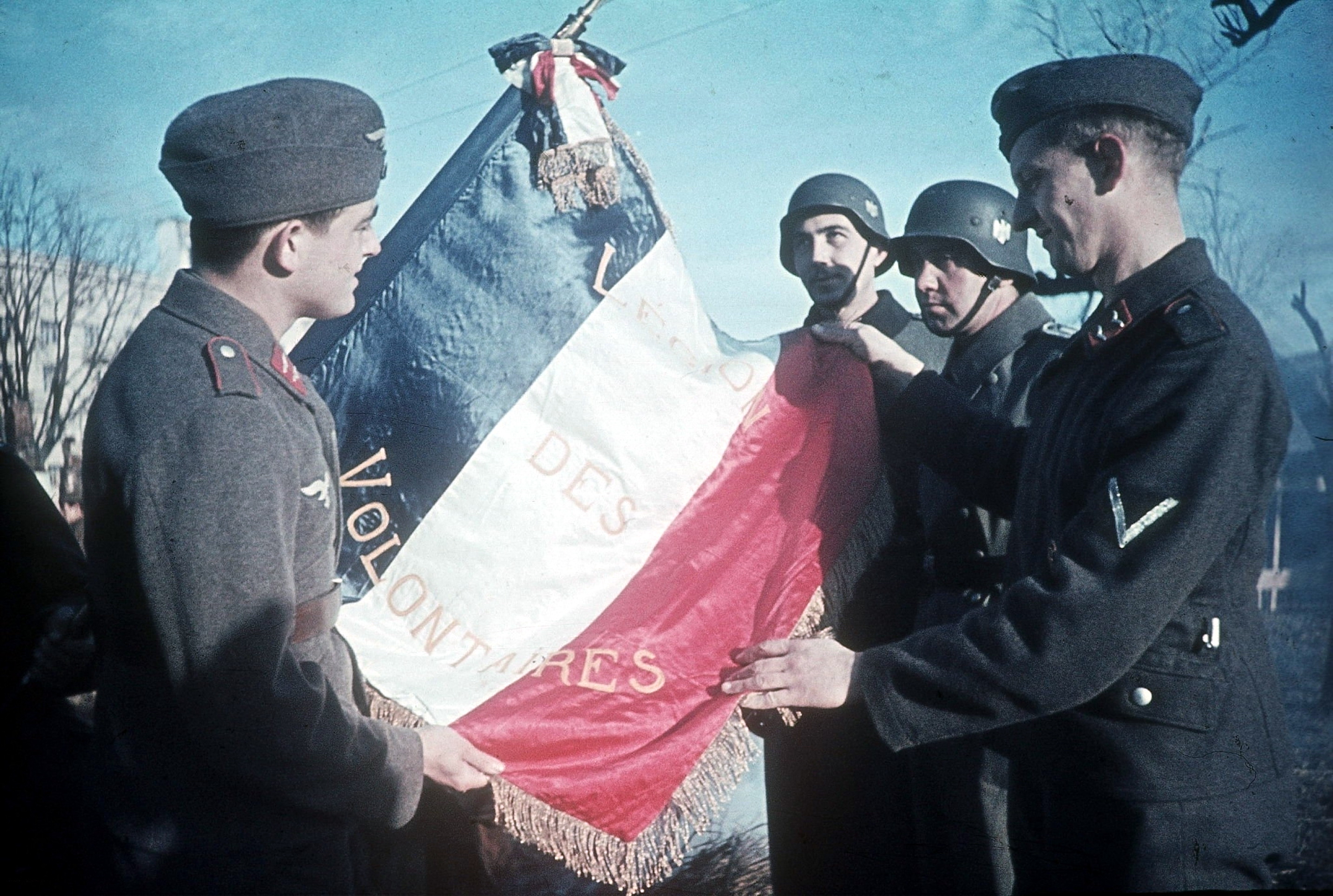
French Volunteers with Their Regiments' Flag

Soldiers of the 'Legion des volontaires francais' (LVF) with their regiments' flag, late autumn 1941. By October 1941, the LVF comprised two battalions with a strength of 2,271 men, 181 French officers, and 35 German officers. They were equipped with light weapons, machine guns, and a small number of 3.7 cm Pak 35/36 anti-tank guns. The LVF was deployed to Smolensk and sent as reinforcements to the fighting near Moscow in November and December 1941 where it became the only foreign unit to fight alongside the Germans! This picture was taken by Artur Grimm.

Source :
https://www.ebay.com/itm/383300489280?_ul=BR
https://en.wikipedia.org/wiki/Legion_of_French_Volunteers_Against_Bolshevism
https://www.gettyimages.com/detail/news-photo/world-war-ii-soldiers-of-the-legion-des-volontaires-news-photo/548133023

Thursday, September 15, 2022

German Cavalry in Russia


Portrait of Wehrmacht Reiterzugführer (mounted platoon leader) and several other German soldiers on horse back, 1941 or 1942. The image was originally published as 'Das Heer im Grossdeutschen Freiheitskampf' (translated as 'The Army in the Greater German Freedom Struggle'), a collection of 50 plus images taken by the German Army's combat photography unit (Propagandakompanie). Photo by E. Bauer.

Source :
"The Cavalry of the Wehrmacht 1941-1945" by Klaus Christian Richter
https://www.alamy.com/stock-photo-wehrmacht-reiterzugfuhrer-german-mounted-infantry-officer-on-the-eastern-19860876.html?imageid=097B1C04-049A-4319-9C94-6A5E7B528168&p=28623&pn=1&searchId=6c6f0b0012fe7704df34ac6fc6f49d8f&searchtype=0
https://www.gettyimages.com/detail/news-photo/portrait-of-several-german-soldiers-on-horse-back-1941-or-news-photo/104329305

Saturday, August 13, 2022

German Infantry March in Soviet Union

German infantry troops march along a dirt road in Ukraine, shortly after the invasion of Soviet Union (Operation Barbarossa), June 1941. Most carry a 98k carbine, the one in the center carries a MG 34 machine gun. Pre-war German infantry training stressed the importance of a methodical approach to small unit tactics. The infantry section used only two simple formations to maneuver in battle, but it had a repertoire of choreographed tactical responses which produced predictable results in a given situation. Company and platoon commanders, section and squad leaders, even lead machine gunners were trained to recognize opportunity, and act on it. In theory, the tactical and operational concepts worked well, and they are valid today, but this kind of expertise is only one aspect of warfare. The Wehrmacht was a well-oiled machine involved in the wrong purpose, it had to fail. The image was originally published as 'Das Heer im Grossdeutschen Freiheitskampf' (translated as 'The Army in the Greater German Freedom Struggle'), a collection of 50 plus images taken by the German Army's combat photography unit (Propagandakompanie) during the German invasion of the Soviet Union.

Source :
Das Heer im Grossdeutschen Freiheitskampf
https://20thcenturywargaming.wordpress.com/2013/06/16/german-infantry-tactics-1932-1945/
https://www.alamy.com/stock-photo-wehrmacht-infantry-march-off-duty-german-army-soldiers-on-the-eastern-19823453.html?imageid=A60F52C6-9692-4619-B99F-28F580BBCF6F&p=28623&pn=1&searchId=4f3f1a6c71448f68833bbfc26f701185&searchtype=0
https://commons.wikimedia.org/wiki/File:German_soldiers_marching_in_Russian_summer.jpg
https://www.gettyimages.com/detail/news-photo/german-infantry-troops-march-along-a-dirt-road-soviet-union-news-photo/103137520
https://www.granger.com/results.asp?image=0025659

Thursday, April 28, 2022

Sd.Kfz.251 of 3. Panzer-Division Passing the Cathedral in Mglin

 
An original color photograph. Sd.Kfz.251 Ausf.A halftrack from 1.Batterie / I.Abteilung / Panzer-Artillerie-Regiment 75 / 3. Panzer-Division passing the Dormition Cathedral in Mglin, Bryansk Region, August 1941. In the Operation Barbarossa, the invasion of the Soviet Union, which began on 22 June 1941, the 3. Panzer-Division were part of Panzergruppe 2 "Guderian". Initially it was engaged in the central sector of the advance but was then redirected south to participate in the Battle of Kiev. From there it participated in the Battle of Moscow, advancing towards Tula. With the Soviet counterattacks in the winter of 1941–42 the division acted as a stand-by emergency force and, in March 1942, participated in the defense of Kharkov.

Source :
https://en.wikipedia.org/wiki/3rd_Panzer_Division_(Wehrmacht)
https://www.facebook.com/photo/?fbid=290564653271517&set=gm.2603839409748599
https://pixpast.com/index.php?catalog=12275&ctypes=photo