Showing posts with label Terrain - Water. Show all posts

Sunday, June 5, 2016

A Curtiss Hawk Squad of Finnish Air Force

A Curtiss squad from the 1st Finnish Flight Regiment, over the Aunus Isthmus in an image taken on 18 October 1943. After the fall of France, Germany agreed to sell captured Curtiss Hawk fighters to Finland in October 1940. In total, 44 captured aircraft of five subtypes were sold to Finland with three deliveries from 23 June 1941 – 5 January 1944. Not all were from the French stocks, 13 were initially sold to Norway and captured when the Germans conquered that country. The aircraft were given serial codes CU-501 to CU-507 (A-4 submodel with Cyclone) and CU-551 to CU-587 (all other submodels with Twin Wasp). In Finnish service, the Hawk was well liked, affectionately called Sussu ("Sweetheart"). The Finnish Air Force enjoyed success with the type, credited with 190⅓ kills by 58 pilots, between 16 July 1941 and 27 July 1944, for the loss of 15 of their own. Finnish ace Kyösti Karhila scored 12¼ of his 32¼ victories in the Hawk, while the top Hawk ace K. Tervo scored 14¼ victories. The Finnish Hawks were initially armed with either four or six 7.5mm machine guns. While sufficient during the early phase of the Continuation War, the increasing speeds and armor of Soviet aircraft soon showed this armament was not powerful enough. From 1942, the State Aircraft Factory replaced the fuselage machine guns with either one or two .50 in (12.7 mm) Colt machine guns and installed two or four .303 in (7.7 mm) Browning machine guns in each wing. The 12.7mm Berezin UB or LKk/42 heavy machine guns were also used. The installation of heavier armament did not change the very good flying characteristics of the fighter, but the armament was much more effective against Soviet aircraft. The Finnish Hawks were also equipped with Revi 3D or C/12D gunsight. Surviving Finnish aircraft remained in service with the FAF aviation units HLeLv 13, HLeLv 11 and LeSK until 30 August 1948, when the last operational Finnsh Hawks were put into storage. In 1953, the stored aircraft were scrapped.


Source :
Book "Finland at War: The Continuation and Lapland Wars 1941-45" by Vesa Nenye, Peter Munter, Toni Wirtanen and Chris Birks 
https://en.wikipedia.org/wiki/Curtiss_P-36_Hawk#Finland

Friday, January 29, 2016

Kriegsmarine AA Crew with 20mm Oerlikon Flak

A color shot of the light naval gun 20mm Oerlikon (2.0cm Flak 28) in action onboard a "Vorpostenboot", a converted fishing cutter. This gun were produced by Semag and Becker in Zürich (Swiss), later than by Oerlikon in Zürich (Swiss). Germany bought many of them before the war, and gave them the name 2 cm Flak 28 and 29 (The Flak 28 used a 15-round clip magazine and the Flak 29 used a large drum magazine with 60-rounds). First they were mainly used in the german navy, but later - and expecially during the war, when many of them got captured - they were also used in other units. The 2cm Oerlikon Flak 28 and Flak 29 apt in the Sockellafette 40 pedestal mount were intended by the Kriegsmarine for installation on ships.The 2cm Oerlikon Flak 28 was the first light automatic Anti-Aircarft weapon to reach the units in 1928 and it was installed on a mobile wheeled carriage.


Source :
http://www.626-squadron.co.uk/willem14.htm
http://forum.axishistory.com/viewtopic.php?f=70&t=149100&p=1295063

Tuesday, January 5, 2016

U-Boat Lookout of U-177

Keeping lookout was one of the most demanding and important jobs aboard a U-boat. No matter what conditions prevailed, men were expected to stand for a period of four hours at a time on the top of the conning tower scouring the horizon for enemy ships - the side that saw the enemy first was the more likely to survive! This remarkable and unique set of color photographs were taken aboard U-177, a very long-range boat on Type IXD2 under Korvettenkapitän Robert Gysae. It operated in the South Atlantic at the same time as U-178 was close by in the Indian Ocean. The circular device in the bottom photo is a repeater from the gyrocompass


Source :
Book "Wolfpacks At War: The U-Boat Experience In WWII" by Jak Mallmann Showell

Saturday, October 10, 2015

Messerschmitt Bf 109 of Werner Schroer in the North African Coast

Messerschmitt Bf 109 E-4/Trop "Schwarze 8" of Oberfeldwebel Werner Schroer (8.Staffel / III.Gruppe / Jagdgeschwader 27) above the North African coast of Ain el Gazala/Libya, April 1941. The aircraft is wearing  a short-lived leopard camo scheme. Werner Schroer was born on 12 December 1918 at Mülheim in Ruhr. His Luftwaffe career began in 1937 as a member of the ground staff. In May 1940 he completed his flying training. On 27 August 1940 he joined 2./JG 27 based on the Channel front. He flew his first combat missions during the Battle of Britain but did not claim any confirmed victories. In March 1941, I./JG 27 was deployed to North Africa in order to support the Afrika Korps under the command of Erwin Rommel. Schroer claimed his first victory, a RAF Hurricane, on 19 April 1941, however, his Bf 109 E (WNr 3790) was hit and he had to make a forced-landing near his airfield with 48 bullet holes in his aircraft. On 21 April, in an engagement with RAF Hurricanes, an aircraft collided with his Bf 109 E (WNr 4170) slightly injuring him and requiring him to make another forced-landing. By the end of 1941 his score stood at seven. In March 1942, he was appointed Adjutant of I./JG 27. He was appointed Staffelkapitän of 8./JG 27 on 22 June. In July he recorded 16 victories. On 9 September, he was awarded the Deutsches Kreuz in Gold. He shot down 13 enemy aircraft in September, including six on 15 September to record his 35th through 40th victories. In October, Schroer claimed 15 victories. Leutnant Schroer was awarded the Ritterkreuz on 21 October for 49 victories. On 4 November, Schroer, with Alfred Stückler (10 victories), shot down two four-engined B-24s. On 11 February 1943, Schroer reportedly shot down two RAF Beauforts, although he claimed them as B-26s. When Major Gustav Rödel (98 victories, including 13 four-engined bombers, RK-EL) was appointed Kommodore of JG 27, Hauptmann Schroer took his place as Gruppenkommandeur of II./JG 27 on 22 April 1943. Operating over Sicily and southern Italy, between 29 April and 23 July, Schroer was to claim 22 Allied aircraft shot down, including 12 four-engined bombers. On 2 August, he became the 268th recipient of the Eichenlaub, awarded for his 84 victories. In August 1943, II./JG 27 was redeployed to Wiesbaden-Erbenheim in Germany for Reichsverteidigung duties. On 6 September, Schroer led the Gruppe on an interception of a formation of 262 B-17s. In all 45 American bombers were lost including four shot down by II./JG 27, three of which were claimed by Schroer as his victories 86 through 88. On 3 March 1944, Major Schroer scored his 99th victory and was appointed Gruppenkommandeur of III./JG 54, relieving Major Rudolf Sinner (39 victories, DK) who had been badly wounded on 6 March attacking a formation of four-engined bombers. III./JG 54 was based at Lüneberg and flew the Bf 109 G-6. On 24 May, Schroer shot down a P-51 and two P-47s for his 100th to 102nd victories. On 21 July 1944, Schroer relinquished command of III./JG 54 to Hauptmann Robert “Bazi” Weiss (121 victories, RK-EL, killed in action 29 December 1944). Schroer was transferred to a fighter pilot school as an instructor. On 4 August, he had to make a forced-landing when his engine malfunctioned. From November 1944 to February 1945 Schroer was retained in a training role. On 14 February 1945, Schroer was appointed Kommodore of JG 3. With this unit he quickly claimed 12 Russian aircraft destroyed. On 19 April 1945 he became the 144th recipient of the Schwertern. Werner Schroer survived the war. He died on 10 February 1985 in Munich, aged 67. Werner Schroer was credited with 114 victories flying 197 missions. 102 of his victories were scored on the Western front, including 61 claimed over North Africa, and 26 four-engined bombers.


Source :
http://www.ww2aircraft.net/forum/aviation/bf-109-thread-2974.html
http://www.luftwaffe.cz/schroer.html

Wednesday, September 30, 2015

German Battleships in the Operation Rösselsprung

This photo is apparently taken from the heavy cruiser Admiral Hipper and is showing the Tirpitz to the right and to the left of the Tirpitz a German destroyer can be seen. The photo is taken in Norway. The combination of the paint scheme used on the Tirpitz and that she is together with Admiral Hipper in Norway indicates that the photo is taken in 1942 and most likely during Operation "Rösselsprung" which took place 2-6 July 1942. Notice the yellow turret top on the main gun of Admiral Hipper. Rösselsprung was the largest operation of its type mounted by the Kriegsmarine during World War II, and arguably the most successful, resulting as it did in the near destruction of arctic convoy PQ-17. Ironically, this success was entirely indirect, as no Rösselsprung ship caught sight of the convoy, or fired a shot at it, all PQ 17s losses being due to U-boat and aircraft attacks. Also, a number of the Rösselsprung ships were damaged in the course of the operation, while only five aircraft were shot down, and no U-boats lost or damaged in the attack on PQ 17. Despite indirectly causing the catastrophic losses to PQ-17, the Rösselsprung operation was a disappointing performance by the German capital ships. Also, Tirpitz, Lutzow and the three destroyers spent a considerable time in dock for repairs. Following this, the Kriegsmarine were unable to mount such an extensive operation again in the Arctic campaign, and never saw a comparable naval success.


Source :
http://www.bismarck-class.dk/tirpitz/gallery/themes/gallthemetirincolour.html
https://en.wikipedia.org/wiki/Operation_R%C3%B6sselsprung_%281942%29

Thursday, September 24, 2015

A Bridge Watch in the Back Light in a Heavy Following Sea

This color photo was taken by Kriegsberichter Garms in 1942. It shows a “Brückenwache” (Bridge Watch) in the back light in a heavy following sea. Such seas could pose a serious threat to the Bridge Watch if it underestimated the wave heights. Few other positions on a U-boat were as critical as the Bridge Watch. Keeping lookout was a “holy act”, on which the success and fate of the boat largely depended. Carelessness at this post could have fatal consequences. The Bridge Watch consisted of four men. An officer and one man stood forward in the conning tower with an NCO and another man aft. Using binoculars, each member of the watch had to observe a fixed sector without interruption. Every five minutes each lookout had to report “Sektor ist frei melden” (sector is clear) if that was the case. Regulations forbade conversation during the watch. Sighting reports were to be made in clear, plain language while pointing a finger to indicate direction. The watch was also forbidden to smoke. In areas where there was no threat from the air, other members of the crews could be allowed onto the bridge to smoke, but never more than two in addition to the Bridge Watch. There was no smoking on the bridge at night. The Bridge Watch was expected to be especially alert transiting areas where the aerial threat was great (Bay of Biscay and the North Sea) and in special situations. These included the stopping of ships, use of the deck gun, encounters with other submarines and the interrogation of survivors. In such situations the Bridge Watch could easily become distracted, resulting in lack of concentration. The danger of a surprise attack rose proportionally in such situations. Because of the blinding effect of the sun, lookouts were required to wear sunglasses when the sun was in their quadrant. The watch was relieved every two or four hours. The lookouts were relieved one at a time at five minute intervals for a full hour. This was intended to prevent too many men from being in the conning tower during a crash dive and to give the new watch time to become accustomed to the darkness or brightness. To accelerate the change at night, 15 minutes before beginning their watch, below deck the new lookouts put on infrared glasses. The lookout being relieved could only leave when the new man had become accustomed to his surroundings. As a rule, the best watch officer and bridge lookouts worked the most dangerous periods. Assignment of lookouts was the responsibility of the captain. In heavy seas, with breakers rolling over the conning tower, Bridge Watch was a task that demanded everything of the men. If wind, cold, rain or fog were added, the men were often completely exhausted when it came time to be relieved. In heavy seas the captain could order the men to put on restraining belts, which were supposed to prevent them from being washed overboard. A following sea was especially dangerous, as its height and power were often underestimated. The restraining belts could only be taken off by order of the captain. The conning tower hatch was kept closed in high seas to avoid damage to the latch. Without an efficient Bridge Watch, a U-boat had neither great chances of success nor a long life expectancy.


Source :
 U-Boot im Focus - ediiton no.3, 2008

U-Boat Bridge Watch

This color photo was taken by Kriegsberichter Garms in 1942. It shows a “Brückenwache” (Bridge Watch) in the conning tower after a storm, still wearing their rubber things. In addition to the four lookouts, the Obersteuermann (first mate) may be seen behind the periscope with the sextant preparing for a “Sonne zu Schießen” (sun shot). He was responsible for accurate navigation and took every opportunity to use the sun to determine the boat’s position. Only the commander and the Obersteuermann were allowed to enter the resulting position on the map. The color photo also documents an interesting detail undetectable in black-and-white photos, namely the very different colors of the rubber clothing, from beige to pale green to dark green.


Source :
U-Boot im Focus - ediiton no.3, 2008

Thursday, July 30, 2015

A Northrop BT-1 Dive Bomber of Enterprise’s ‘Bombing Six’ Squadron

A Northrop BT-1 dive bomber of Enterprise’s ‘Bombing Six’ squadron, BuNo 0681. This one, according to the plane, from the “6-B-10″ you can see its the Sixth Carrier Group (Bomber), 10th aircraft. These BT-1’s were even worse than the Helldivers. Although colorful and at least a mono-plane, they had exceptionally bad low-speed maneuverability, which made them about the worst choice for a carrier aircraft in the world. The Navy accepted just 56 of these troubled planes. In 1939 the aircraft designation was changed to the Douglas SBD-1 with the last 87 on order completed as SBD-2s. By this point, Northrop had become the El Segundo division of Douglas aircraft, hence the change.


Source :
http://laststandonzombieisland.com/2014/09/21/the-big-es-1938-airgroup-in-technicolor/

Monday, July 27, 2015

A squadron of American Lockheed P-38 Lightning in Flight over an Unidentified Aleutian Island

A squadron of American Lockheed P-38 Lightning fighter planes in flight over an unidentified Aleutian Island, Alaska, 1944. The planes are part of the 54th Fighter Sqaudron, 343rd Fighter Group, 11th Air Force. In the foreground is a P-38G, serial number of 42-12908, likely piloted by Bennie H. Stone and behind it is a P-38E, serial number 41-2069, likely piloted by Richard T. Clapper. when the 343rd Fighter Group first went to the Aleutians, the 54th Fighter Squadron had P-38 Lightnings, while 11th Fighter Squadron and 18th Fighter Squadron had P-40s (by the end of the war the whole Group was P-38 equipped). On 29 May 1942, 25 P-38s began operating in the Aleutian Islands in Alaska. The fighter's long range made it well-suited to the campaign over the almost 1,200 mi (2,000 km)–long island chain, and it would be flown there for the rest of the war. The Aleutians were one of the most rugged environments available for testing the new aircraft under combat conditions. More Lightnings were lost due to severe weather and other conditions than enemy action, and there were cases where Lightning pilots, mesmerized by flying for hours over gray seas under gray skies, simply flew into the water. On 9 August 1942, two P-38Es of the 343rd Fighter Group, 11th Air Force, at the end of a 1,000 mi (1,609 km) long-range patrol, happened upon a pair of Japanese Kawanishi H6K "Mavis" flying boats and destroyed them, making them the first Japanese aircraft to be shot down by Lightnings.Photo by Dmitri Kessel from Time & Life Pictures


Source :
http://www.gettyimages.com/detail/news-photo/squadron-of-american-lockheed-p-38-lightning-fighter-planes-news-photo/53315688
http://warbirdinformationexchange.org/phpBB3/viewtopic.php?p=515204

Saturday, July 25, 2015

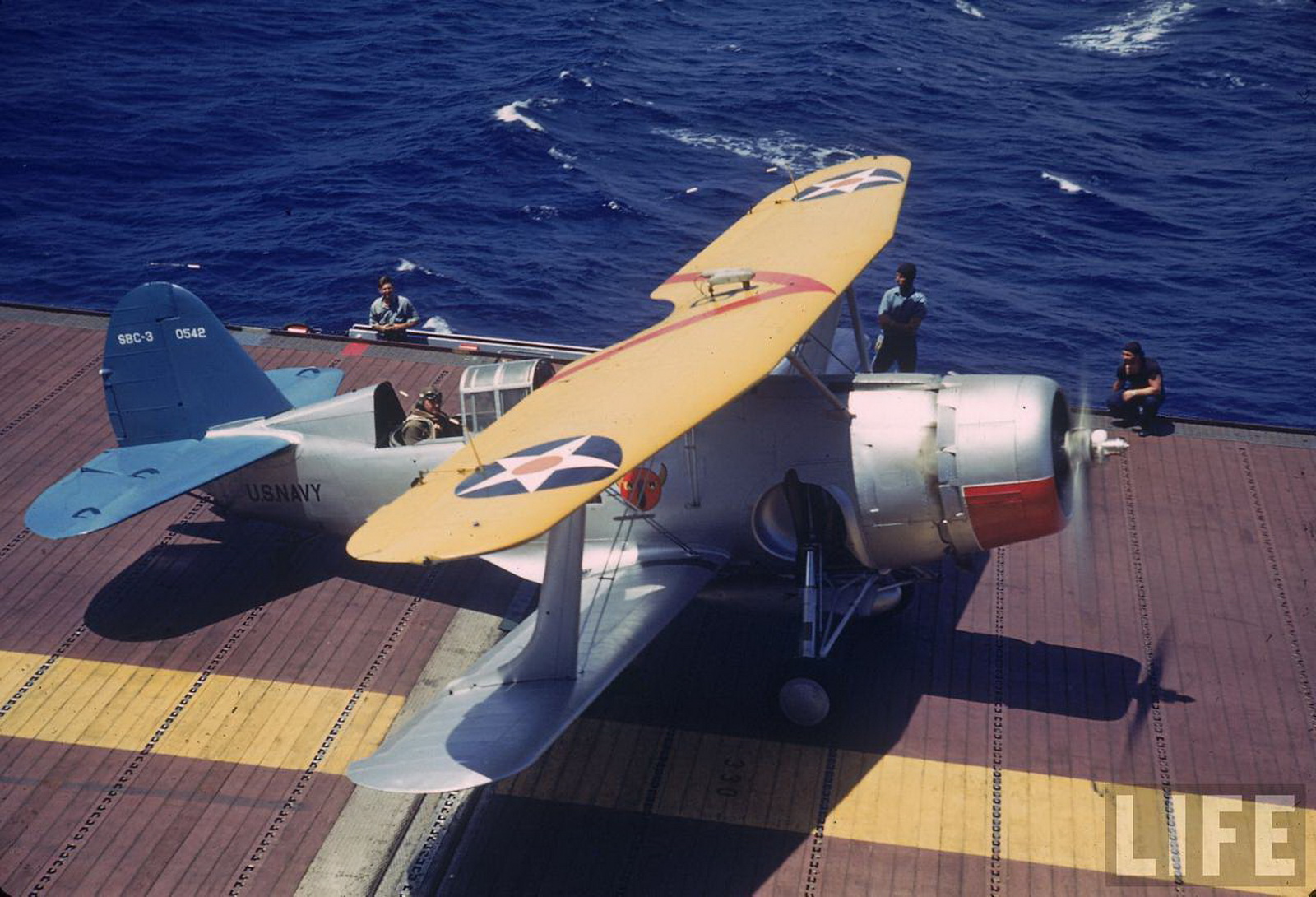
Curtiss SBC-3 Helldiver scout plane Preparing to Take-Off

Curtiss SBC-3 Helldiver scout plane from Scouting Squadron Six (VS-6) preparing for take-off from the deck of the aircraft carrier USS Enterprise (CV-6) during manuevers off the coast of Hawaii in September 1940. This plane, bureau number 0542, was soon pulled from front line service (as were the rest of the cumbersome Helldivers). This airframe was kept around until 1944 as a trainer. The blue tail indicates this aircraft is from the USS Enterprise. The red chevron on the top of the wing and the bottom of the cowling are the colors of the first section, made up of three aircraft, out of six sections in a squadron. The cowling being painted only on the bottom indicates this is aircraft number three, which would fly on the left-wing of the section leader when in a “V’ formation. It’s number, which you cannot see, would be “6-S-3″ for Sixth Carrier Group, Scouting Squadron, aircraft #3. Also, the rear observer looks exceptionally non-plussed. Incidentally, the Curtiss SBC-3 Helldiver, built in 1935, was obsolete as soon as it left the factory. While it would have been useful over the skies of France in WWI, any fighter of its day could have cleaned its clock. In fact, it was the last bi-plane built for the US Navy and Marine Corps. Slow (230 kts) and not very maneuverable, the plane had a short 150-200 nm radius of action as a scout plane and was pitifully armed with just two 30.06 caliber M1919 light machine guns (one forward and one rearward). It could, however, carry a half ton of dumb bombs.


Source :
http://laststandonzombieisland.com/2014/09/21/the-big-es-1938-airgroup-in-technicolor/

Wednesday, June 17, 2015

A Flock of US Navy Douglas SBD Dauntless Dive Bombers Over the Pacific Ocean

A flock of US Navy Douglas SBD Dauntless dive bombers over the Midway Atoll during 1943. Serving primarily on the carriers Yorktown, Hornet, and Enterprise. They saw action in the Battle of Coral Sea, Battle of Midway (sinking 4 Japanese carriers) and worked side by side with TBD Devastator torpedo aircraft among many decisive battles


Source :
http://community.ratsun.net/topic/63908-airplane-porn-and-the-occasional-helicopter/page-3

Friday, November 21, 2014

Afrikakorps POWs at El Guettar Valley

 German POWs receive water ration in an Allied-controlled prison camp at El Guettar Valley, Tunisia, 1943. in mid-February 1943 the Axis forces launched a strong counter-attack against the US II Corps in south-western Tunisia. The 1st Armored Division's counter-moves ended in a complete disaster, the division losing two of its tank battalions in two days, with over 2,500 American soldiers being taken prisoner on February 16 and 17. After 22 days of tough fighting at El Guettar the US Army were regenerated after its unfortunate setback. Now under George S Patton's energetic command, the self-confidence and offensive spirit of the 1st Armored and 1st Infantry Divisions returned and the 9th Infantry Division had gone from being a green, inexperienced outfit to a combat-experienced and able fighting unit. The Battle of El Guettar was fought between elements of the Heeresgruppe Afrika under Generaloberst Hans-Jürgen von Arnim - along with Italian forces under General Giovanni Messe - and U.S. II Corps under Lieutenant General George S. Patton in south-central Tunisia. It was the first battle in which U.S. forces were able to defeat the experienced German tank units, but the followup to the battle was inconclusive. The picture was made by LIFE photographer Eliot Elisofon 


Source:
http://www.afterthebattle.com/store/index.php?id_product=149&controller=product
http://life.time.com/?N=0&Nty=1&p=0&cmd=tags&srchCat=LIFE&s=eliot+elisofon

German POWs at El Guettar Valley

German POWs receive water ration in an Allied-controlled prison camp at El Guettar Valley, Tunisia, 1943. in mid-February 1943 the Axis forces launched a strong counter-attack against the US II Corps in south-western Tunisia. The 1st Armored Division's counter-moves ended in a complete disaster, the division losing two of its tank battalions in two days, with over 2,500 American soldiers being taken prisoner on February 16 and 17. After 22 days of tough fighting at El Guettar the US Army were regenerated after its unfortunate setback. Now under George S Patton's energetic command, the self-confidence and offensive spirit of the 1st Armored and 1st Infantry Divisions returned and the 9th Infantry Division had gone from being a green, inexperienced outfit to a combat-experienced and able fighting unit. The Battle of El Guettar was fought between elements of the Heeresgruppe Afrika under Generaloberst Hans-Jürgen von Arnim - along with Italian forces under General Giovanni Messe - and U.S. II Corps under Lieutenant General George S. Patton in south-central Tunisia. It was the first battle in which U.S. forces were able to defeat the experienced German tank units, but the followup to the battle was inconclusive. The picture was made by LIFE photographer Eliot Elisofon


Source:
http://www.afterthebattle.com/store/index.php?id_product=149&controller=product
http://life.time.com/?N=0&Nty=1&p=0&cmd=tags&srchCat=LIFE&s=eliot+elisofon

Tuesday, March 11, 2014

U-Boat Crew Wearing Diving Equipment

U-boat crew outside the boat hatch wearing tauchretter. Looks like on training. Taken from Signal magazine, May 1943 edition. An escape set (in German Tauchretter = "diver rescuer") is a breathing set, which lets its wearer survive for a time in an environment without (sufficiently) breathable air, in particular underwater, primarily or originally intending mainly to survive long enough to reach safety where the air is breathable


Source:
http://greec.free.fr/diaporama/u%20171/U-boot/album/slides/Tauchretter-Signal-051943-0-site.html