Showing posts with label Russia in World War II. Show all posts

Friday, September 19, 2025

Russian Victory Parade in Moscow (1945)

On 24 June 1945, a scant six weeks following the Fall of Berlin and the end of the Great Patriotic War, residents of the USSR’s capital city were treated to the spoils of victory – a massive military parade.

Organized and undertaken on the direct orders of Stalin himself, the 1945 Victory Parade was (and remains) the largest ever held on Moscow’s Red Square. 40,000 soldiers, sailors, and other service personnel accompanied by 1,850 tanks, artillery pieces, and assorted equipment were mobilized for the occasion. (Alas, overcast skies and steady rain prevented a planned flyover by Red Air Force pilots).

The most memorable moment of the two-hour long procession came as Soviet troops bearing the regimental standards of former Nazi units cast them to the ground in front of Lenin’s Mausoleum – while The Leader and his closest Party comrades gazed down from atop the edifice.

The 1945 Victory Parade was, of course, preserved for posterity. The official version, compressed into less than twenty-minutes, but recorded in color (on film stock seized from German studios) was subsequently distributed throughout the country and, in time, the wider world. A version containing English subtitles accompanied by a terrible voice-over has been available for years on YouTube and across the Interwebs.


Source :
www.youtube.com

Sunday, December 25, 2022

German Soldiers and Civilian in the Eastern Front

German officers in front of a shed on the Eastern front, where women work with hay. The war inflicted huge losses and suffering upon the civilian populations of the affected countries. Behind the front lines, atrocities against civilians in German-occupied areas were routine, including those carried out as part of the Holocaust. German and German-allied forces treated civilian populations with exceptional brutality, massacring whole village populations and routinely killing civilian hostages (see German war crimes). Both sides practised widespread scorched earth tactics, but the loss of civilian lives in the case of Germany was incomparably smaller than that of the Soviet Union, in which at least 20 million were killed.
 

Source :
https://en.wikipedia.org/wiki/Eastern_Front_(World_War_II)
https://forum.axishistory.com/index.php

Wednesday, October 19, 2022

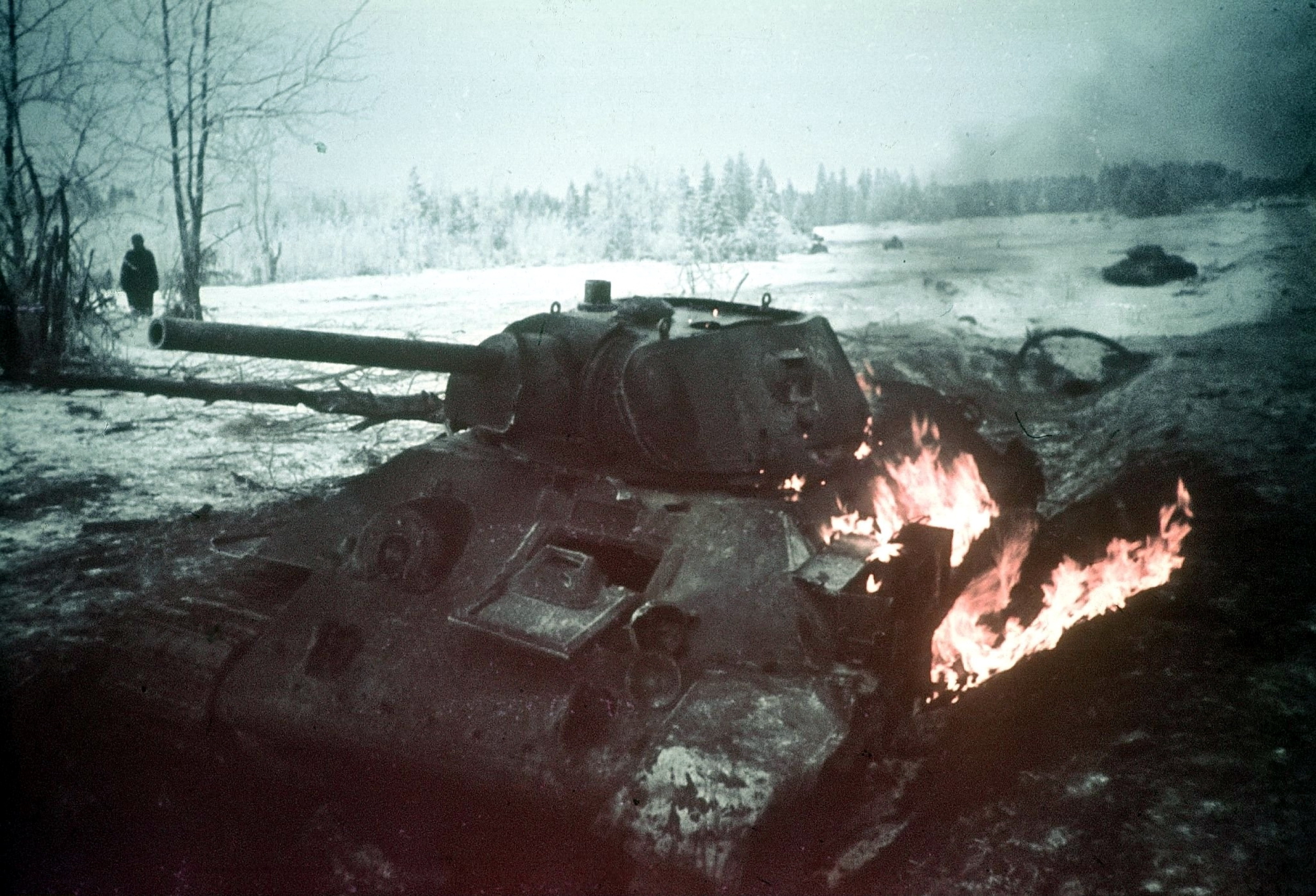
A Burning Soviet T-34

Aftermath of the repel of a Soviet tank attack by German forces in the Eastern Front: a hit, burning T 34 tank. The picture was taken by Kriegsberichter Artur Grimm, early or late 1943 (winter). The T-34 seemed impervious to German weapons and able to destroy German tanks with ease. Panzer commander General Heinz Guderian saw the heavy losses inflicted by the T-34 and realized what a game-changer it was, outclassing his own Panzer IIIs and IVs: “Up to this time we had enjoyed tank superiority, but now the situation was reversed,” Guderian wrote. “The prospect of rapid, decisive victories was fading in consequence."

Source :
https://www.popularmechanics.com/military/weapons/a32439030/t-34-soviet-tank-history/

Saturday, December 11, 2021

Bio of General Ivan Petrov (1896-1958)

 
Soviet Army General Ivan Yefimovich Petrov in Moscow, Russia 1945. Photo by Mark Redkin / FotoSoyuz

Ivan Yefimovich Petrov (30 September 1896 – 7 April 1958) was born in Trubchevsk in 1896. He began his military service in the Red Army in 1918, the year when he also joined the Bolshevik Party. Petrov fought in the Russian Civil War near Samara, the Polish Soviet War of 1920 and the Basmachi rebellion in 1922. In the late 1920s and 1930s Petrov served in Central Asia.

During World War II, Petrov participated in the Battle of Odessa, Battle of Sevastopol and was noted for heading the Separate Coastal Army from October 1941 to July 1942 and in November 1943-February 1944, 44th Army in August–October 1942, Black Sea Group of Forces, North Caucasus Front, 33rd Army in 1944, 2nd Belorussian Front, 4th Ukrainian Front, and several other units. In April–June 1945 Petrov was a chief of the 1st Ukrainian Front Staff.

On May 29, 1945 Petrov was awarded the title of the Hero of the Soviet Union. The United States awarded him the Distinguished Service Cross in War Department General Order No. 3 of 1944.

After the war Petrov commanded the Turkestan Military District and was inspector general of land forces. Petrov died in Moscow in 1958 and is buried in the Novodevichy Cemetery.

Honours and awards
    Hero of the Soviet Union
    Five Orders of Lenin
    Order of the Red Banner, four times
    Order of Suvorov, 1st class
    Order of Kutuzov, 1st class
    Order of the Red Star
    Order of the Red Banner of Labour of the Turkmen SSR
    Order of Red Banner of Labour of the Uzbek SSR
    Order of the Red Banner of Labour
    Order of Merit, 1st class (Hungary)
    Military Order of the White Lion "For Victory", 2nd class (Czechoslovakia)
    War Cross, 1939 (Czechoslovakia)
    Cross of Grunwald, 3rd class (Poland)
    Medal of Victory and Freedom 1945 (Poland)
    Distinguished Service Cross (USA)
    Jubilee Medal "XX Years of the Workers' and Peasants' Red Army"
    Medal "For the Defence of Odessa"
    Medal "For the Defence of Sevastopol"
    Medal "For the Defence of the Caucasus"
    Medal "For the Victory over Germany in the Great Patriotic War 1941–1945"
    Medal "For the Capture of Berlin"
    Medal "For the Liberation of Prague"


Source :
https://diletant.media/articles/35899466/
https://en.wikipedia.org/wiki/Ivan_Yefimovich_Petrov
https://www.facebook.com/groups/237076659811098/posts/1889504567901624/?__cft__[0]=AZWFxi4N0ZJaFrPIiHvF8jL2q2mBgxj8JDP61U8WOAVqn-n-vsXupGgcusXREDmtzuOTkqMeHabciadsQxVc4Lj4-iU357n3uBc0duSorRrKj9m9dfPlcEaIdLCyW8UJ5DwBoA4PIZ_7U45Fns-ChcCmNnk49DyqQ12hMm58QtXaXZLRHM_M4k1j6872YVm5cR8&__tn__=%2CO%2CP-R

Thursday, September 9, 2021

Burial of Russian Civilian

Funeral of a Russian civilian. The body was taken from the coffin and placed in a blanket of the earth. The picture was taken by an unknown German photographer in the period of 1941-1943.


Source :
Bundesarchiv Bild 169-0339

Sunday, August 15, 2021

German standards at the Moscow Victory Parade of 1945

The LSSAH standard staff at the parade (first from left)

At the Moscow Victory Parade of 24 June 1945, marking the defeat of Nazi Germany, there were a total of 201 German cavalry standards and combat banners, majority being from the Wehrmacht. Carried by a battalion of Soviet soldiers from the Separate Operational Purpose Division of the NKVD, they were thrown to the steps of Lenin's Mausoleum under drumroll during the march past of the ground column. Around twenty standards at the parade were not Nazi and belonged to previous German units (in 1944 Adolf Hitler ordered to move all military unit standards to museums to prevent their capture in a battle). All the rest were made in 1935. Among them was the standard staff of the 1st SS Panzer Division Leibstandarte SS Adolf Hitler (LSSAH); its banner had been found separately and was not brought to the parade. The staff was carried in a prominent place on the right of the front rank of the first column of soldiers. It has been incorrectly called Hitler's personal standard which went missing during the war. After the parade additional color shots were made showing the flags of various Nazi organizations being thrown to the ground. The shots were added to the official video of the parade.

The standards were selected from a pool of about 900 standards and banners shipped to Moscow from Berlin and Dresden. Some of them were collected by SMERSH trophy teams in May 1945 and some were taken from museums. The show of contempt to the standards at the parade was proposed by Joseph Stalin, stemming from the old custom of "disdain not for the enemy, but for his defied military distinctions" in the troops of Alexander Suvorov. In order to not touch the standards themselves the soldiers wore gloves. The following list is based on the list of standards approved by Colonel Peredelsky on 21 June 1945. It includes 138 battalion, 36 Division and 26 regimental standards. The standard staff of LSSAH was approved separately from the list. All standards are now housed in the Central Armed Forces Museum of Moscow.

 Battalion standards
Number     Military unit
1     3rd Battalion of the 57th Infantry Regiment
2     2nd Battalion of the 1st Infantry Regiment
3     1st Battalion of the 45th Infantry Regiment
4     3rd Battalion of the 23rd Infantry Regiment
5     2nd Battalion of the 30th Infantry Regiment
6     1st Battalion of the 7th Infantry Regiment
7     1st Battalion of the 3rd Infantry Regiment
8     3rd Battalion of the 106th Infantry Regiment
9     1st Battalion of the 49th Infantry Regiment
10     2nd Battalion of the 83th Infantry Regiment
11     2nd Battalion of the 81st Infantry Regiment
12     1st Battalion of the 84th Infantry Regiment
13     2nd Battalion of the 24th Infantry Regiment
14     3rd Battalion of the 2nd Infantry Regiment
15     9th Tank Battalion
16     1st Battalion of the 1st Infantry Regiment
17     2nd Battalion of the 43rd Infantry Regiment
18     3rd Battalion of the 44th Infantry Regiment
19     1st Battalion of the 22nd Infantry Regiment
20     4th Battalion of the 61st Infantry Regiment
21     1st Battalion of the 36th Infantry Regiment
22     1st Battalion of the 28th Infantry Regiment
23     2nd Battalion of the 51st Infantry Regiment
24     2nd Battalion of the 23rd Infantry Regiment
25     1st Battalion of the 57th Infantry Regiment
26     2nd Battalion of the 38th Infantry Regiment
27     1st Battalion of the 30th Infantry Regiment
28     3rd Battalion of the 43rd Infantry Regiment
29     2nd Battalion of the 88th Infantry Regiment
30     2nd Battalion of the 44th Infantry Regiment
31     1st Battalion of the 106th Infantry Regiment
32     3rd Battalion of the 1st Infantry Regiment
33     2nd Battalion of the 3rd Infantry Regiment
34     1st Battalion of the 51st Infantry Regiment
35     3rd Battalion of the 88th Infantry Regiment
36     3rd Battalion of the 7th Infantry Regiment
37     1st Battalion of the 24th Infantry Regiment
38     2nd Battalion of the 28th Infantry Regiment
39     2nd Battalion of the 36th Infantry Regiment
40     3rd Battalion of the 45th Infantry Regiment
41     3rd Battalion of the 30th Infantry Regiment
42     1st Battalion of the 83rd Infantry Regiment
43     3rd Battalion of the 28th Infantry Regiment
44     2nd Battalion of the 116th Infantry Regiment
45     3rd Battalion of the 33rd Fusilier Regiment
46     3rd Battalion of the 22nd Infantry Regiment
47     3rd Battalion of the 3rd Infantry Regiment
48     2nd Battalion of the 22nd Infantry Regiment
49     2nd Battalion of the 28th Infantry Regiment
50     2nd Battalion of the 49th Infantry Regiment
51     3rd Battalion of the 84th Infantry Regiment
52     1st Battalion of the 59th Infantry Regiment
53     1st Battalion of the 88th Infantry Regiment
54     2nd Battalion of the 2nd Infantry Regiment
55     3rd Battalion of the 24th Infantry Regiment
56     2nd Battalion of the 84th Infantry Regiment
57     1st Battalion of the 81st Infantry Regiment
58     1st Battalion of the 23rd Infantry Regiment
59     2nd Battalion of the 45th Infantry Regiment
60     2nd Battalion of the 7th Infantry Regiment
61     1st Battalion of the 43rd Infantry Regiment
62     2nd Battalion of the 59th Infantry Regiment
63     1st Battalion of the 116th Infantry Regiment
64     1st Battalion of the 38th Infantry Regiment
65     3rd Battalion of the 51st Infantry Regiment
66     2nd Battalion of the 57th Infantry Regiment
67     3rd Battalion of the 49th Infantry Regiment
68     3rd Battalion of the 116th Infantry Regiment
69     1st Battalion of the 6th Rifle Regiment
70     2nd Battalion of the 71st Infantry Regiment
71     3rd Battalion of the 71st Infantry Regiment
72     2nd Battalion of the 15th Reconnaissance Regiment
73     2nd Battalion of the 14th Infantry Regiment
74     1st Battalion of the 2nd Tank Regiment
75     1st Battalion of the 21st Reconnaissance Regiment
76     77th Tank Communication Battalion
77     2nd Battalion of the 7th Cavalry Rifle Regiment
78     29th Combat Engineer Battalion
79     41st Communication Battalion
80     1st Battalion of the 7th Cavalry Rifle Regiment
81     48th Communication Battalion
82     2nd Battalion of the 15th Infantry Regiment
83     15th Communication Battalion
84     Jäger Battalion of the 15th Infantry Regiment
85     21st Communication Battalion
86     1st Battalion of the 71st Infantry Regiment
87     48th Combat Engineer Battalion
88     18th Communication Battalion
89     15th Machine Gun Battalion
90     37th Communication Battalion
91     1st Battalion of the 68th Combat Engineer Regiment
92     2nd Battalion of the 7th Reserve Regiment
93     58th Combat Engineer Battalion
94     4th Reconnaissance Unit
95     59th Machine Gun Battalion
96     9th Reconnaissance Unit
97     2nd Battalion of the 116th Reserve Regiment
98     9th Vehicle Transport Battalion
99     1st Bicycle Infantry Battalion
100     29th Communication Battalion
101     2nd Battalion of the 68th Combat Engineer Regiment
102     1st Battalion of the 15th Infantry Regiment
103     1st Battalion of the 31st Tank Regiment
104     2nd Battalion of the 15th Combat Engineer Regiment
105     1st Battalion of the 27th Tank Regiment
106     2nd Battalion of the unnumbered infantry regiment
107     2nd Battalion of the 6th Rifle Cavalry Regiment
108     38th Machine Gun Battalion
109     1st Battalion of the 14th unknown unit
110     28th Communication Battalion
111     1st Rifle Motorcycle Battalion
112     11th Communication Battalion
113     1st Battalion of the 1st Tank Brigade
114     1st Battalion of the 13th Infantry Regiment
115     2nd Battalion of the 1st Tank Regiment
116     41st Combat Engineer Battalion
117     9th Machine Gun Battalion
118     2nd Battalion of the 2nd Tank Regiment
119     1st Battalion of the 15th Tank Regiment
120     2nd Battalion of the 13th Infantry Regiment
121     1st Reconnaissance Unit
122     29th Reconnaissance Unit
123     1st Communication Battalion
124     8th Communication Battalion
125     11th Combat Engineer Battalion
126     3rd Battalion of the 11th Reserve Regiment
127     31st Machine Gun Battalion
128     21st Combat Engineer Battalion
129     1st Combat Engineer Battalion
130     18th Combat Engineer Battalion
131     28th Combat Engineer Battalion
132     15th Combat Engineer Battalion
133     1st Vehicle Transport Battalion
134     8th Vehicle Transport Battalion
135     8th Combat Engineer Battalion
136     1st Jäger Battalion of the 2nd Infantry Regiment
137     1st Battalion of the 10th Infantry Regiment
138     67th Tank Battalion


 Regimental standards
Number     Military unit
176     5th Cuirassier Regiment
177     8th Cavalry Regiment
178     3rd Grenadier Horst Wessel
179     1st Dragoon Regiment
180     10th Uhlan Regiment
181     3rd Cavalry Regiment
182     12th Light Cavalry Regiment
183     10th Infantry Cavalry Regiment
184     9th Infantry Cavalry Regiment
185     4th Hussar Regiment
186     11th Infantry Cavalry Regiment
187     8th Heavy Dragoon Regiment
188     8th Uhlan Cavalry Regiment
189     1st Cuirassier Regiment
190     4th Hussar Regiment
191     4th Uhlan Regiment
192     1st Cavalry Regiment
193     10th Dragoon Regiment
194     1st Uhlan Cavalry Regiment
195     4th Cavalry Regiment
196     1st Cavalry Regiment
197     2nd Cavalry Regiment
198     2nd Uhlan Regiment
199     6th Hussar Regiment
200     4th Cavalry Regiment
201     17th Artillery Regiment


 Division standards
Number     Military unit
139     3rd Division of the 8th Artillery Regiment
140     1st Division of the 9th Artillery Regiment
141     1st Artillery Instrumental Reconnaissance Division
142     2nd Division of the 18th Artillery Regiment
143     18th Artillery Instrumental Reconnaissance Division
144     2nd Division of the 37th Artillery Regiment
145     2nd Division of the 78th Artillery Regiment
146     2nd Division of the 28th Artillery Regiment
147     21st Anti-Tank Division
148     1st Division of the 54th Artillery Regiment
149     1st Division of the 44th Artillery Regiment
150     1st Division of the 45th Artillery Regiment
151     1st Division of the 28th Artillery Regiment
152     2nd Division of the 47th Artillery Regiment
153     28th Artillery Instrumental Reconnaissance Division
154     2nd Division of the 21st Artillery Regiment
155     3rd Division of the 65th Artillery Regiment
156     2nd Division of the 64th Artillery Regiment
157     2nd Division of the 8th Artillery Regiment
158     3rd Division of the 9th Artillery Regiment
159     1st Division of the 8th Artillery Regiment
160     3rd Division of the 21st Artillery Regiment
161     11th Anti-Tank Division
162     2nd Division of the 9th Artillery Regiment
163     15th Anti-Tank Division
164     1st Division of the 116th Artillery Regiment
165     1st Division of the 15th Artillery Regiment
166     3rd Division of the 1st Artillery Regiment
167     37th Anti-Tank Division
168     2nd Division of the 44th Artillery Regiment
169     1st Division of the 57th Artillery Regiment
170     9th Anti-Tank Division
171     1st Battalion of the 13th Motorized Rifle Regiment
172     42nd Division
173     41st Combat Engineer Battalion
174     3rd Jäger Battalion of the 15th Infantry Regiment
175     1st SS Panzer Division Leibstandarte SS Adolf Hitler (without banner)


Source :
https://www.wikiwand.com/en/List_of_German_standards_at_the_Moscow_Victory_Parade_of_1945

Wednesday, June 30, 2021

Disinfecting the Soviet POWs at Zeithain

Soviet prisoners of war are disinfected in the German prisoner of war camp Zeithain

In the summer of 1942, Karl Schmitt – head of the Wehrmacht mining division in Liège, Belgium – went to Berlin on vacation with his wife. On the way, he visited the Zeithain prisoner of war camp in Saxony. The Soviet POWs were ordered to present themselves for inspection with the aim of deploying them to Belgian mines under German control. They were accordingly checked for physical fitness. Karl Schmitt decided who was to be transported to Belgium and who was not.

Soviet prisoners of war were frequently put to work in mines. The Reich Security Main Office had ruled that they could be employed only in work gangs kept separate from German workers. The authorities considered the mines particularly suitable in that respect.

In September 1942, the prisoner of war camp was closed, and the remaining prisoners of war (by that time more than ten thousand) were transferred to the Leuven camp in Belgium, from where they were sent to the mines of Belgium and Northern France for forced labor – to extract coal. The photo is disinfected before transport to Belgium.


Source :
https://www.ausstellung-zwangsarbeit.org/en/selection-in-a-prisoner-of-war-camp.html
https://www.facebook.com/photo/?fbid=4183730505083768&set=gm.1769254436593305

Thursday, April 1, 2021

Order of Kutuzov for General Ira C. Eaker

M. Alexander Bogomolov, Soviet Representative, Presents The 'Order Of Kutozov' 2nd Class, Russia'S Highest Military Award, To U.S. Army Lieutenant-General Ira C. Eaker In Italy. The Order of Kutuzov is a Soviet military decoration to reward senior officers of the Red Army or foeign allies for skillful avoidance of enemy attacks and successful counter attacks. The Order of Kutuzov was established in three classes: 1st class, 2nd class, and 3rd class. General Ivan Galanin who distinguished himself during the Battle of Stalingrad became the first recipient of the Order 1st class. During World War II, 669 Orders of Kutuzov 1st class were awarded. The Order 2nd class was awarded to 3,325 corps, division, and brigade commanders. The Order 3rd class was awarded to regimental commanders, their chiefs of staff, battalion and company commanders. 3,328 3rd class orders were awarded.

Source :
US AIR FORCE
https://awards.wiki/en/ussr/order_of_kutuzov/12.html
https://www.facebook.com/photo/?fbid=3965190483567735&set=gm.1706463549539061

Friday, March 19, 2021

Soviet Soldiers and Lend-Lease Jeep

Soviet soldiers and their lend-lease Jeep, somewhere in ex Czechoslovakia, May 1945. As soon as Hitler attacked the Soviet Union both Britain (and later America) provided, Free-of-Charge, huge quantities of weapons, trucks and tanks to the Russians. Among the most valued were the Willys and Ford-built Jeeps which arrived by the hundreds and were immediately put into action. In total, the U.S. deliveries to the USSR through Lend-Lease amounted to $11 billion in materials: over 400,000 jeeps and trucks; 12,000 armored vehicles (including 7,000 tanks, about 1,386 of which were M3 Lees and 4,102 M4 Shermans); 11,400 aircraft (4,719 of which were Bell P-39 Airacobras) and 1.75 million tons of food.

Source :
https://en.wikipedia.org/wiki/Lend-Lease
https://www.kingandcountry.com/lend-lease-russian-jeep-p-5572.html
https://ww2jeep.gportal.hu/gindex.php?pg=4236629&gid=465399&fbclid=IwAR1SnCaUyz5YkZrBiCEiAR2A3dhRjMAgGp5PNTBdyqLVWiTS29aXIP_CQ-w

Sunday, January 31, 2021

A Signpost in Southern Russia

 
A signpost in southern Russia, 1941. Estate of Oberstleutnant Matthes of Flieger Nachschub Kolonnen Abteilung (motorisiert) II/200.

Akira Takiguchi: Wegweiser (pronounced vehk-veizer, signpost in German) / Schilderwald (pronounced shilder-valt, literally sign forest) is one of the main reasons for me to collect color slides. Signposts are quite often colorful and comes with various unit markings (which units can you find in these?). Also names of commanders are frequently encountered (like Sponeck). These help identification of the location and time of the slides groups.

 
Top sign is for Krankenkraftwagenzug 188 (Kr.Kw.Zg. 188) of 88. Infanterie-Division, while "Sponeck" is for 22. Infanterie-Division commanded by Generalleutnant Hans Graf von Sponeck


The oak leaf is the sign of II. Flakkorps, while the clock is for Regiment General Göring (later Hermann Göring Division)


Black arrow with bended swastika is for SS-Division "Wiking"


"Panzerstrasse M": M may refer to an axis of advance passable for armor, ie route M, A, G etc. At the bottom is the symbol of Leibstandarte Adolf Hitler, which had a Pionier-Bataillon with 3 Kompanien


Source :
Akira Takiguchi photo collection
https://www.facebook.com/photo/?fbid=10222887987661695&set=gm.1656183317900418

Friday, January 29, 2021

Yak-9 Aircraft in Bari Italy

Soviet Yakovlev Yak-9DD at Bari, Italy. A large formation of the Yak-9DD version was transferred to Bari (the capital of Apulia, in Italy) to help Yugoslav partisans against the Germans in the Balkans.


Source :
https://en.wikipedia.org/wiki/Yakovlev_Yak-9
https://www.facebook.com/photo/?fbid=3560402530725650&set=gm.1662345440617539

Sunday, January 17, 2021

Severe Winter in Russia 1941-42

Winter in the Eastern Front, 1941-42. The winter of 1941–42 is known as the coldest European winter of the 20th Century. The temperature was much below normal from the beginning of January until the end of March 1942. Blockings and cut-off lows were frequent, particularly during January and February 1942. The role of quasi-stationary waves during this winter has been studied by decomposing the 500-mb geopotential height data in a low-pass, filtered, quasi-stationary part and a traveling part. The phase of the quasi-stationary wave was such that a ridge was present over the eastern Atlantic and a trough over western Russia throughout most of the winter. As a result, the majority of migratory cyclones that approached Europe from the west were steered either south toward the Mediterranian or north of Scandinavia. Photos by Dr. Paul Wolff and Alfred Tritschler.


Source :
https://www.facebook.com/groups/237076659811098/permalink/1653292204856196/?__cft__[0]=AZXVbR-ov97tjXfW9zk4mYHF4ga0e1_E2XXLpRZ5lTxcrzqaGdgmfR6RLyeoAeYbR1z9F3WcYJT9qUaJTRhDlCwvA4Z9B69BQCEqfQSEUfku00_bKTcu8opbtFy5wcpXqItcjkKkTeFmUhz2oDMR2LnHs02DyB_7jMZC7LwkBWQF3Lnp9zZLQ5_KcfduSE3_xY0&__tn__=%2CO%2CP-R
https://journals.ametsoc.org/view/journals/bams/70/3/1520-0477_1989_070_0271_tswiet_2_0_co_2.xml

Thursday, December 17, 2020

Old Cossack Soldier


Portrait of a Cossack - from color slide series taken by Kriegsberichter Arndt of PK691 (Propaganda-Kompanie 691). He wears a white "Hilfswillige" armband.


Source :
Akira Takiguchi photo collection
https://www.facebook.com/photo/?fbid=10222602886174336&set=gm.1626894270829323

Saturday, August 1, 2020

Russian POWs during Barbarossa

Some color slides from Russian prisoners of war somewhere in the Soviet Union during Unternehmen Barbarossa, summer of 1941. The series comes from the estate of 11. Panzer-Division.


Source :
https://www.facebook.com/groups/237076659811098/1508209659364452/?comment_id=1508226619362756&reply_comment_id=1508236592695092&notif_id=1596273003048865&notif_t=group_comment&ref=notif