Showing posts with label US Aircraft. Show all posts

Monday, July 10, 2023

A U.S. Army cavalry squadron trots past a Piper Cub


A mounted U.S. Army cavalry squadron trots past a fuels up J-3 Piper Cub and civilian onlookers being evaluated for aerial observation during the 1941 "Louisiana Maneuvers", the war game that were designed to evaluate the U.S. Army for World War II. The success of this demonstration led to the Army acquiring civilian lightplanes to be flown by Army artillery officers. These planes were known as “grasshoppers” – as can be seen with the yellow insignia – for their ability to get in and out of tight landing areas. Photo by Hans Groenhoff.

Source :
From the collection of the National Air and Space Museum Archives, Hans Groenhoff Photographic Collection, NASM 2004-51346
Smithsonian National Air and Space Museum
https://www.flickr.com/photos/airandspace/albums/72157715574200936
https://twitter.com/Erikhistorian/status/1300554071091425280

Sunday, July 9, 2023

Mustang Pilot William R. Groseclose


Portrait of Lt William R Groseclose from Pierre, South Dakota. Pilot of a P-51D Mustang of the 8th Air Force in England.  Assigned to 335FS, 4FG, 8AF USAAF. Lt Groseclose was apparently shot down while flying his P-51D Mustang 44-14432 on 11 September 1944 when the 4th Fighter Group was bounced by 30+ Messerschmitt Bf109's. His aircraft crashed 2 miles south of Erkeln, Germany. POW. MACR 8990. Awards: AM (OLC), POW, WWII Victory. Post War: Retired as a Major having served in Korea and Vietnam.


Source :
NARA Ref 342-FH-3A49666-K2431
https://www.americanairmuseum.com/archive/person/william-r-groseclose

Lieutenant Groseclose Prepares to Depart for a Mission in His Mustang


USAAF Lt. William Groseclose prepares to depart for a mission from an English base in his North American P-51D Mustang of the 335th Fighter Squadron, 4th Fighter Group. He was captured when shot down over Germany on September 11, 1944.

Source :
National Archives and Records Administration, 342-C-K-3914
Smithsonian National Air and Space Museum
https://www.flickr.com/photos/airandspace/albums/72157715574200936

Wednesday, July 5, 2023

“Five Grand” - the 5,000th B-17 off the Production Line

“Five Grand” (Boeing B-17G-70-BO Flying Fortress, Serial number 43-37716) is seen here before deploying to England where it survived 78 combat missions with the 338th Bomb Squadron, 96 Bomb Group.


The B-17G, named, 5 Grand, was constructed at the Boeing Plant 5 in Seattle, WA, in 1944. It was named, 5 Grand, because it was the 5,000th B-17 to come off the Boeing production line in Seattle, since Pearl Harbor. It was the only B-17 that was ever individually signed by all of the Plant 5 workers before leaving the Seattle factory. The largest signature on the airplane, which disappeared in later photos of the plane, was made by Boeing assembler/installer, Frank Novito, on the upper surface of one of it's wings, with large block letters that he made in black paint on the upper wing skin with a large push broom. He, apparently, wanted the German pilots, to think of him and the fine work he did building the plane, as they surely must have done so, while they were trying to shoot, 5 Grand, down !

To boost morale on the home front during the Second World War, aircraft manufacturers began to celebrate production aircraft milestones. Lockheed, for example, painted their 5,000th P-38 Lightning, red, and named it, Yipee. But Boeing wanted to do something different, as it approached delivering the 5,000th B-17 Flying Fortress to be built since the attack on Pearl Harbor, when the U.S. entered the war against the Axis powers. Aircraft number, 40-37716, a B-17G, was that aircraft, and, early on, it was marked with a notice on the fuselage that it was the 5,000th Flying Fortress to be built since the U.S. entered the war. Every worker, who played a part in the construction of this particular aircraft, was invited to sign the part of the aircraft they produced, as it advanced down the production lines in Seattle.

So, these signatures celebrated the efforts of the thousands of workers, who immigrated to Seattle to escape the effects of the Great Depression, in order to work in Boeing's massive production facilities. The enthusiasm that workers applied to their signatures, surprised even the Boeing management, as even parts from the subcontractors' bound for, 40-37716, arrived signed, even though they would be hidden away deep inside the aircraft. Appropriately, the B-17G was named, 5 Grand, and before leaving the Renton plant, it was already being celebrated in newsreels and war bond drives. Instead of towing the B-17G out of Plant 5's front doors, as had always been done for the protocols of the day, upon completion, the workers, themselves, pushed, 5 Grand, out the factory doors to band music, cheers and great fanfare.

In May 1944, 5 Grand, was officially delivered to the U.S. Army Air Forces, at Boeing Field, and a bottle of champagne was ceremonially broken over the aircraft's nose. The USAAF even made sure that the crew assigned to, 5 Grand, were made up of local flyers from the Puget Sound area, with Edward C. Unger of Seattle selected as the aircraft's command pilot. 5 Grand, was, then, flown to Kearney AAF Depot in Nebraska for further modifications to make her combat ready. When she left the United States for the Eighth Air Force's bomber bases in Britain, over 35,000 signatures adorned the bare metal finish of, 5 Grand. Some thought that the plane should be stripped of it's signatures, as they figured, rightfully so, that the Luftwaffe would make special efforts to shoot it down, which they dutifully did just so ! But, it was finally decided the signatures would stay.

On it's trans Atlantic flight to England, the air crew found the B-17G was about 7 mph slower in cruise than a stock B-17G due to the extra weight of the paint used on the signatures and, also, the extra drag of the surface roughness from the thousands of colorful signature applications ! Both of these factors increased fuel consumption, which was also higher than normal, with the lower speeds of the plane, also less than normally forecast for a trip across the Atlantic, resulting in one of, 5 Grand's, engines cutting out upon landing in the U.K. due to low fuel.

Once in the U.K., 5 Grand, was assigned to the 333rd Bomber Squadron of the 96th Bomb Group at Snetterton Heath in Norfolk, U.K. One of it's first local test flights, before any combat missions were flown, also ended in near disaster when, 5 Grand's, electrical system failed, preventing it's main landing gear from extending, causing, 5 Grand, to make a gear up landing after ejecting it's ball turret.

Finally, when ready for combat, 5 Grand, was assigned to the 338th Bomb Squadron, and the 96th Bomb Group, at BX-H, Snetterton, U.K. Once in combat, the plane quickly received a reputation with the American B-17 pilots for being a German fighter plane magnet, because, flying high, above the clouds, on it's many missions over Europe and Germany, the famous B-17, was an unusual looking sight in the air, glowing in the sun, with a sort of bright orange color on it's bare aluminum skin, peppered with yellow, white, red, and black speckled spots, which were the workers' painted signatures, with many of the workers having signed their names on, 5 Grand's, fuselage and wings. Appropriately, the German pilots certainly did take notice of this unique and unusually strange looking and brightly glowing B-17! And, possibly, figuring it for some kind of lead ship, they honored it with unusually fierce attention, by trying very hard, and repeatedly, to shoot it down, damaging it on several occasions with their cannons, so seriously, that it had to be taken out of service and sent back to repair stations for major repairs.

The plane was pulled from combat and delivered to Cheyenne, Wyoming, 15 May 44; Kearney 30/6/44; Dow Field 13 Jul 44; Assigned to the 338th Bomb Squadron, and the 96th Bomb Group, at (BX-H) Snetterton, U.K. 14 Jul 44. During training, the plane's command pilot, Lt. Jack Bimemiller had an electrical failure and was unable to lower the landing gear. He was ordered to Honington, U.K. to land, wheels up. The airplane flew 78 missions after repairs were completed. Then, it was transferred to the 388th Bomb Group. May 1945. It returned to the USA Bradley Repair Depot, 14 Jun 45. After an overhaul, the plane left for Seattle and further refurbishment for a war bond tour in the U.S. from 4168 Base Unit, South Plains, Texas, 29 Jul 45. After completion of the bond tour, 5 Grand, was sent to Lubbock, Texas, for refitting.

After one major repair, 5 Grand, was returned to service (RTS) and reassigned to the 388th Bomber Group kin Britain. It would fly a total of 78 missions over the German Reich adorned with her signatures and her gunners claiming two Luftwaffe fighters destroyed.

On 14 June 1945, 5 Grand, again returned home to the United States, first landing at Bradley Field in Connecticut before continuing on to Boeing Field in Seattle for refurbishment for a war bond tour. While in Seattle, many employees happily found most of their signatures still in place. Local officials wanted to preserve, 5 Grand, as a memorial to the city's home front war effort, but, while the Seattle politicians debated the cost, 5 Grand, was flown to Lubbock AAF Base in Texas for further repairs and refurbishment before being flown to storage at Kingman AAF Base in Arizona to be held in storage while Seattle officials decided how to proceed on the planned memorial, incorporating, 5 Grand. The U.S. Army Air Forces were willing to donate, 5 Grand, to Seattle for the memorial planned by the Seattle Historical Society, but on 3 January 1946, Seattle city officials declined the donation of, 5 Grand, on the grounds that building a memorial with the aircraft, represented too costly an endeavor.

Despite the efforts of Boeing employees who had signed, 5 Grand, and all of those wanting to preserve this piece of history, no one in the local government wished to take responsibility for the aircraft. So, still resplendent, with it's thousands of signatures, the plane was sold off by the Reconstruction Finance Corporation, and sent to Kingman, AZ, to the airplane scrappers, where, 5 Grand, was unceremoniously broken up and scrapped, forever lost to history. 22 Nov 1945


Source :
National Archives and Records Administration, 342-C-K-2442
Smithsonian National Air and Space Museum
https://www.americanairmuseum.com/archive/aircraft/43-37716
https://www.flickr.com/photos/airandspace/albums/72157715574200936
https://www.flickr.com/photos/dougsheley/4127692270

U.S. Navy Officers Review a Line of Brazilian PBY-5A Amphibians


U.S. Navy officers review a line of Brazilian PBY-5A amphibians with Brazilian naval aviators at Galeão International, Rio de Janeiro, Brazil, October 1944. In the background is PBY-5A "Bettye Jayne". The PBY-5A was handed over by VP-94. A second batch of PBY-5As was delivered to Brazil in late 1944. One of the earlier batch, FAB 02, sank a German U-boat on 31 July 1943. Ex BuNo 46524, FAB 14 shows a painted-out US roundel underwing. Later FAB 6513. Redesignated as a PA-10 in 1945. Converted to CA-10A transport aircraft in 1958, but retired in 1959. Brazil, as the United States’ principal South American ally during World War II, engaged in active combat operations against Germany, including deploying forces to the Italian campaign. During the Battle of the Atlantic, Brazilian Consolidated PBYs, like these, participated in anti-submarine operations, and in the case of U-199, one successfully sunk the U-boat off the coast of Rio de Janeiro on July 31, 1943. Here, U.S. Navy officers review a line of Brazilian PBY-5A amphibians with senior Brazilian naval aviators.

Source :
National Archives and Records Administration, 80-G-K-5258
Smithsonian National Air and Space Museum
https://www.flickr.com/photos/airandspace/albums/72157715574200936
https://laststandonzombieisland.com/2021/04/08/catalinas-of-rio/u-s-navy-officers-review-a-line-of-brazilian-pby-5a-amphibians-handed-over-by-vp-94-oct-1944-at-rio/

Sunday, April 2, 2023

Pilots of North American A-36 Apaches

Pilots of North American A-36 'Apaches' (dive-bomber version of the P-51) return from a gunnery training mission in Louisiana, 1943. This aircraft - listed in some sources as "Apache" or "Invader", but generally called Mustang - was the ground-attack/dive bomber version of the North American P-51 Mustang, from which it could be distinguished by the presence of rectangular, slatted dive brakes above and below the wings. A total of 500 A-36 dive bombers served in the Mediterranean and Southeast Asia theaters during World War II before being withdrawn from operational use in 1944. The A-36 project was a stopgap measure intended to keep North American Aviation (NAA) assembly lines running during the first half of 1942 despite the US having exhausted its funds earmarked for fighter aircraft. When the order came for more P-51s in June 1942, the NAA workforce was thoroughly experienced.

Source :
National Archives and Records Administration, 342-C-K-1039
Smithsonian National Air and Space Museum
https://en.wikipedia.org/wiki/North_American_A-36
https://www.flickr.com/photos/airandspace/albums/72157715574200936

Eighth Air Force Losses during World War II

Replacement Boeing B-17G Flying Fortresses lined up on an English airfield to replace squadron losses for the U.S. Eighth Air Force.

The 8th Air Force’s success during World War II came at a high price. Its losses – of both men and machine – were by far the most significant of any branch of the military at that time. The drawback of precision bombing was that it was necessary to bomb by day. Without night vision goggles, or radar technology, sunlight and clear skies were needed to find the targets. Unfortunately, if the bombers could see the targets, then the enemy could see the bombers. Initially the 8th Air Force took staggering losses – up to 86% of fliers were killed, MIA or POW. Although the Flying Fortress had twelve machine guns to defend itself, heavy attacks by German fighters and anti-aircraft ground cannons soon proved that a single squadron was too small of a combat unit. In fact, the Bombardment Group, with the combined force of four squadrons, was also too small. In total, the 8th Air Force lost over 26,000 men. An additional 28,000 men became prisoners of war. Aircraft losses were also grim: 10, 561 planes of varying types were shot down, 4754 of those were B-17 heavy bombers. The 390th Bomb Group lost 176 of its 275 assigned aircrafts.


Source :
National Archives and Records Administration, 342-C-K-2418
Smithsonian National Air and Space Museum
https://390th.org/learn-about-390th/wwii-air-war-over-europe/
https://www.flickr.com/photos/airandspace/albums/72157715574200936

Monday, March 20, 2023

Free French air force formally receives a Curtiss P-40Fs

The newly reconstituted Free French air force formally receives its first frontline combat aircraft, Curtiss P-40Fs, on January 8, 1943, at Casablanca from the U.S. Army Air Forces. This was the first of 1,000 combat aircraft promised by President Roosevelt to General de Gaulle. This is Groupe de Chasse GC II/5, which had just adopted the designation Lafayette Escadrille as a reciprocal tribute to the World War I French squadron of American recruits that had fought the Germans before the U.S. entered WWI in 1917. Less than two months earlier, these P-40s had been catapult launched from a U.S. carrier with U.S. Army Air Forces pilots during Operation Torch, the U.S. invasion of North Africa, while the French pilots of GC II/5 were fighting U.S. Navy Grumman F4F Wildcats under the flag of Vichy France, allied to Germany. The hostilities lasted for only three days, when, on November 11, 1942, the Vichy French forces in North Africa swore allegiance to Free French commander General Charles de Gaulle, resulting in Germany occupying all of Vichy France.

Source :
National Archives and Records Administration, 342-C-K-91
Smithsonian National Air and Space Museum
https://www.flickr.com/photos/airandspace/albums/72157715574200936

Wednesday, March 1, 2023

US Navy L-ships at Naval Air Station Moffett Field

US Navy L-ships at Naval Air Station Moffett Field were used for training patrol crews that operated K and M class blimps equipped with radar and depth bombs to hunt surfaced submarines.

Source :
National Archives and Records Administration, 80-G-K-1472
Smithsonian National Air and Space Museum
https://www.flickr.com/photos/airandspace/albums/72157715574200936

Chaplain Michael Ragan blesses the crew of the Boeing B-17G “Fifinella”

Captain Michael Ragan, the Catholic chaplain of the 91st Bomb Group, blesses the crew of the Boeing B-17G “Fifinella” before a mission in mid-1944. The plane was lost on a mission on August 13, 1944. The “Fifinella” was the female gremlin cartoon created by Walt Disney and adopted by the Women Air Service Pilots (WASP) as their mascot.

Source :
National Archives and Records Administration, 342-C-K-2105
Smithsonian National Air and Space Museum
https://www.flickr.com/photos/airandspace/albums/72157715574200936

Friday, December 23, 2022

Mechanics at Tuskegee Army Air Field Maintain an Engine of a Vultee BT-13A Valiant

Mechanics at Tuskegee Army Air Field, Alabama, maintain an engine of a Vultee BT-13A Valiant. This aircraft was used for basic flight training for the Tuskegee Airmen. History has often ignored the contributions of Black Americans, leaving heroes like the Tuskegee Airmen, the first Black military pilots, overlooked. They flew nearly 1,500 missions and shot down 112 German aircraft. These men flew above prejudice, racism and hate to serve their country and drive positive change in America. Their impressive performance earned them more than 150 Distinguished Flying crosses and helped lead to the integration into the U.S. Armed Forces.

Source :
National Archives and Records Administration, 342-C-K-409
Smithsonian National Air and Space Museum
https://www.adforum.com/agency/5096/creative-work/34630046
https://www.flickr.com/photos/airandspace/albums/72157715574200936

P-51D Mustangs of the 52nd Fighter Group

P-51D Mustangs of the 4th Fighter Squadron, 52nd Fighter Group, 15th U.S. Air Force. These planes flew escorts for Italian-based bombers attacking targets in southeastern Europe late in the war. The USAAF 52nd Fighter Group enjoyed an outstanding record in World War II, but to date its story has never been told. Activated in January 1941, it moved to England in July 1942 for an assignment with the Eighth Air Force. It flew combat missions in Spitfires to France during the summer of 1942 before being reassigned to the invasion force attacking North Africa in November 1942. After moving to North Africa, it was assigned to the Twelfth Air Force and was again equipped with Spitfires. As part of the Twelfth Air Force, it flew combat missions in the Tunisian campaign, and during the invasion of Sicily. In mid-1944, the 52nd was reassigned to the Fifteenth Air Force and converted to P-51 Mustangs. During the remainder of the war, it flew bomber escort and strafing missions to targets in Italy, France, Germany, Czechoslovakia, Austria, Hungary, Rumania, and Yugoslavia. For its outstanding service the Group was twice awarded the Distinguished Unit Citation. During its long campaign, the Group destroyed more than 425 enemy aircraft in aerial combat and damaged 135 plus many more on the ground. The 52nd Fighter Group produced 21 Aces.

Source :
National Archives and Records Administration, 342-C-K-2741
Smithsonian National Air and Space Museum
https://www.flickr.com/photos/airandspace/albums/72157715574200936
https://www.specialtypress.com/spitfires-and-yellow-tail-mustangs-testing-british-and-us-carrier-aircraft.html

Tuesday, December 20, 2022

PBM-3D Mariner Prepares to Launch from a Coastal Naval Air Station

A Martin PBM-3D Mariner prepares to launch from a coastal Naval Air Station to patrol for German submarines, probably in late spring 1943. The landing gear had to be manually removed before takeoff and reinstalled before exiting the water. Mariners were one of the most effective of the Navy’s long-range flying boats.

Source :
National Archives and Records Administration, 80-G-K-16065
Smithsonian National Air and Space Museum
https://www.flickr.com/photos/airandspace/albums/72157715574200936

Sunday, December 4, 2022

African American paratroopers Preparing to Jump from a C-47

During Operation Fire Fly in 1945, the African American paratroopers of the 555th Parachute Infantry Battalion made over 8,000 individual jumps as smokejumpers on wildfires in the Pacific Northwest. Here they are preparing to jump from a Douglas C-47 on a wildfire in Wallowa Forest, Oregon. The 555th Parachute Infantry Battalion, more commonly known as the "Triple Nickles," was the first all-Black paratrooper unit in U.S. history.  First organized in 1943 during World War II, the Triple Nickles trained at Fort Benning, Georgia, but were eventually transferred to Camp Mackall, North Carolina, to prepare for duty in Europe. At the time, the U.S. military was segregated and most Black soldiers were relegated to support roles, rarely trained as combat units let alone elite paratroopers.  For some in the unit, the prospect of fighting Hitler's army presented an exciting opportunity — a chance to prove that Black men were as brave and capable as their white counterparts. But they were never sent to fight the Germans. By 1945, the Axis armies were in retreat and a new threat was developing in the American West — Japanese balloon bombs.


Source :
National Archives and Records Administration, 342-C-K-3751
Smithsonian National Air and Space Museum
https://www.flickr.com/photos/airandspace/albums/72157715574200936
https://www.kgw.com/article/news/history/triple-nickles-first-black-paratroopers-oregon-secret-mission/283-dad8cff6-840c-478d-8af4-16c6353fef92

Thursday, December 1, 2022

An Inspector looks over a Mustang Mk I fighter

An inspector with North American Aviation in Inglewood, California, looks over a Mustang Mk I fighter destined for the British Royal Air Force in fall 1942. In March of 1941, the US Congress passed the Lend/Lease Act which permitted the "lending" of US built aircraft to nations that were "vital to the security of the United States". This allowed the US to place an order for 150 Mustangs to be sent to Brittan. This allocation was NA-91, RAF designation of Mustang Ia. The Mustang Ia was equipped with four Hispano 20mm cannons installed in the wings. The nose guns were deleted. Out of the 150 ordered, only 111 were serialed for the RAF and probably less than that actually received. After the attack of Pearl Harbor, the US Army held the remaining Lend/Lease order of NA-91s to Brittan. These, about 55, were designated P-51 and were fitted with four .50 cal guns instead of the cannons. But not all were configured with the Brownings. Cameras were added and a new designation of F-6A. The US Army actually called the NA-91s "Apache".

Source ;
Library of Congress, Office of War Information, 1a35319u
Smithsonian National Air and Space Museum
https://www.flickr.com/photos/airandspace/albums/72157715574200936
https://www.mustangsmustangs.net/p-51/variants/raf_mustangs

Armorers load AT-6 Texan Aircraft with Ammunition

Armorers load U.S. North American AT-6 Texan advanced trainers with ammunition. Even in its primary role as a trainer, the Texan could be armed. There was provision for a cowl-mounted Browning .30 caliber machine gun for gunnery training, with some versions mounting an additional Browning in the starboard wing. Here armorers load the cowl guns in preparation for a training mission, the photograph providing an excellent view of engine and propeller details.

Source :
National Archives and Records Administration, 342-C-K-143
Smithsonian National Air and Space Museum
https://www.flickr.com/photos/airandspace/albums/72157715574200936
https://inchhighguy.wordpress.com/2022/04/13/

Monday, November 14, 2022

Bio of Top US Naval Ace David McCampbell

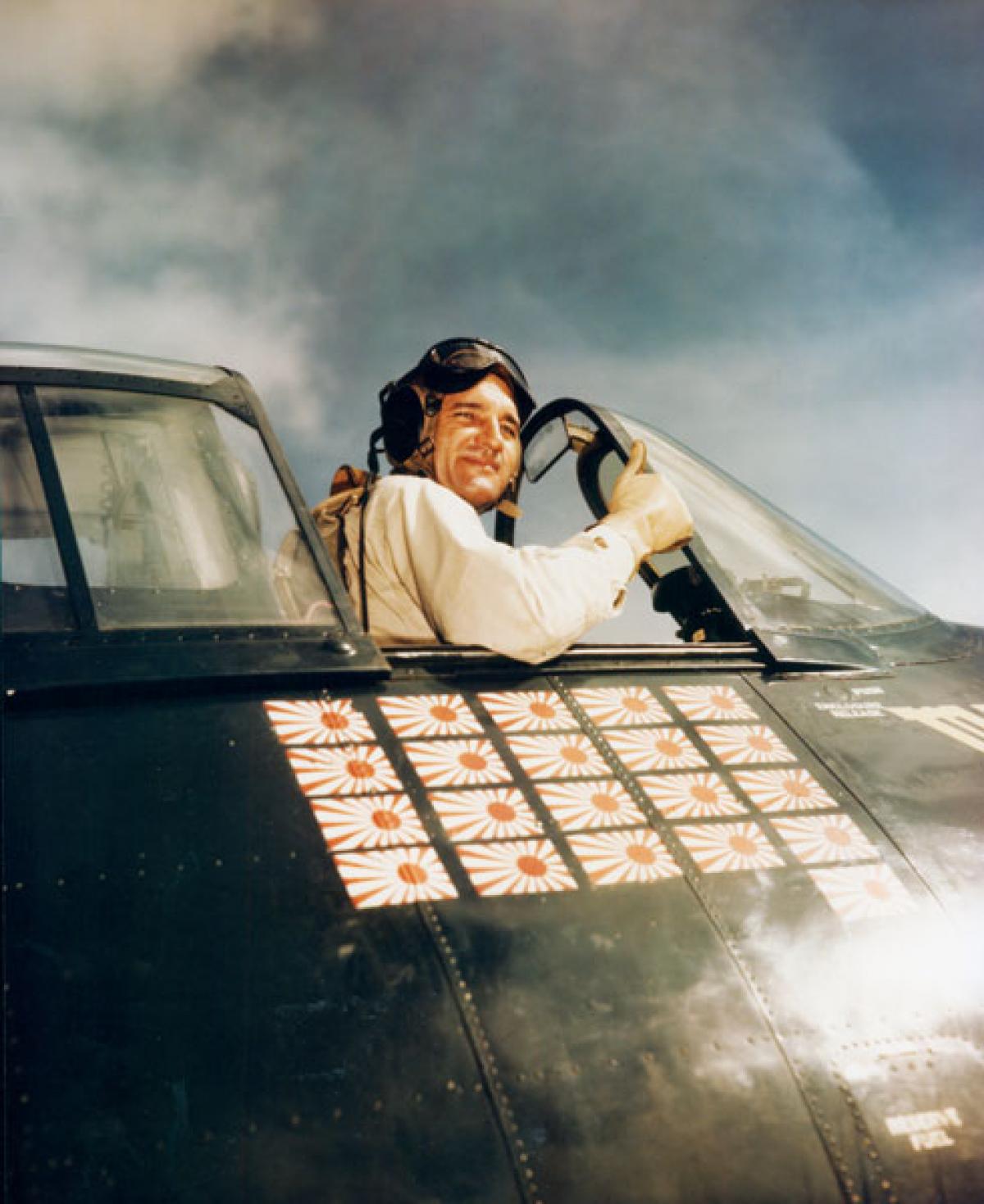
US Navy Capt. David McCampbell wasn't just the top naval ace of World War II — he's considered the service's all-time leader in aerial combat. His spirit and leadership are what made his air group one of the war's most decorated, and they earned him the Medal of Honor.

McCampbell was born Jan. 16, 1910, in Bessemer, Alabama, to parents Andrew and Elizabeth McCampbell. When he was about 12, the family moved him and his older sister, Frances, to West Palm Beach, Florida.

As a teen, McCampbell moved north to attend the Staunton Military Academy in Virginia. His graduation in 1928 earned him an Army commission, according to the Army University Press. Instead, he chose to attend the Georgia Institute of Technology, where he played football and was on the swim team. He also joined Navy ROTC, which led to his appointment to the Naval Academy. While in Annapolis, McCampbell became an accomplished swimmer and diver, competing in and winning various NCAA regional championships.

McCampbell graduated in June of 1933, but since Great Depression-related economic issues had affected the number of commissions that were available, he immediately went into the Naval Reserve. He returned to Alabama to work in construction and at an aircraft assembly plant for a year before finally receiving orders in June 1934 to report for active duty.

The young ensign's first duty station was aboard the USS Portland. By May 1937, he'd worked his way up in the ranks and began flight school in Pensacola, Florida, earning his wings in April 1938. His first few years as an aviator were spent serving on the USS Ranger and the USS Wasp.

World War II began while McCampbell was on the Wasp. The aircraft carrier spent the first half of 1942 in the European theater before being transferred to the Pacific. On Sept. 15, 1942, the ship was sunk during the Guadalcanal campaign. McCampbell, surviving its demise, was promoted to lieutenant commander and brought back to the U.S.

By late 1943, McCampbell was in command of a fighter squadron attached to the USS Essex. He was promoted to commander in January 1944 and put in charge of the ship's Air Group 15 — one of the war's most decorated air groups.  It was in this position that McCampbell became one of World War II's great aces.

McCampbell took out his first Japanese aircraft on June 11, 1944. About a week later, during the First Battle of the Philippine Sea, he led several F6F Hellcat fighter aircraft against 80 Japanese carrier-based planes that were headed toward the U.S. fleet. McCampbell personally destroyed seven of those hostile aircraft — five bombers and two fighters — which helped his outnumbered men virtually annihilate the enemy. According to the Encyclopedia of Alabama, McCampbell's team accounted for about 68 of the 600 Japanese downed aircraft.

On Oct. 24, 1944, during the infamous Battle of Leyte Gulf, McCampbell and a fellow pilot, Ensign Roy Rushing, took on 60 hostile Japanese aircraft that were approaching U.S. ships. Despite the overwhelming airpower against them, McCampbell shot down nine Japanese aircraft, setting a U.S. single mission aerial combat record. Rushing took out another six enemy warplanes. Their successes completely threw off the Japanese air group; the remaining aircraft abandoned their mission before any of them reached the U.S. fleet.

In a 1987 U.S. Naval Institute interview, McCampbell explained how he nearly didn't make it back to his ship after that engagement.

"When I got over the ship, I found they had a flight deck full of planes, and I knew that to launch all those planes would take a good 20 minutes, and I didn't have that much gas left," he said.

When the ship did make room for him to land, he said, "I ran out of gas on the deck. They had to push me out of the landing gear area. I found out from the mechanic that re-ammunitioned the guns that I had exactly six rounds left in the starboard outboard gun, and they were all jammed."

"But it worked out all right," he added nonchalantly.

McCampbell returned to the U.S. in December 1944. By then, he had become the Navy's all-time leading ace and top F6F Hellcat ace, having downed 34 Japanese aircraft during his months of aerial combat. His impressive tally made him the third-highest American scoring ace of World War II, behind only Army Maj. Richard Bong and Army Maj. Thomas B. McGuire, neither of whom survived the war.

For his bravery in the skies, McCampbell received the Medal of Honor on Jan. 10, 1945, from President Franklin D. Roosevelt during a ceremony at the White House.

After the war, McCampbell served in various positions, including as a senior naval aviation advisor to the Argentine Navy. After becoming a captain in July 1952, he also notably served as the captain of the aircraft carrier USS Bonhomme Richard and as a member of the Joint Staff in Washington, D.C. In the latter position, McCampbell helped draw up contingency invasion plans during the 1962 Cuban Missile Crisis, according to a 1996 Palm Beach Post article.

McCampbell was married a few times and had three children, Frances, David and John. He finally retired from the Navy in 1964 after 31 years of service.

According to the Palm Beach Post, McCampbell "dabbled in real estate in the Bahamas" before setting back down near West Palm Beach, where he lived for the rest of his life.  

McCampbell died on June 30, 1996, at a veteran's home he'd been living at for about a year. He was buried in Arlington National Cemetery.


Source :
https://www.defense.gov/News/Feature-Stories/Story/Article/3192422/medal-of-honor-monday-navy-capt-david-mccampbell/
https://www.thesun.ie/news/4108824/amazing-pics-of-us-navys-top-gun-inspiring-fighter-jet-unit-released-on-50th-anniversary-of-its-founding/
https://www.usni.org/magazines/naval-history-magazine/2022/august/brief-illustrated-history-navy-victory-markings

Sunday, November 13, 2022

Wind Tunnel Testing of B-17

An Army Air Forces engineer examines a B-17 model undergoing wind tunnel testing. The wind tunnel staff is experienced in all forms of force, pressure, flight control, vibratory, and dynamic testing of powered and unpowered fixed- and rotary-wing aircraft and other test articles in and out of ground effect.

Source :
National Archives and Records Administration 342-C-K-4195
Smithsonian National Air and Space Museum
https://www.boeing.com/company/key-orgs/boeing-testing-services/wind-tunnels-and-propulsion.page
https://www.flickr.com/photos/airandspace/albums/72157715574200936

Thursday, October 27, 2022

Idiot's Delight


Master Sergeant Penrose Bingham watches Sergeant Pilla (no first name given) paint another bomb on the side of a Boeing B-17F Boeing B-17 Flying Fortress heavy bomber, nicknamed 'Idiot's Delight' of the U.S. 8th Air Force, England, to commemorate the planes 50th successful mission, 1944. Idiots’ Delight (42-30301 XM * J) belonged to the 94th Bomb Group, 332nd Bomb Squadron and was the first in that group to survive 50 missions. She flew her first mission on July 14, 1943 to Le Bourget and her fiftieth mission on March 22, 1944 to Berlin. Camouflage is standard Olive Drab over Neutral Gray with Neutral Gray (instead of white) stars in the national insignia.


Source :
https://www.facebook.com/groups/2598504867039308
https://www.ipmsstockholm.se/home/in-colour/

Thursday, February 3, 2022

Directs a Bomb into Place

 
Corporal Lloyd Shumway directs crane with a 500 lb. bomb into place on the wing of a North American P-51 at a base in England.

Source :
https://www.facebook.com/photo/?fbid=5651403878279712&set=gm.1929517277233686