Showing posts with label France in World War II. Show all posts

Sunday, July 19, 2026

Waldemar Klepke Visiting Luftwaffe Flugplatz in France (1940)


General der Flieger Waldemar Klepke (left, Höherer Fliegerausbildungskommandeur 3) visiting unnamed Luftwaffe Flugplatz in France, 1940. Klepke, born on 6 October 1882 in Bromberg, West Prussia, and a veteran of the Imperial German Army who transitioned into aviation roles during the First World War as an observer and commander of various Feldflieger-Abteilungen before serving as Gruppenführer der Flieger 16, played a significant organizational role in the Luftwaffe during the Second World War as Höherer Fliegerausbildungskommandeur 3. Recalled to active duty on 26 August 1939 amid the general mobilization following his earlier interwar service as Inspekteur der Aufklärungsflieger und des Luftbildwesens in the Reichsluftfahrtministerium and various staff and instructional positions that honed his expertise in flight training and reconnaissance, Klepke assumed command of this higher flying training command, which oversaw advanced pilot instruction, specialized aircrew development, and the coordination of training programs across assigned Luftwaffe schools and facilities to prepare air personnel for operational demands. Holding the post until the end of May 1943, his tenure as Höherer Fliegerausbildungskommandeur 3 contributed to the Luftwaffe's efforts to maintain a steady supply of qualified aviators amid the escalating requirements of the air war, drawing on his prewar experience as a flight instructor at institutions such as the Infanterie-Schule in Dresden and the Kriegsakademie in Berlin, as well as his deep knowledge of aerial observation and photography. Promoted to General der Flieger on 1 January 1939, Klepke ultimately retired from active service on 31 May 1943 and died by suicide in Berchtesgaden on 5 May 1945.


Source :
https://pixpast.wordpress.com/?query-10-page=3&cst&str=428&id_parent=7898&items=12&vd=downloaded&category=7902&flow=1

Monday, March 20, 2023

Free French air force formally receives a Curtiss P-40Fs

The newly reconstituted Free French air force formally receives its first frontline combat aircraft, Curtiss P-40Fs, on January 8, 1943, at Casablanca from the U.S. Army Air Forces. This was the first of 1,000 combat aircraft promised by President Roosevelt to General de Gaulle. This is Groupe de Chasse GC II/5, which had just adopted the designation Lafayette Escadrille as a reciprocal tribute to the World War I French squadron of American recruits that had fought the Germans before the U.S. entered WWI in 1917. Less than two months earlier, these P-40s had been catapult launched from a U.S. carrier with U.S. Army Air Forces pilots during Operation Torch, the U.S. invasion of North Africa, while the French pilots of GC II/5 were fighting U.S. Navy Grumman F4F Wildcats under the flag of Vichy France, allied to Germany. The hostilities lasted for only three days, when, on November 11, 1942, the Vichy French forces in North Africa swore allegiance to Free French commander General Charles de Gaulle, resulting in Germany occupying all of Vichy France.

Source :
National Archives and Records Administration, 342-C-K-91
Smithsonian National Air and Space Museum
https://www.flickr.com/photos/airandspace/albums/72157715574200936

Sunday, December 25, 2022

German Soldiers Observe the Coast

German soldiers observe the coast during the occupation of Normandy by German forces in the spring of 1944. The Germans expected the Allies to come ashore at Calais on the French coast, as this is the narrowest point along the Strait of Dover between England and France, and had heavily reinforced the Atlantic seawall with a vast network of shore batteries, beach obstacles, and minefields. The Allies instead chose to invade the European continent along the Normandy region coastline in the Bay of the Seine, roughly between Le Havre in the north and Cherbourg on the Cotentin Peninsula in the south.

Source :
https://rarehistoricalphotos.com/d-day-rare-photographs/

Sunday, October 2, 2022

French Foreign Volunteers on the Advance to Moscow


Soldiers of the 'Legion des volontaires francais' (LVF) passing through a destroyed town on their advance towards Moscow, autumn 1941. The LVF was deployed to Smolensk and sent as reinforcements to the fighting near Moscow in November and December 1941 where it became the only foreign unit to fight alongside the Germans. By the time of its arrival at the front, the unit "was on its last legs". Many collaborators had feared that the unit might arrive too late at the front to see action, and its training had been cut short for this reason. The LVF was first deployed in combat near the village of Vygliadovka and participated in a successful frontal assault against Soviet positions on 1 December, but was hit by a large Soviet counterattack several days later, suffering extremely high casualties. Within months, the LVF had lost around half its manpower in action or through frostbite; there was also a serious outbreak of dysentery. Some individual soldiers deserted to the Red Army or committed suicide. After two weeks, they were withdrawn from the front line in Djukovo (40 kilometres (25 mi) from Moscow) and returned to Smolensk. Afterwards, the LVF was used only behind the front-line. Photographer: Artur Grimm.

Source :
https://en.wikipedia.org/wiki/Legion_of_French_Volunteers_Against_Bolshevism
https://humus.livejournal.com/6575779.html

French Volunteer Soldiers of the German Army


French Soldiers - with MP40 - of the LVF (Légion des volontaires français contre le bolchévisme a.k.a. French Volunteer Legion) in the Eastern Front, 1942. They are in anti-Partisan operation and wearing Heer uniform with french tricolore armelwappen "FRANCE". They were came from Infanterie-Regiment 638 (Französischer). This regiment was subordinated to the 286. Sicherungs-Division (Security Division) from February 1944. The original French unit in the German army was the Legion of French Volunteers Against Bolshevism (Légion des Volontaires Français contre le Bolchévisme, or LVF). The LVF was also known by its official German designation, the 638th Infantry Regiment (Infanterie-Regiment 638). The LVF was mainly made up of right-wing Frenchmen and French prisoners of war who preferred fighting to forced labor in Germany. The LVF fought near Moscow in November 1941 as part of the 7th Infantry Division. In 1942 the men were assigned to anti-partisan duties in the Byelorussian SSR (Belarus). At the same time, another unit was formed in France, La Légion Tricolore (Tricolor Regiment) but this unit was absorbed into the LVF six months later. The LVF's French commander, Colonel Roger Labonne, was relieved in mid-1942, and the unit was attached to various German divisions until June 1943 when Colonel Edgar Puaud took command. The LVF fought well on the Ukraine front against the Soviets. In June 1944, hours before the LVF's planned departure to France, it was called into action when Army Group Centre's front crumpled under the Red Army's summer offensive. On 25 June, at the Bobr River, elements of the LVF under Major Bridoux fought for 48 hours against a Soviet assault. Attached to the 4. SS-Polizei Division and supported by Stukas and five Tiger tanks, they checked a number of attacks in what is generally regarded as the LVF's most successful operation. Forty or more Soviet tanks were destroyed in front of the French position. Testimony to the ability of the LVF came from a Soviet communique which spoke of their forces being stopped by the sacrifice of "two French divisions"! Photo from 'Signal' magazine
 
Source :
"Signal" magazine Nr.3, 1 February 1942 edition
http://ww2images.blogspot.com/2012/12/french-soldiers-of-legion-des.html

Thursday, September 29, 2022

French Volunteers with Their Regiments' Flag

Soldiers of the 'Legion des volontaires francais' (LVF) with their regiments' flag, late autumn 1941. By October 1941, the LVF comprised two battalions with a strength of 2,271 men, 181 French officers, and 35 German officers. They were equipped with light weapons, machine guns, and a small number of 3.7 cm Pak 35/36 anti-tank guns. The LVF was deployed to Smolensk and sent as reinforcements to the fighting near Moscow in November and December 1941 where it became the only foreign unit to fight alongside the Germans! This picture was taken by Artur Grimm.

Source :
https://www.ebay.com/itm/383300489280?_ul=BR
https://en.wikipedia.org/wiki/Legion_of_French_Volunteers_Against_Bolshevism
https://www.gettyimages.com/detail/news-photo/world-war-ii-soldiers-of-the-legion-des-volontaires-news-photo/548133023

Saturday, August 27, 2022

City Gate of Ville de Mouzon

 
France, Ville de Mouzon.- Historic city gate (La porte de Bourgogne).- Sign reading "La mendicite est rigoureusement interdite dans La Ville de Mouzon" (prohibition of begging); approximately June-July 1940.

Source :
Bundesarchiv B 206 Bild-GD-82

Thursday, August 25, 2022

French Colonial Soldiers in 1940

French colonial soldiers as a prisoners of war on the march through a city guarded by Wehrmacht soldiers on bicycles. The picture was taken somewhere in France, June-July 1940.

In 1940, the French army included more than 100,000 black French soldiers from France’s African colonies, mainly Senegal, Mauritania,and Niger. More than 75,000 of them served in France before and during the German invasion; the rest of them served guard duty in the various colonies. As the Wehrmacht panzer divisions swept across France in May-June 1940, some of those black French soldiers (about 40,000 of them), mainly organized in black regiments or mixed units, were engaged in fierce combat against German soldiers. About 10,000 black soldiers were killed, some wounded, and others taken prisoner during the French debacle. Between 1,500 to 3,000 black French prisoners of war were massacred throughout the campaign, either during or after combat. Generally speaking, Tirailleurs Sénégalais were treated differently from other war prisoners by the victorious army. The existence of a well-implanted anti-black racism and stereotypes among the German soldiers frequently resulted in the black French troops being separated from other prisoners of war. Fear of coupes-coupes (a hand-to-hand weapon used by the Tirailleurs Sénégalais that German soldiers considered a treacherous weapon), latent desire for revenge because of German losses, or simple racism, resulted in random massacres of black French war prisoners by members of the Wehrmacht.


Source :
https://www.h-net.org/reviews/showrev.php?id=24173

Wednesday, August 24, 2022

War Damage in France

Bridge after destruction and houses bombed in the background. Ville de Mouzon, France, June-July 1940.

France suffered staggering manpower losses and much property damage in the war of 1914-1918. She had not fully recovered from the effects of the war when she was plunged into a second conflict in which she sustained more terrible wounds than ever before. Her manpower losses were not as severe in World War II as they had been from 1914 to 1918, but the damage to her cities and towns was far more severe from 1940 to 1945 than it had been during World War I. France's structure of wages and prices, already threatened with inflation as a result of the prolonged period of hostilities from 1914 to 1918, was further weakened during World War II. Living conditions in France are so bad today that only the very wealthy are able to secure sufficient food, clothing, and fuel to maintain a healthful standard of living.

The German armies and air forces inflicted considerable damage upon France during their successful offensive in the spring and summer of 1940. The damage grew more extensive each year thereafter became of systematic German looting and Anglo-American aerial bombardment. Then, on June 6, 1944, the armies of the Western Allies landed in Normandy and commenced to fight their way across France into the Hitler Reich. The German armies resisted furiously, and countless towns and villages were destroyed in the bat-tles which ensued. Unfortunately for France, the invasion which liberated her brought about more destruction than she had suffered during the victorious onslaught of Hitler's armies in 1940.

Many cities, such as Brest, Caen, Dunkerque, Falaise, and St. L6 were almost completely destroyed. Hundreds of towns, villages, and farms suffered the same fate. All told, over 1,200,000 buildings were demolished or sustained major damage, and more than 1,000,000 people were made homeless! Several thousand kilometers of mainline railroad track were torn up, 2,300 railroad bridges were destroyed, and France lost about half of the railroad cars and nearly 8o percent of the locomotives which she had possessed in 1939! Tremendous damage was inflicted upon industrial plants. Many thousands of acres of the best arable land were rendered unproductive because of the war.


Source :
"War Damage and Problems od Reconstruction in France 1940-1945" by George W. Kyte

Monday, August 22, 2022

Wehrmacht Officers at the French Beach

Luftwaffe and Heer officers on the beach of France during landing exercise for "Operation Sea Lion", summer 1940. Facing the camera in the middle is General der Pioniere Alfred Jacob (General der Pioniere und Festungen im Oberkommando des Heeres). German Army and Navy planners set to work in a race against time to solve the manifold and unfamiliar problems of a large- scale amphibious operation. The first big problem was that there were no landing craft, and very little shipping of any description. By gathering up all the barges from inland waterways at the cost of paralyzing large sections of industry, the Germans could reckon on barely enough shipping space to put an effective force ashore in England.6 But towed barges at the mercy of the slightest wind-roughened seas were hardly ideal. The perils of improvisation, furthermore, would be heightened by the lack of naval protection. The only way to guard the convoys seemed to be to mass all submarines and light surface vessels on the North Sea flank and at the same time mount a diversionary expedition on the Atlantic side to draw the British Fleet away from the main crossing. The Navy was decidedly cool toward the project. Grossadmiral Erich Raeder, the Navy Commander in Chief, as early as July had uncovered so many risks that he strongly recommended against the operation except as a last resort.


At left is Generaloberst Franz Halder (Chef des Generalstabes des Heeres), while second from right is General der Pioniere Alfred Jacob (General der Pioniere und Festungen im Oberkommando des Heeres).

Source :
https://www.ibiblio.org/hyperwar/USA/USA-E-XChannel/USA-E-XChannel-4.html
https://www.oocities.org/~orion47/WEHRMACHT/HEER/General2/JACOB_ALFRED.html

Sunday, June 19, 2022

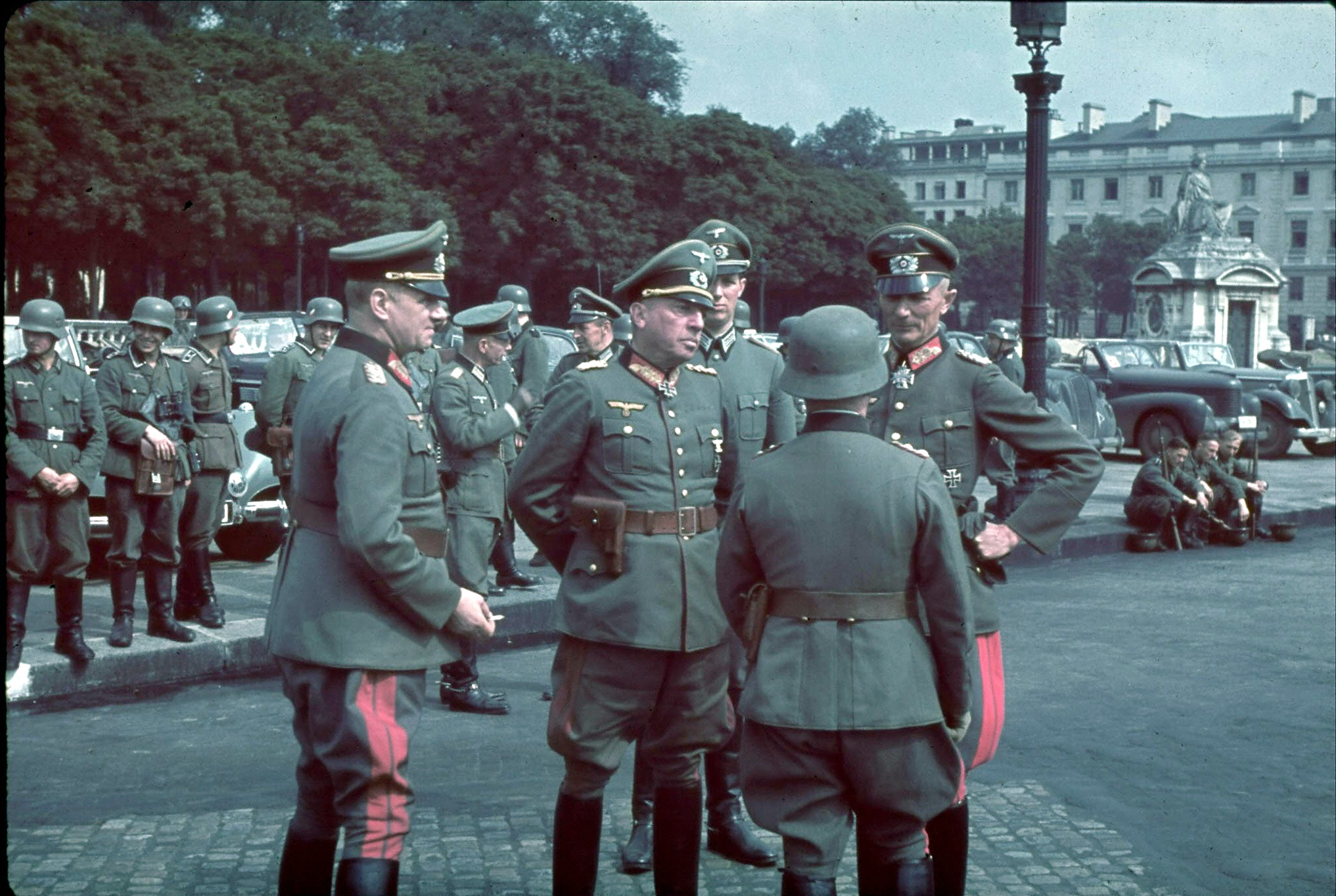
German Generals in the Paris Parade 1940


Wehrmacht high ranking officers gathered at the victory parade of the German troops at the Place de la Concorde, Paris, which held on Friday, June 14, 1940. On that day the French capital fell to the Nazis, while 2,000,000 of its citizens had already fled. In preparation for the parade, the new authorities forbade local residents to approach the vicinity of the Place de la Concorde from 08:00 AM until the afternoon. Front row from left to right: Generalleutnant Hans von Salmuth (Chef des Generalstabes Heeresgruppe B), General der Artillerie Georg von Küchler (Oberbefehlshaber 18. Armee), Oberleutnant der Reserve Heinrich Graf von Lehndorff-Steinort (Adjutant Oberbefehlshaber Heeresgruppe B), General der Kavallerie Georg Stumme (with his back to the camera, Kommandierender General XXXX. Panzerkorps), and Generaloberst Fedor von Bock (Oberbefehlshaber Heeresgruppe B). In the background were rows of parked luxury cars, which were most likely the special rides of the high-ranking German officers who attended the event. The three cars on the right are, in order from left to right: Opel Admiral, Opel Kapitän, and Horch 830 BL. This original color photo was taken by one of Hitler's personal photographers, Hugo Jaeger, who "toured" together with Heeresgruppe B in the invasion of the Low Countries (Netherlands Belgium Luxemburg) and France in the summer of 1940.

Source :
https://artsandculture.google.com/search?q=kuechler&hl=en

Monday, January 3, 2022

U.S. 57 mm M1 Gun

 
A U.S. 57 mm M1 gun firing from Champs-Vauverts gate in Saint-Malo intramuros, in Bretagne in August 1944. It seems to be a reconstructed scene for the movie needs of John Ford who followed Patton's army. The 57mm Gun M1, which was produced in the United States from 1942 to 1945, was the American version of the British 6 Pounder anti-tank gun. Because of production differences between the two countries, there were differences between the M1 and the 6 Pounder. The M1 had a slightly longer barrel than the 6 Pounder.  The longer barrel gave the M1 an increased muzzle velocity of 2793ft/s (853m/s). The 57mm M1 anti-tank gun fired two different types of armor piercing round – the AP and the APC – as well as a high explosive round. It was successfully mounted on self propelled carriages, which were used by the British in North Africa. The strong recoil from the M1 made it unpopular with gunners. The M1 anti-tank gun continued to be used after production ceased in 1945. After World War II ended, the US gave M1s to other countries as a form of military aid.  The guns remained in service in these countries for decades. Central American republics were using M1s at least until the 1980s.

Source :
https://commons.wikimedia.org/wiki/File:57mm_Gun_M1_-_Saint-Malon_Bretagne.jpg
https://www.tanks.net/anti-tank-weapons/united-states-57mm-gun-m1.html

Monday, August 23, 2021

Celebration in Liberated Paris

Celebration in Paris after the French capital was liberated in August 1944

After more than four years of Nazi occupation, Paris is liberated by the French 2nd Armored Division and the U.S. 4th Infantry Division on 25 August 1944. German resistance was light, and General Dietrich von Choltitz, commander of the German garrison, defied an order by Adolf Hitler to blow up Paris’ landmarks and burn the city to the ground before its liberation. Choltitz signed a formal surrender that afternoon, and on August 26, Free French General Charles de Gaulle led a joyous liberation march down the Champs d’Elysees.

Paris fell to Nazi Germany on June 14, 1940, one month after the German Wehrmacht stormed into France. Eight days later, France signed an armistice with the Germans, and a puppet French state was set up with its capital at Vichy. Elsewhere, however, General Charles de Gaulle and the Free French kept fighting, and the Resistance sprang up in occupied France to resist Nazi and Vichy rule.

The French 2nd Armored Division was formed in London in late 1943 with the express purpose of leading the liberation of Paris during the Allied invasion of France. In August 1944, the division arrived at Normandy under the command of General Jacques-Philippe Leclerc and was attached to General George S. Patton’s 3rd U.S. Army. By August 18, Allied forces were near Paris, and workers in the city went on strike as Resistance fighters emerged from hiding and began attacking German forces and fortifications.

At his headquarters two miles inland from the Normandy coast, Supreme Allied Commander Dwight D. Eisenhower had a dilemma. Allied planners had concluded that the liberation of Paris should be delayed so as to not divert valuable resources away from important operations elsewhere. The city could be encircled and then liberated at a later date.

On August 21, Eisenhower met with de Gaulle and told him of his plans to bypass Paris. De Gaulle urged him to reconsider, assuring him that Paris could be reclaimed without difficulty. The French general also warned that the powerful communist faction of the Resistance might succeed in liberating Paris, thereby threatening the re-establishment of a democratic government. De Gaulle politely told Eisenhower that if his advance against Paris was not ordered, he would send Leclerc’s 2nd Armored Division into the city himself.

On August 22, Eisenhower agreed to proceed with the liberation of Paris. The next day, the 2nd Armored Division advanced on the city from the north and the 4th Infantry Division from the south. Meanwhile, in Paris, the forces of German General Dietrich von Choltitz were fighting the Resistance and completing their defenses around the city. Hitler had ordered Paris defended to the last man, and demanded that the city not fall into Allied hands except as “a field of ruins.” Choltitz dutifully began laying explosives under Paris’ bridges and many of its landmarks, but disobeyed an order to commence the destruction. He did not want to go down in history as the man who had destroyed the “City of Light”—Europe’s most celebrated city.

The 2nd Armored Division ran into heavy German artillery, taking heavy casualties, but on August 24 managed to cross the Seine and reach the Paris suburbs. There, they were greeted by enthusiastic civilians who besieged them with flowers, kisses, and wine. Later that day, Leclerc learned that the 4th Infantry Division was poised to beat him into Paris proper, and he ordered his exhausted men forward in a final burst of energy. Just before midnight on August 24, the 2nd Armored Division reached the Hótel de Ville in the heart of Paris.

German resistance melted away during the night. Most of the 20,000 troops surrendered or fled, and those that fought were quickly overcome. On the morning of August 25, the 2nd Armored Division swept clear the western half of Paris while the 4th Infantry Division cleared the eastern part. Paris was liberated.

In the early afternoon, Choltitz was arrested in his headquarters by French troops. Shortly after, he signed a document formally surrendering Paris to de Gaulle’s provisional government. De Gaulle himself arrived in the city later that afternoon. On August 26, de Gaulle and Leclerc led a triumphant liberation march down the Champs d’Elysees. Scattered gunfire from a rooftop disrupted the parade, but the identity of the snipers was not determined.

De Gaulle headed two successive French provisional governments until 1946, when he resigned over constitutional disagreements. From 1958 to 1969, he served as French president under the Fifth Republic.


Source :
https://www.history.com/this-day-in-history/paris-liberated

Monday, May 24, 2021

212. Infanterie-Division Crossing Viaduc de Dinan


German 212. Infanterie-Division stationed in France, 1941. This impressive bridge is Viaduc de Dinan in Brittany. Dinan is without doubt one of the most attractive and best preserved small towns in Brittany. With its 1.8 mile (3km)-long ramparts, half-timbered houses, attractive port and cobbled streets filled with art galleries and craft shops. Wherever you are, you won’t miss the 131ft (40m)-high viaduct. From the estate of Eugen Kastner.

Viaduc de Dinan now


Source :
Akira Takiguchi photo collection
https://www.brittanytourism.com/destinations/the-10-destinations/cap-frehel-saint-malo-mont-saint-michel-bay/dinan/
https://www.facebook.com/photo/?fbid=10223680712759327&set=gm.1727228047462611

Tuesday, January 5, 2021

Free French Rest in a Poppy Field


In the Fields where the Poppies Grow... Free French soldiers rest in a poppy field near the M4 'Sherman' tanks. Between the tanks worth army truck 'Chevrolet' G7107. Italy, August, 1944. Parking in the open instead of near the trees in the background only shows the total allied air supremacy in Europe!


Source :
https://www.facebook.com/photo/?fbid=2896136927341279&set=gm.1644674452384638

Wednesday, July 22, 2020

Paris under Occupation

Paris under occupation: Avenue des Champs-Elysées in the eyes of an unknown SS-Kriegsberichter who travelled with Leibstandarte SS Adolf Hitler Division to France.


SS-Kriegsberichter posing in front of Eifel Tower


Source :
Akira Takiguchi photo collection
https://www.facebook.com/photo.php?fbid=10220780743501908&set=gm.1443269669191785&type=3&theater&ifg=1

Sunday, February 9, 2020

General Dietrich von Choltitz Surrender

General der Infanterie Dietrich von Choltitz (left) surrender to Général de brigade Philippe Leclerc de Hauteclocque (Commander 2e Division Blindée), 25 August 1944. On 7 August previously he was appointed as Kommandierenden General und Wehrmachtbefehlshaber von Groß-Paris (Military Governor of Paris). At a meeting in Germany the following day, Hitler instructed him to be prepared to leave no Parisian religious building or historical monument standing. After Choltitz's arrival in Paris on 9 August, Hitler confirmed the order by cable: "The city must not fall into the enemy's hand except lying in complete rubble." A week later Hitler, in a rage, screamed, "Brennt Paris?" (Is Paris burning?). On 15 August 1944, the Paris police went on strike, followed on 19 August by a general insurrection led by the French Communist Party. The German garrison under Choltitz fought back but was far too small to quell the uprising. He brokered a ceasefire with the insurgents on 20 August, but many Resistance groups did not accept it, and a series of skirmishes continued on the next day. On 25 August, Choltitz surrendered the German garrison of 17,000 men to the Free French, leaving the city largely intact. Because Hitler's directive was not carried out, Choltitz has been described by some as the "Saviour of Paris". General von Choltitz later claimed in his memoir of 1951 that he defied Hitler's order to destroy Paris because he loved the city and had decided that Hitler was by then insane. It is known that the Swedish consul-general in Paris, Raoul Nordling, and the president of the municipal council, Pierre Taittinger, held several meetings with Choltitz, during which he negotiated the release of political prisoners. The all-night confrontation between Nordling and Choltitz on the eve of the surrender, as depicted in the 1965 book and 1966 film, Is Paris Burning?, and again in the 2014 film Diplomacy — in which Nordling persuades Choltitz to spare the city in return for a pledge to protect his family — was reported as factual in some newspaper stories, but lacks a definitive historical basis.


Source :
https://en.wikipedia.org/wiki/Dietrich_von_Choltitz
https://wtop.com/europe/2019/05/rare-color-footage-brings-d-day-memories-alive-75-years-on/

Thursday, May 30, 2019

French Wehrmacht Volunteers in a Captured Russian Town


Two soldiers of the 'Legion des volontaires francais' in a conquered town on the Eastern Front, late autumn 1941. Photograph by Artur Grimm. The 'Legion of French Volunteers Against Bolshevism' (French: Légion des volontaires français contre le bolchévisme, or simply Légion des volontaires français, LVF) was a collaborationist militia of Vichy France founded on 8 July 1941. It gathered various collaborationist parties, including Marcel Bucard's Mouvement Franciste, Marcel Déat's National Popular Rally, Jacques Doriot's French Popular Party, Eugène Deloncle's Social Revolutionary Movement, Pierre Clémenti's French National-Collectivist Party, and Pierre Costantini's French League. It had no formal link with the Vichy regime, even though it was recognized as an "association of public usefulness" by Pierre Laval's government in February 1943. Philippe Pétain, head of state of Vichy France, personally disapproved of Frenchmen wearing German uniforms and never went beyond individual and informal words of support to some specific officers. It volunteered to fight against the Soviet Union on the Eastern Front. It was officially known by its German designation, verstärktes Französisches Infanterie-Regiment 638 (the reinforced 638th French Infantry Regiment).


Source:
https://en.wikipedia.org/wiki/Legion_of_French_Volunteers_Against_Bolshevism
https://www.gettyimages.com/detail/news-photo/world-war-ii-two-soldiers-of-the-legion-des-volontaires-news-photo/548129413
http://waralbum.ru/371634/

Wednesday, January 2, 2019

U.S. MP in a French Ruined Building

Summer of 1944, Northwestern France. A lieutenant of the MP (Military Police) in the courtyard of a ruined building. He wears a black A-1 flight jacket of the USAAF. On the inside he used what technically would be called a "Faithful US Jacket, Army ETO", which is but one of the very first versions of what will be known as "Ike's Jacket" or the British Battledress version for the US Army that is mostly used as a walking uniform (here rarely used as a combat uniform). Another "first" of this jacket is that it has the pockets at an angle with flaps (this has been put inside the pocket) identical to those of the first version of the Parsons jacket. The color of the Ike's Jacket is the Olive Drab shade 33. What looks like a dustbin with fireplace on the right is actually a U.S. Army mobile kitchen. There also seems to be the letter that appears on his helmet. This picture was made by Frank Scherschel


Source :
http://iqisu.blogspot.com/2015/11/photo-minute-post-normandy-france.html
http://www.panzernet.com/foro4/showthread.php?11073-Uniformes-mezclados/page3
http://surfingbird.ru/surf/f6h00111E#.XCvwsWkxXcs

Monday, April 9, 2018

US Troops Marching in Saint-Lô

United States Army trucks and jeeps drive through the ruins of Saint-Lô, Normandy (France), in July of 1944. A group of American soldiers is walking along the street. The town was almost totally destroyed by 2,000 Allied bombers when they attacked German troops stationed there during Operation Overlord. The Battle of Saint-Lô is one of the three conflicts in the Battle of the Hedgerows (fr), which took place between July 9–24, 1944, just before Operation Cobra. Saint-Lô had fallen to Germany in 1940, and, after the Invasion of Normandy, the Americans targeted the city, as it served as a strategic crossroads. American bombardments caused heavy damage (up to 95% of the city was destroyed) and a high number of casualties, which resulted in the martyr city being called "The Capital of Ruins", popularized in a report by Samuel Beckett. The picture was taken by Reinhard Schultz from PRISMA magazine


Source :
http://www.alamy.com/stock-photo-world-war-ii-normandy-saint-lo-july-1944-second-world-war-ww2-war-30511322.html
https://www.gettyimages.com/articles/news/see-rare-color-pictures-of-d-day
http://historyinphotos.blogspot.co.id/2016/01/world-war-ii-in-color.html
https://www.theatlantic.com/photo/2014/06/scenes-from-d-day-then-and-now/100752/
https://www.turkishnews.com/en/content/2015/12/20/d-day-in-color-photographs-from-the-normandy-invasion/