
Source :
https://www.zinnfigur.com/en/Books-Media/Others/Calendars/Zweiter-Weltkrieg-in-Farbe-2023.html
Source :
https://www.zinnfigur.com/en/Books-Media/Others/Calendars/Zweiter-Weltkrieg-in-Farbe-2023.html
 German soldiers and the wall of snow. No information about when and where this pic was taken.
Source :
https://www.wehrmacht-awards.com/forums/forum/wehrmacht-era-militaria/photos-and-paper-items-forum/77941-post-your-exciting-winter-photos/page81
 A pair of German artillery radio operators send coordinates on a portable transmitter in the Soviet Union, winter of 1942. The second man has a captured Russian Ushanka fur hat. The image was originally published as 'Das Heer im Grossdeutschen Freiheitskampf' (translated as 'The Army in the Greater German Freedom Struggle'), a collection of 50 plus images taken by the German Army's combat photography unit (Propagandakompanie) during the German invasion of the Soviet Union. The picture itself was taken by Kriegsberichter Trautvetter.
Letters and other forms of written communication have been transported within and between countries since medieval times, although a cheap, easily accessible postal service only became generally available to the British public with the appearance of the world's first adhesive postage stamp, the Penny Black, on 6 May 1840. This system was based on the sender pre-paying a flat rate for an item, a charge of one penny being made for the delivery of a letter weighing less than ½ ounce (14 grams) regardless of distance, with charges increasing for heavier items.
Other countries, including Germany, soon developed similar postal systems based upon adhesive, pre-paid stamps of a design unique to the area concerned, but it was not until Germany's partial unification in 1871 that the Deutsche Reichspost (German Imperial Mail or DRP) was established as a state monopoly, on 4 May 1871. It then became the official national postal authority for the German Empire and Alsace-Lorraine, being separated from Bismark's Reich Chancellery in 1876 as the Reichpostamt and operated as a separate agency.
Adolf Hitler's appointment as Chancellor in 1933 and the establishment of the Third Reich saw the DRP retain its original form and purpose, with Reichspost Minister Paul Freiherr von Eltz-Rubenach kept in post until 1937, when Karl Wilhelm Ohnesorge was appointed Minister of the Reichspost. He held this post until the end of the war, having been the real power in the Ministry during the whole of Eltz-Rubenbach’s tenure under the Nazi regime.
The Reich postal area was rapidly expanded during the period just before WWII, incorporating the Saar territory in 1935, and Austria and the Sudetenland in 1938. Occupied Polish areas came under its jurisdiction in 1939, including the free port of Danzig which had previously issued its own stamps, although the Feldpost military postal organisation was the main postal authority in these occupied areas. The DRP finally ceased operations on 8 May 1945, the date of the German surrender, being replaced by two post-war organisations, West Germany’s Deutsche Bundespost (German Federal Post Office) and East Germany’s Deutsche Post.
Many early stamps issued by the Third Reich for general circulation typically showed the head of Adolf Hitler in either left or right profile, and in addition to these Hitler head stamps there were also issues of complete series of official stamps which bore only a swastika. Stamps were also issued to commemorate events such as the National Socialist’s 10 years in power or Hitler’s birthday and these usually included engravings appropriate to the event. After 1934, all Reich stamps show the value of the stamp in the top corner/corners and a subscript in Gothic script at the bottom of the stamp reading: ‘DEUTSCHES REICH’
After 1944, Deutsches Reich (German Empire) was replaced with Grossdeutsches Reich (Greater German Empire), as a subscript in Gothic script, reading:
‘GROSSDEUTSCHES REICH’.
As well as ordinary stamps Hitler’s postal service issued a considerable number of semi-postal stamps. These are stamps which include a surcharge and may be easily recognised because they are printed with the purchase price of the stamp, then an addition sign, followed by the surcharge: ‘12+8’ indicating a stamp for which 12 Pfennigs was charged for postage, with an additional surcharge of 8 Pfennigs going to the relevant government project for which the stamp was issued. These stamps were intended by most governments to serve as a contribution to various charitable institutions, but the surcharge from Nazi semi-postals was used to finance all manner of government projects, including the war.
The German government had operated a postal service of some sort specifically for its military personnel since the Seven Years War in 1756, but the system was based upon deliveries by civilian postal authorities and had no resources available to facilitate the delivery of letters and parcels to troops at the front. Even during WWI, when Britain’s GPO was delivering around 12 million letters each week to Allied soldiers, sailors and airmen, the German postal authorities responded to the 1915 pre-Christmas rush by telling soldiers at the front not to send Christmas cards, because the already overburdened postal service could not deliver them.
However, between 1937 and 1945 this system was vastly improved, the Wehrmacht operating a military postal service, the Feldpost (Army Postal Service), organised so that all branches of the German military (Luftwaffe, Kreigsmarine, Waffen SS, etc) were responsible for delivering their own mail, although Feldpost offices closest to the combat zone usually had a mobile facility which processed mail for all the military branches. Charges for members of German military and paramilitary units (units composed of men not of German nationality serving with the Wehrmacht) were minimal, postcards and letters weighing less than 250gm (8oz) going free, while packages weighing between 250gm and 1kg (1,000gm/2.2lb) cost only 20 Reichspfennigs (about 5 old pence or 2p) to be delivered anywhere.
A semipostal from after 1944 commemorating the work of the German labour divisions, face value 12pf, surcharge 8pfComplications arose within this system as a result of the rapid movement of the German army through Europe in 1940 and, after a series of negotiations with the relevant governments, postal agreements were set up between Germany and the occupied countries providing for extended use of the Feldpost service. This was an important consideration for Hitler and his government cronies, as many of those occupied countries had significant numbers of volunteers in Wehrmacht units and Goebbels in particular must have quickly appreciated how the moral of these individuals was increased by access to a free post allowing them to write and receive letters from home. Even neutral countries which had volunteers serving with the Wehrmacht, such as Portugal, Spain, Switzerland, Sweden and Turkey, were eventually included in these postal agreements, relatives receiving their letters from men serving with the German forces by the same Feldpost system as the average Berliner.
Stamps do not appear to have been generally issued for this service until 1942 and then only for parcels and airmail covers, ordinary letters being simply stamped with what was termed a Feldpost number (FPN), in a system similar to the modern postcode. Servicemen could also send items via the civilian postal system, in which case full postage was collected and stamps issued and cancelled upon dispatch.
Unit FPNs typically consisted of five digits indicating a location, preceded by a letter showing whether the recipient’s unit belonged to the Heer, Luftwaffe, Kriegsmarine or some other service branch. There was also a letter following the digits which indicated whether the serviceman was serving in the headquarters company or as part of a line unit. This system was specifically developed to keep troop locations secret, relatives of service personnel receiving a messaging card (Benachrichtigungskarten) bearing the relevant FPN, with mail reaching the recipient in about two weeks. All correspondence from military personnel serving abroad was subject to censorship, although covers and postcards sent to addresses within Germany did not receive such scrutiny.
A Feldpost delivery on the Russian frontPerhaps needless to say, SS mail received special treatment. The SS-Feldpost mail was handled separately by the designated SS-units, the difference between ordinary Feldpost and SS-Feldpost mail being that an item for an SS soldier was required to bear the SS-Feldpost marking, SS unit seal and the sender's rank (SS-Mann), although these regulations do not appear to have been rigidly enforced. The SS also had mail surveillance centres, which used their own censorship markings. Initially the Feldpost was subject to the rules and regulations governing regular postal services and administered by the OKW (Wehrmacht High Command) but on 6 April 1944, all military mail, including its censorship, was removed from Wehrmacht control and came under the jurisdiction of the SS.
As well as their official stamps the Third Reich also produced several series of what are termed propaganda stamps and these include issues parodying the Royal family and the 1935 Silver Jubilee, which replaced the Silver Jubilee superscript with a picture of Stalin and the message ‘THIS WAR IS A JEWISH WAR’.
On the other side of the Channel, British MI6 produced a number of excellent forgeries of 3, 4, 6 and 8 Pfennig Reich stamps, while the OSS produced 6 and 12 Pfennig stamps, although their stamps were claimed to be inferior to MI6’s product. Both the SOE and OSS also produced propaganda stamps, in particular one with Himmler replacing Hitler, specifically intended to undermine the Fuhrer's confidence in his right hand man.
OSS stamp produced for Operation Cornflakes, showing Hitler as a Death's Head and with a subscript which translates as Ruined (or Lost) EmpireNot only did Allied intelligence forge genuine DRP stamps, they also set up an operation to fool the German postal service into delivering Allied propaganda. Designated Operation Cornflakes and run principally by the American OSS, the operation involved dropping subversive material in the form of letters enclosed in Reich-pattern mail bags from specially adapted planes on or near the site of a wrecked mail train. Letters were then re-collected and delivered in the normal way, OSS operatives having used captured German street directories to locate the addresses of real people within the Reich to whom this material was sent. From a collector's viewpoint this operation is of particular interest because the OSS produced a series of special stamps with unique engraving. One in particular shows Hitler’s face as a Death's Head in right profile with the usual subscript, ‘GROSSDEUTSCHES REICH’ replaced with the subscript ‘FUTSCHES REICH’, or ruined empire.
Although stamps, covers and postcards may not immediately seem something for the collector of militaria, many of these items have an intrinsic beauty of their own which can prove very attractive. Also, they are relatively cheap so a small collection of items of intrinsic interest, say, stamps related to Stalingrad, need not break the bank and would add interest to an otherwise mundane collection.
Stamps issued by the Third Reich - Generally, the issues with Hitler's head and the official swastika stamps are fairly common and relatively inexpensive, 20 stamps of the Hitler head issue selling for as little as £6-£7, with the swastika stamps about the same price. Some semipostals and commemorative stamps are also relatively inexpensive, a set commemorating the 1936 winter Olympics being recently offered for only £5, although much depends upon condition and rarity.
Propaganda stamps - Perhaps surprisingly, considering their interesting provenance, these stamps do not seem to fetch huge prices at auction, £5-£6 being the average internet price, depending upon condition and rarity.
Operation Cornflakes - Stamps from this operation are significantly more expensive than the general run of WWII stamps, £100-£200 being not unusual for the 12pf Death’s Head issue.
Feldpost covers and postcards - Normally Feldpost mail could not be dispatched nor received by civil post offices and envelopes (postal covers) or postcards delivered via the service are usually found stamped with a military Feldpost Cancellation and Official Military Unit Seal. Some covers and postcards from paramilitary units may be found with overprinted stamps, indicating that the item was dispatched from an occupied country before the German post office had begun issuing their own stamps, specifically printed for that area. These covers and postcards may also bear stamps from a censor, particularly after June 1944, when all postal items became the responsibility of the SS. Feldpost numbers were also sometimes reassigned to other units, particularly when a formation ceased to exist as a result of military action and consequently legitimate covers may be found which bear the same Feldpost number for two different units.
As usual, values depend upon rarity and provenance, but generally these are not expensive, good quality Bavarian covers starting at about £20.
Reichsparteitag Party Rally Propaganda postcard Postcards - These are really a collecting field in themselves but many of the examples produced by the Third Reich as propaganda tools are of extremely high quality and mint examples can fetch high prices, around £30-£40 being not unusual.
Source :
https://www.alamy.com/stock-photo-events-second-world-war-wwii-back-area-military-mail-service-delivery-24441770.html?imageid=A6C4EDC4-6578-41A1-BAB7-1456CB9AB042&p=58867&pn=1&searchId=d7b5b9a049e0fb6db1aa0742a1ef9e44&searchtype=0
https://www.gettyimages.com/detail/news-photo/dressed-in-winter-gear-two-german-soliders-look-through-a-news-photo/103137516?phrase=Das%20Heer%20im%20Grossdeutschen%20Freiheitskampf
https://www.militaria-history.co.uk/articles/postage-stamps-of-the-third-reich/


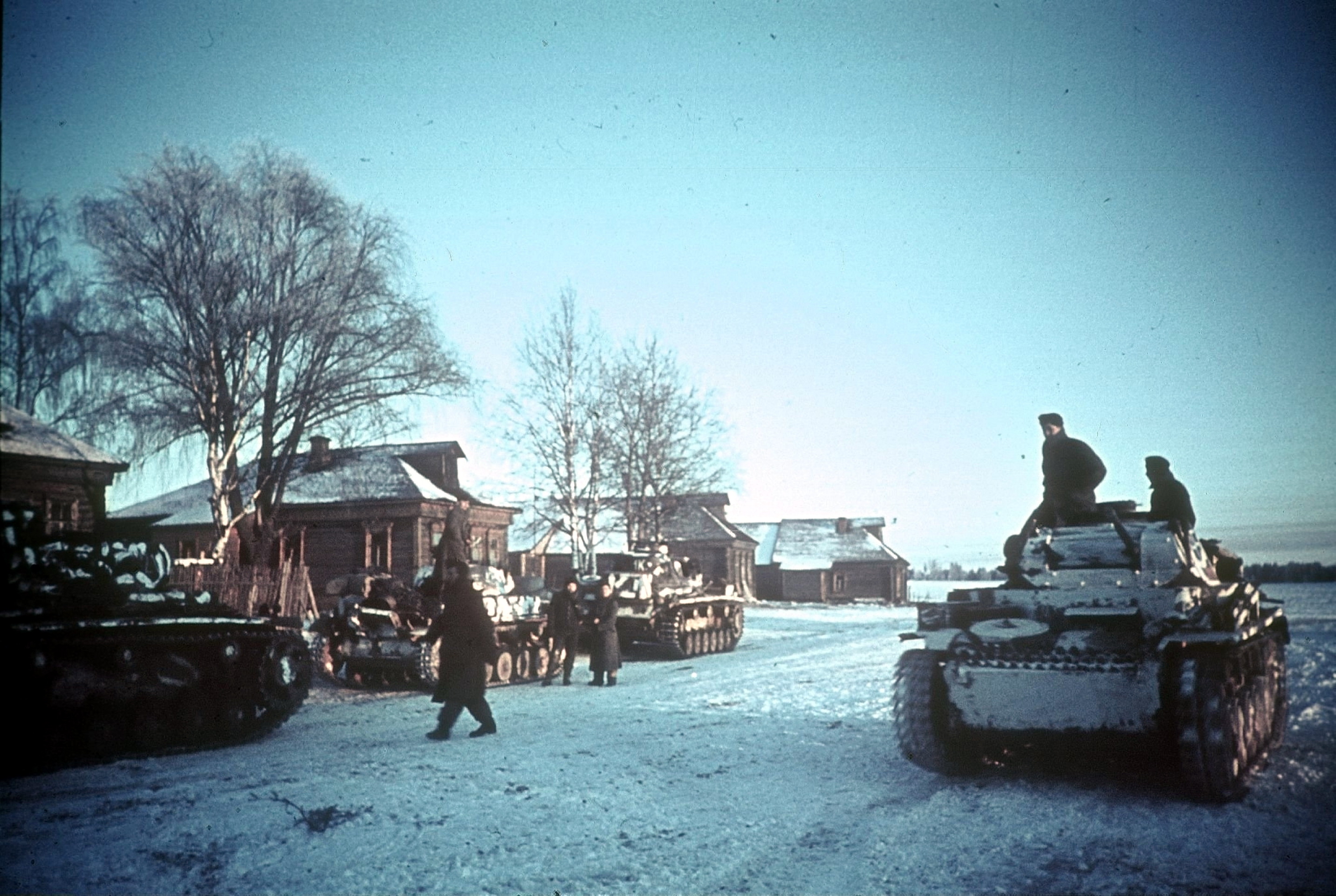 White winter camouflaged tanks of the 11. Panzer-Division in the village of Matronino near Volokolamsk. On the left, the first and third are Panzer III tanks, while between them and on the right is Panzer II tanks. The picture was taken by Kriegsberichter Artur Grimm in Moscow area, November 1941. From 31 October to 13–15 November 1941, the Wehrmacht high command stood down while preparing to launch a second offensive towards Moscow. Although Heeresgruppe Mitte (Army Group Centre) still possessed considerable nominal strength, its fighting capabilities had thoroughly diminished because of wear and fatigue. While the Germans were aware of the continuous influx of Soviet reinforcements from the east as well as the presence of large reserves, given the tremendous Soviet casualties, they did not expect the Soviets to be able to mount a determined defense.
Source :
https://www.jchb.org/neveragain-eastern-front-map/
https://twitter.com/dhkriegbericher?lang=en
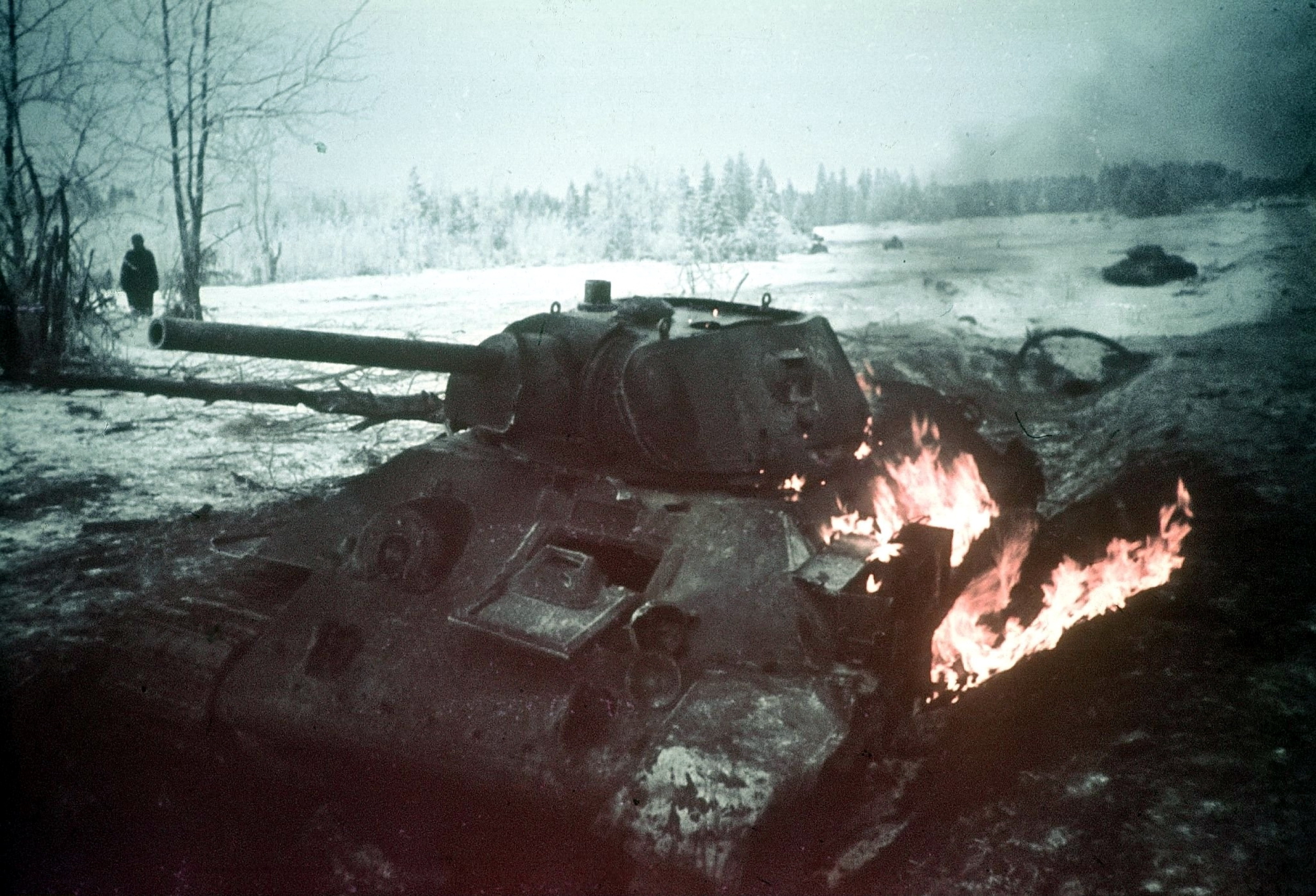 Aftermath of the repel of a Soviet tank attack by German forces in the Eastern Front: a hit, burning T 34 tank. The picture was taken by Kriegsberichter Artur Grimm, early or late 1943 (winter). The T-34 seemed impervious to German weapons and able to destroy German tanks with ease. Panzer commander General Heinz Guderian saw the heavy losses inflicted by the T-34 and realized what a game-changer it was, outclassing his own Panzer IIIs and IVs: “Up to this time we had enjoyed tank superiority, but now the situation was reversed,” Guderian wrote. “The prospect of rapid, decisive victories was fading in consequence."
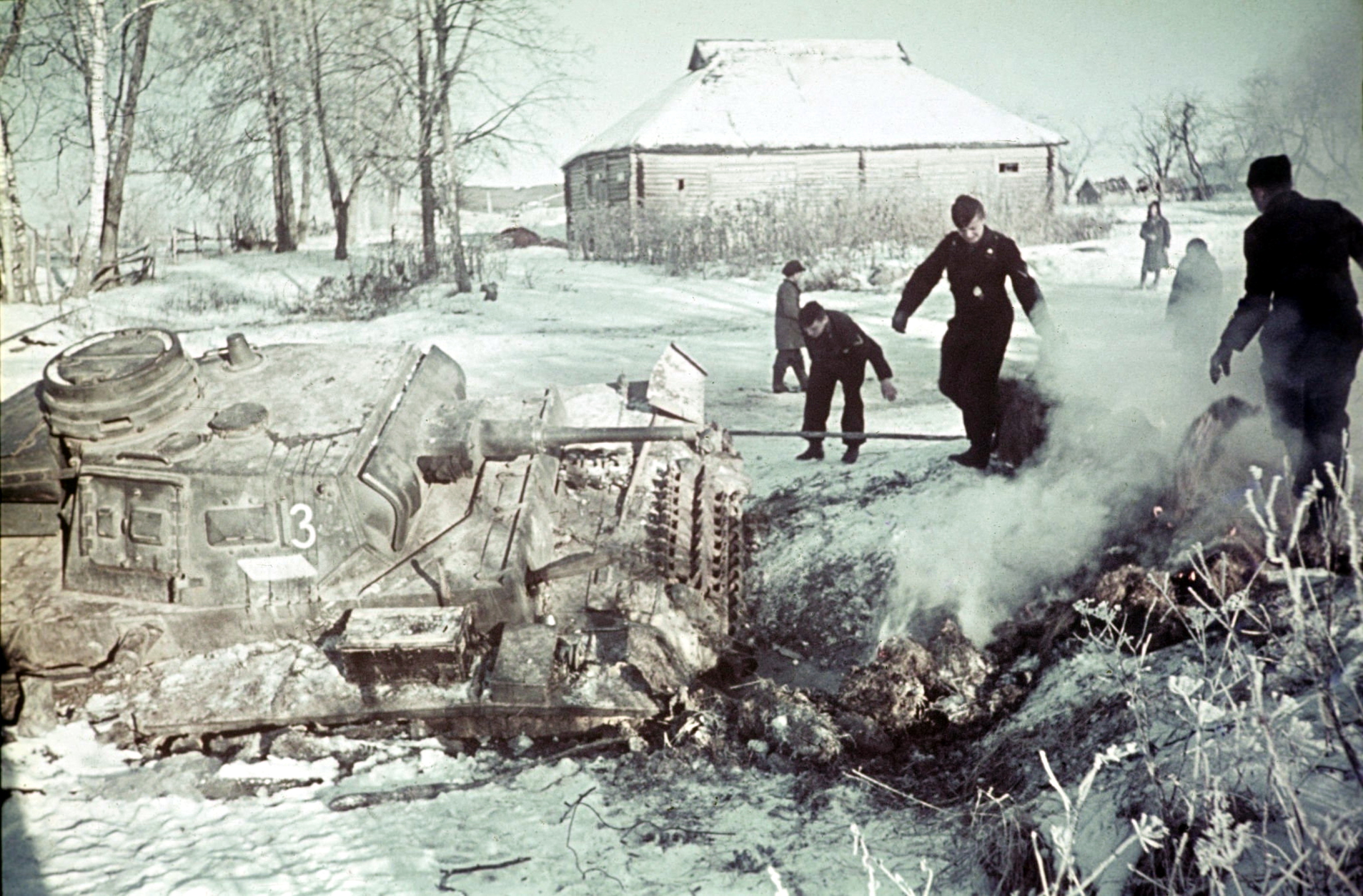 German panzer crew work to free their Panzer III from frozen mud, Ukraine, late 1941. Photographer: Artur Grimm. During the invasion of Russia, the Wehrmacht lacked necessary supplies, such as winter uniforms, due to the many delays in the German army's movements. At the same time, Hitler's plans for Operation Barbarossa actually miscarried before the onset of severe winter weather. Neither Hitler nor the General Staff anticipated a long campaign lasting into the winter. Thus, they failed to make adequate preparations for a possible winter campaign, such as the distribution of warm clothing and winterization of vehicles and lubricants. In fact his eastern army suffered more than 734,000 casualties (about 23% of its average strength of 3,200,000) during the first five months of the invasion before the winter started. On 27 November 1941, Eduard Wagner, the Quartermaster General of the German Army, reported that "We are at the end of our resources in both personnel and material. We are about to be confronted with the dangers of deep winter." Also of note is the fact that the unusually early winter of 1941 cut short the rasputitsa season, improving logistics in early November, with the weather still being only mildly cold.
 German soldiers warming themselves around a fire at the Eastern Front. No place given, but in the winter of 1941/42. At this time, they are still using a standard coat and mantels which are not protected enough from the cold in Russia. Note that this photo is original color, taken on Agfacolor film, and is not a colorization. Photograph taken by Arthur Grimm
 German soldier in winter gear taking aim with his MG 34 machine gun on the Eastern Front, probably winter 1942. This weapon was an excellent improvement on the machine guns of the First World War, which were expensive and slow to manufacture. The only downside of the gun was simply too good work quality. Tightly made parts were sensitive to disturbances caused by dirt and gunpowder residues. In field conditions the weapon was unfortunately often jammed and demanded constant care. The cold weather in winter also caused problems with freezing. Photographer: Artur Grimm.


Source :
Akira Takiguchi photo collection
https://www.facebook.com/photo/?fbid=10223840436992333&set=gm.1743370425848373

Source :
National Archives and Records Administration 80-G-K-5178
Smithsonian National Air and Space Museum
https://www.flickr.com/photos/airandspace/albums/72157715574200936
https://www.history.navy.mil/content/history/nhhc/our-collections/photography/numerical-list-of-images/nhhc-series/nh-series/80-G-K-05000/80-G-K-5178.html

Source :
Akira Takiguchi photo collection
https://www.facebook.com/photo/?fbid=10222880587316691&set=gm.1655515797967170

A Gebirgsjäger soldier posing with his ski. He is wearing a whistle lanyard in his pocket and a darkened lenses goggle associated with snow/ice goggles. They were a standard for the Italian Alpine corps and for the Swiss army till the end of last century. Someone may have brought them down there too, but although robust, they were not good with sand because they easily got scratched as the lenses were celluloid and later soft plastic.
Source :
Akira Takiguchi photo collection
https://www.facebook.com/photo/?fbid=10222852270488788&set=gm.1652878351564248
 Agfacolor color slide of U-Boot Korvettenkapitän Wolfgang Lüth with an unknown officer of the Waffen-SS
Wolfgang Lüth (15 October 1913 - 14 May 1945) was the second most successful German U-boat captain of World War II. His career record of 46 merchant ships plus the French submarine Doris sunk during 15 war patrols, with a total displacement of 225, 204 gross register tons (GRT), was second only to that of Korvettenkapitän (Lieutenant Commander) Otto Kretschmer, whose 47 sinkings totaled 273,043 GRT.
Lüth joined the Reichsmarine in 1933. After a period of training on surface vessels, he transferred to the U-boat service in 1936. In December 1939 he received command of U-9, which he took on six war-patrols. In June 1940 he took command of U-138 for two patrols. In October 1940 he transferred again, this time to the ocean-going submarine U-43 for five war-patrols. After two patrols on U-181, the second being his longest of the war, he was awarded the Knight's Cross of the Iron Cross with Oak Leaves, Swords and Diamonds. He was the first of two U-boat commanders to be so honored during World War II, the other recipient being Albrecht Brandi.
Lüth's last service position was commander of the Naval Academy Mürwik near Flensburg. He was accidentally shot and killed by a German sentry on the night of 13/14 May 1945. On 16 May 1945, Lüth was given the last state funeral in the Third Reich.
Source :
https://en.wikipedia.org/wiki/Wolfgang_Lüth
https://www.facebook.com/photo/?fbid=427652551836908&set=gm.1661641007354649
Bombers of the 17th training squadron of the Finnish Air Force at the Luonejärvi airfield. Finland, March 28-30, 1944. Photographer: Niilo Helander.


Source :
https://www.facebook.com/groups/237076659811098/permalink/1657767927741957/?__cft__[0]=AZWfu-HJ9ckr94TdnGR7xPWM2mhbrmmz_h6DaSpdELcOpJ1wgzMNZ-VGjPgKLZRYrAHA1zfq_nfbcrV3ELaNs--JFJgpwMGF30sQ9uHXezgf7z7eMBOfPNzshlSqQaC-V0kVuJrOpnZiQ-J5PC6FSgLl0aZZl0CQU66e3n6lgG_LTo7ZRf9cRYeLwSiIMuXESYU&__tn__=%2CO%2CP-R
http://sa-kuva.fi/


 Winter in the Eastern Front, 1941-42. The winter of 1941–42 is known as the coldest European winter of the 20th Century. The temperature was much below normal from the beginning of January until the end of March 1942. Blockings and cut-off lows were frequent, particularly during January and February 1942. The role of quasi-stationary waves during this winter has been studied by decomposing the 500-mb geopotential height data in a low-pass, filtered, quasi-stationary part and a traveling part. The phase of the quasi-stationary wave was such that a ridge was present over the eastern Atlantic and a trough over western Russia throughout most of the winter. As a result, the majority of migratory cyclones that approached Europe from the west were steered either south toward the Mediterranian or north of Scandinavia. Photos by Dr. Paul Wolff and Alfred Tritschler.
Source :
https://www.facebook.com/groups/237076659811098/permalink/1653292204856196/?__cft__[0]=AZXVbR-ov97tjXfW9zk4mYHF4ga0e1_E2XXLpRZ5lTxcrzqaGdgmfR6RLyeoAeYbR1z9F3WcYJT9qUaJTRhDlCwvA4Z9B69BQCEqfQSEUfku00_bKTcu8opbtFy5wcpXqItcjkKkTeFmUhz2oDMR2LnHs02DyB_7jMZC7LwkBWQF3Lnp9zZLQ5_KcfduSE3_xY0&__tn__=%2CO%2CP-R
https://journals.ametsoc.org/view/journals/bams/70/3/1520-0477_1989_070_0271_tswiet_2_0_co_2.xml

Source :
Akira Takiguchi photo collection
https://www.facebook.com/photo/?fbid=10222729821307635&set=gm.1640137202838363
 December 8th, 1942. A light (10,5cm) howitzer from 168. Infanterie-Division rests in a position. Note protections on breech block and muzzle cover. They have whitewashed even the breech block leather cover!
Source :
Akira Takiguchi photo collection
https://www.facebook.com/photo/?fbid=10222732878744069&set=gm.1640453822806701