Showing posts with label German Foreign Volunteer. Show all posts

Sunday, September 6, 2026

Blue Division's Swearing-in Ceremony at Grafenwöhr (1941)


From left to right: Generalleutnant Agustín Muñoz Grandes (Kommandeur 250. Infanterie-Division [spanien]), Generaloberst Friedrich Fromm (Chef der Heeresrüstung und Befehlshaber des Ersatzheeres), Gauleiter Fritz Wächtler (NSDAP-Gauleiter der Bayerischen Ostmark), and Dr.phil. Friedrich von Cochenhausen (Kommandierenden General des Stellvertretenden XIII. Armeekorps in Nürnberg und Befehlshaber vom Wehrkreis XIII). The picture was taken at Truppenübungsplatz Grafenwöhr on 31 July 1941 during swearing-in ceremony of the Spanish volunteers in the Wehrmacht.


In the summer of 1941, as German forces advanced deep into the Soviet Union following the launch of Operation Barbarossa on 22 June, a contingent of Spanish volunteers prepared to join the campaign on the Eastern Front. These men formed what became known as the División Azul, or Blue Division, a unit of volunteers raised in Francoist Spain to fight against Bolshevism. After recruitment and initial organization in Spain, the volunteers travelled by train across France and into Germany, arriving at the large military training ground of Grafenwöhr in Bavaria between 17 and 23 July 1941. There, under German supervision, they underwent rapid reorganization, outfitting, and instruction before formal incorporation into the Wehrmacht as the 250. Infanterie-Division.

Grafenwöhr was a major Truppenübungsplatz with extensive facilities capable of accommodating large formations. The Spanish contingent, numbering roughly 18,000 men, was placed under the overall administration of the camp authorities, which operated from the Kommandantur. German instructors oversaw the issue of Wehrmacht uniforms, equipment, and weapons, including the distinctive MG 34 machine gun that the Spaniards quickly came to admire. The only outward marks distinguishing the Spaniards from German personnel were a silk arm shield in the Spanish national colours bearing the word “España” on the right sleeve and, in many cases, the continued wearing of the blue Falange shirt or the red Carlist beret beneath or in place of standard headgear. The division was restructured from the Spanish four-regiment model to the standard German three-regiment organization to facilitate integration into the Wehrmacht supply system. The infantry regiments received the designations 262., 263., and 269. Infanterie-Regiment, supported by an artillery regiment and various independent units and services. Spanish military justice and certain internal police functions remained under Spanish control, in accordance with agreements reached between the two governments.

Training was intensive but abbreviated. German expectations of rapid deployment, combined with the high proportion of veterans of the Spanish Civil War among the volunteers, led to a compressed schedule of roughly two to five weeks rather than the longer period originally envisaged. The men adapted to German drill, marching discipline, and weapons handling while living in the camp’s two-storey barracks built in a style reminiscent of Bavarian architecture.

The formal swearing-in ceremony that sealed the division’s incorporation into the Wehrmacht took place on 31 July 1941 on the instruction field known as Kramemberg (sometimes rendered Kramerbrg in contemporary accounts). The entire division formed up for the occasion, accompanied by a German company of honour. Presiding over the event were the Spanish commander, General Agustín Muñoz Grandes, together with his staff; Generaloberst Friedrich Fromm, representing the German high command as Chef der Heeresrüstung und Befehlshaber des Ersatzheeres; and General der Artillerie Dr.phil. Friedrich von Cochenhausen, who acted as the officer in charge of the ceremony. The Spanish and German national flags stood side by side.

The proceedings began with a Catholic field mass, reflecting the predominantly Catholic character of the Spanish volunteers. After the religious service came the central act: the oath of allegiance. At the insistence of the Spanish authorities, the standard Wehrmacht formula of personal loyalty to Adolf Hitler was modified to limit the obligation to the struggle against communism. General von Cochenhausen first read the oath in German:

“Schwörst Du vor Gott und bei Deiner Ehre als Spanier, dem Obersten Befehlshaber der Deutschen Wehrmacht, Adolf Hitler, im Kampf gegen den Kommunismus unbedingten Gehorsam entgegenzubringen und schwörst Du, als tapferer Soldat zu kämpfen, der jederzeit bereit ist, sein Leben in Erfüllung dieses Eides hinzugeben?”

Colonel José María Troncoso then repeated the text in Spanish:

“¿Juráis ante Dios y por vuestro honor de españoles, absoluta obediencia al jefe de las Fuerzas Armadas alemanas, Adolf Hitler, en la lucha contra el comunismo, y juráis combatir como valientes soldados, dispuestos a dar vuestra vida en cada instante por cumplir este juramento?”

The assembled ranks raised their right arms in the Fascist salute and answered with a collective “¡Sí, juro!” or “Yes, I swear.” Muñoz Grandes himself took the oath separately, adding the emphatic Spanish declaration: “Lo que un español jura, lo cumple o muere” (“What a Spaniard swears, he fulfils or dies”).

Contemporary accounts describe the atmosphere as one of solemn intensity. One participant later recalled the emotional impact of thousands of voices answering as one. After the oath, Muñoz Grandes addressed the division, declaring that the volunteers had sworn to die rather than allow Bolshevism to continue its work of destruction, and instructing that the Führer be informed of their readiness and their determination to keep their word.

A second, smaller ceremony took place on 3 August for those who had not yet sworn. With the formalities completed and the brief period of intensive training concluded, the 250. Infanterie-Division was considered ready for active service. Movement toward the front began in the second half of August 1941. The division travelled by rail and then on foot through Poland and into the Soviet Union, eventually being assigned to the northern sector of the Eastern Front near Leningrad and the Volkhov River.

The Grafenwöhr ceremony of 31 July 1941 marked the official transformation of the Spanish volunteer formation into a unit of the German army. It formalized a carefully negotiated arrangement in which Spanish volunteers fought under German operational command while retaining certain national characteristics in justice, pay, and internal administration. The modified wording of the oath underscored the anti-communist motivation that Spanish authorities emphasized, distinguishing the commitment from a broader personal allegiance. In the months and years that followed, the division would see hard fighting in the frozen landscapes of northern Russia, earning a reputation for tenacity even as it operated far from home under foreign command. The events at Grafenwöhr remain a defining moment in the short but intense history of the División Azul.


Source :
https://www.ebay.com/itm/305590004014
https://www.worldmilitariaforum.com/forums/topic/320832-the-m18-helmet-worn-during-the-war/

Tuesday, August 1, 2023

Spanish Pilot of Escuadrilla Azul


Oberleutnant Andrés Robles Cebrián of Escuadrilla Azul. He is the veteran of the Spanish Civil War (1936-1939), served in Escuadrilla 3-E-3 (Robles ended the war with 1 biplane victory).


Source :
Akira Takiguchi photo collection
https://www.wehrmacht-awards.com/forums/forum/wehrmacht-era-militaria/photos-and-paper-items-forum/13994058-escuadrilla-azul-color-slide

Sunday, October 2, 2022

French Foreign Volunteers on the Advance to Moscow


Soldiers of the 'Legion des volontaires francais' (LVF) passing through a destroyed town on their advance towards Moscow, autumn 1941. The LVF was deployed to Smolensk and sent as reinforcements to the fighting near Moscow in November and December 1941 where it became the only foreign unit to fight alongside the Germans. By the time of its arrival at the front, the unit "was on its last legs". Many collaborators had feared that the unit might arrive too late at the front to see action, and its training had been cut short for this reason. The LVF was first deployed in combat near the village of Vygliadovka and participated in a successful frontal assault against Soviet positions on 1 December, but was hit by a large Soviet counterattack several days later, suffering extremely high casualties. Within months, the LVF had lost around half its manpower in action or through frostbite; there was also a serious outbreak of dysentery. Some individual soldiers deserted to the Red Army or committed suicide. After two weeks, they were withdrawn from the front line in Djukovo (40 kilometres (25 mi) from Moscow) and returned to Smolensk. Afterwards, the LVF was used only behind the front-line. Photographer: Artur Grimm.

Source :
https://en.wikipedia.org/wiki/Legion_of_French_Volunteers_Against_Bolshevism
https://humus.livejournal.com/6575779.html

French Volunteer Soldiers of the German Army


French Soldiers - with MP40 - of the LVF (Légion des volontaires français contre le bolchévisme a.k.a. French Volunteer Legion) in the Eastern Front, 1942. They are in anti-Partisan operation and wearing Heer uniform with french tricolore armelwappen "FRANCE". They were came from Infanterie-Regiment 638 (Französischer). This regiment was subordinated to the 286. Sicherungs-Division (Security Division) from February 1944. The original French unit in the German army was the Legion of French Volunteers Against Bolshevism (Légion des Volontaires Français contre le Bolchévisme, or LVF). The LVF was also known by its official German designation, the 638th Infantry Regiment (Infanterie-Regiment 638). The LVF was mainly made up of right-wing Frenchmen and French prisoners of war who preferred fighting to forced labor in Germany. The LVF fought near Moscow in November 1941 as part of the 7th Infantry Division. In 1942 the men were assigned to anti-partisan duties in the Byelorussian SSR (Belarus). At the same time, another unit was formed in France, La Légion Tricolore (Tricolor Regiment) but this unit was absorbed into the LVF six months later. The LVF's French commander, Colonel Roger Labonne, was relieved in mid-1942, and the unit was attached to various German divisions until June 1943 when Colonel Edgar Puaud took command. The LVF fought well on the Ukraine front against the Soviets. In June 1944, hours before the LVF's planned departure to France, it was called into action when Army Group Centre's front crumpled under the Red Army's summer offensive. On 25 June, at the Bobr River, elements of the LVF under Major Bridoux fought for 48 hours against a Soviet assault. Attached to the 4. SS-Polizei Division and supported by Stukas and five Tiger tanks, they checked a number of attacks in what is generally regarded as the LVF's most successful operation. Forty or more Soviet tanks were destroyed in front of the French position. Testimony to the ability of the LVF came from a Soviet communique which spoke of their forces being stopped by the sacrifice of "two French divisions"! Photo from 'Signal' magazine
 
Source :
"Signal" magazine Nr.3, 1 February 1942 edition
http://ww2images.blogspot.com/2012/12/french-soldiers-of-legion-des.html

Thursday, September 29, 2022

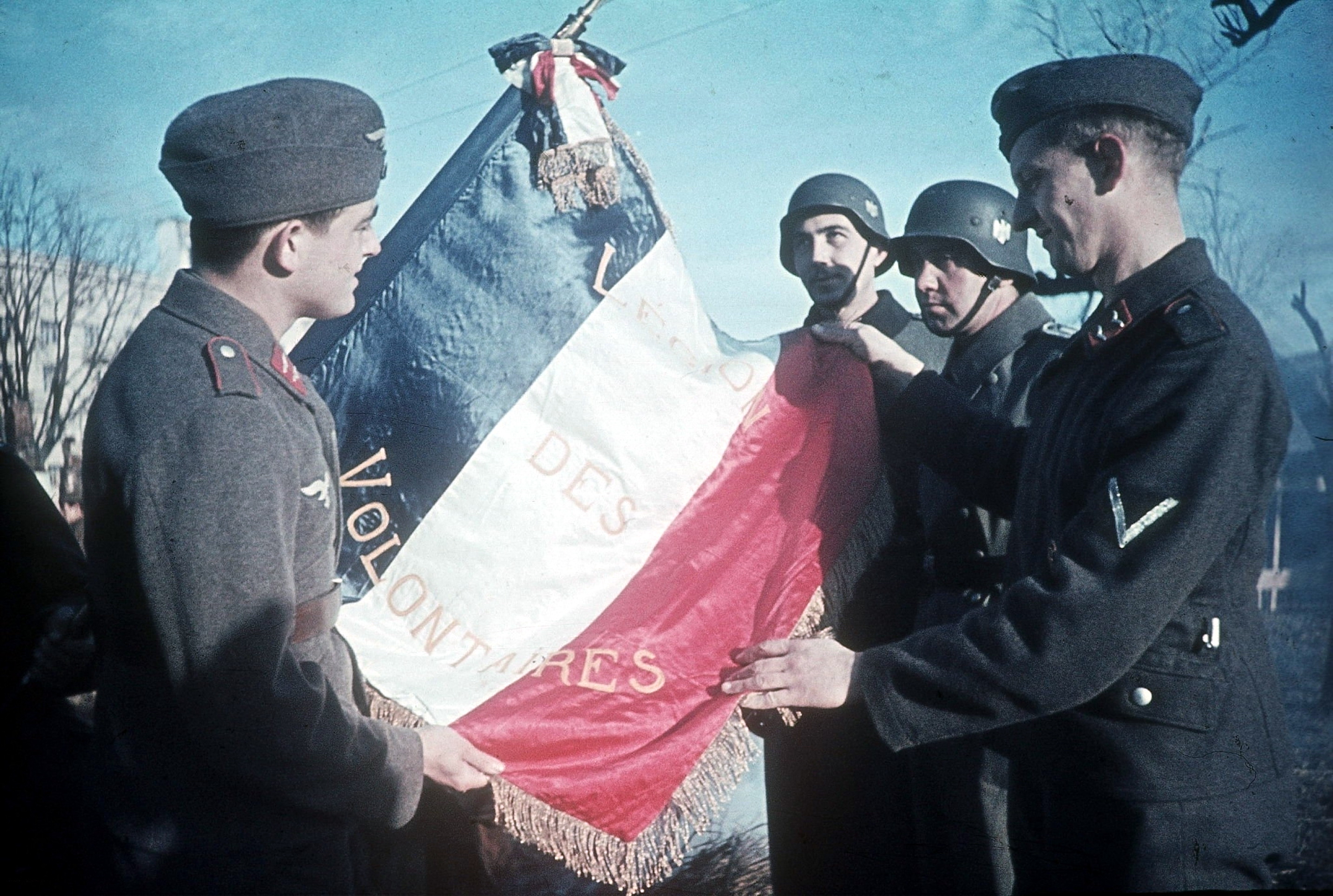
French Volunteers with Their Regiments' Flag

Soldiers of the 'Legion des volontaires francais' (LVF) with their regiments' flag, late autumn 1941. By October 1941, the LVF comprised two battalions with a strength of 2,271 men, 181 French officers, and 35 German officers. They were equipped with light weapons, machine guns, and a small number of 3.7 cm Pak 35/36 anti-tank guns. The LVF was deployed to Smolensk and sent as reinforcements to the fighting near Moscow in November and December 1941 where it became the only foreign unit to fight alongside the Germans! This picture was taken by Artur Grimm.

Source :
https://www.ebay.com/itm/383300489280?_ul=BR
https://en.wikipedia.org/wiki/Legion_of_French_Volunteers_Against_Bolshevism
https://www.gettyimages.com/detail/news-photo/world-war-ii-soldiers-of-the-legion-des-volontaires-news-photo/548133023

Thursday, December 17, 2020

Old Cossack Soldier


Portrait of a Cossack - from color slide series taken by Kriegsberichter Arndt of PK691 (Propaganda-Kompanie 691). He wears a white "Hilfswillige" armband.


Source :
Akira Takiguchi photo collection
https://www.facebook.com/photo/?fbid=10222602886174336&set=gm.1626894270829323

Sunday, November 22, 2020

Norwegian SS Nurse

A Norwegian SS nurse. Her name, location and time is missing. From the backdrop the photo appears to have been taken in Russia or Ukraine.


Source :

Akira Takiguchi photo collection

https://www.facebook.com/photo/?fbid=10222441267213963&set=gm.1608344909350926

Wednesday, July 29, 2020

Oberleutnant Ramón Escudé Gilbert of the Spanish Blue Squadron

Photo of Oberleutnant Ramón Escudé Gilbert, pilot of 2ª Blue Squadron in the Russian Front, 1942. Note Spanish Pilot's Badge above the Luftwaffe eagle, and also Spanish shield in his sleeve as a recognition for his status as a Spanish volunteer in the Wehrmacht.

Source :
https://forum.axishistory.com/viewtopic.php?t=38122&start=60&fbclid=IwAR2lDgrPpvYtz3pfhTAIprpoxcBjdpd60MUOJlf0zwrQYd5nab59AlKZZiA
http://thirdreichcolorpictures.blogspot.com/2012/03/oberleutnant-ramon-escude-gilbert.html

Thursday, March 5, 2020

Generalleutnant Agustín Muñoz Grandes

Agustín Muñoz Grandes (27 January 1896 – 11 July 1970) was a Spanish general, Commander of 250. Infanterie-Division (División Azul / Blaue Division) in the Wehrmacht between 1941 and 1942. This Spanish Civil War veteran was given command of the División Azul, Generalísimo Franco's volunteer unit created for service under the Wehrmacht in Russia, in 1941. Muñoz Grandes was well acquainted with the German military establishment, and attended several interviews with Wilhelm Canaris and Adolf Hitler. During his command Muñoz Grandes was decorated with the Knight's Cross of the Iron Cross (Ritterkreuz des Eisernen Kreuzes), with Oak Leaves (Eichenlaub) personally added by Hitler. He was recalled to Spain in December 1942. A promotion to Lieutenant General awaited him at home, and his post on the Eastern Front was taken up by Emilio Esteban Infantes.


Source:
https://en.wikipedia.org/wiki/Agust%C3%ADn_Mu%C3%B1oz_Grandes
https://forum.axishistory.com/viewtopic.php?t=14230&start=8190

Thursday, May 30, 2019

French Wehrmacht Volunteers in a Captured Russian Town


Two soldiers of the 'Legion des volontaires francais' in a conquered town on the Eastern Front, late autumn 1941. Photograph by Artur Grimm. The 'Legion of French Volunteers Against Bolshevism' (French: Légion des volontaires français contre le bolchévisme, or simply Légion des volontaires français, LVF) was a collaborationist militia of Vichy France founded on 8 July 1941. It gathered various collaborationist parties, including Marcel Bucard's Mouvement Franciste, Marcel Déat's National Popular Rally, Jacques Doriot's French Popular Party, Eugène Deloncle's Social Revolutionary Movement, Pierre Clémenti's French National-Collectivist Party, and Pierre Costantini's French League. It had no formal link with the Vichy regime, even though it was recognized as an "association of public usefulness" by Pierre Laval's government in February 1943. Philippe Pétain, head of state of Vichy France, personally disapproved of Frenchmen wearing German uniforms and never went beyond individual and informal words of support to some specific officers. It volunteered to fight against the Soviet Union on the Eastern Front. It was officially known by its German designation, verstärktes Französisches Infanterie-Regiment 638 (the reinforced 638th French Infantry Regiment).


Source:
https://en.wikipedia.org/wiki/Legion_of_French_Volunteers_Against_Bolshevism
https://www.gettyimages.com/detail/news-photo/world-war-ii-two-soldiers-of-the-legion-des-volontaires-news-photo/548129413
http://waralbum.ru/371634/

Friday, May 17, 2019

Indian Legion Training

Possibly this is the only color photo that shows member of the Legion Freies Indien (Free Indian Legion) of the Wehrmacht! This photo is came from the French "Historia" magazine (Hors série n° 21 Les SS Vol 2 : L'Enfer Organisé) that published in 1971, and shows two member of the Indian Legion who were practicing the operating of artillery weapon. From the turban on their head, we know that they are Sikhs. We can also clearly see the shield on their arms, which shows a Bengal tiger against the background of the Indian national flag.


Source :
http://alifrafikkhan.blogspot.com/2010/07/album-foto-sukarelawan-india-legion.html
http://www.mourningtheancient.com/truth13b.htm

Tuesday, October 17, 2017

Wehrmacht Generals and Spanish Volunteers

From left to right: Generalleutnant Agustín Muñoz Grandes (Kommandeur 250. Infanterie-Division [spanien]), Generaloberst Friedrich Fromm (Chef der Heeresrüstung und Befehlshaber des Ersatzheeres), Gauleiter Fritz Wächtler (NSDAP-Gauleiter der Bayerischen Ostmark), and Dr.phil. Friedrich von Cochenhausen (Kommandierenden General des Stellvertretenden XIII. Armeekorps in Nürnberg und Befehlshaber vom Wehrkreis XIII). The picture was taken in the summer of 1941.


Generaloberst Friedrich Fromm


Source :
https://forum.axishistory.com/viewtopic.php?t=29879&start=13455
http://www.wehrmacht-awards.com/forums/showthread.php?t=586902

Monday, January 11, 2016

Cossacks Serving with the Germans

Cossacks serving with Germans. On 22 June 1941, Nazi Germany launched Operation Barbarossa and attacked the USSR, thus bringing Russia into World War II. During the attack some ROVS, especially the Cossack émigré generals Pyotr Krasnov and Andrei Shkuro, asked Nazi Propaganda Minister Joseph Goebbels’s permission to fight beside Nazi Germany against Communist Russia. Goebbels welcomed their idea and by 1942 General Krasnov and General Shkuro had mustered a Cossack force — mostly from Red Army POWs captured by the Wehrmacht — who would be under the command of General Helmuth von Pannwitz. The Wehrmacht recognized the Cossacks as military units with their own uniforms and insignia; the 1st Cossack Division was established the next year. Although the Cossack units were formed to fight the Communists in Russia, by the time they formed, the Red Army had already liberated most of the Nazi-occupied territory, so they were deployed to the Balkans to fight the Communist Yugoslav Partisans commanded by Josip Broz Tito. By the war’s end, the Cossack units had come under the command of the Waffen-SS. Photo by Kriegsberichter Gert Habedanck


Source :
Magazine "Die Wehrmacht" Nr.22 Ausgabe A, 28 October 1942

Tuesday, September 29, 2015

Latvian Volunteer of Waffen-SS Unit

A Soldier of Waffen SS's Latvian Legion wearing a shield without inscription on his lapel. There was two Latvian divisions in the Waffen-SS: 15. Waffen-Grenadier-Division der SS (lett. Nr.1) and 19. Waffen-Grenadier-Division der SS (lett. Nr.2). The soldiers and officers of the Latvian SS legion wore the standard uniform of the SS forces with corresponding insignia. On their sleeve, the Latvian legionaries wore a red-white-red shield, sometimes with the inscription LATVIJA in the upper portion and sometimes without an inscription. The shield also came in a variety of shapes and was worn not only on the left sleeve, as per regulations, but also on the right and even below the elbow. Near the end of the war, a shield with a wide black mounting was introduced in the 15th SS Division (Latvian No. 1), which had been extricated from the Kurland pocket and operated in Pomerania and East Prussia until the end of the war. This wide black mounting was the same as that introduced in the 20th SS Division (Estonian No. 1) and for the same purpose – a reminder of the lost mother country. As with the Estonian legion, the Latvians initially made use of plain black collar tabs or collar tabs with SS runes, despite the fact that use of the latter was permitted for only German service personnel. On 11 March 1943, collar tabs with a swastika were specially introduced for the Latvian legionaries. In the fall of 1944, new collar tabs with a stylized version of the Latvian military emblem – “sun and stars” – was introduced for the personnel of the 15th SS Division (Latvian No. 1). Use of the swastika collar tabs was then limited to the 19th SS Division (Latvian No. 2). In reality, however, swastika collar tabs continued to be worn in the 15th SS Division, until a sufficient number of the new collar tabs had been produced. In addition to all these variants, some of the soldiers of the 19th SS Division also wore collar tabs with a “twinned” swastika, which had been prepared for the 36th SS Panzer-Grenadier Division (Latvian No. 3). [In the event, there was no such division. The 36th SS Waffen-Grenadier Division was commanded by Oskar Dirlewanger and consisted of convicts and criminals – not Latvians– skoblin]. In January 1945, honorific titles and correspondingly inscribed cuff titles were given to the 42nd and 43rd Regiments of the 19th SS Division (Latvian No. 2): Voldemars Veiss (organizer of the first Latvian police units and the first Latvian to earn the Knight’s Cross – died from wounds 17 April 1944) and Hinrich Schuldt (commander of the Latvian Volunteer Brigade – died 15 March 1944). In addition, the troopers of the 19th SS Division were awarded with the cuff title Kurland as had other soldiers who had taken part in any of the three battles of the Kurland pocket. Another distinctive element of the Latvian SS was the use of ribbons on the shoulder boards, which were used in the regiments of the 15th SS Division (Latvian No. 1): white for the 32nd, red for the 33rd and yellow for the 34th.


Source :
http://latvianhistory.com/2011/03/08/latvian-waffen-ss-legion/

Wednesday, December 11, 2013

Spanish Foreign Volunteers of the Wehrmacht

Spanish member of 1.Bataillon/Infanterie-Regiment 263/250.Infanterie-Division. Men from this division were called "Blue Division" (División Azul) because of the blue Falangist shirt they wearing in the siege of Leningrad. The fahnenträger (flag holder) is wearing gasplane (gas mask bag), MP40 ammo pouch, and stahlhelm with Wehrmacht/Spanish flag decals. Also he is holding the banner of his batallion. Note the Spanish award on their uniform! The red one is the "Cruz al Mérito Militar con Distintivo Rojo"; the yellow one is the "Medalla de Mutilado de Guerra por la Patria"

Source:
http://ww2images.blogspot.com/2012/12/member-of-250-infanterie-division.html

French Foreign Volunteers of the Wehrmacht

French soldiers (with MP40) of the Légion des Volontaires Français (soon to be 33.Waffen-Grenadier-Division der SS "Charlemagne"), when still part of the Wehrmacht. They are in anti-Partisan operation and wearing Heer uniform with french tricolore armelwappen "FRANCE". They were came from Infanterie-Regiment 638 (Französischer). This regiment was subordinated to the 286. Sicherungs-Division (Security Division) from February 1944

Source:
 "Signal" magazine Nr.3, 1 February 1942 edition