Showing posts with label Victory Bar or Ring. Show all posts

Monday, November 14, 2022

Bio of Top US Naval Ace David McCampbell

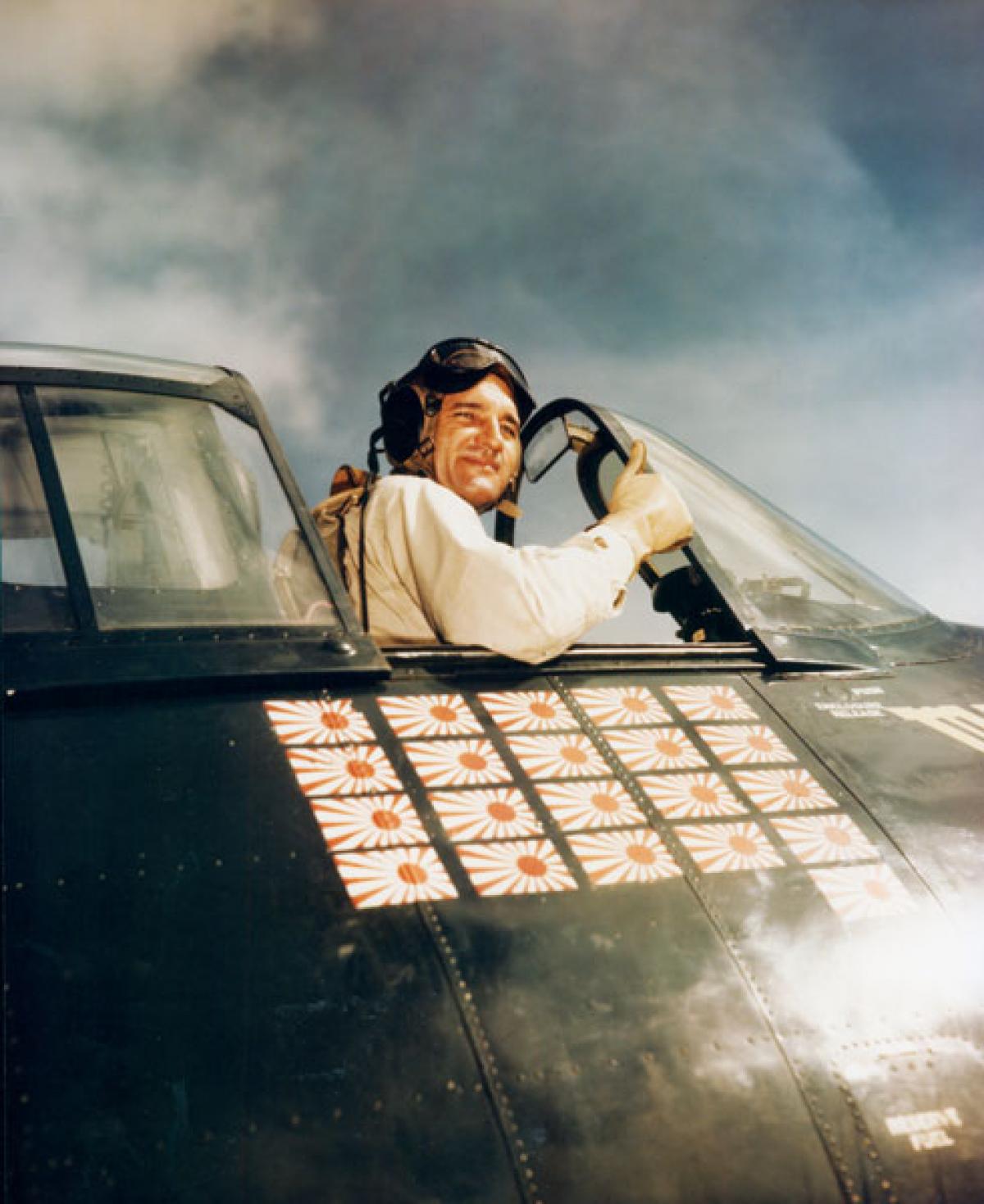
US Navy Capt. David McCampbell wasn't just the top naval ace of World War II — he's considered the service's all-time leader in aerial combat. His spirit and leadership are what made his air group one of the war's most decorated, and they earned him the Medal of Honor.

McCampbell was born Jan. 16, 1910, in Bessemer, Alabama, to parents Andrew and Elizabeth McCampbell. When he was about 12, the family moved him and his older sister, Frances, to West Palm Beach, Florida.

As a teen, McCampbell moved north to attend the Staunton Military Academy in Virginia. His graduation in 1928 earned him an Army commission, according to the Army University Press. Instead, he chose to attend the Georgia Institute of Technology, where he played football and was on the swim team. He also joined Navy ROTC, which led to his appointment to the Naval Academy. While in Annapolis, McCampbell became an accomplished swimmer and diver, competing in and winning various NCAA regional championships.

McCampbell graduated in June of 1933, but since Great Depression-related economic issues had affected the number of commissions that were available, he immediately went into the Naval Reserve. He returned to Alabama to work in construction and at an aircraft assembly plant for a year before finally receiving orders in June 1934 to report for active duty.

The young ensign's first duty station was aboard the USS Portland. By May 1937, he'd worked his way up in the ranks and began flight school in Pensacola, Florida, earning his wings in April 1938. His first few years as an aviator were spent serving on the USS Ranger and the USS Wasp.

World War II began while McCampbell was on the Wasp. The aircraft carrier spent the first half of 1942 in the European theater before being transferred to the Pacific. On Sept. 15, 1942, the ship was sunk during the Guadalcanal campaign. McCampbell, surviving its demise, was promoted to lieutenant commander and brought back to the U.S.

By late 1943, McCampbell was in command of a fighter squadron attached to the USS Essex. He was promoted to commander in January 1944 and put in charge of the ship's Air Group 15 — one of the war's most decorated air groups.  It was in this position that McCampbell became one of World War II's great aces.

McCampbell took out his first Japanese aircraft on June 11, 1944. About a week later, during the First Battle of the Philippine Sea, he led several F6F Hellcat fighter aircraft against 80 Japanese carrier-based planes that were headed toward the U.S. fleet. McCampbell personally destroyed seven of those hostile aircraft — five bombers and two fighters — which helped his outnumbered men virtually annihilate the enemy. According to the Encyclopedia of Alabama, McCampbell's team accounted for about 68 of the 600 Japanese downed aircraft.

On Oct. 24, 1944, during the infamous Battle of Leyte Gulf, McCampbell and a fellow pilot, Ensign Roy Rushing, took on 60 hostile Japanese aircraft that were approaching U.S. ships. Despite the overwhelming airpower against them, McCampbell shot down nine Japanese aircraft, setting a U.S. single mission aerial combat record. Rushing took out another six enemy warplanes. Their successes completely threw off the Japanese air group; the remaining aircraft abandoned their mission before any of them reached the U.S. fleet.

In a 1987 U.S. Naval Institute interview, McCampbell explained how he nearly didn't make it back to his ship after that engagement.

"When I got over the ship, I found they had a flight deck full of planes, and I knew that to launch all those planes would take a good 20 minutes, and I didn't have that much gas left," he said.

When the ship did make room for him to land, he said, "I ran out of gas on the deck. They had to push me out of the landing gear area. I found out from the mechanic that re-ammunitioned the guns that I had exactly six rounds left in the starboard outboard gun, and they were all jammed."

"But it worked out all right," he added nonchalantly.

McCampbell returned to the U.S. in December 1944. By then, he had become the Navy's all-time leading ace and top F6F Hellcat ace, having downed 34 Japanese aircraft during his months of aerial combat. His impressive tally made him the third-highest American scoring ace of World War II, behind only Army Maj. Richard Bong and Army Maj. Thomas B. McGuire, neither of whom survived the war.

For his bravery in the skies, McCampbell received the Medal of Honor on Jan. 10, 1945, from President Franklin D. Roosevelt during a ceremony at the White House.

After the war, McCampbell served in various positions, including as a senior naval aviation advisor to the Argentine Navy. After becoming a captain in July 1952, he also notably served as the captain of the aircraft carrier USS Bonhomme Richard and as a member of the Joint Staff in Washington, D.C. In the latter position, McCampbell helped draw up contingency invasion plans during the 1962 Cuban Missile Crisis, according to a 1996 Palm Beach Post article.

McCampbell was married a few times and had three children, Frances, David and John. He finally retired from the Navy in 1964 after 31 years of service.

According to the Palm Beach Post, McCampbell "dabbled in real estate in the Bahamas" before setting back down near West Palm Beach, where he lived for the rest of his life.  

McCampbell died on June 30, 1996, at a veteran's home he'd been living at for about a year. He was buried in Arlington National Cemetery.


Source :
https://www.defense.gov/News/Feature-Stories/Story/Article/3192422/medal-of-honor-monday-navy-capt-david-mccampbell/
https://www.thesun.ie/news/4108824/amazing-pics-of-us-navys-top-gun-inspiring-fighter-jet-unit-released-on-50th-anniversary-of-its-founding/
https://www.usni.org/magazines/naval-history-magazine/2022/august/brief-illustrated-history-navy-victory-markings

Monday, October 24, 2022

German 88mm Flak Gun during Barbarossa

Positioning of an 8.8 cm Flak gun of the Luftwaffe (German Air Force) at the Eastern Front during Unternehmen Barbarossa, summer 1941. Photographer: Artur Grimm. For the invasion of the Soviet Union, Germany deployed the 8.8 cm Flak in 51 mixed Anti-Aircraft battalions. They were mostly Luftwaffe-subordinated units attached to the Heer at corps or army level, with approximately one battalion per corps. The weapon saw continuous use on the eastern front. The appearance of the outstanding T-34 and the later KV tanks shocked the German panzer crews and anti-tank teams, who could only penetrate the Soviet tanks' armor at extremely close range on the order of 200 yards when using the standard 37 mm and 50 mm guns, while the Russian 76 mm gun was effective out to 1000 yards.

Source :
https://en.wikipedia.org/wiki/8.8_cm_Flak_18/36/37/41
https://photochronograph.ru/2019/04/20/gitlerovskie-vojska-vo-vremya-nastupleniya-v-sssr-1941-43-gody/

Friday, September 24, 2021

Ace Pilot Jeremiah O’Keefe

On April 22, 1945, 1st Lt. Jeremiah O’Keefe shot down five Japanese kamikaze aircraft off Okinawa in his F4U Corsair and then brought down another two six days later. When Japan attacked Pearl Harbor, Jerry enlisted, hoping to become a pilot. He received his wings from the U.S. Marines in May, 1943. In 1944, before leaving for his assignment with the Pacific Fleet, he married his childhood sweetheart, Annette Saxon, and started what would be a family of thirteen children. During combat, Jerry earned the status of 'ace' fighter pilot and was later awarded the US Navy Cross, the Distinguished Flying Cross, the Air Medal, Gold Star and, in 2015, the Congressional Gold Medal for American Aces.   Jeremiah J. O’Keefe, shot down seven Japanese pilots in one week in World War II.

Source :
National Archives and Records Administration 127-GW-120703
Smithsonian National Air and Space Museum
https://www.flickr.com/photos/airandspace/albums/72157715574200936

Friday, March 19, 2021

Pilots of Marine Torpedo Bombing Squadron 232


Three pilots stand by the squadron scoreboard at an advanced South Pacific base, circa 1943-44. As VMSB-232, this unit was active and played an important role in the Guadalcanal Campaign in 1942 and was redesignated as VMTB-232 in 1943 and participated in the Solomons and Admiralities in 1943-44.

Source :
National Archives and Records Administration 80-G-K-3997
Smithsonian National Air and Space Museum
https://www.flickr.com/photos/airandspace/albums/72157715574200936

Sunday, March 14, 2021

Scrappy, the Yorktown Ship's Mascot


ARM3C (Aviation Radioman Third Class) Robert L. Brown of Denver, Colorado, poses in the cockpit of a Grumman F6F Hellcat fighter plane aboard the USS Yorktown (CV-10) with “Scrappy,” the ship’s mascot, November-December 1943. The story goes that Scrappy was found roaming the docks of Pearl Harbor in 1943. Yorktown sailors spotted the Airedale and smuggled him aboard, knowing their captain wouldn’t approve. Once aboard, the spirited little dog was officially named "Scrapper Shrapnel". He earned his nickname, Scrappy, challenging the roaring planes on the flight deck. Quickly a crew favorite, Scrappy eased stress and filled the hearts of hardworking sailors. In true mascot style, he even wore a custom-made life jacket and helmet!

Source :
National Archives and Records Administration 80-G-K-1704
Smithsonian National Air and Space Museum
https://www.flickr.com/photos/airandspace/albums/72157715574200936
https://www.patriotspoint.org/scrappy/?__cf_chl_jschl_tk__=d69c3145fb4b99e14d9acbf844f9cca4d59d149c-1615728787-0-AfVn_n0_uIilihmHT3V-5cDYjUJlOGWkHKY32UHZTnhSK4wtiqgZwA5Y2yGMOk6RrK84KbL9KpXWskC4MAzvP43Ab2GEzuieJtLC9K7ryZ45FyVqyL_fNqF_IPOG2IDJwjkfFzfcllMVLufcwb5VqqPa6WEniRxVBui9eCbG9beikkd96S8GZA7PAdKBOiIXpgDjLDMyZx_xiiZv98oV_VRQDRanLEZQQMLJHbIkUrKtj4lY-ucIqiRe-Tpw52OzV6Cm3WRkC2RdDzXuKpQzVdgvCwOKcoih2_8K9XLu1rGbp0sNX490X8irNdpjKvtsTm8hWLSRfyswDSWNkhmSrF0HisvcevOOydRsRRF9-Q9cKDDgp3LDhj3HgOIwdWP5GmVyrl9Vtr7eQA-cOS8Vw0s

Thursday, September 24, 2015

Messerschmitt Bf 109 Flown by Leutnant Walter Blume

In the summer of 1940, Major Adolf Galland’s III.Gruppe / Jagdgeschwader 26 (JG 26) “Schlageter” was based at Caffiers airfield east of Calais, from where it flew missions over England. There III./JG 26’s technical officer, Hauptmann Rolf Schödter, took a series of color photographs. This photo depict the Messerschmitt Bf 109 E-4 “Weiße 13”, flown by Leutnant Walter Blume of 7.Staffel / III.Gruppe / JG 26. The four black victory bars on the rudder date the photograph between 25 July 1940 (Blume’s 4th victory) and 15 August 1940 (when Leutnant Blume was lost). Also in evidence are the yellow identity markings introduced by Luftflotte 2 at the beginning of August, which were applied to the wingtips and outer horizontal stabilizers and, in some cases, the top of the rudder. The presence of these yellow markings suggest that the photographs must have been taken in the first two weeks of August. The yellow identity markings on “Weiße 13” are clearly visible in this view. Note how haphazardly the painting was done! For example, application of the rudder triangle resulted in significant overspray on the vertical stabilizer. Also of interest is the marked difference between the yellow of the identity markings and the yellow of the octane triangle. The yellow used to apply the identity markings is more orange in color. This color often looks the same as red in black and white photographs, and in the past this has led to errors in interpretation. Note, too, the small tactical number, typical in size and shape for III./JG 26. Visible beneath the port wingtip is the engine cowling bearing the heart emblem of 7. Staffel. On the rudder may be seen four victory bars, the first two red and the last two black. This is surprising, as all of Blume’s victories came against the RAF in the West. The markings above the bars are not cockades, but circles in which the date of each victory was recorded. The aircraft wears the standard 1940 camouflage finish. Note the feeble attempt to hide the wing crosses with straw. The presence of straw on the ground suggests that this was a regular practice. In the background is the Gruppe’s Klemm 35, also camouflaged with straw. On 18 September 1940, several days after this photograph was taken, Leutnant Walter Blume was shot down by Hurricanes of No. 32 Squadron near Canterbury during a mission over England in “Weiße 13”. He was seriously injured in the ensuing crash-landing and the aircraft largely destroyed. Blume returned to Germany in a prisoner exchange in 1943 and resumed operational flying, recording another 14 victories by the end of the war.


Source :
"Luftwaffe im Focus", Spezial No.1 - 2003

Tuesday, December 16, 2014

Theodor Weissenberger Showing Off His Kills

Petsamo airfield (Finland), August 1943. Oberleutnant Theodor "Theo" Weissenberger (Staffelkapitän 7.Staffel / III.Gruppe / Jagdgeschwader 5 "Eismeer") points to his Eichenlaub zum Ritterkreuz des Eisernen Kreuzes award for staggering accomplishments in the air (so far 112th confirmed aerial victories!). The abschußbalken (victory bars) with the awards is painted on the rudder of his personal aircraft, a Messerschmitt Bf 109 G-2 (Werknummer 13912). A Hanhart Luftwaffe Fighter Pilot Chronograph Wristwatch is clearly visible in his pointing hand. Weissenberger flew more than 500 combat missions claiming 208 enemy aircraft shot down. 175 of his victories were in the East and 33 in the Western Front (with 25 victories over the Normandy front, including some 7 heavy bombers, and 8 victories while flying the Me 262). Among his best days are five victories on 7 June, 1944; all five P-47's one at Breteuil, and two SW of Montdidier, and two in the Beauvais area. A triple victory, all 3 P-47's on 12 June, 1944, one at Vernon, one at Gasny and one at Gisors. A double victory on 7 July, 1944; both P-47's at Rosieres-Santerre. As a former Messerschmitt Bf 110 fighter-bomber pilot, he was also credited with fifteen locomotives, two flak installations, and numerous ground targets destroyed! Despite his excellent talents as a fighter pilot, Weissenberger's casual often "non-military" attitude and demeanour meant he often got into trouble with his superiors regarding discipline. He became a motor racing driver after the war and was killed at the infamous Nürburgring circuit on 10 June 1950, when his BMW-powered single seater crashed on the first lap of the XV Eifelrennen motor race


Source:
Book "Luftwaffe Officer Career Summaries Section S-Z" by y: Henry L. deZeng IV and Douglas G. Stankey 
http://www.aircrewremembered.com/KrackerDatabase/?q=weissenberger
http://en.wikipedia.org/wiki/Theodor_Weissenberger
http://historypreservation.com/hpassociates/pilot.php

Sunday, December 14, 2014

Painting Victory Bars

Reputedly identified as Oberfeldwebel Franz Dietrich Fadenau is showing painting "kill marks" on the tail of his Messerschmitt Bf 109F-2. This photo was taken at the Eastern front in 1942. So far 12 abschußbalken visible: 8 on the Eastern Front (note the red star), while the rest were English or French aircraft. Later Fadenau got shot down as he was on the way home from a mission. His body was never found. Abschußbalken, or victory bars, usually painted on the rudders (of Bf 109s and Bf 110s alike). Also common was the custom of painting the propeller spinners in Staffel-specific colours. Bright-coloured rudders and engine cowlings, in turn, helped to quickly distinguish friend from foe in the heat of an air battle. The image presented here are from the book "Fliegende Front" by Hauptmann Walter Eberhard Freiherr von Medem and published in 1942 by Verlag "Die Wehrmacht" KG. in Berlin. The book must be regarded as typical propaganda material to show the German population how well the war was progressing. "Die Wehmacht" itself published a series of other propaganda books during the war. They also released sets of photo postcards from the war


Source:
http://www.asisbiz.com/Battles/camouflage.html
http://www.letletlet-warplanes.com/2013/04/25/luftwaffe-colour-propaganda-photos/nggallery/page/1
https://www.pinterest.com/pin/4222193375219323/