Showing posts with label Battle of Britain. Show all posts

Friday, October 7, 2022

Bf 109 of JG 53 in French Airfield

This picture was taken by photographer Artur Grimm during the Battle of Britain, and its shows Messerschmitt Bf 109 "Emils" of III.Gruppe / Jagdgeschwader 53 (JG 53) at an airfield in northern france, autumn 1940 (or spring 1941). They were seen after the restoration of the ‘Ace of Spades’ badge in November 1940. At some point during September 1940. it is reported that Reichsmarschall Hermann Göring ordered the covering-up of the unit's well-known Pik As 'Ace of Spades' emblem. It was to be replaced with a red cowl band. The precise reasons for this remain unknown.


Source :
http://falkeeins.blogspot.com/2022/07/rote-ringe-red-bands-and-swastikas.html
https://www.gettyimages.com/photos/jg-53?family=creative%2Ceditorial&assettype=image&phrase=jg%2053&suppressfamilycorrection=true

Friday, December 25, 2020

Pilots and Gunners of StG 1 Discussing a Map


All wearing their multi-zippered summer flying suits, pilots and gunners from I.Gruppe / Sturzkampfgeschwader 1 (StG 1) gather around a Leutnant holding a map and compass in front of a Ju 87B at Falaise in the early summer of 1940. They have yet to don their bright yellow kapok lifejackets. Stuka pilots were seen as the elite aviators of the Luftwaffe in the lead up to World War II.


Source :
"RAF Fighters vs Luftwaffe Bombers; Battle of Britain" by Andy Saunders

Thursday, December 24, 2020

MG Gunner on a He 111 Cockpit


German Machine-Gunner in the Cockpit of a two-engine Heinkel He-111 medium bomber, 1940. These He 111 crews of Kampfgeschwader 26 (KG) 26 had long flights over the North Sea from their bases in Norway to contend with, as well as the prospect of meeting RAF fighters off the northeast coast of Britain as they approached their targets.


Source :
"RAF Fighters vs Luftwaffe Bombers; Battle of Britain" by Andy Saunders

Sunday, September 13, 2020

Bus Trapped in the Crater at Balham Station

On 14 October 1940 at 8.02pm, a 1400 kilo semi armour piercing bomb from Luftwaffe bombers penetrated 32 feet underground and exploded just above the cross passage between the two platforms at Balham Underground station, London. Above ground a No.88 London double decker bus, travelling in blackout conditions, plunged into the crater created by the bomb. The dramatic spectacle of the trapped bus was to become emblematic of the dangers of the Blitz, a series of pictures of it appeared in publications around the world. The water and gas mains, along with the sewage pipes, had been broken: water poured down, flooding the tunnels below, and gas hampered rescue efforts. Almost all of the casualties would have resulted from the blast and debris. Yet stories soon developed of trapped people drowning in the flood waters and of miraculous escapes by people swimming along the tunnels to the next station. In total sixty six people died, although over the years there has been confusion over the exact number and only recently Transport for London has agreed to revise the memorial plaque at the station. The recovery of bodies was to take almost until Christmas yet remarkably the damage was repaired and trains were running through the station on 8th January 1941, and the station itself reopened on the 19th January.


For the collection of color photographs during the London Blitz, please see HERE.


Source :
https://www.facebook.com/photo/?fbid=3334514389935729&set=gm.1545682382283846
http://ww2today.com/14th-october-1940-disaster-at-balham-tube-station?fbclid=IwAR3glFnTFkJsTblkhY5a8a3B1xxHSjgn5OQT4QMp1jP5j0rdrcd6Xnz_kYA

The London Blitz (1940-1941)

 Workers wielding pick-axes and shovels are tasked with clearing away the remains of bombed building that would have once stood next to this Central London church.


The appearance of German bombers in the skies over London during the afternoon of September 7, 1940 heralded a tactical shift in Hitler's attempt to subdue Great Britain. During the previous two months, the Luftwaffe had targeted RAF airfields and radar stations for destruction in preparation for the German invasion of the island. With invasion plans put on hold and eventually scrapped, Hitler turned his attention to destroying London in an attempt to demoralize the population and force the British to come to terms. At around 4:00 PM on that September day, 348 German bombers escorted by 617 fighters blasted London until 6:00 PM. Two hours later, guided by the fires set by the first assault, a second group of raiders commenced another attack that lasted until 4:30 the following morning.

This was the beginning of the Blitz - a period of intense bombing of London and other cities that continued until the following May. For the next consecutive 57 days, London was bombed either during the day or night. Fires consumed many portions of the city. Residents sought shelter wherever they could find it - many fleeing to the Underground stations that sheltered as many as 177,000 people during the night. In the worst single incident, 450 were killed when a bomb destroyed a school being used as an air raid shelter. Londoners and the world were introduced to a new weapon of terror and destruction in the arsenal of twentieth century warfare. The Blitz ended on May 11, 1941 when Hitler called off the raids in order to move his bombers east in preparation for Germany's invasion of Russia.


On the night of 14 October 1940, a bomb penetrated the road and exploded in Balham Underground station, killing 68 people. A No 88 bus travelling in black-out conditions then fell into the crater. In this extraordinary picture, the double-decker bus is still visible amid crumbling tarmac and bent girders left in an enormous crater.


The spire of the Central Criminal Court – better known as the Old Bailey – rises defiantly while all around it buildings have become jagged shells in a landscape scarred by the relentless German bombings.


Workers remove rubble from a building decimated in a heavy German air raid during the Blitz. Wallpaper inside the shattered bedrooms can be seen in the gap left in the row of houses.


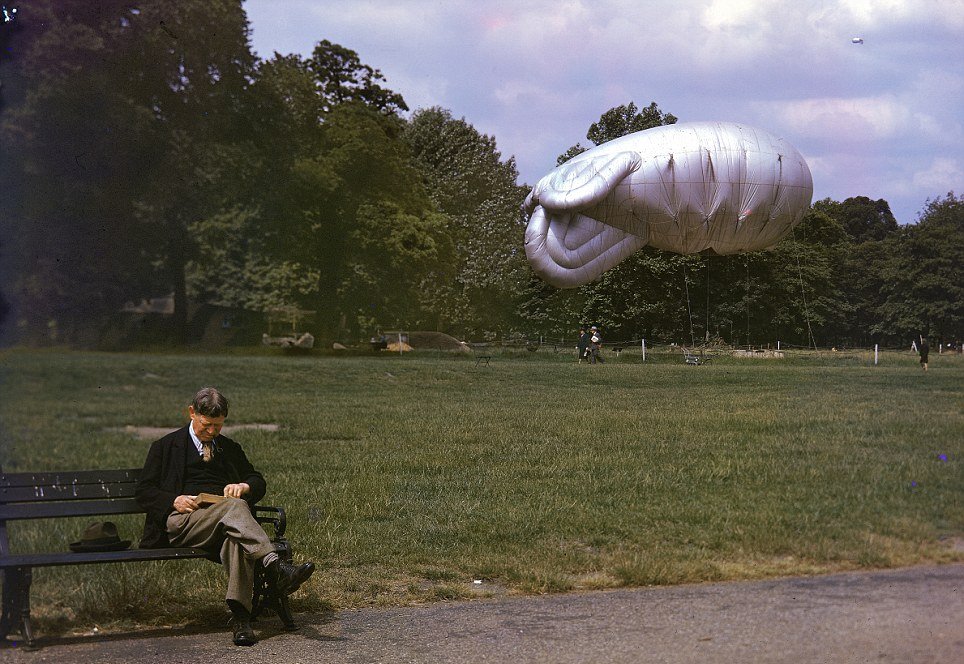
Despite the terrifying raids by the Luftwaffe, they attacks failed to breaks the spirit of the British people. People pressed on with their lives and in one of these extraordinary images a man can be seen in a park calmly reading a book while a barrage balloon hovers close by and a second, right, soars above.


The random nature of the bombing is clearly demonstrated here as a church, right, remains untouched while a vast swathe of buildings close by were reduced to rubble.


The Houses of Parliament with part of them covered in scaffolding are seen across the River Thames on a sunny day in 1941.


Source :
http://www.eyewitnesstohistory.com/blitz.htm
https://www.theundergroundmap.com/wp/the-london-blitz-in-colour/

Monday, August 10, 2020

Ruins in Balham After German Air Raid

A bus lies in a large crater in Balham, London, the morning after a German air raid on 15 October 1940. During the raid, a bomb exploded on Balham high street, destroying part of the tube station beneath. From July to October 1940, Nazi Germany laid siege to the United Kingdom in what is now known as the Battle of Britain. Before the 122-day conflict ceased, over 500 air force pilots and more than 40,000 civilians were killed.

Source :
https://www.buzzfeednews.com/article/gabrielsanchez/harrowing-pictures-from-the-battle-of-britain

Wednesday, April 27, 2016

The Grave of Hauptmann Erwin Aichele

It was a standard practice for markers to be placed at a crash site when a successful or experienced pilot was killed. These markers often consisted of a propeller blade and spinner. This photograph shows the grave of Hauptmann Erwin Aichele of Stab I.Gruppe / Jagdgeschwader 51 (JG 51) who was killed on 29 July 1940 during operations over the English Channel. Aichele's Messerschmitt Bf 109 E-4 was damaged in combat and he was forced to make an emergency landing on the coast in Calais area. The aircraft overturned and he was killed. At 39 years of age, Aichele was one of the oldest German fighter pilots.


Source :
Magazine "Luftwaffe im Focus Spezial" No.1 2003

Monday, May 4, 2015

A Group of Focke Wulf Fw 200 "Condor" Pilots Preparing for a Mission in 1940

 A group of Focke Wulf Fw 200 "Condor" pilots preparing for a mission in 1940. At the same time Condor operations started in the Atlantic, the strategic situation was changing for the Third Reich. Even in July and August 1940, with the Battle of Britain raging, Hitler had lost whatever enthusiasm he had for invading Great Britain, and was already dreaming of his next war, with the USSR. So when it was proposed that the Luftwaffe and Krigsmarine establish a total blockade against the British Isles, Hitler readily agreed, as it freed up the Weremarcht to get moving eastward. Hitler calculated that even if the blockade didn't knock Britain out of the war entirely, it would weaken it to the point the island nation would be unable to oppose his plans, and allow the Nazi war machine to deal with the Soviets without distraction. The key to this strategy would be cooperation between the German air force and navy – which (spoiler alert!) was never very good. In fact, at one point Nazi Germany would be waging no less than five campaigns against British supply lines, with very little coordination between any of them. The search method of the Fw 200, however, was excellent for bombing attacks: given the low visibility haze that usually obtained over the Atlantic, a Condor would be visible to a ship only for a minute or two before it was dropping its bombs. Condors until the C-4 had a very basic bomb-sight, so the attack method was a low level bombing run 'bracketing' the target with the Condor's bomb load. Initially attacking convoy stragglers, Condor crews soon learned that convoys away from land based air cover had no defenses at all against air attacks. So, even a glass bird like the Condor could be used as an effective low level bomber. Petersen, once he discovered this, knew he had found the Condor's niche. As the Battle of Britain ended and the Blitz began, the improvements made to the Condor with the C-3 began to pay dividends. The Germans had been caught off guard before the war began for the need of a maritime bomber; now it was Britain’s turn to be caught off guard. The picture presented here are from the book "Fliegende Front" by by Hauptmann Walter-Eberhard Alexander Albert Freiherr von Medem (4 May 1887 - 9 May 1945), published in 1942 by Verlag ‘Die Wehrmacht’ KG. in Berlin. The book must be regarded as typical propaganda material to show the German population how well the war was progressing. ‘Die Wehmacht’ published a series of other propaganda books during the war. They also released sets of photo postcards from the war


Source :
http://forum.warthunder.com/index.php?/user/89479-mcdeth187/?tab=reputation&app_tab=forums&type=received&st=15
http://www.letletlet-warplanes.com/2013/04/25/luftwaffe-colour-propaganda-photos/

Monday, April 20, 2015

A Group of German Bomber Pilots at Mission Briefing

A group of Focke Wulf Fw 200 "Condor" pilots preparing for a mission in 1940. Looking at the map the target seems to be England. At the same time Condor operations started in the Atlantic, the strategic situation was changing for the Third Reich. Even in July and August 1940, with the Battle of Britain raging, Hitler had lost whatever enthusiasm he had for invading Great Britain, and was already dreaming of his next war, with the USSR. So when it was proposed that the Luftwaffe and Krigsmarine establish a total blockade against the British Isles, Hitler readily agreed, as it freed up the Weremarcht to get moving eastward. Hitler calculated that even if the blockade didn't knock Britain out of the war entirely, it would weaken it to the point the island nation would be unable to oppose his plans, and allow the Nazi war machine to deal with the Soviets without distraction. The key to this strategy would be cooperation between the German air force and navy – which (spoiler alert!) was never very good. In fact, at one point Nazi Germany would be waging no less than five campaigns against British supply lines, with very little coordination between any of them. The search method of the Fw 200, however, was excellent for bombing attacks: given the low visibility haze that usually obtained over the Atlantic, a Condor would be visible to a ship only for a minute or two before it was dropping its bombs. Condors until the C-4 had a very basic bomb-sight, so the attack method was a low level bombing run 'bracketing' the target with the Condor's bomb load. Initially attacking convoy stragglers, Condor crews soon learned that convoys away from land based air cover had no defenses at all against air attacks. So, even a glass bird like the Condor could be used as an effective low level bomber. Petersen, once he discovered this, knew he had found the Condor's niche. As the Battle of Britain ended and the Blitz began, the improvements made to the Condor with the C-3 began to pay dividends. The Germans had been caught off guard before the war began for the need of a maritime bomber; now it was Britain’s turn to be caught off guard. The picture presented here are from the book "Fliegende Front" by by Hauptmann Walter-Eberhard Alexander Albert Freiherr von Medem (4 May 1887 - 9 May 1945), published in 1942 by Verlag ‘Die Wehrmacht’ KG. in Berlin. The book must be regarded as typical propaganda material to show the German population how well the war was progressing. ‘Die Wehmacht’ published a series of other propaganda books during the war. They also released sets of photo postcards from the war


Source :
http://forum.warthunder.com/index.php?/user/89479-mcdeth187/?tab=reputation&app_tab=forums&type=received&st=15
http://www.letletlet-warplanes.com/2013/04/25/luftwaffe-colour-propaganda-photos/

Monday, February 2, 2015

Max Buchholz in Front of Bf 109 Fighter Aircraft

Luftwaffe ace Oberfeldwebel Max Buchholz from 1.Staffel / I.Gruppe / Jagdgeschwader 3 (JG 3) in front of a Messerschmitt Bf 109 E-5 in France, 1940. On 17 May 1940, he claimed four RAF Blenheim twin-engine bombers and two French Curtiss fighters shot down as his first victories! During September 1940, Buchholz shot down three RAF fighters in the aerial battles over Britain. On 15 September, Buchholz was shot down over the Channel. He had participated as one of nine aircraft tasked with escorting He 111 twin-engine bombers to London. However, RAF Spitfire fighters intercepted the formation en-route. In the ensuing aerial combat, Buchholz’s Bf 109 E-1 (W.Nr. 1563) was hit in the radiators and forced him to come down in the Channel. Fortunately, a colleague was able to guide an air-sea rescue aircraft, which was flying nearby, to the scene to rescue Buchholz. By the conclusion of the Battle of Britain, Buchholz’s victory total stood at nine. In the end of the war, Max Buchholz was credited with 28 victories, although other sources indicate his score could be as high as 30. He recorded 18 victories over the Eastern Front


Source:
http://fotobethge.com/index.php?auswahl=Onlineshop&klick=1&zeile=8&hkat=1&ukat=48&katub=
http://www.luftwaffe.cz/bucholz.html