Showing posts with label Ski Troops. Show all posts

Thursday, November 3, 2022

Gebirgsjäger on Ski


This young German Gebirgsjäger (mountain soldier) photographed during the winter of 1938/9 is wearing a typical uniform of the period: a Bergmütze (mountain cap) with the first version of national insignia (white on light grey); a Feldbluse M33 (jacket) with the bluish dark green Schulterklappen (shoulder straps) with a light green distinctive and the first version of white on a light grey national eagle; stone-grey trousers, or Skihose—the quality of the photograph, one of the first slides ever used in Germany, highlights the difference between the jacket and the trousers—with buttoned pocket flaps; and Wickelgamaschen (puttees) made of feldgrau cloth. The ash skis and duralumin sticks likely come from the resort where he is spending his leave.


Source :
"German Mountain Troops" by Yves Beraud

Friday, February 5, 2021

Gebirgsjäger in action


A Gebirgsjäger soldier posing with his ski. He is wearing a whistle lanyard in his pocket and a darkened lenses goggle associated with snow/ice goggles. They were a standard for the Italian Alpine corps and for the Swiss army till the end of last century. Someone may have brought them down there too, but although robust, they were not good with sand because they easily got scratched as the lenses were celluloid and later soft plastic.


Source :
Akira Takiguchi photo collection
https://www.facebook.com/photo/?fbid=10222852270488788&set=gm.1652878351564248

Monday, July 20, 2020

Organisation Todt Dog Sled

OT (Organization Todt) in Norway - dog sledding by an OT skier in warm clothes. From the estate of Franz Guthausen, three dogs pull a sled that carry two "OT" labeled boxes.


Source :
Akira Takiguchi photo collection
https://www.facebook.com/photo.php?fbid=10221071107640830&set=gm.1466913416827410&type=3&theater&ifg=1

Tuesday, June 7, 2016

10th Mountain Division Skitroopers in Colorado Mountains

Group portrait of sixteen U.S. 10th Mountain Division skitroopers posed in a line on skis in the Colorado mountains, 1943 or 1944. None identified. At first, the division was not granted any special insignia, nor could troops wear ski clothing off-post. Some men who displayed on their service dress crossed-ski pins that they had bought at jewelry stores were given a week of work details for the infraction. The division’s morale fell further with news of the fighting in Italy; they questioned why they were not there, and whether they would ever be deployed. For three weeks in March and April 1944 the division undertook a grueling sub-zero exercise in the mountains of the 12,000ft California Coast Range. The D-Series Maneuvers pushed them to the limits of their endurance, exposing deficiencies in personnel, equipment, and organization. Training and cold-weather injuries were modest owing to the troops’ excellent condition, but it was still a brutal experience for the participants.


Source :
Book "US 10th Mountain Division in World War II" by Gordon L. Rottman and Peter Dennis 
http://amyatishkin.livejournal.com/287245.html

Tuesday, May 31, 2016

Soldiers of 10th Mountain Division in front of Jerome Hotel

Five 10th Mountain Division Skitroopers in uniform stand outside a small store at the Jerome Hotel in Aspen, Colorado (1943 or 1944). Anthony Dillon, far left, holds skis. Man on far right is identified as photographer Bill Southworth. At the Jerome Hotel in Aspen, Colorado, the men unwind after a day of skiing. Even though the troops skied during training and camped in the cold and snow, when they had leave for the weekend, many of the soldiers could be found at nearby ski areas. After the war, several men of the 10th were instrumental in building the recreational ski industry that known today.


Source :
http://amyatishkin.livejournal.com/287245.html
http://candiecoded.com/DarlingDollz//Violablu/Colorado/Colorado.html

Tuesday, May 17, 2016

David B. Allen in "Whites"

Portrait of David B. Allen in his "whites" or winter uniform posed in the same postion as the "Ski Trooper" cover of the Saturday Evening Post. He is crouching close to the ground and carrying a knapsack with a white cover, a rifle and is holding his skis and poles crossed in front of him. Snow covers the ground and Camp Hale barracks are in the background. The picture was taken in 1943 or 1944


Source :
http://amyatishkin.livejournal.com/287245.html

Sunday, April 17, 2016

US Skitroopers Crossing the Engineer Wooden Bridge

View of skitroopers testing an experimental wooden bridge built by the Engineering Battalion of US Tenth Mountain Division at Camp Hale Colorado, 1943 or 1944. A line of men are crossing the bridge and more troops wait below. Snow covers the ground. In September 1942, the 126th Engineer Mountain Battalion, with Lieutenant-Colonel John Parker in command, is activated at Camp Carson and becomes part of MTC (Mountain Training Center). Initially, two companies are authorized. Company A is to do experimental work on the construction of aerial tramways. Company B is to experiment with the construction of suspension bridges in mountainous terrain. One consultant to both groups is Major Frederick Roebling, a member of the famous family of engineers. The 126th received a fourth company, which infantry division engineers lacked, giving it one motorized (Co D) and three pack companies. Between November 1944 to November 1945, thay had at least 31 officers, 2 warrant officers, and 749 enlisted personnel.


Source :
Book "Chronology of the 10th Mountain Division in World War II; 6 January 1940-30 November 1945" by John & Barbara Imbrie
http://amyatishkin.livejournal.com/287245.html

Saturday, March 12, 2016

Charles Bradley from 10th Mountain Division


Charles C. Bradley of the U.S. Army Tenth Mountain Division during a ski jump Aspen, Colorado. A wooden building, possibly a watch tower, is visible in the background. Bradley is wearing his ski uniform including his cap. The picture was taken in 1943 or 1944. When the United States entered World War II in 1941, Charles Bradley enlisted in the army. An avid skier and mountaineer with a degree in geology, he quickly found himself among the first members of the new 10th Mountain Division, the only unit of the U.S. Army established to train men in mountain combat. Soon, Bradley was training candidates for a potential ground assault on Japan and in a new theater for mountain warfare: the magnificent but potentially life-threatening Aleutian Islands. Bradley's military career kept him from the front lines of the war, but he and his companions had their own battles with loneliness and fatigue, with Aleutian weather and terrain, and with the military brass. The Axis powers were real enough, but the immediate enemy was the environment. It was Bradley's job, now on assignment with the North Pacific Combat School, to help teach his trainees the skills of survival and mobility under conditions that included rugged terrain, glaciers, fierce winds, heavy rains and snow storms, and the threat of avalanches. Each story of confrontation with that rugged environment is balanced by one of discovery and awe. The Aleutians could be dangerous, but they were also an unspoiled realm for adventure and fascination. Soldier Bradley also grew as an artist; his interest in the natural history and geography of the islands is reflected in his paintings of what he saw near his posts, first at Unalaska and later at Adak. It is also reflected in his honest, insightful prose memoir that was written after the war, "Aleutian Echoes'.

Source :
https://www.alaska.edu/uapress/browse/detail/index.xml?id=94
http://amyatishkin.livejournal.com/287245.html

Tuesday, February 16, 2016

Earl Clark from US 10th Mountain Division

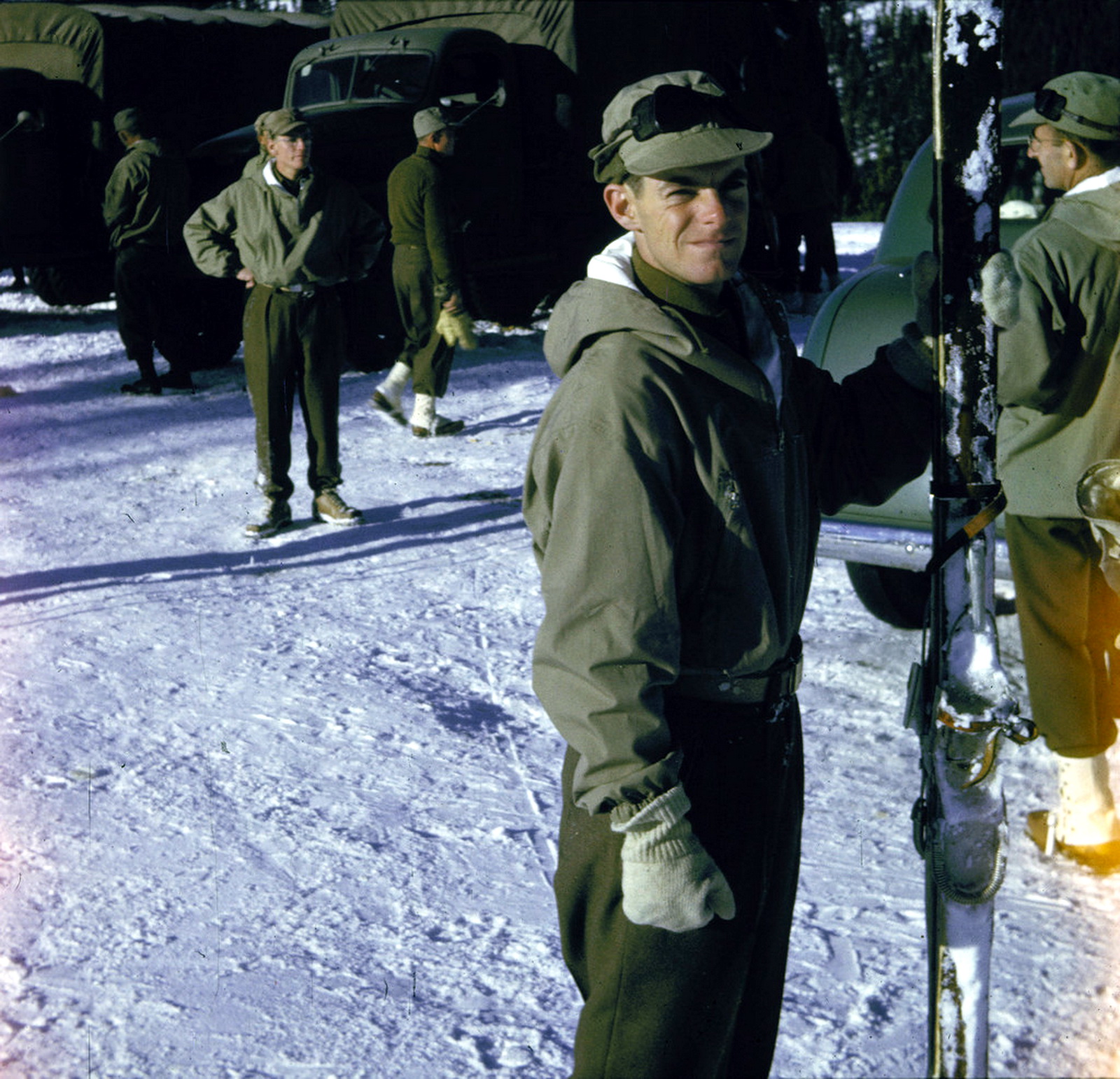
Earl Ervin Clark, a member of the 1st Battalion / 87th Headquarters Regiment / 10th Mountain Division (US Army), poses with a pair of skis at Camp Hale (Eagle County), Colorado, 1943 or 1944. Other soldiers and trucks are nearby. Clark served in the US army's elite 10th Mountain Division from its inception. The division played a key role in breaking down Nazi defences in the Spring Offensive of 1945, helping force the Italian surrender and the fall of the Third Reich.

A skilled skier since his teens, Clark took part in the vital battles for Riva Ridge and Monte Belvedere in Italy's Northern Apennines. His company scaled Belvedere, covered in ice and snow, on 19 February 1945, their hickory skis strapped to their shoulders and bayonets fixed on their M1 rifles. The German defenders, a battalion of highly-trained mountain soldiers, had assumed that the mountain, at points almost vertical, was insurmountable from the south-west and were watching for allied movements in the valley below.

They had laid mines on the steep slopes but the Americans caught them unawares. The 10th Mountain's commander, General George P Hays, had told his men: "until first light, no small arms fire, only hand grenades and bayonets." Clark recalled the last words before the silent assault. "Fix bayonets. Move out!" The next voices he heard, at the peak, were cries and screams in German.

The 10th Mountain Division soldiers, having dismantled the mines, overran the enemy and, after heavy gunfire and bayonet-to-bayonet fighting, captured the peak. Clark always gave credit to the infantrymen of the Brazilian Expeditionary Force, who flanked the Americans.

"Fog had helped in the initial assault on Riva Ridge," Clark recalled. "That gave us a bit of leeway to attack Mount Belvedere." A comrade added: "We usually had a medic with us. This time they gave us five or six. We got the message. We went up in single file. Had they spotted us, there would have been no room for us to deploy. The Germans were either having breakfast or sleeping. Our grenades were their alarm clock."

In the first three days of intense combat for Belvedere, and after several German counter-attacks, the American "mountain warriors" lost 195 dead and 850 wounded or captured. But they took around 1,000 German prisoners and pushed on towards the vital river Po. At noon on 23 April 1945 Clark was among the first allied troops to cross the Po, in 50 light canvas assault boats and under heavy fire.

Spearheading the US Fifth Army, they pushed forward to Lake Garda and cut off the Germans' main escape route to the Brenner Pass. It was one of the fastest forward movements of the war and, in the lowlands, the "Mountain Warriors" ditched their skis, swapped their snow uniforms for olive drabs and hitched rides on army trucks, tanks or their own snow-hardy M-29 Weasel assault vehicles. Hitler surrendered two weeks later.

By the end of the war the 10th Mountain Division had lost 1,000 men, with 4,000 wounded. One of Clark's comrades was 2nd-Lt Bob Dole, whose arm wound left him partially disabled but did not stop him from becoming a US Senator for Kansas and a Republican presidential candidate against Bill Clinton!

In retirement, Clark and many of his former comrades helped create a fledgling ski industry back home, based on what they had seen in the Alps and Apennines, building ski lifts, chalets and resorts and turning the US into a major skiing attraction. To this day, the "10th Mountain" are considered the fathers of the modern American ski industry and a Vail restaurant called The 10th is a paparazzo's dream, favoured by film stars and Michelle Obama as an après-ski stopover.

Clark helped found the 10th Mountain Division National (Veterans') Association and later the International Federation of Mountain Soldiers. The few surviving men who fought each other in the mountains 70 years ago still meet annually to share their common bond.

Earl Ervin Clark was born in Londonderry, Vermont in 1919. Moving with his family to Wisconsin, he learned to ski on Wilmot Hills near Chicago at the age of 13. It was as a mountaineering and ski instructor, that he caught the notice of the US National Ski Patrol, entrusted to pick out an elite unit. The US had also been impressed by white-clad Finnish mountain soldiers who had fought against the Soviet invasion early in the war.

Clark joined up on St Patrick's Day, 1942, and was assigned to 1st Battalion 87th Infantry Regiment, later to form part of the 10th Mountain Division, America's first specific mountain warfare unit. Clark trained at Camp Hale, Colorado at altitudes of around 9,000 feet and even as high as the 14,410ft Mount Rainier in Washington state. Their marching or drinking song was "90 Pounds of Rucksack", which the Division sing to this day.

After the German surrender 10th Mountain were on stand-by to invade Japan but were stood down after the Japanese surrender. Clark was on the USS Mount Vernon when the news came through that an atomic bomb had been dropped on Hiroshima. The 10th Mountain Division took part in Operation Uphold Democracy in Haiti in 1994, helicoptering in to Port-au-Prince airport in scenes reminiscent of Apocalypse Now, and went on to serve in Afghanistan.

Clark enrolled in the University of Denver under the GI Bill, got a business degree and went on to make the mountains and skiing his life. He and other 10th Mountain vets helped design pistes, became ski coaches, guides, patrollers, magazine founders, filmmakers, ski shop owners and even professional downhill and slalom racers. Clark became a volunteer for the US National Ski Patrol as a guide and instructor. He became an office manager for an ice cream distributor and later an insurance agent.

He kept skiing, remained in the Army reserve and retired in 1981 as a Lieutenant-Colonel. He set up a group of 10th Mountain vets called the Pando Commandos, who, wearing their old combat whites, give ski demonstrations in Rocky Mountain resorts and he helped run the Over-The-Hill Gang, initially a US club for older skiers and now running ski tours worldwide.

Earl Ervin Clark, mountain soldier: born Londonderry, Vermont 3 July 1919; married 1948 Betty Grunwald (deceased, one son); died Littleton, Colorado 28 December 2014


Source :
http://amyatishkin.livejournal.com/287245.html
http://www.independent.co.uk/news/people/news/lt-colonel-earl-clark-mountain-warfare-veteran-who-helped-establish-the-leisure-skiing-industry-in-10114601.html

U.S. 10th Mountain Division Men at the Door of their Barracks

Three Members of the 110th Signal Company / 10th Mountain Division (US Army), stand outside the door of their barracks at Camp Hale, Colorado, 1943 or 1944. The man on the far right is the photographer (William A. "Bill" Southworth). All are in uniform and one is carrying skis and poles. The impact of the 10th on the ski industry after the war was huge. Some of the immediate effects included the unloading of all the surplus equipment to the public, including 100,000 pairs of skis, boots, bindings and poles!  This provided an affordable opportunity for a massive amount of the population to jump into the sport.  It also opened up opportunities to produce some high-end gear.


Source :
http://amyatishkin.livejournal.com/287245.html
http://www.chrisanthony.com/the-legend-of-the-10th-mountain-division-and-the-ski-trooper/