Showing posts with label Battle of France. Show all posts

Wednesday, October 12, 2022

German Victory Parade in Paris


German victory parade at Place de la Concorde, Paris, June 14, 1940. Front row from left to right: General der Kavallerie Georg Stumme (Kommandierender General XXXX. Panzerkorps), General der Artillerie Georg von Küchler (Oberbefehlshaber 18. Armee), and Generaloberst Fedor von Bock (Oberbefehlshaber Heeresgruppe B). Far left is Generalmajor Erich Marcks (Chef des Generalstabes 18.Armee), while closest to the camera is Generalleutnant Hans von Salmuth (Chef des Generalstabes Heeresgruppe B). Photo by Hugo Jaeger.

Source :
http://alifrafikkhan.blogspot.com/2010/10/koleksi-ratusan-foto-berwarna-dari-life.html

Thursday, September 29, 2022

The Wehrmacht in Dunkirk

German forces arrive in Dunkirk. The sea front at Dunkirk photographed immediately after the completion of the evacuation of the British Expeditionary Force earlier in the day. Vehicles and troops of the German mobile assault unit Motorensturm 13, drawn up on the sea front at Dunkirk near one of the unit's light anti-tank guns.


Battle of France. German troops in Dunkirk beach immediately after the evacuation of the British Expeditionary Force. These photo in color were taken on June 4, 1940 by an officer of Maschinengewehr-Bataillon 52 (52nd machine gun battalion) of the Wehrmacht, Hermann Weper. These photos capture the initial stage of World War II. The beginning of the history of the great war.

These color photos show the aftermath of the Battle of Dunkirk (Battle of France) – the battle of WW2  between the Allied forces and Germany, which took place on May 26 – June 4, 1940 during the French campaign of the Wehrmacht.

Winston Churchill, in his famous speech “We Will Fight on the Beaches” in 1940, called the events in Dunkirk “a miraculous deliverance” , a good fortune for the allies. Churchill’s accolades were intended for a rescue operation in which 338,226 French and British soldiers were evacuated from the beach and harbor of Dunkirk, France.

Initially, it was assumed that the German troops occupying France would reach the coast where the military was stationed within two days.

In this case, it would be possible to ensure the safety of only 43 thousand soldiers. Nevertheless, thanks to the confusion of the Germans and the courageous actions of the members of the Coalition, the British and military soldiers were saved. The French-German border was almost entirely fortified by the so-called “Maginot Line”, but its northern section was protected only by the Ardennes forest. The Allies assumed that it was too thick and did not require serious protection, but the German troops managed to pave a road through the thicket.

As a result, the Germans actually ended up in the rear of the Allies, forcing them to move into Belgium, where they faced even more enemy soldiers. The only option was to enter the coastal city of Dunkirk, from where the military could be evacuated to England.


German forces arrive in Dunkirk after the completion of the evacuation of the British Expeditionary Force earlier in the day. Under the direction of their German captors, French troops push away an immobilised British Universal Carrier tracked vehicle, clearing the blocked road into Dunkirk. This picture was taken by Hermann Weper, an officer serving with Maschinengewehr-Bataillon 52, on 4 June 1940 following the seizure of Dunkirk.


German forces move into Dunkirk. Disarmed French soldiers file pass German officers on the outskirts of Dunkirk. The evacuation of the British Expeditionary Force had been completed a few hours earlier.


German forces move into Dunkirk hours after the evacuation of the British Expeditionary Force. Curious German officers inspect the memorial to the French aviation pioneer, Louis Bleriot on the sea front at Dunkirk. It is surrounded by German vehicles and the litter of the British evacuation.


On the outskirts of Dunkirk, German officers confer by their vehicles at the roadside before moving into the town.


On the outskirts of Dunkirk, a German officer interrogates two captured French officers who sit under guard near a roadside table laden with wine bottles. A German inflatable rubber dinghy is visible behind the table.


German forces move into Dunkirk hours after the evacuation of the British Expeditionary Force was completed. A beached French coastal patrol craft at low tide at Dunkirk. The ship is armed with a 75mm canon on its foredeck and probably dates from the First World War. A British Universal Carrier and a bicycle lie abandoned half buried in the sand.


A photo taken by Hermann Weper, an officer serving with Maschinengewehr-Bataillon 52, on 4 June 1940 following the seizure of Dunkirk: German forces arrive in Dunkirk. The sea front at Dunkirk photographed immediately after the completion of the evacuation of the British Expeditionary Force earlier in the day. The crew of a 20mm Flak 38 gun of the German mobile assault unit Motorensturm 13 stand guard on the seafront. The gun is covered with a camouflage shelter quarter. Debris left by the evacuating British forces is visible in the background.


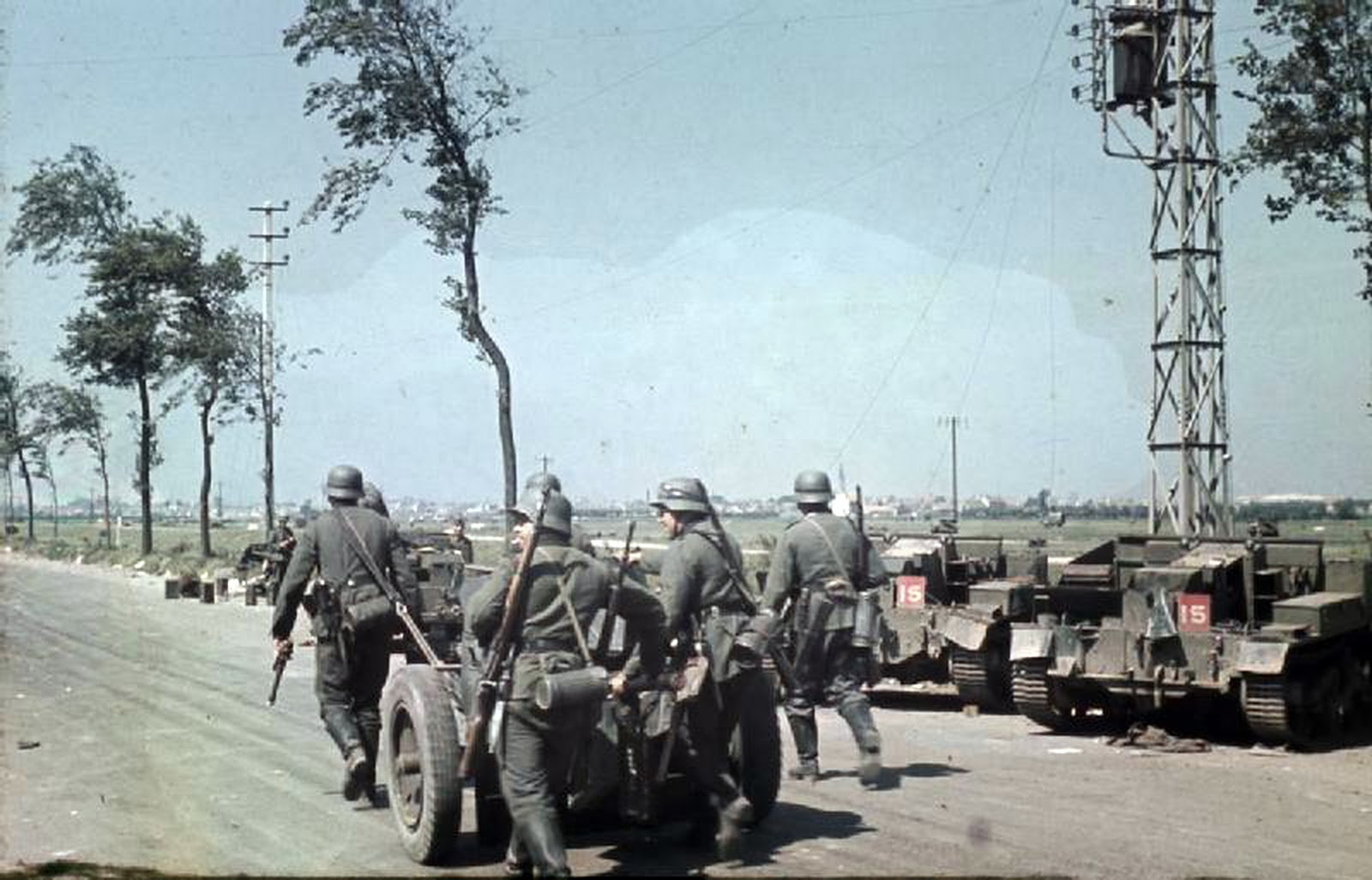
German troops pulling a 37mm anti-tank gun along a road near Dunkirk. Immobilised British Scout carriers are parked at the side of the road

Source :
https://www.relicsww2.net/the-wehrmacht-in-dunkirk-june-1940-8-photo-in-color/

Saturday, August 27, 2022

City Gate of Ville de Mouzon

 
France, Ville de Mouzon.- Historic city gate (La porte de Bourgogne).- Sign reading "La mendicite est rigoureusement interdite dans La Ville de Mouzon" (prohibition of begging); approximately June-July 1940.

Source :
Bundesarchiv B 206 Bild-GD-82

Thursday, August 25, 2022

French Colonial Soldiers in 1940

French colonial soldiers as a prisoners of war on the march through a city guarded by Wehrmacht soldiers on bicycles. The picture was taken somewhere in France, June-July 1940.

In 1940, the French army included more than 100,000 black French soldiers from France’s African colonies, mainly Senegal, Mauritania,and Niger. More than 75,000 of them served in France before and during the German invasion; the rest of them served guard duty in the various colonies. As the Wehrmacht panzer divisions swept across France in May-June 1940, some of those black French soldiers (about 40,000 of them), mainly organized in black regiments or mixed units, were engaged in fierce combat against German soldiers. About 10,000 black soldiers were killed, some wounded, and others taken prisoner during the French debacle. Between 1,500 to 3,000 black French prisoners of war were massacred throughout the campaign, either during or after combat. Generally speaking, Tirailleurs Sénégalais were treated differently from other war prisoners by the victorious army. The existence of a well-implanted anti-black racism and stereotypes among the German soldiers frequently resulted in the black French troops being separated from other prisoners of war. Fear of coupes-coupes (a hand-to-hand weapon used by the Tirailleurs Sénégalais that German soldiers considered a treacherous weapon), latent desire for revenge because of German losses, or simple racism, resulted in random massacres of black French war prisoners by members of the Wehrmacht.


Source :
https://www.h-net.org/reviews/showrev.php?id=24173

Wednesday, August 24, 2022

War Damage in France

Bridge after destruction and houses bombed in the background. Ville de Mouzon, France, June-July 1940.

France suffered staggering manpower losses and much property damage in the war of 1914-1918. She had not fully recovered from the effects of the war when she was plunged into a second conflict in which she sustained more terrible wounds than ever before. Her manpower losses were not as severe in World War II as they had been from 1914 to 1918, but the damage to her cities and towns was far more severe from 1940 to 1945 than it had been during World War I. France's structure of wages and prices, already threatened with inflation as a result of the prolonged period of hostilities from 1914 to 1918, was further weakened during World War II. Living conditions in France are so bad today that only the very wealthy are able to secure sufficient food, clothing, and fuel to maintain a healthful standard of living.

The German armies and air forces inflicted considerable damage upon France during their successful offensive in the spring and summer of 1940. The damage grew more extensive each year thereafter became of systematic German looting and Anglo-American aerial bombardment. Then, on June 6, 1944, the armies of the Western Allies landed in Normandy and commenced to fight their way across France into the Hitler Reich. The German armies resisted furiously, and countless towns and villages were destroyed in the bat-tles which ensued. Unfortunately for France, the invasion which liberated her brought about more destruction than she had suffered during the victorious onslaught of Hitler's armies in 1940.

Many cities, such as Brest, Caen, Dunkerque, Falaise, and St. L6 were almost completely destroyed. Hundreds of towns, villages, and farms suffered the same fate. All told, over 1,200,000 buildings were demolished or sustained major damage, and more than 1,000,000 people were made homeless! Several thousand kilometers of mainline railroad track were torn up, 2,300 railroad bridges were destroyed, and France lost about half of the railroad cars and nearly 8o percent of the locomotives which she had possessed in 1939! Tremendous damage was inflicted upon industrial plants. Many thousands of acres of the best arable land were rendered unproductive because of the war.


Source :
"War Damage and Problems od Reconstruction in France 1940-1945" by George W. Kyte

Monday, February 15, 2021

Abandoned French Char B1 tank

Capitaine Brueneau’s Char B1 tank “Verdun II” of 37e Bataillon de Chars de Combat (BCC). At Solre le Château on the evening of 16th May 1940, one of their tracks was hit by a shell during fighting against the 7th Panzer Division, immobilising the tank and forcing Brueneau and his crew to abandoned the vehicle.
 

Source :
https://www.facebook.com/photo/?fbid=3791552004234357&set=gm.1673956792789737

Sunday, June 21, 2020

German Motorcycle Messenger

Original color slide from a German motorcycle messenger (Kradmelder), somewhere in France around 1940. The bike is a DKW KS 200.


Source :
https://www.facebook.com/photo.php?fbid=271824844086347&set=gm.1470817449770340&type=3&theater&ifg=1
https://forum.axishistory.com/viewtopic.php?f=132&t=184255&p=2275726#p2275726

Monday, February 24, 2020

General Werner Kienitz in France

General der Infanterie Werner Kienitz (Kommandierender General XVII. Armeekorps) and his staff officers looking at ancient pillars in France. The picture was probably taken in May-June 1940, when Kienitz and his corps were stationed in Aisne, France. Between 11 and 13 November 1939, XVII. Armeekorps was transferred to France, and from January 1940 onwards it was placed under reserve in the 2. Armee. During the second phase of the Western campaign, XVII Corps was transferred in June 1940 to the 12th Army and deployed for the attack on the Aisne.


Source :
https://en.wikipedia.org/wiki/XVII_Army_Corps_(Wehrmacht)
https://forum.axishistory.com/viewtopic.php?t=14230&start=9690

Saturday, January 19, 2019

A Motor Column Crossing a River on a Pontoon Bridge

France, 1940: The German convoy crossing a tributary of the Oise at Senlis on a pontoon bridge, in this case a Brücken-Gerät B, some 50m long and capable of supporting as much as 20 tons. While not evident here, anti-aircraft guns were normally emplaced to protect bridge sites. The Bruckengerat B could use two-piece metal pontoons (Halbpontons) or large inflatable boats.


Source :
Book "German Pionier 1939-45: Combat Engineer of the Wehrmacht" by Gordon L. Rottman
http://www.cartula.ro/forum/topic/4297-al-doilea-razboi-mondial-in-fotografiian-sau-color/page__st__620

Wednesday, March 23, 2016

French POWs Clearing the Blocked Road in Dunkirk

German forces arrive in Dunkirk after the completion of the evacuation of the British Expeditionary Force earlier in the day. Under the direction of their German captors, French troops push away an immobilised British Universal Carrier tracked vehicle, clearing the blocked road into Dunkirk. This picture was taken by Hermann Weper, an officer serving with Maschinengewehr-Bataillon 52, on 4 June 1940 following the seizure of Dunkirk


Source :
http://www.iwm.org.uk/collections/listing/object-205012729

Sunday, November 16, 2014

Panzer 38(t) and Panzer II on the Move in France 1940

Panzerkampfwagen 38(t) (SdKfz 140), extreme left, and Panzerkampfwagen II (SdKfz 121) climbing a grade, right, on the move. This is a rare color shot, which may be staged for the German war photographer. Please note that these two tanks have a clean rear deck and the helmets hanging over the side and rear of the Panzer II! It was taken in 1-10 June 1940 during the breakout of 7. Panzer-Division (Generalmajor Erwin Rommel) out of a valley near the Somme river. Originally the picture was published in the book "Entscheidende Stunden", a German propaganda book printed in 1941


Sources:
http://www.worldwar2database.com/gallery/wwii0116
http://www.ww2incolor.com/german-armor/ajr.jpg.html

Monday, May 19, 2014

Mechanised Column of 7. Panzer-Division

Shown here is a mechanised column of the 7. Panzer-Division, commanded by Generalmajor Erwin Rommel, on the move during the Blitzkrieg through France in the last days of May 1940. The photo was taken by General Rommel himself. They are not hindered by Allied aircraft because the German air superiority ensures them a "safe trip" (at least from the air) along the way!


Source:
http://www.cybermodeler.com/history/germany/rommel.shtml

Tuesday, March 11, 2014

German Soldiers Relaxed at the French Beach

There are no sunbeds in sight, but this picture is clear evidence, as if any were needed, that the German aptitude for bagging the best sunbathing spots goes back a long way. There’s barely room to move on this beach near Boulogne, and any Britons trying to find a spot wouldn’t have been terribly welcome. The year was 1940 and this rare colour photo shows a unit of Hitler’s army relaxing as they waited to see if they would be called on to cross the Channel and attack. It was taken on June 6, two days after Churchill told Great Britain – standing alone after the collapse of France – ‘We shall fight them on the beaches…’ As it turned out, the invasion was called off after the Luftwaffe’s failure to defeat the RAF in the Battle of Britain during the exceptionally hot summer of that year. But the picture offers a glimpse of how relaxed and confident these crack troops were after their unstoppable Blitzkrieg through the Low Countries and France. One or two even seem to have packed Das Speedos in their kit bags in preparation for the excursion to the seaside. (Though look closely and it appears that some clearly didn’t.) And is the figure in bright red trunks a shapely collaborator in bikini bottoms? Some are drying out after a swim. Combat gear is scattered across the beach and their rifles are stacked in neat pyramids. They are infantrymen from the 1st Gebirgsjäger (Mountain Huntsmen) Division and were preparing to take part in Operation Sea Lion, which would have seen them streaming across the Channel in landing craft. Further up the coast, British and French troops were fighting for their lives at Dunkirk. The extraordinary snapshot is one of a series taken by an unnamed officer. Others show the same men marching along country lanes and through rubble-strewn towns. The officer seems to have dumped his box of negatives four years later as he fled Paris. They were discovered by photographer Marcel Gesgon but he simply filed them away. Now his son Alain, a Paris-based historian, has had them printed to coincide with the 70th anniversary of the planned invasion. He said: ‘These young men were simply enjoying the sun in a newly-created outpost of the Third Reich. Many of were in their teens or early 20s but they had swept all before them so far, and seemingly had nothing to fear.’ Might some still be alive today? Unlikely, Mr Gesgon said. Some time after this sun-kissed day, the 1st Gebirgsjäger was posted to the freezing, blood-soaked Russian front. 


Source:
http://plasmaticplastic.blogspot.com/2011/11/battle-for-boulogne.html

Thursday, December 26, 2013

Oberleutnant Karl Hanke in a Panzerkampfwagen IV

Panzerkampfwagen IV ausf.D (turmnummer 432) commanded by Oberleutnant (1st Lieutenant) Karl Hanke and assigned to the Panzer Regiment 25/7.Panzer Division under Generalmajor Erwin Rommel during the Battle of France. This propaganda photo appeared in Signal magazine in 1940

Source:
Signal magazine 1940