Showing posts with label Terrain - Sea. Show all posts

Tuesday, December 20, 2022

PBM-3D Mariner Prepares to Launch from a Coastal Naval Air Station

A Martin PBM-3D Mariner prepares to launch from a coastal Naval Air Station to patrol for German submarines, probably in late spring 1943. The landing gear had to be manually removed before takeoff and reinstalled before exiting the water. Mariners were one of the most effective of the Navy’s long-range flying boats.

Source :
National Archives and Records Administration, 80-G-K-16065
Smithsonian National Air and Space Museum
https://www.flickr.com/photos/airandspace/albums/72157715574200936

Sunday, December 18, 2022

U-952 Submarine

Pictures from Walter Nödinger's estate (arrow point). In World War II he served as a sailor on the German submarine U-952, a Type VIIC U-boat whose career began with training at 5th U-boat Flotilla on 10 December 1942, followed by active service on 1 May 1943 as part of the 3rd Flotilla for the next seven months. On 1 February 1944 she transferred to serve with 29th Flotilla, based in La Spezia, for Mediterranean operations. In five patrols she sank two merchant ships, for a total of 13,374 gross register tons (GRT), plus one warship sunk and a further merchant ship damaged. U-952 was decommissioned on 12 July 1944 after being badly damaged on 5 July 1944 by US air raid. Her wreck was captured by French and broken up in 1946. The veteran crews met regularly for many years. Walter Nödinger passed away in May 2014.


Source :
Uwe Rakel photo collection
https://www.facebook.com/groups/2773465416277933/posts/3164685217155949/?__cft__[0]=AZVH9TBiEoEL3XWxCH_o0jefbMbaYMWRM7R0PylpYWxzwJvwQvYdOdwPlafZJU055WriN7rBD8biBHZjaqbrCijarxSE8AX22vr5kFB03euIEXQJzuxwjkwGBf1jw4Nn6NiF7AwpV-fD-na6HgCJOM0E0Ppra5ympX0FnsuTVhd-XlxQp8jHHvSF-pl85_SieJA&__tn__=%2CO%2CP-R

Sunday, December 4, 2022

The carrier USS Franklin (CV-13) Prepares to Dock at the Brooklyn Navy Yard

The carrier USS Franklin (CV-13) approaches Manhattan as it prepares to dock at the Brooklyn Navy Yard on April 28, 1945. The Franklin’s deck shows the melted and burned decking and aircraft parts resulting from a March 19, 1945, dive bomber attack while the carrier was involved in attacks on the Japanese home islands. Over 800 crewmembers lost their lives in the explosion and fires that resulted. When Japan surrendered on 15 August 1945, USS Franklin was still undergoing repairs. A few months later on Navy Day, 13 October 1945, she was opened up to the public and inspected by thousands of visitors. Her extensive repairs were finally completed on 15 June 1946, and two days later, she reported to the Atlantic Reserve Fleet for inactivation. On 17 February 1947, the carrier was placed out of commission at Bayonne, New Jersey.

Source :
National Archives and Records Administration, 80-G-K-4761
Smithsonian National Air and Space Museum
https://www.flickr.com/photos/airandspace/albums/72157715574200936
https://www.history.navy.mil/our-collections/photography/us-navy-ships/alphabetical-listing/f/uss-franklin--cv-13-0.html

Monday, November 14, 2022

Bio of Top US Naval Ace David McCampbell

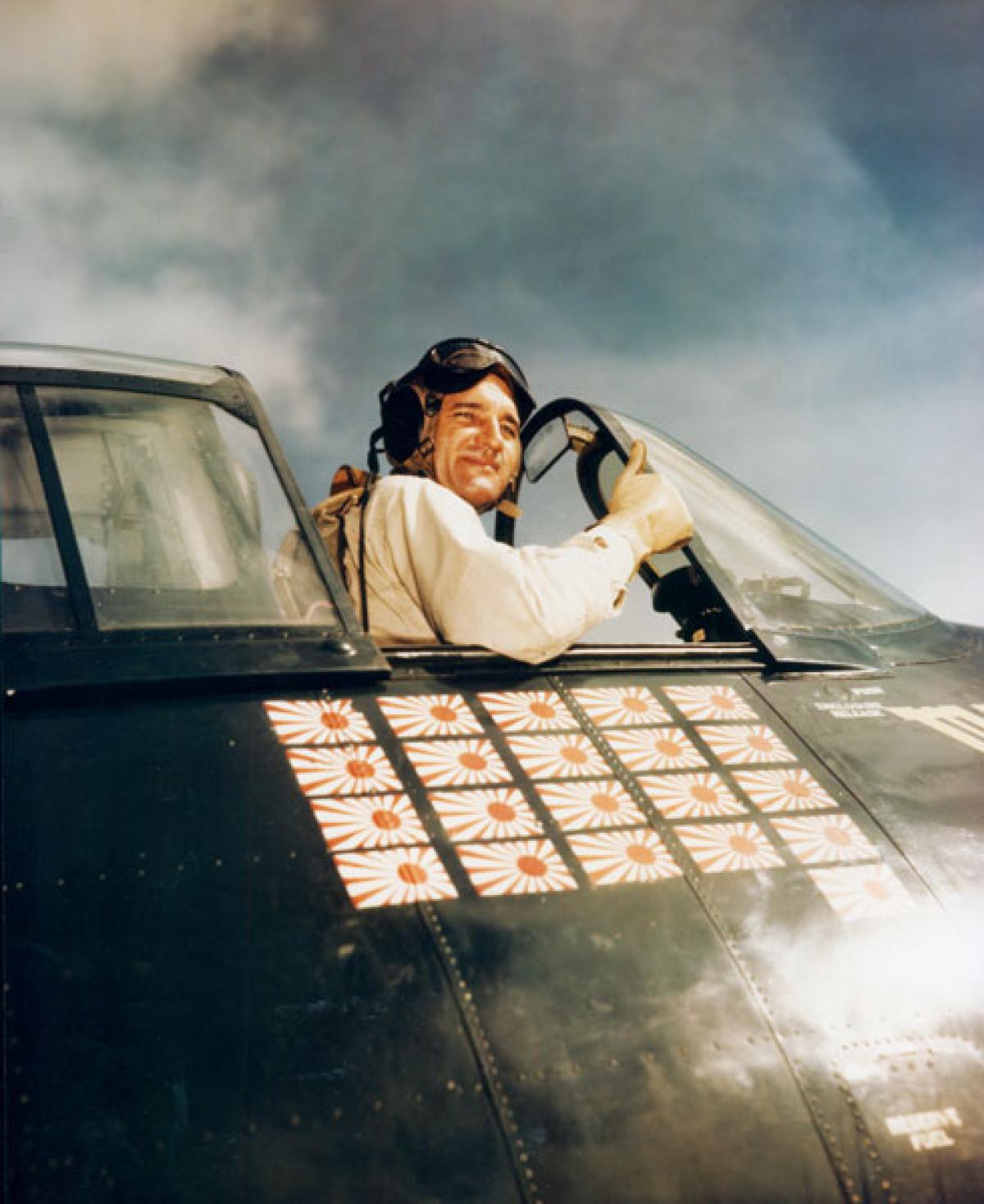
US Navy Capt. David McCampbell wasn't just the top naval ace of World War II — he's considered the service's all-time leader in aerial combat. His spirit and leadership are what made his air group one of the war's most decorated, and they earned him the Medal of Honor.

McCampbell was born Jan. 16, 1910, in Bessemer, Alabama, to parents Andrew and Elizabeth McCampbell. When he was about 12, the family moved him and his older sister, Frances, to West Palm Beach, Florida.

As a teen, McCampbell moved north to attend the Staunton Military Academy in Virginia. His graduation in 1928 earned him an Army commission, according to the Army University Press. Instead, he chose to attend the Georgia Institute of Technology, where he played football and was on the swim team. He also joined Navy ROTC, which led to his appointment to the Naval Academy. While in Annapolis, McCampbell became an accomplished swimmer and diver, competing in and winning various NCAA regional championships.

McCampbell graduated in June of 1933, but since Great Depression-related economic issues had affected the number of commissions that were available, he immediately went into the Naval Reserve. He returned to Alabama to work in construction and at an aircraft assembly plant for a year before finally receiving orders in June 1934 to report for active duty.

The young ensign's first duty station was aboard the USS Portland. By May 1937, he'd worked his way up in the ranks and began flight school in Pensacola, Florida, earning his wings in April 1938. His first few years as an aviator were spent serving on the USS Ranger and the USS Wasp.

World War II began while McCampbell was on the Wasp. The aircraft carrier spent the first half of 1942 in the European theater before being transferred to the Pacific. On Sept. 15, 1942, the ship was sunk during the Guadalcanal campaign. McCampbell, surviving its demise, was promoted to lieutenant commander and brought back to the U.S.

By late 1943, McCampbell was in command of a fighter squadron attached to the USS Essex. He was promoted to commander in January 1944 and put in charge of the ship's Air Group 15 — one of the war's most decorated air groups.  It was in this position that McCampbell became one of World War II's great aces.

McCampbell took out his first Japanese aircraft on June 11, 1944. About a week later, during the First Battle of the Philippine Sea, he led several F6F Hellcat fighter aircraft against 80 Japanese carrier-based planes that were headed toward the U.S. fleet. McCampbell personally destroyed seven of those hostile aircraft — five bombers and two fighters — which helped his outnumbered men virtually annihilate the enemy. According to the Encyclopedia of Alabama, McCampbell's team accounted for about 68 of the 600 Japanese downed aircraft.

On Oct. 24, 1944, during the infamous Battle of Leyte Gulf, McCampbell and a fellow pilot, Ensign Roy Rushing, took on 60 hostile Japanese aircraft that were approaching U.S. ships. Despite the overwhelming airpower against them, McCampbell shot down nine Japanese aircraft, setting a U.S. single mission aerial combat record. Rushing took out another six enemy warplanes. Their successes completely threw off the Japanese air group; the remaining aircraft abandoned their mission before any of them reached the U.S. fleet.

In a 1987 U.S. Naval Institute interview, McCampbell explained how he nearly didn't make it back to his ship after that engagement.

"When I got over the ship, I found they had a flight deck full of planes, and I knew that to launch all those planes would take a good 20 minutes, and I didn't have that much gas left," he said.

When the ship did make room for him to land, he said, "I ran out of gas on the deck. They had to push me out of the landing gear area. I found out from the mechanic that re-ammunitioned the guns that I had exactly six rounds left in the starboard outboard gun, and they were all jammed."

"But it worked out all right," he added nonchalantly.

McCampbell returned to the U.S. in December 1944. By then, he had become the Navy's all-time leading ace and top F6F Hellcat ace, having downed 34 Japanese aircraft during his months of aerial combat. His impressive tally made him the third-highest American scoring ace of World War II, behind only Army Maj. Richard Bong and Army Maj. Thomas B. McGuire, neither of whom survived the war.

For his bravery in the skies, McCampbell received the Medal of Honor on Jan. 10, 1945, from President Franklin D. Roosevelt during a ceremony at the White House.

After the war, McCampbell served in various positions, including as a senior naval aviation advisor to the Argentine Navy. After becoming a captain in July 1952, he also notably served as the captain of the aircraft carrier USS Bonhomme Richard and as a member of the Joint Staff in Washington, D.C. In the latter position, McCampbell helped draw up contingency invasion plans during the 1962 Cuban Missile Crisis, according to a 1996 Palm Beach Post article.

McCampbell was married a few times and had three children, Frances, David and John. He finally retired from the Navy in 1964 after 31 years of service.

According to the Palm Beach Post, McCampbell "dabbled in real estate in the Bahamas" before setting back down near West Palm Beach, where he lived for the rest of his life.  

McCampbell died on June 30, 1996, at a veteran's home he'd been living at for about a year. He was buried in Arlington National Cemetery.


Source :
https://www.defense.gov/News/Feature-Stories/Story/Article/3192422/medal-of-honor-monday-navy-capt-david-mccampbell/
https://www.thesun.ie/news/4108824/amazing-pics-of-us-navys-top-gun-inspiring-fighter-jet-unit-released-on-50th-anniversary-of-its-founding/
https://www.usni.org/magazines/naval-history-magazine/2022/august/brief-illustrated-history-navy-victory-markings

Air Defense Drill of PT Boat Crew

A U.S. PT boat crew runs through an air defense drill. During World War II, PT boats engaged enemy warships, transports, tankers, barges, and sampans. Some were converted into gunboats, which could be effective against enemy small craft, especially armored barges used by the Japanese for inter-island transport. Several saw service with the Philippine Navy, where they were named "Q-boats". Nicknamed "the mosquito fleet" and "devil boats" by the Japanese, the PT boat squadrons were hailed for their daring and earned a durable place in the public imagination that remains strong into the 21st century. Their role was replaced in the U.S. Navy by fast attack craft.

Source :
National Archives and Records Administration, 80-G-K-14517
Smithsonian National Air and Space Museum
https://en.wikipedia.org/wiki/PT_boat
https://www.flickr.com/photos/airandspace/albums/72157715574200936

Sunday, July 17, 2022

Dornier Do 24 in Romania

A Dornier Do 24N of the German Luftwaffe at Romania in 1941. The Dornier Do 24 is a 1930s German three-engine flugboot (flying boat) designed by the Dornier Flugzeugwerke for maritime patrol and search and rescue. A total of 279 were built among several factories from 1937 to 1945. The picture was taken by Kriegsberichter Horst Grund.

Source :
https://en.wikipedia.org/wiki/Dornier_Do_24

Sunday, June 6, 2021

Generalmajor Julius Ringel in Crete

Generalmajor Julius Ringel visits the Küstenwachen (coast guards) in Crete. Austrian-born Ringel commanded the 5. Gebirgs-Division in Greece and Crete. On 22 May 1941 he was given control of all German forces on Crete and told to secure the island. While he achieved this objective, Ringel’s decision to push his troops eastwards towards Retimo allowed the bulk of British Creforce to escape south to Sfakia for evacuation. For his leadership during the battle he was awarded the prestigious Ritterkreuz des Eisernen Kreuzes in June 1941.

Source :
https://nzhistory.govt.nz/media/photo/general-julius-ringel

Sunday, March 7, 2021

U.S. 4th Infantry Division in Normandy


U.S. 4th Infantry Division members boarding a Higgins boat bound for Normandy, 1944. They are heading to the Utah Beach.

The 4th Infantry Division was a regular army division which arrived in England in January 1944 to train and prepare for the cross-channel invasion. The 4th was assigned to conduct the initial D-Day landings on Utah Beach, at the western most end of the invasion area on the Cotentin Peninsula.

The 8th Infantry Regiment of the division was to conduct the initial assault, reinforced with an attached battalion of the 22nd Infantry Regiment. Its mission was to occupy the high ground along the road running between Sainte-Marie-du-Mont and Les Forges, then push westward across the Merderet River. The remaining units of the 22nd Regiment and the 12th Infantry Regiment were to be the follow-up forces and were to assist in the seizure of the causeways exiting Utah Beach and occupation of the surrounding high ground. On D-day the 4th Division also had attached one other regiment, the 359th Infantry, of the 90th Infantry Division, the first follow-on division in its sector. The 4th Division had surprisingly little difficulty in the initial assault, taking only light casualties and quickly gaining a lodgment. The assault forces were erroneously landed some 2,000 yards south of the intended beach, but this mistake proved valuable because much stronger German defenses were in position at the designated landing site. Brigadier General Theodore Roosevelt, Jr., assistant commander of the 4th Division, made the decision to continue the landing where it was and quickly led the forces off the beach. Roosevelt had volunteered to lead the first wave of the assault force, and proved to be an inspiration to the troops on Day with his gallant conduct. His actions that day, improvising and leading an attack out of the unexpected locale, won him a Medal of Honor.

After gaining control of the beaches, the 4th Division’s lead regiment crossed the flooded areas on existing causeways and moved west to establish contact with the airborne units. Follow-on forces attacked northwest to enlarge the beachhead. By dusk most of the division had gotten ashore and pushed some 4 to 7 miles inland. The next day, the 4th Division broke through to Sainte-Mère-Église, and relieved elements of the 82nd Airborne Division. The division was then ordered to attack towards Cherbourg and secure the area beyond the beach.

The 4th Infantry Division had been the first unit to land and cross the Normandy beaches. It had also made the largest gains of the attacking forces on D-Day, while suffering only light casualties. The seizure of the westward invasion area was crucial in the success of Operation Overlord and enabled the American forces to subsequently take the entire Cotentin Peninsula by the end of June.

Source :
https://www.facebook.com/photo/?fbid=272816367649866&set=gm.1685740691611347
https://normandyallies.org/d-day-allied-divisions/u-s-4th-infantry-division/
https://www.usmilitariacollection.com/boutique/bouee-de-sauvetage-m-1926-3-pressions-1942-neuve-de-stock/

Wednesday, February 17, 2021

No. 5 Squadron Sunderland NZ4113 'M' in Flight


Some nice air to air views of a No. 5 Squadron Sunderland NZ4113 'M' in flight over the Waitemata Harbour and the Auckland harbour bridge in 1944.

No. 5 Squadron RNZAF is a squadron of the Royal New Zealand Air Force formed during November 1941 in Fiji. It remains on active duty and logged 2,300 hours flight time in 2007.

Initially, the squadron was equipped with Vickers Vincents. From the outbreak of hostilities with Japan, the squadron operated the Short Singapore Mk.IIIs (transferred in October 1941 from No. 205 Squadron RAF) mainly on maritime patrol and anti-submarine duties, rescuing more than fifty survivors of ditched aircraft and successfully attacking a Japanese submarine in the process with the elderly Singapores. These types were superseded by Consolidated PBY Catalinas, which aided the air-sea rescue capability. The squadron moved from Fiji in late 1944 to operate between Espiritu Santo and the Admiralty Islands. During this time the later conqueror of Mount Everest, Edmund Hillary, served with the squadron. In November 1944, the squadron moved to Luganville Seaplane Base on Espiritu Santo to carry out anti-submarine patrols and escort duty. In August 1945, the squadron was withdrawn to Fiji.


Source :
https://www.facebook.com/groups/237076659811098/permalink/1675710325947717/?__cft__[0]=AZV6AaZA39GQ6sgMEarWLAWJyAEAXlLunSv1LPgYwPT7wJlD1HX72gjhxaYaAHdKusJJ-oQQaOP_3i0NaLdWlD6HP0I54NAaKO-JhTuc2zU3OlfRYkk5Pm48GLpGVgl1XFHYbktB2zVXtKqv0a9dhm29Y8tCgIBLqMKxXGdESjfMhgeWu0TJQncjLUWHbiR3qt4&__tn__=%2CO%2CP-R

Sunday, January 24, 2021

Pilot Veikko Härmälä of Finnish Air Force

Captain Veikko Härmälä of the 2nd Flight of the 6th Naval Aviation Squadron of the Finnish Air Force in the cockpit of a captured Soviet-made SB-2M-103 reconnaissance bomber in flight over the Gulf of Finland, June 1944. Photographer: Niilo Helander.


Source :
https://www.facebook.com/groups/237076659811098/permalink/1657759404409476/?__cft__[0]=AZW-WKN084Jvvwzs7qGLPAjaESj1H93QqhVQBwkTwdUB_y7JjOQfwQwGudkaO_QVotMkBvAlELxtcv0Ropqbu-qERMg8Wzuf6ZJjcUJSg4DXg5ej0huDhelD_79E2Dh78o0iWU9fGgqgQe24RwsZ20S81cNwEEaL6Ow0_uLeAfvmJ0CiRJEKerfu6a8Ksr1N0IU&__tn__=%2CO%2CP-R
http://sa-kuva.fi/neo?tem=webneofin

US Marines Practice at Sea


Off the coast of Dunedin, Florida, autumn 1941. Marines of the Amphibian Tractor Detachment practice formation driving at sea. Semaphore flags were used to communicate since most early amphibian tractors lacked radios. The LVT-1 alligator (seen here) revolutionized ship to shore movement of troops and equipment. First intended strictly as a cargo carrier, the tractors were soon adapted and improved. FMC built about 1,200 LVT-1s, some of which saw combat service through the end of the war. Life Magazine Photo by Dmitri Kessel


LVT-1 Alligators maneuver off the western coast of Florida in the autumn of 1941. Designed by Donald Roebling, the Alligator revolutionized amphibious warfare and was the first true amphibian vehicle. The LVT-1 was the first in an evolutionary line of amtracs and is the forerunner of the AAV-7 tractor still used by Marines.


Autumn 1941, near Dunedin, Florida. Marines of the Amphibian Tractor Detachment practice formation driving at sea. Amtrackers used several basic formation during ship-to-shore movement: column, line and wedge. Most early amtracs did not have radios, so semaphore flags and hand signals were used to signal formation changes.


Autumn 1941, near Dunedin, Florida. Marines of the Amphibian Tractor Detachment practice water movement in a brand-new LVT-1 amphibian tractor. The detachment was formed in May 1941 near the Food Machinery Corporation plant in Dunedin, on Florida's western coast. The new tractors were delivered from the factory straight to the detachment. Such was the need that many of the initial batch of tractors were clad only in the red anti-rust coating. The Amphibian Tractor Detachment was assigned to the 1st Marine Division in December 1941, becoming the nucleus for Co A, 1st Amphibian Tractor Battalion.


Source :
https://www.facebook.com/Fixbayonets1985/photos/a.114279460312369/232247321848915

Friday, December 25, 2020

U-Boat Crew in the Sea


During 1942 and 1943, German U-boats deployed in Norwegian waters had proven highly effective in harrying the Arctic convoys, despite the growing strength of convoy escorts, and the arrival of escort carriers.


Source :
"North Cape 1943: The Sinking of the Scharnhorst" by Angus Konstam

Monday, December 21, 2020

M.S. Hansestadt Danzig


M.S. Hansestadt Danzig in service for Seedienst Ostpreußen. This color slide has unfortunately been heavily infected with mold, still showing nice color of this beautiful ship. Cloud-looking darker spots on the sky is the degradation of color. So the sky was actually very clean with little cloud. Also, the ship is entirely in white, cream-looking places are degraded colors.


M.S. Hansestadt Danzig built in the Oderwerke Stettin. Maximum speed 15 knots, 2431 GRT after conversion capacity: 1158-2061 passengers (depending on route) plus motor vehicles and bicycles.
Launched on 17 March 1926, the ship was operated by Norddeutscher Lloyd for the Seedienst Ostpreußen from 14 July 1926 to August 1939 as a passenger and car ferry, then used as a minesweeper for the navy with a crew of 83. It was sunk on 9 July 1941 near Öland, Sweden (by running into a Swedish-German mine barrier. The German captain as well as the OKM disregarded the Swedish warnings).


Source :
Akira Takiguchi photo collection
https://www.facebook.com/photo/?fbid=10222657066008798&set=gm.1632475266937890
https://sites.google.com/site/seedienstostpreussen/die-schiffe?fbclid=IwAR0LqWjg2tUZhkV10e9NGPTAcyYskHzlw7vhg4_gD9aqPL_2XiT5d_QUtc8

Monday, May 21, 2018

Some of the First Americans to Attack on D-Day

Some of the first American soldiers to attack the German defenses in Normandy (France), transported in Higgins Boats (LCVPs), approach Omaha Beach near Ruquet, Saint-Laurent-sur-Mer, on 6 June 1944. They were part of E Company of the 16th Infantry Regiment. To the right is another LCVP. The soldiers are protecting their weapons with Pliofilm covers against the wetness. This picture was shot by Chief Photographer’s Mate (CPHOM) Robert F. Sargent of the United States Coast Guard (USCG).


Source :
http://allthatsinteresting.com/world-war-2-in-color
https://www.historyinorbit.com/never-before-seen-colored-photos-from-d-day-landings-in-normandy-will-leave-you-breathless/
https://www.turkishnews.com/en/content/2015/12/20/d-day-in-color-photographs-from-the-normandy-invasion/
https://www.vintag.es/2017/06/26-rare-color-photos-of-d-day-show-new.html

Monday, January 16, 2017

U-34 Emblem During Hard Winter of 1940-41

Many training boats could look back on an interesting operational life and their activities were in no way restricted to the Baltic Sea. This photo shows a well-known Type VII A boat of 24. U-Flottille in the Baltic during the hard winter of 1940-41. It is U-34, wearing the emblem consisting of an elephant stepping the head of Winston Churchill, England's First Sea Lord. Beneath it is the training boat emblem. Exactly when the elephant emblem was introduced is not clear, for the boat is believed to have worn the "Raben Huckebein" (Raven Huckebein) emblem during its seven operational patrols. U-34 was lost on 5 August 1943, when it sank after collision with the submarine tender "Lech" off Memel.


Source :
"U-Boot Im Focus" magazine, edition nr.6 - 2010

Type II Training Boats in the Baltic

Many training boats could look back on an interesting operational life and their activities were in no way restricted to the Baltic Sea. Our color photo illustrate several such boats. Photo above shows Type II boats approaching and tying up at the 21. U-Flottille's base in Pillau. The submarine in the foreground is U-62. Under Oberleutnant zur See Hans-Bernhard Michalowski, the Type II C sank two ships during fire patrols in the period 1 February - 30 September 1940, including the British destroyer HMS Grafton. The latter vessel was taking part in "Operation Dynamo", the evacuation of Allied troops from Dunkirk. During the night of 29 May 1940, while attempting to rescue survivors from HMS Wakeful, which had been sunk by the German motor torpedo boat S-30 a short time before, the destroyer was torpedoed by U-62 and sank. In October 1940 U-62 became a training vessel. Note the rescue buoy on the afterdeck and the training emblem on the conning tower. Approaching in the background is U-61, another Type II C. U-61 completed eleven patrols between October 1939 and October 1940, including nine under Oberleutnant zur See Jürgen Oesten. He sank five ships with a combined tonnage of 19,668 GRT. Kapitänleutnant Wolf-Harro Stiebler subsequently replaced Oesten as commander of U-61. Stiebler, who later commanded the "Milchkuh" (Milk Cow) U-461, completed two more patrols. After its days of frontline service were over, U-61 also joined the 21. U-Flottille in the Baltic. Note the emblem of Crew 37 b on the conning tower: to date none of U-61's commanders has been linked to that crew.


Source :
"U-Boot Im Focus" magazine, edition nr.6 - 2010

Tuesday, December 13, 2016

UAK Acceptance Trials of U-595

Even though the photos shown here are not of extraordinary quality, they are still extremely rare color images of the German submarine arm. The photos were taken in November 1941 or January/February 1942 aboard the U-595 in the Baltic Sea. Built by Blohm & Voss in Hamburg, the Type VII C U-boat was commissioned by Oberleutnant zur See Jürgen Quat-Faslem on 6 November 1941. From Hamburg, the boat sailed down the Elbe and the Kaiser-Wilhelm Canal into the Baltic Sea. The route down the Elbe and through the Kaiser-Wilhelm Canal was not without danger, and the boat several times took aboard pilots to assist with navigation. Waiting for U-595 in Kiel was approximately 14 days of UAK acceptance trials. There were test crash dives and compensation of the gyro compass. Another important stage was monitoring of the boat's sound profile by the UAG-Schall in Sonderburg, Denmark. Underwater microphones captured the sounds made by the U-boat at various speeds. The object was to minimize them in order to make the boat less easy to detect when it entered service.


This photo was probably shot during crash dive tests in the Baltic Sea. Taken from U-595, it shows a second U-boat bearing the white UAK emblem on the conning tower, sailing into Kiel Fiord. The white UAK emblem was only applied, on both sides of the conning tower, during the testing phase. Following UAK acceptance on 11 December 1941, U-595 went to the Agru-Front (Hela) in the deep waters of Danzig Bay for further training. This lasted from 12 to 22 December. Then, on 23 December, the boat joined the 8. Unterseebootsflottille (8th Submarine Flotilla) in Königsberg. With this flotilla, which in February 1942 moved to Danzig, U-595 underwent deep-diving tests, measured mile runs to determine maximum speed, depth charge exercises, damage repair, day and night torpedo firing, and anti-aircraft and deck gun training. The training, which continued until 31 July 1942, also included a number of tactical training exercises. In the end there was a final noise monitoring session at Rönne off Bornholm,


This photo was taken in January/February 1942 in one of the training bases in Danzig Bay and shows Obersteuermann Georg Schwarz in front of U-595's conning tower. On it may be seen the boat's large "Frosch" (Frog) emblem which was designed and painted by 1. Wachtoffizier (First Watch Officer) Leutnant zur See Friedrich Kaiser while it was with the Agru-Front. On 14 November 1942, U-595 was bombed off Oran in the Mediterranean and was subsequently run aground and blown up by its crew. Two members of the crew were killed in the bombing attack, the rest were taken prisoner.


Source :
"U-Boot Im Focus" magazine, edition nr.4 - 2008

Monday, October 17, 2016

Maintenance on U-Boat Deck Gun

Maintenance work on the 37mm quick-firing deck gun above the U-boat in the rough sea, with the man wearing both lifejacket and safety harness.  The German U-boats of types I, VII, IX and X had a very powerful secondary weapon which was the deck gun. Each boat had one in front of the conning tower and with a good crew they could fire 15-18 rounds a minute. Often used to finish off damaged vessels or sink smaller ships the gun normally had a crew of 3 to 5 and was usually commanded by the second watch officer (IIWO). In order to use the weapon, the U-boat had to be on the surface naturally and it was normally not used when aircraft were suspected to be around. It required a line of men (3 which on the deck) to transport the ammunition from the main locker below the control room to the gun. The used rounds were taken back into the boat. The U-boats had a small water-proof ammunition locker for the gun on the deck in order to be able to start firing almost immediately when the order was given. The smaller Type II coastal U-boats had no deck gun. In 1937 plans were drawn up for type XI U-boat cruisers. Those huge boats would have had 4 pieces of 12,7cm guns in two separate towers. They were not built.


Source :
Book "Wolfpacks At War: The U-Boat Experience In WWII" by Jak Mallmann Showell
http://uboat.net/technical/guns.htm

Sunday, June 5, 2016

A Curtiss Hawk Squad of Finnish Air Force

A Curtiss squad from the 1st Finnish Flight Regiment, over the Aunus Isthmus in an image taken on 18 October 1943. After the fall of France, Germany agreed to sell captured Curtiss Hawk fighters to Finland in October 1940. In total, 44 captured aircraft of five subtypes were sold to Finland with three deliveries from 23 June 1941 – 5 January 1944. Not all were from the French stocks, 13 were initially sold to Norway and captured when the Germans conquered that country. The aircraft were given serial codes CU-501 to CU-507 (A-4 submodel with Cyclone) and CU-551 to CU-587 (all other submodels with Twin Wasp). In Finnish service, the Hawk was well liked, affectionately called Sussu ("Sweetheart"). The Finnish Air Force enjoyed success with the type, credited with 190⅓ kills by 58 pilots, between 16 July 1941 and 27 July 1944, for the loss of 15 of their own. Finnish ace Kyösti Karhila scored 12¼ of his 32¼ victories in the Hawk, while the top Hawk ace K. Tervo scored 14¼ victories. The Finnish Hawks were initially armed with either four or six 7.5mm machine guns. While sufficient during the early phase of the Continuation War, the increasing speeds and armor of Soviet aircraft soon showed this armament was not powerful enough. From 1942, the State Aircraft Factory replaced the fuselage machine guns with either one or two .50 in (12.7 mm) Colt machine guns and installed two or four .303 in (7.7 mm) Browning machine guns in each wing. The 12.7mm Berezin UB or LKk/42 heavy machine guns were also used. The installation of heavier armament did not change the very good flying characteristics of the fighter, but the armament was much more effective against Soviet aircraft. The Finnish Hawks were also equipped with Revi 3D or C/12D gunsight. Surviving Finnish aircraft remained in service with the FAF aviation units HLeLv 13, HLeLv 11 and LeSK until 30 August 1948, when the last operational Finnsh Hawks were put into storage. In 1953, the stored aircraft were scrapped.


Source :
Book "Finland at War: The Continuation and Lapland Wars 1941-45" by Vesa Nenye, Peter Munter, Toni Wirtanen and Chris Birks 
https://en.wikipedia.org/wiki/Curtiss_P-36_Hawk#Finland

Saturday, May 28, 2016

Frontier City of Petroskoi / Äänislinna

Once the bustling frontier city of Petroskoi (Karelia/Soviet Union) was in Finnish hands in 1941, the name was quickly changed to Äänislinna (‘Castle by Lake Ääninen’). During the next few years Finns opened schools serving both the local population as well as the conquering soldiers. In addition to the institutions of higher education, the Finns also established concentration camps for civilians of Russian ethnicity which they operated until the Red Army liberated the area. Six camps were set up in Äänislinna, with 23,984 civilians of Russian ethnicity confined in them. Civilians of Finnish, Karelian or other Finnic descent were not interned into these camps. Some of the camps were old Soviet camps and some only fenced city areas. One source estimated almost 4,000 people perished there, primarily because of malnourishment, most dying during the spring and summer of 1942. The city was occupied by Finnish troops for nearly three years before it was retaken by Soviet forces on June 28, 1944. This image was taken from the ski-jump tower, looking towards Lake Ääninen, on 17 October 1941


Source :
Book "Finland at War: The Continuation and Lapland Wars 1941-45" by Vesa Nenye, Peter Munter, Toni Wirtanen and Chris Birks 
https://en.wikipedia.org/wiki/Petrozavodsk