Monday, September 11, 2023

Wounded Japanese POWs in Guam


Japanese prisoners of war (POWs) resting in a quonset hut infirmary in a stockade, Guam, 1945. Except for one, they all appear to be turning away from camera or hiding their face. A Navy corpsman is tending to one POW in the right background.

Source :
https://www.facebook.com/photo/?fbid=9124816540938411&set=gm.2359832834202126&idorvanity=237076659811098

Saturday, September 9, 2023

Wehrmacht MG Team


The Wehrmacht crew of a dug in MG nests secure the flank next to the advance route. It was only with a field mount that it possible to use the MG 34 as a heavy machine gun use and set the combat distance up to 1,200 meters to increase. The soldier in the middle shoot the targets according to the instructions of the Gruppenführer at right, while the soldier on the left takes care of the Ammunition feed. However, the withered camouflage should soon be renewed.

Source :
https://www.zinnfigur.com/en/Books-Media/Others/Calendars/Zweiter-Weltkrieg-in-Farbe-2023.html

Friday, September 8, 2023

German Paratroopers Jump Out of a Junkers Ju-52 during Exercise


"Aus der Luft ins Gefecht" (From the air into combat). This is the principle of the Fallschirmjägertruppen. From a Junkers Ju 52 - nicknamed "Tante Ju" (Aunt Ju) - the men jump into action. The parachutes are deployed automatically, which can be seen by the pulling lines blowing backwards. It is also important when taking off that men jump off one after the other in order to land close to each other on the ground.


Source :
https://www.zinnfigur.com/en/Books-Media/Others/Calendars/Zweiter-Weltkrieg-in-Farbe-2023.html

Thursday, September 7, 2023

Bio of Panzer Commander Johannes Kümmel (1909-1944)


Johannes Kümmel was born in Coswig, Saxony on July 21st of 1909. He joined the Reichswehr in 1928 and quickly obtained a rank of Unteroffizer (Junior NCO). Kümmel remained in the military as the Reichswehr became the new Wehrmacht and in 1938 was transferred to the newly formed 8th Panzer Regiment of the 10th Panzer Division at Boblingen near Stuttgart, southwestern Germany. In 1939, he was promoted to the rank of Oberfeldwebel (First Sergeant) and received the command of panzer platoon in the 1st Company. He commanded the unit during the Polish Campaign and was awarded the Iron Cross 2nd Class on September 27th of 1939. Johannes Kümmel received the award as a recognition for taking part in numerous operation including knocking out three Polish light tanks (or probably tankettes). On October 20th of 1939, after the conclusion of the Polish Campaign, Kümmel was awarded the Iron Cross 1st Class for knocking out four more enemy tanks during the campaign. Soon after, he was promoted to the rank of Oberleutnant (First Lieutenant).

On April 1st of 1940, Johannes Kümmel was promoted to the rank of Hauptmann (Captain) and received the command of the 1st Company of 8th Panzer Regiment. During the German offensive in the West of 1940, 10th Panzer Division was part of Guderian's XIX Panzer Corps, which broke through at Sedan, fought in the Low Countries and France, finally reaching the English Channel. Kümmel as the commander of the company remained at the frontlines and on June 5th of 1940, was slightly wounded when a mine blew up his tank.

After the defeat of France on June 25th of 1940, Germany was forced to help Italian ally in their unsuccessful struggle against the British in North Africa. On January 18th of 1941, 8th Panzer Regiment was transferred to the 15th Panzer Division (formed on February 1st of 1940). The division along with 5th Leichte (Panzer) Division formed new Deutsches Afrika Korps (German Africa Corps) commanded by Erwin Rommel, destined for Tripoli. On February 14th of 1941, leading elements 5th Leichte (Panzer) Division along with their commander Erwin Rommel landed in Tripoli and were joined in early May by 15th Panzer Division. Germans found Italians to be demoralized by the defeats inflicted upon them by British from May of 1940 during fighting in Cyrenaica (Operation Compass). The 8th Panzer Regiment had 20 Panzerkampfwagen IV, 71 Panzerkampfwagen III and 55 Panzerkampfwagen I, Panzerkampfwagen II and command tanks.

On June 15th of 1941, British under General Wavell launched Operation Battleaxe and again fighting took place in Cyrenaica. At Halfaya Pass, which has been converted to defensive strongpoint, Hauptmann Wilhelm Bach and his group held his position, while Italian Division Trento held area Sollum-Capuzzo-Bardia under the command of 15th Panzer Division. Johannes Kümmel and 8th Panzer Regiment with some 80 tanks were in reserve between Bardia and Capuzzo. British moved towards Capuzzo and Sollum, while attacking Bardia with 50 tanks from 7th Armored Division. The attack was temporarily halted by a single 88mm gun, which destroyed three leading enemy tanks. The rest of British tanks halted their attack to regroup and attack again under cover of smoke. This delay allowed the 8th Panzer Regiment to reach the area of Capuzzo and attack the enemy with the 1st Panzer Battalion including Kümmel's company with two short-barrel Panzerkampfwagen IV tanks. They soon knocked-out one British Matilda II and reinforced by company's Panzerkampfwagen III tanks continued to fire at the enemy armor. Fierce tank battle resulted and Johannes Kümmel found himself in the center of it all. During the battle, panzer commanded by Oberleutnant Peters was hit and he called Kümmel to ask for covering fire, while leaving their panzer. Johannes Kümmel soon found himself firing at two enemy tanks, which kept firing to finish off Peters' panzer. He soon knocked them out and regrouped his company to attack British anti-tank positions. German panzer destroyed the enemy positions and the battle soon involved the entire 8th Panzer Regiment. Then, another group of 20 British Matilda IIs were spotted on the flank and regiment's commander Hans Cramer ordered Johannes Kümmel to attack the enemy and protect the flank. With half of his company including two Panzerkampfwagen IV tanks, Kümmel soon knocked out eight enemy tanks, putting an end to the British attack. British advance was halted but both sides suffered heavy losses. Following the action, on June 18th, Kümmel received his nickname: "Der Löwe von Capuzzo" (The Lion of Capuzzo) and his tank was decorated with the "roaring lion" by his fellow soldiers. On July 9th of 1941, Kümmel was awarded the Knight's Cross following the recommendation by the commander of the 15th Panzer Division Generalleutnant Neumann-Silkow himself for his heroic action.

In May of 1942, Johannes Kümmel was given the command of 1st Panzer Battalion in time of the German offensive in Cyrenaica and into Egypt - Operation Theseus, which was launched on May 26th of 1942. On June 15th, Kümmel tanks reached the coast and by the evening took Port Piastrino. On June 21st of 1942, Tobruk garrison surrenders to Rommel's forces. Following the fall of Tobruk, three more offensive took place, two launched by the British to drive the Axis out of Egypt and Cyrenaica and one by the Germans to drive into Egypt. Before the last British offensive, on October 11th of 1942, Kümmel was awarded the Oakleaves to his Knight's Cross. In November of 1942, he was given the command of Panzer Battalion and on December 1st, received a promotion to the rank of Major. Following his promotion, Kümmel was transferred to Southern Italy.

Back, in Europe, Kümmel was promoted to the rank of Oberstleutnant (Lieutenant Colonel) and was assigned at the Headquarters of XIV Panzer Corps under General Hans Valentin Hube in Southern Italy. In October of 1943, he received command of 26th Panzer Regiment of the 26th Panzer Division, which fought at Salerno and Cassino areas. On January 30th, Kümmel's regiment was part of the attacking force, which was to destroy the enemy landing at Anzio-Nettuno but failed. Second attack on the enemy forces was to take place on February 27th of 1944, but Kümmel didn't take part in as the day earlier he was killed in a road accident near Cisterna. On May 20th of 1944, Johannes Kümmel was posthumously promoted to the rank of Oberst (Colonel). In his memory, there was a plate erected in his hometown of Boblingen on April 7th of 1943, honoring Johannes Kümmel as the holder of Knight's Cross with Oakleaves.


Source :
http://www.achtungpanzer.com/gen13.htm

Wednesday, September 6, 2023

German Exchange POWs in Stuttgart


German exchange POWs (mostly Afrikakorps) during welcoming ceremony in Stuttgart, summer of 1944. The Geneva Convention makes provision for the repatriation of all Prisoners of War, even during hostilities. During 1939-1945 it was only possible for the British and Germans to reach agreement over the seriously ill and disabled. For the majority of the 40,000 British servicemen who were taken prisoner in 1939 and 1940, the war was to be a very long and dispiriting experience. Negotiations, conducted through the Red Cross, over the repatriation of seriously wounded men, had begun in late 1940. They did not progress very far because there were far fewer German men in this category than British. It was only after substantial numbers of Germans were taken prisoner in the Desert campaign of 1942 that the talks resumed. The actual exchange of prisoners did not take place until October 1943. Other pictures from this series can be seen HERE.


Source :
https://artsandculture.google.com/search?q=hugo%20jaeger&hl=en
https://www.warrelics.eu/forum/history-research-third-reich-ww2/you-war-over-period-photos-german-pows-686919-76/

Tuesday, September 5, 2023

Afrikakorps Exchange POWs


Two German soldiers smiles to the camera. They were part of exchange POWs (mostly Afrikakorps) who just returned from England. The picture was taken by Hugo Jaeger in Stuttgart, summer of 1944. Other pictures from this sequence can be seen HERE.


Source :
https://artsandculture.google.com/search?q=hugo%20jaeger&hl=en

Monday, September 4, 2023

Ritterkreuzträger Josef Stigler


Ritterkreuzträger Josef Stigler as a Major der Reserve. He received the Ritterkreuz des Eisernen Kreuzes on 10 July 1942 as Oberleutnant d.R. and Führer II.Bataillon / Infanterie-Regiment 42 / 46.Infanterie-Division. He is one of the few Ritterkreuz recipients who was also the holder of the Blutorden (Medaille zur Erinnerung an den 9. November 1923). Stigler would ended the war as Gaustabsführer of the Volkssturm in Bayreuth, his birthplace.

Source :
https://www.zinnfigur.com/en/Books-Media/Others/Calendars/Ritterkreuztraeger-in-Farbe-2023.html

SS Nord with Tent and White Camo in the Snow

The winter war in the far north brought many additional stresses to the fighting troops: cold, wet and months of darkness. However, these soldiers of the SS-Division "Nord" are equipped with good winter clothing and are therefore better protected from the weather. The tent in the background is constructed from several tent panels tied together, of which each soldiers carried one with them.


Source :
https://www.zinnfigur.com/en/Books-Media/Others/Calendars/Zweiter-Weltkrieg-in-Farbe-2023.html

Sunday, September 3, 2023

Ritterkreuzträger Josef Dörfel and Hitlerjugend Member


Ritterkreuzträger Oberfeldwebel Josef Dörfel (2 March 1915 - 3 April 2002) chats with the youth member of Hitlerjugend. Dörfel received the Ritterkreuz des Eisernen Kreuzes on 4 March 1942 as a Zugführer in Infanterie-Regiment 439 / 134.Infanterie-Division, but later transferred to Großdeutschland Division.


Source :
https://www.zinnfigur.com/en/Books-Media/Others/Calendars/Ritterkreuztraeger-in-Farbe-2023.html

Saturday, September 2, 2023

German Exchange POWs after Returning from England


Welcoming ceremony in Stuttgart for the German exchange POWs (mostly Afrikakorps) who just returned from England. The picture was taken by Hugo Jaeger in the summer of 1944. Other pictures from this series can be seen HERE.
 

Source :
https://artsandculture.google.com/search?q=hugo%20jaeger&hl=en

Friday, September 1, 2023

General Rudolf Veiel Inspecting Exchange POWs


General der Panzertruppe Rudolf Veiel (Kommandierenden General vom Stellvertretenden Generalkommando V. Armeekorps in Stuttgart und Befehlshaber vom Wehrkreis V) inspecting German exchange POWs in Stuttgart who just returning from England, summer of 1944. His right pocket breast star should be the Bulgarian Military Merit Order 1. Class with War Decoration (which he received on 15 August 1941). Behind him is SA-Obergruppenführer Dr.jur. Jonathan Schmid (württembergischer Innenminister). Many of these prisoners are member of the Afrikakorps. They were exchanged with some British POWs. The picture was taken by Hugo Jaeger. Other pictures from the same series can be seen HERE.


Source :
https://artsandculture.google.com/search?q=hugo%20jaeger&hl=en
https://www.zinnfigur.com/Ritterkreuztraeger-in-Farbe-2023.html#&gid=1&pid=5

German Exchange POWs in 1944


General der Panzertruppe Rudolf Veiel (Kommandierenden General vom Stellvertretenden Generalkommando V. Armeekorps in Stuttgart und Befehlshaber vom Wehrkreis V) inspecting German exchange POWs in Stuttgart who just returning from England, summer of 1944. His right pocket breast star should be the Bulgarian Military Merit Order 1. Class with War Decoration (which he received on 15 August 1941). Behind him is SA-Obergruppenführer Dr.jur. Jonathan Schmid (württembergischer Innenminister). Many of these prisoners are member of the Afrikakorps. They were exchanged with some British POWs. The picture was taken by Hugo Jaeger.


The Geneva Convention makes provision for the repatriation of all Prisoners of War, even during hostilities. During 1939-1945 it was only possible for the British and Germans to reach agreement over the seriously ill and disabled. For the majority of the 40,000 British servicemen who were taken prisoner in 1939 and 1940, the war was to be a very long and dispiriting experience. Negotiations, conducted through the Red Cross, over the repatriation of seriously wounded men, had begun in late 1940. They did not progress very far because there were far fewer German men in this category than British. It was only after substantial numbers of Germans were taken prisoner in the Desert campaign of 1942 that the talks resumed. The actual exchange of prisoners did not take place until October 1943


Welcoming ceremony in Stuttgart for the German exchange POWs (mostly Afrikakorps) who just returned from England. The picture was taken by Hugo Jaeger in the summer of 1944.


Two German soldiers smiles to the camera. They were part of exchange POWs (mostly Afrikakorps) who just returned from England. The picture was taken by Hugo Jaeger in Stuttgart, summer of 1944.


German exchange POWs (mostly Afrikakorps) during welcoming ceremony in Stuttgart, summer of 1944.


Source :
https://artsandculture.google.com/search?q=hugo%20jaeger&hl=en
https://www.warrelics.eu/forum/history-research-third-reich-ww2/you-war-over-period-photos-german-pows-686919-76/#post1825154
https://www.zinnfigur.com/Ritterkreuztraeger-in-Farbe-2023.html#&gid=1&pid=5

Tuesday, August 1, 2023

Spanish Pilot of Escuadrilla Azul


Oberleutnant Andrés Robles Cebrián of Escuadrilla Azul. He is the veteran of the Spanish Civil War (1936-1939), served in Escuadrilla 3-E-3 (Robles ended the war with 1 biplane victory).


Source :
Akira Takiguchi photo collection
https://www.wehrmacht-awards.com/forums/forum/wehrmacht-era-militaria/photos-and-paper-items-forum/13994058-escuadrilla-azul-color-slide

Monday, July 10, 2023

Erwin Niebling receives a Distinguished Flying Cross with gold star


Lieutenant Erwin W. Niebling receives a Distinguished Flying Cross with gold star from Rear Admiral Osborne B. Hardison ( Chief of Naval Air Primary Training) on May 17, 1945, at Naval Air Station New Orleans for his actions as a pilot in the Philippines.

Source :
National Archives and Records Administration, 80-G-K-5302
Smithsonian National Air and Space Museum
https://www.flickr.com/photos/airandspace/albums/72157715574200936
https://www.history.navy.mil/our-collections/photography/numerical-list-of-images/nhhc-series/nh-series/80-G-K-05000/80-G-K-5302.html

A U.S. Army cavalry squadron trots past a Piper Cub


A mounted U.S. Army cavalry squadron trots past a fuels up J-3 Piper Cub and civilian onlookers being evaluated for aerial observation during the 1941 "Louisiana Maneuvers", the war game that were designed to evaluate the U.S. Army for World War II. The success of this demonstration led to the Army acquiring civilian lightplanes to be flown by Army artillery officers. These planes were known as “grasshoppers” – as can be seen with the yellow insignia – for their ability to get in and out of tight landing areas. Photo by Hans Groenhoff.

Source :
From the collection of the National Air and Space Museum Archives, Hans Groenhoff Photographic Collection, NASM 2004-51346
Smithsonian National Air and Space Museum
https://www.flickr.com/photos/airandspace/albums/72157715574200936
https://twitter.com/Erikhistorian/status/1300554071091425280

Sunday, July 9, 2023

Mustang Pilot William R. Groseclose


Portrait of Lt William R Groseclose from Pierre, South Dakota. Pilot of a P-51D Mustang of the 8th Air Force in England.  Assigned to 335FS, 4FG, 8AF USAAF. Lt Groseclose was apparently shot down while flying his P-51D Mustang 44-14432 on 11 September 1944 when the 4th Fighter Group was bounced by 30+ Messerschmitt Bf109's. His aircraft crashed 2 miles south of Erkeln, Germany. POW. MACR 8990. Awards: AM (OLC), POW, WWII Victory. Post War: Retired as a Major having served in Korea and Vietnam.


Source :
NARA Ref 342-FH-3A49666-K2431
https://www.americanairmuseum.com/archive/person/william-r-groseclose

Group Photo of Mustang Pilots


Pilots of a North American P-51 group in flying togs and Mae West jackets at a base in England. In the background is an interesting writing on the wall: "Narvik. Hell' Sapoppin Here!". They are, front row, from left to right: Lieutenant Nicholas W.J. Rosenson (Monessen, Pennsylvania); Lieutenant Charles L. Brock (Lockhart, Texas); Captain Robert J. Mabie; and Lieutenant William R. Groseclose (Pierre, South Dakota). Second Row, from left to right: Lieutenant George D. Green (Whittier, California); Lieutenant Robert J. Cooper (Chicago, Illinois); Lieutenant Hugh W. Lindsay (Paoli, Pennsylvania); and Lieutenant Zack S. Sensibaugh (Decatur, Texas). The Captain, Bob Mabie, flew with the 4th Fighter Group from July 13, 1944 to May 4, 1945. In January 1945 he was designated Flight Commander of D Flight. He flew a P-51D, serial number 5-NA 44-14221, coded WD-I. In February of that same year he was designated Assistant Squadron Operations and Gunnery Officer for the 335th. Mabie flew 80 missions and claimed 3 damaged aircraft.

Source :
NARA Ref 342-FH-3A49647-K2426.
https://www.americanairmuseum.com/archive/media/media-21452jpeg

Lieutenant Groseclose Prepares to Depart for a Mission in His Mustang


USAAF Lt. William Groseclose prepares to depart for a mission from an English base in his North American P-51D Mustang of the 335th Fighter Squadron, 4th Fighter Group. He was captured when shot down over Germany on September 11, 1944.

Source :
National Archives and Records Administration, 342-C-K-3914
Smithsonian National Air and Space Museum
https://www.flickr.com/photos/airandspace/albums/72157715574200936

Air Traffic Control Trainees Practice on Model Aircraft


U.S. Air traffic control trainees practice on model aircraft before working with the real thing. Despite prior close air support experiences beginning in World War I, the United States had no forward air control capability when World War II began. Although forward air control techniques were perfected by such US units as the 1st Air Commando Group in the China Burma India Theater, they would be ignored in the war's aftermath. When the United States Army Air Forces (USAAF) was founded on 20 June 1941, it included provisions for Air Ground Control Parties to serve with the United States Army at the division, corps, and Army headquarters. The Air Ground Control Parties functions were to regulate bombing and artillery in close conjunction with the ground troops, as well as assess bomb damage. They were thus the first of similar units to try to fulfill the functions of the forward air controller (FAC) without being airborne. However, these units were often plagued by interservice rivalry and cumbersome communications between the respective armies and air forces involved. As a result, it could take hours for an air strike requested by ground troops to actually show up. However, the advent of World War II did not lead to a functional US air control system; the 1942 edition of the American Field Manual 31-35 did not even mention a forward air controller. Forward air control during World War II came into existence as a result of exigency, and was used in several theaters of World War II. Its reincarnation in action was a result of field expedience rather than planned operations.

Source :
National Archives and Records Administration, 342-C-K-1721
Smithsonian National Air and Space Museum
https://en.wikipedia.org/wiki/Forward_air_control_operations_during_World_War_II
https://www.flickr.com/photos/airandspace/albums/72157715574200936

Wednesday, July 5, 2023

“Five Grand” - the 5,000th B-17 off the Production Line

“Five Grand” (Boeing B-17G-70-BO Flying Fortress, Serial number 43-37716) is seen here before deploying to England where it survived 78 combat missions with the 338th Bomb Squadron, 96 Bomb Group.


The B-17G, named, 5 Grand, was constructed at the Boeing Plant 5 in Seattle, WA, in 1944. It was named, 5 Grand, because it was the 5,000th B-17 to come off the Boeing production line in Seattle, since Pearl Harbor. It was the only B-17 that was ever individually signed by all of the Plant 5 workers before leaving the Seattle factory. The largest signature on the airplane, which disappeared in later photos of the plane, was made by Boeing assembler/installer, Frank Novito, on the upper surface of one of it's wings, with large block letters that he made in black paint on the upper wing skin with a large push broom. He, apparently, wanted the German pilots, to think of him and the fine work he did building the plane, as they surely must have done so, while they were trying to shoot, 5 Grand, down !

To boost morale on the home front during the Second World War, aircraft manufacturers began to celebrate production aircraft milestones. Lockheed, for example, painted their 5,000th P-38 Lightning, red, and named it, Yipee. But Boeing wanted to do something different, as it approached delivering the 5,000th B-17 Flying Fortress to be built since the attack on Pearl Harbor, when the U.S. entered the war against the Axis powers. Aircraft number, 40-37716, a B-17G, was that aircraft, and, early on, it was marked with a notice on the fuselage that it was the 5,000th Flying Fortress to be built since the U.S. entered the war. Every worker, who played a part in the construction of this particular aircraft, was invited to sign the part of the aircraft they produced, as it advanced down the production lines in Seattle.

So, these signatures celebrated the efforts of the thousands of workers, who immigrated to Seattle to escape the effects of the Great Depression, in order to work in Boeing's massive production facilities. The enthusiasm that workers applied to their signatures, surprised even the Boeing management, as even parts from the subcontractors' bound for, 40-37716, arrived signed, even though they would be hidden away deep inside the aircraft. Appropriately, the B-17G was named, 5 Grand, and before leaving the Renton plant, it was already being celebrated in newsreels and war bond drives. Instead of towing the B-17G out of Plant 5's front doors, as had always been done for the protocols of the day, upon completion, the workers, themselves, pushed, 5 Grand, out the factory doors to band music, cheers and great fanfare.

In May 1944, 5 Grand, was officially delivered to the U.S. Army Air Forces, at Boeing Field, and a bottle of champagne was ceremonially broken over the aircraft's nose. The USAAF even made sure that the crew assigned to, 5 Grand, were made up of local flyers from the Puget Sound area, with Edward C. Unger of Seattle selected as the aircraft's command pilot. 5 Grand, was, then, flown to Kearney AAF Depot in Nebraska for further modifications to make her combat ready. When she left the United States for the Eighth Air Force's bomber bases in Britain, over 35,000 signatures adorned the bare metal finish of, 5 Grand. Some thought that the plane should be stripped of it's signatures, as they figured, rightfully so, that the Luftwaffe would make special efforts to shoot it down, which they dutifully did just so ! But, it was finally decided the signatures would stay.

On it's trans Atlantic flight to England, the air crew found the B-17G was about 7 mph slower in cruise than a stock B-17G due to the extra weight of the paint used on the signatures and, also, the extra drag of the surface roughness from the thousands of colorful signature applications ! Both of these factors increased fuel consumption, which was also higher than normal, with the lower speeds of the plane, also less than normally forecast for a trip across the Atlantic, resulting in one of, 5 Grand's, engines cutting out upon landing in the U.K. due to low fuel.

Once in the U.K., 5 Grand, was assigned to the 333rd Bomber Squadron of the 96th Bomb Group at Snetterton Heath in Norfolk, U.K. One of it's first local test flights, before any combat missions were flown, also ended in near disaster when, 5 Grand's, electrical system failed, preventing it's main landing gear from extending, causing, 5 Grand, to make a gear up landing after ejecting it's ball turret.

Finally, when ready for combat, 5 Grand, was assigned to the 338th Bomb Squadron, and the 96th Bomb Group, at BX-H, Snetterton, U.K. Once in combat, the plane quickly received a reputation with the American B-17 pilots for being a German fighter plane magnet, because, flying high, above the clouds, on it's many missions over Europe and Germany, the famous B-17, was an unusual looking sight in the air, glowing in the sun, with a sort of bright orange color on it's bare aluminum skin, peppered with yellow, white, red, and black speckled spots, which were the workers' painted signatures, with many of the workers having signed their names on, 5 Grand's, fuselage and wings. Appropriately, the German pilots certainly did take notice of this unique and unusually strange looking and brightly glowing B-17! And, possibly, figuring it for some kind of lead ship, they honored it with unusually fierce attention, by trying very hard, and repeatedly, to shoot it down, damaging it on several occasions with their cannons, so seriously, that it had to be taken out of service and sent back to repair stations for major repairs.

The plane was pulled from combat and delivered to Cheyenne, Wyoming, 15 May 44; Kearney 30/6/44; Dow Field 13 Jul 44; Assigned to the 338th Bomb Squadron, and the 96th Bomb Group, at (BX-H) Snetterton, U.K. 14 Jul 44. During training, the plane's command pilot, Lt. Jack Bimemiller had an electrical failure and was unable to lower the landing gear. He was ordered to Honington, U.K. to land, wheels up. The airplane flew 78 missions after repairs were completed. Then, it was transferred to the 388th Bomb Group. May 1945. It returned to the USA Bradley Repair Depot, 14 Jun 45. After an overhaul, the plane left for Seattle and further refurbishment for a war bond tour in the U.S. from 4168 Base Unit, South Plains, Texas, 29 Jul 45. After completion of the bond tour, 5 Grand, was sent to Lubbock, Texas, for refitting.

After one major repair, 5 Grand, was returned to service (RTS) and reassigned to the 388th Bomber Group kin Britain. It would fly a total of 78 missions over the German Reich adorned with her signatures and her gunners claiming two Luftwaffe fighters destroyed.

On 14 June 1945, 5 Grand, again returned home to the United States, first landing at Bradley Field in Connecticut before continuing on to Boeing Field in Seattle for refurbishment for a war bond tour. While in Seattle, many employees happily found most of their signatures still in place. Local officials wanted to preserve, 5 Grand, as a memorial to the city's home front war effort, but, while the Seattle politicians debated the cost, 5 Grand, was flown to Lubbock AAF Base in Texas for further repairs and refurbishment before being flown to storage at Kingman AAF Base in Arizona to be held in storage while Seattle officials decided how to proceed on the planned memorial, incorporating, 5 Grand. The U.S. Army Air Forces were willing to donate, 5 Grand, to Seattle for the memorial planned by the Seattle Historical Society, but on 3 January 1946, Seattle city officials declined the donation of, 5 Grand, on the grounds that building a memorial with the aircraft, represented too costly an endeavor.

Despite the efforts of Boeing employees who had signed, 5 Grand, and all of those wanting to preserve this piece of history, no one in the local government wished to take responsibility for the aircraft. So, still resplendent, with it's thousands of signatures, the plane was sold off by the Reconstruction Finance Corporation, and sent to Kingman, AZ, to the airplane scrappers, where, 5 Grand, was unceremoniously broken up and scrapped, forever lost to history. 22 Nov 1945


Source :
National Archives and Records Administration, 342-C-K-2442
Smithsonian National Air and Space Museum
https://www.americanairmuseum.com/archive/aircraft/43-37716
https://www.flickr.com/photos/airandspace/albums/72157715574200936
https://www.flickr.com/photos/dougsheley/4127692270

U.S. Navy Officers Review a Line of Brazilian PBY-5A Amphibians


U.S. Navy officers review a line of Brazilian PBY-5A amphibians with Brazilian naval aviators at Galeão International, Rio de Janeiro, Brazil, October 1944. In the background is PBY-5A "Bettye Jayne". The PBY-5A was handed over by VP-94. A second batch of PBY-5As was delivered to Brazil in late 1944. One of the earlier batch, FAB 02, sank a German U-boat on 31 July 1943. Ex BuNo 46524, FAB 14 shows a painted-out US roundel underwing. Later FAB 6513. Redesignated as a PA-10 in 1945. Converted to CA-10A transport aircraft in 1958, but retired in 1959. Brazil, as the United States’ principal South American ally during World War II, engaged in active combat operations against Germany, including deploying forces to the Italian campaign. During the Battle of the Atlantic, Brazilian Consolidated PBYs, like these, participated in anti-submarine operations, and in the case of U-199, one successfully sunk the U-boat off the coast of Rio de Janeiro on July 31, 1943. Here, U.S. Navy officers review a line of Brazilian PBY-5A amphibians with senior Brazilian naval aviators.

Source :
National Archives and Records Administration, 80-G-K-5258
Smithsonian National Air and Space Museum
https://www.flickr.com/photos/airandspace/albums/72157715574200936
https://laststandonzombieisland.com/2021/04/08/catalinas-of-rio/u-s-navy-officers-review-a-line-of-brazilian-pby-5a-amphibians-handed-over-by-vp-94-oct-1944-at-rio/

Tuesday, July 4, 2023

StuG in the Acropolis Athens


Sturmgeschütz III StuG 40 moving in the streets of Athens, Greece, against the backdrop of the famous Acropolis hill, and the Parthenon temple that stands above it. This photo was taken in 1943 - when Greece was still occupied by the German troops - and was first published in the SIGNAL magazine in the early 1944 issue. However, this one StuG did not belong to the Sturmartillerie unit of the Heer (Army) or Waffen-SS, but belonged to the Luftwaffe (Air Force), precisely V.Sturmgeschütz-Abteilung / Panzer-Artillerie-Regiment / Panzer-Division "Hermann Göring". In 1943, this Luftwaffe's sole armored unit was operating in the Mediterranean region, primarily in North Africa, Sicily and mainland Italy.


Source :
https://sturgeonshouse.ipbhost.com/topic/11-stug-iii-thread-and-also-other-german-vehicles-i-guess/page/4/

Thursday, June 29, 2023

Bio of SS-Obergruppenführer Leonardo Conti (1900-1945)


SS-Brigadeführer Leonardo Conti (left)


Leonardo Conti (24 August 1900 – 6 October 1945) was the Reich Health Leader and an SS-Obergruppenführer in Nazi Germany. He was involved in the planning and execution of Action T4 that murdered hundreds of thousands adults and children with severe mental and physical handicaps. On 19 May 1945, after Germany's surrender, Conti was imprisoned and in October hanged himself to avoid trial.

Conti was born to a Swiss Italian father, Silvio, and a German mother, Nanna Pauli; his mother later became the Reich Midwifery Leader in Nazi Germany. He attended elementary school in Switzerland and the Friedrich Wilhelm Gymnasium in Berlin. In the summer of 1918, he volunteered for military service in the First World War with the Imperial German Army's 54th Field Artillery Regiment in Küstrin (today, Kostrzyn nad Odrą). However, he did not see any combat before the war ended in November.

Returning to school, Conti then studied medicine at the Humboldt University of Berlin and the University of Erlangen–Nuremberg. He was active in the national student movement and in right wing politics. He became involved in the völkisch movement and co-founded the antisemitic combat association, Deutscher Volksbund. He took part in the Kapp Putsch in 1920 as a member of the Marinebrigade Ehrhardt. After it was disbanded in May 1922, he followed its leader Hermann Ehrhardt into the ultra-nationalist and antisemitic terrorist organization Organisation Consul. After this organization was banned by the government in July 1922, Conti enrolled in the Viking League, another right wing group committed to the overthrow of the Weimar Republic. He was also involved with the Deutschvölkischer Schutz- und Trutzbund, the largest and most active antisemitic organization in Germany. He passed his state medical examinations in November 1923 and joined the Sturmabteilung (SA) in Erlangen that year, becoming their first physician in Berlin. He obtained his license to practice medicine in 1925 and moved to Munich where he worked as a general practitioner and a pediatrician.

In 1927, Conti moved back to Berlin and joined the Nazi Party on 20 December (membership number 72,225). He was appointed the SA physician for Standarte V and was placed in charge of organizing the SA medical services in Berlin. From 1929 to 1930 he was the senior physician in SA-Gruppe Ost. He also founded the Berlin branch of the National Socialist German Doctors' League, (NSDÄB). In February 1930, he was called upon to treat Horst Wessel, an SA member who was shot by members of the Communist Party of Germany and whose death was exploited by Joseph Goebbels in a propaganda campaign to elevate him into a martyr of the Nazi movement. However in September 1930, Conti, who had reached the rank of SA-Oberführer, was expelled from the SA when he came into conflict with Walter Stennes, at that time the commander of SA-Gruppe Ost.

Conti joined the SS on 16 November 1930 (member number 3982) and became the senior doctor for SS-Gruppe Ost. In May 1932, Conti was elected as a Nazi deputy to the Landtag of Prussia where he served until it was dissolved on 14 October 1933. After the Nazi seizure of power, Conti was given a number of official positions in the German government, mostly in the areas of medicine and health. On 12 April 1934 he was appointed by Hermann Göring to the Prussian State Council. He was placed in charge of all medical arrangements for the 1936 Berlin Olympics. On 1 April 1936, he was assigned to the personal staff of Reichsführer-SS Heinrich Himmler. In 1937 Conti was elected to the presidency of the FIMS, the International Federation of Sports Medicine. The FIMS today considers this to have been "a black page" in their history. Conti also played a role in the banning of Jewish physicians from medical practice. In an interview in 1938, he declared: "It is only the elimination of the Jewish element which provides for the German doctor the living space due to him."

On 20 April 1939, Conti was appointed Reich Health Leader, President of the NSDÄB and head of the Main Office of Public Health; he was granted the Party rank of Hauptdienstleiter. This was followed on 28 August by Adolf Hitler appointing him State Secretary for Public Health and Nursing in the Reich and Prussian Ministry of the Interior. Conti attempted to have the use of the methamphetamine Pervitin restricted by the Wehrmacht, which had been issuing millions of tablets to their soldiers and airmen. In July 1941 Conti succeeded in having Pervitin added to the list of restricted substances but only a warning was issued to the military. In August 1941, Conti was elected to the Reichstag. On 1 October 1941 he was promoted to SS-Gruppenführer and attained the rank of SS-Obergruppenführer on 20 April 1944.

Conti was a staunch promoter of a public medical administration strongly controlled by the Nazi state. Under his leadership, local health offices were further expanded to allow for a genetic control and selection of the population in order to remove "weak" elements for the improvement of the German race, a doctrine known as eugenics. The various programmes were the basis for "racial hygiene" a lethal part of the Nazi philosophy. Conti worked with Dr. Karl Brandt to draft plans for the extermination of all Germany's mental patients along with those suffering from severe physical handicaps. This program, known euphemistically as Action T4, is estimated to have killed over 200,000 adults and children between 1939 and 1945. Conti was initially placed in charge of this initiative but soon was replaced by Philip Bouhler.

Accordingly, he was co-responsible for the forced sterilization program, the racially motivated forced pregnancy interruptions, and ultimately the Action T4 euthanasia program. It is also undisputed that Conti participated in human experiments. Conti was also involved in the forensic investigation into the Katyn massacre, and received a detailed report, known as the Katyn Commission on the discovery from an international team of experts.

On 19 May 1945, after Germany's surrender, Conti was arrested by the British in Flensburg and was imprisoned and held as a witness for the Nuremberg trials. He would have been brought to the Doctors' Trial for his involvement in Action T4. However, on 6 October 1945, Conti hanged himself in his Nuremberg cell. On 1 May 1959, his estate was fined 3000 Deutsche Marks by the Berlin denazification tribunal.


Source :
https://en.wikipedia.org/wiki/Leonardo_Conti
https://index.hu/fortepan/2015/05/30/usznak_el_a_felmalhazott_nepek/
https://milosvojinovic.substack.com/p/11-nacisticki-kamp-u-beogradu-1940

Dresden Neues Rathaus (New Townhall)


View of the entrance doors of the Dresden Neues Rathaus (New Townhall). Built in 1904-1910 to a design of K.Roth, with tower 98m high culminating in the golden man statue of Hercules by Richard Guhr, with the adjacent yellow coloured Gewandhaus or robing house, of 1768-70. The latter building was designed by JG Schmidt, but reformed in the 1920s into the Stadtbank. In the bombing in February 1945, the building was heavily damaged and needed extensive reconstruction in a simplified form. After wartime destruction, it was recreated and in the mid 1960s turned into an hotel. The picture was taken by Kriegsberichter Otto Kaiser in 1942-1944.

Source :
https://www.bild.bundesarchiv.de/dba/de/search/?topicid=dcx-thes_fotograf_779xk33w21d1iarjt6kc&page=17#
https://commons.wikimedia.org/wiki/File:Dresden_Neues_Rathaus,_with_unknown_Sculpture._March_1994_(4197813061).jpg
https://www.flickr.com/photos/129231073@N06/26556568905

Wednesday, June 21, 2023

Generalleutnant Walter Eckstein in a Ceremony


Generalleutnant Walter Eckstein (left) in a ceremony with Nazi officials.


Source :
https://forum.axishistory.com/viewtopic.php?p=2478691#p2478691

Friday, June 9, 2023

Bio of Fallschirmjäger Arnold von Roon

Oberstleutnant i.G. Arnold von Roon (19 July 1914 – 24 October 1990) began his military career in 1934 as a member of the Heer (Army) Cavalry. A year later he was transferred to the Luftwaffe and underwent training as a reconnaissance aircraft pilot. His first action took place during the Spanish Civil War (1936-1939) as a member of Aufklärungsstaffel (F) A/88 (Legion Condor). In 1938 Roon was transferred to the Fallschirmjäger unit as a member of the 7th Flieger-Division led by "Father of the German Parachute Troops" Kurt Student. Arnold von Roon was received the Ritterkreuz des Eisernen Kreuzes on 9 July 1941 as Oberleutnant and Chef 3.Kompanie / I.Bataillon / Fallschirmjäger-Regiment 2 / 7.Flieger-Division. The medal was awarded for the leadership of his company during the battle for Crete in May 1941. With his men he was able to capture a number of important objectives, culminating in the seizure of the all-important Hill 156 from the Allies on 27 May 1941. Later on his Kompanie would play a key role in the final fighting on the island, when on 30 May 1941 he and his Kompanie launched an attack towards the west (near the oil factory) and made contact with friendly Gebirgsjäger. After the Battle of Crete, Roon spent the rest of his military career in World War II as Ia (Head of Operations) of 4. Fallschirmjäger-Division, XI. Fliegerkorps, and 1. Fallschirmarmee. After the war he wrote the book "Die Bildchronik der Fallschirmtruppe 1935-1945", about the history of the German paratrooper in pictures.


Source :
http://alifrafikkhan.blogspot.com/2014/03/album-foto-1-fallschirmjager-division.html

Friday, June 2, 2023

Bio of Oberst Rudolf Flinzer (1889-1976)


Oberst der Reserve Dr.Ing. Rudolf Flinzer (Kommandeur Grenadier-Regiment 317 / 211.Infanterie-Division) posed for the camera after Eichenlaub award ceremony with Hitler at Führerhauptquartier Wolfsschanze, Rastenburg, September 1944. Flinzer received the Eichenlaub #575 on 5 September 1944 for the sum of his achievements during the first defensive battle of Vitebsk, battles in the Pripet marshes, the retreat to the Bug and during the fighting in Eastern Poland.


Rudolf Flinzer joined the 105th Infantry Regiment on March 1, 1909 as an ensign, was promoted to lieutenant on January 21, 1910 and fought in World War I as a platoon commander, company commander and regimental adjutant. On August 2, 1917 he was promoted to captain and served on the staff of the 45th Landwehr Division at the end of the war. On August 25, 1919 he was discharged from the army and then studied chemistry at the Technical University of Dresden. Ing. and then went into the chemical industry. In 1936 he became head of the Landwehr officers' community in Cologne at Army Office 9, which developed into the 211th Infantry Division in August 1939. Promoted to major on August 26, 1939, he became commander of the 1st Infantry Regiment 317. In May 1940 he took part in the French campaign with his battalion and came to Russia in early 1942. On June 1, 1942, he was promoted to lieutenant colonel in the reserve, became commander of the 211th Field Training Battalion and took command of the 317th Grenadier Regiment on January 28, 1943. He distinguished himself in the heavy defensive fighting south of Orel in early 1943 The regiment was particularly distinguished, for which he was awarded the Knight's Cross on April 6, 1943. Promoted to colonel in the reserve on September 1, 1943, he earned the German Cross in Gold during retreat fighting in autumn and winter 1943, which he was awarded on January 27, 1944. After the Russian summer offensive in 1944, he led his regiment during heavy defensive fighting, for which he was awarded the Oak Leaves on September 5, 1944. From September 29, 1944 he was commander of the sea fortress Hoek van Holland, where he was taken prisoner at the end of the war.


Source :
http://alifrafikkhan.blogspot.com/2011/07/album-foto-berwarna-perwira-dan.html
https://www.lexikon-der-wehrmacht.de/Personenregister/F/FlinzerR.htm

Saturday, May 20, 2023

Bio of Generaloberst Alfred Jodl (1890-1946)

Alfred Josef Ferdinand Baumgärtler was born in Würzburg, Bavaria, Germany. His parents, army officer Alfred Jodl and Therese Baumgärtler, were not married until 1899, hence Jodl did not assume the name Alfred Jodl until that year. he was educated at the Cadet School in Munich, Germany, graduating in 1910, then joined the army as an artillery officer. In Sep 1913, he married Irma Gräfin von Bullion; they had no children. During WW1, he commanded an artillery battery on the Western Front between 1914 and 1916 where he wounded twice (once severely to his thigh), on the Eastern Front briefly in 1917, and then back on the Western Front as a staff officer at the end of the war. After WW1, he considered leaving the military and becoming a doctor, but he ultimately chose to remain in the German Army.

In 1923, Jodl met Adolf Hitler. Through the 1920s, they worked together to gain influence for the Nazi Party. By 1935, at the rank of major general, he was named the Chief of the National Defense Section in the High Command of the Army (Abteilung Landesverteidigung im Oberkommando des Heeres, OKH). On 11 Mar 1938, he signed the order given by Hitler to invade Austria, then later that year commanded troops in Czechoslovakia during the annexation of that country. Between Oct 1938 and Aug 1939, he was a senior artillery officer with the 44th Division in Vienna, Austria. In Sep 1939, he led troops during the invasion of Poland. Between Oct 1939 and the end of the war, he was the Chief of Operations with the Supreme Command of the Armed Forces (Oberkommando der Wehrmacht, OKW), making him a key deputy to Wilhelm Keitel. In this role, he was among Hitler's top military advisors, personally involved in the planning of the invasions of Norway, Denmark, the Netherlands, and Greece. He was promoted to the rank of colonel general in Jan 1944. On 20 Jul 1944, during the July Plot on Hitler's life, Jodl was present in the meeting room with Hitler where a bomb planted by Claus von Stauffenberg.

Jodl's wife Irma died on 18 Apr 1944. He married his former secretary and mistress Luise Katharina von Benda on 7 Apr 1945.

At the end of the war, Colonel General Jodl signed the instruments of unconditional surrender on 7 May 1945 in Reims, France. Upon signing, he was arrested and transferred to the prisoner of war camp at Flensburg, Schleswig-Holstein, Germany. At the Nuremberg Trials, he was accused of conspiracy to commit crimes against peace, waging wars of aggression, war crimes, and crimes against humanity; some of this charges were brought upon him after his signing of the Commando Order and the Commissar Order which executed certain prisoners of war, and the order to deport Danish citizens to concentration camps. He pleaded not guilty, swearing "before God, before history and my people". He was found guilty on all four charges and was sentenced to death. He requested to be executed by firing squad, but he was ultimately hanged. His last words were reportedly "[m]y greetings to you, my Germany". His remains were cremated at Munich, and the ashes were scattered into the Conwentzbach River. A cenotaph served as a memorial to him at the family plot in the Fraueninsel Cemetery, Chiemsee, Germany.

On 28 Feb 1953, a Munich court found Jodl not guilty and posthumously cleared him of all four charges. His property, seized by the Allied powers upon his arrest, were given to his widow.


Source :
http://alifrafikkhan.blogspot.com/2011/09/album-foto-terbaik-alfred-jodl.html
https://m.imdb.com/name/nm0423513/quotes/
https://ww2db.com/person_bio.php?person_id=386

Sunday, May 14, 2023

Bio of Luftwaffe Ace Gordon Gollob (1912-1987)

 
Oberstleutnant Gordon Gollob after receiving the Brillanten for his Ritterkreuz.


Gordon Gollob (16 June 1912 – 7 September 1987) was an Austrian fighter pilot during World War II. A fighter ace, he was credited with 150 enemy aircraft shot down in over 340 combat missions. Gollob claimed the majority of his victories over the Eastern Front, and six over the Western Front.

Gollob was born on 16 June 1912 in Vienna, the capital of Austria-Hungary. His father, Heinrich Gollob, worked as an academic painter. His mother, Johanna (née Reininghaus), was the daughter of Zoe von Karajan, a distant relative of Herbert von Karajan and wife of Carl Reininghaus. Gollob was the first of five children. Both his parents had studied at the Academy of Fine Arts Vienna, where they mutually befriended Gordon Mallet McCouch, an American artist of Scottish descent. McCouch was his godfather and the namesake for his first name, Gordon. Max was his middle name, not Mac, but because of McCouch, he was called "Mac". In his youth, Gollob already wanted to become an engineer and pilot. In 1930, as a student at an Oberrealschule, a secondary school, he built his first primary glider in Tirol, experimenting with it at the old airfield at Innsbruck. He also completed his A- and B-license to fly glider aircraft and became an instructor as well as a construction and airframe inspector.

Following four semesters of mechanical engineering at the University of Graz, Gollob joined the Austrian Armed Forces in 1933 as an officer cadet in the artillery. For three years he was trained at the Theresian Military Academy at Wiener Neustadt and was promoted to Leutnant (second lieutenant) on 1 September 1936. He then served as an instructor in the Austrian Air Force and commander of Schulstaffel A (Training Squadron A). Following the Anschluss in March 1938, the forced incorporation of Austria into Nazi Germany, Gollob was transferred to the Luftwaffe (the Nazi German Air Force). There, he was promoted to Oberleutnant (first lieutenant) on 1 June 1938. On 15 March 1939, Gollob was posted to the 3. Staffel (3rd squadron) of Zerstörergeschwader 76 (ZG 76—76th Destroyer Wing) flying the Messerschmitt Bf 110 twin-engined heavy fighter.

Germany invaded Poland on 1 September 1939 starting World War II in Europe. ZG 76 had been stationed at the Polish border prior to the invasion. Gollob scored the first of his aerial victories over Poland on 5 September 1939, shooting down a PWS 56 (Podlaska Wytwórnia Samolotów—Podlasie Aircraft Factory) biplane. He also flew ground support missions, attacking an airfield and destroying several aircraft on the ground. On 21 September 1939, Gollob was awarded the Iron Cross 2nd Class (Eisernes Kreuz 2. Klasse). Following the campaign in Poland, ZG 76 was moved to Germany for defensive operations. The I. Gruppe of ZG 76 first relocated to the Stuttgart area on 29 September 1939 to defend the western border against the French and British, who had declared war on Germany on 3 September 1939. From early October to mid-December, I. Gruppe operated from airfields in the Stuttgart and Ruhr regions before relocating north to Jever on 16 December 1939. There, on 18 December 1939, Gollob claimed his second aerial victory over a Royal Air Force (RAF) Vickers Wellington bomber in what became known as the Battle of the Heligoland Bight. During the battle, he shot down and killed Squadron Leader Archibald Guthrie, of No. 9 Squadron.

On 8 April 1940, Gollob was appointed Staffelkapitän (squadron leader) of 3. Staffel of ZG 76. The unit took part in Operation Weserübung, Germany's assault on Denmark and Norway in the opening operation of the Norwegian Campaign. In June 1940, I. Gruppe was based at Trondheim-Værnes, when the Allied expeditionary force composed of the British, French, and Free Polish forces, were being evacuated from Narvik. In support of the evacuation, the RAF was targeting German shipping in Norwegian waters and Luftwaffe occupied airfields along the coast. On 13 June, fifteen Blackburn Skua dive bombers, six from 800 Naval Air Squadron and nine from 803 Naval Air Squadron, launched from the Royal Navy aircraft carrier Ark Royal attempted to attack the battleship Scharnhorst in the Trondheimsfjord. The flight was intercepted by the Luftwaffe and in the resulting aerial encounter, eight Skuas were shot down, the first by Gollob. That day, he was awarded the Iron Cross 1st Class (Eisernes Kreuz 1. Klasse).

Gollob then received night fighter training. At the time, he made several recommendations for technical improvement of the Messerschmitt Bf 109 single-engined fighter. Based on these recommendations, he was transferred to the Erprobungstelle Rechlin, the Luftwaffe test facility at Rechlin in June 1940. At 14:47 on 9 July 1940, Gollob intercepted and shot down Short Sunderland flying boat "Y" (N6133) from No. 201 Squadron. The Sunderland, piloted by Flight Lieutenant J.D. Middleton, was on patrol off Norway and crashed 140 kilometers (90 mi) southwest of Sumburgh Head. That same day at 17:20, Gollob, together with Oberfeldwebel (Staff Sergeant) Herbert Schob and Oberleutnant Gerhard Böhmel, shot down a patrolling Lockheed Hudson reconnaissance aircraft "J" (N7377) from No. 233 Squadron off Shetland.

On 7 September 1940 during the Battle of Britain, Gollob was transferred to the Gruppenstab (headquarters unit) of II. Gruppe Jagdgeschwader 3 (JG 3—3rd Fighter Wing) based at Arques in northern France. On 8 October, Oberleutnant Werner Voigt, Staffelkapitän of 4. Staffel was shot down over England and taken prisoner of war. Four days later, Gollob took command of 4. Staffel. In February 1941, the entire II. Gruppe returned to Germany for a period of rest. The pilots went on a ski vacation in Kitzbühel from 9 to 28 March 1941. 4. Staffel was housed at the foot of the Ehrenbachhöhe, the highest point of the Hahnenkamm. The Gruppe then reassembled at Darmstadt-Griesheim where they received a complement of the new Bf 109 F-2 fighter aircraft. On 25 April 1941, II. Gruppe began relocating back to the English Channel Front at Monchy-Breton. The Gruppe completed relocation on 4 May and flew its first mission on 7 May 1941. That day, the RAF flew several fighter sweeps over the French coast and Gollob was credited with shooting down a Supermarine Spitfire fighter, his sixth of the war and last on the Western Front. On 1 June 1941, Gollob was promoted to Hauptmann (captain) and II. Gruppe began its relocation to the Eastern Front. The ground elements moved immediately while the air elements followed on 8 June. On that day, they flew to Saint-Dizier and then to Böblingen. On the following day, they continued to Breslau-Gandau, now the Wrocław–Copernicus Airport in Poland, via Straubing.

In preparation for Operation Barbarossa, the German invasion of the Soviet Union, II. Gruppe headed further east on 18 June. Following a stopover at Kraków, the unit was moved to Hostynne. At the start of the campaign, JG 3 under the command of Major (Major) Günther Lützow was subordinated to the 5th Air Corps, under the command of General der Flieger (General of the Aviators) Robert Ritter von Greim, itself part of Luftflotte 4 (4th Air Fleet), under the command of Generaloberst (Colonel General) Alexander Löhr. These air elements supported Generalfeldmarschall (Field Marshal) Gerd von Rundstedt's Army Group South, with the objective of capturing Ukraine and its capital Kiev. At 17:00 on 21 June 1941, the 5th Air Corps, based at Lipsko, briefed the various unit commanders of the upcoming attack.[Note 5] That evening, Gruppenkommandeur (group commander) of II. Gruppe Lothar Keller informed his subordinates of the attack.

The invasion of the Soviet Union began on 22 June 1941. II. Gruppe flew its first missions on the Eastern Front shortly before 04:00, flying low attacks against Soviet airfields in the vicinity of Lvov in Ukraine. At 06:30 the Gruppe fought its first aerial battles. 4. Staffel claimed three victories and the Gruppenstab four. One of these victories was credited to Gollob, who claimed a Polikarpov I-16 fighter shot down at 07:00. On 25 June, II. Gruppe claimed 17 victories, 6 of which were credited to 4. Staffel. The Staffel engaged Ilyushin DB-3 bombers escorted by I-16 "Ratas" on a free chase mission west of Lutsk. The Soviet bombers targeted the German advance roads from Hrubieszów through Volodymyr-Volynskyi to Lusk. Gollob was credited with two victories over DB-3s in this encounter. On 26 June 1941, Gruppenkommandeur Keller was killed in a mid-air collision. The next day, Gollob succeeded Keller in this position and turned over command of 4. Staffel to Oberleutnant Karl Faust. In the beginning of July 1941, the front in the vicinity of the northern sector of Army Group South became increasingly fluid. This necessitated the relocation of II. Gruppe to Volodymyr-Volynskyi. By this time the war of attrition had reduced the Gruppe to 50 percent of its authorized strength. One reason for this was the almost complete lack of new aircraft or of engines and other spare parts. Another factor was overwork of the ground crews and signs of exhaustion were apparent. Flying combat air patrols over Berdychiv and Zhytomyr on 1 July, II. Gruppe claimed four victories. On this day at 19:42, Gollob claimed his tenth aerial victory over a Petlyakov Pe-2 light bomber. The following day, the Gruppe claimed 23 aerial victories for the loss of one in combat. The first victory of the day was claimed by Gollob who shot down a ZKB-19—a German alias for the Polikarpov I-17 fighter, possibly a misidentified Mikoyan-Gurevich MiG-1 or Mikoyan-Gurevich MiG-3—at 05:52 in the morning. On another mission that day, he claimed two Vultee V-11 attack aircraft shot down at 11:30 and 11:43.

The rapid advance of German ground forces required II. Gruppe to move to Lutsk on 5 July, then to Dubno that evening and to Miropol on 10 July. Flying missions east of Zhytomyr, Gollob claimed his 14th victory over a Polikarpov I-153 at 06:30 on 13 July 1941. A victory over a DB-3 at 11:42 and a further victory over a Tupolev SB-2 bomber at 11:44, both claimed on 16 July, took his total to 16 aerial victories. On 20 July 1941, II. Gruppe relocated from Miropol to Berdychiv. One day later, Gollob was awarded the Honor Goblet of the Luftwaffe (Ehrenpokal der Luftwaffe) for 16 aerial victories. On 23 July 1941 at 16:35, Gollob claimed a Polikarpov R-5 reconnaissance bomber, his 17th aerial victory. That day, II. Gruppe received orders to turn over its remaining aircraft to I. Gruppe of Jagdgeschwader 53 (JG 53—53rd Fighter Wing). Gollob's Gruppe was re-equipped with the Bf 109 F-4. On 28 July, the pilots were flown to Krosno on a Junkers Ju 52 where they received a full complement of Bf 109 F-4s. After a single familiarization flight, they departed to Berdychiv and on the following morning they were transferred to Bila Tserkva. During the first days in August 1941, II. Gruppe flew missions over the combat areas along the Dnieper in support of the main German attack to encircle Soviet forces near Uman, approximately 200 km (120 mi) south of Kiev. Most II. Gruppe missions were subsequently in the greater Kiev area and to the north near Malyn, where Soviet forces were still holding onto the west bank of the Dnieper. Until 6 August 1941, II. Gruppe claimed five victories without loss. Two victories claimed on 5 August took Gollob's total to 20 aerial victories. He was victorious over a I-153 at 17:46 and a I-17 at 18:22.

On 7 August, II. Gruppe moved again, from Bila Tserkva the Gruppe moved to Signajewka, a forward airfield near Shpola. In the days to come, the Gruppe flew combat missions over the Dnieper, between Kaniv and Kremenchuk as well to the south. Flying from Signajewka for the next 10 days, II. Gruppe claimed 64 aerial victories, including 11 on 8 August, 7 on 9 August, 8 on 12 August and 27 on 17 August 1941, the Gruppe's most successful day of the entire 1941 summer campaign. In the same timeframe, Gollob increased his tally of aerial victories to 26. II. Gruppe had to relocate again to keep up with the German advance. On the afternoon of 17 August parts of the air elements flew to Kirovohrad-North airfield. Their primary mission was to protect the armored spearheads in the Dnipropetrovsk area. On 21 August 1941, II. Gruppe claimed 17 victories, five of which were by Gollob. This "ace-in-a-day" achievement, the first of six during his combat career, took his total to 33 aerial victories. On 25 August, III Army Corps took Dnipropetrovsk and captured the first bridgehead across the Dnieper. Until the end of August 1941, II. Gruppe primary objective was to help secure the bridgehead on the east bank of the Dnieper. In support of these battles, Gollob scored a I-17 on 22 August, a Polikarpov I-180 fighter aircraft on 24 August and a Tupolev TB-3 heavy bomber on 31 August 1941, taking his total to 36 aerial victories. On 1 September 1941, the 17th Army began crossing the Dnieper in force and II. Gruppe was moved to Myronivka. Flying from Myronivka was characterized by poor weather conditions with rain and fog, as a result operations were kept to a minimum. At the time, II. Gruppe's primary objective was the defense of the Dnieper crossing. In these defensive battles, Gollob score his 37th victory on 8 September. His opponent was classified as an I-26 fighter aircraft, later referred to as Yakovlev Yak-1. One day later, he claimed an Ilyushin Il-2 ground-attack aircraft. On 12 September weather conditions improved and flight operations increased. II. Gruppe flew missions in support of the armored spearheads as well as fighter escort missions for Junkers Ju 87 dive bombers. That day, Gollob claimed two victories, an Il-2 and a I-26, taking his total to 40 aerial victories. On 13 September, the Gruppe claimed 20 victories over Soviet bombers and ground-attack aircraft, including a V-11 shot down by Gollob at 17:19. On 14 September 1941, the German airfield at Myronivka came under Soviet air attack. Following the attack, Gollob and his wingman Oberleutnant Walther Dahl managed to pursue the attackers, and both shot down one of them. This victory over an I-153 claimed at 05:47 in the morning took his total to 42 aerial victories. II. Gruppe was again forced to relocate, on 15 September it moved to an airfield at Kremenchuk. On 18 September, Gollob was awarded the Knight's Cross of the Iron Cross (Ritterkreuz des Eisernen Kreuzes) for 42 victories. On 19 September 1941, II. Gruppe was tasked with strafing Soviet airfields in the Poltava area. That day, Gollob claimed his 43rd aerial victory over an R-5 at 13:55. He became an "ace-in-a-day" again on 28 September 1941 which took his score to 48 aerial victories. That day he had claimed three Pe-2s and two I-61s, a designation for the MiG-1 fighter aircraft.

On 30 September 1941, the Gruppe was temporarily transferred from the southern sector of the Eastern Front. Their new area of operation was Sechtschinskaja, approximately 40 km (25 mi) southeast of Roslavl. The Gruppe was then subordinated to the 2nd Air Corps under the command of General der Flieger Bruno Loerzer and was part of the preparations for Operation Typhoon, the planned assault on Moscow. All available German forces were concentrated under the command of Generalfeldmarschall Fedor von Bock's Army Group Centre for the attack which began on 2 October 1941. In the first days of this campaign, II. Gruppe supported the advance northeast by 4th Panzer Group and the 4th Army towards Vyazma and Yukhnov. Predominantly flying escort missions for Ju 87 dive bombers and combat air patrols over the battle zone east of Desna, Gollob claimed one enemy aircraft shot down on 4 October and two more the following day, including his 50th aerial victory over a I-61.

Gollob claimed two Pe-2s shot down on 6 October, the first at 10:15 and the second two hours later. The following day, he was victorious over two further Pe-2s and one Il-2, taking his total to 56 aerial victories. On that night, the first snow fell, worsening road conditions. By 9 October German units had encircled major Soviet forces in two separate pockets at Vyazma and Bryansk. In support of German ground forces, II. Gruppe detached a Schwärme—two pairs of two fighter aircraft—to a forward airfield at Syevsk, approximately 100 km (62 mi) south of Bryansk. From 9 to 11 October the air elements operated from the Kirov and Oryol airfields, which had been captured by German forces on 3 October. Operating from these airfields, Gollob claimed his 57th and 58th victories on 10 October, both aircraft were I-61s shot down at 12:40 and 12:43. The missions on 11 October 1941 were II. Gruppe's last in support of Operation Typhoon. Orders had been received to transfer the air element and a small technical ground crew detachment, which was airlifted by several Ju 52s to Chaplynka. From there, the Gruppe participated in the Crimean Campaign, the conquest of the Crimean peninsula. The transfer began on 13 October, but due to bad weather conditions, it was only completed on 16 October. At Chaplynka, the Gruppe was placed under the command of the Geschwaderstab (headquarters unit) of Jagdgeschwader 77 (JG 77—77th Fighter Wing).

The first missions over the battle zone in front of Perekop and over the Crimea were flown on 17 October 1941, either flying Ju 87 escort missions or combat air patrols. On two separate missions that day, Gollob claimed two I-61s and one I-16 shot down. On 18 October 1941, the 11the Army began its attack on the Isthmus of Perekop and Ishun. II. Gruppe flew several combat air patrols that day and reported 16 aerial victories for the loss of two Bf 109s damaged in combat. Gollob alone accounted for nine of these 16 claimed victories. This was the third time he had become an "ace-in-a-day" and was the most successful day of his combat career. During the course of three combat missions, he increased his personal score to 70. That day he filed a claim for nine I-61s shot down, two at 07:18 and 07:20, five more at 10:05, 10:07, 10:19, 10:20 and 10:29 and two more at 14:46 and 14:48. On 19 October, Gollob again achieved "ace-in-a-day" for the fourth time, claiming a I-61 at 08:55, three P-2s at 12:36, 12:37 and 12:42, and another I-61 at 15:35. The next day, he was credited with one further I-61, taking his total to 76 victories. Two days later, on 22 October, Gollob made "ace-in-a-day" for the fifth time and surpassed eighty victories. That day he claimed three I-16s, one Pe-2 and one I-61. One day later, he claimed three aerial victories, all I-61s, and on 24 October, he was credited with his 85th victory after he shot down a I-153. Following this streak of 37 aerial victories in October 1941, he was awarded the Knight's Cross of the Iron Cross with Oak Leaves (Ritterkreuz des Eisernen Kreuzes mit Eichenlaub) after reaching 85 victories. He was the 38th member of the German armed forces to be so honored. Gollob, together with Oberleutnant Erbo Graf von Kageneck, received the Oak Leaves from Adolf Hitler personally at the Wolf's Lair, Hitler's headquarters in Rastenburg, present-day Kętrzyn in Poland, on 5 November 1941.

On 31 October 1941, II. Gruppe flew its last combat missions over the northern Crimea. The Gruppe was then ordered to return to Germany, to be stationed at the Wiesbaden-Erbenheim airfield where it arrived in early November. Prior to departure, all of the remaining aircraft where handed over to III. Gruppe of JG 77. Since the start of Operation Barbarossa on 22 June 1941, II. Gruppe had claimed 504 aerial victories for the loss of ten pilots killed or missing in action, and a further nine pilots who had been injured. In addition, 27 aircraft were lost or damaged beyond repair, a further 21 aircraft received heavy damaged and another 27 were lightly damaged. On 20 November 1941, Gollob was again posted to the central Erprobungstelle Rechlin primary Luftwaffe test facility. Gollob was replaced by Hauptmann Karl-Heinz Krahl as commander of II. Gruppe of JG 3. At Rechlin, he flew numerous test and comparison flights with the latest version of the Bf 109 and Focke-Wulf Fw 190 fighter aircraft, as well as a variety of types which never went beyond a prototype variant.

In early 1942, the General der Jagdflieger (General of Fighters), Oberst (Colonel) Adolf Galland recommended Gollob for the Geschwaderkommodore (wing commander) position of Jagdgeschwader 77. Gollob was sent to the Geschwaderstab of Jagdgeschwader 54 (JG 54—54th Fighter Wing) as a commander-in-training under Major Hannes Trautloft. On 1 May 1942, Gollob was officially appointed Geschwaderkommodore of JG 77, replacing Major Gotthard Handrick. He took operational command of the Geschwader after he arrived on 16 May 1942. On the same day of his arrival, Gollob flew his first combat mission as Geschwaderkommodore. That day, he claimed his aerial victories 87 to 89, shooting down three Lavochkin-Gorbunov-Gudkov LaGG-3 fighter aircraft. Gollob's success continued the following day, when he was credited with three R-5s and one LaGG-3 destroyed.

JG 77 had been given the task of supporting the German ground forces in the Crimean Campaign over the Kerch Strait on the Crimean Peninsula. An anonymous JG 77 pilot described Gollob's methods; "Gollob flew from Kerch together with his wingman. They positioned themselves at a low altitude beneath a Soviet formation. Then they started climbing in spirals, carefully maintaining their position beneath the enemy formation. Before the peacefully flying Soviets had even suspected any mischief, the two planes at the bottom of their formation had been shot down and the two Germans were gone." On 18 May 1942, Gollob claimed his 94th to 96th aerial victories over Kerch and the Caucasus coast; all three were Polikarpov R-5 reconnaissance bombers. JG 77, led by Gollob, and its I. Gruppe, led by Hauptmann Heinrich Bär, were engaged in an intense rivalry, each striving to outperform the other, and both eager to achieve the century mark first. Bär claimed his 100th aerial victory on 19 May. That day, Gollob claimed three more R-5 shot down, taking his total to 99 aerial victories. One day later, on 20 May 1942, Gollob shot down two aircraft, a DB-3 and a LaGG-3, and thereby exceeded 100 aerial victories. He was the 10th Luftwaffe pilot to achieve the century mark.

On 7 June 1942, German and Romanian forces began Operation Störfang, the final assault in the siege of Sevastopol, which resulted in the city's capture on 4 July 1942. On the first day of this operation, Gollob claimed his 102nd victory, a LaGG-3 shot down over Sevastopol. The attack on Sevastopol was still making slow progress on 9 June, largely due to the artillery deployed within the fortress. Over the battle zone, Gollob claimed a I-153 shot down that day. Gollob did not claim any further victories until 18 June. The fighting over Sevastopol was still ongoing and Gollob claimed an Il-2 and a LaGG-3 over the southern sector of Sevastopol. These two victories took his total to 105. On 21 June 1942, Gollob was credited with two victories over LaGG-3 fighter aircraft. For this achievement, on 23 June, he was awarded the Knight's Cross of the Iron Cross with Oak Leaves and Swords (Ritterkreuz des Eisernen Kreuzes mit Eichenlaub und Schwertern), after his score had increased to 107 aerial victories. This was the 13th presentation of this award. On 1 July 1942, he was promoted to Major.

On 22 July 1942, the Geschwaderkommodore of Jagdgeschwader 52 (JG 52—52nd Fighter Wing), Major Herbert Ihlefeld, was severely injured in a flight accident and had to surrender command during his convalescence. At the time, all three Gruppen of JG 77 were lent out to other units, and Gollob had time to spare, so temporarily took over command of JG 52 as acting Geschwaderkommodore. On this or one of the following days, he departed and flew to the Geschwaderstab of JG 52. On 28 June 1942, the Wehrmacht had initiated Fall Blau (Case Blue), the 1942 strategic summer offensive in southern Russia. The objective was to secure the oil fields of Baku as well as an advance in the direction of Stalingrad along the Volga River, to cover the flanks of the advance towards Baku. Tasked with aerial support of this offensive was Luftflotte 4 to which JG 52 was subordinated. By the time Gollob joined the Geschwader in late July 1942, the offensive had been renamed Operation Braunschweig and JG 52 was located at Rostov-on-Don. Gollob claimed his first victory with the Stab of JG 52 on 26 July 1942, a I-16 and his 108th in total. The next day, he shot down two I-153 biplane fighters. He claimed the first aerial victory of August 1942, his last month of combat operations, on 4 August over a Yakovlev Yak-1 fighter aircraft. He was then credited with four victories on 6 August, two Il-2, one Yak-1 and one R-5 took his score to 115 aerial victories. He claimed one Yak-1 on each of the next two days. On 14 August, he was credited with two LaGG-3 and one Douglas A-20 Havoc, referred to as a Boston. For the last time in his combat career, Gollob achieved "ace-in-a-day" for the sixth time on 16 August 1941. That day he claimed two LaGG-3, two I-16 and one Il-2. His success as a fighter pilot continued, as he shot down two LaGG-3 on 17 August, three I-16 on 18 August, and two Il-2 and an I-153 on 19 August, taking his overall total to 133 aerial victories.

Following three victories on 20 August, two I-153 and a I-16, Gollob shot down two Bostons on 22 August. On 24 August 1941, he took his total to 142 aerial victories by claiming three LaGG-3 and one Boston. Over the course of the next four days, he scored one victory on each day, a Boston on 25 August, a Pe-2 on 26 August, a I-16 on 27 August, and another Boston on 28 August. After three victories over LaGG-3s and one Pe-2 on 29 August 1942, he reached 150 aerial victories and became the Luftwaffe's highest scoring pilot at that point. For this he was awarded the Knight's Cross of the Iron Cross with Oak Leaves, Swords and Diamonds (Ritterkreuz des Eisernen Kreuzes mit Eichenlaub, Schwertern und Brillanten) on 30 August. Gollob was the third member of the Wehrmacht and the third fighter pilot who had received this award. Fearing he would be lost in combat, Hitler imposed a flying ban on him. Der Adler, a biweekly Nazi propaganda magazine published by the Luftwaffe, also reported his actions in volume 19 of 1942. On 30 September 1942, Gollob was officially replaced in command of JG 77 by Hauptmann Joachim Müncheberg. Gollob was then posted to the Stab of Jagdfliegerführer 3 (Jafü 3—3rd Fighter Pilot Leader) at Brest-Guipavas on the English Channel Front.

On 15 October 1942, Gollob was made Jagdfliegerführer 3, responsible for tactical fighter command over northwestern France. Jagdfliegerführer 3 was renamed Jagdfliegerführer 5 (Jafü 5—5th Fighter Pilot Leader) on 6 September 1943. In this command position, he was promoted to Oberstleutnant (lieutenant colonel) on 20 April 1943, effective as of 1 April, and to Oberst on 1 May 1944. When he became Jafü 5 he frequently submitted reports to his superiors at the 5. Jagd-Division (5th Fighter Division) about the suitability of the Bf 109 on the Western Front. He indicated that in its present state the Bf 109 G-3 to G-6 were no longer adequate for service in the West and that the Fw 190 and Bf 109 were inferior to enemy aircraft. Learning about the Messerschmitt Me 262 jet-powered aircraft, Gollob became a strong advocate of it and its employment as fighter aircraft. Hitler had become interested in the idea of using the Me 262 in a fighter-bomber role, which contributed to the delays in preparing the aircraft for operational readiness as an interceptor.

"I appointed him to my staff and entrusted him with full responsibilities for the preparation and planning for operational employment of the Me 262 and Me 163. Gollob did not tackle the task to my satisfaction. He was interested only in the purely technical aspects, neglecting ground organization, the training of air- and groundcrews, setting up a communications network and the information of operational units. This caused considerable friction between Gollob, myself and my staff."
Adolf Galland, General der Jagdflieger

In April 1944, Gollob was transferred to the personal staff of General der Jagdflieger Galland, to advise on the development of the Me 262 jet and Messerschmitt Me 163 rocket aircraft projects. Gollob quarrelled with Galland in September and was transferred to Kommando der Erprobungstellen (headquarters of test units), which two years previously had been put under the command of Oberst Edgar Petersen. Gollob was also involved in the development and testing of the FuG 217 Neptun "J2" and FuG 218 Neptun "J3" airborne radar specifically for single-engined night fighters and air-to-air rockets, such as the R4M. In November 1944, Gollob was appointed commander of the Jäger-Sonderstab—or special fighter command—for the Ardennes offensive and the ill-fated Operation Bodenplatte. On 11 November, Reichsmarschall (Marshal of the Reich) Hermann Göring, the Commander-in-Chief of the Oberkommando der Luftwaffe (Air Force High Command), organized a meeting of high-ranking Luftwaffe officers, including Gollob. The meeting, also referred to as the "Areopag" was held at the Luftkriegsakademie (air war academy) at Berlin-Gatow. This Luftwaffe version of the Greek Areopagus—a court of justice—aimed at finding solutions to the deteriorating air war situation over Germany. On 15 November, Gollob and Leutnant Karl Schnörrer, Hauptmann Heinz Strüning, Major Georg Christl, Major Rudolf Schoenert, Major Josef Fözö formed the guard of honor at Walter Nowotny funeral at the Zentralfriedhof in Vienna. Nowotny had been killed in action on 8 November while evaluating the Me 262 under combat conditions. The eulogy was delivered by Generaloberst Otto Deßloch.

Reichsführer-SS Heinrich Himmler had suggested to Hitler that he appoint Gollob as General der Jagdflieger. Himmler's intervention in Luftwaffe affairs had been an irritation to Göring. Himmler had ambitions to expand his influence and power base into the Luftwaffe. One aspect of this was to put jet fighter units under control of the SS and later, Göring ordered Galland to prepare a report on Gollob. Galland's conclusion was that Gollob required close supervision in a responsible post. In early January 1945, Göring summoned Gollob to Karinhall, Göring's estate northeast of Berlin, and read out selected excerpts from Galland's report to him and Gollob became infuriated with Galland. Göring then ordered Galland to Karinhall and informed him of his dismissal. During the meeting, Göring postponed his decision as to what position Galland would receive and sent Galland on vacation. News of Galland's dismissal soon spread, leading to the failed Fighter Pilots' Revolt, an insurrection of a small group of high-ranking Luftwaffe pilots, including Oberst Johannes Steinhoff who after the war became Chairman of the NATO Military Committee, aimed at re-instating Galland as General der Jagdflieger. On 31 January 1945, Gollob was officially appointed as General der Jagdflieger.

In his new role, Gollob worked with General der Flieger Josef Kammhuber, responsible for fighting against the enemy four-engined bombers, and SS-Obergruppenführer Hans Kammler, responsible for air armament and manufacturing of the Me 262. Gollob's objective was to deploy and arm the Me 262 as a defensive weapon against the Allied air offensive. Hitler's decision to use the Me 262 in a fighter bomber role had not been revised. Gollob gathered data and hoped to meet Hitler to convince him that the Me 262 was better suited as a fighter aircraft and not as a fighter bomber, but this meeting never occurred. On 7 April 1945, frustrated over the lack of progress made, Gollob submitted his written request to be released from office as General der Jagdflieger, but the request was not approved by Göring. Gollob left Berlin on 10 April 1945 after his staff had left for southern Germany. At that time he needed urgent hospitalization to treat his appendicitis. Gollob underwent surgery by Prof. Dr. Burghard Breitner at a hospital in Igls, in the present-day a borough of Innsbruck, eight days after his departure from Berlin. On 24 April, he was transferred to the Luftwaffe hospital at Kitzbühel, which was in the middle of the so-called Alpine Fortress. At Kitzbühel, he met with the last Commander-in-Chief of the Luftwaffe, Generalfeldmarschall Greim and the female pilot Hanna Reitsch. Greim was convalescing from an injury sustained during a flight by Reitsch into the encircled city of Berlin on 26 April. At Kitzbühel, Gollob was taken prisoner of war by elements of the 36th Infantry Division of the United States Army under the command of General John E. Dahlquist. Shortly after, he was transferred into the custody of the US 42nd Infantry Division commanded by Major General Harry J. Collins.

On 1 June 1945, Gollob, who had been released on parole, was arrested by the Austrian Gendarmerie acting for the US authorities. From Kitzbühel, he was taken via Pass Strub, and other internment camps, to Ludwigsburg in Württemberg, and then flown to England. In England, he was held at Latimer and interrogated at the Combined Services Detailed Interrogation Centre regarding combat operations. He was released by US forces in 1946 and was then interned by the French authorities, as his home region of North Tyrol had become part of the French Occupation Zone. After release, Gollob made a living by contributing to aircraft magazines and lecturing.

In 1948, Gollob became General Secretary of the Federation of Independents (German: Verband der Unabhängigen, VdU), a right-wing political party in Austria. Gollob adhered to strongly German nationalist viewpoints. In June 1950 he caused a public scandal, when he spoke at a public rally held by the Styrian organization of the VdU in Graz. Gollob had criticized the anti-Nazi legislation and called the Austrian Government a "fake democracy". As a consequence the Styrian party organization was banned by the Austrian government to avoid a ban of the party as a whole by the Allied Council. For the same reason the party at first suspended and on 20 July 1950 expelled Gollob from the party. This resulted in a bitter strife between the party's factions. Gollob's expulsion was revoked. On 1 October 1950 he was elected to be one of the deputies of party leader Herbert Kraus. In 1951 Gollob moved to Germany.

"Well, I will say this, then I will say nothing else about Gollob. Losses soared under his leadership everywhere he went, much like Göring in the first war. He placed leaders in command of units not because of their competence, but due to their loyalty to the Nazi Party, which were very few in the Jagdwaffe."
Johannes Steinhoff, Chairman of the NATO Military Committee

Gollob and his wife Elisabeth Lüning, had married on 14 February 1943, and had two sons and a daughter. Their first son, Ulrik, was born on 30 November 1943 in Kitzbühel, their second son, Gerald was born on 9 January 1946, also in Kitzbühel, and their daughter Cornelia was born on 16 March 1954 in Sulingen. The family had moved to his wife's hometown of Sulingen. There, from November 1951, he started working in a sales role for the Klöckner Humboldt Deutz AG, a company making motors and vehicles. Until a myocardial infarction impeded his health in 1975, he regularly flew powered and glider aircraft. Gollob died in Sulingen, Diepholz, Lower Saxony on 7 September 1987.

According to US historian David T. Zabecki, Gollob was credited with 150 aerial victories. Spick also lists Gollob with 150 aerial victories claimed in 340 combat missions, 144 of which were on the Eastern Front. He never lost a wingman in combat, nor was he shot down. Mathews and Foreman, authors of Luftwaffe Aces — Biographies and Victory Claims, researched the German Federal Archives and found records for 146 aerial victory claims, plus five further unconfirmed claims. This number includes one claim over a Polish Air Force aircraft, five aerial victory claims on the Western Front, and 140 Soviet Air Forces piloted aircraft on the Eastern Front.


Hauptmann Gordon Gollob (Gruppenkommandeur II.Gruppe / Jagdgeschwader 3) relaxes with his pet dog while busy writing down what he experienced that day in his flight log. Behind the ace we can see a 1937 Packard car. This photo was taken on the Eastern Front during the Operation Barbarossa (German invasion of the Soviet Union), summer 1941.


Hauptmann Gordon Gollob after receiving the Schwerter for his Ritterkreuz.


Hauptmann Gordon Gollob after receiving the Schwerter for his Ritterkreuz.


Hauptmann Gordon Gollob after receiving the Schwerter for his Ritterkreuz.


Major Gordon Gollob with the Schwerter for his Ritterkreuz.
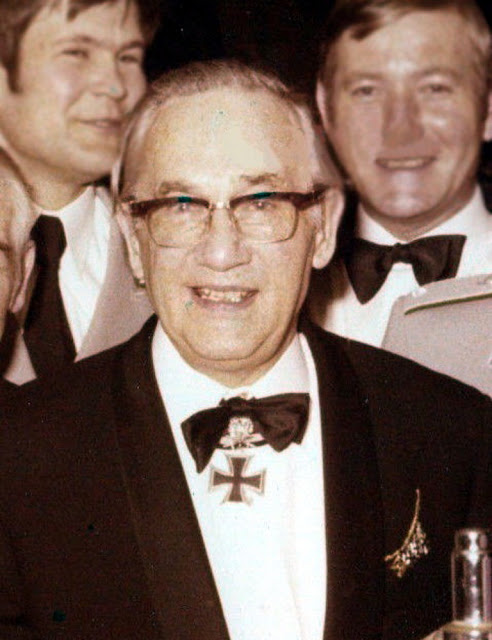


Gordon Gollob postwar.


Source :
http://alifrafikkhan.blogspot.com/2022/05/foto-gordon-gollob-pilot-pertama-yang.html
https://en.wikipedia.org/wiki/Gordon_Gollob
http://thirdreichcolorpictures.blogspot.com/2010/07/oberst-gordon-gollob.html
https://www.worthpoint.com/worthopedia/ww2-luftwaffe-ace-gordon-gollob-1845727198