
Wolfram Karl Ludwig Moritz Hermann Freiherr von Richthofen was born on
10 October 1895, at the Richthofen Barzdorf (now Bartoszówek, Poland)
estate (Gut Barzdorf), near Striegau (Strzegom), Lower Silesia to an
aristocratic family. His father, Wolfram Freiherr von Richthofen
(1856–1922), and mother, Therese Gotz von Olenhusen (1862–1948) were of
the Silesian nobility, and the family had been ennobled 350 years before
Wolfram's birth.
Richthofen was the second child and oldest son
of four children. His older sister, Sophie-Therese, was born in 1891
(and died in 1971). His brother Manfred was born in 1898 and Gerhard in
1902. He was the fourth cousin of the German World War I flying ace
Manfred von Richthofen, popularly known as the "Red Baron", and the
baron's younger brother Lothar von Richthofen. As the son of a nobleman,
he enjoyed a life of privilege. The family's noble status dated back to
the 1500s, and by the 1700s the Richthofens owned 16 estates in Lower
Silesia. When Frederick the Great annexed Silesia in 1740, he personally
granted the title of Baron (Freiherr) to one of Richthofen's direct
ancestors. The family remained in Silesia for a further three
generations.
Richthofen's home, an eighteenth-century estate, was
only one of 25 Richthofen-owned properties totalling 140 square
kilometres (35,000 acres; 54 sq mi). Barzdorf, where he lived, was a
modest 350 hectares (860 acres; 1.4 sq mi), of which 269 was farmed and
the rest was forest. Wolfram, as the oldest son did not inherit the
estate. Instead, on the death of his father in 1922, it was given to his
younger brother, Manfred. Some years before, Wolfram's uncle General of
Cavalry Manfred von Richthofen, his father's brother, had asked him to
inherit his estate to keep it in the family, as he himself had no
children. Wolfram inherited the estate after Manfred legally adopted
him. The general died in 1939.
He had a distant relationship with
his youngest brother, but a close one with Manfred. Unlike most
Prussian nobles Wolfram von Richthofen went to the local Gymnasium
(academic high school) and did not have private tutors at home. He
attended school in Striegau. His grades in mathematics and German
language were good, but he did not excel at foreign languages (in which
he scored average to poor results). He found studying language to be
boring, but did learn Italian and could converse competently in it in
later life.
He became a close friend of his cousins, Lothar and
Manfred von Richthofen, and hunted game at the estate with them
regularly. By the end of his teens, he had become an established hunter
and horse rider – interests which remained with him for the rest of his
life. He enjoyed being outdoors and, while still at school, opted to
apply for a commission in the German Army (rather than choose an
academic career).
In 1913, at the age of 18, he joined the army
and took the officer course in Berlin. The Cavalry was the most
prestigious arm, and he applied to join the 4th Hussars which belonged
to the 12th Cavalry Brigade of the Sixth Army Corps in Breslau. He did
not have much time to experience peacetime military service. In August
1914 the First World War began. He completed flight training in the Fall
of 1917 and in the Spring of 1918 joined Jagdgeschwader 11, his cousin
Baron Manfred von Richthofen's new command. It was 21 April 1918 that
Wolfram was attacked by British planes while on patrol with his
squadron. In an effort to save Wolfram from being eliminated by the
British, Manfred von Richthofen was attacked by Captain Roy Brown and
received a single .303 bullet wound in the chest. Brown was credited
with the victory but the source of the bullet taking the Baron's life
remains a mystery.
On 18 September 1920, he married Jutta von
Selchow (March 1896 – 1991) at a Lutheran church in Breslau (now the
city of Wrocław in Poland). They had been introduced by her brother
Gunther. Jutta was also of Silesian nobility, and had moved in the same
circles. She had served as a nurse in the war. They lived in an
apartment in Hanover while Wolfram restarted his academic career in
Engineering. During their marriage they rarely traveled abroad in the
1920s. In the 1930s they took skiing holidays in Switzerland. The couple
had three children; Wolfram (born 25 May 1922), Götz (27 November 1925)
and Ellen (15 February 1928). Wolfram was posted missing in action over
northern Romania on 5 June 1944. He was never found.
The Hussars
of the 12th Cavalry Brigade were attached to the 5th Cavalry Division,
which was part of the First Cavalry Corps. It formed part of the German
Third Army which carried out the attack on France and Belgium in August
1914 as part of the long-prepared Schlieffen Plan. Richthofen crossed
the Meuse at Dinant, and his unit was involved in heavy action against
the French VIII Cavalry Corps. It fought in Belgium at Namur on 23–24
August during the siege of the city and again at Saint-Quentin. The 5th
Cavalry continued its drive into France after the Battle of the
Frontiers, but was stopped at the First Battle of the Marne in
September. In recognition for bravery in combat, Richthofen was awarded
the Iron Cross Second Class (Eisernes Kreuz zweiter Klasse) on 21
September 1914. The new combat environment of trench warfare greatly
lessened the effectiveness of cavalry, so Richthofen's division was
transferred to the Eastern Front, arriving in Poland in November 1915.
On
the Eastern Front, the Cavalry Division was mostly deployed in the
south. It saw little fighting, as the German army did not use cavalry
frequently, and the division was kept mainly in reserve. Richthofen's
brigade served near Pinsk in 1916, and the division would spend late
1915 to January 1917 on defensive duties in the Pripet Marshes.
Richthofen was given command of the horse depot of the Brigade in the
autumn of 1916 and was promoted to Squadron Commander, with 160 men
under his command. This was never going to garner him the level of fame
his cousins, Lothar and Manfred, were now achieving in the
Luftstreitkräfte (Imperial Air Service), and they personally encouraged
him to transfer to the air service, which he finally did in June 1917.
Before
he joined the Air Service, Richthofen was given leave in Germany until
he reported to the 14th Flying Replacement Regiment based at Halle, one
of several large flight schools. At this point in the war, German
training was more thorough and longer than that of the British Royal
Flying Corps (RFC) and at least equal to that of the French Air Force
and the United States Army Air Service (USAAS). His training lasted
three months, and he was assigned to the 11th Flying Replacement
Battalion for advanced training in March 1918.
On 4 April 1918,
Richthofen was assigned to Jagdgeschwader 1, commanded by his cousin
Manfred von Richthofen. On 21 April, Wolfram flew his first mission. As
he was a new pilot, Manfred instructed him to avoid the fighting. When
the squadron became engaged in a dogfight, Wolfram climbed and circled
above the fray. Lieutenant Wilfred May also a new pilot was also
circling above the dogfight. He attacked and pursued Richtofen. On
seeing his cousin being attacked, Manfred flew to his rescue and fired
on May, causing him to pull away and saving Wolfram's life. Richthofen
pursued May across the Somme. It was in this pursuit that Manfred was
killed in action.
Wolfram continued flying and went on to claim eight aerial victories before the armistice ended the war on 11 November 1918.
Richthofen
studied aeronautical engineering from 1919 to 1922 at the Technical
University of Hanover. He served in Rome between 1929 and 1931 as an
"informal" air attache, in violation of the disarmament clauses of the
Versailles Treaty. Richthofen gained a Ph.D. in the subject.
In
1933 Richthofen joined the Luftwaffe, which was commanded by his former
commanding officer at JG 1 in 1918, Hermann Göring. By 1934 he was in
charge of developing and testing new aircraft in the Technisches Amt, or
Technical Service, under the overall direction of Ernst Udet. Although
Richthofen had known Göring, having served under him in the First World
War in JG 1, the two did not get along. They both came from aristocratic
backgrounds, but Richthofen was a Silesian from Lower Silesia, a driven
commander, and a good and hard working staff officer who enjoyed the
company of engineers and like-minded men, while Göring was a Bavarian
and a playboy who enjoyed talking about the First World War and his time
as an ace and particularly enjoyed the trappings of power. Göring
preferred men like himself, and promoted them on that basis. He passed
over the more highly qualified Richthofen in favour of Udet, a hard
drinker and playboy, who like Göring had grown up in Bavaria, to head
the Technisches Amt.
Richthofen's role was mainly concerned with
aircraft procurement programs for the fledgling Luftwaffe. He was
involved in the development of types such as the Dornier Do 23, Heinkel
He 111 and Junkers Ju 86. In the event, only the He 111 would make a
real impact during the war. Richthofen was following a considerably
difficult assignment, stemming from a directive issued to the Reichswehr
before Adolf Hitler's rise to power. In July 1932, the Reichswehr had
been pursuing the Schnellbomber (fast bomber) concept. The need for
modern and fast bombers was to meet the future vision of air warfare for
bombers that were faster than fighter aircraft. These concepts became
even more important when Hitler seized power and issued demands for
rapid rearmament.
As the 1930s progressed the He 111 was refined,
and the Dornier Do 17 Schnellbomber entered planning, production and
service in 1936–37. Even so, Göring was still interested in the heavy
bomber program, which would give the Luftwaffe a firm strategic bombing
capability. Richthofen was dubious about the employment of heavy
bombers, and wanted the projects developing types like the Dornier Do 19
cancelled. Unfortunately for Richthofen, for the time being, the
Luftwaffe's first Chief of the General Staff, Walter Wever, did believe
in the heavy bomber program. The development of what Wever called the
"Ural bomber" designs continued. At the time, Göring and Wever also
required a long-range fighter escort design for protecting the bombers
over Britain and the Soviet Union, Germany's expected enemies.
Richthofen joined Wever in moderating some of the design requests of
Göring, who insisted on a fast, fighter, bomber, ground attack and
reconnaissance aircraft rolled into one design. However, Richthofen used
his position to split the specification into separate designs on 22
January 1935, viewing the request as impossible.
Wever was killed
in an air accident in June 1936, and the emphasis shifted back to more
economical (in manpower and material terms) medium bombers. After
Wever's death, Göring and Ernst Udet became more active in the
development programs. Udet favoured the close support designs, such as
the Junkers Ju 87 Stuka dive bomber, while Göring favoured having more
medium bombers rather than a small number of heavy bombers. Richthofen
did not get along with Udet, and did not believe in his ideas about dive
bombing. Udet, much like Göring, favoured combining the qualities of
aircraft. Udet sought out a design that could dog fight, dive bomb and
carry out level bombing, much like Göring had requested. This was at
odds with Richthofen's fundamental desire for aircraft that were easy to
mass-produce and designed for, and to excel at, specialised tasks.
Although
Richthofen had managed to prevent aircraft design from heading into
mediocrity, and had kept them specialised for particular tasks, Udet
still influenced the selection of the multi-purpose Messerschmitt Bf 110
and the Schnellbomber (fast bomber) designed Junkers Ju 88 by the end
of 1936. With the Ju 88, he insisted it should have a dive bombing
capability, although it was more suited to, and ideal for, the level
bombing Schnellbomber concept. By the autumn, 1936, Richthofen decided
he had had enough of working with Udet, whose ideas he thought were
totally wrong. With an expanding Luftwaffe and a civil war starting in
Spain, an opportunity came for a field command.
In November 1936,
Richthofen left the Technical Service staff to take a field command in
the Condor Legion, a Luftwaffe contingent sent to support General
Francisco Franco's Nationalists in the Spanish Civil War. Udet continued
with the dive bomber concept and the Ju 87 first saw action under
Richthofen's command in Spain. Wolfram retained his position as Head of
Development, but he was now tasked with the evaluation of aircraft under
operational conditions. His role expanded in January 1937, and he
became Chief of Staff to Hugo Sperrle, who was to command the Legion.
Richthofen's
experiences were to serve the Luftwaffe well in the long-term and he
was leading proponent of army support aviation at this time. His own
learning curve in the war highlighted several issues that a modern air
force would have to overcome. The most important issues concerned
tactical and operational level warfare. The Germans put a great deal of
effort into developing close air support doctrine in the late 1930s.
Tactically, Richthofen found little need to retain anti-aircraft
artillery to defend airfields. He pushed Flak units into the frontline
to bolster the artillery units. Rapid fire 20 mm calibres and 88 mm
weapons were first used in Spain and their effectiveness was reported to
Berlin. Soon this tactic became part of Luftwaffe doctrine.
Another
tactical consideration led to operational innovation. Richthofen
adopted the shuttle air tactic. In order to maximise support over the
frontline, aircraft operated from bases near the front to keep and gain
an advantage. It was very successful in the 1937 battles. Aircraft were
sent in small formations to bomb frontline positions, while other groups
of ground attack aircraft were en route and refuelling. This way a
constant air presence was maintained over the battlefield which eroded
the effectiveness and morale of the enemy. In order for this to be able
to work effectively, three or more sorties needed to be flown per day.
This required a large number of personnel to set up and man forward
airfields. At the operational level, the Luftwaffe's logistics units had
to be completely motorised to bring in fuel, ammunition and spare
parts. These units had the opportunity to be tested under tough
operational conditions. The experience in Spain had shown air transport
units were invaluable to logistics, and with Richthofen's input, were
expanded accordingly. By 1939, the Luftwaffe would have the largest, and
most capable transport service in the World.
Richthofen employed
these learned tactics and operational methods during the Battle of
Bilbao. The motorised logistics also helped during the rapid
redeployment to the south, after the surprise Republican offensive at
Brunete in July 1937. The air support was vital in defeating the
offensive, which was supported by modern aircraft sent to the
Republicans from the Soviet Union. German types like the Messerschmitt
Bf 109 fighter, which replaced the Heinkel He 51, the Do 17 and He 111
helped win and hold air superiority and interdict the battlefield. The
Republicans had spent most of their gold reserves on buying Soviet
equipment. With most of that equipment used up, the Condor Legion and
Nationalists gained the technological edge.
The Spanish
experience began a late surge in interest of close support aircraft in
Luftwaffe. In the first years of the Nazi state these types remained a
low-priority for air planners who shaped the embryonic Luftwaffe. This
apparent regression from the practices and experiences of World War I
stemmed from the belief among the General Staff (Oberkommando der
Luftwaffe) that army support aviation in 1917–1918 was purely a reaction
to trench warfare. The German Heer did not insist the Luftwaffe change
its approach at this time either. German air doctrine remained rooted in
the fundamentals of Operativer Luftkrieg (Operational Air War) which
stressed interdiction, Strategic bombing (when and if possible) but
primarily the air supremacy mission. The Spanish experience encouraged
the General Staff to embrace the dive-bomber concept, for which
Richthofen was partly responsible, but the influence of the conflict on
German operational preferences remain ambiguous. On the eve of World War
II, some German air planners regarded the dive-bomber as a strategic
weapon to strike with precision at enemy industry. Even factored into
the army support groups, only fifteen percent of Luftwaffe front-line
strength contained specialist ground-attack aircraft in September 1939.
The
most difficult aspect of close support was communication. Air-ground
liaison officers had been used since 1935, when the Luftwaffe first set
up a training program for this purpose. By 1937, precise procedures had
yet to be worked through for air to ground coordination. Staff officers
were trained to solve operational problems, and the lack of doctrine and
reluctance of the Oberkommando der Luftwaffe (OKL = High Command of the
Air Force) to micromanage gave Sperrle and Richthofen a free hand to
devise solutions. Aircraft could not communicate with the frontline.
Instead, they could communicate via radio with each other and their home
base. One of the first innovations was to prepare signals staff on the
frontline in the region of any planned air strikes, and equip them with
telephones. The forward officers could telephone the base with updates,
who in turn could radio the aircraft. It became an important standard
operational practice. Liaison officers were attached to the Nationalist
Army, and improved coordination continued in the second half of 1937
despite occasional friendly-fire incidents. In the Second World War, the
Luftwaffe air units and liaison officers at the front could communicate
directly with updated radios.
The Luftwaffe entered the Second
World War with high standards of training. Although other air forces
also had training programs and pilots equal to the Germans, the
Luftwaffe emphasised training its large units, the Geschwader (Wings),
Corps and Luftflotten (Air Fleet) staffs in large-scale manoeuvres with
the army in the pre-war years. War games and communication exercises in a
different variety of combat operations allowed the officers to
familiarise themselves with mobile warfare, and this produced proficient
doctrine and better prepared operational methods than most of its
opponents. With notable exceptions, such as RAF Fighter Command, most of
the Allied air forces did not conduct large-scale unit and staff
exercises, testing tactics and doctrine. Given the slight numerical and
technological advantage of the Luftwaffe over its enemies in 1939–1941,
its success during these years can largely be attributed to extensive
officer and staff training programs along with the experiences of the
Condor Legion in Spain.
Richthofen and Sperrle made an effective
team in Spain. Sperrle was an experienced officer and was intelligent
with a good reputation. Richthofen was considered a good leader in
combat. They combined to advise and oppose Franco on a number of topics
to prevent the misuse of air power and debates were heated. Both Germans
men were blunt with the Spanish leader and although the Germans and
Spanish did not like each other, they had a healthy respect which
translated into an effective working relationship. Richthofen even
learned a little Spanish and Italian, an effort appreciated by the
Nationalist officers.
After Sperrle returned to Germany,
Richthofen assumed command of the Condor Legion. Hellmuth Volkmann
assumed his place, but his pessimistic reports to Berlin, his continued
demands for support and resources, and his personal disagreements with
Richthofen forced his replacement in October 1938. Richthofen was
promoted to the rank of Generalmajor on 1 November 1938 and he oversaw
the final stages of the civil war in early 1939. By this time, his
belief in the Junkers Ju 87 Stuka was cemented. It had proved highly
successful in its limited role and Richthofens's fear of excessive
losses in low-level ground attack operations proved ill-founded.
During
the Spanish Civil War, the Condor Legion bombed Guernica. Beginning
soon afterward and continuing today, historians saw the attack as a
deliberate act of terror bombing designed to break civilian morale. In
April 1937 the town was located just behind the Republican frontline and
Nationalist forces were applying pressure in the area. One possible
reason for Richthofen sanctioning the bombing, was that two main roads
being used to supply 23 Basque battalions at Bilbao intersected at
Guernica. At least the 18th Loyola and Saseta battalions were stationed
in the city at the time, making it a legitimate target. The destruction
of the road and train lines around Guernica, as well as the bridges,
denied the Republicans an escape route as well as the only way to
evacuate heavy equipment.
Some accounts of the raid, including
defenses proffered after the fact by Condor Legion veterans, argued that
the "poor accuracy" of German bomb sights in early 1937 was responsible
for the carnage caused by the attack. Some facts suggest otherwise,
however, fueling speculation that the raid was one of Richthofen's
experiments in air warfare tactics. The Condor Legion had made
systematic twenty-minute relays above the town over the course of
two-and-a-half hours. Loads included anti-personnel twenty-pound bombs
and incendiaries dropped in aluminum tubes that set fleeing livestock
and humans alight with white phosphorus. Blackened bodies lay curled in
the town square and streets and buried in the rubble of their homes. Low
estimates put the number of killed in the hundreds. Historians have
pointed out that the key Renteria bridge just outside the town was never
hit in the raid, that the attacking Condor Legion Junkers flew abreast
over the town and not in line as they would to fell a bridge, and that
anti-personnel bombs, incendiaries and machine gun bullets would not
have been effective against stone structures like the Renteria bridge.
"Guernica burning," Richthofen wrote in his war diary the day of the
attack. Two days later he speculated that the town "must be totally
destroyed."
By the 1937 rules of international warfare, Guernica
was a legitimate target – a green light, in effect, for the air-war
horrors to come. Richthofen had planned and executed the attack with the
approval of the Spanish Nationalists. From a purely military
perspective, it was a success, closing the city to traffic for 24 hours.
A "technical success," Richthofen called it, disappointed that the
Nationalists failed to follow it up quickly and so missed a chance to
cut off large portions of the enemy forces.
Richthofen commanded
Fliegerführer z.b.V. (zur besonderen Verwendung—for special deployment)
during the invasion of Poland, which began on 1 September 1939, quickly
triggering the war in Europe. This unit was a tactical formation and was
attached to 2nd Fliegerdivision, under the joint command of Bruno
Loerzer and Alexander Löhr. The operational goal of Fliegerführer
z.b.V., was to support the 10th Army, under the command of Walter von
Reichenau. The army contained the majority of the motorised and armoured
units and was to form the focal point, or Schwerpunkt, of the offensive
against Poland.
Richthofen's order of battle included a powerful
concentration of strike aircraft. The formation had its headquarters at
Birkental-Oppeln, but its units were spread out. Schlosswalden was home
to 1.(F)/AufklGr (Aufklärungsgruppe—reconnaissance group) 124, which
operated Dornier Do 17P aircraft. Lehrgeschwader 2 (Learning Wing 2),
was based at Nieder-Ellguth, while the bulk of Sturzkampfgeschwader 77
(Dive Bombing Wing 77 or StG 77), which operated the Junkers Ju 87
Stuka, was based at Neudorf. Richthofen also commanded the Slovak Air
Force units (Slovenske Vzousne Zbrane), the 38th and 48th Fighter
Squadrons, and the 16th Corps Squadron.
On the first day of the
offensive StG 77 was committed to counter-air operations, striking
Polish Air Force (PAF) bases. The need for counter-air operations left
only II.(Schlacht)/LG 2 for close support operations. The unit supported
the German mechanised XVI Army Corps. Along with other units,
Richthofen's I./StG 77 decimated a cavalry brigade of the Polish Armii
Łódź during the Battle of Łódź.
Only eight days into the
campaign, on 8 September, the Tenth Army had advanced so far into
Poland, that Richthofen was obliged to move Günter Schwartzkopff, his
most experienced dive-bomber exponent, into Polish airfields, while
Reichenau closed in on Warsaw. Richthofen was able to keep logistical
elements functioning, which kept units flying three sorties per day. At
the end of the first week of September, Richthofen's battle group was
transferred to Luftflotte 4 (Air Fleet 4).
The fast moving
frontline caused army headquarters to lose touch with its forward units.
The collapse of communications deprived commanders and squadrons of
orders, a situation exacerbated by the lack of a common radio frequency
and by over-stretched logistics, which also forced them to scavenge
enemy supply depots. Richthofen was the most affected. As early as 3
September, he noted in his diary that the army headquarters had ceased
to know where the frontline was, and he refused to respond to army
requests for air support. Instead, he responded according to his own
interpretation of the situation. This method did cause friendly fire
incidents. On one occasion, Ju 87s knocked out a bridge across the
Vistula river when a Panzer Division was about to cross.
The
air-ground coordination was the responsibility of Kolufts, who
synthesised data from their own aerial reconnaissance and forward units,
but they were only advisers and had little experience in air warfare.
They were controlled by the army staffs (Nahaufklarungsstaffeln) and
depended on the Luftwaffe's Air Liaison Officer
(Fliegerverbindungsstaffeln or Flivo) for fighter or bomber support.
However, Flivo units were responsible to the Luftwaffe, not the army,
and their role was to keep air commanders informed of the situation
through the use of radio-equipped vehicles. Loerzer was out of contact
with Reichenau's command post for three days, while Richthofen was soon
complaining to Löhr about the former's ignorance. Because he was
impetuous and wanted to be in the thick of the action, Richthofen began
flying around over the frontline in a Fieseler Fi 156 Storch, as
air-ground liaison collapsed. His claims were not always believed, and
these personal operations were a waste of time and needlessly exposed
him to danger. Indeed, Major Spielvogel was shot down over Warsaw in his
Storch on 9 September, and killed. While the operational situation was
not good, Löhr took command of Fliegerführer z.b.V., giving the unit
virtual autonomy and allowing Richthofen to build a personal empire of
six Gruppen (Groups).
By 11 September, the fuel situation was
acute, and logistics failed. On the first day his units were flying
three missions every day, now it was reduced to one per day. Despite the
problems, by 8 September Richthofen was preparing an assault on Warsaw.
The raids had barely begun when a major threat developed behind him. A
Polish counter offensive engaged the German Eighth Army, in an attempt
to reach the Vistula river. Richthofen joined the assault and
counterattack from the air. For three days the Germans bombed Polish
forces contributing to the success in the Battle of Radom and Battle of
the Bzura. Richthofen sent his air units up under orders to spend only
ten minutes over the battlefield, and to expend all ammunition. Polish
forces sought refuge in the forests nearby but were smoked out by
incendiaries. Richthofen's men flew 750 sorties and dropped 388 tons of
bombs. The air action destroyed remaining resistance, allowing the army
to defeat the remaining Polish forces.
The remaining threat from
Polish forces generated calls for attacks on Warsaw. Air attacks against
the city had been planned for the first day, codenamed Wasserkante, or
Operation Seaside. Just after midnight on 12/13 September, the Luftwaffe
chief of staff Hans Jeschonnek ordered Löhr to prepare to attack
ghettos in northern Warsaw, in retaliation for unspecified war crimes
against German soldiers in recent battles. Richthofen's airmen flew 183
to 197 sorties, dropping equal quantities of high explosives and
incendiaries. Some bombs fell close to German forces conducting the
Siege of Warsaw and smoke made it impossible to assess damage.
Richthofen confronted Hermann Göring over the need for a united air
command for the Warsaw campaign and hinted he was the man for the job.
He did not get his way until 21 September. Weather delayed the attack,
which began on 22 September. That morning, Richthofen signaled the OKL;
"Urgently request exploitation of last opportunity for large experiment
as devastation and terror raid", and added "every effort will be made to
completely eradicate Warsaw." The OKL rejected the proposal. Leaflets
demanding the city's surrender had been dropped on four days earlier,
but Richthofen began acting on his own initiative, using Luftwaffe
Directive 18, dated 21 September, which gave him responsibility for the
conduct of air operations.
Richthofen did not get the aircraft he
wanted for the operation, in particular the Heinkel He 111, and instead
was handed old Junkers Ju 52 transports which delivered bombs by airmen
throwing them out of the doors. His Ju 87s were also banned from using
bomb loads greater than 50 kg. On 22 September, Richthofen's command
flew 620 sorties. German air units dropped 560 tonnes of high explosive
and 72 tonnes of incendiaries. The bombing did great damage, causing
40,000 casualties and destroying one in ten of the buildings in the
city, while only two Ju 87s and one Ju 52 were lost.
The army
complained of near friendly fire incidents while fighting through the
city and smoke made life difficult for the German artillery spotters.
Hitler, despite the complaints, ordered the bombing to continue.
Richthofen's force also flew 450 sorties against Modlin Fortress,
securing the town's surrender on 27 September after 318 tonnes of bombs
had been dropped on it in two days. Warsaw surrendered soon afterwards,
and the campaign was declared over after the Polish surrender on 6
October 1939.
The invasion of Poland prompted both the United
Kingdom and France to declare war on Germany. Originally, Richthofen's
force had retained its original name, Fliegerfuhrer zbV, after its
transfer from Poland, but on 1 October it was renamed Fliegerdivision 8
(Flying Division 8), and some days later it was given Corps status.
Richthofen was given command of the unit, now a specialist ground-attack
Corps, VIII. Fliegerkorps (8th Flying Corps). Most of the Geschwader
involved were based at Cologne and Düsseldorf. Included in the order of
battle was Jagdgeschwader 27 (JG 27), equipped with Messerschmitt Bf
109s; KG 77, equipped with Dornier Do 17s; Sturzkampfgeschwader 2 (StG
2) and StG 77, equipped with Ju 87 Stukas; and LG 2, equipped with Ju
87s, Bf 109s, Ju 88s and He 111s. The Corps was a purpose-built ground
attack organisation. By 10 May, the order of battle had changed. Only
one gruppe (group) of LG 2 remained, III.(Schlacht).
IV.(St)./Lehrgeschwader 1 (LG 1), with Ju 87s were added, as was
I.Sturzkampfgeschwader 76 (StG 76).
The task of Richthofen
varied. He was to support Reichenau's German Sixth Army in Belgium and
Paul Ludwig Ewald von Kleist's XXXXI and XIX Corps. During the Phoney
War period, he established his headquarters at Koblenz on 18 October
1939, and thereafter his Corps steadily rose in strength, from 46
Staffeln (Squadrons), 27 of them Ju 87 units, to 59 by the end of the
month. In December, he was first assigned to support Reichenau. Attacks
on enemy air bases were only to be carried out if Allied air power
attempted to interdict the German ground forces. Ground support was the
first priority. This was reflected in Fliegerkorps VIII order of battle
which contained six Ju 87 Gruppen (Groups, of 30 aircraft). Fliegerkorps
V had the primary counter-air role and was positioned close to the
front to provide air superiority support. When a breakthrough took
place, it was ordered to exchange airfields with Fliegerkorps VIII, to
allow for effective air support to the army. However, the Corps' war
diary and Richthofen's personal diary make no mention of this order,
which may indicate a breakdown in staff work at some level.
Operationally,
the air division and corps headquarters were placed alongside, and
moved with, army equivalents. The air liaison teams attached to the
corps and Panzer Divisions were directed to report the battle situation
at the front, but were forbidden to advise the army, or request air
support. The army sent separate reports, under the same conditions. The
reports were digested by Kleist and Richthofen's chiefs of staff, and
action was or was not taken with mutual agreement. Attack orders could
be delivered in minutes to air units. A Gruppe (Group) of Ju 87s and Bf
109s was ready in reserve to respond, and could do so within 45 to 70
minutes. Fliegerkorps VIII and Richthofen were led to believe they would
spend the entire campaign supporting Reichenau in northern Belgium, but
the OKL did not inform the Corps that it was going to be used in a
Meuse breakthrough.
Richthofen knew Reichenau, and they had a
close working relationship. During the planning for the Sixth Army's
operations, Reichenau seemed to display a lack of interest when the
subject turned to the capture of the bridges at Maastricht, in the
Netherlands, and Fort Eben-Emael in Belgium. The defeat and/or capture
of these objectives were essential for the Sixth Army to advance into
the Low Countries. So unenthusiastic was Reichenau about the suggested
airborne operation by glider troops against the fort, that he refused to
allow the diversion of any army artillery. Richthofen supplied a Flak
battalion, Flakgruppe Aldinger, for the task of supporting them.
Richthofen
found himself under pressure in other sectors on 10 May, the first day
of the offensive. In the early phase of the Battle of the Netherlands,
the Fallschirmjäger (paratrooper) forces had been tasked with capturing
The Hague and the Dutch Royal Family. In the subsequent Battle for The
Hague, German forces met heavy resistance. The French Seventh Army
advancing through Belgium and the Netherlands threatened German
progress. Richthofen was ordered to throw in half of his force in the
Hague battle and to attack the Scheldt estuary, near Antwerp, the Dutch
border, to stop the French before they positioned themselves near the
Moerdijk bridgehead. Despite thick cloud, German aircraft helped drive
them back.
After the Dutch capitulation, Richthofen turned to
support Reichenau in the Battle of Belgium. Richthofen provided close
and interdiction support to the German Sixth Army, in particular, to
Erich Hoepner's XVI Army Corps. Just 12 Ju 87s were lost, anti-aircraft
fire accounted for six I./StG 76 machines. His support operations were
usually 65 kilometres (40 mi) ahead of the forward edge of the
battlefield, with even reconnaissance aircraft pressed into service as
bombers. Army units carried flares and Swastika flags to prevent
friendly fire incidents. In the Battle of Hannut Richthofen's forces
proved effective against French armour during the battle. He also
supported the German divisions a day or so later, at the Battle of
Gembloux Gap.
For the cost of twelve aircraft (four Ju 87s), he
helped attack French communication and supply positions, and supported
Reichenau as he reached the Dyle river. At that time, he had moved into
the Netherlands, at a Hotel, near Maastricht. He had a basic room, with a
bath that did not work. In the afternoon, he received an order to cease
operations in Belgium, and send all he had to support Georg-Hans
Reinhardt's XLI Corps, north of Sedan. Richthofen was incredulous, and
he had to move his entire infrastructure 100 kilometres to the south.
The failure of the OKL to inform him he was to support the breakthrough
is difficult to explain. He later noted in his diary that it was a major
oversight for the OKL not to have informed him of his expected input,
but his diary also suggests he relished the fog of war and the unknown.
His forces were split between support for the advance in Belgium, while
most were moved south. During the winding down of operations in the
north, his units did help the Sixth Army capture Liege in Belgium on 17
May.
The most notable actions of his Corps took place during the
Battle of Sedan. By this time, Richthofen had moved into St. Trond-Liege
in Belgium. The heavy German air assaults on French positions included
360 by his medium bombers, although his Ju 87 units could only fly 90
owing to the difficulties he had moving his Corps around. On 14 May
Richthofen's JG 27 helped defend the bridgehead from Allied air attacks.
Allied bomber strength was decimated. During the battle Richthofen
suffered a personal blow when one of his experienced officers, Günter
Schwartzkopff, was killed.
After the German breakthrough at
Sedan, Richthofen asked that Fliegerkorps VIII be allowed to support
Kleist to the sea. Richthofen convinced Göring to help press for the
Panzers to continue, while his air Corps provided an aerial flank. His
Ju 87s broke up attacks on the flanks of Army Group A, most notably
combining to repulse Charles de Gaulle's Fourth Armoured Division on 16
and 19 May, at the Battle of Montcornet and Crécy-sur-Serre. This
effectively destroyed French Ninth Army. Excellent ground-to-air
communications were maintained throughout the campaign. Radio equipped
forward liaison officers could call upon the Stukas and direct them to
attack enemy positions along the axis of advance. In some cases the
Luftwaffe responded to requests in 10–20 minutes. Oberstleutnant Hans
Seidemann (Richthofen's Chief of Staff) said that "never again was such a
smoothly functioning system for discussing and planning joint
operations achieved".
Richthofen moved his HQ to Ochamps to keep
up with events, while he gambled on German air superiority holding out
to fill forward airfields up with aircraft leading to overcrowding. He
also had communication difficulties, and flew around in his Storch to
organise air support for the army. Hugo Sperrle, chief of Luftflotte 3
(Air Fleet Three) arrived at the same HQ, disrupting staff work and
leading Richthofen to explode with rage. The pressures compelled him to
risk being shot down in order to pass on orders, and while flying on 22
May he was forced to land owing to a fractured fuel tank. He organised
support for Reinhardt and covered Heinz Guderian's Corps. While he
complained about communication, by the standards of the day, it was
efficient. The radio-equipped forward liaison officers assigned
Fliegerkorps VIII new targets, while leaving less important orders to
land line officers. The Ju 87s were on 20-minute alert, and within 45 to
75 minutes they were diving onto their targets. In some cases, they
were able to respond in 10 minutes. By 21 May, with his fighters based
at Charleville-Mézières, Ju 87s at Sint-Truiden, and his Do 17s back in
Germany, Richthofen's logistics were overstretched and his fuel was
running out.
By 21 May the Allied armies were encircled and
counterattacks had been repulsed at Arras. The Allies were evacuating
the ports of Dunkirk and Calais. During the Battle of Dunkirk and Siege
of Calais (1940), Richthofen supported the advance of Army Groups A and B
in these operations. His command were frequently meeting Royal Air
Force (RAF) fighters, flying across the Channel. Richthofen noted RAF
Fighter Command and its No. 11 Group RAF were responsible for 25 per
cent of German losses. Richthofen helped capture Calais and was awarded
the Knight's Cross of the Iron Cross on 23 May. Richthofen was ordered
to support the German Fourth Army, though he showed little interest in
the Dunkirk battles. He regarded them as a waste of time, and they
disrupted preparations against southern France (Case Red). He believed
the attempt to destroy Allied forces, or prevent the evacuation with the
Luftwaffe was unrealistic. Over Dunkirk, losses were heavy and progress
slow. On 26 May, Richthofen made a special effort to gain and hold air
superiority. Overall, German air power failed to prevent the evacuation.
After
the expulsion of the British Army and the surrenders of the Dutch and
Belgians, Richthofen was ordered to support the German Ninth Army,
containing Guderian's Corps. The battles were swift. The French lost
their most capable formations in the encirclement, and they capitulated
on 22 June 1940, after the capture of Paris on 14th, and the
encirclement of the Maginot Line on 15 June.
Richthofen continued
after the French capitulation to command VIII. Fliegerkorps during the
Battle of Britain. The British refusal to reach a compromise with
Germany forced the OKL to prepare a plan for attaining air superiority,
codenamed Operation Eagle Attack. Should this have been successful, the
Wehrmacht may have launched an invasion of Britain, codenamed Operation
Sea Lion.
For the first time, the Luftwaffe was engaged in an
offensive air war without the support of the German Army. Despite
Richthofen's Corps being primarily a specialist ground assault
organisation, which supported ground forces, he was expected to help
lead the assault over Britain. His Stuka units were the best precision
attack aircraft in the Luftwaffe and their 500 kg bombs were capable of
sinking merchant shipping, and/or seriously damaging warships. In June
1940, Richthofen and his Corps' specific mission was to establish air
superiority over the southern part of the English Channel (near France)
and to clear British shipping from the strip of sea altogether,
particularly from the region between Portsmouth and Portland.
Fliegerkorps VIII had a particular advantage; British fighters did not
have enough radar warning and were operating at the limits of their
range. This gave his Ju 87s a near-free hand in operations.
In
July 1940, skirmishes took place, between Luftflotte 2, under Albert
Kesselring and Hugo Sperrle's Luftflotte 3 on one side, and air vice
marshal Keith Park's No. 11 Group RAF of Fighter Command on the other.
The initial battles revolved around the British southern coast. Attempts
by German air fleets to interdict British shipping in the English
Channel were met with a significant response from the RAF, and many air
battles ensued over the Channel. They were referred to by the Germans as
Kanalkampf ("the Channel battles"). Richthofen made use of his Do 17P
reconnaissance aircraft to locate convoys. When located, he usually
dispatched a Gruppe (30 aircraft) to engage the convoy, holding other
Stuka Gruppen back for repeat attacks. The campaign was complicated by
the weather, which grounded the Corps for long periods, and while the Ju
87s proved effective, they proved vulnerable to RAF fighters. On 17
July 1940, Richthofen was promoted to the rank of General der Flieger in
recognition of his service.
Operations over the Channel were
successful. Although Richthofen's force severely over-claimed the number
of ships sunk, they did succeed in forcing the Royal Navy to suspend
convoys through the Channel temporarily, as well as forcing it to
abandon Dover as a base. On 8 August 1940, during one of the last
operations against shipping, his airmen claimed 48,500 tons of shipping
sunk in one operation. The actual number was just 3,581 tons.
In
mid-August, the Luftwaffe was ready to begin the main assault over the
British mainland. The campaign opened on 13 August 1940, christened
Adlertag (Eagle Day), by Hermann Göring. The entire day met with
repeated German failures, in communication, intelligence, and
coordination. The objective of the raids, Fighter Command's airfields,
remained unscathed. Cloudy skies were largely responsible for the
failure of the raids.
On 18 August, a large group of air battles
led the day to be called "The Hardest Day". On that day, Richthofen sent
his units against airfields in southern England. Faulty intelligence
meant all those hit by his units were unimportant. StG 77 struck at
Fleet Air Arm bases, which had little to do with Fighter Command. In the
process, the Geschwader took heavy losses.
Richthofen was not so
much shocked by total Ju 87 losses, which were running at a bearable 15
per cent, assuming the raids were getting results and the battle short,
but he was alarmed at the near destruction of an entire Gruppe, a loss
rate which ran at 50 per cent. It required a rethink of the types to be
used in the campaign. The Battle of Britain amounted to a defeat for the
Ju 87. The Ju 87s were removed from the battle, and were limited to
small-scale attacks on shipping until the spring, 1941, by which time
the Battle of Britain was over and the air war over Britain (The Blitz)
was winding down. Richthofen's force flew 100 sorties in October,
compared to the 100 per day in July 1940. In December 1940, Fliegerkorps
VIII ended its Ju 87s operations and entered intensive winter training
to be ready for the resumption of operations in the spring.
In
April 1941 VIII. Fliegerkorps was tasked with supporting the German
invasion of Yugoslavia and the German Army in the Battle of Greece and
the Battle of Crete. The failure of the Italian Army in the
Greco-Italian War forced Hitler to intervene to secure the Axis flank,
close to the Romanian oilfields. Operation Marita was expanded to
involve the invasion of Greece and Yugoslavia.
Richthofen moved
his units into Bulgaria via Romania. He found the country primitive, and
resolved to improve the infrastructure, particularly communications,
for the invasion of Yugoslavia. He intended to operate 120 aircraft from
Bulgarian airfields and moved them into place on 1 March. While
preparations were taking place he indulged in hunting and horse riding
expeditions as a guest of the Bulgarian Royal Family. With Boris III of
Bulgaria, he discussed dive-bombing techniques and the Corps' new
aircraft, such as the Junkers Ju 88.
Richthofen's Corps was given
two wings of Ju 87s for the task; StG 2 and Sturzkampfgeschwader 3 (StG
3), based in Bulgaria. With reinforcements, the German air contingent,
under Luftflotte 4, would have a total of 946 combat aircraft supported
by hundreds of transport machines. This force outnumbered the Greek,
Yugoslav and RAF forces combined. Richthofen arranged to have the German
Twelfth Army's air reconnaissance units cooperate with his own
formations through the use of a liaison. The Corps' operations supported
the German Twelfth Army in southern Yugoslavia, which cut the Yugoslav
Army off from Greece and the Allied forces there. The victory in
Yugoslavia was complete with the bombing of Belgrade, which facilitated a
rapid victory by destroying command and control centres.
Richthofen's
force did not participate in the bombing of Belgrade, but were engaged
in attacking Yugoslav reinforcements, concentrated on the Austrian and
Hungarian borders in the north, that were streaming south to block the
break through. Mass columns of Yugoslav forces were caught in the open
and decimated. The bombing of the capital disabled the command and
control function of the Yugoslav Army, but it also convinced those in
the government that further resistance would meet with even more
destruction. Yugoslavia surrendered on 17 April.
Operations
shifted to Greece. The Axis success in the Battle of the Metaxas Line
allowed them to outflank the main Greek Army position and encircle the
most effective Greek force. Richthofen's units supported the attack
against the Line, without much interference from Allied air forces. Just
99 RAF aircraft (74 bombers) and 150 Greek aircraft opposed
Richthofen's 500. By 15 April, the RAF had withdrawn. From this date,
Fliegerkorps VIII's main targets were Allied ships cramming the
evacuation ports. Unlike the gross over claiming against British
shipping in the English Channel in 1940, the claims of 280,000 tons of
shipping (60 vessels) destroyed up until 30 April 1941 were
approximately correct.
Allied forces withdrew down the east coast
of Greece, where the Royal Navy and Greek Navy began evacuating them
from ports around southern Greece, including the capital, Athens. Ju 87
units from Richthofen's Corps inflicted high losses on shipping,
eliminating the small Greek Navy and causing damage to British shipping.
In two days, the Greek Naval base at Piraeus lost 23 vessels to Stuka
attack. From 21 to 24 April 43 ships were sunk on the southern coast.
Total Allied shipping losses amounted to 360,000 tons.
The end of
the campaign on the mainland meant the sole remaining objective was the
island of Crete, which lay off Greece's southern coastline. During the
Battle of Crete Richthofen's Ju 87s also played a significant role. The
operation came close to disaster on the first day. Most of the airborne
forces that landed by glider or parachute lost most of their radios,
which meant Richthofen had to rely on aerial reconnaissance aircraft.
The German parachute troops were pinned down on the island, on the
Cretan airfields they were supposed to capture. The level of effort
Richthofen directed at relieving the pressure on them quite possibly
saved the German units from destruction.
On 21–22 May 1941, the
Germans attempted to send in reinforcements to Crete by sea, but lost 10
vessels to "Force D" under the command of Rear-Admiral Irvine Glennie.
The force consisting of the cruisers HMS Dido, Orion and Ajax forced the
remaining German ships to retreat. The Stukas were called upon to deal
with the British Naval threat. On 21 May, the destroyer HMS Juno was
sunk, and the next day, the battleship HMS Warspite was damaged and the
cruiser HMS Gloucester was sunk with the loss of 45 officers and 648
ratings. The Ju 87s also crippled the cruiser HMS Fiji that morning,
while sinking the destroyer HMS Greyhound with a single hit. As the
Battle of Crete drew to a close the Allies began yet another withdrawal.
On 23 May the Royal Navy also lost the destroyers HMS Kashmir and Kelly
sunk followed by HMS Hereward on 26 May; Orion and Dido were also
severely damaged. Orion had been evacuating 1,100 soldiers to North
Africa and lost 260 of them killed and another 280 wounded during the
attacks. Around eight British destroyers and four cruisers were sunk
(not all by air attack), along with five destroyers of the Greek Navy.
On
22 June 1941 the Wehrmacht launched Operation Barbarossa, the invasion
of the Soviet Union. Richthofen continued his command of Fliegerkorps
VIII which contained JG 27, StG 2, StG 3, 10./LG 2, and II.(S)./LG 2.
Added to this force was II./Jagdgeschwader 52 (JG 52),
I./Kampfgeschwader 2 (KG 2), III./Kampfgeschwader 3 (KG 3) and
Zerstörergeschwader 26 (ZG 26). Initially his force supported Army Group
Centre, under the command of Kesselring's Luftflotte 2.
The
Flivos that Richthofen had championed in 1939 became a uniform facility
throughout the Luftwaffe. Each Panzer and Motorised division, now had
air liaison officers attached to them to allow for effective air
support. The experiments in France and the low countries had paid off.
By the summer, 1941, the Luftwaffe and its land-air liaison teams would
dramatically reduce the number of friendly-fire incidents, as German
assault aviation would have detailed knowledge of friendly and enemy
dispositions. It would not be until the beginning of 1943 that the
Western Allies began adopting the same methods. In the opening phase of
Barbarossa, Richthofen's units were able to perform well. The response
for air support did not usually exceed two hours.
In the opening
rounds, Richthofen was involved in large pre-emptive strikes against the
Red Air Force (Voyenno-vozdushnyye sily, or VVS) airfields. The
Luftwaffe lost 78 aircraft on 22 June, but destroyed 1,489 aircraft on
the ground, though further research indicates the number exceeded 2,000
destroyed. In July, waves of unescorted Soviet bombers tried in vain to
halt the German advance, only to suffer extremely high loses. Within
three days, the close support units of Kesselring's Luftflotte 2,
including Richthofen's Corps, were able to revert to close support and
interdiction operations largely unhindered.
On 23 June, his Corps
decimated the Soviet 6th Cavalry Corps (Western Front) when they
attempted a counterattack near Grodno. Richthofen threw all available
aircraft at the thrust and played a vital role in its defeat. The Soviet
Corps suffered 50 per cent casualties, mostly from air attack.
Richthofen's Corps claimed 30 tanks, and 50 motor vehicles in 500
sorties. Army Group Centre continued to advance, reaching Vitebsk.
Fliegerkorps VIII supported the army in the Battle of Smolensk only days
later. In this phase he was also moved south, to support Panzer Group
Guderian, which succeeded in supporting the capture of Orsha. The
encirclement of Soviet forces at Smolensk was complete on 17 July 1941.
Three weeks later, the last Soviet forces in the pocket were eliminated.
Fliegerkorps VIII's achievements were important in defeating Soviet
counterattacks and attempted breakouts. Richthofen was awarded the Oak
Leaves to his Knight's Cross for an impressive performance. Results from
the battles, and in particular the defeat of the Soviet counterattacks
by the Soviet 13th and 24th Armies, were impressive. Richthofen's forces
were credited with disrupting reinforcements and destroying 40 motor
vehicles on 24 July alone.
However, logistically, the Germans
were starting to suffer serious problems in supplying their frontline
just four weeks into the campaign. Richthofen lamented, "the Germans are
good at fighting but weak at logistics". While German production could
make up for losses at the front, it took time to get aircraft to the
sector. The common operating strength by late summer was 50 to 60
percent, including Fliegerkorps VIII. Between 19 July and 31 August, the
Luftwaffe had lost 725 aircraft. Before the operations in the Soviet
Union, scant attention had been made to logistical operations in the
east, primarily because of German over-confidence.
The victories
had been hard won, but growing Soviet resistance and increased
counterattacks brought the Smolensk-Moscow front to a stalemate. Hitler
wavered, and on 30 July ordered Army Group Centre to assume the
strategic defensive. In Directive 34, he refocused the main effort of
Barbarossa on Leningrad because of strong concentrations of enemy forces
west of Moscow. To this end, Richthofen and his Fliegerkorps was
assigned to Luftflotte 1 (Air Fleet 1). During July 1941, the
Oberkommando der Wehrmacht (OKW, or German High Command) displayed a
lack of coherent strategy. It shifted from pursuing one objective to the
next. It first wanted to advance to Moscow, then Leningrad, before
shifting operations further south.
Richthofen took almost all of
his units to support Army Group North. In heavy combat, working with
Fliegerkorps I, Richthofen's fleet flew 1,126 sorties on 10 August,
supporting the German army's advance on Narva. They claimed 10 tanks,
more than 200 motor vehicles and 15 artillery batteries. Further support
was rendered to the German Sixteenth Army at Novgorod near Lake Ilmen.
Experienced crews from Richthofen's Corps, attacked railways near
Leningrad to disrupt reinforcements. Fliegerkorps VIII's airmen noted
Soviet resistance was far harder in the Lake Ilmen area than they had
previously experienced. On 15 August, a major effort destroyed the main
Soviet supply bridge over the Volkhov River. The fortress of Novgorod
was destroyed by Richthofen's Ju 87s, and was abandoned. The city fell
on 16 August. Just 24 hours later, a major Soviet counter offensive by
the Soviet Northwestern Front attempted to recapture the city.
Richthofen, in conjunction with Fliegerkorps I destroyed the attackers,
almost completely, near Staraya Russa.
The German Eighteenth Army
and the Sixteenth Army overran the remaining parts of Estonia, seizing
Chudovo, north of Novgorod, which severed one of the two main supply
lines from Leningrad to Moscow. In support of these operations,
Richthofen's Corps dropped 3,351 tons of bombs in 5,042 attacks from 10
to 20 August 1941. Wilhelm Ritter von Leeb, the commander-in-chief of
Army Group North, was shocked by the ferocity of Richtofen's bombing
operations, describing him as "merciless". On 20 August Richthofen moved
strike and fighter aircraft to Spasskaya Polist, 40 km north-east of
Novgorod, to support an attack that would encircle Leningrad, and cut it
off from Murmansk. German XXXXI Panzer Corps sealed in Soviet forces in
the Lake Ilmen-Luga-Novgorod sector. The Leningrad Front attempted to
relieve them, and Richthofen was ordered to blunt the attack. The
Soviets were supported by strong air units, and large air battles broke
out. The Germans succeeded in maintaining their lines, and could now
turn to capturing Leningrad.
Before a main assault could be
launched, Leningrad needed to be completely cut off from the Soviet
hinterland which led to the Siege of Leningrad. This was achieved by
Fliegerkorps VIII, which supported the German Eighteenth Army in forcing
the Soviet 54th Army from the shores of Lake Ladoga and Leningrad was
isolated. Thereafter, Fliegerkorps VIII and I concentrated on a 16
square kilometres of front over Leningrad, achieving numerical
superiority. Richthofen's bombers participated in great efforts to
destroy Leningrad from the air, some crews flying two missions per
night. On 8 September, 6,327 incendiaries alone were dropped causing 183
fires. The German Army advanced into the breaches created by the
Luftwaffe. However, by committing their last resources and reinforcing
their 54th Army (later renamed the 48th Army), the Soviets stalled the
German advance on 25 September. With the offensive stopped, Hitler
returned Richthofen to Luftflotte 2. Operations had been expensive. In
August Fliegerkorps VIII had lost 27 aircraft destroyed and 143 damaged.
Frustrated
in the north, Hitler turned to Moscow. On 2 October 1941 he enacted
Operation Typhoon, an offensive aimed at capturing Moscow via a pincer
movement. It achieved early success in enveloping considerable Soviet
forces at Vyazma and Bryansk by 10 October. However, the initial success
gave way to a grinding battle of attrition. By 11 November the
situation in the air was also changing from a position of initial
parity. Kesselring's Luftflotte 2 and the headquarters of Fliegerkorps I
were moved to the Mediterranean Theatre. This left Richthofen's
Fliegerkorps VIII in control of all Axis aviation supporting Army Group
Centre against Moscow. The Soviet opposition was growing in number and
quality. By 10 November, 1,138 aircraft (738 serviceable) including 658
fighters (497 serviceable) were defending Moscow. The weather slowed
down operations until 15 November, when the mud and rain water froze and
mobile operations became possible. Richthofen threw all available
aircraft into the Battle for Moscow whenever conditions permitted.
Fliegerkorps VIII flew 1,300 sorties from 15 to 24 November.
One
last attempt to capture Moscow was made on 2 December, but lack of fuel
and ammunition and increasingly stiff resistance prevented its success.
By this time, the Soviet air forces had gained air superiority. By 5
December, when the counteroffensive drove Army Group Centre back, they
could muster 1,376 aircraft against just 600 German. The Germans
possessed just 487 fighters (200 serviceable) on the entire Eastern
Front. There were 674 Soviet fighters (480 serviceable) on the Moscow
front. When the Soviet offensive began it quickly gained ground. German
morale sank and Army Group Centre, overstretched and exhausted, was
threatened with collapse. Richthofen's forces, despite enemy air
superiority, did all they could to blunt the attack. The effectiveness
and determination of German air units improved the morale of the army.
Concentrating aviation against Soviet ground forces, the Luftwaffe
delivered a series of attacks that took the wind out of the Soviet
offensive within two weeks. Richthofen's forces bore the main burden of
the air defence against the Soviet attack, and had been reinforced with
four Kampfgruppen. Hitler had forbidden a retreat, and Richthofen
endorsed this view. His refusal to give ground and his tenacity saw him
become one of Hitler's favourites. Hitler gave him a further five
transport groups to keep his Corps effective. Fliegerkorp VIII would
stay on the front until April 1942, fighting against a series of Soviet
counter offensives.
In the winter, 1941–1942, the stalemate on
the north and central sectors was not mirrored in the south. Army Group
South had overrun the Ukraine, were outside Rostov, considered the gate
to the Caucasus and its rich oil fields, and had occupied most of the
Crimea. However, in December the Soviets made an amphibious landing at
the Kerch Peninsula, on the extreme east coast of the Crimea. The
landing threatened to cut off the German Eleventh Army commanded by
Erich von Manstein, which were engaged in the siege of Sevastopol. On 31
March, Manstein laid down his plans and called his offensive Operation
Trappenjagd (Bustard Hunt). On 17 April, he demanded massed close
support aviation for his offensive. Manstein turned to Richthofen and
Fliegerkorps VIII, which had returned to the front after resting and
refitting in Germany. The Crimean base allowed the Black Sea Fleet to
continue operating against Axis shipping and it would also provide air
bases for the VVS to attack the Romanian oil fields. Hitler supported
Manstein and called for the greatest possible concentration of air power
to support the operation.
Richthofen had arrived in Luneberg on
12 April, ready for a four-week period of leave. On 18 April he received
a call from the Luftwaffe's Chief of the General Staff Hans Jeschonnek
who informed him he was to leave for Kerch immediately. He commented in
his diary, "By order of the Führer, I must immediately leave again, to
work at Kerch. Get there quickly and get everything started! Formal
orders still to come". After meeting Hitler he wrote, "The Fuhrer
insisted in a very respectful manner that I should take part at Kerch,
because I'm the only person who can do the job". Hitler had a high
opinion of Richthofen and believed the Corps' record, as a specialised
close-support force, was unparalleled and would guarantee success.
Richthofen was arrogant, aggressive and harsh, but he was a driven,
pro-active, successful and influential tactical air commander.
Richthofen's
Corps had been resting in Germany, rebuilding after the winter battles.
This was still in progress when Richthofen landed at Luftflotte 4's
headquarters at Nikolayev on 21 April. The discussion that Richthofen
had with Löhr, the air fleet's commander, was unique in Luftwaffe
history. For the first time organisational custom, which was to place
Corps level units under the command of an air fleet in whatever region
the Corps was deployed, was abandoned. Richthofen was allowed to operate
independently alongside Luftflotte 4. Fliegerkorps VIII was under his
command at all times and would provide the lion's share of close support
operations. All offensive air operations were the responsibility of
Richthofen, and he was only answerable to Hermann Göring. This news was
not received well by Löhr or his chief of staff at Luftflotte 4, Günther
Korten.
Richthofen met with Manstein on 28 April, and largely
got on with Manstein. Despite being conceited personalities, they both
genuinely respected each other. Though on one occasion Richthofen
claimed in his diary to have taken great delight in beating Manstein in a
debate over tactical differences. Manstein and Richthofen determined
that the limited land forces available made cooperation between land and
air forces critical. The main points of effort were discussed and each
man's staff was ordered to deal directly with each other to facilitate
rapid cooperation.
Richthofen flew in his small Storch aircraft
around the front, often coming under enemy fire and occasionally
force-landing. He urged his Corps to speed up preparations and openly
criticised his superiors, including Löhr of Luftflotte 4, over what he
considered to be "inferior" preparations. The difficulty in getting
units out of Germany quickly, where they were refitting, prompted
Richthofen, in consultation with Jeschonnek and Manstein, to ask for a
postponement of the offensive for two days until they could be brought
in. His request was granted, and the offensive was moved to 7 May 1942.
When the reinforcements arrived, he had 11 bomber, three dive-bomber and
seven fighter Gruppen at his disposal.
Richthofen's forces
quickly established air superiority in the Battle of the Kerch
Peninsula, destroying 82 enemy fighters within the first day. Richthofen
arrived at his command post as the bombs first fell. He was impressed
with the 2,100 sorties flown on 7 May. Inter service communication was
facilitated by Fliegerverbindungsoffizier (air liaison officers or
Flivos), specially trained air force officers attached to ground units.
They advised the air Corps on the situation and intentions of the ground
forces and also advised the army of the best use of air power. This
operational style was effective against fixed targets in slow-moving
operations, but was more difficult in fast-moving operations such as
Bustard Hunt. The advance meant Richthofen had to keep moving forward.
He complained bitterly about the inability of his signals teams to set
up new telephone and radio communications quickly enough.
Operations
were successful. The Corps flew 1,700 missions on 9 May, destroying 42
enemy aircraft for two losses. On 10 and 11 May, bad weather prevented
large-scale operations, but on 12 May they flew 1,500 sorties. On this
day, the Soviet line in the Crimea collapsed. Enjoying air supremacy,
the Wehrmacht made large gains. Near the Sea of Azov, Soviet infantry,
massed and unprotected, suffered heavy losses to Richthofen's units
which were using cluster bombs. Richthofen was delighted at the
"wonderful scene", stating, "we are inflicting the highest losses of
blood and material". He described the destruction as "terrible!
Corpse-strewn fields from earlier attacks....I have seen nothing like it
so far in this war". He was so shocked, he felt compelled to show the
Luftwaffe's signals officer, Wolfgang Martini, the carnage.
However,
that same evening, Richthofen received bad news. He was ordered to send
one fighter, one dive-bomber and two bomber Gruppen to help contain a
Soviet breakthrough in the north, and the developing Second Battle of
Kharkov. Richthofen complained in his diary, claiming success was now in
question at Kerch. The statement was likely hyperbole. By this time the
Soviets had collapsed in the Crimea, and were streaming back to the
port of Kerch. Kerch fell on 15 May. Richthofen then complained he did
not have the adequate forces to stop the Soviets evacuating by sea, but
Axis aviation did inflict considerable attrition on Soviet units on the
beaches and sank a number of vessels. German artillery and air attack
brought the Dunkirk-style evacuation to an end on 17 May. Manstein
praised Richthofen's support, describing his air operations as decisive
in the Kerch victory. The Corps had flown between 1,000 and 2,000
missions per day before the Kharkov withdrawal, and 300 to 800
afterwards. It reduced Soviet air power in the region from 300 aircraft
to 60 in 10 days. Other sources give a total of 3,800 sorties flown in
support of Trappenjagd.
On 20 May, Richthofen met Manstein again
to discuss preparations for overcoming the fortress port of Sevastopol.
It was emphasised that the same level of air support offered at Kerch
was needed. On 22 May, Richthofen had the chance to meet with Hitler,
who once again flattered the Luftwaffe commander and his abilities,
referring to him as "his specialist". The aim of the discussion as far
as Richthofen was concerned, was to impress upon Hitler the importance
of not diverting forces away from the front as had been done at Kerch.
Hitler listened closely and agreed. Hitler and the Chief of the General
Staff Hans Jeschonnek intended to promote Richthofen to command
Luftflotte 4, while sending Alexander Löhr to the Balkans. Göring wanted
Bruno Loerzer, his friend and commander of Fliegerkorps II to take the
job, but Hitler wanted a hands-on commander. Jeschonnek agreed that the
higher command of the air force was lousy, and needed a competent combat
leader. On 25 May he flew the six-hour flight back to Simferopol.
During
the planning phase he ordered anti-shipping operations to cease in the
region. Richthofen feared that the coming operations would mean friendly
fire incidents against Axis shipping near Sevastopol. Admiral Götting
and Fliegerführer Süd (Flying Leader South) Wolfgang von Wild,
responsible for all naval aviation in the region, ignored the request;
it was only necessary to abandon operations in the Crimean shipping
lanes, not the whole expanse of the Black Sea.
Richthofen pooled
his resources with Wild and Kurt Pflugbeil's Fliegerkorps IV. This gave
the Luftwaffe some 600 aircraft to support Manstein. Richthofen scraped
up all the forces he could for the assault, getting three dive-bomber,
six medium bomber and three fighter Gruppen for the operation. He was
not overly concerned with his fighter strength, as his fighters
outnumbered the 60-odd aircraft of the Soviet air defence. He could
begin close support operations immediately and did not have to wait to
conduct time-wasting battles for air superiority. So confident was
Richthofen that the VVS posed no threat, he lent his Flak forces to the
army, though he retained operational control.
The stages of the
air campaign were managed into three; attacking Soviet reserves beyond
German artillery; raids against harbour facilities, airfields,
fortresses and shipping; cooperating with German artillery to cancel out
Soviet mortar and gun batteries. Richthofen acknowledged that not all
of these components could be conducted simultaneously. He chose
shattering the fortifications through relentless air bombardment as most
important. To do this, Richthofen garnered most of the air units into
supporting the land operations. His view of anti-shipping operations,
and Wolfgang von Wild's conduct of them, was scathing. However, he did
not take into account the systemic technical problems with German U-Boat
and aerial torpedoes which were unreliable, and blamed Wild and the air
units instead for failing to achieve much success.
When the
operation, Sturgeon Catch, began on 2 June 1942, Richthofen watched it
all unfold. He watched the first waves of bombers hit Sevastopol from
his own Storch, in company with his chief of staff. The air units of
Fliegerkorps VIII were positioned close to the front. Richthofen's
forces flew 723 sorties and dropped 525 tons of bombs. The bombs
included the fortress busting 1,400, 1,700 and 1,800 kg bombs. Between 3
and 6 June, 2,355 missions showered 1,800 tons of bombs and 23,000
incendiaries. On 7 June 1,300 tons of bombers were dropped in 1,368 air
attacks and were followed on 8 June by another 1,200 sorties. The
mechanics were working around the clock to keep the aircraft operational
in sweltering heat (up to 40C). On 9 June 1,044 sorties and 954 tons of
bombs were dropped, followed by 688 sorties and 634 tons the next day.
Richthofen's logistics were stretched after a week of action. On 11 June
another effort dropped 1,000 tons of bombs in 1,070 sorties. Richthofen
noted that he now had only enough supplies for 36 hours of operations.
He ordered only important and fewer targets attacked, ordering aircraft
to attack in columns to reduce the wastage of bombs and keep the
pressure up on the fortifications. It failed to solve the "bomb
calamity", Richthofen noted on 14 June and three days later he could
only drop 800 of the planned 1,000 tons.
Richthofen's
participation on the operation came to an abrupt end on 23 June 1942.
Having been informed by Jeschonnek and Hitler that he was to assume
command of Luftlfotte 4 after the fall of Sevastopol earlier, they
decided not to wait. They ordered him to Kursk in order to take up his
command, leaving his Corps behind, and Sevastopol air operations under
the command of Wild. Richthofen was disgusted. He felt it was ridiculous
to move him mid-operation, and he had wanted to be there when the
fortress fell. He wrote, "It is a pity that one can never finish what
one starts in the east. After a while, it takes away all the pleasure".
Without
Richthofen, Fliegerkorps VIII continued to contribute to the successful
but costly operation. The Corps flew 23,751 sorties and dropped 20,000
tons of bombs, losing just 31 aircraft. The Axis finally achieved
victory on 4 July 1942, when the last defenders were routed. The
Luftwaffe's close support arm reached a peak over Sevastopol. From then
on, it would be dispersed over the Eastern Front.
On 28 June 1942
the Axis began their major summer offensive, Case Blue. Army Group
South's objective was to advance towards the Stalingrad and Caucasus
regions. Now commanding Luftflotte 4, Generaloberst Richthofen had one
of the largest commands supporting the effort. The Luftwaffe
concentrated its largest single force since Barbarossa. Of the 2,690
aircraft supporting Case Blue, 52 per cent (1,400) were under the
command of Richthofen. A further 265 Romanian, Hungarian, Italian and
Slovak aircraft were also present. Opposing them were 2,800 aircraft
(900 in reserve) including 1,200 fighters of the southern VVS front. To
the north, the Soviets had been convinced the main attack was to come
against Moscow owing to the German deception plan Operation Kremlin.
The
offensive opened on 28 June, and the Red Army put the German forces on
the boundary of Army Groups Centre and South under severe pressure in
the belief the main thrust to Moscow would emanate from that region. The
battles of Voronezh cost the Soviets 783 aircraft by 24 July, but it
meant Richthofen had to divert Fliegerkorps VIII, now under the command
of Martin Fiebig, north to deal with the threats while Pflugbeil's
Fliegerkorps IV covered the advance into the Caucasus. On 18 July
Richthofen moved Luftflotte 4 and its headquarters to Mariupol on the
Sea of Azov. On 2 August Richthofen created the Gefechtsverband Nord
under the command of Alfred Bulowius. Within six weeks, Richthofen had
lost 350 aircraft and objected to Hitler's directive splitting the two
armies (Army Group A and B) to pursue the capture of Stalingrad and the
Baku oilfields at the same time, as he now had to support two lines of
logistics which he could ill-afford. Nevertheless, he committed himself
to his task, and ordered Fiebig to destroy rail links around Stalingrad,
where the German Sixth Army, despite having 1,000 aircraft supporting
its drive to the city, were struggling to make rapid headway.
On 3
September, the Luftwaffe began its major effort against the city by
beginning several destructive raids. The Battle of Stalingrad initiated a
regression in air tactics back to the First World War, where a few
flights of aircraft made pin-point attacks against enemy infantry and
acted as an extension of the infantry. In October, the Romanian Air
Corps (consisting of 180 aircraft) arrived and began attacking rail
targets north east of Stalingrad, easing the air situation. Logistics
were stretched and the front in Stalingrad formed into a stalemate, with
the Germans having taken central and southern Stalingrad. With no
reinforcements, and having lost 14 percent of his strength, Richthofen
turned to support the German Army in the Caucasus. Göring ordered him to
concentrate on Stalingrad, but Richthofen refused to return. This
prompted a meeting between Hitler, Jeschnonnek and Göring on 15 October.
Hitler was in a good mood, and he had taken personal command of Army
Group A operations in the Caucasus on 9 September. He supported
Richthofen and gave him the authority to continue, partly in the belief
that the battle in Stalingrad was nearly over. Richthofen accused the
army of "constipation" in Stalingrad on 22 September and was critical of
its vacillation a month earlier.
This had not always been the
case. Most of German aviation had been concentrated on the Stalingrad
Front in August, on Hitler's orders. Pflugbeil's Fliegerkorps IV was
over-stretched for over a month from 28 July. Richthofen had wanted to
support Army Group A in the south, but despite the Caucasus oilfields
being the primary target for German strategy, the Army Group received
poor air support. Richthofen's arm-chair general tactics were important
in deciding where air power was to be used, and would be done so only if
he rated the army's chances of success. He allowed some raids against
Grozny's oilfields and close support operations, but the mountain
terrain in the region made it difficult for the Panzer Divisions to
exploit the actions of his air units. In a fit of pique at the army's
failures, Richthofen refused to provide support for the Caucasus front.
This remained the situation until mid-October. For a few days, a
concentrated effort was made in the Caucasus. Hitler's realisation that
the oilfields at Baku could not be captured meant that he was forced to
order the Luftwaffe to eliminate them. The operations had limited
success.
In the winter, Richthofen was forced to reshuffle his
units around to meet threats and offer support. By 7 November, he had
helped the German Sixth Army eliminate nearly all of the Soviet forces
in Stalingrad. But the effort created a supply crisis. The Luftwaffe's
railheads were 100 kilometres west of Stalingrad, and regardless of the
army's difficulties, his units got logistical priority. Richthofen
recommended this be amended. The battle in Stalingrad had meant, in
Richthofen's view, that air units could not be effective in
close-quarter combat. Until this point, Richthofen had received 42,630
tons of supplies and 20,713 tons of fuel while the army received 9,492
tons of fuel. He rationed his own fuel stocks which allowed him to
create a reserve but also increased, by air lift, the tonnage from 2,000
to 5,000 tons.
On 19 November the Red Army began a counter
offensive, named Operation Uranus. Within days, the Soviets had
encircled some 300,000 German, Italian, Romanian and Hungarian soldiers
in the city of Stalingrad. It was decided by Hitler and the OKL to
supply the Axis forces by air. Richthofen was horrified. He telephoned
Berchtesgaden and tried to get through to Hitler, but none of his aides
would put him through. He tried to convince Göring that his air fleet
did not have the resources to sustain an air lift, and that the best
option would be to attempt a breakout before the Soviet forces
entrenched. He flew to Manstein's headquarters, and the Field Marshal
agreed a breakout must take place. With the Sixth Army preserved, the
initiative could be regained later. He made this request to Hitler. The
Soviet divisions were smaller than their German counterparts: but they
had 97. Holding Stalingrad was now impossible.
In the event,
Hitler chose to continue with the airlift, perhaps influenced by the
Luftwaffe's success in the Demyansk Pocket. Luftflotte 4 failed to alter
the situation. The best air lift operation took place on 7 December
1942, when 363.6 tons were flown in. However, the concentration of
Soviet aviation disrupted the intended supply operations and German
transport losses were heavy. Some 266 Junkers Ju 52s were destroyed,
three-quarters of the fleet's strength on the Eastern Front. The He 111
gruppen lost 165 aircraft in transport operations. Other losses included
42 Junkers Ju 86s, nine Fw 200 Condors, five Heinkel He 177 bombers and
a Junkers Ju 290. The Luftwaffe also lost close to 1,000 highly
experienced bomber crew personnel. So heavy were the Luftwaffe's losses
that four of Luftflotte 4's transport units (KGrzbV 700, KGrzbV 900,
I./KGrzbV 1 and II./KGzbV 1) were "formally dissolved". In the air, the
Luftwaffe had sustained its heaviest defeat since the Battle of Britain.
The remnants of the German Sixth Army surrendered on 2 February 1943.
A
complete disaster was averted by Army Group South, largely thanks to
Richthofen's Luftflotte 4 and his former Fliegerkorps VIII, under his
overall command. The loss of Stalingrad left Rostov-on-Don the only
bottleneck supplying Army Group A in the Caucasus. In December 1942,
Luftflotte 4 was still one of the most powerful single air commands in
the world. On 15 January 1943, 1,140 of the 1,715 aircraft on the
Eastern Front were under Richthofen's command. Its attacks on the Soviet
Southwestern Front prevented the Soviets from achieving the goal of
isolating the Army Group in the Caucasus. Its air operations proved
decisive in this regard.
Although defeated, Luftflotte 4 had
flown 24,760 wounded and 5,150 technical personnel out of Stalingrad,
which was 11 per cent of the total German manpower. It delivered only 19
per cent of the required supplies. It had four fewer transport groups
than at Demyansk, so failed in its overall task despite Fiebig ordering
his bombers onto transport operations. They managed an average of 68
sorties per day, delivering 111 tons of supplies against the requirement
of 300 tons for the Sixth Army.
After the defeat, Richthofen
travelled to see Hitler on 11 February. He first met with Göring and
allayed his fears Richthofen would use the opportunity to criticise
Göring's leadership in front of Hitler. Richthofen later did criticise
Göring's reluctance to disagree with Hitler and attacked his willingness
to allow Hitler to receive what Richthofen considered to be faulty
advice. When Richthofen did meet Hitler he was critical of him for
micromanagement, though he soothed Hitler's ego by insisting he had been
let down by advisors. Hitler apparently took all of this calmly, and
admitted that he bore the ultimate responsibility for the air lift
fiasco. Richthofen argued commanders needed more tactical and
operational freedom and won Hitler's agreement – though subsequent
operations showed Hitler's remarks were insincere. Richthofen avoided a
confrontation because Hitler liked him and believed him to be loyal.
Four days later Richthofen was promoted to the rank of field marshal
being the youngest officer beside Göring to reach this rank in the
Wehrmacht.
The frontline threatened to collapse altogether in the
east, but the Red Army had not yet learned the full lessons of
manoeuvre warfare. At Stalin's behest, it attempted to cut off the Axis
forces in the Caucasus by advancing to Rostov, using Kharkov and
Belgorod as a springboard. It strained the logistics of Soviet forces
and presented an ideal chance for Manstein to counterattack. Radio
intercepts suggested the Soviets were low on fuel, for their ground
forces and the VVS, giving more urgency for a counter strike. It would
lead to the Third Battle of Kharkov, where Manstein would win a major
victory.
To support his attack Richthofen sent eight of his
weakest Gruppen home to rest and refit, which allowed the machines left
to be redistributed among stronger units. With congestion eased the
infrastructure could cope with serviceability, which improved
dramatically. The Luftwaffe was also now back near to pre-prepared air
bases, near logistical railheads at Mykolaiv and Poltava which enabled
accelerated rates of re-equipment. After allowing his forces to re-equip
near Rostov, he moved his units on 18 February. Richthofen moved his
forces closer to the front; Fliegerkorps I, now under Günther Korten was
moved from Boryspil, near Kiev to Poltava, Fliegerkorps IV under Fiebig
was moved to the Kuban and Fliegerkorps V under Pflugbeil was moved to
Dnepropetrovsk in the centre of the German offensive thrust. These
forces were to support the First Panzer Army and the Fourth Panzer Army.
Korten began his support for the Fourth Panzer Army on 19 February
1943. By 21 February 1,145 sorties had been flown, and another 1,486
were flown the following day. The Luftwaffe flew a daily average of
1,000 sorties, with total air superiority owing to the absence of the
VVS. Manstein encircled and destroyed a large number of enemy forces,
stabilising the front, but leaving a bulge in the east, around the city
of Kursk.
Throughout the spring and early summer, 1943,
Richthofen began preparing his air fleet for Operation Citadel, and the
Battle of Kursk, the major summer campaign which was supposed to repeat
the Kharkov victory on a larger scale, and turn the tide in the east
back in the Axis favour. Richthofen did not take part. The Third Battle
of Kharkov proved to be his last battle in the Soviet Union, and he was
transferred to the Mediterranean to begin operations there.
Throughout
1944 Richthofen suffered from headaches and exhaustion. In October it
was discovered he was suffering from a brain tumour. He was sent on
medical leave to the Luftwaffe hospital for neurological injuries at Bad
Ischl in Austria. On 27 October 1944, he was operated on by a leading
brain surgeon, Wilhelm Tönnis. Formerly a professor at the University of
Würzburg, Tönnis was one of the most notable German specialists.
Initially it was thought that the operation had been successful, but the
progression of the tumour had only been slowed. In November 1944
Richthofen was officially relieved of his command in Italy and
transferred to the Führerreserve. His condition declined steadily in
early 1945. It is thought likely that Tönnis attempted a second
operation, but that the tumour had progressed beyond hope of recovery.
Germany surrendered on 8 May 1945. The hospital was taken over by the
American Third Army, and Richthofen became a prisoner of war. He died in
captivity on 12 July 1945.
The German Officer Corps was
generally supportive of Adolf Hitler and the Nazi Party. They supported
German re-armament, Hitler's disarming of the Sturmabteilung, and lauded
the Nazi leader's promises to establish the Reichswehr as the sole
military organisation in the Third Reich. The appointment of Werner von
Blomberg further bolstered support for Hitler among the remaining
aristocratic army officers. Richthofen was an open admirer of Hitler,
and by extension of the National Socialist cause. In 1938, Richthofen
crossed the boundaries keeping politics and military officers separate,
when he gave a speech at a Nazi-sponsored "Party Day" rally in Lüneburg.
From the lectern, he extolled the virtues of Hitler's wisdom and
leadership. Richthofen stated that the Nazi Party provided a strong
sense of national unity and expressed the view that Germany would once
again become a great power. Richthofen's sincerity cannot be doubted,
for he was not compelled to make public speeches and did not need to
play political games to safeguard or advance his career.
Richthofen's
view of Nazi ideology was not straightforward. Richthofen was
"remarkably uninterested in politics or political ideology". His
politics consisted of simple nationalism and belief in the leader, ideas
common to his class. Though an admirer of Hitler, he was disinterested
in the politics of the party, believing it lacked any coherent ideology
beyond following the leadership of Adolf Hitler. Nevertheless,
Richthofen never wavered in his admiration for Hitler and sincerely
believed that Germany's military decline, and the disastrous military
decisions, were the fault of the General Staff advising Hitler.
Richthofen subscribed to the Hitler myth—that the Nazi leader was a
genius, who would revitalise Germany. Richthofen's diary—which survived
the war—has many examples of conversations with fellow officers in which
he expresses his confidence in Hitler. After one briefing, in the
summer of 1943, Richthofen praised Hitler's "brilliant grasp" of
military strategy, and blamed the "idiotic" Alfred Jodl and Wilhelm
Keitel for the failures of the Wehrmacht. Richthofen's biographer
observed that he did not appear to question why a genius surrounded
himself with incompetents and "yes men".
Richthofen and Hitler
maintained their harmonious relationship largely because they never
worked closely together. Hitler, a soldier in the First World War,
appreciated front-line fighting men and the perspective they brought
back from the battlefield. Richthofen saw himself in this light, as a
clear-thinking commander who had experienced the reality of the front.
Because they met only occasionally, Richthofen maintained his idealised
perception of Hitler.
Throughout German history, and in other
militaries, leaders rewarded high-ranking military commanders for their
service. These awards went from medals, to titles, to the appropriation
of estates. Hitler practised the same policy, although his methods were
fundamentally corrupt. When Richthofen was promoted to field marshal in
1943, he became a benefactor of financial payments, which were not part
of the state's expenses and were transferred secretly. Richthofen was on
"List C", which earned him 4,000 Reichsmarks monthly; a standard
monthly sum for the rank. This was an annual salary for the average
German worker, and the manner of transfer allowed Richthofen to avoid
income tax, thus committing fraud. Hitler used the system to keep his
generals loyal to the war's end, and Richthofen accepted the payments.
Richthofen
is often regarded as a war criminal in the "popular German press",
because of the aerial bombings of Guernica in 1937 and Warsaw in 1939.
In Corum's view, this perception is based on the mythology surrounding
German aerial doctrine of the time, which asserted without evidence,
that the Luftwaffe had a policy of "terror bombing" for which killing
civilians and terrorising civil populations into submission was the
primary aim. The sensationalism of press coverage since the bombings and
"grossly inflated casualty figures" have not helped Richthofen's image.
Corum asserts Guernica was never intended as a model for aerial terror
attacks.
Warsaw, however, appeared to have all the hallmarks of a
"terror attack"; the use of high explosives and incendiary bombs (632
tons), destroyed a portion of the city and killed an estimated 6,000
civilians or non-combatants. The casualty figures have been exaggerated
in contemporary and post-war accounts. Corum argues that the bombing was
a "cruel act of war", but international law, as it was then commonly
understood, allowed for the bombardment of a defended city, which at
that time had approximately 150,000 Polish soldiers defending its
districts. Corum argued it was in the German interest to secure victory
through aerial bombing and avoid potentially costly urban warfare. The
Luftwaffe had limited ability to carry out "massive" strategic bombing
operations, even if terror bombing had formed part of German doctrine.
Corum also exculpates Richthofen for involvement in the attack on
Belgrade, in April 1941 (Operation Retribution). Richthofen was active
against Greek Army positions in northern Greece at the time; rejecting
some historians who associate Richthofen with the death of 17,000
civilians—which Corum also argues is inflated.
Corum concludes
Richthofen was not a "master of terror bombing" and never made it his
"prime operational method. When he bombed towns and cities he did it for
justifiable tactical and operational reasons. His manner was ruthless
and he never expressed any moral qualms about his actions, nor did he
show any sympathy for the people he bombed." This was a ruthless trait
Richthofen shared with Allied air commanders, who did not agonise over
the destruction of towns and cities if it offered a military advantage.
The 1907 Hague Convention included little on aerial warfare. Articles
23, 25 and 27 forbade attacks on undefended cities, civilians or
specific monuments. The convention's vagueness offered large and obvious
loopholes for air power practitioners.
Richtofen was morally
guilty of war crimes. His personal responsibility, as a high-ranking
commander in the Luftwaffe, was in his willingness to support Hitler's
grand program of conquest. During the war, the Wehrmacht systematically
violated the rules of war and norms of civilisation. On 6 June 1941 the
High Command issued the Commissar Order, which was sent throughout the
chain of command of both the army and air force. The nature of the war
on the Eastern Front—which differed enormously from its prosecution in
Western Europe—can have left no doubt in the minds of senior Wehrmacht
commanders that Germany was operating outside the rules of international
law.
The German army was mainly responsible for the German
mistreatment of Soviet prisoners of war. Corum argues the Luftwaffe
cannot escape culpability for the part it played in the deaths of 1.6 to
3.3 million prisoners. The Luftwaffe soldiers, ground forces and
personnel, exhibited the same callous disregard for prisoners in his
opinion. On one recorded occasion, Richthofen's air corps moved into an
airfield so rapidly that Soviet ground crews were found working in the
facility. The unknown number were locked in a hangar, while the
Luftwaffe waited for them to be taken off the airfield. They were denied
food or water for a few days. When Richthofen was told he "heartily
approved." Slave labour was also used to build airfields in Eastern
Europe—there is no evidence that workers were treated any better by the
Luftwaffe than by the German army. Few questions were raised by senior
Luftwaffe officers about Nazi policy, and there were even fewer
objections.
Richthofen is credited with contributions to the
development of modern air-ground joint operations which encompassed the
tactical and operational level. In 1942 his relationship with Erich von
Manstein, was a partnership of "two great operational minds." While
Richthofen may have had a "superb" military mind, it was orientated
toward the practical and technical. He had little interest in
literature, culture or ideas.
Richthofen was one of the few air
commanders that pioneered practical solutions to the cooperation of
ground and air forces, rather than developing theory. The successes of
the German military in 1939 and 1940 placed them three years ahead of
the Allied powers. No senior commander in the Luftwaffe put as much
effort in developing close air support tactics from 1936 to 1942, or
achieved comparable success. Of particular note was his secondment of
airmen to the army with specialised vehicles which allowed the army and
air force to direct air strikes from the frontlines. Not all of his
methods were revolutionary. Age-old principles, such as employing forces
en masse (focus of effort), at the decisive points, was standard
military practice stretching back centuries.
In the 1920s and
1930s, Richthofen's biographer argues that he can be seen as one of "air
power's visionaries" for his understanding of how the development of
the aeroplane and air power could change the battlefield, and worked to
make it a reality. Richthofen was also supportive of rocketry and jet
propulsion while working at the Technical Research Office, at a time
when leaders of the other major powers settled for larger piston-engine
aircraft. During his time at the technical office, it was Richthofen who
issued the contracts that led to the development of the V-1, the first
practical cruise missile and the V-2, the first long-ranged ballistic
missile. These orders allowed for the development of German jet engines.

Source :
http://alifrafikkhan.blogspot.com/2011/07/album-foto-berwarna-jenderal-luftwaffe.html
https://en.wikipedia.org/wiki/Wolfram_von_Richthofen
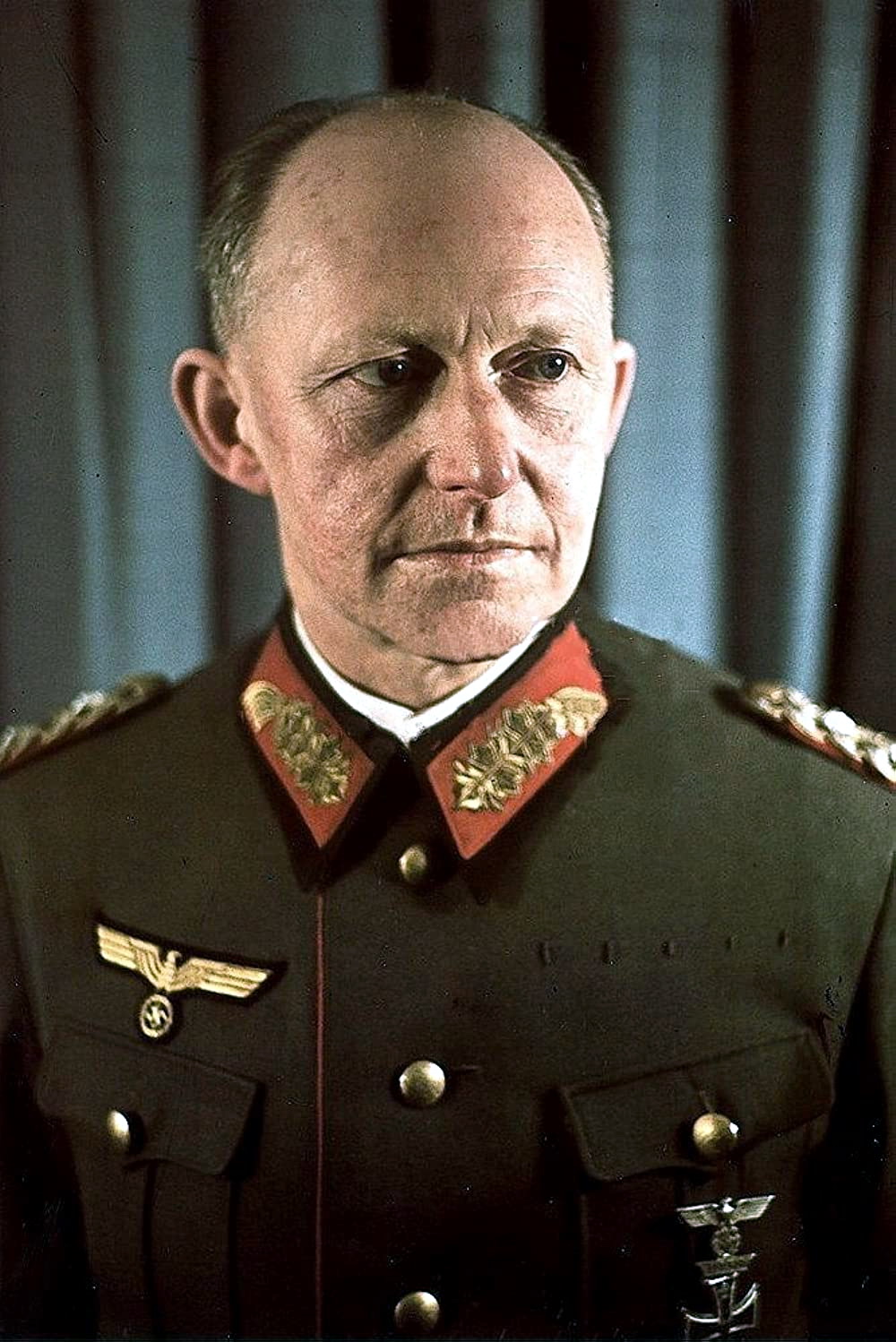


.jpg)

.jpg)


.jpg)


