.jpg)
France, Ville de Mouzon.- Historic city gate (La porte de Bourgogne).- Sign reading "La mendicite est rigoureusement interdite dans La Ville de Mouzon" (prohibition of begging); approximately June-July 1940.
Source :
Bundesarchiv B 206 Bild-GD-82


In 1940, the French army included more than 100,000 black French soldiers from France’s African colonies, mainly Senegal, Mauritania,and Niger. More than 75,000 of them served in France before and during the German invasion; the rest of them served guard duty in the various colonies. As the Wehrmacht panzer divisions swept across France in May-June 1940, some of those black French soldiers (about 40,000 of them), mainly organized in black regiments or mixed units, were engaged in fierce combat against German soldiers. About 10,000 black soldiers were killed, some wounded, and others taken prisoner during the French debacle. Between 1,500 to 3,000 black French prisoners of war were massacred throughout the campaign, either during or after combat. Generally speaking, Tirailleurs Sénégalais were treated differently from other war prisoners by the victorious army. The existence of a well-implanted anti-black racism and stereotypes among the German soldiers frequently resulted in the black French troops being separated from other prisoners of war. Fear of coupes-coupes (a hand-to-hand weapon used by the Tirailleurs Sénégalais that German soldiers considered a treacherous weapon), latent desire for revenge because of German losses, or simple racism, resulted in random massacres of black French war prisoners by members of the Wehrmacht.
Source :
https://www.h-net.org/reviews/showrev.php?id=24173
 Bridge after destruction and houses bombed in the background. Ville de Mouzon, France, June-July 1940.
France suffered staggering manpower losses and much property damage in the war of 1914-1918. She had not fully recovered from the effects of the war when she was plunged into a second conflict in which she sustained more terrible wounds than ever before. Her manpower losses were not as severe in World War II as they had been from 1914 to 1918, but the damage to her cities and towns was far more severe from 1940 to 1945 than it had been during World War I. France's structure of wages and prices, already threatened with inflation as a result of the prolonged period of hostilities from 1914 to 1918, was further weakened during World War II. Living conditions in France are so bad today that only the very wealthy are able to secure sufficient food, clothing, and fuel to maintain a healthful standard of living.
The German armies and air forces inflicted considerable damage upon France during their successful offensive in the spring and summer of 1940. The damage grew more extensive each year thereafter became of systematic German looting and Anglo-American aerial bombardment. Then, on June 6, 1944, the armies of the Western Allies landed in Normandy and commenced to fight their way across France into the Hitler Reich. The German armies resisted furiously, and countless towns and villages were destroyed in the bat-tles which ensued. Unfortunately for France, the invasion which liberated her brought about more destruction than she had suffered during the victorious onslaught of Hitler's armies in 1940.
Many cities, such as Brest, Caen, Dunkerque, Falaise, and St. L6 were almost completely destroyed. Hundreds of towns, villages, and farms suffered the same fate. All told, over 1,200,000 buildings were demolished or sustained major damage, and more than 1,000,000 people were made homeless! Several thousand kilometers of mainline railroad track were torn up, 2,300 railroad bridges were destroyed, and France lost about half of the railroad cars and nearly 8o percent of the locomotives which she had possessed in 1939! Tremendous damage was inflicted upon industrial plants. Many thousands of acres of the best arable land were rendered unproductive because of the war.
Source :
"War Damage and Problems od Reconstruction in France 1940-1945" by George W. Kyte
 Destroyed / damaged Polish State Railways PKP train on collapsed bridge with German soldiers waiting in the bottom. The picture was taken in September-October 1939, not long after the end of the German invasion in Poland.
In 1939, Polish State Railways had 220 thousand employees. It was a well-organised occupational group. 85% of railwaymen were members of trade unions. Most of them were also members of the Railway Military Training Organisation who had done compulsory military service.
As part of mobilisation activities, some railwaymen were summoned to join the army. In the last weeks before the outbreak of war numerous cases of German sabotage against railway facilities were recorded. Some acts of sabotage were prevented thanks to vigilant railway workers. The most tragic act of terror was an explosion of a time bomb on 28 August at 11:18 PM in the waiting room of the railway station in Tarnów. The lethal device was planted by Antoni Guz from Bielsko. 20 people were killed under the ruins of the destroyed railway station and 35 were injured.
When war broke out railways were handling emergency and general mobilisation transports. Also, the first evacuation trains pulled out on the route. Germans carried out bombing raids and airborne fire attacks on railway stations, echelons but also on evacuation trains carrying civilians and identification-bearing sanitary trains. Large railway stations such as those in Bydgoszcz, Grudziądz, Inowrocław, Toruń, Łowicz, Piotrków Trybunalski, Skierniewice, Kraków, Lublin and the stations of the Warsaw railway junction were bombed – some of them even more than once. Despite this fact, railwaymen and sappers were able to restore traffic on the damaged lines within 3–4 hours.
The first military transports were put into operation before mobilisation was declared; 5 large troops were transferred at that time. Subsequent echelons were transported under a mobilisation plan which provided that 32 out of 56 large troops would be transported by rail, as a whole or in part, to build-up points. In total they were to account for 3/5 of Polish forces. This task required 3 thousand trains. In addition, railways had an obligation to deliver 700 thousand reservists from emergency mobilisation and 400 thousand from general mobilisation and 100 thousand soldiers withdrawn from the west to reserve centres situated in the east. Railway troops were supposed to remove damages to railroads.
The attack of Nazi Germany on Poland on 1 September 1939 was also aimed at main junction stations and railway lines. Bombing raids on the stations in Tczew and Kutno started at dawn. Also, the bridge on the Bugonarew in Modlin was bombed. To prevent the progress of the German army, Polish sappers blew up some railway structures e.g. viaducts, tunnels in Żegiestów (on the line Muszyna– –state border) and in Łupków (on the Łupków–Medzilaborce line), bridges in Tczew, Grudziądz, Bydgoszcz-Fordon, on the Bydgoszcz Canal, in Toruń and in Płock.
The events in Szymankowo became a symbol of the heroism of railwaymen. Here, Polish railwaymen prevented an insidious seizure of the bridge in Tczew by the Germans. The scheduled transit train was followed by an armoured train which was sent to a sidetrack and derailed. In retaliation Germans murdered the railwaymen from Szymankowo. In Chojnice, instead of the scheduled train, a German armoured draisine pulled into the station followed by an armoured train. Polish railwaymen and soldiers had been able to take control of the draisine and destroy the bridge before the armoured train reached it. Two railway companies took part in the defence of Warsaw.
Armoured trains were used in the defensive war, including “Danuta” (No. 11) and “Poznańczyk” (No. 12) which took part in the Battle of the Bzura and were destroyed. “Generał Sosnkowski” (No. 13) was derailed and damaged after a bombing raid near Łochów. “Paderewski” (No. 14) was destroyed near Łowicz, and “Śmierć” (No. 15) suffered damage during fighting near Modlin. “Pierwszy Marszałek” (No. 51) fought both against Germans and the Red Army and was damaged in combat with Soviet airplanes. “Piłsudczyk” (No. 52), “Śmiały” (No. 53) and “Bartosz Głowacki” (No. 55) were seized by the Soviets in Lviv (Podzamcze), and “Groźny” (No. 54), fighting in Silesia, was destroyed by the crew when they reached a blown-up bridge on the Dunajec.
As a result of the warfare, 11 large bridges were destroyed, 8,000 smaller structures were damaged and 25,000 damages to stations and tracks were recorded. Some trains and evacuated rolling stock – the exact number is difficult to estimate – reached the eastern parts of the Republic of Poland that on 17 September were occupied by the Red Army.
Both occupying forces introduced their own order. The Germans divided the conquered territory. In the area of the General Government (95 thousand sq. km), on 19.11.1939 the General Directorate of Eastern Railways (Ostbahn) (GEDOB) was established in Kraków. District directorates were set up in Kraków, Warsaw, Radom and Lublin. The general organisation of divisions in the new general directorate was not changed compared to the organisation before the war. German identification symbols were applied on the rolling stock. At the beginning of 1940 the German railway police, called the Bahnschutz, was established as another element of the system of repression. Poles could travel by all trains except fast trains. Also, they could not sit in carriages for Germans. On the other hand, Jews were not allowed to travel without pass cards. In the territories incorporated into the Reich Poles could use the train service only if they were issued special pass cards. Polish railwaymen, and in particular members of the Silesian uprising, plebiscite activists, members of the Greater Poland uprising, and activists involved in social activity before the war were subject to repressions including executions by firing squads and imprisonment in concentration camps. Managerial and other functions were handled by the Germans.
Railway transport was a very important element of the German war machine, therefore, when the fighting ceased in September 1939, the occupying power commenced the reconstruction of the destroyed railway network. Railwaymen were called to work. Work on railways offered protection against being taken away to Germany and forced to work and railway passes enabled travelling after curfew. The war production required efficient technical back-up. Thus, some workshops (e.g. in Nowy Sącz) and factories (Chrzanów) were expanded. The steam locomotives and wagons were marked with vainglorious slogans: “Alles Rädern mussen rollen für den Sieg! (Wheels must roll for victory!)” and “V” signs painted on locomotive smoke-boxes.
In the meantime, Polish railwaymen organised acts of sabotage spontaneously or under emerging conspirators’ organisations, to make operation of the railway difficult to a varying degree and extent. Among other things, they poured sand into wagon grease tanks, falsified transport documents, replaced address stickers on wagons, or assigned double numbers to wagons after repairs. The official gazette of Ostbahn of September 1943 listed the numbers of 500 wagons and 200 tankers which were lost while carrying cargo. 25% of tankers of the former Polish State Railways’ network were sabotaged. In 1942 every fifth steam locomotive was out of order. Railwaymen provided enormous support in organising illegal deliveries of foodstuffs to cities, in conspiracy carriage of mail and courier mail or hiders and in warning against round-ups at railway stations and in intelligence operations. They were at a risk of severe repressions for such activities.
Prior to the attack on the Soviet Union, railway transport in Poland became particularly significant to the Reich. In the territory of the occupied country the Germans gathered 102 divisions of the Wehrmacht, i.e. nearly 3 million soldiers! Following the outbreak of the war between the Germans and Soviets on 22 June 1941 the Commander-in-Chief of the Polish Armed Forces, General Władysław Sikorski, ordered the chief commander of the Union of Armed Struggle, General Stefan Grot-Rowecki to intensify the sabotage and subversion activities in the Reich and in the direct vicinity of the German army. At that time 420 military transports passed through Poland every day. During sabotage and subversion actions in the second half of 1941 as many as 1935 steam locomotives were damaged and 91 were held in repair workshops, 91 railway transports were derailed and 237 were set on fire. In addition, 2,851 wagons were damaged. At that time Ostbahn employed 150 thousand Polish railwaymen, 60 thousand Polish railway workers, 8.3 thousand Germans and 3.5 thousand rail guards.
Sabotage on railway lines passing near the frontline was further intensified in 1942. The largest achievement of the Warsaw District Union of Retaliation was Operation Wieniec (lit. Operation Corona) in the night of 7/8 October 1942, in which the rails surrounding Warsaw were blown up at the same time. Operation Bariera (Barrier) interrupted railway traffic at 92 points simultaneously. Actions at German rail transports were also carried out by partisan groups of any political orientation, including Soviet groups.
At the second stage of the war the retreating Germans purposefully destroyed railway lines on their way. They blew up tunnels, bridges, water towers and pump stations. The occupying forces burnt down and demolished railway station buildings and engine houses, and sappers blew up the poles of teletechnical networks. The Germans took machines, tools and rolling stock away to the Reich. 4 out of 11 main workshops were completely destroyed (Warsaw Chmielna, Warsaw-Praga, Eastern Warsaw and Łapy). 80–90% of machines and equipment was lost by the workshops in Pruszków, Tarnów and Nowy Sącz. Smaller losses were suffered in Radom, Gdańsk, Poznań and Bydgoszcz. The The Germans stole all equipment and machine tools from the regained territories, from, among other places, Opole, Oleśnica, Świdnica, Ostróda and Stargard Szczeciński. They also took away most machines from Wrocław and from 2 steam locomotive and wagon workshops in Gliwice. Only in Piła was complete equipment saved.
The total losses suffered by Polish railways, also calculated taking into account territories allocated after 1945, amounted to 16 billion zlotys (in pre-war currency). 38% of railway lines, 46% of bridges (including all major bridges), 50% of tunnels, 37% of railway buildings, 6 thousand steam locomotives and 60 thousand wagons were destroyed.
Source :
https://kolejnictwopolskie.pl/baza-wiedzy/kolejowa-ii-wojna?article_lang=en
 German soldiers crossing a wooden bridge over a river in Poland, September-October 1939. They are most likely from 213. Infanterie-Division. During the Invasion of Poland, the 213th Infantry Division served in the reserves of Army Group South (Gerd von Rundstedt). It did not play a significant role in the Poland campaign. After the campaign, the division served under XXXV Army Corps.
 German soldiers and officers in an unnamed town square in Poland, September-October 1939. The one in the middle is Generalmajor René de l'Homme de Courbière (Kommandeur 213. Infanterie-Division). During the Invasion of Poland, the 213th Infantry Division served in the reserves of Army Group South (Gerd von Rundstedt). It did not play a significant role in the Poland campaign. After the campaign, the division served under XXXV Army Corps.
 Luftwaffe and Heer officers on the beach of France during landing exercise for "Operation Sea Lion", summer 1940. Facing the camera in the middle is General der Pioniere Alfred Jacob (General der Pioniere und Festungen im Oberkommando des Heeres). German Army and Navy planners set to work in a race against time to solve the manifold and unfamiliar problems of a large- scale amphibious operation. The first big problem was that there were no landing craft, and very little shipping of any description. By gathering up all the barges from inland waterways at the cost of paralyzing large sections of industry, the Germans could reckon on barely enough shipping space to put an effective force ashore in England.6 But towed barges at the mercy of the slightest wind-roughened seas were hardly ideal. The perils of improvisation, furthermore, would be heightened by the lack of naval protection. The only way to guard the convoys seemed to be to mass all submarines and light surface vessels on the North Sea flank and at the same time mount a diversionary expedition on the Atlantic side to draw the British Fleet away from the main crossing. The Navy was decidedly cool toward the project. Grossadmiral Erich Raeder, the Navy Commander in Chief, as early as July had uncovered so many risks that he strongly recommended against the operation except as a last resort.
 At left is Generaloberst Franz Halder (Chef des Generalstabes des Heeres), while second from right is General der Pioniere Alfred Jacob (General der Pioniere und Festungen im Oberkommando des Heeres).
 German infantry troops march along a dirt road in Ukraine, shortly after the invasion of Soviet Union (Operation Barbarossa), June 1941. Most carry a 98k carbine, the one in the center carries a MG 34 machine gun. Pre-war German infantry training stressed the importance of a methodical approach to small unit tactics. The infantry section used only two simple formations to maneuver in battle, but it had a repertoire of choreographed tactical responses which produced predictable results in a given situation. Company and platoon commanders, section and squad leaders, even lead machine gunners were trained to recognize opportunity, and act on it. In theory, the tactical and operational concepts worked well, and they are valid today, but this kind of expertise is only one aspect of warfare. The Wehrmacht was a well-oiled machine involved in the wrong purpose, it had to fail. The image was originally published as 'Das Heer im Grossdeutschen Freiheitskampf' (translated as 'The Army in the Greater German Freedom Struggle'), a collection of 50 plus images taken by the German Army's combat photography unit (Propagandakompanie) during the German invasion of the Soviet Union.
Full name: Michael Kneissl
Nickname: unknown
Date of Birth: 30 November 1891 in Münich, Bavaria (German Empire)
Date of Death: 29 March 1947 in Brno prison (Czechoslovakia)
Religion: Gottgläubig (believing in God)
Blood group: unknown
NSDAP Number: 64 395 (13 July 1927)
SS Number: 24990 (8 February 1932)
Academic Title: no
Family: unknown
Physical Feature: unknown
Beförderungen (Promotion):
20.10.1931 SS-Anwärter
08.02.1932 SS-Mann
08.02.1932 SS-Scharführer
12.02.1932 SS-Truppführer
01.12.1932 SS-Sturmführer (SS-Untersturmführer)
31.07.1933 SS-Obersturmführer
24.12.1933 SS-Sturmhauptführer (SS-Hauptsturmführer)
01.06.1936 SS-Sturmbannführer
09.11.1943 SS-Obersturmbannführer
30.01.1944 SS-Obersturmbannführer der Reserve
Karriere (Career):
17.06.1937 - 01.02.1938 Führer I.Sturmbann / SS-Standarte 74 in Swinemünde
01.02.1938 - 01.09.1939 Führer II.Sturmbann / SS-Standarte 74 in Swinemünde
01.09.1939 - 01.05.1940 Fi.Ru.S. Boden Amt Prag
01.05.1940 - 01.05.1944 Führer beim Stab SS-Abschnitt XXXIX
01.05.1944 - 08.05.1945 Führer beim Stab SS-Abschnitt XXXVII
Orden und Ehrenzeichen (Medals and Decorations):
00.00.194_ Verwundetenabzeichen in Schwarz
00.00.194_ Kriegsverdienstkreuz II.Klasse mit Schwertern
30.01.1944 Kriegsverdienstkreuz I.Klasse mit Schwertern
------------------------------------------------------------------------------
Michael Kneissl was born on November 30, 1891 in the Bavarian metropolis of Munich as the eldest of three children. His father was a butcher and coachman. After finishing elementary school he entered the apprenticeship and at the same time attended the art-industrial school in Munich, where he trained as an artistic carpenter. He went to Austria, Liechtenstein and Baden looking for experience. Just before his nineteenth birthday, however he had to return to Munich, where he entered military service with the 2nd Royal Bavarian infantry regiment. After completing his basic military service, he voluntarily signed up the army. In 1915, he also managed to get married and two children were born from this marriage.
After the outbreak of World War I, Kneissl fought on both the Eastern and Western fronts. In 1916 he was transferred to the 16th Bavarian Reserve Infantry Regiment (List), i.e. the same unit in which the later "leader of the German nation"Adolf Hitler served, but now an insignificant ordinary soldier. As a result of a severe head injury, Vizefeldwebel Kneissl was redeployed in July 1917 as an auxiliary officer in the War Department. Shortly after the end of the war he became the official representative entrusted with the management of the personnel department. About half a year later his commission was revoked and Kneissl remained until early March 1920 in the Heeresabwickelungsamt Bayern as a civil employee. In 1918–1919 he also worked with the Freikorps, made up of career officers in the Bavarian Ministry of War, who sought to overthrow the Bavarian Republic of Soviets. After released from military service, he held various small office jobs in the state service before becoming office assistant from July 1921 and finally at the beginning May 1924 as a secretary at the official court in Berchtesgaden. However, his career took a turn for the worse when he was sentenced to one year in 1928 and seven months in prison for embezzlement and fraud. The reason was allegedly not his profiteering, but rather chaos in the agenda and reduced performance due to head injuries he received in the war (however, he forgot to mention this fact during the post-war interrogation).
According to the same protocol, which may contain misleading information, in the 1920s Kneissl reported as a member for the Social Democratic Party. However, he soon turned around and leaned towards the radical right. He joined the NSDAP on July 13, 1927 in the local group in Berchtesgaden and received membership number 64 395. It happened long before the NSDAP became strong political party in the breakthrough election of 1930. Kneissl thus undoubtedly belonged to the "old fighters" of the Nazis movement. After the war, however, he testified that after only three months as a Nazi member he came out and was not politically organized. From his personal records it also appears that in the years 1929–1931 he belonged to the members of the largest veteran organization in Germany, Stahlhelm. Kneissl was to return to the ranks of the NSDAP in 1932. In the same year he also applied to become the member of the SS. He became a candidate for membership on October 20, 1931, and only after upon completion of the probationary period, he was accepted into the SS in the rank of SS-Scharführer on February 8, 1932. He was assigned to the position of adjutant within the III./1. Sturmbann and soon the entire Standarte. Starting on April 20, 1934, he worked as an SS officer of special purpose for Abschnitt I. However, he submitted a transfer request even before taking up his new position to the Political Cash of Württemberg in Ellwangen (future 2. SS-Standarte). Command With effect from May 26, 1934, SS Kneissl complied, and at the same time he entered. On May 8, 1934, he joined the SS. He also appeared as an exemplary member of the SS from the Catholic Church and declared himself a "believer in God", which in the context of the time it meant subscribing to the Nazi ideology and Adolf Hitler. Soon however, it caught up with a stain from the past, because he hid his criminal prosecution when joining the SS and was threatened with expulsion. However, taking into account the great merits in the "struggle for movement', his offense was finally forgiven and the SS even tried to erase him from the criminal record.
So the whole case did Kneissl no harm. On the contrary, he already started on May 8, 1935 to the SS-Verfügungstruppen and with effect from 17 May 1935 became a company commander in 9/1. SS-Standarte. On March 1, 1936, he was appointed commander of the training camp for the Austrian Legion in Ranis within the SS collection center. Soon after that Kneissl was also promoted to the rank of SS-Sturmbannführer. With his poor performance however, the service had significant problems and the command of the collection center even submitted a proposal on his release from office after various improprieties occurred in the camp. However, Kneissl was able to make significant efforts to make amends and request his release. It was eventually withdrawn. However, the SS command was not convinced of Kneissl for other needs, and in January 1937 it was decided not to pay it as a regular tax employee. Kneissl would therefore have to look for a civilian profession. Finally however, he kept his job in the SS and was transferred with effect from June 17, 1937 to I. and later II. battalion 74. SS-Standarte as their commander. However, he did not generally appear as a prospective cadre. As a result of an old injury, he suffered from dizziness, memory losses, nervousness and irritability. He therefore did not meet the criteria for an officer of the SS and was found unfit for service. The review expressly recommended placing it in a quieter place.
In addition, Kneissl's situation was complicated by personal problems. His marriage was falling apart because he was having an affair with another woman with whom he had two more children. The SS Command However, even in this case, did not throw the "old fighter" overboard and offered him the service of an SS lawyer in divorce, medical leave and even a smaller financial injection to bridge his desperate financial circumstances. Kneissl actually went on medical leave because of an old injury that has been extended to him several times. After finishing the treatment, he then being supported from the B fund of the Reich SS leader, and was to be paid before he found a new civilian employment.
In the meantime, however, the overall situation has changed. Aggressive policies of Germany bear fruit when Adolf Hitler found himself at war and the SS began to expand massively into the occupied territories. Officers, even those unfit for field service, were suddenly in critical shortage. Application was also found for Kneissl, namely in the Society for People's Care and Assistance settlement, to which he was transferred on September 13, 1939. He was tabulated and thus paid by the Land Office in Prague. With effect from May 1, 1940, he was then appointed officer at staff XXXIX. section SS. So he became an important official institution of the German occupation administration in the Protectorate of Bohemia and Moravia. The Land Office was a key tool for the Germanization of the Czech lands, a form of modern colonization. In his own words, Kneissl carried out the distribution of "land parcels".
Rapid growth of the armed forces of the SS organization (Waffen-SS) however, exploited its personnel reserves to the limit. Sources were also sought in civil society institutions. The decision of the SS command became crucial for the reactivation of Kneissl on the establishment of a guard battalion to guard occupation authorities and repressive facilities, which was to be built mainly from local resources, i.e. members of the Allgemeine-SS from the Protectorate. On July 22, he was in charge of the personnel matters of the new unit. In 1940 in Berlin he met with the commander of XXXIX. section of the SS, SS-Oberführer W. Opländer. As a result, Kneissl was drafted into the Waffen-SS on 30 July 1940 with effect from 1 August 1940 with the rank of SS-Hauptsturmführer der Reserve. He was also appointed as commander of the newly formed guard battalion SS Böhmen-Mähren. Together with him, another employee of the Land Office became an officer of this unit, SS-Untersturmführer Hans Hempel. SS Böhmen-Mähren Guard Battalion is made from the security office and prisons of the Gestapo office in Brno and from 1 November 1940 also the police prison in the relatively distant Terezín, where the company moved under Hempel's command. Kneissl then went to the Terezín prison regularly as part of business trips.
Kneissl lasted almost three years at the head of the SS Böhmen-Mähren guard battalion. Under his command, the unit played a vital role in the terror of the period, the so-called first and second state of emergency in Moravia. A total of 396 persons were executed by the SS in the courtyard of the Kounice dormitories in 1941, of which 71 women and 8 juveniles under 18. After the war Kneissl confirmed that he was personally present at almost every execution. His men also performed house raids, street closures and accompanied prison transports to concentration camps. In the following period, Kneissl with his battalion took part in a campaign against the partisan movement in southern Moravia.
The Waffen-SS command in Bohemia and Moravia evaluated Kneissl's activities with satisfaction and his attitudes were described as "befitting an old warrior". The proposal for promotion states that Kneissl exercised "impeccable command of the battalion since July 27, 1940, i.e. two whole years. It was especially evident in the tense period in the fall of 1941 and after the assassination of the SS-Ogruf. Heydrich from the end of May 1942. As a result, Kneissl earned a promotion to the rank of SS-Sturmbannführer with effect from 1 September 1942.
The SS command did not forget Kneissl's merits even after the guard battalion was abolished. In the summer of 1943, with effect from 13 July 1943, he became the commander of the fraternal guard battalion SS Prag. He replaced SS-Obersturmbannführer Peter. The command of the SS guard units thus remarkably remained, especially in wartime. At the time of Kneissl's command, the subordinated 4th guard company were tasked with carrying out executions without a court verdict (so-called Sonderbehandlung). Since 1943, the Small Fortress has executed 300 prisoners. Kneissl received other awards while in command of the battalion. On the occasion the "festival of fallen heroes", that is, the killed participants of the Munich "beer party" coup on 9 November 1943, he was promoted to the rank of SS-Obersturmbannführer, first within the Allgemeine-SS. On the day of another official Nazi holiday of January 30, 1944, which commemorated the accession of Hitler to the post of Reich chancellor, Kneissl was promoted to the same rank within the Waffen-SS. on the same date he was also awarded the War Meritorious Cross of the First Class with swords. On the other hand, his transfer to the status of staff of XXXVIII. section of the SS as of May 1, 1944 was only a formal matter.
Due to his "rich" Nazi past, Kneissl was also in a special position of SS guard units in the protectorate area by more important personalities than one would expect from a mere regular battalion commander. Courtesy correspondence, which, however, often turned into a more personal tone, he maintained with a whole range of representatives of the state administration, the repressive apparatus, the army and other components not only in protectorate territory (for example, the Gauleiter and the Reich Governor in Vienna dr. H. Jury or the head of the SS Main Command Office H. Jüttner).
Personal relationships bound him, for example, to a "specialist" in brutal operations in the rear of eastern front, C. von Gottberg, or the chief of Himmler's personal staff and later supreme commander of the SS and police in Italy K. Wolff. Considering to his position, he also maintained close relations with the Gestapo, albeit he denied vehemently after the war. On the last New Year of the war, the head of the Prague administrative office E. Gerke did not fail to respond to New Year's wishes: "I wish you the same all the best in the coming year and may I express my hope for the space here the very important good cooperation between our two headquarters will continue and to be created in the following year as well."
However, the situation at the fronts continued to deteriorate for Nazi Germany, and the German command had to start planning for the defense of Prague. Guard Battalion SS Prag, together with other army and police units in Section C within defense point "Northwest" (Stützpunkt "Nordwest") assigned SS-Obersturmbannführer Kneissl as the commander of the so-called government district, i.e. the surroundings of Prague Castle and Černín Palace. However, at the last moment he was replaced when he was recalled on May 2 or 3, 1945, according to his statement through K. H. Frank's military adviser SS-Oberführer B. Voss. The reason was supposed to be laziness in the construction of defense facilities around Černínský palaces. Kneissl argued after the war that, from a military point of view, the palace had no defense without a front field meaning, and therefore he decided not to defend it in the long term. His successor is an instructor from the SS-Junkerschule in Prague, SS-Sturmbannführer Schlappauf.
Kneissl kept quiet about his activities during the uprising after the war. Supposedly only at night from 7 to 8 May he took over the abandoned battalion and in the morning hours of 9 May moved simultaneously with the 4th SS Panzer Grenadier Regiment "Der Führer" and various Wehrmacht units and the police from Prague to Rokycany, where these groups surrendered to the Americans. After the signing of the armistice, there is no combat action between the German occupation and the insurgents, and the retreat took place without a single shot being fired.
However, Kneissl ultimately failed to escape justice. First, the German prisoners were sent to the prison camp in Ejpovice near Pilsen and then to Klatov. Here the SS members were separated from the others and transported to a prison camp in Regensburg, where Kneissl was investigated by an American military commission. Subsequently, he was released from the Regensburg camp and transferred to a civilian interned camp in Plattling and gradually to other places. He finally being sent to the Dachau prison camp, which was located in the place of the longest functioning concentration camp of the Nazi regime. Here his identitiy was discovered and handed over to Czechoslovakia, including together with Otto, a former member of the Brno Gestapo Koslowski, with whom Kneissl interacted during his service in Brno. Subsequently, on January 18, 1947 Captain Rudolf Lukaštík from the search group transported the general B. Ečer to the prison in Pilsen, and four days later the Regional Office took over both prisoners of State Security in Brno to stand up for crimes committed during the war before extraordinary people's court. In his defense he relied on his disability, difficult circumstances in his youth, or his originally left-wing orientation. He didn't forget to express his alleged sympathy for the struggle of the Czech nation and opposition to executions, as well as an allegedly complicated relationship with members of the Gestapo. However devotional, his defense did not help him in the court. Michael Kneissl, according to the judgment no. Lsp 227/47 of March 29, 1947, was found guilty of crimes against the state, persons and property. He was sentenced to death and executed on the same day.


Source :
https://forum.axishistory.com/search.php?keywords=michael+kneissl&terms=all&author=&sc=1&sf=all&sr=topics&sk=t&sd=d&st=0&ch=300&t=0&submit=Search
https://www.pamatnik-terezin.cz/search?q=michael+kneissl
https://www.youtube.com/watch?v=vx7A6DcuU3A
%20with%20a%20Ford%20Eifel%20car.jpg)
 A Dornier Do 24N of the German Luftwaffe at Romania in 1941. The Dornier Do 24 is a 1930s German three-engine flugboot (flying boat) designed by the Dornier Flugzeugwerke for maritime patrol and search and rescue. A total of 279 were built among several factories from 1937 to 1945. The picture was taken by Kriegsberichter Horst Grund.
 1943. New Wehrmacht recruits being given their kit
As a German conscript in to a combat unit in the Wehrmacht in mid to late war, first your journey would have begun with the arrival of a notice to report to the nearest training and replacement battalion to wherever you lived.
You’d report to the Stammkompanie of the replacement unit in question- a reception company of sort intended to introduce you to military life. You’d turn in your Wehrpaß, a booklet you were given when you registered for the draft(you’d receive it back when you were discharged) and you’d be issued your uniform, ID disc, and Soldbuch. You’d spend about a week or two along with other called up recruits at the Stammkompanie camp.
After the acclimatization, during which you were taught the basics of military life, you’d be sent to an Ausbildungskompanie, a training company, of your replacement battalion. A year or two back, these units would probably have been separate entities sprawled across occupied Europe, in order to provide extra occupation troops in form of recruits being trained and the training cadres. By mid and late 1944, as the Germans were being pushed out of most of their occupied territories, many of those formations would be unified again as they were in 1940 and stationed in Germany proper.
Nevertheless, you’d receive your basic training in this company alongside your batch of recruits for about the next few months- a total of 14 weeks in total. This was training for infantrymen- more specialized branches like artillerymen would’ve received longer and different training.
Basic training was tough and vicious in entirely realistic ways: the day would start from sunrise and last well past sundown. You’d receive training with rifles, pistols, submachine guns, grenades and machine guns. Long marches with full gear and regular field exercises were hallmarks of training. Navigation, fieldcraft, and other important aspects of infantry warfare were heavily emphasized.
You and your fellow recruits hardened by rigorous training would then be sent back to the Marschkompanie, transfer company, of your replacement battalion, whereupon all of you, as a batch, would be issued to a division. Ideally, this division would be the one which the replacement battalion was specifically assigned to- but by 1944, it wasn’t unheard of for recruits from replacement units to be sent to other divisions receiving their replacements from the same district, depending on how needed replacements were in which division. You could’ve also been sent to a new division being formed in your area, if desired.
You and your comrades from training would arrive to their designated unit- most likely either at the frontline, or pulled back for rest and refit. There you’d be assigned to the division’s field replacement battalion. You’d spend a few more weeks there, receiving training from the veterans of the division, being acclimatized to the specific conditions of the front, and be imparted the particularly relevant methods and knowledge that the division had learned through experience. In the meanwhile you’d gather a bit of practical experience yourself, as the battalion was employed for guard, rear area protection and anti-partisan sweep duties.
Assuming nothing went wrong for you, like the battalion being pressed into the frontline on an emergency(or the rear area becoming the frontline on an emergency…), after a few weeks in the field replacement battalion you and your fellow recruits would be issued to the division’s frontline formations.
Between reporting for your draft and leaving the field replacement battalion for the frontline elements of your division, you’d have spent slightly more than four months.
In all likelihood, you’d be well received by your division. In a country with strong regional identities, all your comrades would be coming from the same region as you. If you were sent to the assigned frontline unit of your replacement battalion(which was the ideal circumstances, and it was tried to make that happen as much as possible) as opposed to being diverted to another unit in dire need of replacement, things would be even better: your old-timer comrades would have gone through the same training program in the same unit and same barracks. Your instructors, veterans from the division, would’ve been people your old-timer comrades personally knew. And of course, no unit would be unhappy to receive much-needed reinforcements.
The existence of regional recruitment districts, replacement formations assigned to specific field units, and the field replacement battalions made for a replacement system quite effective at ensuring unit cohesion and esprit de corps. You’d be serving alongside the same men you spent four months training alongside, and formed friendships with. This gave German formations quite strong esprit de corps down to the last day of the war.
Source :
https://www.quora.com/As-a-German-conscript-in-to-a-combat-unit-in-the-Wehrmacht-in-mid-1944-What-was-my-training-like-How-did-veteran-members-of-my-unit-see-me-How-much-time-in-between-training-and-being-thrown-in-to-an-active-combat
https://www.treasurebunker.com/forums/index.php?/topic/2864-high-quality-color-exceptional-bw-photographs-german-side/#comments

 Some of Adolf Hitler's 50th birthday gifts - including flower vases emblazoned with swastikas and paintings - stored in a room at the New Reich Chancellery. The painting at left shows the figure of Helmuth von Moltke the Elder (1800-1891), a Prussian field marshal who is regarded as the creator of a new, more modern method of directing armies in the field. The picture was taken by Hugo Jaeger on 20 April 1939.
 Party and military officials in the Reichsparteitag (Reichs Party Congress) in Nürnberg, November 1938. Nearest to the camera, from left to right: SS-Gruppenführer Paul Körner (Staatssekretär Preußischen Staatsministerium), NSKK-Obergruppenführer Dr.Ing. e.h. Karl-Wilhelm Ohnesorge (Reichspostminister), Großadmiral Erich Raeder (Oberbefehlshaber der Kriegsmarine), Dr.jur. h.c. Konrad Henlein (saluting, Gauleiter Sudetengau), Generalmajor der Luftwaffe Bruno Loerzer (Inspekteur der Jagdflieger), and SS-Obergruppenführer Dr. Philipp Bouhler (Chef der Kanzlei des Führers). The picture was taken by Hugo Jaeger.
 Commemoration of Hitler's failed coup in 1923 (Münich Putsch or Beer Hall Putsch), which held in Münich on 9 November 1938. Front row: Dr. Friedrich Weber, Hermann Göring, Adolf Hitler, Ulrich Graf and Hermann Kriebel. Back row: Max Sasselmann, Dr. Walter Schultze, Alfred Rosenberg, Arno Schickdanz, Philipp Bouhler and Max Amann. Please note that these brown uniforms are not SA uniforms but Alte Kampfer (Blutorden holders). Ulrich Graf even wears an SS sleeve band! The picture was taken by Hugo Jaeger.
 Welcoming ceremony for the Legion Condor which was held in Lustgarten square, Berlin, June 6, 1939. Adolf Hitler (Führer und Oberster Befehlshaber der Wehrmacht) had just arrived at the location of the ceremony and was immediately greeted by the Wehrmacht high officials. They are, from left to right: SS-Gruppenführer Karl Wolff (Chef der Hauptamt Persönlicher Stab Reichsführer-SS), Generaloberst Erhard Milch (Generalinspekteur der Luftwaffe als Vertreter des Oberbefehlshaber Göring), Generalmajor Wolfram Freiherr von Richthofen (Befehlshaber der Legion Condor), Generalfeldmarschall Hermann Göring (Oberbefehlshaber der Luftwaffe), and General der Flieger Hugo Sperrle (Chef der Luftflotte 3). The driver next to Hitler is SS-Sturmbannführer Erich Kempka. The Condor Legion (German: Legion Condor) was a unit composed of military personnel[1] from the air force and army of Nazi Germany, which served with the Nationalist faction during the Spanish Civil War of July 1936 to March 1939. The picture was taken by Hugo Jaeger.
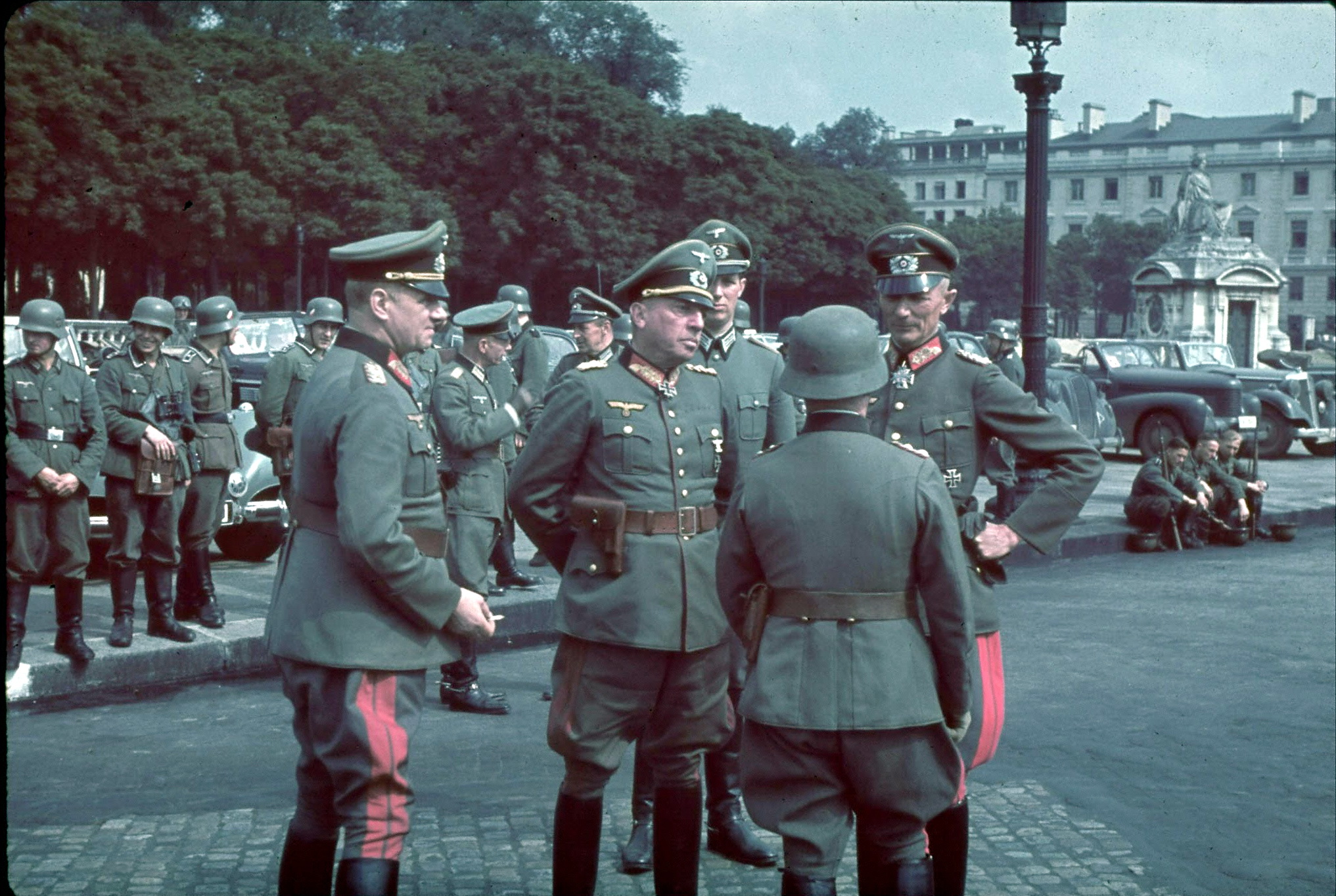 Wehrmacht high ranking officers gathered at the victory parade of the German troops at the Place de la Concorde, Paris, which held on Friday, June 14, 1940. On that day the French capital fell to the Nazis, while 2,000,000 of its citizens had already fled. In preparation for the parade, the new authorities forbade local residents to approach the vicinity of the Place de la Concorde from 08:00 AM until the afternoon. Front row from left to right: Generalleutnant Hans von Salmuth (Chef des Generalstabes Heeresgruppe B), General der Artillerie Georg von Küchler (Oberbefehlshaber 18. Armee), Oberleutnant der Reserve Heinrich Graf von Lehndorff-Steinort (Adjutant Oberbefehlshaber Heeresgruppe B), General der Kavallerie Georg Stumme (with his back to the camera, Kommandierender General XXXX. Panzerkorps), and Generaloberst Fedor von Bock (Oberbefehlshaber Heeresgruppe B). In the background were rows of parked luxury cars, which were most likely the special rides of the high-ranking German officers who attended the event. The three cars on the right are, in order from left to right: Opel Admiral, Opel Kapitän, and Horch 830 BL. This original color photo was taken by one of Hitler's personal photographers, Hugo Jaeger, who "toured" together with Heeresgruppe B in the invasion of the Low Countries (Netherlands Belgium Luxemburg) and France in the summer of 1940.
