Source :
https://artsandculture.google.com/asset/hitler-jaeger-file/EgHmP3BzbacCzQ?hl=en
https://en.wikipedia.org/wiki/Adolf_Hitler%27s_50th_birthday
World War II, WW2, Color, Farbe, Berwarna, ORI, Original, Germany, Italy, Japan, USA, Nazi, Great Britain, France, Soviet Union, Red Army, Waffen-SS, Luftwaffe, Kriegsmarine, Soldiers, Generals, Officers, Tank, Panzer, Tiger, Panther, Sherman, Aircraft, Bomber, Messerschmitt, Spitfire, Hitler, Churchill, Stalin, Rommel, Himmler, Goering, Roosevelt, Patton, Guderian, Mustang, Zero, Admiral, Sailot, Battleship, Holocaust, Third Reich, fascist, Kaigun, Rikugun, RAF, Battle, Operation
Some of Adolf Hitler's 50th birthday gifts - including flower vases emblazoned with swastikas and paintings - stored in a room at the New Reich Chancellery. The painting at left shows the figure of Helmuth von Moltke the Elder (1800-1891), a Prussian field marshal who is regarded as the creator of a new, more modern method of directing armies in the field. The picture was taken by Hugo Jaeger on 20 April 1939.
Party and military officials in the Reichsparteitag (Reichs Party Congress) in Nürnberg, November 1938. Nearest to the camera, from left to right: SS-Gruppenführer Paul Körner (Staatssekretär Preußischen Staatsministerium), NSKK-Obergruppenführer Dr.Ing. e.h. Karl-Wilhelm Ohnesorge (Reichspostminister), Großadmiral Erich Raeder (Oberbefehlshaber der Kriegsmarine), Dr.jur. h.c. Konrad Henlein (saluting, Gauleiter Sudetengau), Generalmajor der Luftwaffe Bruno Loerzer (Inspekteur der Jagdflieger), and SS-Obergruppenführer Dr. Philipp Bouhler (Chef der Kanzlei des Führers). The picture was taken by Hugo Jaeger.
Commemoration of Hitler's failed coup in 1923 (Münich Putsch or Beer Hall Putsch), which held in Münich on 9 November 1938. Front row: Dr. Friedrich Weber, Hermann Göring, Adolf Hitler, Ulrich Graf and Hermann Kriebel. Back row: Max Sasselmann, Dr. Walter Schultze, Alfred Rosenberg, Arno Schickdanz, Philipp Bouhler and Max Amann. Please note that these brown uniforms are not SA uniforms but Alte Kampfer (Blutorden holders). Ulrich Graf even wears an SS sleeve band! The picture was taken by Hugo Jaeger.
Welcoming ceremony for the Legion Condor which was held in Lustgarten square, Berlin, June 6, 1939. Adolf Hitler (Führer und Oberster Befehlshaber der Wehrmacht) had just arrived at the location of the ceremony and was immediately greeted by the Wehrmacht high officials. They are, from left to right: SS-Gruppenführer Karl Wolff (Chef der Hauptamt Persönlicher Stab Reichsführer-SS), Generaloberst Erhard Milch (Generalinspekteur der Luftwaffe als Vertreter des Oberbefehlshaber Göring), Generalmajor Wolfram Freiherr von Richthofen (Befehlshaber der Legion Condor), Generalfeldmarschall Hermann Göring (Oberbefehlshaber der Luftwaffe), and General der Flieger Hugo Sperrle (Chef der Luftflotte 3). The driver next to Hitler is SS-Sturmbannführer Erich Kempka. The Condor Legion (German: Legion Condor) was a unit composed of military personnel[1] from the air force and army of Nazi Germany, which served with the Nationalist faction during the Spanish Civil War of July 1936 to March 1939. The picture was taken by Hugo Jaeger.
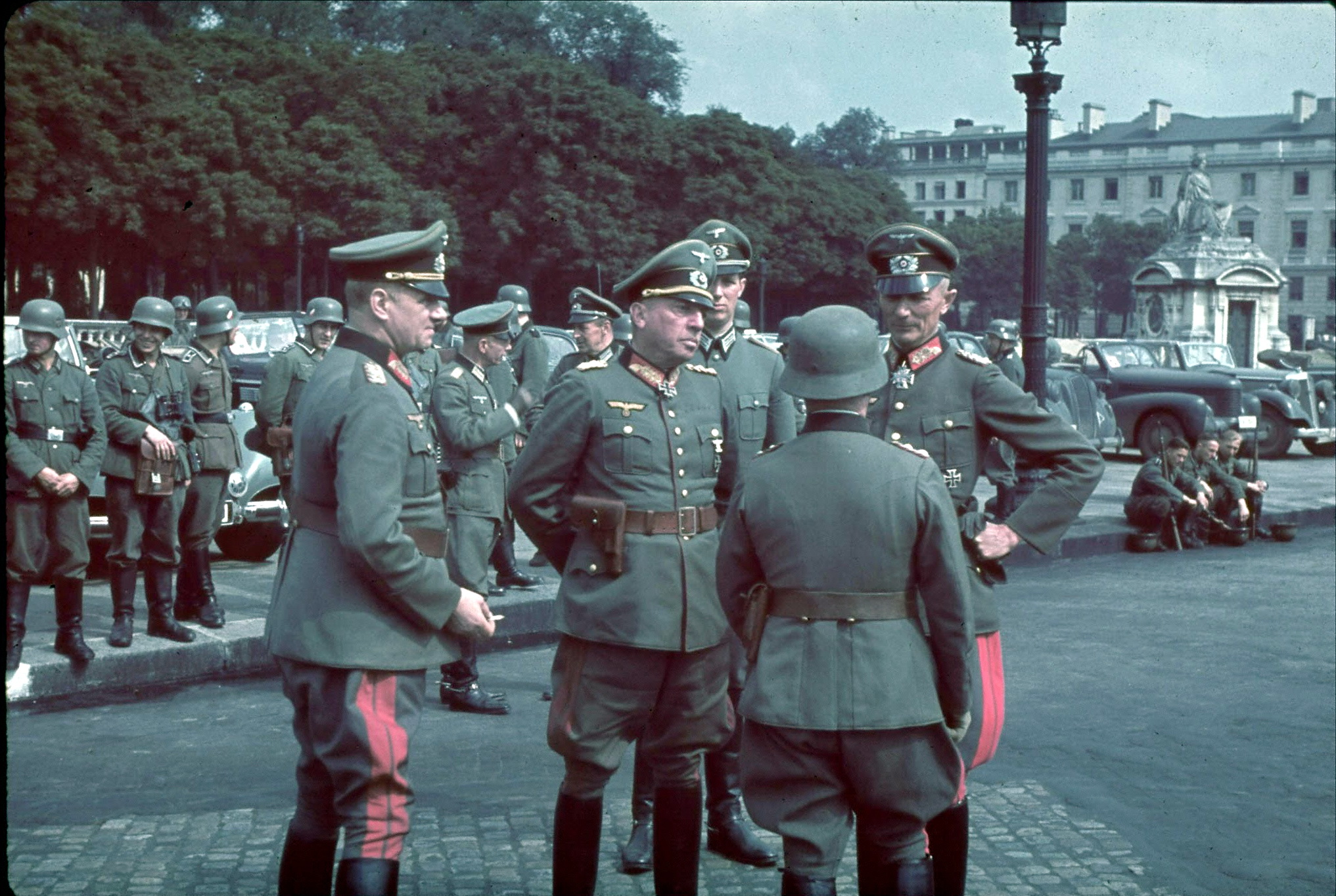
Wehrmacht high ranking officers gathered at the victory parade of the German troops at the Place de la Concorde, Paris, which held on Friday, June 14, 1940. On that day the French capital fell to the Nazis, while 2,000,000 of its citizens had already fled. In preparation for the parade, the new authorities forbade local residents to approach the vicinity of the Place de la Concorde from 08:00 AM until the afternoon. Front row from left to right: Generalleutnant Hans von Salmuth (Chef des Generalstabes Heeresgruppe B), General der Artillerie Georg von Küchler (Oberbefehlshaber 18. Armee), Oberleutnant der Reserve Heinrich Graf von Lehndorff-Steinort (Adjutant Oberbefehlshaber Heeresgruppe B), General der Kavallerie Georg Stumme (with his back to the camera, Kommandierender General XXXX. Panzerkorps), and Generaloberst Fedor von Bock (Oberbefehlshaber Heeresgruppe B). In the background were rows of parked luxury cars, which were most likely the special rides of the high-ranking German officers who attended the event. The three cars on the right are, in order from left to right: Opel Admiral, Opel Kapitän, and Horch 830 BL. This original color photo was taken by one of Hitler's personal photographers, Hugo Jaeger, who "toured" together with Heeresgruppe B in the invasion of the Low Countries (Netherlands Belgium Luxemburg) and France in the summer of 1940.
A Russian T-26 with a machine gun installed in the turret.
Hanns Elard Ludin (10 June 1905, in Freiburg – 9 December 1947, in Bratislava) was a German diplomat and SA-Obergruppenführer. Born in Freiburg to Friedrich and Johanna Ludin, Ludin began his Nazi affiliation in 1930 by joining the party, and was arrested for his political activities the same year. Imprisoned until 1931, he joined the SA on his release.
Ludin was lucky to survive the "Night of the Long Knives" in 1934 when Hitler purged much of the left-wing of the Nazi party. Ludin restored his reputation by joining the Foreign Office and became Ambassador to the Slovak Republic in 1941, replacing Manfred von Killinger. Ludin's activities included convincing the Slovak government to comply with deportations for slave labor and providing diplomatic cover to such activities. In 1943, he was promoted to SA-Obergruppenführer.
Ludin was arrested after the war and extradited to Czechoslovakia, where he was tried with SS-Obergruppenführer Hermann Höfle (not to be confused with SS-Sturmbannführer Hermann Julius Höfle). He was sentenced to death and was hanged on 9 December 1947.
Married to Erla von Jordan (1905 – 1997), Ludin had six children: Erika (1933 – 1997), Barbara (born 1935), Ellen (born 1937), Tilman (1939 – 1999), Malte (born 1942) and Andrea (born 1943). Hanns Ludin's youngest son, Malte Ludin, filmed a documentary about the impact of his father's involvement in the Third Reich on his family. The film, 2 oder 3 Dinge, die ich von ihm weiß, had its initial release in 2005. The movie's commercial run in New York City began on 24 January 2007 at the Film Forum.
Source ;
https://en.wikipedia.org/wiki/Hanns_Ludin
https://twitter.com/eugenij38848533/status/1071794893641650176?lang=en
Panzerkampfwagen I Ausf. Bs of 1.Kompanie / Panzer-Abteilung z.b.V. 40 at the entrance of the Jørgensens Hotel in Horsens, Denmark, which housed the headquarters of the battalion, April 1940. The hotel is located at Søndergade Street no. 17.Source :
https://www.emedals.com/a-group-of-documents-to-a-luftwaffe-fighter-ace-fritz-karch-47-air-victories
Joachim Schepke (8 March 1912 – 17 March 1941) was a German U-boat commander during World War II. He was the seventh recipient of the Knight's Cross of the Iron Cross with Oak Leaves. Schepke is credited with having sunk 36 Allied ships. During his career, he gained notoriety among fellow U-boat commanders for exaggerating the tonnage of ships sunk.
Schepke joined the Reichsmarine in 1930. In 1934, he was assigned to the newly created U-boat arm, and in 1938 he commanded U-3. After a short stint commanding U-19 and serving in a staff position, Schepke received the command of U-100, a Type VIIB boat. After 5 patrols in U-100 she was heavily damaged on 17 March 1941 by depth charges from HMS Walker and Vanoc while attacking Convoy HX-112. U-100 was forced to surface and was detected on radar and rammed by Vanoc. Schepke and most of the crew died.
Schepke claimed to have sunk 37 ships, for a total of 213,310 gross register tons (GRT) and damaged 4 more. If true, this would have made him the third skipper to have sunk over 200,000 tons. While he definitely sank 36 ships, he was known throughout the fleet to exaggerate his tonnage claims; other U-boat men came to use the expression "Schepke tonnage" in reference to this. Nonetheless, at one point Schepke ranked first in number of ships sunk, and was recommended by Admiral Dönitz for the Knight's Cross with Oak Leaves.
Source :
https://en.wikipedia.org/wiki/Joachim_Schepke
Source :
https://www.facebook.com/photo/?fbid=660998631835631&set=gm.1942078655977548
Full name: Erich Rudorffer
Nickname: unknown
Date of Birth: 1 November 1917 at Zwochau, Sachsen (German Empire)
Date of Death: 8 April 2016 at Bad Schwartau, Schleswig-Holstein (Germany)
NSDAP Number: unknown
SS Number: unknown
Academic Title: unknown
Family Member: unknown
Physical Feature: unknown
Beförderungen (Promotion):
00.01.1940 Oberfeldwebel
28.10.1940 Leutnant
20.11.1941 Oberleutnant
01.01.1943 Hauptmann
01.01.1944 Major
Karriere (Career):
16.04.1936 Joined the Luftwaffe with Flieger-Ersatz-Abteilung 61.
02.09.1936 - 15.10.1936 Served with Kampfgeschwader 253.
16.10.1936 - 24.02.1937 Trained as an aircraft engine mechanic at the Technische Schule Adlershof in Berlin.
14.03.1937
Posted as a mechanic to Kampfgeschwader 153 where he served as a
mechanic until end October 1938. He was then transferred to
Flieger-Ersatz-Abteilung 51 based at Liegnitz in Silesia for flight
training. There he was first trained as a bomber pilot and then as a
Zerstörer, a heavy fighter or destroyer, pilot.
01.10.1939 Transferred to the Jagdwaffe and was posted to the Jagdfliegerschule 2 at Schleißheim.
06.12.1939
Following the conversion training, Rudorffer was transferred to the
Jagdergänzungsstaffel Döberitz, the supplementary fighter squadron based
at Döberitz.
28.12.1939 - 07.01.1940 Transferred to the
Ergänzungs-Jagdgruppe Merseburg, another supplementary training unit
stationed at Merseburg, where newly trained fighter pilots received
instruction from pilots with combat experience.
08.01.1940 Posted to 2. Staffel / Jagdgeschwader 2 (JG 2) "Richthofen".
00.00.19__ Flugzeugführer in 6.Staffel / Jagdgeschwader 2 (JG 2) "Richthofen".
11.11.1941 Staffelkapitän 6.Staffel / Jagdgeschwader 2 (JG 2) "Richthofen".
17.04.1943 Führer II.Gruppe / Jagdgeschwader 2 (JG 2) "Richthofen".
30.06.1943 Gruppenkommandeur IV.Gruppe / Jagdgeschwader 54
00.07-08.1943 Gruppenkommandeur II.Gruppe / Jagdgeschwader 54
15.01.1945 Gruppenkommandeur I.Gruppe / Jagdgeschwader 7
00.00.19__ Kraftfahrbundesamt (BRD)
Orden und Ehrenzeichen (Medals and Decorations):
00.00.19__ Medaille zur Erinnerung an den 1. Oktober 1938
00.00.19__ Verwundetenabzeichen 1939 in Schwarz
00.00.19__ Gemeinsames Flugzeugfuhrer-Beobachter Abzeichen (ohne brillianten)
22.05.1940 Eisernes Kreuz II.Klasse
28.06.1940 Eisernes Kreuz I.Klasse
20.10.1940 Luftwaffe Ehrenpokale für besondere Leistungen im Luftkrieg
00.00.194_ Vapaudenristin 2.luokka (Finland)
01.05.1941
Ritterkreuz des Eisernen Kreuzes, as Leutnant and Flugzeugführer in
6.Staffel / II.Gruppe / Jagdgeschwader 2 (JG 2) "Richthofen". Awarded
after 19 aerial victories
09.12.1941 Deutsches Kreuz in Gold
00.00.194_ Frontflugspange für Jäger in Gold
00.00.194_ Frontflugspange für Zerstörer in Gold mit Anhänger und Einzatszahl
00.00.1943 Ärmelband "AFRIKA"
11.04.1944
Ritterkreuz des Eisernen Kreuzes mit Eichenlaub #447, as Major and
Gruppenkommandeur II.Gruppe / Jagdgeschwader 54 (JG 54) "Grünherz".
Awarded after 130 aerial victories
30.10.1944 Mentioned in
Wehrmachtbericht: "Among those aerial victories in Kurland that had been
reported yesterday are eleven aircraft shot down by the recipient of
the Eichenlaub to the Ritterkreuz des Eisernen Kreuzes Major Rudorffer,
bringing his total to 206 aerial victories."
26.01.1945 Ritterkreuz des Eisernen Kreuzes mit Eichenlaub und Schwertern #126, as
Major and Gruppenkommandeur II.Gruppe / Jagdgeschwader 54 (JG 54)
"Grünherz". Awarded after 210 aerial victories
------------------------------------------------------------------------------
Source :
http://ritterkreuztraeger.blogspot.com/2022/02/hitler-and-manstein-in-conference.html
Source :
https://www.facebook.com/photo/?fbid=5651403878279712&set=gm.1929517277233686
Adelbert Schulz (20 December 1903 – 28 January 1944) received the Ritterkreuz des Eisernen Kreuzes on 29 September 1940 as Hauptmann and Kommandeur I.Abteilung / Panzer-Regiment 25 / 7.Panzer-Division. Hauptmann Schulz led a company, and later a full battalion, of Panzers over a total of 17 armoured attacks during the Western campaign, where he showed himself to be a fine commander of armour. Over the course of the campaign he particularly distinguished himself on 14 May 1940 during the heavy fighting in the Dinant bridgehead, and later on 23 May 1940 where he helped resolve a critical combat situation near Hersin.
Adelbert Schulz received the Eichenlaub #47 for his Ritterkreuz on 31 December 1941 as Hauptmann and Kommandeur I.Abteilung / Panzer-Regiment 25 / 7.Panzer-Division. The medal was awarded for distinguishing himself near Klin during the winter of 1941/1942. Despite having only a handful of operational tanks, being outnumbered 8-1 and having to contend with -40 Celsius weather, he nevertheless was able to successfully cover the retreat of friendly German forces. These included a full field hospital with over 4000 wounded men.
Adelbert Schulz received the Schwerter #33 for his Ritterkreuz on 6 August 1943 as Oberstleutnant and Kommandeur Panzer-Regiment 25 / 7.Panzer-Division. On 11 July 1943 previously, during the attack of the 7. Panzer-Division in the southern sector of the battle of Kursk, Schulz was able to conduct a successful armoured breakthrough south of Scheino. Smashing through Soviet fieldworks, and in spite of enemy probes on all sides, he launched an armoured pursuit with his Kampfgruppe and was able to catch a foot-bound Soviet group in the process of withdrawing. Schulz's men were able to capture almost 600 prisoners, 83 cannons and over 100 heavy machine guns and mortars. In addition to this notable success, Schulz and his regiment were also able to destroy a total of 76 enemy tanks over the course of 11 days of battle in the attempted attack towards Kursk.
Adelbert Schulz received the Brillanten #9 for his Ritterkreuz on 14 December 1943 as Generalmajor and Kommandeur 7. Panzer-Division. The medal was awarded for the distinguished command of his Panzer-Regiment during the fluid battles around Kiev and Zhitomir in October/November 1943.
Source :
https://www.facebook.com/groups/237076659811098/posts/1925981594253921/?__cft__[0]=AZUzHYDRIVjSLXPVBlS_IlY2YNXfbkaYYu60vttfZHgSz6jnQPVWmQ6GGIIemvHm7ATExZQMYdg1kq1xwqgYN4woL8CECbr52-3rz8dgo8lNrl5H4Lv7F_YbcvC4Y6sXZQ9Dzr6L8LT108GUPsRvCObL&__tn__=%2CO%2CP-R
https://www.tracesofwar.com/persons/216/Schulz-Adelbert.htm
Ernst-Günther Baade (20 August 1897 – 8 May 1945) volunteered for military service in 1914 and fought during World War I. During World War II, in March 1942 Baade was assigned to the active reserve of officers (Führerreserve). He subsequently transferred to the 15th Panzer Division in North Africa and took command of the 115th Rifle Regiment on 15 April 1942, at that time committed to action in Libya and Cyrenaica.
Baade became a legend in the Afrika Korps. In May 1942 he took part in the Battle of Bir Hakeim. Baade was awarded the Knight's Cross of the Iron Cross for his actions during the battle. He was wounded on 28 July 1942 at El-Alamein, and evacuated to Germany.
During the evacuation of German forces from Sicily to the Italian mainland in early August 1943, Baade was placed in charge of the force defending the Straits of Messina. Baade commanded the 90th Infantry Division in the Battle of Monte Cassino. He was known for his occasionally eccentric behavior, his very small staff, and his frequent front-line inspection visits, all of which made him popular with his troops. He was awarded a Tank Destruction Badge for the single-handed destruction of an enemy tank with an infantry weapon.
Baade was wounded on 24 April 1945, when his staff car was strafed by a British fighter aircraft near Neverstaven in Holstein. He died of gangrene in a hospital at Bad Segeberg on 8 May 1945.
Awards
Wound Badge in Black (1 July 1918)
Wehrmacht Long Service Award 2nd Class (2 October 1936)
German Cross in Gold on 2 November 1941 as Oberstleutnant in the I./Reiter-Regiment 22
Iron Cross (1914) 2nd Class (25 November 1916) & 1st Class (24 December 1917)
Clasp to the Iron Cross (1939) 2nd Class (18 September 1939) & 1st Class (5 June 1940)
Knight's Cross on 27 June 1942 as Oberst and commander of Schützen-Regiment 115
Oak Leaves on 22 February 1944 as Oberst and leader of the 90. Panzergrenadier-Division
Swords on 16 November 1944 as Generalleutnant and commander of the 90. Panzergrenadier-Division
Source :
https://en.wikipedia.org/wiki/Ernst-G%C3%BCnther_Baade
http://ritterkreuztraeger.blogspot.com/2021/09/bio-of-generalleutnant-ernst-gunther.html
In the beginning of the Norwegian campaign, there were 6 Marineartillerie-Abteilungen: MAA Horten, MAA Kristiansand, MAA Stavanger, MAA Bergen, MAA Drontheim, and MAA Narvik. These units were to man captured Norwegian Coastal Fortresses. In June 1940, the MAA’s got number designations, the first ones for just 1 month, before they got permanent numbers.
The German MAA’s were divided into companies, each company manned a battery. Each MAA usually consisted of 6 companies, but this could range from 2 – 12 coys. The commander of a MAA was usually Korvettenkapitän, but could also be Fregattenkapitän or Kapitänleutnant.
Army artillery units designed for coastal defense appeared in Norway in 1941. They established several Heeresküstenartillerie-regimenter (HKAR), Heeresküstenartillerie-Abteilungen (HKAA) and 160 Heeresküsten-Batterien (HKB). At the end of the war, there were 221 batteries divided into 29 units & 10 regiments. The Germans had serious problems in commanding and controlling this effectively. The mix-up between army and naval artillery also caused serious problems when it came to effective command.
The Heeresküstenartillerie had standard army OOB, but had guns of varying quality.They were also equipped with tanks, mostly French captured ones, like the Somua. The coastal defense had a big need of men. In 1930, the whole Kriegsmarine counted 15000 men. In Norway, the total number of Army / Naval Coast defense personnel was about 65000 (1945). Artillery Schools were established several places, amongst them Rauöy in the Oslo-fjord, and Stavern.
Source :
Akira Takiguchi photo collection
https://www.facebook.com/groups/237076659811098/posts/1906782666173814/?__cft__[0]=AZUuO_vSByS790n9KaQIsAbuwn8LeoffMWol5IX4nTf8sMPB_b34YSFLfnbFNMHPXLxRg0lkaLFjrhIf2gtox2fDPXMGqWLcR0qR6L5drmcG2BYeiqK9p9N8otNjwmO1Rf-6ZdxwqD1wJhtPEqRwEXJ0&__tn__=%2CO%2CP-R
https://www.feldgrau.com/ww2-german-norway-coastal-defence/
Source :
https://commons.wikimedia.org/wiki/File:57mm_Gun_M1_-_Saint-Malon_Bretagne.jpg
https://www.tanks.net/anti-tank-weapons/united-states-57mm-gun-m1.html
Portrait of Hanskarl von Hasselbach (doctor accompanying the Führer), 1942/43. Source: Walter Frentz Collection.
Hanskarl von Hasselbach, actually Hans Karl von Hasselbach, (born November 2, 1903 in Berlin; † December 21, 1981 in Pullach im Isar Valley) was a German surgeon and attending physician to Adolf Hitler. Hasselbach, son of the Prussian Rittmeister Karl von Hasselbach, finished his school career in Hirschberg (Silesia) in 1921 with the Abitur. He then studied medicine at the Universities of Breslau, Munich, Freiburg and Rostock. He was approved in 1927 and was awarded a doctorate in Freiburg with the dissertation "About neck fibroids". med. PhD.
He then became an assistant under the chief physician Georg Magnus at Bergmannsheil Hospital in Bochum and, after his appointment to the Charité in November 1933, also moved to Berlin. In addition to Hasselbach, Magnus Karl Brandt's assistant also came to Berlin, as did Magnus from Jena, known Werner Haase. In 1934 Brandt became Hitler's first accompanying surgeon, and Haase soon after became Brandt's deputy in this function. After Haase temporarily resigned from this post due to health reasons, Hasselbach became another deputy surgeon accompanying Hitler through Brandt's mediation in 1936. Hasselbach had already joined the NSDAP (membership number 2,794,377) and SA before the handover of power to the National Socialists in 1932. He switched from the SA to the SS in 1933/34 (SS No. 264.054). Due to his extensive medical work for Hitler and his environment, he was only able to qualify for his habilitation in 1938 with the work "Die Endangitis obliterans" at the University of Munich. He was released from teaching at the Charité.
With the beginning of the German-Soviet War, his place of work was the Führer headquarters in Wolfsschanze in East Prussia. As an SS doctor he was appointed associate professor on April 20, 1943, and in June 1943 he achieved the rank of SS-Sturmbannführer of the Waffen-SS within the SS. In the course of Brandt's dismissal as Hitler's attending physician, Hasselbach also lost his deputy post in October 1944. He was then used in a field hospital on the Western Front.
After the end of the war, Hasselbach was interned by the United States and was interrogated as a witness during the Nuremberg trials. The American authorities found him honest and credible. After his release from Allied internment, he headed the surgery department of the Sarepta hospitals of the Von Bodelschwinghschen Anstalten Bethel as chief physician from 1949 to 1970.
Source :
https://www.facebook.com/photo/?fbid=631162261485935&set=gm.1906226999562714
Albin Sawatzki (born October 6, 1909 in Danzig; † May 1, 1945 in Warburg) was a German engineer and was responsible for the series production of the A4 surface-to-surface missile in the underground Mittelwerk during the final phase of the National Socialist German Empire. Sawatzki, a member of the NSDAP since May 1933, was initially operations manager at Henschel & Sohn in Kassel, where he was responsible for tank production. He was responsible for the manufacture of the VI Tiger armored vehicle. In July 1943, Sawatzki was appointed to the A4 Special Committee, which dealt with issues relating to the testing and production of the A4, by Armaments Minister Albert Speer as head of the Series Production Working Committee. Initially he was based in the Peenemünde Army Research Center and, after the bombing of the Peenemünde Army Research Center, in Nordhausen from the beginning of September 1943. From February 1944, Sawatzki finally became a member of the management of Mittelwerk GmbH as director of the planning department. Sawatzki's working committee prepared the mass production of the rocket, including the establishment of underground factories. The most famous production facility, the Mittelwerk in the tunnel system in Kohnstein, was in operation for over a year. There, prisoners from the Dora-Mittelbau concentration camp had to drive the tunnels under catastrophic conditions and later, in some cases, also produce rockets. In 1944, Sawatzki also became Technical Director at Henschel. Because of his “services to German armaments”, Sawatzki received a grant of 30,000 RM from Adolf Hitler. Shortly before the end of the war, Sawatzki evaded the evacuation of 450 rocket specialists to the Alpine fortress in Oberammergau, which began on April 6, 1945, and did not implement the destruction of the tunnel in Kohnstein ordered by the SS. On April 11, 1945, the US Army marched into Nordhausen and Niedersachswerfen and discovered the underground tunnels in Kohnstein, in which, in addition to the prisoners of the concentration camp, more than 10,000 people from the area had found refuge. On April 13, 1945, Sawatzki was mistreated by former prisoners and on April 14, 1945, he was interrogated by the US Army. He died under unknown circumstances on May 1, 1945 in Warburg, Westphalia.
Major-General Dr. Walter Robert Dornberger (born September 6, 1895 in Gießen; † June 27, 1980 in Obersasbach) was a German Army artillery officer whose career spanned World War I and World War II. He was a leader of Nazi Germany's V-2 rocket program and other projects at the Peenemünde Army Research Center. Dornberger was born in Gießen and enlisted in 1914. In October 1918, as an artillery lieutenant Dornberger was captured by United States Marines and spent two years in a French prisoner of war camp, mostly in solitary confinement because of repeated escape attempts. In the late 1920s, Dornberger completed an engineering course with distinction at the Berlin Technical Institute, and in the Spring of 1930, Dornberger graduated after five years with an MS degree in mechanical engineering from the Technische Hochschule Charlottenburg in Berlin. In 1935, Dornberger received an honorary doctorate, which Col. Karl Emil Becker arranged as Dean of the new Faculty of Military Technology at the TH Berlin.
Source :
https://www.facebook.com/groups/237076659811098/posts/1906251222893625/?__cft__[0]=AZWdSEgaczYdYmzXi1tPr_TCkhjNwKu5WbpDtgW9kyfHWRj_DhlySyiW-S2XvwNEAI_fWPG-EWt2F9_M2HRZ2W1IZavClye0Z_SIHpcVUS9BH-qUvCu7gHqzVcz6_pQZQBwblt3fc5E1S9za8-_QtmZn012I9hAdOZHhhIHBb78lbJ458nB5HpCV0Jwnjm0wM08&__tn__=%2CO%2CP-R
Full name: Wilhelm Kaiser
Nickname: unknown
Date of Birth: 30 November 1914 at Pockau, Sachsen (German Empire)
Date of Death: 24 September 1993 at Niedernhausen, Hesse (Germany)
NSDAP Number: unknown
SS Number: unknown
Academic Title: unknown
Family Member: unknown
Physical Feature: unknown
Beförderungen (Promotion):
01.01.1938 Leutnant
01.06.1940 Oberleutnant
01.04.1942 Hauptmann (advanced from 01.10.1942)
Karriere (Career):
01.10.1935 (01.11.1935?) entered the Luftwaffe
01.04.1938 assigned to Fliegergruppe 50 in summer 1938 and then to II./St.G. 163 (later III./St.G. 2) on 01.11.38
10.05.1940 in 9./St.G. 2 WIA - Ju 87 B lost ivo Vroenhoven, crashed near Roosteren
00.10.1940 with 2./St.G. 2. - Adj. of III./St.G. 2
21(22?).05.1941 in 2./St.G. 2, shot down over Canea Bay/Crete, but rescued from the sea and returned to unit
00.00.1941 WIA
00.07.1941 appointed Staka in III./St.G.2
00.08.1941 appointed Adjutant III./St.G. 2
00.07.1942 transfered to Stukaschule 2 Graz and a few months later began general staff training
00.09.1943 assigned to Stab/General der Schlachtflieger as a weapons and bombs specialist
01.07.1943 appointed Ia op 2/1. Fliegerdivision and temporary Ia / Luftflotte 6
02.08.1944 appointed acting Ia / II. Fliegerkorps
15.10.1944 appointed Ic/II. Jagdkorps
Orden und Ehrenzeichen (Medals and Decorations):
00.00.1938 Flugzeugführerabzeichen
10.05.1940 Verwundetenabzeichen in Schwarz. His Ju 87 B lost ivo Vroenhoven, crashed near Roosteren
00.00.194_ Eisernes Kreuz II.Klasse
00.00.194_ Eisernes Kreuz I.Klasse
00.05.1941 Verwundetenabzeichen in Silber. Shot down over Canea Bay/Crete, but rescued from the sea and returned to unit
20.10.1941 Ehrenpokal fur besondere Leistung im Luftkreig
19.01.1942 Deutsches Kreuz in Gold
04.02.1942 Ritterkreuz des Eisernen Kreuzes, as Oberleutnant and Adjutant III.Gruppe / Sturzkampfgeschwader 2 "Immelmann". Awarded after flying 130 ground attack sorties
00.00.1942 Frontflugspange für Kampfflieger in Gold
00.00.1942 Medaille "Winterschlacht im Osten 1941/42" (Ostmedaille)
_______________________________________________________________
* Flew a total of 180 sorties.
Source :
https://www.tracesofwar.com/persons/23656/Kaiser-Wilhelm-Stuka-Geschwader-2-Immelmann.htm
Walther Nehring (15 August 1892 – 20 April 1983) was born on 15 August 1892 in Stretzin, West Prussia. Nehring was the descendant of a Dutch family who had fled the Netherlands to escape religious persecution in the seventeenth century. His father, Emil Nehring, was an estate owner and officer of the Military Reserve. While Nehring was still a child the family moved to Danzig.
Nehring joined the military service on 16 September 1911 in the Infanterie-Regiment 152. He became a commissioned Leutnant on 18 December 1913.
On 26 October 1940 he received command of the 18th Panzer Division at Chemnitz, which he commanded during the operations Barbarossa and Typhoon. The division led by Nehring stands accused of war crimes by numerous accounts.
Nehring took command of the Afrika Korps in May 1942 and took part in the last major Axis offensive (Operation Brandung) of the Western Desert campaign and the subsequent Battle of Alam Halfa (31 August - 7 September 1942), during which he was wounded in an air raid. Between November and December 1942, he commanded the LXXXX Army Corps, the German contingent in Tunisia.
After North Africa, Nehring was posted to the Eastern Front where he commanded first the XXIV Panzer Corps, and then from July to August 1944 the Fourth Panzer Army. Nehring then returned to the XXIV in August 1944 and led the Corps until March 1945 when he was made commander of the 1st Panzer Army. During 1944 he was also the commanding officer of the XXXXVIII Panzer Corps.
Following the end of the war, Nehring wrote a comprehensive history of the German panzer forces from 1916 to 1945, Die Geschichte der deutschen Panzerwaffe 1916 bis 1945. He also wrote the foreword to Len Deighton's Blitzkrieg: From the Rise of Hitler to the Fall of Dunkirk.
Awards
Iron Cross (1914) 2nd Class (27 January 1915) & 1st Class (25 November 1917)
Clasp to the Iron Cross (1939) 2nd Class (11 September 1939) & 1st Class (29 September 1939)
Knight's Cross on 24 July 1941 as Generalmajor and commander of the 18. Panzer-Division
383rd Oak Leaves on 8 February 1944 as General der Panzertruppe and commanding general of the XXIV. Panzerkorps
124th Swords on 22 January 1945 as General der Panzertruppe and commanding general of the XXIV. Panzerkorps
Bundesverdienstkreuz 1st Class (27 July 1973)