Monday, March 7, 2016

Wehrmacht Fuhrmann with Their Horses

This picture was taken by Hugo Jaeger and showing Wehrmacht Fuhrmann (coachman) from an unidentified artillery unit ready to feed their horses. An animal ration is the amount of food consumed by one horse, draft ox, dog, or carrier pigeon for one day. The quantity of an animal ration allowance (Rationssatz) depends on the type of animal, the area in which it is serving, and the content of the ration it is being fed. Horses, for instance, are divided into four groups: draft horses of the heaviest breed, draft horses of heavy breed, saddle horses and light draft horses, and small horses. On the Eastern Front, draft horses of the heaviest breed receive a maximum ration allowance of 5,650 grams of oats, 5,300 grams of hay, and 5,750 grams of straw (including 1,500 grams of bedding straw). The allotments to other horse groups are proportionately less. On fronts other than the Eastern Front the allotments for all horses are generally smaller. In addition, substitutes such as preserved forage, barley, corn, etc., may change the ration weight. If the horse is being fed an iron ration, it is given a single item such as oats or hay or straw. Local stores obtained by purchase or confiscation play a greater part in the supply of rations in the field (Feldportionen for men and Feldrationen for animals) than is the case for any other class of supply. It is part of the German planning principle to live off the land as much aspossible and to obtain only the remaining requirements from stocks procured through channels. The Germans fully appreciate the difficulty of employing such methods during periods of combat and do not count upon local stores during operative periods. Usually a normal reserve of about 10 days' rations for each man of an army is maintained within the army. The rations consist of full and iron rations, although the latter may be eaten only upon the receipt of special orders.


Source :
http://www.armchairgeneral.com/forums/showthread.php?t=107580&page=3
http://ww2historywargamingsceneryandterrain.blogspot.co.id/2012/06/german-infantryman-eastern-front-1941.html

Sunday, March 6, 2016

General of the Army George C. Marshall

Portrait of American General (and later Secretary of State) George C. Marshall, 1941, by Dmitri Kessel.

George Catlett Marshall (December 31, 1880-October 16, 1959) was one of the great American statesmen of the century. He played a crucial role in international affairs from 1939 to 1951 -- the years that shaped the second half of the century. Until 1945, he was in the military service of the United States. As Chief of Staff of the U.S. Army from 1939 to 1945 he was, in the words of Winston Churchill, the "true architect of victory" in the West European arena of World War II.

Marshall's father owned a prosperous coal business in Pennsylvania, but the boy, deciding to become a soldier, enrolled at the Virginia Military Institute from which he was graduated in 1901 as senior first captain of the Corps of Cadets. After serving in posts in the Philippines and the United States, Marshall was graduated with honors from the Infantry-Cavalry School at Fort Leavenworth in 1907 and from the Army Staff College in 1908. The young officer distinguished himself in a variety of posts in the next nine years, earning an appointment to the General Staff in World War I and sailing to France with the First Division. He achieved fame and promotion for his staff work in the battles of Cantigny, Aisne-Marne, St. Mihiel, and Meuse-Argonne. After acting as aide-de-camp to General Pershing from 1919 to 1924, Marshall served in China from 1924 to 1927, and then successively as instructor in the Army War College in 1927, as assistant commandant of the Infantry School from 1927 to 1932, as commander of the Eighth Infantry in 1933, as senior instructor to the Illinois National Guard from 1933 to 1936, and as commander, with the rank of brigadier general, of the Fifth Infantry Brigade from 1936 to 1938. In July, 1938, Marshall accepted a post with the General Staff in Washington, D. C., and in September, 1939, was named chief of staff, with the rank of general, by President Roosevelt. He became general of the army in 1944, the year in which Congress created that five-star rank.

In his position as chief of staff, Marshall urged military readiness prior to the attack on Pearl Harbor in 1941, later became responsible for the building, supplying, and, in part, the deploying of over eight million soldiers. From 1941 he was a member of the policy committee that supervised the atomic studies engaged in by American and British scientists. The war over, Marshall resigned in November, 1945.

But Marshall could not resign from public service; his military career ended, he took up a diplomatic career. He had been associated with diplomatic events while chief of staff, for he participated in the conference on the Atlantic Charter (1941-1942), and in those at Casablanca (1943), Quebec (1943), Cairo-Teheran (1943), Yalta (1945), Potsdam (1945), and in many others of lesser import. In late 1945 and in 1946, he represented President Truman on a special mission to China, then torn by civil war; in January, 1947, he accepted the Cabinet position of secretary of state, holding it for two years. In the spring of 1947 he outlined in a speech at Harvard University the plan of economic aid which history has named the "Marshall Plan".

For one year during the Korean War General Marshall was secretary of defence, a civilian post in the U. S. Cabinet. Having resigned from this post in September, 1951, three months before his seventy-first birthday, he retired from public service, thereafter performing those ceremonial duties the public comes to expect of its famous men.

General of the Army George C. Marshall died at Walter Reed General Hospital on 16 October 1959 at the age of seventy-eight. By virtue of his former positions as Chief of Staff of the Army and as Secretary of Defense, General Marshall was entitled to a Special Military Funeral and, as a former Secretary of State, he was entitled to the more elaborate honors of an Official Funeral. He received a Special Military Funeral, but in keeping with his known wishes and with what has been described as his "Spartan concept of propriety," the rites for General Marshall were among the simplest ever conducted for a man of his rank and prestige.


Source :
http://www.arlingtoncemetery.net/gcm.htm
http://www.gettyimages.com/detail/news-photo/french-military-commander-and-head-of-the-french-news-photo/103371909
http://www.nobelprize.org/nobel_prizes/peace/laureates/1953/marshall-bio.html

Charles de Gaulle Met with American High Ranking Officers

6 July 1944: French military commander and head of the French Provisional Government (and later President), General Charles de Gaulle (left), is met at Washington National Airport (later renamed Ronald Reagan Washington National Airport) by Chief of Staff of the United States Army, General George C. Marshall (right), accompanied by Commanding General of the U.S. Army Air Forces, General Henry H. Arnold (behind de Gaulle) and Commander in Chief of United States Fleet (COMINCH) and Chief of Naval Operations (CNO), Admiral Ernest J. King (behind Marshall). General de Gaulle visits President Franklin D. Roosevelt at the White House, and while in New York City he addresses the American people. During World War II, de Gaulle made two official visits to the United States (July 1944 and August 1945). He also went to Moscow in December 1944 and signed a pact of alliance and mutual assistance with Stalin.


Source :
http://www.gettyimages.com/detail/news-photo/french-military-commander-and-head-of-the-french-news-photo/103371909
http://www.marshallfilms.org/filminfo.asp?enlarge=1&id=44.07.06A

Sunday, February 28, 2016

The Rations of the German Army

Eastern Front. A German courier delivering mail and rations to combat troops in the trenches.

The German Army, like all others, had ration scales laid down for both men and horses. However, once the Russian campaign had started, ration supplies were often erratic, and the men in the field had to scavenge for themselves. Quite often the horses became food, especially during the siege of the encircled 6. Armee at Stalingrad. The following is an intelligence report on ration scales. It applied whenever possible, but was never more than a guide when means were in short supply:

1. Human rations scales
The daily ration quantity (Portionsatz) is the amount of food consumed by one man for one day. It consists of three meals, the noon meal amounting to one-half of the total, the evening meal to one-third, and the next morning's breakfast to one-sixth. Oberkommando der Wehrmacht (Armed Forces High Command) has laid down an over-all plan specifying the maximum amount of any ration item that may be served. The amount depends upon two factors: the duty class of the man receiving the ration, and the component class of the particular item being served. 'There are four main types of rations served to troops. Ration I (Verpflegungssatz I) is for troops committed to combat, for those that are recuperating from combat, and for troops stationed in Norway north of 66° North. Ration II is for occupation and line of communication troops. Ration III is for garrison troops within Germany. Ration IV goes to office workers and nurses within Germany. Hospital cases may fall within any of these classes depending on the seriousness of the cases. The most important items of the component classes are as follows:
(a) bread;
(b) meats, soy bean flour, cheese, fish, and eggs;
(c) vegetables;
(d) puddings and milk;
(e) salt, mustard, vinegar, and other seasonings;
(f) spices such as pepper, cinnamon, and cloves;
(g) butter, lard, marmalades, fats, and bread spreads; (h) coffee and tea;
(i) sugar;
(j) spirits and wines;
(k) tobacco.
Substitute issues may be made within a component class but not among different component classes. Thus the daily maximum allowance of vegetables for a soldier is 60 grams of dried vegetables, or 1,200 grams of kidney beans, or 400 grams of salted vegetables, or equivalent quantities of any of about 30 other substitutes. It is not possible to predict which items will be served on any given day.

2. Special types of human rations
(1) March ration {Alarmverpflegung). The march ration is a cold food ration issued for not more than three or four consecutive days to units in transit either by carrier or on foot. It consists of approximately 700 grams of bread, 200 grams of cold meat or cheese, 60 grams of bread
spreads, 9 grams of coffee (or 4 grams of tea), 10 grams of sugar, and 6 cigarettes. Thus it has a total weight of about 987 grams.
(2) Iron ration (Eiserne Portion). An iron ration consists of 250 grams of biscuits, 200 grams of cold meat, 150 of preserved vegetables, 25 of coffee, and 25 of salt. Total weight is 650 grams without packing and 825 grams with packing. An iron half-ration is composed of 250 grams of biscuits and 200 grams of preserved meat: thus its total weight is 450 grams without packing and 535 grams with packing.
(3) Combat Package (Grosskampfpacken) and Close Combat Package (Nahkampfpacken). The Germans have begun to use these types of ration for troops engaged in combat. They includechocolate bars, fruit bars, sweets, cigarettes and possibly biscuits.


Source :
http://ww2historywargamingsceneryandterrain.blogspot.co.id/2012/06/german-infantryman-eastern-front-1941.html

Gebirgsjäger Wearing Swedish Fur Coat

A wartime Agfa color slide of a Gebirgsjäger Hauptmann eating some bread ration. He is wearing a Swedish Livpäls M1909 sheepskin parka coat, just like Major König (Ed Harris) in the movie "Enemy at the Gates" (the different is, this photo show a Swedish officer's double breasted version with button holes, while the one worn by Konig/Harris is a Swedish enlisted man's version which was single breasted and had the button tabs). Even though Sweden was neutral in World War II, they still traded raw materials and commerce with the Germans. Most of these coats were private purchase items for officers in Norway and Finland. The grey version are for tankers, artillery men and higher ranking officers, while the white are for frontline officers, cavalry and frontline support troops. This coat was only issued to personal who don't have to move much, as it is INSANELY warm. The Germans made one that looked like this for their airmen, only difference is that the German one is a full-body suit rather than merely a coat.


Source :
http://www.filmjackets.com/forum/viewtopic.php?p=9168&sid=b43ab0cee016bda9d54cd98ffb88bb1f
http://www.panzergrenadier.net/forum/viewtopic.php?f=30&t=16039

Reichsminister Albert Speer

Reichsminister Albert Speer (19 March 1905 - 1 September 1981) photographed by Walter Frentz in 1942. Speer was the architect who served Adolf Hitler with devotion and efficiency, starting with his enthusiastic crafting of Nazi rallies and going on to become the organisational genius whose efforts are credited - if that is the word to use - with keeping the German war machine functioning under the onslaught of the Allied blockade and bombardment. He studied at the technical schools in Karlsruhe, Munich, and Berlin, and acquired an architectural license in 1927. After hearing Hitler speak at a Berlin rally in late 1930, he enthusiastically joined the Nazi Party January 1931 and so impressed the Führer by his efficiency and talent that, soon after Hitler became chancellor, Speer became his personal architect. He was rewarded with many important commissions, including the design of the parade grounds, searchlights, and banners of the spectacular Nürnberg party congress of 1934, filmed by Leni Riefenstahl in "Triumph of the Will". A highly efficient organizer, Speer became 1942 minister for armaments, succeeding the engineer Fritz Todt. In 1943 he also took over part of Hermann Goering's responsibilities as planner of the German war economy. From Todt, Speer inherited the Organisation Todt, an organization using forced labor for the construction of strategic roads and defenses. Under Albert Speer's direction, economic production reached its peak in 1944, despite Allied bombardment. In the last months of the war Speer did much to thwart Hitler's scorched-earth policy, which would have devastated Germany. Speer was jailed in 1946 for 20 years in the post-war Nuremberg trials. After his release he wrote his memoirs, grew wealthy, and until his death in 1981 worked hard at being a penitent, presenting himself as someone who should have known what was being done, but did not know. Albert Speer offered himself as the scapegoat for Germany's collective guilt. On the stand at Nuremberg Albert Speer stood out among the accused as the one "good Nazi." A dedicated servant of the party who, as Hitler's minister of wartime production, was the Nazis' principle exploiter of forced labor.


Source :
http://www.auschwitz.dk/speer.htm
https://www.ullsteinbild.de/ullstein-webshop/workbench.html;jsessionid=47162293062578C849BAC6B63DD40732.as04?newTitle=ullstein+bild+|+Dossier%3A+End+of+World+War+II+1945+-+The+Flensburg+Government+headed+by+Grand+Admiral+Karl+D%C3%B6nitz+1945&cqAction=openInTab&viewMode=tile&id=10330518

German Soldier with His Horse and Plucked Chicken

This German soldier is preparing to move further after a rest, 1941. With him one of the millions of horses who did their "duty" for Wehrmacht in World War II. The soldier is holding a plucked chicken and his k98 rifle is slung on his shoulder. On his back is the backpack, including the blanket called "affe" (monkey). Each infantryman in the German Army was familiar with the platoon horse; this beast went everywhere with the platoon, pulling the platoon cart into which packs were loaded together with any extra items that soldiers could manage to load. Often the carts in the West had carried the booty of the conqueror, for example: French wines, Dutch cheeses, Belgian chocolates. In the East, however, the wagons carried the bare essentials, for there was little loot to be had, and warm clothing soon became more important than any fine wine. The German Army went into Russia with over 700,000 horses, yet only a few thousand tanks. In every company eight horse-drawn wagons were needed for movement, plus a further company wagon at regimental level to carry extra (heavy) company equipment. These eight wagons were used as follows: three one-horse wagons to carry the machine guns and mortars for the three heavy platoons of the company; two four-horse wagons: one for ammunition, one for the field kitchen (later reduced to a two-horse wagon); and two two-horse wagons for back packs, and one two-horse wagon for rations. This meant that a number of men (21 in all, including NCOs in charge) spent the majority of their time looking after horses and driving wagons. The wagons themselves were of good design, but the concept, in a so-called mobile army, was archaic. The other problems that arose for the German Army in Russia were the vulnerability of the horses to the intense cold, and the need for constantsupplies of fodder for the animals when the army itself was desperate for ammunition, clothing and other supplies. Furthermore the horses were very easily injured.
Training for horse handlers was less intense than that for cavalrymen, but involved acquiring a basic ability to ride, the care of the horse in the field, and dietary training to ensure that the animals were fed and cared for and so were able to pull their loads.


Source :
http://ww2historywargamingsceneryandterrain.blogspot.co.id/2012/06/german-infantryman-eastern-front-1941.html
http://www.ww2incolor.com/german/soldier-horse-k98.jpg.html

Corporal William "Bill" Southworth from 10th Mountain Division with a Road Sign

Tenth Mountain Division Corporal, William A. "Bill" Southworth poses for a portrait at the Continental Divide, Loveland Pass, Colorado (U.S.A.). He is wearing a khaki uniform with a white belt, which was not army issue. The signs at the side of the highway identify the place: the first is Colorado, U.S. Highway 6. Denver 62 miles east, Dillon 15 miles west. A larger sign reads Continental Divide, Loveland Pass, elevation 11,992 feet above sea-level; Atlantic Ocean watershead to the east, Pacific Ocean ; watershead to the west; Clear Creek County to the east, Summit County to the west. The picture was taken in 1943 or 1944.


Source :
http://amyatishkin.livejournal.com/287245.html

Corporal William "Bill" Southworth from 10th Mountain Division on a Sled

This picture was taken in 1943 or 1944 and showing a toboggan (boat tow) is used at Aspen, Colorado, to transport skiers to the top of the slope. The photographer, Corporal "Bill" Southworth, turns his head toward the camera. He is wearing his U.S. Tenth Mountain Division skiing uniform and sunglasses. A group of young men and boys are in the boat tow. William A. "Bill" Southworth was born in 4 November 1921 in Dallas, Texas. He attended Le Rosey prep-school at Gstaad, Switzerland and graduated from Great Neck High School, New York, in 1940. Bill studied architecture at the University of Virginia before volunteered for 10th Mountain Division in 14 December 1942. He was assigned to 110th Signal Platoon and graduated from Signal Corps OCS in 28 December 1944. After honorably discharged in February 1946 with Good Conduct medal, Bill was recalled for the Korean Conflict but again did not serve overseas. Finally, he was action on three tours of duty in Vietnam in 1961, 1963 and 1966 as correspondent and CBS news cameraman. He is a founding member of the International Combat Camera Association.


Source :
Book "10th Mountain Division" by Randy W. Baumgardner
http://amyatishkin.livejournal.com/287245.html

Pete Seibert of 10th Mountain Division

Pete Seibert, a member of F Company / 86th Regiment / 10th Mountain Division, poses outdoors during training at Camp Hale (Eagle County), Colorado, in 1943 or 1944. He wears a jacket, cap, and sunglasses.

Peter W. Seibert (August 7, 1924 – July 15, 2002) was an American skier and the founder of Vail Ski Resort in Colorado. In 1980 he was inducted into the Colorado Ski and Snowboard Hall of Fame.

Seibert, a Massachusetts native, graduated from the New Hampton School in New Hampshire and joined the 10th Mountain Division in 1943, training as an elite ski trooper at Camp Hale in Colorado. On 3 March 1945, as a platoon sergeant in the Battle of Riva Ridge in Italy, he was nearly killed by mortar shells, shattering both arms and severely injuring his face and right leg. After 17 months of rehabilitation in the United States, he was released from the army and, like other ski soldiers who had trained at Camp Hale, returned to Colorado where he became a ski patrolman at the Aspen. In 1950 he qualified for the 1950 U.S. Ski Team, which hosted the 1950 World Championships at Aspen, although his injury prevented him from competing.

In 1957, Seibert and rancher Earl Eaton climbed Vail Mountain where, as trainees from Camp Hale (Earl did not train at Camp Hale but he did help build it), they had learned winter bivouacking, and decided to build "the most beautiful ski resort in the world". They raised funds from a group of Denver investors, bought a ranch at the base of Vail mountain and, to distract competitors, called it the "Trans Montane Rod and Gun Club". The resort was built in 1962 at the base of Vail mountain, opening on December 15, 1962 with two chairlifts, one gondola. A lift ticket cost $5.

In seven years, Vail grew to become the most popular ski resort in Colorado. Seibert hoped that Vail and (the future) Beaver Creek would host the skiing portions of the 1976 Winter Olympics, which had been awarded to Denver in 1970. However the proposition was voted down, funding rejected in November 1972, and the games returned to Innsbruck, Austria, which had hosted the 1964 Winter Olympics.

Seibert led a partnership which bought "Snow Basin" near Ogden, Utah, in 1978, but ran into financial difficulty in 1984. The area was sold that October to Earl Holding, owner of Sun Valley in Idaho. Snowbasin was the venue for the alpine speed events of the 2002 Winter Olympics. Pete's Bowl in Vail's Blue Sky Basin, and the Pete's Express lift, was named for Seibert when the second phase of the expansion area opened in December 2000.

Seibert died at age 77 on July 15, 2002, following a nine-month battle with esophageal cancer. A small plaza, built in the 1970s, at the top of Bridge Street in Vail is named Seibert Circle in his honor. While Pete was best known for founding Vail, Pete's life was dedicated to the passion that skiing should be accessible to everyone.


Source :
http://amyatishkin.livejournal.com/287245.html
https://en.wikipedia.org/wiki/Pete_Seibert

Friday, February 26, 2016

Ritterkreuzträger Josef Luxenberger Back from a Successful Mission

Hauptmann Josef Luxenburger (2 April 1915 - 5 September 2009) just back from a successful mission. He received the coveted Ritterkreuz des Eisernen Kreuzes (Knight's Cross of the Iron Crosses) on 3 April 1943 as Oberleutnant and Beobachter (Observer) of 4.Staffel / II.Gruppe / Kampfgeschwader 55 (KG 55) "Greif". He also received Eisernes Kreuz II.Klasse und I.Klasse; and Deutsches Kreuz in Gold (2 January 1942). The wing of the aircraft in the background is from a Heinkel He 111 medium bomber, the standard bomber for KG 55 from its conception through to the last days of the war.


Source :
http://das-ritterkreuz.de/index_search_db.php4?modul=search_result_det&wert1=3935&searchword=luxenburger

Focke-Wulf Fw 189 "Uhu"

The Focke-Wulf brand Fw 189 Uhu (translated to "Owl") was of the most peculiar aircraft design for the German Luftwaffe in the Second World War, but by no means made less lethal by its appearance. The system accounted for a successful operational run across the Eastern Front against the Russians, where it was used in a short-range tactical reconnaissance role with limited usage in a nightfighting capacity. In all, the 848 examples would produce several variants, each with specialized changes and modifications to suit required roles. The Fw 189 was of a twin-engine design, made up of a long-spanning wing element and twin booms. The Fw 189 system was crewed by three personnel (consisting of the pilot and two gunners) positioned in a cockpit sitting high above and between the engine booms featuring a nearly all-glazed greenhouse-type design. The three crew consisted of the pilot and two gunners - one gunner manning a twin barrel dorsal machine gun mounting and the other a twin-barrel machine gun mounting in a tail cone turret assembly. An additional 441lbs of external stores were afforded the system. The real dedicated role of the Fw 189 was as a reconnaissance aircraft and the systems were fielded en masse against the Soviets. Though range limited the system to just 416 miles, no fewer than 30 Fw 189's were converted to the nightfighter role to combat light Soviet fighter incursions occurring on a regular basis along the front. In all, the Fw 189 system maintained a successful service record and played an important - albeit limited role - in the Eastern Front offensives.


Sources :
http://www.militaryfactory.com/aircraft/detail.asp?aircraft_id=472
http://theairtacticalassaultgroup.com/forum/showthread.php?t=12771&page=2

Ju 88 Refueling in Sicily

This picture was taken by Carl Werner in Sicily (possibly in 1941) and showing a Junkers Ju 88A from 2.(Fern)Staffel / Aufklärungsgruppe 123 being refueled by Luftwaffe groundcrew from a Flugbetriebsstoffkesselkraftwagen Kfz.385 (auf Opel Blitz 3t S) refueling truck. The Octane rating of the Luftwaffe's standard aviation fuel was 87 Octane (B4), this was the same Octane as used for all Wehrmacht Vehicles including Panzers. C3 on the other hand was 96 Octane and this was completly reserved for the Messerschmitt Bf 109's running the DB601N, DB605AS, and DB605D-2 (C3 fuel Only) engines. As for the vehicle fuel, although the Fuel was 87 Octane throughout the war, it was the quality of it that suffered in the later part of the war when Allied bombings intensified, because a large part of the fuel was refined from Lignite Coal Feed Stock in the Fischer-Tropsch & Bergius processes. Because of these processes, the Fuel was more benzene than "Petroleum" (from Crude Oil), so ideally it should use a petrol with a small percentage of benzene (because of it's "Anti-Knocking" ability and it's Octane Boosting properties). What the German got is a benzene fuel with a small percentage of Petrol, so it just leads to problems because in low compression motors it predetonates (causing rough idle at all rpm) and simply burns out motors (all German vehicle motors were low compression types). 

Source :
http://www.asisbiz.com/il2/Ju-88/%28F%29123/pages/A-color-photo-of-a-%28F%29.123-Junkers-Ju-88A-being-refueled-Sicily-01.html
http://forum.axishistory.com/viewtopic.php?f=47&t=114231&start=15

Perfectly Balanced Fw 190 in an Airfield

Rare color image of 6.Staffel / II.Gruppe / Schlachtgeschwader 1 (SG 1), January 1943, displaying 13 new Focke-Wulf Fw 190 A-5/U3s based on the Eastern Front at Deblin-Irema, Poland. This version of the A-5 carried additional protective armor and was capable of carrying 4 x 50kg bombs under the wing. Later, it was redesignated as the F-2 ground attack model. In this photo, although they carry the black triangle at the rear of the fuselage, they have no letter codes. It is possible that the photo was taken soon after the aircrafts were delivered to the unit.


Source :
Book "Focke-Wulf Fw 190 Owner's Workshop Manual" by Graeme Douglas
https://www.pinterest.com/pin/318066792410055798/

Thursday, February 18, 2016

Italian Partisans gave up Their Arms to American MPs

Every 25 April, Italian people celebrate the liberation from the Nazi-Fascist Forces and the Resistance’s fight against the same forces side by side of the Allies. This photo show the U.S. MPs (Military Police) disarming the Italian partisans, dressed with worker coverall and white band over the left hand, at Bologna, Piazza Vittorio Emanuele, late April 1945. They were disarmed after the end of the fights and the formal disbandment of their organization ordered by the Allies Authorities. During the Second World War, the campaign in Italy was one of the most destructive fought in Europe – a long, bitter and highly attritional conflict that raged up the country’s mountainous leg. For frontline troops, casualty rates at Cassino and along the notorious Gothic Line were as high as they had been on the Western Front in the First World War. There were further similarities too: blasted landscapes, rain and mud, and months on end with the front line barely moving. And while the Allies and Germans were fighting it out through the mountains, the Italians were engaging in bitter battles too. Partisans were carrying out a crippling resistance campaign against the German troops but also battling the Fascists forces as well in what soon became a bloody civil war. Around them, innocent civilians tried to live through the carnage, terror and anarchy.


Source :
http://historylink101.com/ww2_color/WorldWarIIParade1/IMG_1099.html
http://stukasoverstalingrad.blogspot.co.id/2013/02/italian-partisans.html

Pilot of JG 54 with His Girl inside an Umbrella

Although it looks as if it might have come from a propaganda magazine, this photograph is in fact from the private collection of a pilot of III.Gruppe / Jagdgeschwader 54 (JG 54) "Grünherz". Interestingly, this photo of 9./JG 54's "Staffelschirms" (Staffel Umbrella) with hand-painted "Teufelskopf" (Devil's Head) emblem was not taken early in the war when there was still time for such fun, but during the Reichsverteidigung (Reich's Defense) period. The photograph was shot in September 1943 at 9.Staffel's airfield at Schwerin-Görries. The umbrella, created by members of the Staffel, appears to be made of parachute silk.


Source :
Magazine "Luftwaffe im Focus", Spezial No.1 - 2003

Sunrise at Lehrgeschwader 2's Base in Greece

May 1941, sunrise at 7.(Fern)Staffel / Lehrgeschwader 2's base in Greece. Operations have already begun in spite of the twilight; note the three Junkers Ju 52s taking off in the background. The ground crews must have had a very early start to have these aircraft ready for a dawn takeoff. In the foreground is a Messerschmitt Bf 110 reconnaissance aircraft of 7.(F)/LG 2.


Source :
Magazine "Luftwaffe im Focus", Spezial No.1 - 2003

Wednesday, February 17, 2016

Burnt out German vehicles north of Rome

18 June 1944: A German mechanized column completely destroyed by the ubiquitous Allied fighter-bombers near one of the great northward Consular Ways from Rome during the retreat from the Italian Capital (liberated by the Allies on 4 June 1944) as discovered by the advancing British troops. The completely burned truck in foreground is a former Italian Army vehicle, one of many seized by the German forces on September 1943 after the Armistice of the Italy with the Allies, likely a Fiat 626 truck. In background a French-built Renault AHR truck.


Source :
https://www.facebook.com/photo.php?fbid=1689342874612016&set=gm.496634357188659&type=3&theater
http://www.iwm.org.uk/collections/item/object/205188924

Soviet Stalinetz Tractor Drove into the Wall

This picture was taken by Kriegsberichter Koster on 16 October 1941 at Uman (Ukraine) and show a Russian Heavy Tractor Stalinez - ChTZ S-60 with an 152-mm howitzer M1938 (M-10) gun in its stowed position, drove into the wall of a village house after its crew was killed by attacking German troops. Widely unknown, the Russian tractor industry which later in war almost completely switched to tank production was erected with massive American assistance in the late 20s and early 30s of the last century. The young communist state had such an urgent need for agricultural machines that many of the so-called "Tractor Zavod" were established nationwide, among those the Chelyabinskii Traktornyi Zavod imeni Stalina (ChTZ). "Stalinetz" (The son of Stalin) S-60 produced from 1933-1937 and was a copy of the Caterpillar 60, fitted with a 4-cyl. 60 hp. petrol engine yielding a max speed of only 6 km/h and hence making the S-60 an easy prey for the German blitz.


Source :
http://www.o5m6.de/s-60.html
http://waralbum.ru/116025/

US Stuart Light Tank in Soviet service with a Towed Gun

A Soviet M3 Stuart tank (supplied through Lend-Lease) with a towed 152mm field howitzer, destroyed at the Second Battle of Kharkov (Ukraine) in May 1942. By December 1941 it did look as if Russia just might collapse. It was around this time that Russia started to receive substantial numbers of M3s. As it turns out, they're not too happy with the tank, considering it under-gunned, under-armored, likely to catch fire, and too sensitive to fuel quality. The M3's radial aircraft engine required high-octane fuel, which complicated Soviet logistics as most of their tanks used diesel or low-octane fuel. High fuel consumption led to a poor range characteristic, especially sensitive for reconnaissance vehicle. Also, compared to Soviet tanks, the M3's narrower tracks resulted in a higher ground pressure, getting them more easily stuck in the spring and autumn mud and winter snow conditions on the Eastern Front. In 1943, the Red Army tried out the M5 and decided that the upgraded design was not much better than the M3. Being less desperate than in 1941, the Soviets turned down an American offer to supply the M5. M3s continued in Red Army service at least until 1944. The Soviets appreciated the high reliability of American tanks.


Source :
https://en.wikipedia.org/wiki/M3_Stuart

Men of 509th Parachute Infantry Battalion in North Africa

Members of the independent American 509th Parachute Infantry Battalion in North Africa. The picture most probably taken between December 1942 and June 1943 when the 509th trained in Algeria, Tunisia and Morocco in preparation for the Allied invasion of Sicily in July 1943. During the invasion of Sicily, the 509th was attached to the 82nd Airborne Division, but was held in division reserve and saw no action in that campaign. You will note the 50 niners are wearing the small gauze 82nd pattern arm flag. The 509th although attached to the 82nd at this time never did adopt the 82nd Patch and in fact had a bad relationship with the "All Americans" during this attachment! Please note that at least the trooper on the left has bar lacing. The Bar Lacing method was intended for the medics to be able to cut easier. Paratroopers and honor guard usually used this method, but sometimes still use ladder lacing due to its distinctive look. The picture was taken by LIFE photographer Robert Capa


Source :
http://triggertimeforum.yuku.com/reply/60010/Re-Nice-color-photo-of-82nd-trooper-in-1943-#.VsRi-0Aprgw
http://www.usmilitariaforum.com/forums/index.php?/topic/85738-boot-lacing-styles/

Tuesday, February 16, 2016

Earl Clark from US 10th Mountain Division

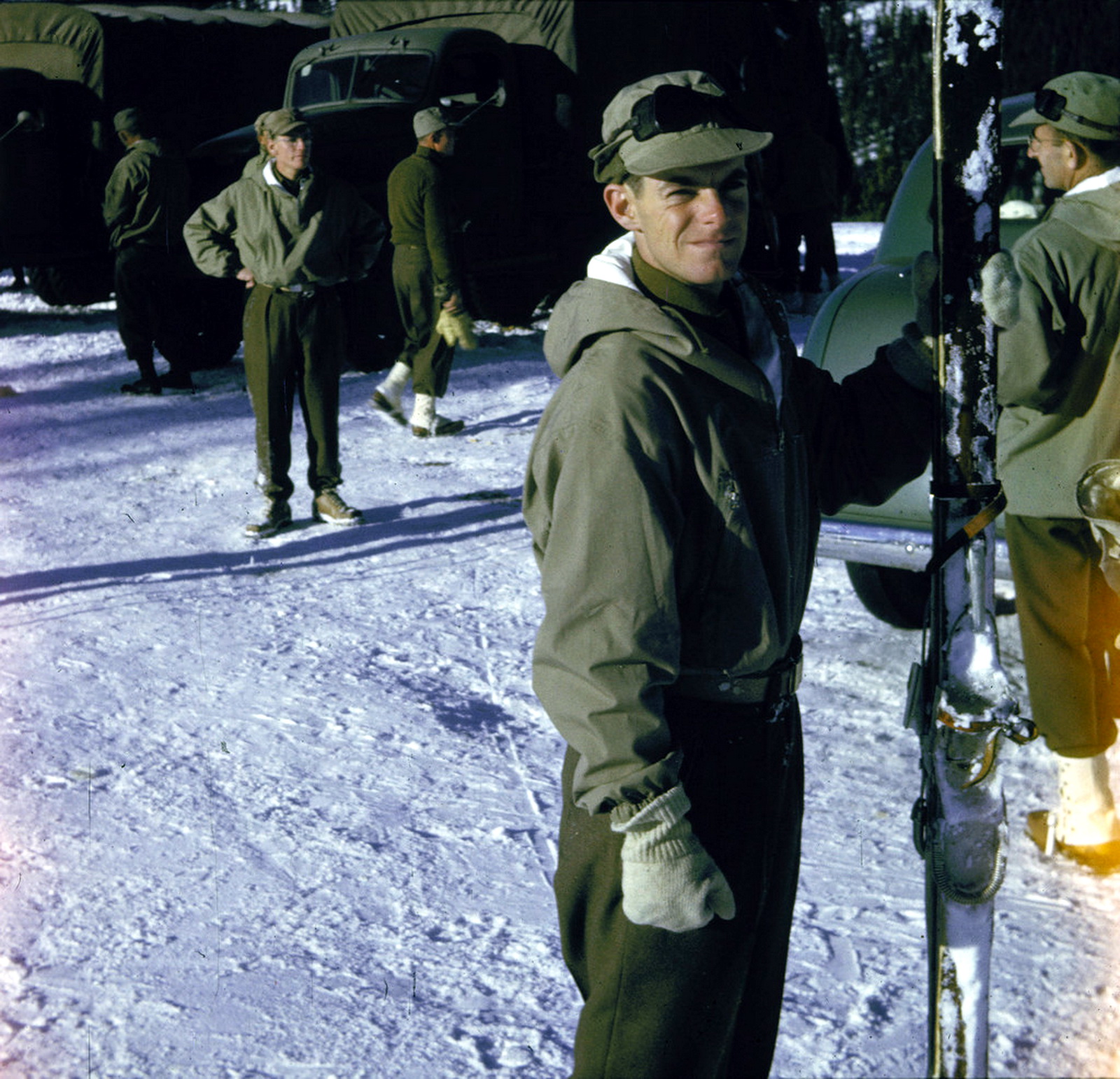
Earl Ervin Clark, a member of the 1st Battalion / 87th Headquarters Regiment / 10th Mountain Division (US Army), poses with a pair of skis at Camp Hale (Eagle County), Colorado, 1943 or 1944. Other soldiers and trucks are nearby. Clark served in the US army's elite 10th Mountain Division from its inception. The division played a key role in breaking down Nazi defences in the Spring Offensive of 1945, helping force the Italian surrender and the fall of the Third Reich.

A skilled skier since his teens, Clark took part in the vital battles for Riva Ridge and Monte Belvedere in Italy's Northern Apennines. His company scaled Belvedere, covered in ice and snow, on 19 February 1945, their hickory skis strapped to their shoulders and bayonets fixed on their M1 rifles. The German defenders, a battalion of highly-trained mountain soldiers, had assumed that the mountain, at points almost vertical, was insurmountable from the south-west and were watching for allied movements in the valley below.

They had laid mines on the steep slopes but the Americans caught them unawares. The 10th Mountain's commander, General George P Hays, had told his men: "until first light, no small arms fire, only hand grenades and bayonets." Clark recalled the last words before the silent assault. "Fix bayonets. Move out!" The next voices he heard, at the peak, were cries and screams in German.

The 10th Mountain Division soldiers, having dismantled the mines, overran the enemy and, after heavy gunfire and bayonet-to-bayonet fighting, captured the peak. Clark always gave credit to the infantrymen of the Brazilian Expeditionary Force, who flanked the Americans.

"Fog had helped in the initial assault on Riva Ridge," Clark recalled. "That gave us a bit of leeway to attack Mount Belvedere." A comrade added: "We usually had a medic with us. This time they gave us five or six. We got the message. We went up in single file. Had they spotted us, there would have been no room for us to deploy. The Germans were either having breakfast or sleeping. Our grenades were their alarm clock."

In the first three days of intense combat for Belvedere, and after several German counter-attacks, the American "mountain warriors" lost 195 dead and 850 wounded or captured. But they took around 1,000 German prisoners and pushed on towards the vital river Po. At noon on 23 April 1945 Clark was among the first allied troops to cross the Po, in 50 light canvas assault boats and under heavy fire.

Spearheading the US Fifth Army, they pushed forward to Lake Garda and cut off the Germans' main escape route to the Brenner Pass. It was one of the fastest forward movements of the war and, in the lowlands, the "Mountain Warriors" ditched their skis, swapped their snow uniforms for olive drabs and hitched rides on army trucks, tanks or their own snow-hardy M-29 Weasel assault vehicles. Hitler surrendered two weeks later.

By the end of the war the 10th Mountain Division had lost 1,000 men, with 4,000 wounded. One of Clark's comrades was 2nd-Lt Bob Dole, whose arm wound left him partially disabled but did not stop him from becoming a US Senator for Kansas and a Republican presidential candidate against Bill Clinton!

In retirement, Clark and many of his former comrades helped create a fledgling ski industry back home, based on what they had seen in the Alps and Apennines, building ski lifts, chalets and resorts and turning the US into a major skiing attraction. To this day, the "10th Mountain" are considered the fathers of the modern American ski industry and a Vail restaurant called The 10th is a paparazzo's dream, favoured by film stars and Michelle Obama as an après-ski stopover.

Clark helped found the 10th Mountain Division National (Veterans') Association and later the International Federation of Mountain Soldiers. The few surviving men who fought each other in the mountains 70 years ago still meet annually to share their common bond.

Earl Ervin Clark was born in Londonderry, Vermont in 1919. Moving with his family to Wisconsin, he learned to ski on Wilmot Hills near Chicago at the age of 13. It was as a mountaineering and ski instructor, that he caught the notice of the US National Ski Patrol, entrusted to pick out an elite unit. The US had also been impressed by white-clad Finnish mountain soldiers who had fought against the Soviet invasion early in the war.

Clark joined up on St Patrick's Day, 1942, and was assigned to 1st Battalion 87th Infantry Regiment, later to form part of the 10th Mountain Division, America's first specific mountain warfare unit. Clark trained at Camp Hale, Colorado at altitudes of around 9,000 feet and even as high as the 14,410ft Mount Rainier in Washington state. Their marching or drinking song was "90 Pounds of Rucksack", which the Division sing to this day.

After the German surrender 10th Mountain were on stand-by to invade Japan but were stood down after the Japanese surrender. Clark was on the USS Mount Vernon when the news came through that an atomic bomb had been dropped on Hiroshima. The 10th Mountain Division took part in Operation Uphold Democracy in Haiti in 1994, helicoptering in to Port-au-Prince airport in scenes reminiscent of Apocalypse Now, and went on to serve in Afghanistan.

Clark enrolled in the University of Denver under the GI Bill, got a business degree and went on to make the mountains and skiing his life. He and other 10th Mountain vets helped design pistes, became ski coaches, guides, patrollers, magazine founders, filmmakers, ski shop owners and even professional downhill and slalom racers. Clark became a volunteer for the US National Ski Patrol as a guide and instructor. He became an office manager for an ice cream distributor and later an insurance agent.

He kept skiing, remained in the Army reserve and retired in 1981 as a Lieutenant-Colonel. He set up a group of 10th Mountain vets called the Pando Commandos, who, wearing their old combat whites, give ski demonstrations in Rocky Mountain resorts and he helped run the Over-The-Hill Gang, initially a US club for older skiers and now running ski tours worldwide.

Earl Ervin Clark, mountain soldier: born Londonderry, Vermont 3 July 1919; married 1948 Betty Grunwald (deceased, one son); died Littleton, Colorado 28 December 2014


Source :
http://amyatishkin.livejournal.com/287245.html
http://www.independent.co.uk/news/people/news/lt-colonel-earl-clark-mountain-warfare-veteran-who-helped-establish-the-leisure-skiing-industry-in-10114601.html

U.S. 10th Mountain Division Men at the Door of their Barracks

Three Members of the 110th Signal Company / 10th Mountain Division (US Army), stand outside the door of their barracks at Camp Hale, Colorado, 1943 or 1944. The man on the far right is the photographer (William A. "Bill" Southworth). All are in uniform and one is carrying skis and poles. The impact of the 10th on the ski industry after the war was huge. Some of the immediate effects included the unloading of all the surplus equipment to the public, including 100,000 pairs of skis, boots, bindings and poles!  This provided an affordable opportunity for a massive amount of the population to jump into the sport.  It also opened up opportunities to produce some high-end gear.


Source :
http://amyatishkin.livejournal.com/287245.html
http://www.chrisanthony.com/the-legend-of-the-10th-mountain-division-and-the-ski-trooper/

French Renault R35 Tank in German Service

French Renault R 35 Nr.50968 "Le Hérisson" (The Hedgehog) tank of 2e Compagnie / 21e Bataillon, (commanded by Lieutenant Gout in the Battle of France in 1940), after its captured by the Germans. After the fall of France, 843 of R35s fell into German hands; 131 were used as such as Panzerkampfwagen 35R 731 (f), issued to panzer units and mainly used for security duties or driver training, or used on armoured trains; most were later rebuilt as artillery tractors and ammunition carriers after removing the turret. A considerable number, 174 according to some sources, were converted into a 47 mm tank destroyer to replace the Panzerjäger I: the 4,7 cm PaK(t) auf Panzerkampfwagen 35R(f) ohne Turm. The tank destroyer version had the turret replaced with an armoured superstructure mounting a 47mm kanon P.U.V. vz. 36 (Škoda A6) anti-tank gun. The vehicles were converted by Alkett between May to October 1941 to try and make an equivalent vehicle to the Panzerjäger I. The result was not as successful as the Panzerjäger I, mainly due to the slow speed of the R 35 and the overloaded chassis. A few were deployed in Operation Barbarossa, most were deployed in occupied territories, such as the Channel Islands, The Netherlands (with Panzerjäger-Abteilung 657, part of Panzer-Kompanie 224) and France. They fought in the battles for Normandy with Schnelle Brigade 30 in 1944 (five attached to the 3.Kompanie / Schnelle-Abteilung 517), and around Arnhem with Panzerjäger-Abteilung 657. Other possible users include 346. Infanterie-Division in Normandy and 59. Infanterie-Division who fought the 101st Airborne at Arnhem. Some of the turrets were detached from the tanks and were used on defensive fighting positions known as "Tobruks". This gave the Tobruk enhanced firepower and the gunner protection from shrapnel and small arms. Fourteen R 35 tanks, used to train tank drivers, equipped the 100. Panzer-Ersatz-Bataillon (100th Panzer Replacement Battalion) in the German 7. Armee in 1944. On 6 June 1944, they were among the first Armee-Reserve units sent into combat near Sainte-Mère-Église to oppose the American airborne landings in Normandy. Supporting a counterattack by the Grenadier-Regiment 1057, R35s penetrated the command post of the U.S. 1st Battalion 505th Parachute Infantry Regiment before being destroyed by bazooka fire.


Source :
http://www.dishmodels.ru/gshow.htm?p=12786
https://en.wikipedia.org/wiki/Renault_R35

Soldiers of sPz.Abt.508 in Italy

Two soldiers of schwere Panzer-Abteilung 508 used their spare time for sightseeing in Rome (Italy) with their staff car, 20 February 1944. This color side is interesting mainly because it provides an excellent view of the camouflage finish on the BMW 321 as well as the battalion emblem and the pink and black battalion pennant. In early February the Tiger tank battalion was sent to oppose Allied landings at Anzio. Transportation by rail ended at Ficulle in Italy, far from the enemy beachhead. Because Allied air superiority made further rail transport difficult, the battalion drove the remaining distance, via Rome. One Tiger caught fire on route and was destroyed in an explosion. Sixty percent of the Tigers suffered mechanical breakdown on the 200-kilometre (120 mi) journey through the narrow, winding, mountainous roads. By 14 February, the first company deployed piecemeal in the Anzio region near Aprilia (known as The Factory), as the second company arrived in Rome. This color slide itself is one of a series of color images of the Werkstattkompanie taken by Hans Becker. In the mid-1970s Becker's son loaned the slides to a model maker, who displayed them in the booklet "Modell Magazin - Foto Archiv". Since then the photos have appeared regularly in publications about the Tiger. Unfortunately the slides have not been returned to the son!


Source :
Book "Als Panzermann in Afrika und Italien 1942-45: Panzer Regiment 8 und schwere Panzer-Abt. 508" by Axel Urbanke and Hans Becker
https://en.wikipedia.org/wiki/508th_Heavy_Panzer_Battalion
http://forum.axishistory.com/viewtopic.php?f=47&t=73232&start=7800

Monday, February 15, 2016

Helmut Hudel


Helmut Hudel, born in 4 July 1915 at Raunheim, joined the Reichswehr in 1934 and initially served with Kraftfahr Abteilung 5, ostensibly a transport unit. It should be remembered, however, that at this time many such units were being used for the surreptitious training of Germany's future tank crews. Identified at an early stage as a potential officer, Hudel subsequently underwent training at military academy and was commissioned Leutnant in 1936, being posted to Panzer-Regiment 7, part of 10. Panzer-Division.

Two years later he was appointed to the staff of the Kriegsschule at Potsdam, remaining in that post until 1940 and missing the campaign in the West. On completion of his posting he rejoined Panzer-Regiment 7 in time to take part in the opening phases of Operation Barbarossa on the central sector of the Russian Front, seeing particularly heavy combat around Minsk and Smolensk. In early 1942 Hudel's division was badly battered in heavy fighting against the Soviet winter counter-offensive. Hudel, by now a company commander with the rank of Hauptmann, was temporarily attached to a Kampfgruppe from 20. Panzer-Division. He showed such determination, skilled leadership and gallantry in heavy fighting around Viazma that he was recommended for the Ritterkreuz (Knight's Cross), and the award was made on 27 May 1942.

That month the mauled 10. Panzer-Division was withdrawn from Russia for rest and rebuilding near Amiens in France. It remained there until December 1942, when it was shippped to North Africa to bolster Rommel's forces in Tunisia after the Allied landings in Morocco and Algeria. Now the battalion commander of I.Abteilung / Panzer-Regiment 7, Hudel once again showed considerable skill and leadership in difficult defensive fighting under heavy enemy pressure. He was rewarded with the addition of the Eichenlaub (Oak leaves) to his Knight's Cross on 2 April 1943. By 21 April his division's armored strength had been worn down to just 25 tanks; Hudel himself was transferred back to Europe in the closing days of the campaign, and avoided the captivity into which the remnants of 10. Panzer-Division passed when they surrendered to US troops.

Hudel subsequently served in Italy, where he was promoted to Major and commanded schwere Panzer-Abteilung 508, a battalion equipped with the Panzerkampfwagen VI Tiger. In late 1944 he was transferred to command the tank training and replacement battalion of the elite "Großdeutschland" division. In February 1945, Hudel took command of Panzer-Lehr-Regiment 130, the tank unit of the crack Panzer-Lehr-Division. He saw action in Holland and later against the Allied bridgehead at Remagen. By the closing weeks of the war, Panzer-Lehr-Regiment 130 had been reduced to just 15 tanks; it finally surrendered to US forces in the Ruhr Pocket.

Helmut Hudel died in retirement in 11 March 1985 at the age of 69 years.

This color slide is one of a series of color images of the Werkstattkompanie taken by Hans Becker. In the mid-1970s Becker's son loaned the slides to a model maker, who displayed them in the booklet "Modell Magazin - Foto Archiv". Since then the photos have appeared regularly in publications about the Tiger. Unfortunately the slides have not been returned to the son!


Source :
Book "Knight's Cross Oak-Leaves Recipients 1941-45" by Gordon Williamson
http://www.tiif.de/thread.php?threadid=621&sid=2d4eb416700eec368fa8d05b8617735c

U.S. Paratrooper Ready for a Jump

U.S. paratrooper braces himself in front of the door of a C-47, while learning proper jump procedures during training, mid-1940s. This photograph was obviously staged for the benefit of home front audiences. The standard procedure for exiting a C-47 in flight would have called for the trooper to stand in the doorway with both hands on the outside of the door. He is holding his static line in his left hand. After exiting from the plane, the static line would pull the cover off of his pack tray and deploy his parachute.


Source :
Book "Screaming Eagles: The 101St Airborne Division from D-day to Desert Storm" by Christopher J. Anderson
http://www.gettyimages.com/detail/news-photo/world-war-ii-paratrooper-braces-himself-in-front-of-the-news-photo/103404178

A Jeep Equipped with a Portable Radio is Loaded onto a C-47

The crew of a C-47 works with a Willys MB operator to get his ¼ ton truck (jeep) - equipped with a portable radio - on board the aircraft for transport to France. The picture was taken in England in 1944. Although experiments like this were conducted, jeeps of the U.S. Army 101St Airborne Division were most frequently landed with the division's gliders. Unlike ordinary 'leg' infantry divisions, which had 612 jeeps, the more lightly equipped airborne divisions only had 283 of this highly versatile vehicle. During World War II, the armed forces of many countries used the C-47 and modified DC-3s for the transport of troops, cargo, and wounded


Source :
Book "Screaming Eagles: The 101St Airborne Division from D-day to Desert Storm" by Christopher J. Anderson
http://historylink101.com/ww2_color/WorldWarIITransportPlanes/PICT0392.html
Gotha Go 244

The German Gotha Go 244, a powered version of the Go 242 glider, was used in limited numbers during the Second World War. The only units to be equipped with the type were the Special Purpose Battle Groups (Kampfgruppen zur besonderen Verwendung, or KGr.z.b.V.) 104 and 106. The two units converted to the Go 244 from the Junkers Ju 52 at Hagenow in the summer of 1942. Conversion training lasted until mid-June. These two photographs, which were taken there in May or June 1942, depict a brand-new machine (NI+FQ) with a large personal emblem beneath the cockpit. It consists of a red wagon with yellow lettering pulled by two horses against a large cloud. Also note the red and white rosette on the fuselage nose. Yellow Eastern Front bands have been painted on the fuselages of the aircraft. Conversion training ended on 22 June, and KGr.z.b.V. 106 returned to Russia. There it operated from Kirovograd, between Kiev and the Crimea. The Gruppe had 37 aircraft at the beginning of August. However, the Go 244 proved a disappointment. On 2 November 1942 the unit returned to Germany and relinquished its aircraft. Noteworthy features of the Go 244 were its tricycle undercarriage and opposite-handed engines, which eliminated the tendency to swing during takeoff.


Source :
Magazine "Luftwaffe im Focus", Spezial No.1 - 2003

Friday, February 12, 2016

Finnish Hämeen Cavalry Regiment in Velikaja Niva

Finnish Hämeen Ratsurykmentti (Hämeen Cavalry Regiment) in a winter patrol through the snow-covered trail in Velikaja Niva, Kareliya (Soviet Union), 15 March 1942. Horses played a vital role in the Finnish Army, supplying front-line troops and enabling the rapid transport of troops and equipment. Virtually all army units employed horses, and during the Winter War some 90,627 animals served the nation. Despite the greatly increased degree of mechanisation, 45,426 horses continued to serve between 1941 and 1944. The horses suffered high casualty rates compared to the men handling them. The horse-driven supply columns were also favourite targets for enemy airplanes and artillery. During the Winter War, the casualty rate for horses was 16.6 per cent and during the Continuation War 12.8 per cent.


Source :
Book "Finland at War: The Winter War 1939-40" by Vesa Nenye, Peter Munter & Toni Wirtanen