Gerhard
"Gerd" Barkhorn (20 March 1919 – 11 January 1983) was a German military
aviator and wing commander in the Luftwaffe during World War II. As a
fighter ace, he was the second most successful fighter pilot of all time
after fellow pilot Erich Hartmann. Other than Hartmann, Barkhorn is the
only fighter ace to ever exceed 300 claimed victories. Following World
War II, he became a high-ranking officer in the German Air Force of the
Federal Republic of Germany.
Barkhorn flew 1,104 combat sorties
and was credited with 301 victories on the Eastern Front piloting the
Messerschmitt Bf 109. In January 1945, he left JG 52 on the Eastern
Front and joined Jagdgeschwader 6 (JG 6—6th Fighter Wing) as
Geschwaderkommodore (wing commander), defending Germany from Western
Allied air attack. In April 1945, he joined Galland's Jagdverband 44 (JV
44—44th Fighter Detachment) and surrendered to the Western Allies in
May 1945 and was released later that year. After the war, Barkhorn
joined the German Air Force of the Bundeswehr, serving until 1975. On 6
January 1983, Barkhorn was involved in a car crash with his wife
Christl. She died instantly and Barkhorn died five days later on 11
January.
Barkhorn was born on 20 March 1919 in Königsberg in the
Free State of Prussia of the Weimar Republic. Today it is Kaliningrad in
Kaliningrad Oblast, the Russian exclave between Poland and Lithuania on
the Baltic Sea. He was the third of four children of
Stadtbauoberinspektor Tiefbautechniker im Straßenbau (inspector for road
construction) Wilhelm and his wife Therese. Barkhorn had two brothers,
Helmut and Dieter, and a sister Meta. The four children were all members
of the Bündische Jugend, a German youth movement. From 1925 to 1929,
Barkhorn attended the Volksschule (primary school) in Königsberg and
then the Wilhelms-Gymnasium, a secondary school, where he graduated with
his Abitur (diploma) in early 1937.
On 1 April 1937, Barkhorn
started his compulsory Reichsarbeitsdienst (Reich Labour Service) with
Arbeitsdienstabteilung 6/12, a labor service department, in Mehlkehmen,
present-day Kalinino in Kaliningrad Oblast. His Reichsarbeitsdienst
ended on 30 September. A month later, on 1 November, Barkhorn joined the
military service in the Nazi German Luftwaffe as a Fahnenjunker (cadet)
at the Air War School Klotzsche in Dresden. He started his flight
training in March 1938 at the Luftkriegsschule 2 at Gatow. His
classmates at Gatow included Julius Meimberg and Egon Mayer. On 4 March,
he made his maiden flight on a Heinkel He 72 biplane trainer. Until 25
March, accompanied by his flight instructor, he flew up to nine times
daily, flights of up to 60 minutes. His first solo flight, his 68th in
total, was flown on 29 March. In April and May, he learns to fly the
Focke-Wulf Fw 44 and Bücker Bü 131. On 1 June, he began with learning
aerobatics on the Gotha Go 145. One of his flight instructors at the
time was Franz Stigler who initially thought that Barkhorn was a bad
pilot but later graduated him with good ratings.
In December
1938, Barkhorn and the other flight students transferred from Dresden to
the airfield at Garz on the island of Usedom. On 6 December, Barkhorn
made a crash landing in a Heinkel He 51 biplane fighter and sustained
minor injuries. The pilots for the first time flew a mock combat against
one of the other pilots in January 1939. In February, the students
returned to Dresden where theoretical training was emphasized. Prior to
completing his training, Barkhorn was given home leave in the summer.
Effective as of 1 August 1939, Barkhorn was promoted to Oberfähnrich
(rank equivalent to master sergeant) and at the same time to the officer
rank of Leutnant (second lieutenant) on 27 August. His training in
Dresden ended that day.
World War II in Europe began on Friday 1
September 1939 when German forces invaded Poland and Barkhorn was
selected for specialized fighter pilot training. That day, Barkhorn was
posted to the Jagdfliegerschule Schleißheim, the fighter pilot school in
Schleißheim. Training began on the He 51, on 10 October, training
progressed to the Messerschmitt Bf 108 Taifun single-engine sport and
touring aircraft. Barkhorn first flew the Messerschmitt Bf 109 on the
morning of 21 October. His first aerial gunnery training was flown on
the He 51 on 7 November, scoring 20 out of 100 hits, a relatively poor
performance. His next attempt, flown on 16 November was even worse,
scoring only 10 out 100 hits on the target. Training in Schleißheim
ended on 23 November with an aerial gunnery training on the Bf 109 and a
navigation flight on the He 51. On 1 December, he was posted to the
Ergänzungs-Jagdgruppe Merseburg, a supplementary training unit based at
Merseburg. There, he received further training, particularly in
formation flying. He made his last two flights in Merseburg on 7 January
1940, both aerial gunnery training on a Bf 109 B. His last flight was
his 615th in total.
Upon completion of his training, he was
posted to 3. Staffel (3rd squadron) in Jagdgeschwader 2 "Richthofen" (JG
2—2nd Fighter Wing), named after the World War I fighter pilot Manfred
von Richthofen, on 10 January 1940. At the time, the squadron was based
Frankfurt-Rebstock Airfield and commanded by Hauptmann Henning
Strümpell. The squadron was subordinated to I. Gruppe (1st group) of JG 2
headed by Hauptmann Jürgen Roth. The Gruppe was equipped with the Bf
109 E and flew combat air patrols along Germany's western border during
the "Phoney War" period of World War II. In total, Barkhorn flew on 22
such missions with JG 2.
From 1 April until 30 June, Barkhorn was
posted to Fliegerausbildungs-Regiment 10 (10th Aviators Training
Regiment) based in Pardubitz, present-day Pardubice in the Czech
Republic, as a company commander. In June 1940, Barkhorn fell ill and
was diagnosed with scarlet fever. He was sent to a hospital in
Wildenschwert, present-day Ústí nad Orlicí in the Czech Republic. By
July, he had fully recovered and on 1 July was posted to the 4. Staffel
of Jagdgeschwader 52 (JG 52—52nd Fighter Wing), a squadron of II.
Gruppe. This squadron was commanded by Oberleutnant Johannes Steinhoff
while the Gruppe was led by Hauptmann Horst-Günther von Kornatzki.
Barkhorn conducted many training flights with 4. Staffel at Nordholz and
Stade. Shortly after 18 August, he was transferred to 6. Staffel. His
new Staffelkapitän (squadron leader) was Oberleutnant Werner Lederer.
Lederer commanded the Staffel until 6 October when he was transferred
and replaced by Oberleutnant Rudolf Resch. Flying from Peuplingues on 27
September, Barkhorn for the first time had enemy contact on a combat
air patrol across the English Channel during the Battle of Britain. Near
Maidstone and Chatham, the flight encountered Royal Air Force (RAF)
fighters. He flew many fighter escort missions to England, on 29
September he participated on a mission providing protection for bombers
from II. Gruppe of Lehrgeschwader 2 (LG 2—2nd Demonstration Wing)
targeting London. On 4 October, he helped escort bombers from I. Gruppe
of LG 2, and again on the following day. Barkhorn flew two further
missions in support of I. Gruppe of LG 2 on 5 October and three days
later, he escorted II. Gruppe of LG 2 and fighter bombers to London. On
10 October, he flew a courier mission, taking documents to Rouen,
Beaumont and Cherbourg, before returning to Peuplingues. On 11 and 12
October, Barkhorn flew two further missions to London. On 23 October
1940, for his service he was awarded the Iron Cross 2nd Class (Eisernes
Kreuz zweiter Klasse).
On 27 October, Barkhorn flew a further
mission, escorting bombers of LG 2 to England. Two days later, on his
38th combat mission, Barkhorn encountered Supermarine Spitfires over the
English Channel. His Bf 109 E-7 (Werknummer 5922—factory number) took
numerous hits, forcing him to make an emergency landing in the English
Channel. Floating in a small inflatable dinghy for two hours, he was
rescued by the Seenotdienst, the German air-sea rescue service. Barkhorn
flew again on 2 November. This was also the last day of operations for
II. Gruppe before it relocated to Germany again. That day, II. Gruppe
had also lost its commanding officer, Hauptmann Wilhelm Ensslen, who had
led the Gruppe since 26 August and was killed in action. Ensslen was
replaced by Hauptmann Erich Woitke. On 5 November, II. Gruppe moved to
München Gladbach, present-day Mönchengladbach, for a period of rest and
replenishment. On 3 December 1940, Barkhorn was awarded the Iron Cross
1st Class (Eisernes Kreuz erster Klasse).
On 22 December, II.
Gruppe was ordered to Leeuwarden Airfield where they were tasked with
flying fighter patrols along the Dutch North Sea coast. On 15 January
1941, the Gruppe moved to Ypenburg Airfield where they stayed until 10
February. Barkhorn's 6. Staffel also used a forward airfield at
Haamstede. From this airfield, Barkhorn flew many escort missions for
German shipping. On 10 February, II. Gruppe moved to Berck-sur-Mer. From
this airfield, the Gruppe again patrolled the English Channel and
missions to England. Barkhorn flew two more patrols on 12 February.
Three days later, he participated on a mission to Dover-Dungeness. On 6
March, II. Gruppe was ordered to Maldegem, where they were joined by
Walter Krupinski, someone Barkhorn had befriended during training,
having completed his training with the Ergänzungsgruppe. Until 24 March,
Barkhorn flew further combat air patrols, mostly in the area of Ostend
to Calais followed by a shipping escort mission on 27 March. On 15
April, the Gruppe moved again, this time to Raversijde. On 27 April, II.
Gruppe was ordered to Katwijk where they received the new Bf 109 F
variant. On 24 May, the Gruppe returned again to Raversijde. During this
time, Barkhorn flew many training and patrol missions on the Bf 109 F-2
until 20 April when he received the Front Flying Clasp of the Luftwaffe
in Silver (Frontflugspange in Silber). II. Gruppe was withdrawn from
the Channel on 9 June and headed east.
In preparation of
Operation Barbarossa, the German invasion of the Soviet Union, II.
Gruppe of JG 52, without a period of replenishment in Germany, was
ordered to airfields close to the German-Soviet demarcation line. While
the Gruppenstab (group headquarters unit) and 4. Staffel were based at
Suwałki in northeastern Poland, 5. and 6. Staffel were transferred to a
forward airfield at Sobolewo. For the invasion, II. Gruppe of JG 52 was
subordinated to the Geschwaderstab (headquarters unit) of Jagdgeschwader
27 (JG 27—27th Fighter Wing). The Geschwader was part of the VIII.
Fliegerkorps commanded by Generaloberst Wolfram Freiherr von Richthofen
which supported the northern wing of Army Group Centre.
On 22
June, the German forces launched the attack on the Soviet Union which
opened the Eastern Front. That day, Barkhorn flew five combat missions
in support of the invasion. On his third mission, he was credited with a
ground victory over a Polikarpov I-15 fighter aircraft during a
strafing attack on a Soviet airfield. Barkhorn claimed his first aerial
victory by shooting down a Red Air Force Ilyushin DB-3 bomber on 2 July,
flying his 120th combat sortie. That day, II. Gruppe claimed 19 aerial
victories in combat near Barysaw. The next day, II. Gruppe moved further
east to an airfield at Sloboda, east of Minsk where they stayed for two
days. The Gruppe then moved to Lyepyel where they supported
Panzergruppe 2 and 3 in their advance to Vitebsk and Polotsk. On 12
July, the Gruppe moved to Kamary, an airfield in the western parts of
Vitebsk. Barkhorn flew many combat missions during this period without
claiming a further aerial victory. On 16 July, he was tasked with
shuttling a Bf 109 back to Werneuchen in Germany for repairs, a task
normally given to junior pilots. Ten days later, he returns to the
Eastern Front. By this time, II. Gruppe had advanced to Andrejewka
airfield near Smolensk. On 28 July, Barkhorn claimed his second aerial
victory over a Polikarpov I-16 fighter. The following day, he was
credited with the destruction of a DB-3 bomber, his third aerial
victory.
On 5 August, II. Gruppe was ordered to relocate to
Soltsy, west of Lake Ilmen, in support of the 16th Army and Army Group
North. In the following days, Barkhorn flew many ground support, combat
air patrols and Junkers Ju 87 dive bomber escort missions to the combat
area near Shimsk and Veliky Novgorod. He claimed the destruction of an
I-18 fighter, an early German designation for a Mikoyan-Gurevich MiG-1
fighter, on 19 August. The next day, II. Gruppe was ordered to an
airfield at Spasskaya Polist, south of Chudovo and north of Lake Ilmen.
Two days later, Barkhorn escorted a Focke-Wulf Fw 189 aerial
reconnaissance aircraft to Chudovo on his first mission of the day. On
his second mission that day, he claimed a Vultee V-11 attack aircraft
which was an Ilyushin Il-2 attack aircraft. On 25 August, Barkhorn was
credited with two aerial victories, a Polikarpov I-153 fighter on his
first mission of the day and later an I-18 fighter. On 27 August,
Barkhorn's Front Flying Clasp of the Luftwaffe was upgraded to Gold
(Frontflugspange in Gold).
On 2 September, II. Gruppe moved to
Lyuban, staying there until end-September. From there, the Gruppe flew
missions against Shlisselburg, Mga and Leningrad. II. Gruppe's
subordination to JG 27 ended on 20 October and they came under the
command of the Stab of JG 52. Barkhorn was promoted to Oberleutnant
(first lieutenant) on 1 November 1941. He claimed his tenth and last
aerial victory in 1941 on a meteorological reconnaissance mission
(Wetterflug) over an I-61, an early German designation for a
Mikoyan-Gurevich MiG-3 fighter,[36] on 30 November.
On 24 January
1942, having been withdrawn from the Eastern Front, II. Gruppe arrived
in Jesau near Königsberg, present-day Kaliningrad in Russia, for a
period of recuperation and replenishment. In Jesau, the Gruppe received
many factory new Bf 109 F-4 aircraft. On 14 April, II. Gruppe received
orders to move to Pilsen, present-day Plzeň in the Czech Republic, for
relocation to the Eastern Front.
While II. Gruppe was based at
Jesau, Barkhorn was appointed Staffelkapitän of 4. Staffel of JG 52 on 1
March 1942. He succeeded Steinhoff in this capacity who had been given
command of II. Gruppe of JG 52. The unit then moved to Wien-Schwechat on
24 April before flying to Zürichtal, present-day Solote Pole, a village
near the urban settlement Kirovske in the Crimea. There, II. Gruppe
participated in Operation Trappenjagd, a German counterattack during the
Battle of the Kerch Peninsula, launched on 8 May. On 16 May, II. Gruppe
relocated to Artyomovsk, present-day Bakhmut where JG 52 supported the
German forces fighting in the Second Battle of Kharkov.
On 22
June, German forces launched Operation Fridericus II, the attack on
Kupiansk, a preliminary operation to Case Blue, the strategic summer
offensive in southern Russia. That day, Barkhorn for the first time
became "ace-in-a-day", claiming five Lavochkin-Gorbunov-Gudkov LaGG-3
fighters shot down, taking his total to 26 aerial victories. Barkhorn
again became an "ace-in-a-day" on 19 July, flying four missions that
day, he shot down six Soviet fighters taking his total to 51 aerial
victories. His claims that day include two Hawker Hurricanes, three
LaGG-3s and an I-16 shot down. The following day, he increased his total
number of aerial victories to 56, again an "ace-in-a-day" achievement.
With Leutnant Waldemar Semelka as his wingman, Barkhorn shot down five
LaGG-3 fighters.
On 22 July, II. Gruppe moved to an airfield
named Nowy Cholan, approximately 200 kilometers (120 miles) northeast of
Rostov-on-Don. On 24 July, Barkhorn transferred to an airfield named
Nikolajewskaja, approximately 15 minutes flying time closer to front
lines. During this day, Barkhorn claimed three further aerial victories,
increasing his total to 64. The following day, he flew on an escort
mission for a Fieseler Fi 156 Storch heading for the front lines. His Bf
109 F-4/R1 (Werknummer 13388—factory number) took a hit from
anti-aircraft artillery, resulting in a forced landing near Morosow.
Although the damage to the aircraft was only minor, Barkhorn was
severely injured in his lower leg and had to be flown out. He was taken
to a makeshift hospital installed at the Olympiapark Berlin. During his
convalescence, Barkhorn was temporarily replaced by Semelka who was
killed in action on 21 August. Command was then given to Leutnant Otto
Leicher who was also killed in action. In consequence, Krupinski was
transferred from 6. Staffel, taking command of 4. Staffel on 10
September. In July 1942, Barkhorn had destroyed 30 Soviet aircraft.
While hospitalized, on 21 August 1942, he was awarded the German Cross
in Gold (Deutsches Kreuz in Gold) and two days later the Knight's Cross
of the Iron Cross (Ritterkreuz des Eisernen Kreuzes).
In late
September, following his convalescence, Barkhorn returned to his 4.
Staffel. By this time, II. Gruppe had made several relocations was then
based at Maykop since 21 September. On 2 October, he logged his first
brief maintenance flight after returning to the front. On 7 October,
Barkhorn, with Unteroffizier Werner Quast as his wingman, claimed a
LaGG-3 fighter shot down north of Tuapse. Later that day, he claimed
three further LaGG-3 fighters destroyed. On 19 December 1942, Barkhorn
had raised his score to 101 victories. That day, he became the 32nd
Luftwaffe pilot to achieve the century mark. Barkhorn came to respect
the Soviet pilots. On one occasion he was involved in a forty-minute
dogfight with a LaGG-3. "Sweat was pouring off me just as though I had
stepped out of the shower", he recalled: despite having a faster
aircraft he was simply unable to get a bead on the Russian pilot.
On
9 January 1943, Barkhorn claimed his 105th aerial victory. His victims
included Lieutenant Vasiliyev, and Hero of the Soviet Union Podpolkovnik
Lev Shestakov of the 236 IAP Fighter Regiment. Barkhorn strafed their
Yakovlev Yak-1 fighters until they caught fire. Both pilots survived. On
11 January 1943, Barkhorn was awarded the Knight's Cross of the Iron
Cross with Oak Leaves (Ritterkreuz des Eisernen Kreuzes mit Eichenlaub).
Barkhorn claimed his 120th aerial victory on 27 February, four days
later he went on home leave. During his vacation, he was presented the
Oak Leaves to his Knight's Cross and married his fiancé, Christine
Tischer, also known as Christl, in Tegernsee. The marriage produced
three daughters, Ursula born 1943, Eva born 1945 and Dorothea born 1954.
Barkhorn
returned to his unit on 23 April. At the time, II. Gruppe was based at
Anapa located on the northern coast of the Black Sea near the Sea of
Azov and was fighting in the Battle of the Caucasus. During his absence,
Steinhoff as commander of II. Gruppe had been replaced by Hauptmann
Helmut Kühle. On 28 April, Barkhorn claimed his 121st aerial victory, a
LaGG-3 fighter. Barkhorn's 157 aerial victory, claimed on 23 August, was
also II. Gruppe's 2000th aerial victory in total. From 4 to 30 August,
Barkhorn temporarily led I. Gruppe of JG 52. The acting commander of I.
Gruppe, Hauptmann Johannes Wiese had fallen ill on 1 August and needed
to be replaced during his recovery.
Barkhorn was appointed
Gruppenkommandeur (group commander) of II. Gruppe of JG 52 on 1
September 1943. He replaced Kühle who was transferred. Command of 4.
Staffel was passed on to Leutnant Heinrich Sturm. On 5 September, he
shot down Hero of the Soviet Union and Soviet fighter ace Nikolay
Klepikov, an ace with 10 personal and 32 shared victories. This was
offset by the loss of II. Gruppe's 173-victory ace Oberleutnant Heinz
Schmidt. The two Lavochkin La-5s shot down by Barkhorn were his 165th
and 166th aerial victories. Barkhorn reached the 200 mark on 30 November
1943. This achievement earned him a named reference in the
Wehrmachtbericht on 2 December. That day, he also became an
"ace-in-a-day" for the fourth time in combat near Tuzla Island. On 28
December, he yet again became an "ace-in-a-day", taking his total number
of aerial victories to 222. On 23 January 1944, Barkhorn became the
first German pilot to fly 1,000 combat missions. At the time, Barkhorn's
regular wingman was Heinz Ewald.
The main German fighter unit
covering the Crimea and Kuban was his II. Group of JG 52 and in the
three months between December 1943 and 13 February 1944 the unit claimed
350 victories, of which 50 were claimed by Barkhorn personally. On 13
February 1944, he reached 250 aerial victories. Barkhorn was the third
pilot to reach this total, earning him a second named reference in the
Wehrmachtbericht on 14 February. For several days, Barkhorn was grounded
and did not fly any further combat missions. He claimed his next aerial
victory on 25 February over a Petlyakov Pe-2 bomber.
On 2 March
1944, he was awarded the Knight's Cross of the Iron Cross with Oak
Leaves and Swords (Ritterkreuz des Eisernen Kreuzes mit Eichenlaub und
Schwertern). The presentation of the Swords was made at the
Führerhauptquartier (Führer Headquarter) on 24 March. Barkhorn took an
overnight train to the Führerhauptquartier from the Anhalter Bahnhof in
Berlin. On the train he met fellow JG 52 pilots Krupinski, Wiese and
Hartmann, who were to receive the Oak Leaves to the Knight's Cross. At
the Führerhauptquartier they joined Kurt Bühligen, Horst Ademeit,
Reinhard Seiler, Hans-Joachim Jabs, Dr. Maximilian Otte, Bernhard Jope
and Hansgeorg Bätcher from the bomber force, and the Flak officer Fritz
Petersen, all destined to receive the Oak Leaves. The travelers assumed
that they were heading for the Wolf's Lair in East Prussia but the train
was heading for the Berghof in Berchtesgaden. On the train, all of them
got drunk on cognac and champagne. Supporting each other and unable to
stand, they arrived at Berchtesgaden. Major Nicolaus von Below, Hitler's
Luftwaffe adjutant, was shocked. After some sobering up, they were
still intoxicated. Hartmann took a German officer's hat from a stand and
put it on, but it was too large. Von Below became upset, told Hartmann
it was Hitler's and ordered him to put it back. Barkhorn was sent on a
propaganda tour in Germany, visited Jagdgeschwader 11 (JG 11—11th
Fighter Wing) at Wunstorf Airfield and was promoted to Major (major) on 1
April 1944. He returned to his II. Gruppe in late April, which was then
based at Chersonesus at Sevastopol.
Barkhorn was credited with
shooting down three Yakovlev Yak-7 fighters on 26 April, a further Yak-7
the following day, and again three Yak-7 fighters on 28 April. Barkhorn
thus surpassed Walter Nowotny who at the time was credited with 256
aerial victories. On 25 May, Barkhorn was ordered to transfer one
Staffel to the west in Defense of the Reich. Barkhorn selected Leutnant
Hans Waldmann's 4. Staffel which was officially assigned to the II.
Gruppe of Jagdgeschwader 3 "Udet" (JG 3—3rd Fighter Wing), at the time
under the command of Hauptmann Hans-Ekkehard Bob, and later by Hauptmann
Herbert Kutscha. Two days later, II. Gruppe was moved to Huși. On 30
May, Barkhorn was credited with shooting down two Bell P-39 Airacobra.
The following day, he claimed his 273rd aerial victory and was shot down
by Soviet fighters and hospitalized for four months. On that day,
Barkhorn was escorting Ju 87 dive bombers from III. Gruppe of
Schlachtgeschwader 2 (SG 2—2nd Ground Attack Wing) headed by Major
Hans-Ulrich Rudel on a ground support mission to the combat area at the
Prut. Barkhorn claimed two P-39s fighters, an Il-2 ground attack
aircraft and Yak-9 fighter. He was then shot down in his Bf 109 G-6
(Werknummer 163195) by a P-39 fighter. Severely wounded in his right arm
and leg, he made a forced landing near Iași. It had been his sixth
mission of the day and he was attacking Soviet bombers when he was
attacked from behind. Following immediate treatment at a field hospital
in Huși, he was evacuated to Bad Wiessee for convalescence. With
Barkhorn sidelined, Hartmann surpassed his total, taking his total to
301 aerial victories. Following this achievement, Hartmann was sent on
home leave and married at Bad Wiessee on 10 September. Barkhorn, who was
still recovering in Bad Wiessee at the time, attended the wedding and
became Hartmann's best man.
Eventually returning to his unit the
psychological damage and combat stress on Barkhorn became apparent;
sitting in his cockpit he became overcome with anxiety, and even when
flying with friendly aircraft behind him he felt intense fear. It took
several weeks for him to overcome this condition. Returning to combat in
October he claimed his 275th victory on 14 November. Over the next few
weeks Barkhorn added another 26 victories, scoring his 301st (and final)
victory on 5 January 1945.
On 1 January 1945, the Luftwaffe
launched Operation Bodenplatte, a failed attempt to gain air superiority
during the stagnant stage of the Battle of the Bulge. In this attack,
Jagdgeschwader 6 (JG 6—6th Fighter Wing) lost its Geschwaderkommodore
(wing commander), Oberstleutnant Johann Kogler, who was taken prisoner
of war. Following Operation Bodenplatte, JG 6 relocated from the Western
Front to the Eastern Front where it was based at Tschenstochau,
present-day Częstochowa in southern Poland. On or near 23 January,
Barkhorn took command of JG 6, the Geschwaderstab had just moved from
Schroda, present-day Środa Wielkopolska, to Sorau, present-day Żary. At
the time, the Geschwaderstab was equipped with the Focke-Wulf Fw 190 A-8
and A-9. While the three groups of JG 6 were equipped with the Bf 109
G-14 and the Fw 190 A, the Geschwaderstab was equipped with Fw 190 D-9
in February.
Barkhorn led this unit until the end-March 1945.
During his ten weeks tenure as Geschwaderkommodore of JG 6, he did not
claim any aerial victories. He had difficulties adjusting to the Fw 190
D-9. He later stated that he would have needed 50 more flights to master
the aircraft. It is unclear whether Barkhorn flew the Fw 190 D-9 in
combat. Nevertheless, on 11 February, he was presented the Front Flying
Clasp of the Luftwaffe in Gold with Pennant "1,100" (Frontflugspange in
Gold mit Anhänger "1,100"). Shortly after 23 March, Barkhorn was
relieved of command. His wingman later stated that Barkhorn was forced
to leave out of medical reasons. At the time he was suffering from
severe physical and mental strain after four years of combat.
Following
the dismissal of Generalleutnant Adolf Galland as General der
Jagdflieger (Inspector of Fighters), Galland was given the opportunity
by Hitler to prove his ideas about the Messerschmitt Me 262 jet fighter.
He had hoped that the Me 262 would compensate for the numerical
superiority of the Allies. In consequence, Galland formed Jagdverband 44
(JV 44—44th Fighter Detachment) at Brandenburg-Briest on 24 February
1945. Galland was also given a carte blanche with respect to staffing
and began recruiting his pilots. On 31 March, JV 44 had relocated to
Munich-Riem. Galland and Steinhoff, who had also joined JV 44, drove to
Bad Wiessee where Barkhorn and Krupinski were recovering. Both pilots
accepted Galland's offer and joined JV 44. Barkhorn found flying the Me
262 over the western front difficult and he did not score any victories
in it. On 21 April 1945, he flew his 1,104th and last mission. One of
the engines of his aircraft flamed out as he was approaching an enemy
bomber formation and he was forced to make an emergency landing. As he
approached the airfield, his jet was attacked by several prowling North
American P-51 Mustang fighters. Barkhorn managed to land his burning
plane though he received a slight wound as a result of this action when
the cockpit canopy – which on the Me 262 A, flipped open to starboard,
like a Bf 109's did – prior to crash landing, slammed shut on his neck.
On 4 May, JV 44 surrendered to U.S. forces at Maxglan, near Salzburg.
Barkhorn and other pilots were taken to a makeshift prisoner of war camp
near Bad Aibling. Five days later, a U.S. officer was looking for JV 44
pilots and Barkhorn, Krupinski, Karl-Heinz Schnell, Erich Hohagen and
Waldemar Wübke stepped up. The men were then taken to Heidelberg,
Wiesbaden-Erbenheim and flown to England for interrogation near London.
In June, Barkhorn was taken to Southampton and then with a ship to
Cherbourg where he was interred in a prisoner of war camp near
Foucarville.
Barkhorn was released as a prisoner of war on 3
September 1945. He then returned to Tegernsee to be reunited with his
family. There, he was also joined by his mother who had managed to
escape from Königsberg. In October, Barkhorn first employment as an
auxiliary worker was with Linhof, a manufacturer of cameras, based in
Munich. A year later, he found employment in Grünwald. His employment in
Grünwald ended in 1949. Following a brief period of unemployment, he
took a course at Volkswagen in November 1949. In December, he was hired
by Auto Junk, a Volkswagen dealership in Trier, at first as head of
technical field services. Four years later, Barkhorn was promoted to
head of facility and service management.
Following the decision
of the Cabinet of Germany to rearm the Federal Republic of Germany,
Barkhorn was approached by the Federal Ministry of Defense in late 1955.
He accepted the offer, and on 2 January 1956 joined the newly created
German Air Force, at the time referred to as the Bundesluftwaffe. On 19
June 1956, Barkhorn was again promoted to the rank of Major, then
followed by his oath of allegiance. The first three Bundesluftwaffe
pilots to receive jet aircraft training were Steinhoff, Barkhorn's
former squadron commander during World War II, Dietrich Hrabak and Kurt
Kuhlmey. All three of them were trained by the United States Air Force
(USAF) in the USA. Barkhorn, along with Krupinski and Herbert Wehnelt,
belonged to the second batch of pilots which were sent to England and
were trained by the RAF. At first, Ralph von Rettberg had been
considered for training in England. Von Rettberg reconsidered and
Krupinski then suggested to give the now vacant training position to
Günther Rall. Rall however was already scheduled for a training in the
U.S.. In consequence, the vacant training position was given to
Barkhorn.
The three pilots were welcomed by the German ambassador
in the UK, Hans von Herwarth. Training began at RAF Feltwell on 19
January 1956 on the Percival Provost, a propeller driven trainer
aircraft. The pilots completed their refresher training on 23 March.
Barkhorn then advanced to the de Havilland Vampire jet aircraft.
Barkhorn, Krupinski and Wehnelt complete this training in May 1956. In
June, the pilots trained on the Hawker Hunter for ten weeks. On 18 June
1956, Barkhorn, Krupinski and Wehnelt received the RAF aircrew brevet
from Air Vice-Marshal George Philip Chamberlain in Stanford Park.
Following his return to Germany, Barkhorn was appointed squadron leader
of 1. Staffel of the Waffenschule der Luftwaffe 30 (WaSLw 30—Air Force
Weapons School 30). Based at Fürstenfeldbruck Air Base, the training
unit was commanded by Krupinski and later became the
Jagdbombergeschwader 33 (JaboG 33—Fighter-Bomber Wing 33). On 1 July
1957, Barkhorn succeeded Krupinski as commander of the weapons school
which was then moved to Büchel Air Base. From 1 April 1957 to 31
December 1962, he commanded the Jagdbombergeschwader 31 "Boelcke" (JaboG
31—Fighter-Bomber Wing 31), initially equipped with the Republic F-84F
Thunderstreak. During this timeframe, Barkhorn was promoted to
Oberstleutnant (lieutenant colonel) on 28 April 1958, effective as of 12
May 1958. Because Barkhorn had been separated from his family for more
than two years, he requested to be transferred to a position located in
southern Germany on 13 October 1958. This request was denied. On 28
September 1960, Barkhorn was promoted to Oberst (colonel). In May and
June 1961, Barkhorn attended the 4. Staffel of the Waffenschule der
Luftwaffe 10 (WaSLw 10—Air Force Weapons School 10) at Oldenburg Air
Base. There, he was trained to fly the Lockheed F-104 Starfighter. In
1962, JaboG 31, under the command of Barkhorn, was the first unit to
complete transition to the fighter bomber F-104 G. This event was to be
celebrated at the Nörvenich Air Base on 20 June 1962. The day before,
the aerobatics team of the Bundesluftwaffe, led by their flight
instructor Captain Jon Speer from the USAF, practiced the diamond
formation for the celebration. Flying too fast and too low, the four
F-104 F Starfighters crashed near Balkhausen, present-day part of
Kerpen. The pilots Speer, Bernd Kuebart, brother of Jörg Kuebart, Wolf
von Stürmer and Hein Frye were all killed in the accident. The diamond
formation was forbidden after the accident. Barkhorn had found out that
pilots of JaboG 31 had also practiced this formation flying their F-104 G
fighter bombers. On 1 January 1963, Barkhorn was transferred to the
Führungsstab der Luftwaffe (German Air Staff), a department of the
Federal Ministry of Defense.
In 1964, Barkhorn was posted to the
staff of Luftwaffen-Erprobungskommando (Air Force Test Command). From
October 1964 until November 1965, Barkhorn headed the six-man
Bundesluftwaffe contingent of the Tripartite Kestrel Evaluation Squadron
at RAF West Raynham, Norfolk, England. The squadron's mission was to
evaluate the military capabilities of the V/STOL Kestrel, the Hawker
Siddeley P.1127 and forerunner of the Hawker Siddeley Harrier V/STOL
aircraft. The squadron consisted of military pilots and ground staff
from three nations: Britain, USA and West Germany. In addition to being
one of the squadron pilots, Barkhorn also served as one of the
squadron's two deputy commanders. During one mission on 13 October 1963,
he crash-landed a Hawker Siddeley Kestrel FGA.1, XS689, No. 9, at RAF
West Raynham, when he apparently cut thrust one meter above ground,
wiping out the undercarriage. A Luftwaffe experten with 301 kills, he is
said to have commented, "Drei hundert und zwei!" as he was helped from
the jet. At the conclusion of the evaluation, Barkhorn then accompanied
the American contingent to the U.S., where he assisted in that nation's
continuing trials of six of the Kestrels that had been shipped to the
U.S. and renamed the XV-6A.
In April 1968, Barkhorn became a
member of the Air Force Staff. He was then transferred to the Fourth
Allied Tactical Air Force (4 ATAF) and the AIRBALTAP, Allied Forces
Baltic Approaches at the headquarters in Karup, Denmark. On 10 September
1969, with the permission of the President of Germany, he was given the
temporary rank of Brigadegeneral (brigadier general), the official
promotion followed on 14 May 1970, effective as of 1 April. In February
1972, Barkhorn was informed that his assignment to AIRBALTAP would have
to be extended until 1 October 1973 because there were no vacant
positions for a Brigadegeneral in Germany at the time. As of 1970, the
first generation senior Bundesluftwaffe officers started going into
retirement. Steinhoff, who had advanced in career to Inspector of the
Air Force, had defined a small group of second generation leaders, among
them Krupinski, Rall, Gerhard Limberg and Friedrich Obleser. At first,
Barkhorn was also a member of this inner circle. However, Rall, who
succeeded Steinhoff as Inspector of the Air Force in 1971, attested that
Barkhorn lacked the toughness and ability to work under pressure
required for a higher command position in the Bundesluftwaffe.
In
early 1973, Rall had promised Barkhorn command of the 1st Luftwaffe
Division, an offer that was later withdrawn. Following his assignment to
AIRBALTAP, Barkhorn was promoted to Generalmajor (major general) on 1
October 1973. Barkhorn, whose aspiration for an higher command position
in the Bundesluftwaffe was unfulfilled, asked to be released from active
service in early 1974. This request was initially refused until in
February 1975 his retirement process was initiated. On 16 April 1975, he
requested that the authorities spare him from a personal handout of his
retirement papers. His last position was Chief of Staff of the Second
Allied Tactical Air Force (2 ATAF), a NATO military formation under
Allied Air Forces Central Europe based in Ramstein Air Base. He retired
from active service on 30 September 1975.
On 6 January 1983,
Barkhorn was driving his wife Christl and their friend Reichsfreiherr
Walter von Loë on a wintry highway close to the interchange Frechen,
near Cologne, when they were involved in a serious car accident which
was not Barkhorn's fault. Christl was thrown from the vehicle and killed
instantly, while Barkhorn and von Loë were taken to a nearby hospital.
Although Barkhorn had sustained severe internal injuries, he was still
conscious when he arrived at the hospital. He asked the doctor about his
wife, and learned that she had not survived the accident. Shortly
afterwards, he fell into a coma. Von Loë died two days later. Barkhorn
died on 11 January without regaining consciousness.
On 14
January, Barkhorn and his wife were buried in Tegernsee. He was given a
military funeral, with many senior officers of the Bundesluftwaffe in
attendance. Oberst Gert Overhoff, the Geschwaderkommodore of JaBoG 31
"Boelcke", carried his military decorations pillow. Generalleutnant
Obleser, the Inspector of the Air Force, and Steinhoff gave a eulogy.
According
to US historian David T. Zabecki, Barkhorn claimed 301 victories in
1,100 combat missions. He was shot down nine times, bailed out once and
was wounded twice. Author Spick states his total number of combat
missions was 1,104. Matthews and Foreman, authors of Luftwaffe Aces –
Biographies and Victory Claims, researched the German Federal Archives
and found records for 300 aerial victory claims, plus one further
unconfirmed claim. All of his aerial victories were claimed on the
Eastern Front.
Awards
Pilot's Badge (3 May 1939)
Iron Cross 2nd class (23 October 1940)
Iron Cross 1st class (3 December 1940)
Front Flying Clasp of the Luftwaffe in Silver (20 April 1941)
Front Flying Clasp of the Luftwaffe in Gold (27 August 1941)
Front Flying Clasp of the Luftwaffe in Gold with Pennant (6 October 1942)
Front Flying Clasp of the Luftwaffe in Gold with Pennant "1,100" (11 February 1945)
Combined Pilots-Observation Badge
Honor Goblet of the Luftwaffe on 20 July 1942 as Oberleutnant and Staffelkapitän
Wound Badge in Black (25 July 1942)
German Cross in Gold on 21 August 1942 as Oberleutnant in the 4./Jagdgeschwader 52
Eastern Medal (31 August 1942)
Crimea Shield (15 March 1943)
Slovakian Medal of Valor in Silver 2nd Class (17 August 1943)
Knight's Cross on 23 August 1942 as Oberleutnant and Staffelkapitän of the 4./Jagdgeschwader 52
175th Oak Leaves on 11 January 1943 as Oberleutnant and Staffelkapitän of the 4./Jagdgeschwader 52
52nd Swords on 2 March 1944 as Hauptmann and Gruppenkommandeur of the II./Jagdgeschwader 52
With
an unknown date of presentation, Barkhorn was also awarded the
Hungarian Cross of Valor, the Croatian Medal of Valor in Silver, and the
Wehrmacht Long Service Award for four years of service.
Dates of rank
Wehrmacht
27 August 1939: Leutnant (second lieutenant)
1 November 1941: Oberleutnant (first lieutenant)
1 April 1943: Hauptmann (captain)
1 April 1944: Major (major)
Bundeswehr
19 June 1956: Major
12 May 1958: Oberstleutnant (lieutenant colonel)
28 September 1960: Oberst (colonel)
10 September 1969: Brigadegeneral (brigadier general; TR—temporary rank)
1 April 1970: Brigadegeneral (brigadier general)
1 October 1973: Generalmajor (major general)
Source :
http://alifrafikkhan.blogspot.com/2011/07/album-foto-berwarna-perwira-dan_5529.html
https://en.wikipedia.org/wiki/Gerhard_Barkhorn
 German forces arrive in Dunkirk. The sea front at Dunkirk photographed immediately after the completion of the evacuation of the British Expeditionary Force earlier in the day. Vehicles and troops of the German mobile assault unit Motorensturm 13, drawn up on the sea front at Dunkirk near one of the unit's light anti-tank guns.
 German forces arrive in Dunkirk after the completion of the evacuation of the British Expeditionary Force earlier in the day. Under the direction of their German captors, French troops push away an immobilised British Universal Carrier tracked vehicle, clearing the blocked road into Dunkirk. This picture was taken by Hermann Weper, an officer serving with Maschinengewehr-Bataillon 52, on 4 June 1940 following the seizure of Dunkirk.
 German forces move into Dunkirk. Disarmed French soldiers file pass German officers on the outskirts of Dunkirk. The evacuation of the British Expeditionary Force had been completed a few hours earlier.
 German forces move into Dunkirk hours after the evacuation of the British Expeditionary Force. Curious German officers inspect the memorial to the French aviation pioneer, Louis Bleriot on the sea front at Dunkirk. It is surrounded by German vehicles and the litter of the British evacuation.
 On the outskirts of Dunkirk, German officers confer by their vehicles at the roadside before moving into the town.
 On the outskirts of Dunkirk, a German officer interrogates two captured French officers who sit under guard near a roadside table laden with wine bottles. A German inflatable rubber dinghy is visible behind the table.
 German forces move into Dunkirk hours after the evacuation of the British Expeditionary Force was completed. A beached French coastal patrol craft at low tide at Dunkirk. The ship is armed with a 75mm canon on its foredeck and probably dates from the First World War. A British Universal Carrier and a bicycle lie abandoned half buried in the sand.
 A photo taken by Hermann Weper, an officer serving with Maschinengewehr-Bataillon 52, on 4 June 1940 following the seizure of Dunkirk: German forces arrive in Dunkirk. The sea front at Dunkirk photographed immediately after the completion of the evacuation of the British Expeditionary Force earlier in the day. The crew of a 20mm Flak 38 gun of the German mobile assault unit Motorensturm 13 stand guard on the seafront. The gun is covered with a camouflage shelter quarter. Debris left by the evacuating British forces is visible in the background.
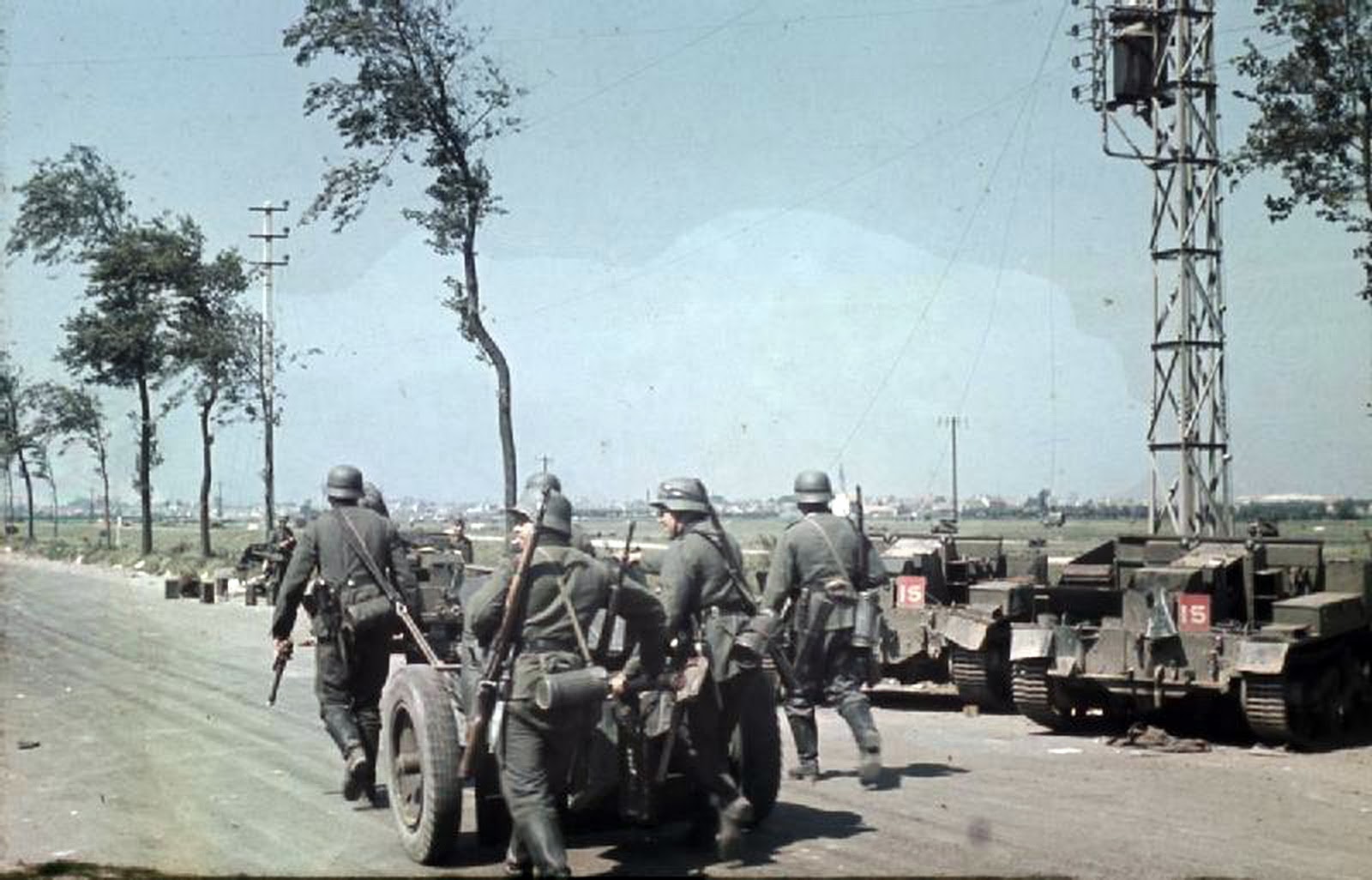 German troops pulling a 37mm anti-tank gun along a road near Dunkirk. Immobilised British Scout carriers are parked at the side of the road


.jpg)


