Wednesday, July 22, 2020

The Explosion of ST Voorbode


The Dutch steam trawler Voorbode was a fishing vessel, until it was confiscated by the Germans during World War II and used for military transport. In April 1944, it was on its way from Oslo to Kirkenes when it faced mechanical problems, forcing it to seek repair in Bergen, Norway. Due to lack of control, the ship was allowed entrance to Bergen harbour loaded with 124,000 kg (273,000 lb) of explosives, even though the ship did not satisfy security regulations and should not have been allowed into major cities with this cargo.

On April 20 at 8:39, the ship exploded at the quay in the center of Bergen. The force of the explosion caused a water column that was hundreds of metres high, spreading heavy debris. Several ships were thrown on land and Voorbode's anchor was later found on the 417-metre-high (1,368 ft) mountain Sandviksfjellet at 60.41756°N 5.34043°E at a distance of 3 km away from the blast area. The air pressure from the explosion and the tsunami that followed flattened whole neighbourhoods near the harbour; then fires broke out and further destroyed the wooden houses, leaving 5,000 people homeless; 160 people were killed and 5,000 wounded, mostly civilians. The Nykirken was among the buildings which were severely damaged.

The Germans initially tried to conceal the extent of the catastrophe, probably because it exposed their failure to maintain security regulations. Because the explosion occurred on Adolf Hitler's birthday, there was some suspicion of sabotage, but investigations revealed that the explosion was an accident caused by self-ignition. Rescue efforts after the event were extensive and have been well documented.

The pictures were all taken by photographer Franz Guthausen.


Source :
Akira Takiguchi photo collection
https://en.wikipedia.org/wiki/ST_Voorbode
https://www.facebook.com/photo.php?fbid=10220914645449373&set=gm.1453693828149369&type=3&theater&ifg=1

Luftwaffe Training Glider

A DFS SG 38 training glider, most likely at Wasserkuppe, Germany. About 10.000 were built and used throughout the war for Luftwaffe pilot training. This photo itself come from the estate of a Luftwaffe flying personnel from his time during glider training.

Source :
Akira Takiguchi photo collection
https://www.facebook.com/photo.php?fbid=10221002087195362&set=pcb.1460824884102930&type=3&theater&ifg=1

Monday, July 20, 2020

Interesting Red Cross Flag

Interesting Red Cross flag found in color slide group of 16. Panzer-Division. The sign says:  "Vorgeschobene Verwundeten-Hilfe" (advanced casualty assistance).

Source :
Akira Takiguchi photo collection
https://www.facebook.com/photo.php?fbid=10221014698350633&set=gm.1461844117334340&type=3&theater&ifg=1

Organisation Todt Dog Sled

OT (Organization Todt) in Norway - dog sledding by an OT skier in warm clothes. From the estate of Franz Guthausen, three dogs pull a sled that carry two "OT" labeled boxes.


Source :
Akira Takiguchi photo collection
https://www.facebook.com/photo.php?fbid=10221071107640830&set=gm.1466913416827410&type=3&theater&ifg=1

World War II Snow Blowing Machines

 
Snow blowing machines used by the Germans in Norway during World War II. From the estate of Franz Guthausen, two pictures of snow blowing machines in action in Norway. The first one (top) was snow blower on a DER ( Diesel-Elektrisch-Raupenantrieb ) built on Renault R40 drive train by Süddeutsche Maschinenbaugesellschaft Erich Schad & Co.  The other is one (bottom) on a "BER" ( Benzin-Elektrisch-Raupenantrieb ). For more information, take a look at a thread in Missing Lynx forum - https://www.tapatalk.com/groups/missinglynx/identification-request-for-a-raupenfahrzeug-t324308-s10.html


Source :
Akira Takiguchi photo collection
https://www.facebook.com/photo.php?fbid=10221137924551211&set=pcb.1472700962915322&type=3&theater&ifg=1

German Officers Holding Wolchowstock

Officers of 212. Infanterie-Division in Wolchow, holding Wolchow stocks in their hands. Variations of their uniform colors is remarkable.

Source :
Akira Takiguchi photo collection
https://www.facebook.com/photo.php?fbid=10221420448414131&set=gm.1497216527130432&type=3&theater&ifg=1

A Gebirgsjäger Oberleutnant

A lovely portrait from the former Kai Rossmann Collection, showing a Gebirgsjäger-Oberleutnant from unknown unit, with both classes of Iron Cross, wound badge and eastern front medal. He was attached to a Gebirgsjäger wehrmacht medical hospital unit and was in Orel and then into Kharkov in 1942.


Source :
Akira Takiguchi photo collection
https://www.facebook.com/photo.php?fbid=10221422606948093&set=gm.1497475623771189&type=3&theater&ifg=1

Sunday, July 19, 2020

Bio of Canadian General Harry Crerar


General Henry Duncan Graham (‘Harry’) CRERAR, CH, CB, DSO, CD

Born: 28 April 1888 Hamilton, Ontario
Died: 01 April 1965 Ottawa, Ontario

Promotions
24/06/1909 Lt 4th Field Battery Canadian Artillery (CA)
22/09/1914 Captain 11th Battery Canadian Artillery
15/08/1915 Temp Major CO 10th Battery Canadian Artillery
07/12/1915 Captain Reverts to Captain
25/03/1916 Temp Major Brigade Major 11th Battery Canadian Artillery
19/07/1916 Temp Major CA
10/04/1917 Acting LCol CA
01/05/1917 Temp Major CA
10/11/1918 Brevet LCol CA
10/11/1918 Temp LCol CA
01/04/1920 Major RCA
01/01/1923 Temp LCol RCA
15/08/1938 Colonel RCA
15/08/1938 T/Brigadier Commandant RMC
25/01/1940 A/MGen VCDS
19/11/1941 LGen GOC – 1st Canadian Corps
20/03/1944 General GOC – 1st Canadian Army

Civilian
1909 Ontario Hydro-Electric Commission, Toronto

Military
20/08/1906 Officer Cadet Royal Military College 1906 to 1909
01/06/1909 Lieutenant 4th Field Battery Cdn Artillery Hamilton (Militia)
14/10/1914 Captain Overseas with 1st Contingent 11th Battery, 3 Brigade CFA
11/07/1915 Temp Major Acting Commander 10th Battery Cdn Field Artillery France
22/07/1916 Captain End Acting Commander 10th Battery Cdn Field Artillery
15/08/1915 Temp Major Acting Commander 10th Battery Cdn Artillery France
07/12/1915 Captain Reverts to Captain Seniority 22/09/1914 LG 26/01/1917+
25/03/1916 Major Promoted Temporary Major LG 05/09/1916+
06/07/1917 Major Brigade Major, 11th Battery, 3rd Brigade Cdn Field Artillery
01/03/1917 Major Brigade Major, 11th Battery, 1st Brigade Cdn Field Artillery
19/06/1917 Major Brigade Major, 11th Battery, 8th Army Brigade, CFA
17/08/1917 Major Brigade Major 5th Canadian Division Artillery France
21/06/1918 Major Staff Course England
15/07/1918 Major Staff Officer, Royal Artillery, Canadian Corps
10/10/1918 Brevet LCol Counter Battery Staff Officer/CBSO Cdn Corps France
09/02/1919 Brevet LCol To Canada – General Staff
18/08/1920 Major Staff Officer Artillery - Reorganization Plans
04/06/1923 LCol Staff College in Camberley
01/04/1925 LCol GSO2 War Office London
01/04/1927 LCol Officer Commanding B Battery RCHA
01/01/1928 LCol Professor of Tactics RMC
30/04/1929 LCol GSO1 NDHQ working on reorganization of Cdn Militia
15/02/1932 LCol Canadian Representative Geneva Disarmament Conference
18/12/1933 LCol Local LCol on Military Duty in the United Kingdom
01/05/1934 LCol Imperial Defence College London
01/01/1935 LCol Director of Military Operations & Intelligence
14/05/1937 LCol Canadian Representative London Imperial Conference
15/08/1938 BGen Commandant RMC
14/10/1939 BGen Brigadier General Staff CMHQ London
01/03/1940 MGen Mobilization Plans at NDHQ
06/07/1940 MGen Vice-Chief of General Staff Ottawa
22/07/1940 MGen Chief of General Staff Ottawa
23/12/1941 LGen GOC - 2nd Cdn Infantry Div (never actually in command)
06/04/1942 LGen GOC – 1st Canadian Corps
01/11/1943 LGen GOC – 1st Canadian Corps in Italy
20/03/1944 General GOC – 1st Canadian Army
30/07/1945 General Retires
01/08/1947 General Head of Canadian Mission on Japanese Peace Settlement
19/06/1952 General Appointed ADC General to the Queen

Honours
CG 07/07/1945 CH Companion of Honour
CG 09/01/1943 CB Companion of the Order of the Bath
CG 01/09/1917 DSO Distinguished Service Order
CG 17/03/1945 Commander Legion of Merit (USA)
CG 28/07/1945 Medal Distinguished Service Medal (USA)
CG 29/09/1945 Grand Officer Order of Leopold (Belgium)
CG 29/09/1945 Croix Croix de Guerre 1940 with Palm (Belgium)
CG 04/11/1944 5th Class Order of Virtuti Militari (Poland)
CG 02/11/1946 Order Order of the White Lion for Victory (Czechoslovakia)
CG 05/10/1946 1st Class Order of the White Lion (Czechoslovakia)
CG 14/04/1945 Commander Legion of Honour (France)
CG 14/04/1945 Croix Croix de Guerre avec Palme en Bronze (France)
CG 28/07/1945 Grand Cross Order of Orange Nassau with Swords (Netherlands)
CG 04/10/1945 1st Class Order of Kutozov (USSR)
LG 19/05/1945+ MID Mentioned-in-Despatches
LG 23/06/1945+ MID Mentioned-in-Despatches
LG 02/04/1946+ MID Mentioned-in-Despatches
LG 04/04/1946+ MID Mentioned-in-Despatches
LG 07/01/1955 KStJ Knight of the Order of St. John

Source :
"Canadian Generals in World War II"
https://en.wikipedia.org/wiki/File:Crerar_e010750463-v8.jpg

Wednesday, July 15, 2020

Afrikakorps Soldiers Eating

DAK (Deutsches Afrikakorps) soldiers eating their rations in the desert of North Africa. The very important issue of rations had to be addressed as well and was not just a matter of transferring the European diet and applying it the the Tropical theatre. The hot climate would turn many foods inedible in a relatively short space of time and foods such as potatoes and bread were replaced with black bread in a carton and dried peas and beans. Rice was also issued but the main food was bread which was either German Kommisbrot or Italian Maisbrot with olive oil instead of butter which would go off rapidly in the heat of the desert but the olive oil proved very unpopular with German troops. The Italians were forced to provide foodstuffs for the Germans which included coffee beans, cooking oil, marmalade and tins of preserved meat which was also very unpopular with both German and Italian troops. The tins were stamped with the initials AM which stood for "Administrazione Militare" but the Germans always refereed to this as Alte Mann (Old Man) or as some Italians called it "Asinus Mussolini" (Mussolini's Arse) due to it's rancid taste but they  went one better calling it Arabio Morte (Dead Arab). Captured tins of British corned beef, white bread, jam, hard tack biscuits and tinned fruit were considered a luxury and was most a most welcome supplement to the bland tasting rations issued to the Afrika Korps. The British thought their rations were terrible and welcomed captured German foodstuffs as well! Fresh meat was sometimes procured in the shape of a goat or pig but this was a rare occurrence as livestock was relatively hard to come by and the preservation of fresh meat in the desert was difficult to say the least. Perhaps the most important commodity in the desert was water. Vital for sustaining life and keeping vehicles moving it was important to preserve it as best as possible. The "Jerrycan" as it was nicknamed by the British could hold 4.5 gallons of either water, fuel or lubricants and was much preferred to the British petrol can which would often leak and much of its precious cargo of fuel or water would be lost, a very serious situation as being stranded in the desert miles from friendly or even hostile lines could prove fatal. Both sides marked their respective water cans with a white cross to denote it was carrying water and  this would mean that the particular can in question would never hold the wrong substance as water stored in a can that previously contained petrol would be undrinkable ( a lesson found out by the United Nations troops stationed in the congo during the 1960's).

Source :
http://deutsches-afrikakorps.blogspot.com/2010/12/life-in-afrika-korps.html
https://id.pinterest.com/davidmichaeld/dak/

Monday, July 13, 2020

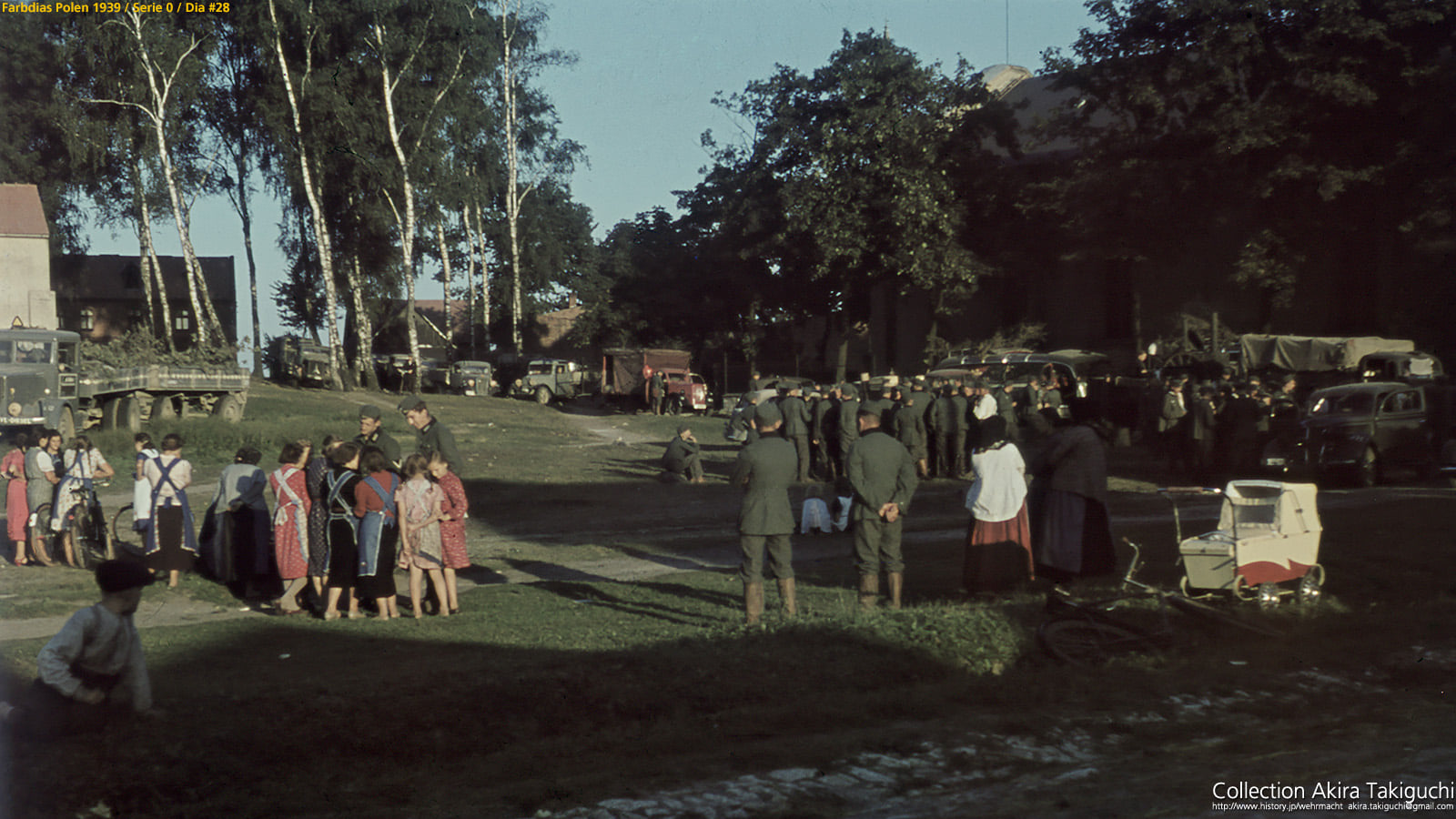
Soldiers and Civilians in Poland 1939

Slide group from 1939, 8 films (5 are color, 3 are B/W), Frame 28 of film 0. Film 0 is from September 1939 (the photographer's note). Civilians in varying clothes and soldiers, vehicles, a bicycle and a somewhat out-of-place baby car.  Many soldiers wear brown boots.

Source:
Akira Takiguchi photo collection
https://www.facebook.com/photo.php?fbid=10221173543481662&set=ms.c.eJxNzckNQkEQA9GMkN12b~%3BknhuDPIK7vUEVEUFmq6A4ILx6JtmKH~_wi3FVtdQhxppeVh1RUtRRc1utIb4SZz~%3B8SZDPIRNIkuY~_4ddO0oUTodIDDNTd3XRzbI9ORXsPSoas30T8ppr~%3BrpoAdtJbiYIyoUG57lGzSgNYY~-.bps.&type=3&theater&ifg=1

German Artillery on the Way to Stalingrad

Advancing to Stalingrad: 10cm guns of 16.Panzer-Division, August 1942. These are sK18 10cm guns firing at flat trajectory. Note the sighting poles in two colors (white/red and white/black).

Source :
Akira Takiguchi photo collection
https://www.facebook.com/photo.php?fbid=10221356362772030&set=ms.c.eJxNzckNQkEQA9GMkN12b~%3BknhuDPIK7vUEVEUFmq6A4ILx6JtmKH~_wi3FVtdQhxppeVh1RUtRRc1utIb4SZz~%3B8SZDPIRNIkuY~_4ddO0oUTodIDDNTd3XRzbI9ORXsPSoas30T8ppr~%3BrpoAdtJbiYIyoUG57lGzSgNYY~-.bps.&type=3&theater&ifg=1

Two Luftwaffe Officers and a Bird

Two Luftwaffe Flak officers looking at a bird at peacetime. Well, just after Anschulß but before Sudetenland, March 30, 1938.

Source :
Akira Takiguchi photo collection
https://www.facebook.com/photo.php?fbid=10221356274329819&set=gm.1491259877726097&type=3&theater&ifg=1

General der Infanterie z.V. Hans Schmidt


Hans Joachim Hermann Schmidt
* 28.04.1877 Ulm
† 05.06.1948 Stuttgart

11.07.1895 Fahnenjunker
15.02.1896 Fähnrich
18.10.1896 Sekondeleutnant
01.01.1899 Leutnant (Umbenennung)
13.09.1906 Oberleutnant ohne Patent
14.04.1907 Patent erhalten
01.10.1912 Hauptmann
18.04.1917 Major
20.03.1922 Oberstleutnant (m. W. v. 01.04.1922; RDA: 01.08.1921)
01.12.1926 Oberst
01.10.1929 Generalmajor
31.01.1931 Charakter als Generalleutnant
26.08.1939 Generalleutnant z.V.
01.02.1942 General der Infanterie
31.10.1943 General der Infanterie a.D.
21.07.1944 als General der Infanterie reaktiviert


Sohn des kgl. württembergischen Oberstabsarztes II. Klasse und späteren Generalarztes Dr. med. Hermann (von) Schmidt (* 23.12.1839 Brackenheim , † 16.03.1915) und seiner Ehe-frau Adelheid geb. Krell (* 31.10.1849 Plieningen/Württ., † 13.06.1930);
Bruder des Generalleutnants z.V. Wolfgang Schmidt-Logan {auch Generalmajor der Landespolizei, SA-Oberführer]

11.07.1895 Eintritt in das 3. Württembergische Infanterie-Regiment “Alt-Württemberg” Nr. 121, Ludwigsburg
00.00.1895 - 00.00.1896 Besuch der Kriegsschule
01.10.1899 Adjutant des III. Bataillons des 3. Württembergischen Infanterie-Regiments “Alt-Württemberg” Nr. 121
27.01.1906 Regimentsadjutant des 3. Württembergischen Infanterie-Regiments “Alt-Württemberg” Nr. 121
20.03.1911 zum Großen Generalstab kommandiert
22.04.1914 im Generalstab des Gouvernements Thorn/Westpreußen (heute: Toruń/Polen)
15.02.1915 im Generalstab der 36. Infanteriedivision
00.00.1915 Bataillonskommandeur im 3. Württembergischen Infanterie-Regiment “Alt-Württemberg” Nr. 121
30.10.1917 im Generalstab des XXV. Reservekorps
25.08.1918 im Stab der 9. Infanteriedivision
00.00.1919 im Grenzschutz von Oberschlesien
00.05.1919 im Generalstab der Reichswehr-Brigade 29, Bernstadt/Niederschlesien (heute: Bierutów/Polen), der Vorläufigen Reichswehr
01.10.1919 Bataillonskommandeur im Reichswehr-Schützen-Regiment “Alt-Württemberg” Nr. 25, der Reichswehr-Brigade 13. Stuttgart, der Vorläufigen Reichswehr
01.10.1920 Kommandeur des Ausbildungs-Bataillons des 13. (Württembergischen) Infanterie-Regiments, Schwäbisch Gmünd
01.10.1921 im Stab der 5. Division, Stuttgart
01.08.1925 im Stab des 13. (Württembergischen) Infanterie-Regiments, Ludwigsburg
01.03.1928 Kommandeur des 13. (Württembergischen) Infanterie-Regiments, Ludwigsburg, zugleich Landeskommandant von Württemberg
01.03.1930 Infanterieführer VI, Hannover
31.01.1931 Abschied
15.05.1933 - 20.05.1933 hält einen “Führerlehrgang” für Polizeioffiziere in Stuttgart ab
26.08.1939 z.V. gestellt und Kommandeur der 260. Infanterie-Division
01.01.1942 mit der Führung des IX. Armee-Korps beauftragt
01.02.1942 Kommandierender General des IX. Armee-Korps
15.10.1943 Führerreserve OKH (V)
31.10.1943 Abschied
30.11.1943 MobBestimmung aufgehoben
31.01.1944 z.V.-Stellung aufgehoben
21.07.1944 reaktiviert, Kommandierender General des Stellvertretenden Generalkommandos V. Armeekorps und Befehlshaber im Wehrkreis V, Stuttgart
08.08.1944 Befehlshaber des “Erkundungsstabes Vogesen”
22.09.1944 Kommandant der “Befestigungen Vogesen”
17.10.1944 Befehlshaber des “Erkundungsstabes Donaueschingen” für einen Rahmenverband mit dem Tarnnamen 24. Armee zur Irreführung des Gegners an der linken Flanke der gesamten Westfront zwischen Dreiländereck Schweiz-Frankreich-Deutschland und Ostrand des Schwarzwaldes bei Lörrach gegen eine vermeintliche alliierte Offensive über die Schweiz
00.11.1944 Oberbefehlshaber der 24. Armee; anfänglich nur ein paar Baukompanien und vier Erkundungsstäben, es soll eine Abwehrstellung bzw. ein Sperrriegel gegen einen vermute-ten alliierten Angriff über die Schweiz erkundet bzw. ausgebaut werden
00.02.1945 die “24. Armee” wird dem AOK 19 unterstellt
00.04.1945 die Garnisonen Radolfzell, Konstanz und Friedrichshafen werden übernommen, ferner 5 Bataillone Zollgrenzschutz [Zollgrenzschutz-Bataillone Oberrhein VIII, IX, X, XII, XIV] und eine Panzerspähkompanie (Holzgas), insgesamt 10 Btle. zu je 300 Mann, ausgebildet waren eigentlich nur 2 Bataillone
26.04.1945 die im Raum Bad Wurzach stehende Division Nr. 405 unter Generalleutnant Karl Faulenbach wird von der 19. Armee als Ersatz- und Ausbildungsdivision mit sechs Bataillonen überstellt. Der Verband erhält den Verteidigungsauftrag für Vorarlberg [Vorarlberg scheidet damit aus dem Befehlsbereich des Gen. d. Geb.Tr. Valentin Feurstein aus]
27.04.1945 Beginn der Bildung von drei Verteidigungszonen: Immenstadt mit einer ad hoc gebildeten Ersatz- und Ausbildungstruppe unter GLt (Erich ?) Hofmann mit 1½ Marschbataillonen, Staufen mit Kampfgruppe Oberst Jurkschat (2 Marsch-Btle. aus Isny und Leutkirch) und schließlich Weiler-Bregenz unter GLt Faulenbach mit 6 Ersatzbataillonen der 405. Ersatz- und Ausbildungs-Division, dem einzig wirklichen Verband. Das sind insgesamt 8.000 bis 9.000 Mann, einschließlich versprengter Waffen-SS, Standschützen, Ordnungstruppen etc., dazu kommt 1 Bttr. Leichte Geb.Flak (12 x 2 cm). Nun schützt das AOK 24 den Westeingang der letztlich nicht existenten “Alpenfestung”
24./25.04.1945 um nicht eingeschlossen zu werden überquert die Truppe mit Booten bei Lochau und Eglofs den Bodensee und sucht Anschluss an das AOK 19, was am 26.04. nördlich Ulm gelingt
26.04.1945 Gefechtsstand in Eglofs
27.04.1945 Gefechtsstand in Weiler
28./29.04.1945 Gefechtsstand in Haselstauden
30.04.-02.05.1945 Gefechtsstand in Satteins
04.-05.05.1945 Rückzug durch den Arlberg-Tunnel nach Strengen
04.05.1945 Parlamentäre dieser kleinen Streitmacht (noch 4 schwache Bataillone) sind vor den Linien der 1. Französischen Armee. Kurz vorher war deren OB, General Jean de Lattre de Tassigny. vom vorgesetzten OB der 6. Alliierten Armeegruppe, General Jacob L. Devers, aufgefordert worden, seinerseits einen Parlamentär zu den Verhandlungen mit dem deutschen AOK 19 zu entsenden. Fälschlicherweise folgert der Franzose nun, dass er wohl zur Übergabe des AOK 19 geladen würde, gleichzeitig aber selber berechtigt sei, die Übergabe des AOK 24 ausschließlich an die grande armée anzunehmen
05.05.1945 der Stab des AOK 24 ergibt sich der 44. US-Division und geht in Gefangenschaft
05.05.1945 auch Schmidts vorgesetzte Heeresgruppe G kapituliert durch Gen.d.Inf. Hermann Foertsch im Auftrag von GFM Kesselring in Haar bei München
So muss Schmidt dem indignierten General de Lattre mitteilen, dass sich eine alleinige Kapitulation seines AOK 24 damit erübrigt habe. Der Franzose, nachdem er von Devers dessen Übereinstimmung mit Schmidt‘s Auffassung erfahren hatte, widerspricht mit dem Hinweis, dass in den Kapitulationsdokumenten vom AOK 24 überhaupt nicht die Rede sei!
Auf Wunsch von Devers sendet er nun einen Kurier zu General Brandenberger (OB AOK 19), damit dieser das AOK 24 auffordere, vor den Franzosen zu kapitulieren. Bis dahin werde weiter gekämpft!
Beim AOK 24 bzw. bei dessen einzigem Verband, der E.u.A.D. 405, nimmt man Waffenruhe ab 05.05.1945 18h an, und ist nun doch vom französischen Angriff nach diesem Termin überrascht
In der Nacht zum 06.05.1945 wird die Truppe im Raum Innsbruck in die amerikanische Zone abgedrängt, die Demarkationslinie ist den Deutschen nicht bekannt
De Lattre de Tassigny glaubt nun, dass die bösen Deutschen dies absichtlich getan hätten, um ihn um den Ruhm zu bringen, eine ganze Armee gefangen zu haben. Der ebenso untröstliche wie realitätsferne Franzose meint schließlich, der deutsche General Schmidt habe noch am Abend des 04.05.1945 seine “Armee” im deutschen AOK 19 aufgehen lassen, um der Kapitulation vor einer französischen Armee zu entgehen
Nur ganz wenige Soldaten gerieten in französische Gefangenschaft, das Gros kommt zur US-Army in Gefangenschaft


Seit 03.03.1922 mit Selma geb. Nagel, verw. Wintterlin verheiratet


Kgl. Preuß. Kronen-Orden IV. Klasse
EK II
EK I
Ritterkreuz des Kgl. Preuß. Hausordens von Hohenzollern mit Schwertern
Ritterkreuz des Kgl. Württembg. Militär-Verdienstordens
Ritterkreuz II. Klasse des Kgl. Sächs. Albrechts-Ordens
Kgl. Bayer. Militär-Verdienstorden IV. Klasse mit Schwertern
Kgl. Bayer. Militär-Verdienstorden IV. Klasse mit Schwertern und mit der Krone
Ritterkreuz I. Klasse des Kgl. Württembg. Friedrichs-Ordens mit Schwertern
Hamburgisches Hanseatenkreuz
k.u.k. Österr. Militär-Verdienstkreuz III. Klasse mit der Kriegsdekoration
Kgl. Württembg. Dienstehrenzeichen I. Klasse
Ehrenkreuz für Frontkämpfer
Wehrmacht-Dienstauszeichnung IV. - I. Klasse
Spange zum EK I: 04.07.1940
Spange zum EK II: 31.12.1939
22.09.1941 Ritterkreuz
Medaille “Winterschlacht im Osten 1941/1942”
06.11.1942 Deutsches Kreuz in Gold
24.11.1943 Eichenlaub (334.)


Source :
https://forum.axishistory.com/viewtopic.php?t=199947
http://www.historicalwarmilitariaforum.com/topic/6937-ritterkreuztr%C3%A4ger-photos-in-color-thread/?page=31&tab=comments#comment-52326

Sunday, July 12, 2020

General der Panzertruppe Smilo Freiherr von Lüttwitz


Smilo Walther Hinko Oskar Constantin Wilhelm Freiherr von Lüttwitz (23 December 1895 – 19 May 1975) was a German general during World War II and son of Walther von Lüttwitz. After World War II he joined the Bundeswehr on 1 June 1957 and retired on 31 December 1960.

Lütwitz was born on 23 December 1895 in Straßburg (now Strasbourg) into a family with a long history of military service. He joined the military service during the mobilisation on 3 August 1914 as an officer cadet in the 25th Division in Darmstadt. Lüttwitz was posted to the Eastern Front and saw combat at Tannenberg, Courland and Düna. He was severely wounded twice in 1915 and received the Iron Cross 1st class. He was commissioned as an officer in 1915.

In 1916 Lüttwitz was transferred to a staff position with the X Corps in the Heeresgruppe Kronprintz for two years. The corps was under the command of his father General Walther von Lüttwitz. His father, a recipient of the Pour le Mérite, was one of the most highly decorated generals of the German Empire. He returned to front line duty in 1918 as an adjutant with the Darmstädter Dragoner in the temporary occupation of the Ukraine and southern Russia. By the end of World War I he had received both classes of the Iron Cross and the Wound Badge in Silver. He remained in the Weimar Republic's Army, serving in various cavalry units. After the beginning of the Nazi leadership he joined the Panzer (armor) branch.

In 1939 he was promoted to lieutenant colonel and served as adjutant in the XV Army Corps. He was later commanding an infantry regiment and the 4th Rifle Brigade. He served on the Eastern Front. Later, he commanded the 26th Panzer Division in Italy, the LXXXV Army Corps and the 9th Army. During this time, he learned of the government issued orders for summary justice. He opposed it and faced a trial but was allowed to retain command of his unit.

He was released from internment in 1947. He then went to the Evangelical Academy in Friedewald. During the period from 1954-1957 he was the head business manager for the relief organization Order of St. John in Rolandseck. Later he returned to the Evangelical Academy as Head of Administration.

In 1957, he joined the new West German army (Bundeswehr) as a lieutenant general. He was appointed commanding general of the III Corps in Koblenz. He retired in 1960. In 1963, he became chairman of the board for a defense industry. In 1955, Lüttwitz was made a knight in the Order of St. John. In 1963, he took over as president of that organization. At the end of his military service, Lüttwitz received the American Legion of Merit in recognition of his service.

Promotions:
August 4th, 1914: Fahnenjunker;
June 16th, 1915: Leutnant (entering August 10th, 1914);
April 1st, 1925: Oberleutnant;
May 1st, 1930: Rittmeister;
?: Major;
January 1st, 1939: Oberstleutnant;
November 1st, 1941: Oberst;
September 1st, 1942: Generalmajor;
October 1st, 1943: Generalleutnant;
September 1st, 1944: General der Panzertruppe (entering April 1st, 1944);
1958: Generalleutnant Bundeswehr.

Career:
August 3rd, 1914: Leib-Dragoner-Regiment (2. Großherzoglich Hessisches) Nr. 24, Darmstadt;
1916: Ordonnanzoffizier Korpskommandos / Stab der "Heeresgruppe Kronprinz";
1918: Regimentsadjutant Leib-Dragonerregiment (2. Großherzoglich Hessisches) Nr. 24;
?: Reiterregiment 7, Breslau;
?: Reiterregiment 6, Pasewalk;
?: 1. Eskadron / 6. (Preußischen) Reiterregiments, Pasewalk;
?: 2. Adjutant (II b) "Kommando der Kraftfahrkampftruppen";
1935: Kommandeur Panzeraufklärungsabteilung 5, Kornwestheim;
1938: IIa-Offizier Heeresgruppe 4, Leipzig
1939: Adjutant XV. Armeekorps, Jena;
July 24th, 1940: Kommandeur Schützenregiment 12;
March 1st, 1942 - April 1st, 1942: Kommandeur 4. Schützenbrigade;
April 1st, 1942: m.F.b. 23 Infanterie-Division;
July 24th, 1942 - July 10th, 1944: Kommandeur 26. Panzer-Division;
July 24th, 1944: Kommandierender General LXXXV. Armeekorps;
September 1st, 1944 - January 19th, 1945: m.F.b. 9. Armee;
March 29th, 1945 - May 7th, 1945: Kommandierender General LXXXV. Armeekorps;
May 7th, 1945 - 1947: American POW;
?: Evangelischen Akademie, Friedewald;
1954 - 1957: Hauptgeschäftsführer Johanniter-Unfall-Hilfe, Rolandseck;
June 1st, 1957 - December 31st, 1960: Kommandierender General III. Korps, Bundeswehr;
December 31st, 1960: Retirement;
1963: Vorsitzender der Gesellschaft für Wehrkunde;
1963: Präsidentschaft der Johanniter-Unfall-Hilfe.

Awards:
Clasp to the Iron Cross (1939) 2nd Class (6 October 1939) & 1st Class (27 May 1940)
German Cross in Gold on 27 October 1941 as Oberstleutnant and commander of the Schützen-Regiment 12
Knight's Cross on 14 January 1942 as Oberst and commander of the Schützen-Regiment 12
426th Oak Leaves on 16 March 1944 as Generalleutnant and commander of the 26. Panzer-Division
76th Swords on 4 July 1944 as Generalleutnant and commander of the 26. Panzer-Division
Rechtsritter (Knight of Justice) of the Order of Saint John (Bailiwick of Brandenburg)
Great Cross of Merit with star
Legion of Merit


Source :
https://en.wikipedia.org/wiki/Smilo_Freiherr_von_L%C3%BCttwitz
http://www.historicalwarmilitariaforum.com/topic/6937-ritterkreuztr%C3%A4ger-photos-in-color-thread/?page=5&tab=comments#comment-36744
https://www.tracesofwar.com/persons/11491/L%C3%BCttwitz-Freiherr-von-Smilo.htm

Afrikakorps Soldiers Sleeping

These young Afrikakorps troopers are resting somewhere in the Western Desert, probably during 1942. Their uniforms need to be suitable for the hot days and cool nights.

Source :
https://www.histclo.com/essay/war/ww2/camp/eur/na/wd/wd-ak.html

Saturday, June 27, 2020

Feldgendarmerie Controlling Traffic in a Muddy Road

Road?  Mud! A Wehrmacht Feldgendarmerie is controlling the traffic with his signal stick. Patched tarp of the truck is also interesting. The picture was taken in Southern Russia in 1942 from a photo album of Kraftfahr-Abteilung 562. What is interesting was the very white wall of the house we see in the middle despite of this messy ground. Cars, people... everything muddy and dusty, how can a house keep white wall? It is because the muddy road never reaches directly to the house. And as you can see, there is a grey stripe painted along the base of the house to avoid splashes of dirt on the wall in heavy rain. It’s still made everywhere in Europe today when the house is white.

Source :
Akira Takiguchi photo collection
https://www.facebook.com/photo.php?fbid=10221197329676302&set=gm.1478307359021349&type=3&theater&ifg=1

Friday, June 26, 2020

Captured T-34 Tank in German Hands

A captured Soviet T34/76 medium tank in winter camouflage is marked with Balkenkreuz to confront former owners. Estate of Oberst Schutz from Infanterie-Regiment 470 / 260.Infanterie-Division

Source :
Akira Takiguchi photo collection
https://www.facebook.com/photo.php?fbid=10220914836694154&set=gm.1453716798147072&type=3&theater&ifg=1

Tuesday, June 23, 2020

Wehrmacht Shooting Training


This picture is part of a slide group from 1939, 8 films (5 are color, 3 are B/W), Frame 40 of film 5. It shows a Wehrmacht shooting training (note the non-uniform color variation in their uniforms!). This photo was taken after the victory against Poland (because the NCO has been awarded with Eisernes Kreuz II.Klasse which can be confirmed in another frame), so it could be early 1940.  No date on the film unfortunately.

Source :
Akira Takiguchi photo collection
https://www.facebook.com/photo.php?fbid=10221139131461383&set=gm.1472787892906629&type=3&theater&ifg=1

Sunday, June 21, 2020

German Motorcycle Messenger

Original color slide from a German motorcycle messenger (Kradmelder), somewhere in France around 1940. The bike is a DKW KS 200.


Source :
https://www.facebook.com/photo.php?fbid=271824844086347&set=gm.1470817449770340&type=3&theater&ifg=1
https://forum.axishistory.com/viewtopic.php?f=132&t=184255&p=2275726#p2275726

Sunday, June 14, 2020

Waffen-SS Panzer Reconnaissance Troops

SS-Armoured Crews in front of an Sd.kfz.222


Source :
Book "Tip of the Spear: German Armored Reconnaissance in Action in World War II" by Robert J. Edwards, Michael H. Pruett and Michael Olive
https://www.facebook.com/photo.php?fbid=721701321740358&set=gm.1466515296867222&type=3&theater&ifg=1

Ritterkreuzträger SS-Hauptsturmführer Bruno Hinz


Bruno Hinz was born on August 25 1915 in Petersdorf, Sachsen. In 1933, he joined the SS and became a member of the SS-Standarte "Deutschland" / SS-Verfügungstruppe. He participated in the Polish Campaign and in the Campaign in France. In October 1941, now an SS-Untersturmführer, Hinz reached SS-Division Wiking at the Eastern Front. He was designated a platoon leader in SS-Regiment Westland, fighting alongside many Scandinavian and West-European volunteers of the Waffen-SS. By that winter, Bruno Hinz had already earned the Eisernes Kreuz I.Klasse (Iron Cross First Class) and the Infanterie-Sturmabzeichen in Silber (Infantry Assault Badge in Silver) for his bravery. Demonstrating decisiveness at the head of his soldiers, defensive prowess when needed and bravery in close combat, Hinz was always involved in critical situations. Hinz experienced some difficult months during the offensive through the southern Ukraine, the fighting in the Caucasus and the bloody withdrawal from Grozny. In the spring of 1943, the constantly attacking SS-Panzergrenadier-Division Wiking took some heavy casualties but Hinz was able to demonstrate his capabilities in the weeks that followed. He received the Deutsches Kreuz in Gold (German Cross in Gold) for his successful command and accumulated so many close-combat days in such a short period that he was not given the Nahkampfspange in Bronze (Close Combat Clasp in Bronze), instead, Hinz started with the Nahkampfspange in Silber! His company had showed its combat expertise in countless assaults, bouts of house-to-house and street fighting, patrols and hunting down enemy armor. Wounded several times in the fighting around Kharkov, Hinz was awarded the Wound Badge in Silver. He rallied his men through several crises as a result of his own initiative and bravery. In September 1943 his company was in a defensive position on the Dnieper which allowed the Wiking to cross the Dnieper River. Hinz held the position but was badly wounded by a rifle round through the lung. It was only weeks later, after Hinz had regained some strength and had escaped death by the narrowest of margins, that he was informed of his award of the Ritterkreuz (Knight's Cross). On November 9 1943, he was promoted SS-Obersturmführer. In February 1944 Hinz was given command of the SS-Panzergrenadier-Regiment 38 of the newly formed 17.SS-Panzergrenadier-Division Götz von Berlichingen. Involved in heavy fighting in Normandy and separated from his battalion, the veteran of the Eastern Front railed his company, incorporated elements from other companies into his own force and formed a Kampfgruppe. In the space of two days, Hinz led his men around enemy strongpoints. Often involved in intense firefights and without any sort of rations, he, and 100 of his combat effectives and a few wounded made it back to the German lines by exploiting terrain. For his actions, Hinz was awarded the Eichenlaub (Oakleaves) to his Ritterkreuz as one of the lowest-ranking individuals to receive that award in the entire German armed forces! A few days after receiving the award, Hinz was wounded for the ninth time. In the military hospital, the news reached him that he had been awarded the Nahkampfspange in Gold. At his own request, the SS-Hauptsturmführer, who had been promoted on November 9 1944, was sent back to the field in January 1945. He participated in hard fighting in the Alsace and Franconia during the withdrawals. His regimental commander was the Austrian Knight's Cross Holder SS-Obersturmbannführer Vinzenz “Zenz” Kaiser. Hinz lost almost his entire battalion as a result of Allied air attacks and became prisoner of U.S. Army in late March 1945, Götz von Berlichingen could only muster some 800 men at the time. The remaining Kampfgruppen surrendered in southern Germany in May 1945. As well as being awarded the Oakleaves to the Knight's Cross and Wound Badge in Gold, Hinz was awarded the very rare Close Combat Clasp in Gold, which was only awarded 631 times during World War II! Only 98 received both the Knight's Cross and the Close-Combat Clasp in Gold. Bruno Hinz rebuilt his life after the war and died aged 52 on February 28 1968 in München

Source :
Book "The Face of Courage" by Florian Berger
https://ritterkreuztraeger.blogspot.com/2020/06/ss-hauptsturmfuhrer-bruno-hinz-in-color.html
http://stabswache-de-euros.blogspot.com/2013/04/hauptsturmfuhrer-der-waffen-ss-bruno.html

Friday, June 12, 2020

German Prisoners in the Last Day of the War

May 8th 1945...the war is over.

Source :
Courtesy of Markus Hawranke at https://www.facebook.com/photo.php?fbid=642184269841443&set=gm.1464638437054908&type=3&theater&ifg=1

Thursday, June 11, 2020

Doolittle Stands Next to a Recruiting Poster

Portrait of American military Brigadier General James Doolittle (1896 - 1993) as he stands next to an Army Air Corps recruiting poster, 1943.

James Harold Doolittle (December 14, 1896 - September 27, 1993) was an American military general and aviation pioneer. He made early coast-to-coast flights, won many flying races, and helped develop instrument flying. Doolittle studied as an undergraduate at University of California, Berkeley, graduating with a Bachelor of Arts in 1922 and earning a doctorate in aeronautics from the Massachusetts Institute of Technology in 1925. He was a flying instructor during World War I and a Reserve officer in the United States Army Air Corps, but he was recalled to active duty during World War II. He was awarded the Medal of Honor for personal valor and leadership as commander of the Doolittle Raid, a bold long-range retaliatory air raid on some of the Japanese main islands on April 18, 1942, four months after the attack on Pearl Harbor. The attack was a major morale booster for the United States and Doolittle was celebrated as a hero. Doolittle was promoted to lieutenant general and commanded the Twelfth Air Force over North America, theFifteenth Air Force over the Mediterranean, and the Eighth Air Force over Europe. After World War II, he retired and left the Air Force but remained active in many technical fields, and was eventually promoted to general 26 years after retirement.


Source :
Courtesy of Tobi Moll at https://www.facebook.com/photo.php?fbid=266322547969910&set=gm.1463650983820320&type=3&theater&ifg=1

Wednesday, May 27, 2020

Generalmajor Walter Dornberger


Generalmajor Dr.-Ing. h.c. Walter Dornberger was born in Giessen, Germany on 6th September, 1895. He joined the German Army in 1914 and during the First World War was captured by the French Army and was held as a prisoner-of-war until 1919.

Dornberger remained in the army and in 1925 was sent to the Charlottenberg Institute of Technology to study ballistics. While at Charlottenberg he met a young student, Wernher von Braun, and fellow member of the German Society for Space Travel.

In 1932 Dornberger was placed in charge of the solid-fuel rocket research and development in the Ordnance Department of the German Army. Dornberger recruited Wernher von Braun and in 1934 they successfully built two rockets that rose vertically for more the than 2.4 kilometres (1.5 miles).

In 1937 Dornberger was appointed military commander of rocket research station at Peenemunde. Braun became technical director of the establishment and he began to develop the long-range ballistic missile, the A4 (V2 Rocket) and the supersonic anti-aircraft missile Wasserfall.

During the Second World War Dornberger and Braun began working on a new secret weapon, the V2 Rocket. This 45 feet long, liquid-fuelled rocket carried a one ton warhead, and was capable of supersonic speed and could fly at an altitude of over 50 miles. As a result it could not be effectively stopped once launched. He later commented: "This is the first of a new era in transportation, that of space travel. So long as the war lasts, our most urgent task can only be the rapid perfection of the rocket as a weapon. The development of possibilities we cannot yet envisage will be a peacetime task."

Albert Speer told Adolf Hitler: "The A-4 is a measure that can decide the war. And what encouragement to the home front when we attack the English with it. This is the decisive weapon of the war, and what is more it can be produced with relatively small resources. Speer, you must push the A-4 as hard as you can! Whatever labour and materials they need must be supplied instantly. You know I was going to sign the decree for the tank program. But my conclusion now is: Change it around and phase it so that A-4 is put on a par with tank production. But in this project we can use only Germans. God help us if the enemy finds out about this business."

The V2 Rocket was first used in September, 1944. Over 5,000 V-2s were fired on Britain. However, only 1,100 reached their target. These rockets killed 2,724 people and badly injured 6,000. After the D-Day landings, Allied troops were on mainland Europe and they were able to capture the launch sites and by March, 1945, the attacks came to an end.

With the Red Army advancing on the Peenemunde Research Station, Wernher von Braun surrendered to the US Army. Braun and 40 other scientists working on rocket technology were taken to the United States where they worked on the development of nuclear missiles.

Dornberger was arrested by Allied forces and spent two years in England as a prisoner. He emigrated to the United States in 1947 where he worked as an adviser on the development of guided missiles. He later worked for the Bell Aircraft Corporation and on the Air Force-NASA Dyna-Soar project. Walter Dornberger died in Baden-Wurttemburg, West Germany, on 27th June, 1980.


Source :
http://alifrafikkhan.blogspot.com/2011/07/album-foto-berwarna-jenderal-heer.html
https://spartacus-educational.com/GERdornberger.htm

Friday, May 8, 2020

Königsberg and Surroundings in East Prussia 1944/45


 On 24 January 1945, the 3rd Belorussian Front led by General Chernyakhovsky, surrounded the capital city of East Prussia, Königsberg. The 3rd Panzer Army and around 200,000 civilians were trapped inside the city. In response to this, General Georg-Hans Reinhardt, commander of the Army Group Center, warned Hitler of the imminent Soviet threat, but the Führer refused to act. Due to the rapid approach of the 2nd Belorussian Front led by General Rokossovsky, Nazi authorities in Königsberg decided to send trains full of refugees to Allenstein, without knowing that the town had already been captured by the Soviet 3rd Guards Cavalry Corps.

During the Soviet assault, the Frische Nehrung spit became the last means of escape to the west. However, civilians who tried to escape along the spit were often intercepted and killed by Soviet tanks and patrols. Two thousand civilians left Königsberg every day and tried to reach the already crowded town of Pillau. The final Soviet assault on Königsberg started on 2 April with a heavy bombardment of the city. The land route to Pillau was once again severed and those civilians who were still in the city died by the thousands. Eventually, the Nazi garrison surrendered on 9 April, and as Beevor wrote, "the rape of women and girls went unchecked in the ruined city".

Evacuation of East Prussia

The evacuation of East Prussia was the movement of German civilian population and military personnel from East Prussia between 20 January and March 1945, that was initially organized and carried out by state authorities but quickly turned into a chaotic flight from the Red Army.

A part of the evacuation of German civilians towards the end of World War II, these events are not to be confused with the expulsion from East Prussia that followed after the war had ended. The area that was evacuated was not the Gau East Prussia, but the inter-war East Prussia where most people already held German citizenship. German citizens in Memel and other regions with proximity to East Prussia also took part in the evacuation, wishing to escape by sea, even though in their regions there was no official evacuation announced.

The evacuation, which had been delayed for months, was initiated due to fear of the Red Army advances during the East Prussian Offensive. Some parts of the evacuation were planned as a military necessity, Operation Hannibal being the most important military operation involved in the evacuation. However, many refugees took to the roads on their own initiative because of reported Soviet atrocities against Germans in the areas under Soviet control. Both spurious and factual accounts of Soviet atrocities were disseminated through the official news and propaganda outlets of Nazi Germany and by rumors that swept through the military and civilian populations.

Despite having detailed evacuation plans for some areas, the German authorities, including the Gauleiter of East Prussia, Erich Koch, delayed action until 20 January, when it was too late for an orderly evacuation, and the civil services and Nazi Party were eventually overwhelmed by the numbers of those wishing to evacuate. Coupled with the panic caused by the speed of the Soviet advance, civilians caught in the middle of combat, and the bitter winter weather, many thousands of refugees died during the evacuation period. The Soviet forces took control of East Prussia only in May 1945. According to the West German Schieder commission, the civilian population of East Prussia at the beginning of 1944 was 2,653,000 people. This accounting, which was based on ration cards, included air raid evacuees from western Germany and foreign workers. Before the end of the war an estimated 2 million people were evacuated, including 500,000 in the Autumn of 1944 and 1,500,000 after January 1945. An estimated 600,000 remained behind in Soviet-controlled East Prussia in April/May 1945.

According to a 1974 West German government study, an estimated 1% of the civilian population was killed during the Soviet offensive. The West German search service reported that 31,940 civilians from East Prussia, which also included Memel, were confirmed as killed during the evacuation.


------------------------------------------------------------------------------ 


"Auxiliary train Hermann Göring", used to serve meals in autumn 1944


 Two German infantrymen lighting a fire near Pillau in East Prussia. 1945


 German post on an anti-tank gun on the outskirts of an East Prussian town. January / February 1945


 Königsberg am Wrangeltor. Food supplies are unloaded. January / February 1945


 Quadruple flak as a self-propelled gun on a half-chain tractor at Fischhausen in East Prussia, March 1945


Sources :
Tobi Moll photo collection
https://en.wikipedia.org/wiki/Evacuation_of_East_Prussia?fbclid=IwAR2SxdWecP87o-oIPfsMLzUvXI3UyuAJkcPWyVv0D5R1LZ_uil6FfxGUcTA
https://www.facebook.com/groups/237076659811098/permalink/1435014336683985/
http://nevsepic.com.ua/nostalgiya/3581-fotografii-kenigsberg-i-vostochnaya-prussiya-90-foto.html

Thursday, May 7, 2020

Stuka Ace Johann Zemsky Near Stalingrad


German Luftwaffe Knights Cross Winner Stuka Bomber Ace Johann Zemsky talks to stuka pilots near Stalingrad 1942. Zemsky flew a total of 600 sorties, dying on his 600th when his parachute failed to open.


Source :
https://www.gettyimages.co.uk/photos/stuka-pilot?mediatype=photography&phrase=stuka%20pilot&sort=best

Sunday, May 3, 2020

Generalmajor Hans Graf von Kanitz

German General Hans Graf von Kanitz (17 November 1893 - 25 August 1968) was in the fields of the first war and ended as an Oberleutnant and Ordinance Officer with the General Command of the East Prussian Volunteer Corps. At the start of World War II he as an Oberstleutnant was the director of Unterofficers Courses at the Army Gas Protection School in Celle until October 1939, promoted to Oberst on April 1, 1939. Appointed to Commander of Army Gas Protection School, Celle, until November 1944 and landed in the Führer Reserve to November 18, 1944 and released of the Army service, age 51. The Führerreserve ("Officers Reserve") was set up in 1939 as a pool of temporarily unoccupied high military officers waiting for new assignments in the German Armed Forces during World War II. The various military branches and army groups each had their own pool which they could use as they saw fit. The officers were required to remain at their assigned stations and be available to their superiors, but could not exercise any command function, which was equivalent to a temporary retirement while retaining their previous income. Especially in the second half of the war, more and more politically problematic, troublesome, or militarily incompetent officers were assigned to the Führerreserve.


Source :
https://www.findagrave.com/memorial/120027584/hans-graf-von_kanitz
https://forum.axishistory.com/viewtopic.php?f=5&t=14230&start=11460

Saturday, May 2, 2020

Walther von Brauchitsch in Belgium

Generaloberst Walther von Brauchitsch (2nd from right, Oberbefehlshaber des Heeres) together with German officers on the Grote Markt in Ypres, Belgium. June 1940. At right wearing monocle is Oberstleutnant Curt Siewert (1. Adjutant Oberbefehlshaber des Heeres).


Source :
Tobi Moll photo collection
https://www.facebook.com/photo.php?fbid=239966457272186&set=gm.1429997340519018&type=3&theater&ifg=1

Wednesday, April 29, 2020

German Soldier with a Cat

Cats unburden all the stress we have... A Nachrichten-unteroffizier from 225. Infanterie-Division. The picture was taken on Northern Russia.


Source :
Akira Takiguchi photo collection
https://www.facebook.com/photo.php?fbid=10220570510326210&set=gm.1427743760744376&type=3&theater&ifg=1

Sunday, April 26, 2020

The photographer Franz Grasser posed as a Wehrmacht soldier with a machine gun in a foxhole. The picture was taken in the Russian front, 1943-1944.


Source :
http://www.deutschefotothek.de/documents/obj/89006233