Friday, July 31, 2015

Heinkel He 111 H-3 of the Royal Rumanian Air Force in Bessarabia

This Heinkel He 111 H-3, Nr. 27 of Aeronautica Regala Romana (ARR, or the Royal Rumanian Air Force) - here seen on an airfield in Bessarabia in summer 1941 - was seriously damaged at Stalino on January 24th 1943 and left behind when this airfield was abandoned. According to a German-Rumanian military contract signed in early 1939, Rumania received a significant number of weapons, including combat airplanes. Among the warplanes delivered to ARR at short notice was a batch of 32 brand new Heinkel He 111Hs (although the Werknummern assigned to this batch of He 111s is situated between two batches of H-5s, all Rumanian documents refer to the sub-type as H-3). The contract was completed in early 1940 and the bombers were assigned to Grupul 5 Bombardament (5th Bomber Group), based at Brașov (Kronstadt), in South-Eastern Transylvania. The group was made up of three squadrons, namely Escadrile 78, 79 and 80 Bombardament. Grupul 5 Bombardament was the élite bomber unit of ARR in the Rumanian Army's first two campaigns, namely the "Battle for Bessarabia and Odessa" of the summer of fall 1941, and the "Battle of Stalingrad" of the winter of 1942/1943. Being thrown in the thick of battle, the He 111 suffered heavy losses, despite being the most modern bomber type of ARR until being replaced by the superior Junkers Ju 88. Battle losses and attrition were replaced by a batch of 15 used H-6s that were assigned to the re-formed Escadrila 78 Bombardament Maritim. Despite the unit's name, these H-6s were not equipped with torpedoes, as originally planned, but were rather used as regular bombers against surface and not naval targets. They saw combat in the spring and summer of 1944, in the defence of Moldavia. Ironically, the last combat actions of the Heinkel He 111Hs were carried out against German and Hungarian forces, soon after the Rumanian forces left the Axis camp and joined the Allies in late August 1944. It was on December 20, 1944, when the few surviving Heinkel He 111Hs took part in their last combat mission: a large bombing raid against targets in Northern Hungary (today Lučenec, Slovakia). After the war the last surviving Rumanian Heinkel He 111H - incidentally an ex-Luftwaffe 'H-20 captured in late August 1944 - was withdrawn and cut up for scrap in 1956. The Rumanian He 111 H-3s were numbered in sequence from 1 to 32, painted in white on the fin. They wore a pre-war type of Splinter camouflage scheme, made of RLM 61 (Dark Brown), RLM 62 (Green) and RLM 63 (Light Grey), over RLM 65 (Light Blue). Since the Heinkel He 111 H-6s were ex-Luftwaffe machines, they kept their original camouflage of RLM 71 (Dark Green) and RLM 70 (Black Green), over RLM 65 (Light Blue). They were serialled from 47 to 60, numbers painted in white on the centre fin section.


Source :
"Luftwaffe im Focus" magazine, edition Nr.1 - 2002

Thursday, July 30, 2015

The Catholic Army Chaplain is Celebrating Mass in Stalingrad

In one of the many eroded balkas (gullies) in the outskirts of Stalingrad, The Catholic army chaplain Kriegspfarrer Dr. Alois Beck is celebrating mass to absolves soldier's sins from an unidentified infantry battalion about to attack the city, autumn 1942. What lies in store for these men, weighed down by the fear of impending death? The services is intended to calm their nerves and perhaps to offer them a little solace as well. A couple of days later, only a handful of men were left alive. "You could count them on the fingers", Dr. Beck reminisced after the war


Sources :
Book "The Onslaught; The German Drive to Stalingrad Documented in 150 Unpublished Colour Photographs" by Max Hastings

A Northrop BT-1 Dive Bomber of Enterprise’s ‘Bombing Six’ Squadron

A Northrop BT-1 dive bomber of Enterprise’s ‘Bombing Six’ squadron, BuNo 0681. This one, according to the plane, from the “6-B-10″ you can see its the Sixth Carrier Group (Bomber), 10th aircraft. These BT-1’s were even worse than the Helldivers. Although colorful and at least a mono-plane, they had exceptionally bad low-speed maneuverability, which made them about the worst choice for a carrier aircraft in the world. The Navy accepted just 56 of these troubled planes. In 1939 the aircraft designation was changed to the Douglas SBD-1 with the last 87 on order completed as SBD-2s. By this point, Northrop had become the El Segundo division of Douglas aircraft, hence the change.


Source :
http://laststandonzombieisland.com/2014/09/21/the-big-es-1938-airgroup-in-technicolor/

Adolf Hitler at the party reception at Führerbau

Adolf Hitler (Führer und Reichskanzler) with his cronies at the party reception at Führerbau, 25 February 1939. Behind we can see his deputy, Rudolf Hess, and famous German female pilot Hanna Reitsch. The man standing facing right in the background is Gauleiter Franz Hofer (Nazi party chief for the Tirol/Vorarlberg province), while the SA-Obergruppenführer sitting at left is Wilhelm Schepmann. Schepmann would succeeded Viktor Lutze as Stabschef (SA) after Lutze was killed in a car accident in 2 May 1943


Source :
http://forum.axishistory.com/viewtopic.php?f=45&t=148486&p=1958767&hilit=wenckstern#p1958767

Focke-Wulf Fw 190 of Joachim Müncheberg

Two photos of Focke-Wulf 190 A-2 (Werknummer 20209) of Hauptmann Joachim Müncheberg, at that time Kommandeur of II.Gruppe / Jagdgeschwader 26 (JG 26) "Schlageter". The photos must have been taken between April 4th and April 10th 1942 at Abbeville-Drucat, as the last victory bars (66th and 67th) date from April 4th. The next was on April 10th. Until his death on March 23rd 1943, Hauptmann Müncheberg achieved a total of 153 victories, 101 of those in the West. In the morning March 23rd he collided with the remains of a Spitfire, his last victory, and was killed in the crash near Gafsa/Tunisia. At that time he held the rank of Major and was Kommodore of Jagdgeschwader 77 (JG 77). This Fw 190 A-2 was definitely flown by Müncheberg between December 1941 and early May 1942, maybe even until his posting to Jagdgeschwader 51 (JG 51) "Mölders" in mid July 1942. Pictures of the tails with the Werknummer (factory number) split in two rows shows the same aircraft. It is more than likely that the Werknummer was painted in one row after repair of the tail (note darker color). On November 13th, 1944 this aircraft was lost when Fähnrich Armin Rössel of 2.Staffel / I.Gruppe / Jagdgeschwader 110 (JG 110) crashed near Laufenhein. Camouflage: RLM 74/75/76


Source :
"Luftwaffe im Focus" magazine, edition Nr.1 - 2002

Wednesday, July 29, 2015

Walther von Reichenau and his Staff in Belgium, May 1940

This picture was taken in Belgium in May 1940 and showing Generaloberst Walther von Reichenau (3rd from right, front row) listen intently with his staff officers while Oberstleutnant Hans Mikosch explaining the unit operation with his map. Front row, from left to right: Mikosch (Kommandeur Pionier-Bataillon 51), Generalleutnant z.V. Siegfried Haenicke (Kommandeur 61. Infanterie-Division), Reichenau (Oberbefehlshaber 6. Armee), General der Infanterie Viktor von Schwedler (Kommandierender General IV. Armeekorps), and Generalmajor (Luftwaffe) Otto Deßloch (Kommandierender General II. Flakkorps). During the invasion of the Low Countries the 6. Armee saw active service linking up with paratroopers and destroying fortifications at Eben Emael, Liège, and Namur during the Battle of Belgium. 6. Armee was then involved in the breakthrough of the Paris defences on 12 June 1940, before acting as a northern flank for German forces along the Normandy coast during the closing stages of the Battle of France


Sources :
https://en.wikipedia.org/wiki/6th_Army_%28Wehrmacht%29
http://forum.axishistory.com/viewtopic.php?f=5&t=14230&sid=d17dd501e98182712ff02a24d2686c7d&start=6450#p1958761

Field Marshal Von Reichenau with Wehrmacht Officers in the Eastern Front

 Generalfeldmarschall Walther von Reichenau (right, Oberbefehlshaber 6. Armee) during the Russian Campaign, accompanied by Wehrmacht officers. Behind Reichenau is Generalleutnant Max Pfeffer (Kommandeur 297. Infanterie-Division) which subordinated to 6. Armee. During its offensive into Russia, the German army was confronted with a number of superior tank designs. Reichenau inspected the Soviet tanks he came across, entering each tank and measuring its armour plate. According to general staff officer Paul Jordan, after examining a T-34, Reichenau told his officers "If the Russians ever produce it on an assembly line we will have lost the war." On 19 December 1941, Hitler sacked Walther von Brauchitsch as Commander-in-Chief and tried to appoint Reichenau to the post. But the senior Army leaders rejected Reichenau as being "too political", and Hitler appointed himself instead. The picture was taken in autumn 1941 by Alois Beck


Sources :
http://www.akg-images.co.uk/C.aspx?VP3=SearchResult&VBID=2UMESQ736PZ8E&SMLS=1&RW=1280&RH=864
https://en.wikipedia.org/wiki/Walther_von_Reichenau
http://forum.axishistory.com/viewtopic.php?f=5&t=14230&start=6435

Monday, July 27, 2015

A squadron of American Lockheed P-38 Lightning in Flight over an Unidentified Aleutian Island

A squadron of American Lockheed P-38 Lightning fighter planes in flight over an unidentified Aleutian Island, Alaska, 1944. The planes are part of the 54th Fighter Sqaudron, 343rd Fighter Group, 11th Air Force. In the foreground is a P-38G, serial number of 42-12908, likely piloted by Bennie H. Stone and behind it is a P-38E, serial number 41-2069, likely piloted by Richard T. Clapper. when the 343rd Fighter Group first went to the Aleutians, the 54th Fighter Squadron had P-38 Lightnings, while 11th Fighter Squadron and 18th Fighter Squadron had P-40s (by the end of the war the whole Group was P-38 equipped). On 29 May 1942, 25 P-38s began operating in the Aleutian Islands in Alaska. The fighter's long range made it well-suited to the campaign over the almost 1,200 mi (2,000 km)–long island chain, and it would be flown there for the rest of the war. The Aleutians were one of the most rugged environments available for testing the new aircraft under combat conditions. More Lightnings were lost due to severe weather and other conditions than enemy action, and there were cases where Lightning pilots, mesmerized by flying for hours over gray seas under gray skies, simply flew into the water. On 9 August 1942, two P-38Es of the 343rd Fighter Group, 11th Air Force, at the end of a 1,000 mi (1,609 km) long-range patrol, happened upon a pair of Japanese Kawanishi H6K "Mavis" flying boats and destroyed them, making them the first Japanese aircraft to be shot down by Lightnings.Photo by Dmitri Kessel from Time & Life Pictures


Source :
http://www.gettyimages.com/detail/news-photo/squadron-of-american-lockheed-p-38-lightning-fighter-planes-news-photo/53315688
http://warbirdinformationexchange.org/phpBB3/viewtopic.php?p=515204

Sunday, July 26, 2015

Birthday Celebration of Fritz Witt

SS-Brigadeführer und Generalmajor der Waffen-SS Fritz Witt (27 May 1908 – 14 June 1944), commander of 12. SS-Panzer-Division "Hitlerjugend", receives a model of an 8-wheel armoured scout car Sd.Kfz.232. The model was a birthday present by the division’s reconnaissance battalion (led by SS-Sturmbannführer Gerhard Bremer) to their divisional commander’s 36th birthday on May 27, 1944. To the left of Witt, his adjutant SS-Sturmbannführer Heinrich "Hein" Springer (3 November 1914 - 27 October 2007), followed by - possibly - SS-Obersturmführer Heinz Ritzert (Chef 15.Kompanie / SS-Panzergrenadier-Regiment 25 / 12.SS-Panzer-Division "Hitlerjugend"). The birthday celebration itself was held in Tillierès-sur-Avre, France. Over the next week, Witt’s division managed to hold the line above Caen despite incessant determined attacks and constant air, artillery and naval bombardments. On 14 June 1944, a British naval barrage hit the divisional command post in Venoix. Witt was hit in the face by shrapnel and killed instantly. The 12th SS-Hitlerjugend and his former 1st SS-Leibstandarte comrades mourned his loss. Kurt Meyer, as the next highest ranking officer, was promoted to divisional commander; at 33 years of age. Fritz Witt, recipient of the Ritterkreuz des Eisernen Kreuzes mit Eichenlaub (Knight’s Cross with oakleaves), was buried with full military honours at Champigny—Saint-André-de-l’Eure in France. Photo by Propaganda-Kompanie photographer (SS-PK) Wilfried Woscidlo


Source :
https://knightsandsteel.wordpress.com/2011/06/25/ss-brigadefuhrer-und-generalmajor-fritz-witt/

SS-Untersturmführer Willi Klein, Adjutant of SS-Sturmbannführer Hans Waldmüller

SS-Untersturmführer Willi Klein, Adjutant of SS-Sturmbannführer Hans Waldmüller (Kommandeur I.Bataillon [motorisiert] / SS-Panzergrenadier-Regiment 25 / 12.SS-Panzer-Division "Hitlerjugend") in his foxhole near Cambes/Normandy, summer of 1944. Klein (SS number 456 070) was born in 4 August 1921 in Grenzhausen. He started his career in 1.Kompanie / Bataillon der Waffen-SS z.b.V. as SS-Unterscharführer (July 1941), followed by a tour of duty in 2. SS-Infanterie-Brigade (March 1943) and SS-Panzergrenadier-Regiment 25 (June 1944). He was killed in action in 1945 as an SS-Obersturmführer and Chef 10.Kompanie / SS-Panzergrenadier-Regiment 25. Photo by Propaganda-Kompanie photographer (SS-PK) Wilfried Woscidlo


Source :
http://forum.axishistory.com/viewtopic.php?f=38&t=196458&p=1766053&hilit=willi+klein#p1766053
http://www.ww2incolor.com/german/D12SSPDHJ_41_2%23.html

Men of SS-Panzergrenadier-Regiment 25 Erect Temporary Grave Crosses for the Dead

Men of SS-Panzergrenadier-Regiment 25 / 12.SS-Panzer-Division "Hitlerjugend" erect temporary grave crosses for SS-Oberscharfuhrer Helmut Belke along the walls of Abbaye d'Ardenne (Ardenne Abbey) during the first days of the Normandy Invasion. Those who fell were generally buried first at site in the blood-drenched soil of Normandy. During the few pauses in the battle, members of the division cared for the graves of their fallen comrades. Belke himself was the driver for the Regimentskommandeur, SS-Standartenführer Kurt "Panzermeyer" Meyer. He was killed in action in the attack on Bretteville on June 9, 1944. As you can see the soldier on the left is wearing Italian camo (M1929, "telo mimetico"), the right one has a smock in Rauchtarn-Muster (blurred edge, spring version). Photo by Propaganda-Kompanie photographer (SS-PK) Wilfried Woscidlo


Source :
https://knightsandsteel.wordpress.com/

Saturday, July 25, 2015

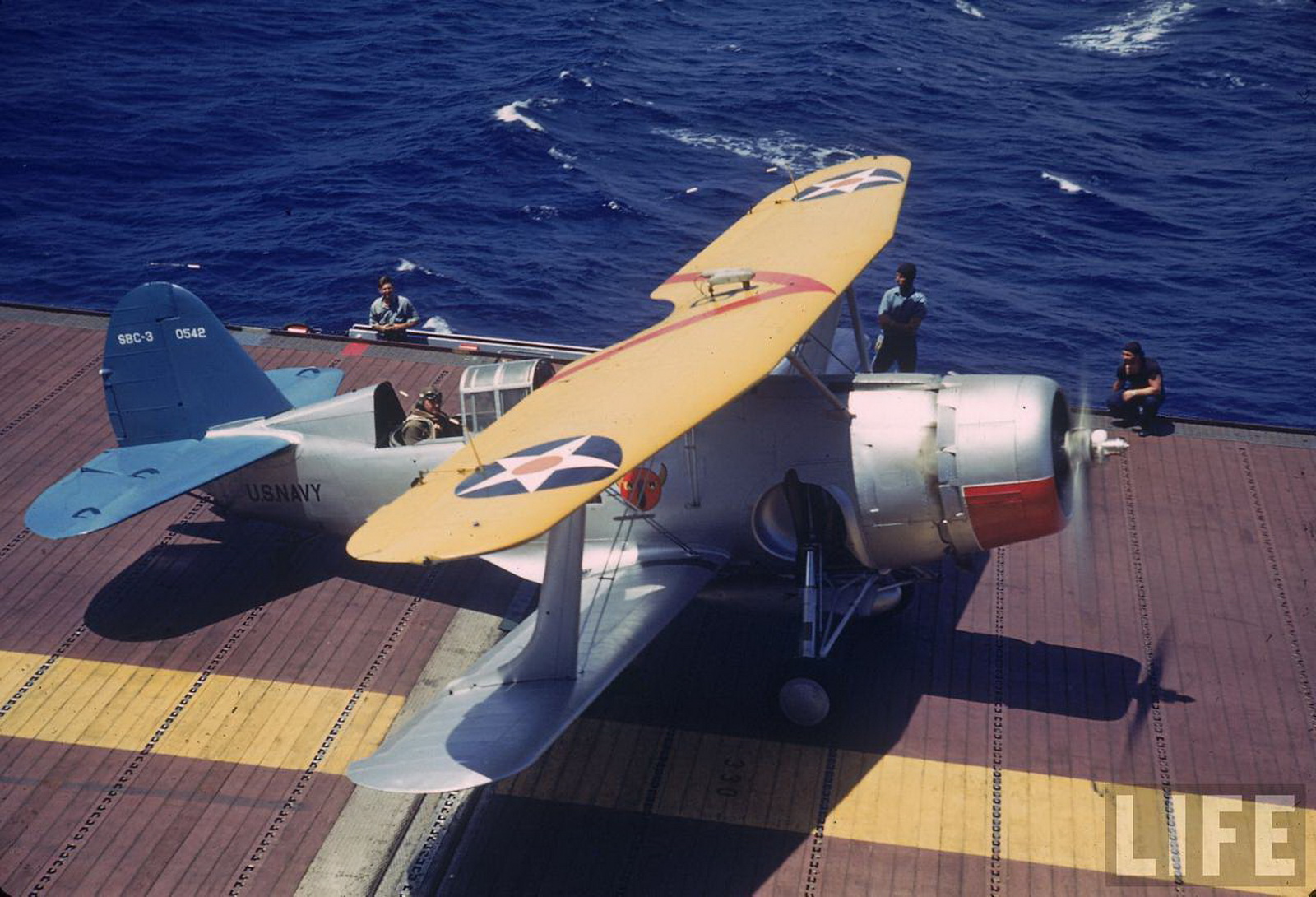
Curtiss SBC-3 Helldiver scout plane Preparing to Take-Off

Curtiss SBC-3 Helldiver scout plane from Scouting Squadron Six (VS-6) preparing for take-off from the deck of the aircraft carrier USS Enterprise (CV-6) during manuevers off the coast of Hawaii in September 1940. This plane, bureau number 0542, was soon pulled from front line service (as were the rest of the cumbersome Helldivers). This airframe was kept around until 1944 as a trainer. The blue tail indicates this aircraft is from the USS Enterprise. The red chevron on the top of the wing and the bottom of the cowling are the colors of the first section, made up of three aircraft, out of six sections in a squadron. The cowling being painted only on the bottom indicates this is aircraft number three, which would fly on the left-wing of the section leader when in a “V’ formation. It’s number, which you cannot see, would be “6-S-3″ for Sixth Carrier Group, Scouting Squadron, aircraft #3. Also, the rear observer looks exceptionally non-plussed. Incidentally, the Curtiss SBC-3 Helldiver, built in 1935, was obsolete as soon as it left the factory. While it would have been useful over the skies of France in WWI, any fighter of its day could have cleaned its clock. In fact, it was the last bi-plane built for the US Navy and Marine Corps. Slow (230 kts) and not very maneuverable, the plane had a short 150-200 nm radius of action as a scout plane and was pitifully armed with just two 30.06 caliber M1919 light machine guns (one forward and one rearward). It could, however, carry a half ton of dumb bombs.


Source :
http://laststandonzombieisland.com/2014/09/21/the-big-es-1938-airgroup-in-technicolor/

HJ SS soldier in Normandy

A grenadier from 12. SS-Panzer-Division "Hitlerjugend" in Normandy (France), summer 1944. He is wearing italian Telo Mimetico M29 camo trousers that were common throughout the 12th SS in normandy. Note that he is also holding a 15 cm sIG 33 (schweres Infanterie Geschütz 33), a heavy infantry support gun. It was the standard German heavy infantry gun used in the Second World War. It was the largest weapon ever classified as an infantry gun by any nation. Sources differ on the development history, but the gun itself was of conventional design. Early production models were horse-drawn, with wooden wheels. Later production models had pressed steel wheels, with solid rubber tires and air brakes for motor towing. The sIG 33 was rather heavy for its mission and it was redesigned in the late 1930s to incorporate light alloys in an effort to save weight. This saved about 150 kilograms (330 lb), but the outbreak of war forced the return to the original design before more than a few hundred were made, as the Luftwaffe had a higher priority for light alloys. A new carriage, made entirely of light alloys, was tested around 1939, but was not accepted for service. This picture was made by SS-Kriegsberichter Wilfried Woscidlo


Source :
https://en.wikipedia.org/wiki/15_cm_sIG_33
http://www.ww2incolor.com/german/12hj%23.html

Thursday, July 23, 2015

20mm AA Gun on 1-to-Zgkw in the Terek region/Southern Soviet Union

A German SdKfz 10/4 half-track with 20mm flak gun in the Terek region (Caucasus), alert for low-flying Soviet aircraft, autumn of 1942. 13. Panzer-Division had eight single-barrelled 2cm mobile flak guns and two quad 2cm flak guns, which was insufficient to cover the division’s combat elements when they were dispersed over a wide area


Source :
Book "The Caucasus 1942-43; Kleist's Race for Oil" by Robert Forczyk and Steve Noon

A Group of Grenadiers of the SS Wiking Prepares for an Attack

In September 1942, the SS-Division ‘Wiking‘ began pushing eastward toward Sagopshi and Malgobek in Caucasus, but encountered very stiff resistance and suffered heavy casualties. On 28 September, ‘Wiking’ reached the outskirts of Sagopshi but the Soviets committed two tank brigades, which resulted in a large-scale tank battle outside the town. Most of the tank combat occurred at ranges of just 200 to 400m. ‘Wiking’ claimed to have knocked out 11 Soviet tanks in the action, but admitted losing about a dozen of their own. Despite heavy losses, the ‘Wiking’ continued to attack for another week, until it finally secured Malgobek on 6 October. After that, the division shifted to the defence and Koroteev’s 9th Army began launching regular counterattacks. Here, an assault group of SS Panzergrenadiers is about to launch an attack from dead space behind a barrage


Source :
Book "The Caucasus 1942-43; Kleist's Race for Oil" by Robert Forczyk and Steve Noon

Saturday, July 18, 2015

German heavy coastal artillery of the Atlantikwall preparing to fire

German heavy coastal artillery of the Atlantikwall preparing to fire. The successful German offensive in May and June 1940 placed Calais and its environs under the control of an enemy of the United Kingdom for the first time since the end of the Napoleonic Wars, 125 years earlier. In the initial directive for the invasion of the United Kingdom, codenamed Operation Sealion, which was issued on 2 July 1940 by the Oberkommando der Wehrmacht, the supreme command of the German armed forces, the requirement was stated for powerful coastal artillery to "provide additional cover... against English naval attack". In a further directive on 10 July, the purpose of the guns was stated to be "for covering the front and flanks of a future crossing and landing" and they were placed under the overall control of Erich Raeder, the Commander-in-Chief of the Kriegsmarine. Work to assemble and begin emplacing every Army and Navy heavy artillery piece available, primarily at Pas-de-Calais, commenced on 22 July 1940. The heavy construction work was undertaken by the Organisation Todt. The first such guns to be put in place were Wehrmacht guns on the French coast, which began to be installed around the end of 1940. First came Siegfried Battery at Audinghen, south of Cap Gris Nez, with one 38 cm (15 in) gun (later increased to 4 and renamed Todt Battery), shortly followed by: Three 30.5 cm (12 in) guns at Friedrich August Battery, to the north of Boulogne-sur-Mer; Four 28 cm (11 in) guns at Grosser Kurfürst Battery at Cap Gris Nez; Two 21 cm (8.3 in) guns at Prinz Heinrich Battery just outside Calais; Two 21 cm (8.3 in) guns at Oldenburg Battery in Calais; Three 40.6 cm (16 in) guns (from among the so-called Adolf Guns) at Lindemann Battery between Calais and Cap Blanc Nez (the battery was named after the fallen commander of the battleship Bismarck, Kapitän zur See Ernst Lindemann)


Sources :
https://en.wikipedia.org/wiki/Cross-Channel_guns_in_the_Second_World_War
https://www.pinterest.com/danielesorgato/artiglieria/

Men of the 12. SS-Panzer-Division "Hitlerjugend" in Normandy


 Junior leaders and men of the 12. SS-Panzer-Division "Hitlerjugend" in Normandy, summer 1944. The relentless fighting has already left its traces on the young faces. These "Crack Babies" held their position in the trenches tenaciously, defying all attacks by the enemy who was superior in numbers and materials. The division itself was formed around a nucleus of experienced officers and NCOs from the Leibstandarte Division, such as Fritz Witt, Kurt Meyer, Max Wünsche and Wilhelm Mohnke. It would be up to these men to mould the Hitlerjugend into a potent combat unit. They knew how to soldier the Waffen-SS way: aggressively, taking risks to achieve victory. The picture was taken by SS-Kriegsberichter Wilfried Woscidlo


Source :
https://www.tumblr.com/search/12.%20ss%20panzer%20division%20hitlerjugend

Wednesday, July 1, 2015

German Infantry Advance Through a Russian Cornfields

German infantry advance through a Russian corn field, summer 1942. The Caucasus is visible in the background and the machine gunner in the foreground, carrying the MG 34, is protected by his assistant gunner carrying a MP 38. This type of advance was nerve-wracking for the troops, since close combat could occur at any time. It was also difficult to detect mines in such terrain.


Sources :
Book "The Caucasus 1942-43; Kleist's Race for Oil" by Robert Forczyk
http://ww2-weapons.com/mg34/mg34-cornfield-caucasus-px800/

Armored Soldiers Standing on Panzer IV (short) in Front of Thatched House Asking for Water

Panzermänner (tank crew) of this Panzerkampfwagen IV Ausf.F1 has established itself in front of a thatched house in a village on the Kalmyk Steppe, asking for water to the locals, September 1942. This photo was taken near the town of Elista near the Caspian Sea leading one to believe that this unit belonged to 16. Infanterie-Division (motorisiert) who was doing reconnaissance in the vast no-man's land between Astrakhan and the Terek river. Initially this sector was fairly quiet and the German troops had time to rest after the rapid advance from the Don, but in time isolated German detachments in this area were at great risk. While Ewald von Kleist's 1. Panzerarmee waited for fuel in order to resume his advance towards the Terek River and Grozny, the bulk of German combat activity shifted towards clearing the Taman Peninsula and the Kuban. The OKH believed that this operation would improve German logistics in the Crimea by allowing naval convoys to arrive through the ports of Anapa and Novorossiysk, as well as eliminating a good part of the Soviet coastal forces


Source :
Book "The Caucasus 1942-43; Kleist's Race for Oil" by Robert Forczyk
http://stukasoverstalingrad.blogspot.com/2013/06/recon.html

German Armour Crosses the Don River Over a Pontoon Bridge

A Panzerkampfwagen IV Ausf.F2 with the "long" 75mm from Infanterie-Division Großdeutschland (motorisiert) crossing the Don River over a pontoon bridge, east of Rostov, summer 1942. Operation Fall Blau commenced on 28 June 1942 with Heeresgruppe B making its push towards Voronezh and the Don, but it was not until 9 July that Heeresgruppe A joined in. Ewald Von Kleist’s 1. Panzerarmee then attacked the right flank of General-polkovnik Rodion I. Heeresgruppe A was faced with crossing one water obstacle after another (as shown in this picture, taken by Kriegsberichter Hanns Hubmann), which strained its limited engineering capabilities


Source :
Book "The Caucasus 1942-43; Kleist's Race for Oil" by Robert Forczyk

Wednesday, June 17, 2015

German Tank Crews Loaded Shells in their PzKpfw III tank

German tank crews from Panzer-Regiment 15 / 11.Panzer-Division loaded 5cm L60 (KwK39) shells in their Panzerkampfwagen III tank. Presumably on the way to Moscow, autumn 1941. For Operation Barbarossa, the 11. Panzer-Division initially started as part of XLVIII.Panzerkorps / Panzergruppe 1 / Heeresgruppe Süds. It took part in the encirclement of Kiev, and then participated in Operation Typhoon, the attempted encirclement of Moscow. At that time, the division (led by Generalleutnant Walter Scheller) were part of XXXXVI.Panzerkorps / Panzergruppe 4 / Heeresgruppe Mitte


Source :
http://allabouttanks.com/german-tank-crews-loaded-shells-in-their-tank-pzkpfw-iii/
http://www.armortek.co.uk/Forum3b/viewtopic.php?f=4&t=1385

A Flock of US Navy Douglas SBD Dauntless Dive Bombers Over the Pacific Ocean

A flock of US Navy Douglas SBD Dauntless dive bombers over the Midway Atoll during 1943. Serving primarily on the carriers Yorktown, Hornet, and Enterprise. They saw action in the Battle of Coral Sea, Battle of Midway (sinking 4 Japanese carriers) and worked side by side with TBD Devastator torpedo aircraft among many decisive battles


Source :
http://community.ratsun.net/topic/63908-airplane-porn-and-the-occasional-helicopter/page-3

Monday, June 15, 2015

SS Hitlerjugend Officers Conferred at Ardenne Abbey

At the building of l'Abbaye d'Ardenne (Ardenne Abbey), regimental command post of the SS-Panzergrenadier-Regiment 25 / 12.SS-Panzer-Division "Hitlerjugend" in Caen, Normandy, late June 1944. On the left wearing Italian Telo Mimetico M29 camo is the regimental commander SS-Obersturmbannführer Heinz Milius, who was to report the recent battle situation to SS-Sturmbannführer Hubert Meyer (Ia Erster Generalstabsoffizier of 12. SS-Panzer-Division "Hitlerjugend", Chief of staff). On the right wearing Demjanskschild is SS-Obersturmführer Bernhard-Georg Meitzel (Ib Quartiermeister of 12. SS-Panzer-Division "Hitlerjugend", Supply Officer in the Division staff), while the NCO behind Meyer is SS-Oberscharführer Herbert Reinecker (1914-2007), who served as an SS-Kriegsberichter. He started writing for nazi magazines in 1935 and was a writer for "Das Schwarze Korps" during the war years. He became a famous crime writer for TV series in Germany after the war, and never made a secret about his Waffen-SS membership though. This picture was taken by SS-Kriegsberichter Wilfried Woscidlo


Sources :
http://alifrafikkhan.blogspot.com/2011/10/album-foto-12ss-panzer-division.html
http://forum.axishistory.com/viewtopic.php?t=198608
https://www.pinterest.com/pin/325736985524947978/
https://www.ww2incolor.com/german/bs_14_14_1462269s.html

A Young Grenadier from Hitlerjugend Division in Normandy

 This picture was taken in Normandy front (France) in June 1944 by SS-Kriegsberichter Wilfried Woscidlo and showing a young Grenadier from 12. SS-Panzer-Division "Hitlerjugend" wearing camouflaged cloth and headgear. The division fought superbly throughout the Normandy campaign, its performance a testimony to the training it had received, its leaders and the calibre of its individual recruits. However, its fighting qualities were to no avail in the face of the Allies so-called ‘materialschlacht’, their overwhelming strength in tanks, aircraft, motorised infantry and artillery.


Source :
https://www.tumblr.com/search/hitlerjugend%20division

Hitler Reviewing the German Victory Parade in Warsaw

With the fighting in central Poland winding down, Hitler presided over an 8. Armee victory parade in Warsaw, the recently captured enemy capital, on 5 October 1939. Although PzKpfw I Ausf.B, such as these, were ill-suited for direct combat, necessity often dictated otherwise; including the fight for Warsaw. Soon to gain fame commanding 7. Panzer-Division in the West, Generalmajor Erwin Rommel – a distant cousin of Lódź Army’s commander, Major General Juliusz Rómmel – stands with other high ranking officers below Hitler as head of the Führerbegleithauptquartier (Führer Escort Headquarters), having provided security for the event, while at the podium we can see, from left to right: Generaloberst Walther von Brauchitsch (Oberbefehlshaber des Heeres), Hitler, General der Kavallerie Maximilian Reichsfreiherr von Weichs (Kommandierender General XIII. Armeekorps), Generaloberst Walther von Reichenau (Oberbefehlshaber 10. Armee), and General der Flieger Alexander Löhr (Chef Luftflotte 4). Generaloberst Johannes Blaskowitz (Oberbefehlshaber 2. Armee) and General der Flieger Albert Kesselring (Chef Luftflotte 1) were blocked by the back of panzer commander at right. The picture was taken by Hugo Jaeger, one of Hitler's personal photographer


Sources :
Book "Panzer II vs 7TP - Poland 1939" by David R Higgins
http://alifrafikkhan.blogspot.com/2010/10/koleksi-ratusan-foto-berwarna-dari-life.html
http://www.iwm.org.uk/collections/item/object/205095248

Sunday, June 14, 2015

A Grenadier from Hitlerjugend SS Division Smoking in Normandy

A Grenadier from 12. SS-Panzer-Division "Hitlerjugend" lit a cigarette during a pause in the battle. The picture was taken in Normandy front (France) in June 1944 by SS-Kriegsberichter Wilfried Woscidlo. Described as a "Crack Babies" division, the Hitlerjugend was unique because the majority of its junior enlisted men were drawn from members of the Hitler Youth born in 1926, while the senior NCOs and officers were generally veterans of the Eastern Front. The division, with 20,540 personnel, first saw action on June 7, 1944 as part of the German defense of the Caen area during the Normandy campaign. The battle for Normandy took its toll on the division and it came out of the Falaise pocket with a divisional strength of 12,500 men. The division has been criticized for performing inadequately in the opening days of the Normandy campaign. Following the invasion battles, the division was sent to Germany for refitting. On 16 December 1944, it was committed against the US Army in the Battle of the Bulge. After the failure of the Ardennes offensive the division was sent east to fight the Red Army near Budapest. The 12th SS Division eventually withdrew into Austria; on 8 May 1945, the surviving 10,000 men surrendered to the US Army at Enns.The reputation of Hitlerjugend has been affected by war crimes committed by members of the division during the early battles in Normandy.


Source :
http://www.ww2incolor.com/rating/3.5%3Fg2_itemId%3D1060?g2_itemId=347004

Monday, June 8, 2015

Werner Baumbach as a Flight Guest in the Cockpit of Heinkel He 111

Bomber ace Major Werner Baumbach (left, Gruppenkommandeur III.Gruppe / Kampfgeschwader 30 "Adler") as a "Fluggast" inside the cockpit of a Heinkel He 111. In the pilot seat at right is Leutnant der Reserve Herbert Kuntz (Flugzeugführer in 3.Staffel / I.Gruppe / Kampfgeschwader 100 "Wiking"). This picture was taken by Michael Sobotta in 1942. During World War II, Baumbach was Germany's leading bomber pilot. He flew the Junkers Ju 88 two-engine bomber on a number of fronts. He also got pulled out of combat in the middle of the war to help develop the "Mistel", an unmanned bomber. Shortly before the end of the war, he got put in charge of a secret, SS-run squadron known as KG200, which he reorganized into a special escape squadron to fly high-level Nazis out of Germany to safe havens abroad. They used any available aircraft, including captured B-17s, to do this!


Sources :
http://alifrafikkhan.blogspot.com/2015/02/foto-werner-baumbach.html
http://brendanmcnallynazisanddinosaurs.blogspot.com/2012/06/person-of-interest-werner-baumbach.html

SS Officers Playing Guitar and Singing during the Battle of Normandy

During a break in the fighting, SS-Untersturmführer Franz-Josef "Franzl" Kneipp (Signal officer of III.Bataillon / SS-Panzergrenadier-Regiment 25 / 12.SS-Panzer-Division "Hitlerjugend") plays his guitar in the trenches with the battalion adjutant, SS-Untersturmführer Kurt Bergmann, and just out of sight to the left is Battalion Commander SS-Obersturmbannfuhrer Karl-Heinz Milius.  Kneipp is wearing a Waffen-SS Plane Tree pattern tunic (Platanenmuster), while Bergmann is wearing a Splinter Pattern tunic (Splittertarn). This color photo was taken near Buron in Normandy (France), June 1944, and are originally produced by Wilfried Woscidlo, a Kriegsberichter attached to the "HJ" Division. Bergmann would be MIA (Missing in action) on 8 July 1944, while Kneipp survived the war


Sources :
http://www.feldgrau.net/forum/viewtopic.php?f=42&t=31121
http://www.militaryimages.net/forums/printthread.php?t=9362&pp=40&page=3
http://wurmhoudt.blogspot.com/2013_06_01_archive.html

Sunday, May 31, 2015

SS-Untersturmführer Franz-Josef Kneipp in Normandy Front

SS-Untersturmführer Franz-Josef "Franzl" Kneipp (19 September 1911 - 12 October 2002) in Normandy front, June 1944. He was a signal officer (Nachrichtenoffizier) in the III.Bataillon / SS-Panzergrenadier-Regiment 25 / 12.SS-Panzer-Division "Hitlerjugend". The picture was taken by Wilfried Woscidlo. Kneipp was originally a signaler in the police on the staff of the High SS and Police Leader Rhein in Wiesbaden until he joined the Aufklärungs-Abteilung of the Totenkopf division in 1939. He was a signal platoon NCO as an Oberscharführer in the SS-Flak Abteilung “Ost” from August 1941 thru April 1943. Despite being kicked out of the officer course at the signal school in Metz near graduation for an affair with a French girl, he was promoted to Untersturmführer in April 1944 upon the recommendation of his regimental commander, Kurt Meyer. He was wounded on July 8, 1944 as signal officer of III./SS-Panzergrenadier Regiment 25 in Normandy. He was sent out on a reconnaissance mission in a tank to look for the enemy. He was standing in the tank turret looking through his binoculars and the next thing he remembers is waking up while some Canadian soldiers were pulling him out of the tank with his arms streaming blood. His tank had taken a hit from a Canadian tank and he had been wounded in both arms. Following a brief hospitalization in Scotland, Kneipp was handed over to the Americans and transported by ship to the United States where he was brought to Washington, D.C. for questioning about his knowledge of German code machines. He had also been interrogated by the British about code machines and threatened with being shot if he did not tell what he knew. Kneipp refused. After his return to Germany Kneipp ended up on the staff of the US Air Force Wiesbaden air base commander. For many years Kneipp was the chairman of the Wiesbaden HIAG veterans association.


Sources :
http://5sswiking.tumblr.com/page/2
http://www.feldgrau.net/forum/viewtopic.php?f=42&t=31121&sid=ef9b52263389f7751162ebbd65755b6d
http://www.ww2incolor.com/german/kneipp1944a50lu8.html

Monday, May 4, 2015

A Group of Focke Wulf Fw 200 "Condor" Pilots Preparing for a Mission in 1940

 A group of Focke Wulf Fw 200 "Condor" pilots preparing for a mission in 1940. At the same time Condor operations started in the Atlantic, the strategic situation was changing for the Third Reich. Even in July and August 1940, with the Battle of Britain raging, Hitler had lost whatever enthusiasm he had for invading Great Britain, and was already dreaming of his next war, with the USSR. So when it was proposed that the Luftwaffe and Krigsmarine establish a total blockade against the British Isles, Hitler readily agreed, as it freed up the Weremarcht to get moving eastward. Hitler calculated that even if the blockade didn't knock Britain out of the war entirely, it would weaken it to the point the island nation would be unable to oppose his plans, and allow the Nazi war machine to deal with the Soviets without distraction. The key to this strategy would be cooperation between the German air force and navy – which (spoiler alert!) was never very good. In fact, at one point Nazi Germany would be waging no less than five campaigns against British supply lines, with very little coordination between any of them. The search method of the Fw 200, however, was excellent for bombing attacks: given the low visibility haze that usually obtained over the Atlantic, a Condor would be visible to a ship only for a minute or two before it was dropping its bombs. Condors until the C-4 had a very basic bomb-sight, so the attack method was a low level bombing run 'bracketing' the target with the Condor's bomb load. Initially attacking convoy stragglers, Condor crews soon learned that convoys away from land based air cover had no defenses at all against air attacks. So, even a glass bird like the Condor could be used as an effective low level bomber. Petersen, once he discovered this, knew he had found the Condor's niche. As the Battle of Britain ended and the Blitz began, the improvements made to the Condor with the C-3 began to pay dividends. The Germans had been caught off guard before the war began for the need of a maritime bomber; now it was Britain’s turn to be caught off guard. The picture presented here are from the book "Fliegende Front" by by Hauptmann Walter-Eberhard Alexander Albert Freiherr von Medem (4 May 1887 - 9 May 1945), published in 1942 by Verlag ‘Die Wehrmacht’ KG. in Berlin. The book must be regarded as typical propaganda material to show the German population how well the war was progressing. ‘Die Wehmacht’ published a series of other propaganda books during the war. They also released sets of photo postcards from the war


Source :
http://forum.warthunder.com/index.php?/user/89479-mcdeth187/?tab=reputation&app_tab=forums&type=received&st=15
http://www.letletlet-warplanes.com/2013/04/25/luftwaffe-colour-propaganda-photos/