Showing posts with label Destroyed War Machine. Show all posts

Monday, September 11, 2023

Luftwaffe Soldiers Inspecting T-34 Tank


Members of the Luftwaffe inspects a captured Russian T-34/76 medium tank. The enemy's vehicles were always of great interest. This tank in particular was a nasty surprise, as it was initially superior to the German combat vehicles. However, the open commander's hatch shown in the picture was a disadvantage because it was difficult to open and close and therefore did not have a good overview of the battle.

Source :
https://www.zinnfigur.com/en/Books-Media/Others/Calendars/Zweiter-Weltkrieg-in-Farbe-2023.html

Wednesday, October 19, 2022

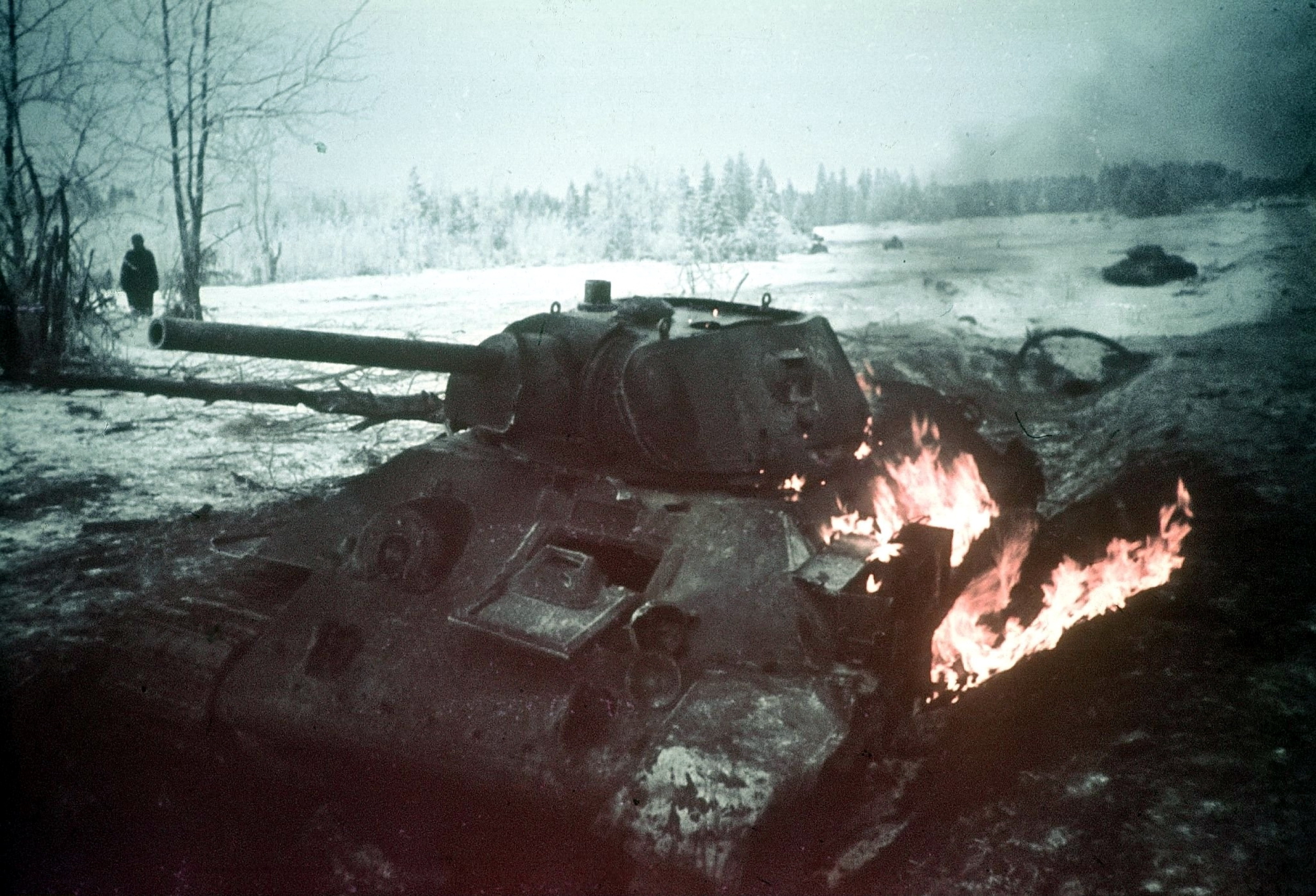
A Burning Soviet T-34

Aftermath of the repel of a Soviet tank attack by German forces in the Eastern Front: a hit, burning T 34 tank. The picture was taken by Kriegsberichter Artur Grimm, early or late 1943 (winter). The T-34 seemed impervious to German weapons and able to destroy German tanks with ease. Panzer commander General Heinz Guderian saw the heavy losses inflicted by the T-34 and realized what a game-changer it was, outclassing his own Panzer IIIs and IVs: “Up to this time we had enjoyed tank superiority, but now the situation was reversed,” Guderian wrote. “The prospect of rapid, decisive victories was fading in consequence."

Source :
https://www.popularmechanics.com/military/weapons/a32439030/t-34-soviet-tank-history/

Wednesday, August 24, 2022

Polish Railway in World War II

Destroyed / damaged Polish State Railways PKP train on collapsed bridge with German soldiers waiting in the bottom. The picture was taken in September-October 1939, not long after the end of the German invasion in Poland.

In 1939, Polish State Railways had 220 thousand employees. It was a well-organised occupational group. 85% of railwaymen were members of trade unions. Most of them were also members of the Railway Military Training Organisation who had done compulsory military service.

As part of mobilisation activities, some railwaymen were summoned to join the army. In the last weeks before the outbreak of war numerous cases of German sabotage against railway facilities were recorded. Some acts of sabotage were prevented thanks to vigilant railway workers. The most tragic act of terror was an explosion of a time bomb on 28 August at 11:18 PM in the waiting room of the railway station in Tarnów. The lethal device was planted by Antoni Guz from Bielsko. 20 people were killed under the ruins of the destroyed railway station and 35 were injured.

When war broke out railways were handling emergency and general mobilisation transports. Also, the first evacuation trains pulled out on the route. Germans carried out bombing raids and airborne fire attacks on railway stations, echelons but also on evacuation trains carrying civilians and identification-bearing sanitary trains. Large railway stations such as those in Bydgoszcz, Grudziądz, Inowrocław, Toruń, Łowicz, Piotrków Trybunalski, Skierniewice, Kraków, Lublin and the stations of the Warsaw railway junction were bombed – some of them even more than once. Despite this fact, railwaymen and sappers were able to restore traffic on the damaged lines within 3–4 hours.

The first military transports were put into operation before mobilisation was declared; 5 large troops were transferred at that time. Subsequent echelons were transported under a mobilisation plan which provided that 32 out of 56 large troops would be transported by rail, as a whole or in part, to build-up points. In total they were to account for 3/5 of Polish forces. This task required 3 thousand trains. In addition, railways had an obligation to deliver 700 thousand reservists from emergency mobilisation and 400 thousand from general mobilisation and 100 thousand soldiers withdrawn from the west to reserve centres situated in the east. Railway troops were supposed to remove damages to railroads.

The attack of Nazi Germany on Poland on 1 September 1939 was also aimed at main junction stations and railway lines. Bombing raids on the stations in Tczew and Kutno started at dawn. Also, the bridge on the Bugonarew in Modlin was bombed. To prevent the progress of the German army, Polish sappers blew up some railway structures e.g. viaducts, tunnels in Żegiestów (on the line Muszyna– –state border) and in Łupków (on the Łupków–Medzilaborce line), bridges in Tczew, Grudziądz, Bydgoszcz-Fordon, on the Bydgoszcz Canal, in Toruń and in Płock.

The events in Szymankowo became a symbol of the heroism of railwaymen. Here, Polish railwaymen prevented an insidious seizure of the bridge in Tczew by the Germans. The scheduled transit train was followed by an armoured train which was sent to a sidetrack and derailed. In retaliation Germans murdered the railwaymen from Szymankowo. In Chojnice, instead of the scheduled train, a German armoured draisine pulled into the station followed by an armoured train. Polish railwaymen and soldiers had been able to take control of the draisine and destroy the bridge before the armoured train reached it. Two railway companies took part in the defence of Warsaw.

Armoured trains were used in the defensive war, including “Danuta” (No. 11) and “Poznańczyk” (No. 12) which took part in the Battle of the Bzura and were destroyed. “Generał Sosnkowski” (No. 13) was derailed and damaged after a bombing raid near Łochów. “Paderewski” (No. 14) was destroyed near Łowicz, and “Śmierć” (No. 15) suffered damage during fighting near Modlin. “Pierwszy Marszałek” (No. 51) fought both against Germans and the Red Army and was damaged in combat with Soviet airplanes. “Piłsudczyk” (No. 52), “Śmiały” (No. 53) and “Bartosz Głowacki” (No. 55) were seized by the Soviets in Lviv (Podzamcze), and “Groźny” (No. 54), fighting in Silesia, was destroyed by the crew when they reached a blown-up bridge on the Dunajec.

As a result of the warfare, 11 large bridges were destroyed, 8,000 smaller structures were damaged and 25,000 damages to stations and tracks were recorded. Some trains and evacuated rolling stock – the exact number is difficult to estimate – reached the eastern parts of the Republic of Poland that on 17 September were occupied by the Red Army.

Both occupying forces introduced their own order. The Germans divided the conquered territory. In the area of the General Government (95 thousand sq. km), on 19.11.1939 the General Directorate of Eastern Railways (Ostbahn) (GEDOB) was established in Kraków. District directorates were set up in Kraków, Warsaw, Radom and Lublin. The general organisation of divisions in the new general directorate was not changed compared to the organisation before the war. German identification symbols were applied on the rolling stock. At the beginning of 1940 the German railway police, called the Bahnschutz, was established as another element of the system of repression. Poles could travel by all trains except fast trains. Also, they could not sit in carriages for Germans. On the other hand, Jews were not allowed to travel without pass cards. In the territories incorporated into the Reich Poles could use the train service only if they were issued special pass cards. Polish railwaymen, and in particular members of the Silesian uprising, plebiscite activists, members of the Greater Poland uprising, and activists involved in social activity before the war were subject to repressions including executions by firing squads and imprisonment in concentration camps. Managerial and other functions were handled by the Germans.

Railway transport was a very important element of the German war machine, therefore, when the fighting ceased in September 1939, the occupying power commenced the reconstruction of the destroyed railway network. Railwaymen were called to work. Work on railways offered protection against being taken away to Germany and forced to work and railway passes enabled travelling after curfew. The war production required efficient technical back-up. Thus, some workshops (e.g. in Nowy Sącz) and factories (Chrzanów) were expanded. The steam locomotives and wagons were marked with vainglorious slogans: “Alles Rädern mussen rollen für den Sieg! (Wheels must roll for victory!)” and “V” signs painted on locomotive smoke-boxes.

In the meantime, Polish railwaymen organised acts of sabotage spontaneously or under emerging conspirators’ organisations, to make operation of the railway difficult to a varying degree and extent. Among other things, they poured sand into wagon grease tanks, falsified transport documents, replaced address stickers on wagons, or assigned double numbers to wagons after repairs. The official gazette of Ostbahn of September 1943 listed the numbers of 500 wagons and 200 tankers which were lost while carrying cargo. 25% of tankers of the former Polish State Railways’ network were sabotaged. In 1942 every fifth steam locomotive was out of order. Railwaymen provided enormous support in organising illegal deliveries of foodstuffs to cities, in conspiracy carriage of mail and courier mail or hiders and in warning against round-ups at railway stations and in intelligence operations. They were at a risk of severe repressions for such activities.

Prior to the attack on the Soviet Union, railway transport in Poland became particularly significant to the Reich. In the territory of the occupied country the Germans gathered 102 divisions of the Wehrmacht, i.e. nearly 3 million soldiers! Following the outbreak of the war between the Germans and Soviets on 22 June 1941 the Commander-in-Chief of the Polish Armed Forces, General Władysław Sikorski, ordered the chief commander of the Union of Armed Struggle, General Stefan Grot-Rowecki to intensify the sabotage and subversion activities in the Reich and in the direct vicinity of the German army. At that time 420 military transports passed through Poland every day. During sabotage and subversion actions in the second half of 1941 as many as 1935 steam locomotives were damaged and 91 were held in repair workshops, 91 railway transports were derailed and 237 were set on fire. In addition, 2,851 wagons were damaged. At that time Ostbahn employed 150 thousand Polish railwaymen, 60 thousand Polish railway workers, 8.3 thousand Germans and 3.5 thousand rail guards.

Sabotage on railway lines passing near the frontline was further intensified in 1942. The largest achievement of the Warsaw District Union of Retaliation was Operation Wieniec (lit. Operation Corona) in the night of 7/8 October 1942, in which the rails surrounding Warsaw were blown up at the same time. Operation Bariera (Barrier) interrupted railway traffic at 92 points simultaneously. Actions at German rail transports were also carried out by partisan groups of any political orientation, including Soviet groups.

At the second stage of the war the retreating Germans purposefully destroyed railway lines on their way. They blew up tunnels, bridges, water towers and pump stations. The occupying forces burnt down and demolished railway station buildings and engine houses, and sappers blew up the poles of teletechnical networks. The Germans took machines, tools and rolling stock away to the Reich. 4 out of 11 main workshops were completely destroyed (Warsaw Chmielna, Warsaw-Praga, Eastern Warsaw and Łapy). 80–90% of machines and equipment was lost by the workshops in Pruszków, Tarnów and Nowy Sącz. Smaller losses were suffered in Radom, Gdańsk, Poznań and Bydgoszcz. The The Germans stole all equipment and machine tools from the regained territories, from, among other places, Opole, Oleśnica, Świdnica, Ostróda and Stargard Szczeciński. They also took away most machines from Wrocław and from 2 steam locomotive and wagon workshops in Gliwice. Only in Piła was complete equipment saved.

The total losses suffered by Polish railways, also calculated taking into account territories allocated after 1945, amounted to 16 billion zlotys (in pre-war currency). 38% of railway lines, 46% of bridges (including all major bridges), 50% of tunnels, 37% of railway buildings, 6 thousand steam locomotives and 60 thousand wagons were destroyed.


Source :
https://kolejnictwopolskie.pl/baza-wiedzy/kolejowa-ii-wojna?article_lang=en

Thursday, December 16, 2021

A Disabled Sherman Near Nederweert

The Liberation of Belgium and the Netherlands : British Sherman tank of the Royal Scots Grays (4th Armories Brigade) - equipped with a 'Culin Hedgerow Device' because of the fighting in the bocage in Normandy - is disabled at a cornfield in or near Nederweert, 1944. Note an entry wound on the front left 1/4 of the hull. Looks like the driver and loader had no chance. Photo by J.A.H. de Haan.

Source :
https://beeldbankwo2.nl/nl/beelden/?mode=gallery&q=J.A.H.%20de%20Haan&page=1&record=e87d4474-025a-11e7-904b-d89d6717b464&view=horizontal
https://www.facebook.com/photo/?fbid=621909545744540&set=gm.1894813764037371

Sunday, September 5, 2021

Polish Armored Train "Danuta"

Poland, near Łowicz, September 1939. Damaged Polish armored train No. 11 "Danuta" captured by German troops. The Danuta was built in Poznań in 1919. In August 1920, the train participated in the Battle for Warsaw, as part of the Polish 1st Army. In 1924, the Danuta was assigned to the armoured train training unit located in Jabłonna, Legionowo County. Like most other Polish armoured trains, the Danuta was modernised in the early 1930s by receiving a Ti3 type locomotive, additional guns and AA machine guns. After the Polish Army was mobilised in 1939, the train was assigned to the Poznań Army. In the first days of the war, the Danuta supported various Polish infantry units. On 4 September, the train was bombed by the Luftwaffe, but received only minor damage. Next the train participated in the Battle of the Bzura. On 16 September, the train helped to halt the advance of the German 24. Infanterie-Division and tried to withdraw towards the Polish 16 Infantry Division, but was ambushed by the German anti-tank artillery. The damage received in the ambush and the fact that the train's ammunition supplies were almost depleted forced the commander of the train, Captain Korobowicz, to order the train to be blown up, together with the assaulting German infantry, to prevent German capture. Out of the tanks used to scout on and off the rails, five tankettes TKS were evacuated successfully and two FT-17 tanks blown up.

Source :
Bundesarchiv B 206 Bild-GD-52
https://en.wikipedia.org/wiki/Danuta_(armoured_train)

Monday, May 3, 2021

Sherman Tanks Set Fire to Japanese Aircraft

Marine flamethrowing Sherman tanks set fire to Japanese aircraft in Sasebo, Japan, on November 2, 1945. Sasebo is a core city located in Nagasaki Prefecture, Japan. It is also the second largest city in Nagasaki Prefecture, after its capital, Nagasaki. The city which had 206,000 inhabitants in 1945 suffered severe damage by bombing on June 29, 1945 during World War II and was destroyed by 48%. Sasebo was one of the original 17 targets selected for the dropping of the atomic bomb. After the end of the war, part of the base facilities were taken over by the United States Navy, forming U.S. Fleet Activities Sasebo.

Source :
National Archives and Records Administration 127-GW-137979
Smithsonian National Air and Space Museum
https://en.wikipedia.org/wiki/Sasebo
https://www.flickr.com/photos/airandspace/albums/72157715574200936

Saturday, August 1, 2020

Russian KV-2 Tank Knocked-Out

This photo came from a Color slide group of II.Abteilung / Artillerie-Regiment 63 / 27.Infanterie-Division. The owner of the group drove on this Morris Commercial CS8 in the Russian front. Multiple Russian KV-2 heavy tanks were lost near this place, since in frame 5 (this is frame 8) another completely destoyed KV-2 is pictured. More pictures from this group can be seen in my earlier postings, including the recent burnt out BT-7. This scan is unfortunately in 8-bits, so subtle colors are lost during the processing.  I (Akira) should rescan it in 16-bits some time in the future.

Source :
Akira Takiguchi photo collection
https://www.facebook.com/photo.php?fbid=10220735149802094&set=gm.1439929659525786&type=3&theater&ifg=1

Tuesday, August 16, 2016

Luftwaffe Soldiers Near the Burning Wreck of American P-38 Lightning

German Luftwaffe soldiers near the burning wreck of an American Lockheed P-38 Lightning "ES-J" fighter aircraft that shot down in Tunisia, early 1943. The plane belong to the USAAF's 48th Fighter-Squadron / 14th Fighter Group. This picture was first published in the SIGNAL magazine, May 1943 edition. Operation Torch (the invasion of North West Africa) was the first major Anglo-American operation of the Second World War. It was also the first time the P-38 saw significant action against the Luftwaffe. The only indication of how the P-38 would cope against German fighter aircraft came from a test flight against a captured Fw 190. Two P-38 equipped Fighter Groups – the 1st and 14th – were allocated to Operation Torch, with a third (the 78th) kept in reserve in Britain. They did not play a part in the initial landings on 8 November 1942 – the 14th FG did not go operational in North Africa until 11th November. At first they were based in western Algeria, as part of the Central Task Force that had occupied by Oran, but in the days that followed the Germans built up an impressive presence in Tunisia, and the P-38 groups were moved east, initially to Algiers. The 14th FG was first, moving to the recently captured airbase at Youks-les-Bains, with the first squadron moving on 21 November. This base was close to the Tunisian border, and the P-38s soon found themselves coming up against the increasingly strong Luftwaffe presence in North Africa. Over the next two months the 14th FG carried out a mix of ground attack, bomber escort and air superiority missions. At first they had been involved in supporting the first, unsuccessful, attempt to capture Tunis, which had occupied most of late November 1942. The front line was 150 miles east of Youks, not a problem for the P-38, but there were never enough aircraft. P-38 formations on fighter sweeps over Tunisia were often outnumbered by formations of Bf 109s and Fw 190s. The 14th FG suffered very heavy losses during this period. Between November 1942 and 28 January 1943 the group lost 32 pilots (out of an original complement of 54) and had been reduced to only seven operational aircraft. During its first period of service in North Africa, the 14th FG claimed 62 victories. Even though North Africa had been given the highest possible priority for new P-38s, there simply weren’t enough aircraft being produced in late 1942 to sustain such heavy losses. On 28 January the 14th FG was withdrawn, and replaced by the 82nd Fighter Group, also equipped with the P-38.


Source :
http://www.historyofwar.org/articles/weapons_P-38_NorthAfrica.html
http://militaryhistory.x10.mx/ww2colorphotos/afrika_02.htm

Sunday, May 15, 2016

Finnish NCO Inspects the Russian Vehicles Captured at the Porlampi Motti

A Finnish junior sergeant inspects the Russian vehicles captured at the Porlampi motti on 5 September 1941. Here some 9,000 Soviet soldiers were captured by Finns, along with their leader Major General Vladimir Kirpitsnikov, while 7,000 of their comrades died in the encirclement and some 12,000 managed to escape, having to leave behind all heavy equipment.


Source :
Book "Finland at War: The Continuation and Lapland Wars 1941-45" by Vesa Nenye, Peter Munter, Toni Wirtanen and Chris Birks 
http://www.ww2incolor.com/finnish_forces/BillionMotti_Porlammi-Sommee_encirclement_1941.html

Wednesday, April 27, 2016

Burnt-Out Wreck of an Tupolev SB-2bis in Russia

Burnt-out wreck of an Tupolev SB-2bis in Russia. The SB-2bis differed from the preceding variant mainly in its more powerful M-103 engines, which each produced 130 h.p. more than the M-100 engines of the SB-2. The SB-2bis also had increased fuel tankage and consequently was the Soviet Air Force's standard medium bomber during the first half of the war against Germany. The aircraft seen in the photo was most probably shot down. The bent propeller blades suggest a forced landing with the engines running. Note the unusual curved demarcation line between the two camouflage colors on the rear fuselage.


Source :
Magazine "Luftwaffe im Focus Spezial" No.1 2003

A Wrecked I-153 in the Operation Barbarossa

By the time Germany invaded the Soviet Union, the Polikarpov I-153 Chaika (Russian Чайка, "Seagull") was no longer a serious opponent for German fighters, although it remained a significant aircraft based on numbers alone. On 22 September 1941 there were 1,549 I-153s stationed in the Western Military Districts. More than 50% of these were destroyed on the ground or rendered unusable in the first few days of the conflict! The photograph shows two "Chaikas" found by advancing German forces. The fabric-covered areas of the aircraft were painted silver, while the metal panels were pale gray. Note the early-war version of the Soviet star with a narrow black outline and black circle in the center of the star. The fuselage star has been removed by a souvenir hunter


Source :
Magazine "Luftwaffe im Focus Spezial" No.1 2003

Wednesday, February 17, 2016

Burnt out German vehicles north of Rome

18 June 1944: A German mechanized column completely destroyed by the ubiquitous Allied fighter-bombers near one of the great northward Consular Ways from Rome during the retreat from the Italian Capital (liberated by the Allies on 4 June 1944) as discovered by the advancing British troops. The completely burned truck in foreground is a former Italian Army vehicle, one of many seized by the German forces on September 1943 after the Armistice of the Italy with the Allies, likely a Fiat 626 truck. In background a French-built Renault AHR truck.


Source :
https://www.facebook.com/photo.php?fbid=1689342874612016&set=gm.496634357188659&type=3&theater
http://www.iwm.org.uk/collections/item/object/205188924

Soviet Stalinetz Tractor Drove into the Wall

This picture was taken by Kriegsberichter Koster on 16 October 1941 at Uman (Ukraine) and show a Russian Heavy Tractor Stalinez - ChTZ S-60 with an 152-mm howitzer M1938 (M-10) gun in its stowed position, drove into the wall of a village house after its crew was killed by attacking German troops. Widely unknown, the Russian tractor industry which later in war almost completely switched to tank production was erected with massive American assistance in the late 20s and early 30s of the last century. The young communist state had such an urgent need for agricultural machines that many of the so-called "Tractor Zavod" were established nationwide, among those the Chelyabinskii Traktornyi Zavod imeni Stalina (ChTZ). "Stalinetz" (The son of Stalin) S-60 produced from 1933-1937 and was a copy of the Caterpillar 60, fitted with a 4-cyl. 60 hp. petrol engine yielding a max speed of only 6 km/h and hence making the S-60 an easy prey for the German blitz.


Source :
http://www.o5m6.de/s-60.html
http://waralbum.ru/116025/

US Stuart Light Tank in Soviet service with a Towed Gun

A Soviet M3 Stuart tank (supplied through Lend-Lease) with a towed 152mm field howitzer, destroyed at the Second Battle of Kharkov (Ukraine) in May 1942. By December 1941 it did look as if Russia just might collapse. It was around this time that Russia started to receive substantial numbers of M3s. As it turns out, they're not too happy with the tank, considering it under-gunned, under-armored, likely to catch fire, and too sensitive to fuel quality. The M3's radial aircraft engine required high-octane fuel, which complicated Soviet logistics as most of their tanks used diesel or low-octane fuel. High fuel consumption led to a poor range characteristic, especially sensitive for reconnaissance vehicle. Also, compared to Soviet tanks, the M3's narrower tracks resulted in a higher ground pressure, getting them more easily stuck in the spring and autumn mud and winter snow conditions on the Eastern Front. In 1943, the Red Army tried out the M5 and decided that the upgraded design was not much better than the M3. Being less desperate than in 1941, the Soviets turned down an American offer to supply the M5. M3s continued in Red Army service at least until 1944. The Soviets appreciated the high reliability of American tanks.


Source :
https://en.wikipedia.org/wiki/M3_Stuart

Thursday, October 15, 2015

Messerschmitt Bf 110 undergoing Repairment in Greece

Two photographs of Messerschmitt Bf 110 E-3 L2+KR of 7.Staffel (Fern) / Lehrgeschwader 2 (LG 2), taken in May 1941 following the entry of German forces into Greece, probably at the Athens-Kalamaki airport. The aircraft's tail section has sustained battle damage. The right rudder had been damaged previously, this time the Bf 110 was hit in the tailwheel and left rudder. The number of technicians examining the tailwheel suggests that the damage was something out of the ordinary. Note the Bf 110's gray camouflage scheme, the yellow elevators and the retouched finish on the vertical stabilizers. Beneath the fuselage is the "Gartenzaun" (Garden Fence) antenna of the FuG III - a U instrument-landing system - and the DF loop of the Peil G V.


Source :
"Luftwaffe im Focus", Spezial No.1 - 2003

Thursday, October 8, 2015

Aftermath of the Battle in Radzikhov-Koloyov Area


By 27 June 1941, The German 6. Armee had reached the Radzikhov-Lopatin-Lezhniov-Snurdare line. Tanks and artillery were used by the defending Russian forces in an attempt to halt the attack. The pictures show shot-up tanks and the result of artillery in action at Radzikhov-Koloyov area


Source :
"The Onslaught; The German Drive to Stalingrad Documented in 150 Unpublished Colour Photographs" by Max Hastings

Monday, October 5, 2015

Wreckage of Bf 110 in France

The sad remains of a Messerschmitt Bf 110 G-4, aircraft code 3C+DR (all in black), of 7.Staffel / III.Gruppe / Nachtjagdgeschwader 4 (NJG 4). The photographs were taken in the summer of 1945 at Reims airfield in France. III./NJG 4 had began converting from the Bf 110 G-4 to the Junkers Ju 88 G-1 in the summer of 1944 and completed the process in October, therefore this must have been an aircraft that was taken out of service or used for some other purpose by the Gruppe. The Bf 110 was probably parked in some corner of the airfield and left to rot, as its seriously faded camouflage finish would suggest. Pieces of a Ju 88 are visible in the background. The remnants of a yellow fuselage band may just be seen in front of the unit code "3C", while a letter of the manufacturer's code is visible under the "3C". Also note the simplified white Balkenkreuz. In the other photograph we can see the remnants of the SN-2 radar on the fuselage nose. Camouflage: RLM 75 + 76.


Source :
 "Luftwaffe im Focus", Spezial No.1 - 2003

Sunday, October 4, 2015

A Crash-Landing of Hungarian Messerschmitt Bf 109

Two photographs of V- + 08, a Messerschmitt Bf 109 F-4 of Hungarian 5/1. Staffel, after a training mission ended in a crash-landing, February 1943. It appears that the aircraft ground-looped, shearing off the undercarriage. The "08" of the aircraft code may be seen in the photo as well. The aircraft sustained considerable damage in the crash, losing its undercarriage, tail and one wingtip. In the second photograph, the wingtip - the undersurface of which was painted yellow - may be seen lying in the snow next to tail section, on which the Hungarian national colors may be seen. Note the gray fuselage behind the cockpit. V- + 08 was destroyed when Stary Oskol was evacuated on 18 March 1943; presumably it had not yet been repaired. This picture was made by Fähnrich (Officer Candidate) Gynes, one of the pilot in the Hungarian fighter-bomber squadron who was also an amateur photographer


Source :
"Luftwaffe im Focus", Spezial No.1 - 2003

Monday, September 28, 2015

A Crash Landed Kawasaki Ki-61 Being Inspected by the Marines

This sad Kawasaki Ki-61-I KAIc Hien, code-named 'Tony', had suffered several indignities during its short life. These marines were practicing the age old American art of "chicken plucking" for souvenirs. Before their arrival on the scene at this Okinawa airfield on 9 April 1945, the Japanese Army interceptor had been involved in a crash landing, and that piece of ground support equipment (oil drum) was evidently being used in an attempt to remove the propeller. Like ground crews of all nations, the line mechanics wanted to salvage what they could from the broken hulk, but the American invasion of April 1st quickly put an end to things. The Kawasaki Ki-61 Hien (飛燕, "flying swallow") was a Japanese World War II fighter aircraft used by the Imperial Japanese Army Air Force. The first encounter reports claimed Ki-61s were Messerschmitt Bf 109s: further reports claimed that the new aircraft was an Italian design, which led to the Allied reporting name of "Tony", assigned by the United States War Department


Source :
Book "WWII Pacific War Eagles: China/Pacific Aerial Conflict in Original Color" by Jeffrey L. Ethell and Warren M. Bodie
https://www.pinterest.com/pin/341781059197234472/
http://www.ww2incolor.com/forum/showthread.php/3475-Imperial-Japanese-Army-Fighter-Aircraft

Wednesday, November 26, 2014

SdKfz 7/1 in Fischhausen, March 1945

Abandoned SdKfz 7/1 in Fischhausen (now Primorsk in the Kaliningrad Oblast), March 1945, during the East Prussian Offensive, 13 January – 25 April 1945. The halftrack mounted a a 2 cm Flakvierling 38 quadruple anti-aircraft gun system (German official name: 2cm Flakvierling 38 auf Selbstfahrlafette Sd.Kfz.7/1). Interesting to note that both the added armour plate in front of the engine grill as well as the armour plate of the Flakvierling appears to be in Panzergrau.

Source:
http://www.vintag.es/2013/04/color-photos-of-east-prussian-from-1944.html