Tuesday, February 16, 2016

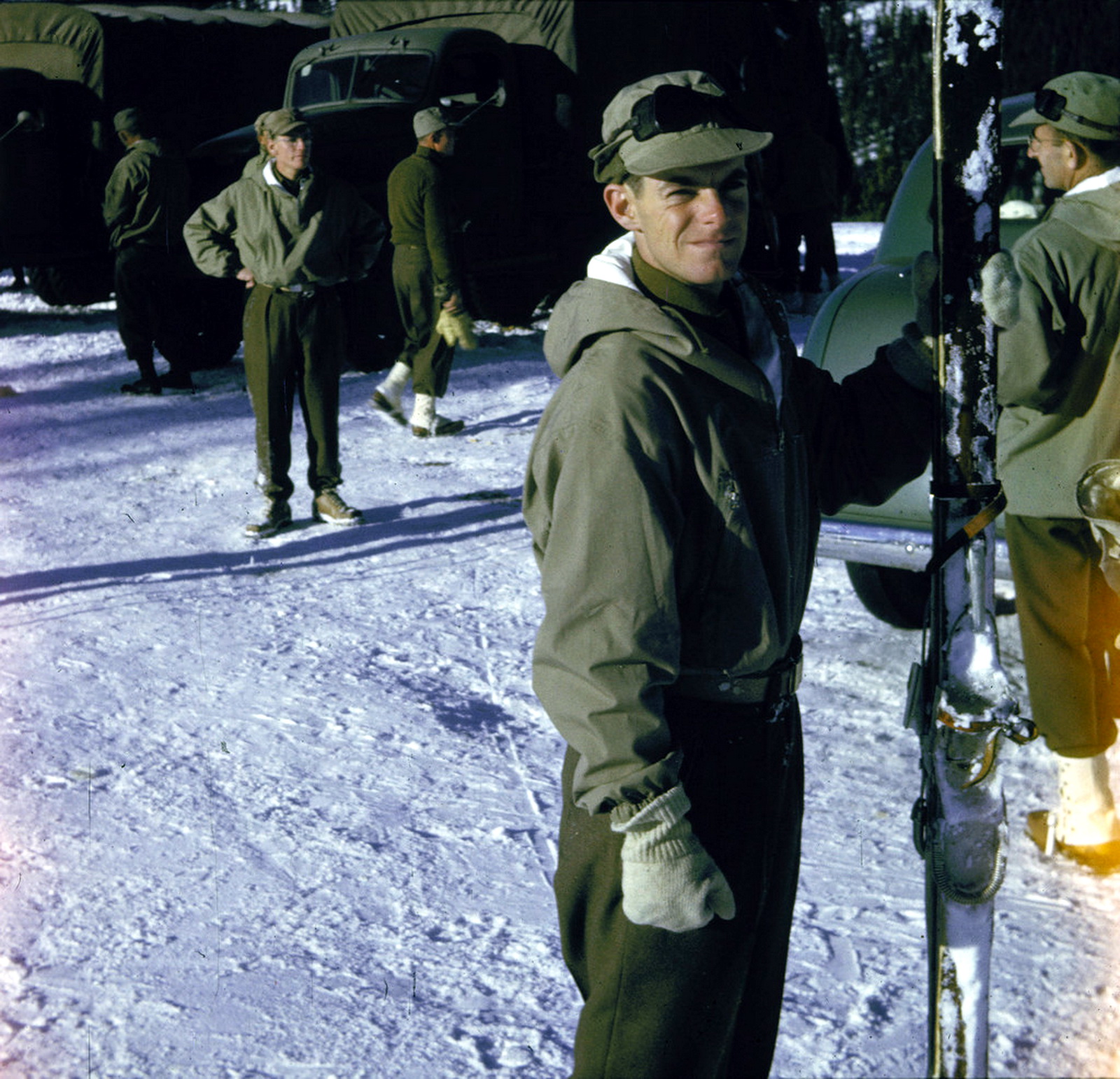
Earl Clark from US 10th Mountain Division

Earl Ervin Clark, a member of the 1st Battalion / 87th Headquarters Regiment / 10th Mountain Division (US Army), poses with a pair of skis at Camp Hale (Eagle County), Colorado, 1943 or 1944. Other soldiers and trucks are nearby. Clark served in the US army's elite 10th Mountain Division from its inception. The division played a key role in breaking down Nazi defences in the Spring Offensive of 1945, helping force the Italian surrender and the fall of the Third Reich.

A skilled skier since his teens, Clark took part in the vital battles for Riva Ridge and Monte Belvedere in Italy's Northern Apennines. His company scaled Belvedere, covered in ice and snow, on 19 February 1945, their hickory skis strapped to their shoulders and bayonets fixed on their M1 rifles. The German defenders, a battalion of highly-trained mountain soldiers, had assumed that the mountain, at points almost vertical, was insurmountable from the south-west and were watching for allied movements in the valley below.

They had laid mines on the steep slopes but the Americans caught them unawares. The 10th Mountain's commander, General George P Hays, had told his men: "until first light, no small arms fire, only hand grenades and bayonets." Clark recalled the last words before the silent assault. "Fix bayonets. Move out!" The next voices he heard, at the peak, were cries and screams in German.

The 10th Mountain Division soldiers, having dismantled the mines, overran the enemy and, after heavy gunfire and bayonet-to-bayonet fighting, captured the peak. Clark always gave credit to the infantrymen of the Brazilian Expeditionary Force, who flanked the Americans.

"Fog had helped in the initial assault on Riva Ridge," Clark recalled. "That gave us a bit of leeway to attack Mount Belvedere." A comrade added: "We usually had a medic with us. This time they gave us five or six. We got the message. We went up in single file. Had they spotted us, there would have been no room for us to deploy. The Germans were either having breakfast or sleeping. Our grenades were their alarm clock."

In the first three days of intense combat for Belvedere, and after several German counter-attacks, the American "mountain warriors" lost 195 dead and 850 wounded or captured. But they took around 1,000 German prisoners and pushed on towards the vital river Po. At noon on 23 April 1945 Clark was among the first allied troops to cross the Po, in 50 light canvas assault boats and under heavy fire.

Spearheading the US Fifth Army, they pushed forward to Lake Garda and cut off the Germans' main escape route to the Brenner Pass. It was one of the fastest forward movements of the war and, in the lowlands, the "Mountain Warriors" ditched their skis, swapped their snow uniforms for olive drabs and hitched rides on army trucks, tanks or their own snow-hardy M-29 Weasel assault vehicles. Hitler surrendered two weeks later.

By the end of the war the 10th Mountain Division had lost 1,000 men, with 4,000 wounded. One of Clark's comrades was 2nd-Lt Bob Dole, whose arm wound left him partially disabled but did not stop him from becoming a US Senator for Kansas and a Republican presidential candidate against Bill Clinton!

In retirement, Clark and many of his former comrades helped create a fledgling ski industry back home, based on what they had seen in the Alps and Apennines, building ski lifts, chalets and resorts and turning the US into a major skiing attraction. To this day, the "10th Mountain" are considered the fathers of the modern American ski industry and a Vail restaurant called The 10th is a paparazzo's dream, favoured by film stars and Michelle Obama as an après-ski stopover.

Clark helped found the 10th Mountain Division National (Veterans') Association and later the International Federation of Mountain Soldiers. The few surviving men who fought each other in the mountains 70 years ago still meet annually to share their common bond.

Earl Ervin Clark was born in Londonderry, Vermont in 1919. Moving with his family to Wisconsin, he learned to ski on Wilmot Hills near Chicago at the age of 13. It was as a mountaineering and ski instructor, that he caught the notice of the US National Ski Patrol, entrusted to pick out an elite unit. The US had also been impressed by white-clad Finnish mountain soldiers who had fought against the Soviet invasion early in the war.

Clark joined up on St Patrick's Day, 1942, and was assigned to 1st Battalion 87th Infantry Regiment, later to form part of the 10th Mountain Division, America's first specific mountain warfare unit. Clark trained at Camp Hale, Colorado at altitudes of around 9,000 feet and even as high as the 14,410ft Mount Rainier in Washington state. Their marching or drinking song was "90 Pounds of Rucksack", which the Division sing to this day.

After the German surrender 10th Mountain were on stand-by to invade Japan but were stood down after the Japanese surrender. Clark was on the USS Mount Vernon when the news came through that an atomic bomb had been dropped on Hiroshima. The 10th Mountain Division took part in Operation Uphold Democracy in Haiti in 1994, helicoptering in to Port-au-Prince airport in scenes reminiscent of Apocalypse Now, and went on to serve in Afghanistan.

Clark enrolled in the University of Denver under the GI Bill, got a business degree and went on to make the mountains and skiing his life. He and other 10th Mountain vets helped design pistes, became ski coaches, guides, patrollers, magazine founders, filmmakers, ski shop owners and even professional downhill and slalom racers. Clark became a volunteer for the US National Ski Patrol as a guide and instructor. He became an office manager for an ice cream distributor and later an insurance agent.

He kept skiing, remained in the Army reserve and retired in 1981 as a Lieutenant-Colonel. He set up a group of 10th Mountain vets called the Pando Commandos, who, wearing their old combat whites, give ski demonstrations in Rocky Mountain resorts and he helped run the Over-The-Hill Gang, initially a US club for older skiers and now running ski tours worldwide.

Earl Ervin Clark, mountain soldier: born Londonderry, Vermont 3 July 1919; married 1948 Betty Grunwald (deceased, one son); died Littleton, Colorado 28 December 2014


Source :
http://amyatishkin.livejournal.com/287245.html
http://www.independent.co.uk/news/people/news/lt-colonel-earl-clark-mountain-warfare-veteran-who-helped-establish-the-leisure-skiing-industry-in-10114601.html

U.S. 10th Mountain Division Men at the Door of their Barracks

Three Members of the 110th Signal Company / 10th Mountain Division (US Army), stand outside the door of their barracks at Camp Hale, Colorado, 1943 or 1944. The man on the far right is the photographer (William A. "Bill" Southworth). All are in uniform and one is carrying skis and poles. The impact of the 10th on the ski industry after the war was huge. Some of the immediate effects included the unloading of all the surplus equipment to the public, including 100,000 pairs of skis, boots, bindings and poles!  This provided an affordable opportunity for a massive amount of the population to jump into the sport.  It also opened up opportunities to produce some high-end gear.


Source :
http://amyatishkin.livejournal.com/287245.html
http://www.chrisanthony.com/the-legend-of-the-10th-mountain-division-and-the-ski-trooper/

French Renault R35 Tank in German Service

French Renault R 35 Nr.50968 "Le Hérisson" (The Hedgehog) tank of 2e Compagnie / 21e Bataillon, (commanded by Lieutenant Gout in the Battle of France in 1940), after its captured by the Germans. After the fall of France, 843 of R35s fell into German hands; 131 were used as such as Panzerkampfwagen 35R 731 (f), issued to panzer units and mainly used for security duties or driver training, or used on armoured trains; most were later rebuilt as artillery tractors and ammunition carriers after removing the turret. A considerable number, 174 according to some sources, were converted into a 47 mm tank destroyer to replace the Panzerjäger I: the 4,7 cm PaK(t) auf Panzerkampfwagen 35R(f) ohne Turm. The tank destroyer version had the turret replaced with an armoured superstructure mounting a 47mm kanon P.U.V. vz. 36 (Škoda A6) anti-tank gun. The vehicles were converted by Alkett between May to October 1941 to try and make an equivalent vehicle to the Panzerjäger I. The result was not as successful as the Panzerjäger I, mainly due to the slow speed of the R 35 and the overloaded chassis. A few were deployed in Operation Barbarossa, most were deployed in occupied territories, such as the Channel Islands, The Netherlands (with Panzerjäger-Abteilung 657, part of Panzer-Kompanie 224) and France. They fought in the battles for Normandy with Schnelle Brigade 30 in 1944 (five attached to the 3.Kompanie / Schnelle-Abteilung 517), and around Arnhem with Panzerjäger-Abteilung 657. Other possible users include 346. Infanterie-Division in Normandy and 59. Infanterie-Division who fought the 101st Airborne at Arnhem. Some of the turrets were detached from the tanks and were used on defensive fighting positions known as "Tobruks". This gave the Tobruk enhanced firepower and the gunner protection from shrapnel and small arms. Fourteen R 35 tanks, used to train tank drivers, equipped the 100. Panzer-Ersatz-Bataillon (100th Panzer Replacement Battalion) in the German 7. Armee in 1944. On 6 June 1944, they were among the first Armee-Reserve units sent into combat near Sainte-Mère-Église to oppose the American airborne landings in Normandy. Supporting a counterattack by the Grenadier-Regiment 1057, R35s penetrated the command post of the U.S. 1st Battalion 505th Parachute Infantry Regiment before being destroyed by bazooka fire.


Source :
http://www.dishmodels.ru/gshow.htm?p=12786
https://en.wikipedia.org/wiki/Renault_R35

Soldiers of sPz.Abt.508 in Italy

Two soldiers of schwere Panzer-Abteilung 508 used their spare time for sightseeing in Rome (Italy) with their staff car, 20 February 1944. This color side is interesting mainly because it provides an excellent view of the camouflage finish on the BMW 321 as well as the battalion emblem and the pink and black battalion pennant. In early February the Tiger tank battalion was sent to oppose Allied landings at Anzio. Transportation by rail ended at Ficulle in Italy, far from the enemy beachhead. Because Allied air superiority made further rail transport difficult, the battalion drove the remaining distance, via Rome. One Tiger caught fire on route and was destroyed in an explosion. Sixty percent of the Tigers suffered mechanical breakdown on the 200-kilometre (120 mi) journey through the narrow, winding, mountainous roads. By 14 February, the first company deployed piecemeal in the Anzio region near Aprilia (known as The Factory), as the second company arrived in Rome. This color slide itself is one of a series of color images of the Werkstattkompanie taken by Hans Becker. In the mid-1970s Becker's son loaned the slides to a model maker, who displayed them in the booklet "Modell Magazin - Foto Archiv". Since then the photos have appeared regularly in publications about the Tiger. Unfortunately the slides have not been returned to the son!


Source :
Book "Als Panzermann in Afrika und Italien 1942-45: Panzer Regiment 8 und schwere Panzer-Abt. 508" by Axel Urbanke and Hans Becker
https://en.wikipedia.org/wiki/508th_Heavy_Panzer_Battalion
http://forum.axishistory.com/viewtopic.php?f=47&t=73232&start=7800

Monday, February 15, 2016

Helmut Hudel


Helmut Hudel, born in 4 July 1915 at Raunheim, joined the Reichswehr in 1934 and initially served with Kraftfahr Abteilung 5, ostensibly a transport unit. It should be remembered, however, that at this time many such units were being used for the surreptitious training of Germany's future tank crews. Identified at an early stage as a potential officer, Hudel subsequently underwent training at military academy and was commissioned Leutnant in 1936, being posted to Panzer-Regiment 7, part of 10. Panzer-Division.

Two years later he was appointed to the staff of the Kriegsschule at Potsdam, remaining in that post until 1940 and missing the campaign in the West. On completion of his posting he rejoined Panzer-Regiment 7 in time to take part in the opening phases of Operation Barbarossa on the central sector of the Russian Front, seeing particularly heavy combat around Minsk and Smolensk. In early 1942 Hudel's division was badly battered in heavy fighting against the Soviet winter counter-offensive. Hudel, by now a company commander with the rank of Hauptmann, was temporarily attached to a Kampfgruppe from 20. Panzer-Division. He showed such determination, skilled leadership and gallantry in heavy fighting around Viazma that he was recommended for the Ritterkreuz (Knight's Cross), and the award was made on 27 May 1942.

That month the mauled 10. Panzer-Division was withdrawn from Russia for rest and rebuilding near Amiens in France. It remained there until December 1942, when it was shippped to North Africa to bolster Rommel's forces in Tunisia after the Allied landings in Morocco and Algeria. Now the battalion commander of I.Abteilung / Panzer-Regiment 7, Hudel once again showed considerable skill and leadership in difficult defensive fighting under heavy enemy pressure. He was rewarded with the addition of the Eichenlaub (Oak leaves) to his Knight's Cross on 2 April 1943. By 21 April his division's armored strength had been worn down to just 25 tanks; Hudel himself was transferred back to Europe in the closing days of the campaign, and avoided the captivity into which the remnants of 10. Panzer-Division passed when they surrendered to US troops.

Hudel subsequently served in Italy, where he was promoted to Major and commanded schwere Panzer-Abteilung 508, a battalion equipped with the Panzerkampfwagen VI Tiger. In late 1944 he was transferred to command the tank training and replacement battalion of the elite "Großdeutschland" division. In February 1945, Hudel took command of Panzer-Lehr-Regiment 130, the tank unit of the crack Panzer-Lehr-Division. He saw action in Holland and later against the Allied bridgehead at Remagen. By the closing weeks of the war, Panzer-Lehr-Regiment 130 had been reduced to just 15 tanks; it finally surrendered to US forces in the Ruhr Pocket.

Helmut Hudel died in retirement in 11 March 1985 at the age of 69 years.

This color slide is one of a series of color images of the Werkstattkompanie taken by Hans Becker. In the mid-1970s Becker's son loaned the slides to a model maker, who displayed them in the booklet "Modell Magazin - Foto Archiv". Since then the photos have appeared regularly in publications about the Tiger. Unfortunately the slides have not been returned to the son!


Source :
Book "Knight's Cross Oak-Leaves Recipients 1941-45" by Gordon Williamson
http://www.tiif.de/thread.php?threadid=621&sid=2d4eb416700eec368fa8d05b8617735c

U.S. Paratrooper Ready for a Jump

U.S. paratrooper braces himself in front of the door of a C-47, while learning proper jump procedures during training, mid-1940s. This photograph was obviously staged for the benefit of home front audiences. The standard procedure for exiting a C-47 in flight would have called for the trooper to stand in the doorway with both hands on the outside of the door. He is holding his static line in his left hand. After exiting from the plane, the static line would pull the cover off of his pack tray and deploy his parachute.


Source :
Book "Screaming Eagles: The 101St Airborne Division from D-day to Desert Storm" by Christopher J. Anderson
http://www.gettyimages.com/detail/news-photo/world-war-ii-paratrooper-braces-himself-in-front-of-the-news-photo/103404178

A Jeep Equipped with a Portable Radio is Loaded onto a C-47

The crew of a C-47 works with a Willys MB operator to get his ¼ ton truck (jeep) - equipped with a portable radio - on board the aircraft for transport to France. The picture was taken in England in 1944. Although experiments like this were conducted, jeeps of the U.S. Army 101St Airborne Division were most frequently landed with the division's gliders. Unlike ordinary 'leg' infantry divisions, which had 612 jeeps, the more lightly equipped airborne divisions only had 283 of this highly versatile vehicle. During World War II, the armed forces of many countries used the C-47 and modified DC-3s for the transport of troops, cargo, and wounded


Source :
Book "Screaming Eagles: The 101St Airborne Division from D-day to Desert Storm" by Christopher J. Anderson
http://historylink101.com/ww2_color/WorldWarIITransportPlanes/PICT0392.html

Gotha Go 244

The German Gotha Go 244, a powered version of the Go 242 glider, was used in limited numbers during the Second World War. The only units to be equipped with the type were the Special Purpose Battle Groups (Kampfgruppen zur besonderen Verwendung, or KGr.z.b.V.) 104 and 106. The two units converted to the Go 244 from the Junkers Ju 52 at Hagenow in the summer of 1942. Conversion training lasted until mid-June. These two photographs, which were taken there in May or June 1942, depict a brand-new machine (NI+FQ) with a large personal emblem beneath the cockpit. It consists of a red wagon with yellow lettering pulled by two horses against a large cloud. Also note the red and white rosette on the fuselage nose. Yellow Eastern Front bands have been painted on the fuselages of the aircraft. Conversion training ended on 22 June, and KGr.z.b.V. 106 returned to Russia. There it operated from Kirovograd, between Kiev and the Crimea. The Gruppe had 37 aircraft at the beginning of August. However, the Go 244 proved a disappointment. On 2 November 1942 the unit returned to Germany and relinquished its aircraft. Noteworthy features of the Go 244 were its tricycle undercarriage and opposite-handed engines, which eliminated the tendency to swing during takeoff.


Source :
Magazine "Luftwaffe im Focus", Spezial No.1 - 2003

Friday, February 12, 2016

Finnish Hämeen Cavalry Regiment in Velikaja Niva

Finnish Hämeen Ratsurykmentti (Hämeen Cavalry Regiment) in a winter patrol through the snow-covered trail in Velikaja Niva, Kareliya (Soviet Union), 15 March 1942. Horses played a vital role in the Finnish Army, supplying front-line troops and enabling the rapid transport of troops and equipment. Virtually all army units employed horses, and during the Winter War some 90,627 animals served the nation. Despite the greatly increased degree of mechanisation, 45,426 horses continued to serve between 1941 and 1944. The horses suffered high casualty rates compared to the men handling them. The horse-driven supply columns were also favourite targets for enemy airplanes and artillery. During the Winter War, the casualty rate for horses was 16.6 per cent and during the Continuation War 12.8 per cent.


Source :
Book "Finland at War: The Winter War 1939-40" by Vesa Nenye, Peter Munter & Toni Wirtanen

A Morane-Saulnier MS.406 Fighter of Finnish Air Force

An Ilmavoimat (Finnish Air Force) Morane-Saulnier MS.406 fighter of 1.Lentue/Lentolaivue 28 (1st Flight, No. 28 Squadron) at Viitana base, near Äänislinna in 1942. A more modern type of Finnish fighter that saw service during the Winter War (1939-1940) was the heavy Morane Saulnier MS.406, which was slow and lightly armed. France donated 30 of these aircraft. They reached combat readiness in February 1940 and achieved 14 aerial victories. During the Interim Peace and Continuation War, a further 57 were purchased from Germany. The MS.406 suffered heavy losses due to its poor performance, and was recommended for shelving as early as 1942. This was unfeasible because of the overall lack of aircraft, so modification and modernisation efforts were undertaken instead. The results were underwhelming, to say the least.


Source :
Book "Finland at War: The Winter War 1939-40" by Vesa Nenye, Peter Munter & Toni Wirtanen

Finnish Bristol Blenheim Coming in for a Landing

British made Bristol Blenheim light bomber aircraft of Finnish Air Force coming in for a landing on Luonetjärvi airfield (now Jyväskylä Airport), between 28 March 1944 and 31 March 1944. The yellow stripe at the tail of this Finnish plane was the designation for the German Eastern Front. The British-made Bristol Blenheim light bomber represented the 1930s mindset that newer bombers would be protected from fighter attack by their increased speed. Finland’s interest in this model grew during the early 1930s and they received their first Blenheims in 1937. By that time it had become apparent that the Blenheim’s speed advantage, compared to modern fighters, had already vanished. Additionally, the plane’s defensive armament, consisting of one or two wingmounted, forward facing machine guns, and one machine gun operated by a rear gunner, was insufficient for the demands of the time.


Source :
Book "Finland at War: The Winter War 1939-40" by Vesa Nenye, Peter Munter & Toni Wirtanen
https://commons.wikimedia.org/wiki/Category:SA-kuva

Thursday, February 11, 2016

Wehrmacht Reiterzugführer in Operation Barbarossa

Wehrmacht Reiterzugführer (commander of mounted infantry platoon) on the Eastern Front in the Russian campaign of 1941 (Operation Barbarossa). Contrary to common idea, the German Army made extensive use of the horse, both as a service animal in artillery and supply units and also in combat cavalry units. Germany had five or six full cavalry divisions - the 1st (served on the Eastern Front in 1941, and was then converted into a Panzer division); the 1st and 2nd Cossacks (formed in 1943 from pro-Nazi Russians, were mostly used for anti-partisan duty in Yugoslavia), and the 8th and 22nd SS Cavalry (raised in 1942 and 1944 respectively) which fought on the Eastern Front and in Yugoslavia. They also had several smaller (regimental or brigade-size) cavalry units. Also, at the start of Operation Barbarossa each infantry division had an integral cavalry battalion of just over 200 men. Gradually these were replaced by motorised reconnaissance forces.


Source :
http://3reich-collector.com/concentration-camp-ww2-german/set-51-huge-full-color-photos-idealized-conception-life-german-soldier
https://www.quora.com/How-prevalent-were-cavalry-in-the-Eastern-Front-of-WWII

U.S. 10th Mountain Division at Camp Hale

Members of the U.S. 10th Mountain Division at their training ground in Camp Hale, Colorado, 1943 or 1944. The 10th Mountain Division is a light infantry division in the United States Army based at Fort Drum, New York. Originally constituted as a mountain warfare unit, the division was the only one of its size to receive intense specialized training for fighting in mountainous and arctic conditions. Originally activated as the 10th Light Division (Alpine) in 1943, the division was redesignated the 10th Mountain Division in 1944 and fought in the mountains of Italy in some of the roughest terrain in the country


Source :
http://amyatishkin.livejournal.com/287245.html
https://en.wikipedia.org/wiki/10th_Mountain_Division_%28United_States%29

Tuesday, February 9, 2016

Hans-Valentin Hube


Probably the best German general to fight at Stalingrad was Hans-Valentin Hube, commander of the 16. Panzer-Division, who replaced Gustav von Wietersheim as commander of the XIV. Panzerkorps on September 15, 1942. Hube was born in the garrison town of Naumburg in 1890, joined the army in 1909, and received his commission in the Königlich Bayerische 26. Infanterie-Regiment the following year. After two years of fighting on the Western Front, he was so badly wounded in the Battle of Verdun that his right arm had to be amputated, and it seemed that his military career was over. With the same iron determination that characterized his entire career, however, young Hube rehabilitated himself, overcame his handicap, and returned to duty. He was a Hauptmann (Captain) when the war ended.

When the 4,000-man officer corps was selected in 1919 and 1920, the Army Personnel Office had the pick of the best, both physically and mentally. Hans-Valentin Hube was the only one-armed officer they chose to retain! Known for his determination, innovation, energy, and attention to detail, Hube strove to master every facet of his profession. Even so, promotions came slowly for officers in the Reichsheer (which was typical of a small army in this respect), and Hube did not become a major until 1929. He was promoted to Oberstleutnant (Lieutenant-Colonel) in 1934, the same year he took charge of a special experimental motorized battalion, which distinguished itself in the summer maneuvers and added impetus to the demand for mechanization in the German Army. Meanwhile, Hube was named commandant of the prestigious Infantry School at Döberitz, a suburb of Berlin. This was a choice assignment, but Hube’s rise was just beginning.

In October 1935, Hube was named commandant of the Olympic Village, which was to be erected in the meadows adjoining the barracks. He was also in charge of security. Since Hitler was personally involved in all aspects of “his” Olympics, it was only natural that he conferred frequently with Hube. It was soon obvious that the one-armed officer was the master of his assignment. Hitler was so impressed that he rewarded Hube with a special promotion to full Oberst (Colonel) in August 1936.

When World War II broke out, Hube petitioned OKH (Oberkommando des Heeres) for a field command. He was given the Infanterie-Regiment 3 in early October 1939, but this formation was nonmotorized and had an ultra-conservative (and almost hereditary) East Prussian officer corps. Not happy with his assignment, Hube used his contacts in Berlin (and possibly even the Führer himself!) to get a transfer. On May 15, 1940, he assumed command of the 16. Infanterie-Division, whose commander had fallen ill. This unit was already scheduled to be converted into a panzer division, and part of it was already motorized. In any case Oberst Hube led it with exceptional skill in France and was promoted to Generalmajor on June 1.

After France capitulated, Hube supervised the conversion of the 16th into a panzer unit and oversaw its armored training. It was slated to take part in the invasion of Yugoslavia, but the country fell so quickly that Hube’s division was not committed to any heavy fighting. After taking part in the triumphant entry into Belgrade, Hube and his men were sent to Silesia and then into the Soviet Union.

From the first, Hans Hube proved to be an outstanding panzer commander and a master tactician, both in offensive and defensive operations. He fought at Uman, Kiev, Rostov, in the Mius River defense in the winter of 1941–1942, and at Kharkov. He was successively decorated with the Ritterkreuz (Knight’s Cross) and Eichenlaub (Oak Leaves), and was promoted to Generalleutnant on April 1, 1942. Meanwhile, he earned a reputation throughout the army as a tough, fair, no-nonsense commander, noted for his physical courage and tactical brilliance. The men of his unit—and others as well—called him "Der Mensch" (The Man), implying that no one else in the whole German Army approached his stature. And that is exactly the way that many of the men of the 6. Armee felt about him.

A measure of the respect that Hube commanded was the fact that he echoed Wietersheim’s objections to the way the Stalingrad campaign was being handled, including his criticisms of Hitler’s meddling in the affairs of subordinate units. An outspoken officer known for his absolute honesty, Hube stood so high in the estimation of the Führer that he not only got away with it, but he also received his promotion to General der Panzertruppe on October 1, 1942—only six months after his previous promotion!

In January 1943, as the end neared for the soldiers trapped in Stalingrad, Hitler signaled for Hube to fly out of the dying pocket. Many in the city would have given everything they owned to have received this order, but Hube categorically refused to obey it. He sent word back that he had led his men into Stalingrad and had ordered them to fight to the last bullet. Now he intended to show them how to do it. Hitler responded by sending four members of his SS bodyguard to Stalingrad in a special airplane. Hube and four members of his staff were called to 6th Army headquarters, where the SS men surprised them and flew them out of the pocket at gunpoint!

In 1943, Hube rebuilt the XIV. Panzerkorps and led it in the Battle of Sicily, where he held off 12 Allied divisions (including those of the redoubtable General George S. Patton) for 38 days with four understrength German divisions, in spite of the Allies’ almost total command of the sea and the air! Then Hube escaped across the Straits of Messina with his entire command ("The Man" himself left in one of the last boats). After serving for a short time in Italy, where he fought at Salerno and was briefly acting commander of the 10. Armee, Hube assumed command of the 1. Panzerarmee in Russia and, much to the delight of the Führer, brilliantly led it out of a Soviet encirclement in March 1944, with help from Generalfeldmarschall Erich von Manstein. On April 20, 1944—his own birthday—Hitler promoted Hube to Generaloberst and decorated him with the Brillanten zum Ritterkreuz des Eisernen Kreuzes mit Eichenlaub und Schwertern (Diamonds to his Knight’s Cross with Oak Leaves and Swords). Hube was also earmarked to take charge of Heeresgruppe Südukraine (Army Group South Ukraine) shortly thereafter; presumably it had already been decided to give its then commander, Ferdinand Schörner, command of Heeresgruppe Nord (Army Group North). But Hans-Valentin Hube was killed the very next day, when his airplane crashed a few miles from Hitler's private retreat at Berchtesgaden! A few weeks before his own death, Adolf Hitler was still lamenting the passing of "Der Mensch", stating that he was one of the top three commanders to emerge from the Second World War...


Source :
http://alifrafikkhan.blogspot.co.id/2011/10/album-foto-terbaik-hans-valentin-hube.html
http://weaponsandwarfare.com/2015/08/17/hans-valentin-hube/

Fieseler Fi 156 Storch Liaison Aircraft

Liaison aircraft was indispensable for maintaining direct contact between the headquarters of armies and front-line units. Without them, it would have been impossible for senior commanders to meet with subordinates at short notice to discuss the situation or make snap visits to the front. Since command posts and headquarters were often well-camouflaged in wooded areas, small villages or other inaccessible locations, there was normally no regular runway for aircraft to land on. For this reason, the Fieseler Storch, with its short takeoff and landing capabilities, was favored by senior staff officers. The Storch could even land on rough ground, as might be found in a cow pasture, for example.


A commander departs with two staff officers. The situation maps and papers suggest that they have just attended a situation conference. The Fieseler Fi 156 C "Storch", manufacturer's code GK+M?, wears the yellow fuselage band for aircraft operating on the Eastern Front. The photograph was taken in Russia in the summer of 1941 or 1942.


An officer boards a Fieseler Fi 156 C "Storch", code ?F+YF. The aircraft's engine is already running in preparation for takeoff across the horse pasture. The configuration of the cockpit glazing (with MG 15 in an armored lens-type mount) identifies the aircraft as a C-series Storch.


Source :
Magazine "Luftwaffe im Focus", Spezial No.1 - 2003

Soldiers of U.S. E/506 Return from Training Exercise

From left to right: Private Amos "Buck" Taylor, Private Terrence "Salty" C. Harris, Private Cecil M. Pace and Corporal Walter "Smokey" S. Gordon, Jr. (another source said as Paul Rogers, Terrance Harris, Joseph Ramierez and an unknown trooper) of Easy Company, 506th Parachute Infantry Regiment (E/506), return from a training exercise in North Carolina. The four men are wearing the Herringbone Twill (HBT) coveralls. The man standing second from the left has a 60mm mortar over his right shoulder and the man at right has a .30 caliber Browning M1919A4 machine gun cradled in his arms.


Source :
Book "Screaming Eagles: The 101St Airborne Division from D-day to Desert Storm" by Christopher J. Anderson

Soldiers of U.S. E/506 Prepare for Training Jump

The real Band of Brothers, from left to right: Private Carl L. Fenstermaker, Private Roderick "Rod" G. Strohl, Private Forrest "Gutty" L. Guth, and Private Amos "Buck" Taylor. All from Third Platoon, Easy Company, 506th Parachute Infantry Regiment (E/506), prepare for a training jump at Camp Toccoa, Georgia, in 1942 (other sources said as Camp Mackall in North Carolina). They're kitted up with dummy 'chutes for the outdoor exit trainer, seen here in the background. Rather than wear the M1942 jump suit, these men are wearing the first pattern (M1938) herringbone twill (HBT) coverall uniform. The use of HBT coverall during training jumps was frequently practiced early in the war by US Army parachute units. "Band of Brothers" co-producer Tom Hanks, speaks eloquently about the nature of heroism: "they would tell you they wouldn't trade [their war experience] for anything, nor would they want to repeat it for the world". But it is the soldiers' personal accounts that really hit home. "Call any of them 'hero', Hanks said, "and they will look away."


Source :
Book "Airborne: The Combat Story of Ed Shames of Easy Company" by Ian Gardner
Book "Screaming Eagles: The 101St Airborne Division from D-day to Desert Storm" by Christopher J. Anderson
http://users.skynet.be/jeeper/page126.html

Friday, January 29, 2016

Kriegsmarine AA Crew with 20mm Oerlikon Flak

A color shot of the light naval gun 20mm Oerlikon (2.0cm Flak 28) in action onboard a "Vorpostenboot", a converted fishing cutter. This gun were produced by Semag and Becker in Zürich (Swiss), later than by Oerlikon in Zürich (Swiss). Germany bought many of them before the war, and gave them the name 2 cm Flak 28 and 29 (The Flak 28 used a 15-round clip magazine and the Flak 29 used a large drum magazine with 60-rounds). First they were mainly used in the german navy, but later - and expecially during the war, when many of them got captured - they were also used in other units. The 2cm Oerlikon Flak 28 and Flak 29 apt in the Sockellafette 40 pedestal mount were intended by the Kriegsmarine for installation on ships.The 2cm Oerlikon Flak 28 was the first light automatic Anti-Aircarft weapon to reach the units in 1928 and it was installed on a mobile wheeled carriage.


Source :
http://www.626-squadron.co.uk/willem14.htm
http://forum.axishistory.com/viewtopic.php?f=70&t=149100&p=1295063

Kriegsmarine Gunner Operating 2.0 cm Flak 29 Oerlikon

Eastern Front. Kriegsmarine Gunner at sea pointing weapon into the sky for protection against air attack. The gun is a 20mm Oerlikon - a.k.a. 2.0cm Flak 29, produced by Semag and Becker in Zürich (Swiss), later than by Oerlikon in Zürich (Swiss). Germany bought many of them before the war, and gave them the name 2 cm Flak 28 and 29 (The Flak 28 used a 15-round clip magazine and the Flak 29 used a large drum magazine with 60-rounds). First they were mainly used in the german navy, but later - and expecially during the war, when many of them got captured - they were also used in other units. The 2cm Oerlikon Flak 28 and Flak 29 apt in the Sockellafette 40 pedestal mount were intended by the Kriegsmarine for installation on ships.The 2cm Oerlikon Flak 28 was the first light automatic Anti-Aircarft weapon to reach the units in 1928 and it was installed on a mobile wheeled carriage.


Source :
http://forum.axishistory.com/viewtopic.php?f=70&t=149100&p=1295063
https://www.pinterest.com/donnybosma/war/

Sunday, January 24, 2016

Wehrmacht Kriegsberichter with Ukrainian Farmers

A Russian-speaking German Kriegsberichter (war correspondent) of Berichterstaffel z.b.V. OBH in a BMW R12 motorcycle with sidecar strikes a conversation with Ukrainian female farmers out in the fields. Note on the front of the sidecar the emblem of the "Berichterstaffel zur besonderen Verfügung Oberbefehlshaber des Heeres" (Special War Reporters Command for the Army Headquarters), comprising a pen and a sword. June-August 1942. In the Steppes East of the Ukraine, there were no road signs and few landmarks by which the Germans could take their bearings. Good maps were few and far between. As a result german patrols and motorcycle riders (such as this one) had to ask their way of women and old men working in the fields. The poor planning and the consequent foundering of the German troops in the vastnesses of the uncharted territory, are reflected in photos such as this one. One must also remember the tough terrain that the Germans faced in their drive. RRs and roads built well enough to accommodate tanks were in limited supply in the Soviet Union. The ability to hold on to these roads was just as important on the long retreat as it was on the drive forward. The difference in gauges of RR track width between those in Russia and those in Germany also called for track conversion or trains able to travel on any given line of tracks - Russian on Russian tracks and German on German tracks. It was, indeed, a mess.


Source :
https://www.pinterest.com/pin/110971578290433196/
http://www.ww2incolor.com/german/German+Dispatch+rider.html

Staff Sergeant of the US 10th Mountain Division

This staff sergeant of the US Army 10th Mountain Division offers a good view of his divisional SSI and of the ice axe carried by the US "Alpine Troops". Among the ribbons and decorations on his left breast are the combat infantryman's badge, bronze star, pre-Pearl Harbor Army Service ribbon, American Theater ribbon, European Theater ribbon, and good conduct medal.


Source :
Book "US Special Forces of World War Two" by Leroy Thompson

German Corps HQ in a Small Russian Village

In this photo we see a small Russian village surrounded by forest. The standard in front of the house on the left reveals that the commander of an Armeekorps has set up his headquarters here. In the background is a Fieseler Fi 156 "Storch", which was used either to fly the corps commander to visit his front-line units or bring division commanders to him. Liaison aircraft was indispensable for maintaining direct contact between the headquarters of armies and front-line units. Without them, it would have been impossible for senior commanders to meet with subordinates at short notice to discuss the situation or make snap visits to the front. Since command posts and headquarters were often well-camouflaged in wooded areas, small villages or other inaccessible locations, there was normally no regular runway for aircraft to land on. For this reason, the Fieseler Storch, with its short takeoff and landing capabilities, was favored by senior staff officers. The Storch could even land on rough ground, as might be found in a cow pasture, for example.


Source :
Magazine "Luftwaffe im Focus", Spezial No.1 - 2003

Saturday, January 16, 2016

Heinkel He 111 of Fliegerstaffel des Führers

The three photographs depict CA+NA, a Heinkel He 111 P-2 with the Werknummer 2471. This aircraft was part of the "Fliegerstaffel des Führers" (Leader's Air Squadron). The photographs were taken in the spring of 1942 during a visit by Hitler to an airfield in the southern sector of the Eastern Front. The serial number is clearly visible on the fin. Also note the yellow Eastern Front fuselage band and the unusually glossy finish of the aircraft code letters and fuselage cross. By the spring of 1942, CA+NA already had several years of service behind it. The aircraft's acceptance flight (as D-ADNH) took place on 21 October 1938. On 10 September 1939 it sustained 20% damage in a crash at Schweidnitz. At that time the Heinkel was with the Regierungsstaffel (Government Squadron) and used by Generalfeldmarschall Erhard Milch. Soon afterward, in autumn 1939, the unit was renamed to "Fliegerstaffel des Führers" (F.d.F.). In February 1941 the aircraft's marking were changed to CA+NA. It remained with the Staffel, as shown by numerous logbook entries. One such entry reveals that on 29 April 1941 the aircraft was being overhauled by Heinkel in Rostock-Marienehe. In 1942 the aircraft was known to have made flights from Imola, Finland, to Stalino in the south of the Eastern Front. The last known reference to this machine appears in the logbook of the Malmi airport in Finland, which records that it departed for Rastenburg in East Prussia (Hitler's headquarters) on 5 August 1944. The aircraft's subsequent fate is not known.


Source :
Magazine "Luftwaffe im Focus", Spezial No.1 - 2003

Friday, January 15, 2016

Heinrich Hoffmann and Sepp Dietrich at Berghof Terrace


Shown here on the terrace of the Berghof Adlerhorst (Eagle's Nest) on the Obersalzberg, from left to right: Heinrich Hoffmann (Reichsbildberichterstatter/Hitler's personal photographer) and SS-Obergruppenführer und General der Waffen-SS Josef "Sepp" Dietrich (Kommandierender General I. SS-Panzerkorps) during the spring-summer of 1944. As regard of decorations, Dietrich is wearing the neck order of Ritterkreuz des Eisernen Kreuzes mit Eichenlaub und Schwertern (Knight's Cross of the Iron Crosses with Oakleaves and Swords), ribbons of Blutorden (Blood Order) and Medaille "Winterschlacht im Osten 1941/4 (Ostmedaille), Alter Kämpfer chevron; Goldenes Parteiabzeichen der NSDAP (NSDAP Badge in Gold); Gemeinsames Flugzeugführer- und Beobachterabzeichen in Gold mit Brillanten (Combined Pilots and Observers Badge in Gold with Diamonds), and Kampfwagen-Erinnerungsabzeichen (World War I Tank Badge). Sepp was one of the most impressively decorated soldiers of World War II - not excluding Patton!


Source :
http://alifrafikkhan.blogspot.co.id/2014/08/kampfwagen-erinnerungsabzeichen-world.html

US Paratroopers of the 82nd Airborne Preparing for a Jump in Italy

US Paratroopers of the 82nd Airborne preparing for a jump on Salerno (Italy) in September 1943. The distinctive color of the parachutist's utilities and the brown jump boots are clearly seen. Note also the CCKW 2 1/2-ton 6x6 transport truck with color bar marking on the door. These color bar coding used as a representation of army unit numbers used for shipping vehicles on a sea voyage (probably because it would be easier to put the vehicles of a certain unit together on the same boat that way, but you see different versions of the bars, with and without a letter next to it).


Source :
Book "US Special Forces of World War II" by Leroy Thompson
http://cckw.org/forum/viewtopic.php?f=1&t=2683

A B-1 Stand of a Junkers Ju 188

View of the movable dorsal defensive position (B-1 Stand) of a Junkers Ju 188 E-1 or F-1. The engine cowlings suggest that the aircraft was powered by BMW 801 G engines. The LLG 131 turret, with its kidney-shaped armored glass, was armed with an MG 131 machine-gun. The photograph illustrates just how restricted the gunner's view was from this position. Note the small windows on either side of the turret providing a view toward the rear. This feature was not seen on all Ju 188 aircraft. Just visible at the top of the photograph is the DL 131/1 D electrically-driven turret (B-2 Stand), which is also equipped with a single MG 131 machine-gun. An HD 151/2 turret could also be fitted in this position. In many cases the B-2 Stand was removed to minimize speed loss with the maximum bomb load. Note the interesting camouflage pattern on the engine cowlings. It may have been an RLM 65 finish with patches of RLM 71, which would suggest a maritime role. The photograph was taken somewhere in the Mediterranean, however the precise location and date are not known.


Source :
Magazine "Luftwaffe im Focus", Spezial No.1 - 2003

German Soldiers Taking a Break during the Russian Summer Campaign in 1942

Wehrmacht combat infantrymen taking a "Feuerpause" (firebreak) - the formal term for "cease-fire", a cigarette break or a short rest break - in their advance in Russia, summer of 1942. Soviet Union was in mortal peril, and with her the whole Allied cause. It was not so much the German advances, although they were great enough; nor the Russian retreats, although they were foreboding enough. It was the total fashion of retreat and defeat in the valley of the Don that chilled the hearts of Russia's allies and sharpened Moscow's cry for a second front. The warning from the Don was this: It was the Red Army, not the German Army, which had suffered the most in the previous winter campaign


Source :
SIGNAL magazine, 1942 edition
http://content.time.com/time/magazine/article/0,9171,802337,00.html

Thursday, January 14, 2016

Amphibious Assault Training of the American Infantry Unit

A few photographs of the U.S. 41st Infantry Division conducting amphibious assault training in Australia in early 1942. The Division was supposed to go to the Philippines in late 1941, but there wasn't enough shipping available to get it there. As a result, it was stuck at Fort Lewis until early 1942 when shipping became available. By then, the Philippines were a lost cause and the division was deployed to Australia as one of the first American units to get overseas in World War II. The photos come from the National Archives US Army Signal Corps collection (Record Group 111-SC). They clearly show that the unit was only partially re-equipped with the standard wartime gear most GI's carried.

Source :
http://airsoftpacific.com/viewtopic.php?t=11137&start=45
http://historylink101.com/ww2_color/WorldWarIIAmphibiousUnits/IMG_1548.html

Luftwaffe Aircraft Armorers in Action

Regardless of the weather, the aircraft armorers were required to move enormous quantities of bombs daily to keep the Luftwaffe bombers, dive-bombers and fighter-bombers operational. While hydraulic bomb trolleys were available (an LWC trolley is seen here), they were often of little use on rain-softened Russian airfields and muscle power was the only option. Here armorers are loading SC 50 high-explosive bombs onto a bomb trolley. Note the "Jericho" device on the bomb lying on the trolley. The "Jericho" was a cardboard whistle that was attached to the tail fins of a bomb. The "Jericho Whistles", which produced a shrieking sound as the bomb fell, were intended to demoralize the enemy. In the background an SC 500 anti-personnel bomb (with electric contact fuse) on a bomb sled. When and where the photograph was taken is not known.


Source :
Magazine "Luftwaffe im Focus", Spezial No.1 - 2003

Wednesday, January 13, 2016

American Soldiers Talk with a Swiss Watchmaker during Leave

At the war's end, three veteran soldiers from the US Third Army get a few pointers form an elderly Swiss watchmaker in what to look for when purchasing a good watch. Watches are very cheap in Switzerland, and nearly every GI sent home with one for himself or his girl! All three men are wearing wool "Eisenhower" jackets, wool trousers and two buckle boots. The "Eisenhower" jacket was inspired by the British battledress and ETO jackets. It had been originally designed to be worn as a liner to the 1943 field jacket but was instead used as a dress, or Class A, jacket. The man on the right has sewn a Third Army patch to his left shoulder. He is also wearing a later pattern trouser with a pocket flap added to the back pockets. Earlier pattern of trouser would have had a simple slash pocket.


Source :
Book "Patton's Third Army" by Christopher J. Anderson
http://historylink101.com/ww2_color/WorldWarIIRecreation/PICT0151.html