 German soldiers and the wall of snow. No information about when and where this pic was taken.
Source :
https://www.wehrmacht-awards.com/forums/forum/wehrmacht-era-militaria/photos-and-paper-items-forum/77941-post-your-exciting-winter-photos/page81
German soldiers and the wall of snow. No information about when and where this pic was taken.
Source :
https://www.wehrmacht-awards.com/forums/forum/wehrmacht-era-militaria/photos-and-paper-items-forum/77941-post-your-exciting-winter-photos/page81
 Two captured Russian T-34 tanks with camo under german command. It was captured and used by Panzer-Regiment 35 / 4.Panzer-Division, as can be seen by the blue bear in the turret (bears are supposed to have been painted in company colors).
In the May-June 1950 issue of the Armored Cavalry Journal, Mr. Garrett Underhill, in Part IV of "The Story of Soviet Armor," writes that the poor quality of Russian tanks is demonstrated by the fact that Germany made no use of the large numbers of Russian tanks (T 34 and KV) which it had captured, although it used Czech tanks and, in the Balkans, in the fighting against the Partisans, French tanks.
This gives a false idea of the situation. In order to clear up this matter, I should like to make the following points:
It is undoubtedly true that from time to time the armor used for Russian tanks was of very poor quality and often did not have the resistance to penetration normally required.
But there are other reasons for the fact that Russian tanks, especially the T 34, were not used by the German Army:
Mere possession of a captured tank is not enough. It is useless unless continuous maintenance of the vehicles is possible, and this depends on the availability of spare parts. Aside from technical difficulties, manufacture of spare parts for the T 34 in German factories would have been possible only at the expense of a reduction in the number of German tanks turned out. For this reason the use of T 34 tanks could not be considered.
In isolated instances the German Army organized captured-tank companies using captured T 34 tanks and tried to get the needed spare parts from captured matériel. But the method was unsuccessful, and these captured-tank units were dissolved very soon. In was impossible to get enough spare parts from the matériel captured. The method also involved an irrational expenditure of effort, which was increased by the fact that maintenance itself required special experts thoroughly trained in the work and the manufacture of special repair tools.
As far as the Czech and French tanks were concerned the situation was different. Factories and repair installations for these types of tanks were available. However, the French tanks were at best useful only to frighten peasants; they were altogether inferior to the T 34 regardless of the poor materials used in the latter's construction.
The fact that in the East the captured T 34 was not used except in a few cases had a second and equally important reason:
From a tactical viewpoint the T 34 was inferior to the German tank types (Pz III and Pz IV with long barreled 75 mm gun) because it combined the functions of commander and gunner in one person. As soon as the commander began firing, he lost his overall viewpoint and was unable to direct his tank. Even as gunner, however, he was unable to fulfill his mission because when functioning as such he had no commander from which to receive directions. As a result, the T 34 was in most cases hopelessly inferior to the German tanks, especially after German tank were armed with a long gun, in the spring of 1942. I often saw Russian tank attacks in which the T 34's charged like a herd of wild bulls and continuously fired their guns, obviously without aiming, while driving forward. While the limited training given tank crews as a result of the high losses incurred may have been one of the reasons for adopting such tactics, it is certain that the union of the functions of commander and gunner in one person was a contributing factor.
Partly as a result of this tactical inferiority, in the Ukraine my Panzer regiment, from the end of October to the middle of December 1943, destroyed 356 Russian tanks, most of them T 34's, with a total loss of only 12 German tanks. The regiment was equipped with a little more than 100 tanks, half of them Pz IV and the rest Sturmgeschuetz III (self-propelled assault gun), both equipped with the long-barreled 75 mm gun model L 48.
Signed: B. Mueller-Hillebrand
Source :
https://panzerworld.com/german-opinion-of-captured-t-34s
https://www.wehrmacht-awards.com/forums/forum/wehrmacht-era-militaria/photos-and-paper-items-forum/586209-original-ww2-color-photo-slides/page111

Traugott Herr (16 September 1890 – 13 April 1976) was a German general during World War II who commanded the 14th Army and the 10th Army of the Wehrmacht. He was a recipient of the Knight's Cross of the Iron Cross with Oak Leaves and Swords.
Born in 1890, Herr joined the army of Imperial Germany in 1911 as an Fahnen-junker (officer cadet) in the infantry. Serving in the Wehrmacht of Nazi Germany in the late 1930s, he commanded the 3rd Battalion of the 33rd Infantry Regiment.
Herr commanded an infantry regiment, part of the 13th Motorized Infantry Division, from 8 September 1939 to 14 October 1940, taking part in the Invasion of Poland (September 1939) and France (May 1940 to October 1940). In October 1940, the division was reformed in Vienna as 13th Panzer Division. Herr was given command of 13th Rifle Brigade, which controlled the division's two infantry regiments, on 14 October 1940.
In the invasion of Poland, the division used civilians as human shields in the battle with the retreating Polish Prusy Army and on 8 September 1939 attacked a medical column marked with the Red Cross signs near Odrzywół. A day later, soldiers from the division took part in the revenge killing of 11 civilians and two Polish priests including Dean Stanisław Klimecki in the nearby town of Drzewica in retaliation for their own military losses. Killings have also been reported in nearby settlements of Gielniów, Kamienna Wola, Klwów, Ossa, Przysucha, Potok, Rozwady and Zarzęcin.
In May 1941 the regiment returned to Germany to take part in Operation Barbarossa, the invasion of the Soviet Union, as part of 1st Panzergruppe under Paul Ludwig Ewald von Kleist in Army Group South. In December 1941, Herr was given acting command of 13th Panzer Division.
On 31 October 1942, on the Terek River deep in the Caucasus, Herr suffered a serious head wound, being struck by shrapnel, and was repatriated to Germany to recuperate. He was later appointed commander of the LXXVI Panzer Corps stationed in France; in August 1943 it was sent to Italy. In Italy, his unit faced the British Eighth Army in Calabria, and the U.S. Fifth Army in Salerno.
Herr commanded the corps in the Italian Campaign until 24 November 1944. He also temporarily took command of 14th Army for a brief period from late November to mid-December 1944. On 18 December 1944, he was awarded the Swords to the Knight's Cross. On 15 February 1945 he took command of 10th Army. The Allies final and decisive spring 1945 offensive in Italy opened in early April, Herr was defending the Adriatic sector with orders to hold the lines. On 2 May 1945 the 14th army was overrun by British forces, and Herr was taken prisoner. He was never charged for the war crimes committed in the east and was released in April 1948.
Awards and Decorations:
Wound Badge in Black
Iron Cross (1914) 2nd Class (14 September 1914) & 1st Class (21 October 1915)
House Order of Hohenzollern with Swords
Bavarian Military Merit Cross (3rd Class)
Panzer Badge in Silver
Clasp to the Iron Cross (1939) 2nd Class (24 September 1939) 1st Class (12 May 1940)
Knight's Cross on 2 October 1941 as Oberst and commander of 13. Schützen-Brigade
110th Oak Leaves on 9 August 1942 as Generalmajor and commander of 13. Panzer-Division
117th Swords on 18 December 1944 as General der Panzertruppe and commanding general of LXXVI Panzer Corps (LXXVI. Panzerkorps)
Source :
https://en.wikipedia.org/wiki/Traugott_Herr


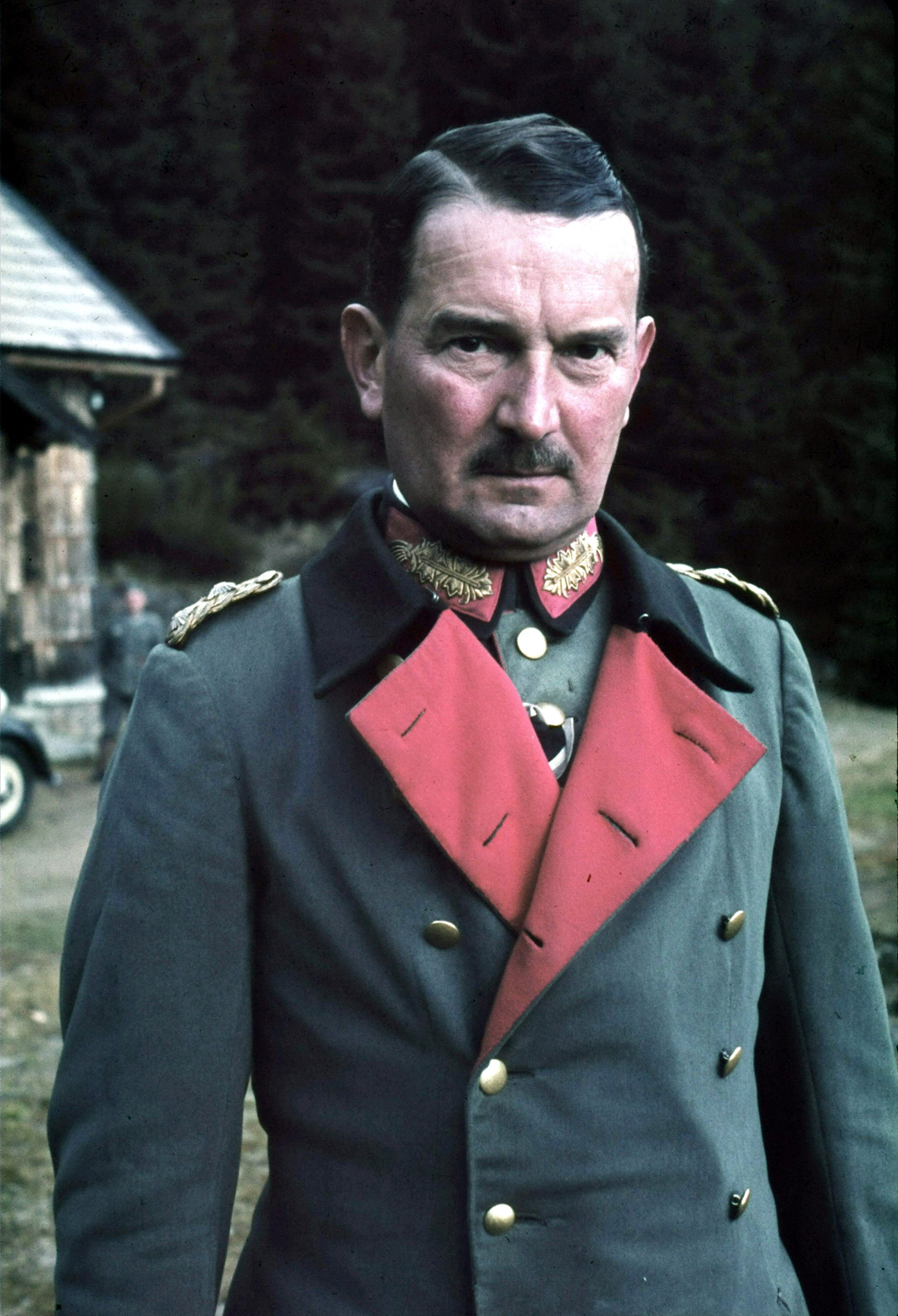
Eugen Siegfried Erich Ritter von Schobert (13 March 1883 – 12 September 1941) was a German general during World War II. He commanded the 11th Army during Operation Barbarossa, the invasion of the Soviet Union. Schobert died when his observation plane crashed in a Soviet minefield.
Schobert was born as Eugen Schobert in Würzburg in the Kingdom of Bavaria, a member state of the German Empire. He was the son of Major Karl Schobert and Anna née Michaely. Schobert entered the Royal Bavarian Army in July 1902. He served primarily in the 1st Bavarian Infantry Regiment "König" and underwent pilot training in 1911.
During World War I, Schobert remained a Bavarian infantry officer, serving the entire war on the Western Front. During the German spring offensive of 1918, he led the 3rd Battalion of the 1st Bavarian Infantry Regiment. For his actions on 23 March 1918, when he personally and successfully led his battalion in the crossing of a canal near Jussy against stiff British resistance, he was awarded the Knight's Cross of the Military Order of Max Joseph. This was Bavaria's highest military honor, comparable to the Prussian Pour le Mérite, and conferred a patent of nobility on a recipient who was a commoner. Hence Eugen Schobert became Eugen Ritter von Schobert.
After World War I, Schobert remained in the Reichswehr and then the Wehrmacht, steadily rising up the ranks. He was Inspector of Infantry from December 1933 to September 1934 and then commanded the 17th Infantry Division from 1935 to 1936 and the 33rd Infantry Division from 1936 to 1938. He took command of the VII Army Corps (VII. Armeekorps) on 4 February 1938.
In September 1939, Schobert led his VII Army Corps in the invasion of Poland as part of the reserve of Army Group South. In May–June 1940, his corps, part of General Ernst Busch's Sixteenth Army of Army Group A, participated in the invasion of Belgium and Luxembourg and the Battle of France. He received the Knight's Cross of the Iron Cross for his leadership of the VII Corps in the breakthrough of the Maginot Line and the capture of Nancy and Toul. He remained in command of the corps during preparations for the invasion of Great Britain.
In September 1940, Schobert was given command of the Eleventh Army. The army was assigned to Army Group South for Operation Barbarossa, the invasion of the Soviet Union. During combat operations in the southern Soviet Union, Schobert was killed when his Fieseler Storch observation aircraft crashed in a Soviet minefield. He was succeeded by Erich von Manstein. A German war correspondent, Leo Leixner, wrote Schobert's biography.
Schobert married Alice Rieder-Gollwitzer in 1921. They had three children: two sons and one daughter. His younger son was killed in combat in 1944 while serving as a fighter pilot for the Luftwaffe.
Source :
https://artsandculture.google.com/entity/m064km4b?hl=en
https://en.wikipedia.org/wiki/Eugen_Ritter_von_Schobert


Franz Ritter von Epp (born Franz Epp; from 1918 as Ritter von Epp; 16 October 1868 – 31 January 1947) was a German general and politician who started his military career in the Bavarian Army. Successful wartime military service earned him a knighthood in 1916. After the end of World War I and the dissolution of the German Empire, von Epp was a commanding officer in the Freikorps and the Reichswehr. He was a member of Bavarian People's Party, before joining the Nazi Party in 1928, when he was elected as a member of the German parliament or Reichstag, a position he held until the fall of Nazi Germany. He was the Reichskommissar, later Reichsstatthalter, for Bavaria, and a Reichsleiter of the Nazi Party.
Franz Epp was born in Munich in 1868, the son of the painter Rudolph Epp and Katharina Streibel. He spent his school years in Augsburg and after this joined the military academy in Munich. He served as a volunteer in East Asia during the Boxer Rebellion in 1900–01 and then became a company commander in the colony of German South-West Africa (now Namibia), where he took part in the bloody Herero and Namaqua Genocide. During the First World War, he served as the commanding officer of the Royal Bavarian Infantry Lifeguards Regiment in France, Serbia, Romania, and at the Isonzo front.
For his war service, Epp received numerous medals, of which the Pour le Mérite (29 May 1918) was the most significant. He was also knighted, being made Ritter von Epp on 25 February 1918, and received the Bavarian Military Order of Max Joseph (23 June 1916).
After the end of the war, Epp formed the Freikorps Epp, a right-wing paramilitary unit mostly made up of war veterans, of which the future leader of the SA Ernst Röhm was a member. This unit took part in the crushing of the Bavarian Soviet Republic in Munich, being responsible for various massacres. Epp joined the Reichswehr and was promoted to Generalmajor in 1922. He took his leave from the German Army after getting involved with right-wing associations in 1923.
When it became necessary for the Nazi Party to purchase a newspaper to publicize its political creed, Epp made available some 60,000 Reichsmarks from secret army funds to acquire the Völkischer Beobachter, which became the daily mouthpiece of the party.
As the Sturmabteilung (SA) expanded, it became an armed band of several hundred thousand men, whose function was to guard Nazi rallies and disrupt those of other political parties. Some of its leaders, particularly Ernst Röhm, visualized the SA as supplanting the regular army when Adolf Hitler came to national power. To this end, a department was set up under Epp called the Wehrpolitisches Amt (Army political office). Nothing came of this, as a distrustful Hitler had the SA crushed and many of its leaders killed in the Night of the Long Knives in the summer of 1934.
After leaving the Bavarian People's Party, Epp on 20 May 1928 was elected from electoral constituency 26 (Franconia) as one of the first 12 Nazi Party deputies to the Reichstag. He would continue to be elected to the Reichstag in each subsequent election throughout the Weimar and Nazi regimes to 1945. He served as the Nazi Party's head of its Military-Political Office from 1928 to 1945, and later as leader of the German Colonial Society, an organization devoted to regaining Germany's lost colonies. On 31 August 1933 he was made a Reichsleiter, the second highest political rank in the Nazi Party. On 3 October 1933, he was also made a member of the Academy for German Law. In May 1934 he became head of the NSDAP Office of Colonial Policy until its dissolution in February 1943.
Epp's final notable historical action occurred on 9 March 1933, two weeks before the Reichstag passed the enabling act, which granted Hitler dictatorial powers. On the orders of Hitler and Wilhelm Frick, he abolished the Government of Bavaria and set up a Nazi regime, with himself as Reichskommissar. On 10 April Hitler appointed him Reichsstatthalter for Bavaria. In this position he often clashed with Bavaria's Nazi Minister-President Ludwig Siebert. Epp's attempt to limit the influence of the central government on Bavarian politics failed. He, however, retained his post as Reichsstatthalter until the end of the war, although by then he was politically insignificant.
On 8 May 1933, von Epp's DO X crashed at the Passau Kachlet. The city named one of its streets Ritter-von-Epp-Straße.
He was arrested on Paul Giesler's orders in 1945, for being associated with the Freiheitsaktion Bayern, an anti-Nazi group led by Rupprecht Gerngroß. However, Epp had not wanted to be directly involved with the group, as he considered their goal—surrender to the Allies—a form of backstabbing of the German Army.
Suffering from a heart condition, he was hospitalised at Bad Nauheim at the end of the war. On 9 May 1945, a clerk at the hospital alerted agents from the US Counterintelligence Corps that Epp was a patient there, and he was arrested and sent to a prison camp in Munich to await trial at Nuremberg. He died in detention on 31 January 1947.
Decorations and awards
Order of the Red Eagle, 4th class (German Empire)
Order of the Crown, 4th class with swords (Prussia)
Military Merit Order, 3rd and 4th class with Swords (Bavaria)
1914 Iron Cross 2nd Class, 1914
1914 Iron Cross 1st Class, 1915
Knights Cross of the Military Order of Max Joseph (Kingdom of Bavaria), 1917
Pour le Mérite, 1918
Knight of the Princely House Order of Hohenzollern with swords (Hohenzollern-Sigmaringen)
Knight 2nd class of the House and Merit Order of Peter Frederick Louis (Oldenburg)
Knight of the Order of Saint John (Bailiwick of Brandenburg)
Honour Chevron for the Old Guard, February 1934
Honour Cross of the World War 1914/1918, 1934
Golden Party Badge
Sudetenland Medal, 1938
Anschluss Medal, 1939
War Merit Cross 2nd Class and 1st Class with Swords
Knights Cross of the War Merit Cross with Swords, 1943
Military Merit Cross, 2nd class (Grand Duchy of Mecklenburg-Schwerin)
Nazi Party Long Service Award (10 and 15 years)
Order of the Iron Crown, 3rd class (Austria)
On 18 May 1933, the city of Passau decided to make von Epp a Citizen of Honor.


Georg Wilhelm Schöning
Date of birth: 8 June 1908 (Gumbinnen an der Pissa, Ostpreußen, German Empire)
Date of death: 2 November 1987 (Bochum, Westfalen, West Germany)
Promotions:
01.10.1937 Leutnant der Reserve
00.00.1940 Oberleutnant der Reserve
01.03.1942 Hauptmann der Reserve
01.10.1943 Major der Reserve
21.01.1945 Oberstleutnant der Reserve
Career:
00.00.1937 Reserveoffizier in Infanterie-Regiment 23
26.08.1939 Drafted to Infanterie-Regiment 23 during mobilization
00.11.1939 Chef 10.Kompanie / Infanterie-Regiment 244
00.00.1940 Chef 10.Kompanie / Infanterie-Regiment 120
00.05.1942 Ordonannzoffizier in Infanterie-Regiment 120
01.06.1942 Führer III.Bataillon / Infanterie-Regiment 120
16.10.1942 Seriously wounded near Kalatsch
00.03.1943 Kommandeur I.Bataillon / Grenadier-Regiment "Feldherrnhalle"
08.02.1944 Führer Füsilier-Regiment "Feldherrnhalle"
26.07.1944 Kommandeur Panzer-Brigade 110
00.09.1944 Führer Panzergrenadier-Regiment 66
00.05.1945 POW of the Soviet
00.10.1945 Released from the POW camp
Awards and Decorations:
00.00.19__ Wehrmacht-Dienstauszeichnungen
11.07.1940 1939 Eisernes Kreuz II.Klasse
12.08.1941 1939 Eisernes Kreuz I.Klasse
00.00.194_ Infanterie-Sturmabzeichen in Silber
00.00.194_ Nahkampfspange in Bronze
00.00.194_ Verwundetenabzeichen in Bronze und Silber
14.02.1942 Deutsches Kreuz in Gold
00.00.1942 Medaille “Winterschlacht im Osten 1941/42”
00.00.194_ Order of Bravery 4th Class (Bulgaria)
00.00.194_ Ordinul Mihai Viteazul 3rd Class (Rumania)
00.00.194_ Krimschild
16.10.1942 Ehrenblattspange des Heeres und Waffen-SS
07.02.1944
Ritterkreuz des Eisernen Kreuzes, as Major der Reserve and Kommandeur
I.Bataillon / Füsilier-Regiment (motorisiert) “Feldherrnhalle” /
246.Infanterie-Division
21.01.1945 Ritterkreuz des Eisernen Kreuzes
mit Eichenlaub #707, as Major der Reserve and Führer
Panzergrenadier-Regiment 66 / 13.Panzer-Division
----------------------------------------------------------------------
Wilhelm
Schöning (8 June 1908 – 2 November 1987) served as commander of the
66th Panzergrenadier Regiment of the 13th Panzer Division during the
Siege of Budapest.
Most of the division was encircled and
destroyed in Budapest between December 1944 and February 1945. Those who
escaped, consisting of 200-300 men, were reformed under Schöning.
Wounded during the battle, Schöning broke through Soviet lines and
reached the German 3rd Cavalry Brigade on the Buda side. Schöning
remembered it thus:
"Suddenly I had the feeling that my leg was
being torn off. (...) As my pistol was empty I ordered my lieutenant to
finish me off because I didn't want to be taken prisoner. He was himself
wounded in the arm. He then called to me: “Only another 2,000 metres,
Lieutenant Colonel. We have to make it!'” I crept through the snow up a
hill with the major...Two wounded grenadiers from our battle group
picked us up under the arms under the heaviest fire and stood us upright
and I dragged myself with several wounds to the feet the two kilometres
to the German position."

 Swedish Army Captain Viggo Olson (right) posed with a decorated World War I veteran, probably from Germany. One of the nice medal in his uniform is a Turkish one, Gallipoli Star. The picture was taken by Carl-Erik Suneson on 18 May 1941.
 Two German Panzer IVs moving towards the German-Soviet demarcation line on 21 June 1941, less than 24 hours away before the start of Unternehmen Barbarossa, German invasion of Russia. In the foreground road sign "Grenze 1 km". For the campaign against the Soviet Union, the Germans allotted almost 150 divisions containing a total of about three million men. Among those units were 19 panzer divisions, and in total the Barbarossa force had about 3,000 tanks, 7,000 artillery pieces, and 2,500 aircraft.
 Channel Islands, German officers visiting the graveyard of their comrades, circa 1940. The military occupation of the Channel Islands by Nazi Germany lasted for most of the Second World War, from 30 June 1940 until liberation on 9 May 1945. The Bailiwick of Jersey and Bailiwick of Guernsey are two island countries and British Crown dependencies in the English Channel, near the coast of Normandy. The Channel Islands were the only de jure part of the British Empire to be occupied by Nazi Germany during the war. However, Germany's allies, Italy and Japan also occupied British territories in Africa and Asia, respectively. Anticipating a swift victory over Britain, the occupying German forces initially experimented by using a moderate approach to the non-Jewish population, supported by local collaborators. However, as time progressed the situation grew gradually worse and ended in near starvation for both occupied and occupiers during the winter of 1944-45. Armed resistance by islanders to the German occupation was nearly non-existent. Many islanders were employed by the Germans, and Germany imported thousands of captive workers to build extensive defensive works on the islands. Island leaders maintained some authority, independence, and freedom of decision from the German occupiers.
  Officers of the Wehrmacht (German Armed Forces) in coats with luggage, including two officers of the army (left and 3rd from left) and the air force (2nd from left and 4th from left).
 German soldiers observe the coast during the occupation of Normandy by German forces in the spring of 1944. The Germans expected the Allies to come ashore at Calais on the French coast, as this is the narrowest point along the Strait of Dover between England and France, and had heavily reinforced the Atlantic seawall with a vast network of shore batteries, beach obstacles, and minefields. The Allies instead chose to invade the European continent along the Normandy region coastline in the Bay of the Seine, roughly between Le Havre in the north and Cherbourg on the Cotentin Peninsula in the south.
 German officers in front of a shed on the Eastern front, where women work with hay. The war inflicted huge losses and suffering upon the civilian populations of the affected countries. Behind the front lines, atrocities against civilians in German-occupied areas were routine, including those carried out as part of the Holocaust. German and German-allied forces treated civilian populations with exceptional brutality, massacring whole village populations and routinely killing civilian hostages (see German war crimes). Both sides practised widespread scorched earth tactics, but the loss of civilian lives in the case of Germany was incomparably smaller than that of the Soviet Union, in which at least 20 million were killed.
 Mechanics at Tuskegee Army Air Field, Alabama, maintain an engine of a Vultee BT-13A Valiant. This aircraft was used for basic flight training for the Tuskegee Airmen. History has often ignored the contributions of Black Americans, leaving heroes like the Tuskegee Airmen, the first Black military pilots, overlooked. They flew nearly 1,500 missions and shot down 112 German aircraft. These men flew above prejudice, racism and hate to serve their country and drive positive change in America. Their impressive performance earned them more than 150 Distinguished Flying crosses and helped lead to the integration into the U.S. Armed Forces.
 P-51D Mustangs of the 4th Fighter Squadron, 52nd Fighter Group, 15th U.S. Air Force. These planes flew escorts for Italian-based bombers attacking targets in southeastern Europe late in the war. The USAAF 52nd Fighter Group enjoyed an outstanding record in World War II, but to date its story has never been told. Activated in January 1941, it moved to England in July 1942 for an assignment with the Eighth Air Force. It flew combat missions in Spitfires to France during the summer of 1942 before being reassigned to the invasion force attacking North Africa in November 1942. After moving to North Africa, it was assigned to the Twelfth Air Force and was again equipped with Spitfires. As part of the Twelfth Air Force, it flew combat missions in the Tunisian campaign, and during the invasion of Sicily. In mid-1944, the 52nd was reassigned to the Fifteenth Air Force and converted to P-51 Mustangs. During the remainder of the war, it flew bomber escort and strafing missions to targets in Italy, France, Germany, Czechoslovakia, Austria, Hungary, Rumania, and Yugoslavia. For its outstanding service the Group was twice awarded the Distinguished Unit Citation. During its long campaign, the Group destroyed more than 425 enemy aircraft in aerial combat and damaged 135 plus many more on the ground. The 52nd Fighter Group produced 21 Aces.
 A Martin PBM-3D Mariner prepares to launch from a coastal Naval Air Station to patrol for German submarines, probably in late spring 1943. The landing gear had to be manually removed before takeoff and reinstalled before exiting the water. Mariners were one of the most effective of the Navy’s long-range flying boats.
 German soldiers on bicycles (Radfahrtruppen) driving towards the German-Soviet demarcation line to their deployments before the attack on the USSR a.k.a. "Unternehmen Barbarossa" (Operation Barbarossa), June 1941. The Wehrmacht did invest in bicycle troops for Barbarossa, but the soviet road system was bad enough that most bike columns looked like this and mobility was effectively foot mobile with perhaps slightly greater combat load per soldier. As well, German bike troops frequently lacked organic artillery and engineers that the giant kessels that Barbarossa created forced the infantry to use to grind them down, and this further limited bike troop’s utility.
 Pictures from Walter Nödinger's estate (arrow point). In World War II he served as a sailor on the German submarine U-952, a Type VIIC U-boat whose career began with training at 5th U-boat Flotilla on 10 December 1942, followed by active service on 1 May 1943 as part of the 3rd Flotilla for the next seven months. On 1 February 1944 she transferred to serve with 29th Flotilla, based in La Spezia, for Mediterranean operations. In five patrols she sank two merchant ships, for a total of 13,374 gross register tons (GRT), plus one warship sunk and a further merchant ship damaged. U-952 was decommissioned on 12 July 1944 after being badly damaged on 5 July 1944 by US air raid. Her wreck was captured by French and broken up in 1946. The veteran crews met regularly for many years. Walter Nödinger passed away in May 2014.


 SS-Obergruppenführer und General der Waffen-SS Karl Wolff (Höhere SS und Polizeiführer Italien und Bevollmächtigter General der deutschen Wehrmacht in Italien) in a ceremony in Italy, October 1944. The picture was taken by Walter Frentz.


 Autoblindo fiat-ansaldo
 Operation Barbarossa - German pioneers cutting through barbed wire on the German-Soviet demarcation line behind the Granitza River at the beginning of the Russian campaign. On June 22, 1941, more than 3 million German and Axis troops invaded the Soviet Union along an 1,800-mile-long front, launching Operation Barbarossa. It was Germany’s largest invasion force of the war, representing some 80 percent of the Wehrmacht, the German armed forces, and one of the most powerful invasion forces in history.
 USS Randolph -CV-15 Two of the ship's Marines standing lookout watch beneath 40mm gun barrels. They are PFC H.J. Zukowski -left- and PFC Sam Paladins. On February 10, 1945 USS Randolph departed Ulithi Lagoon with Task Force 58 (TF-58). On February 16, 1945 and February 17, 1945 her aircraft participated in attacks against Tokyo area airfields and the Tachikawa factory. On February 18, 1945 her aircraft attacked Chi Chi Jima. On February 20, 1945 launched three sorties to provide ground support for the U.S. Marines on Iwo Jima plus two strikes against Haha Jima. Over the next four days attacked targets on Iwo Jima and Combat Air Patrols (CAP) were flown over the invasion force. On February 25, 1945 launched aircraft for strikes against Tokyo area airfields and Hachijo Jima then returned to Ulithi Lagoon.
.jpg) Japanese Yokosuka MXY7 Ohka (Baka) piloted flying bomb which had been captured intact by Marines on Okinawa. Photographed 26 June 1945. During the Okinawa Campaign, the Japanese utilized the Yokosuka MXY-7 Okha "Baka Bomb" against U.S. Navy warships. USS West Virginia (BB-48) is believed to be the first ship damaged by a Baka Bomb on April 1. USS Mannert L. Able (DD-733) was the first ship to be sunk by the weapon on April 12. Other ships damaged by these weapons during Operation Ten-Go were: USS Gayety (AM-239), USS Hugy W. Hadley (DD-744), and USS Shea (DD-750).Usually carried and transported by a Japanese Mitsubishi G4M2 "Betty" aircraft, the "glider weapon" would be released when close enough to its target, then aimed to subsequently destroy it.
Japanese Yokosuka MXY7 Ohka (Baka) piloted flying bomb which had been captured intact by Marines on Okinawa. Photographed 26 June 1945. During the Okinawa Campaign, the Japanese utilized the Yokosuka MXY-7 Okha "Baka Bomb" against U.S. Navy warships. USS West Virginia (BB-48) is believed to be the first ship damaged by a Baka Bomb on April 1. USS Mannert L. Able (DD-733) was the first ship to be sunk by the weapon on April 12. Other ships damaged by these weapons during Operation Ten-Go were: USS Gayety (AM-239), USS Hugy W. Hadley (DD-744), and USS Shea (DD-750).Usually carried and transported by a Japanese Mitsubishi G4M2 "Betty" aircraft, the "glider weapon" would be released when close enough to its target, then aimed to subsequently destroy it. 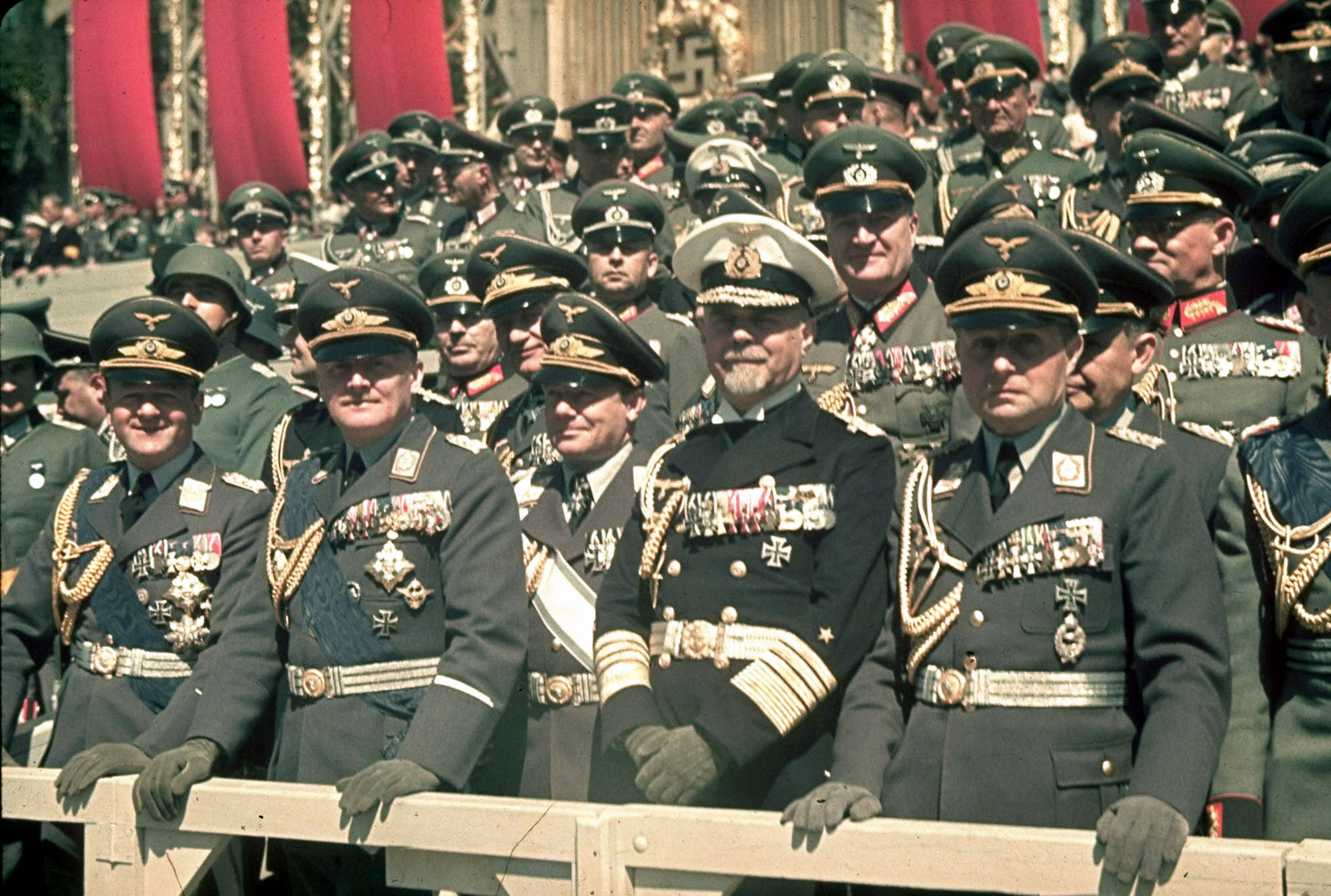 Generals and admirals of the Wehrmacht stood in the stands of honor at the culmination of Adolf Hitler's 50th birthday celebration, which was held in Berlin on April 20, 1939. They all wore paradeanzug (parade uniform), complete with feldbinde (brocade belt), auszeichnungen (medal bars) and schnurr (lanyard). Front row from left to right: Generaloberst Erhard Milch (Generalinspekteur der Luftwaffe), General der Flieger Hans-Jürgen Stumpff (Chef der Luftwehr), Generalleutnant Ernst Udet (Generalluftzeugmeister und Chef Planungsamts der Luftwaffe), Admiral Max Bastian (Präsident Reichsfürsorge- und Versorgungsgerichts der Wehrmacht), and Generalmajor Friedrich Fahnert (Höheren Kommandeur Luftnachrichtenschule Berlin). For additional identification: Generalleutnant Walter Petzel (Inspekteur der Artillerie) is the bespectacled man standing behind Fahnert; Generalmajor Hermann von Hanneken (Bevollmächtigter für Eisen- und Stahl auch zum Leiter der Hauptabteilung II Industrie) stood between Bastian and Fahnert, Generaloberst Wilhelm List (Oberbefehlshaber Heeres-Gruppenkommando 5) between Udet and Bastian, and General der Flieger Friedrich Christiansen (Korpsführer NSFK) between Stumpff and Udet. This photo itself was made by Hitler's personal photographer, Hugo Jaeger. Note that Milch and Stumpff both wear the Star of the Yugoslav Order of the Crown on their chests!
%20prepares%20to%20dock%20at%20the%20Brooklyn%20Navy%20Yard.jpg) The carrier USS Franklin (CV-13) approaches Manhattan as it prepares to dock at the Brooklyn Navy Yard on April 28, 1945. The Franklin’s deck shows the melted and burned decking and aircraft parts resulting from a March 19, 1945, dive bomber attack while the carrier was involved in attacks on the Japanese home islands. Over 800 crewmembers lost their lives in the explosion and fires that resulted. When Japan surrendered on 15 August 1945, USS Franklin was still undergoing repairs. A few months later on Navy Day, 13 October 1945, she was opened up to the public and inspected by thousands of visitors. Her extensive repairs were finally completed on 15 June 1946, and two days later, she reported to the Atlantic Reserve Fleet for inactivation. On 17 February 1947, the carrier was placed out of commission at Bayonne, New Jersey.
The carrier USS Franklin (CV-13) approaches Manhattan as it prepares to dock at the Brooklyn Navy Yard on April 28, 1945. The Franklin’s deck shows the melted and burned decking and aircraft parts resulting from a March 19, 1945, dive bomber attack while the carrier was involved in attacks on the Japanese home islands. Over 800 crewmembers lost their lives in the explosion and fires that resulted. When Japan surrendered on 15 August 1945, USS Franklin was still undergoing repairs. A few months later on Navy Day, 13 October 1945, she was opened up to the public and inspected by thousands of visitors. Her extensive repairs were finally completed on 15 June 1946, and two days later, she reported to the Atlantic Reserve Fleet for inactivation. On 17 February 1947, the carrier was placed out of commission at Bayonne, New Jersey. During Operation Fire Fly in 1945, the African American paratroopers of the 555th Parachute Infantry Battalion made over 8,000 individual jumps as smokejumpers on wildfires in the Pacific Northwest. Here they are preparing to jump from a Douglas C-47 on a wildfire in Wallowa Forest, Oregon. The 555th Parachute Infantry Battalion, more commonly known as the "Triple Nickles," was the first all-Black paratrooper unit in U.S. history. First organized in 1943 during World War II, the Triple Nickles trained at Fort Benning, Georgia, but were eventually transferred to Camp Mackall, North Carolina, to prepare for duty in Europe. At the time, the U.S. military was segregated and most Black soldiers were relegated to support roles, rarely trained as combat units let alone elite paratroopers. For some in the unit, the prospect of fighting Hitler's army presented an exciting opportunity — a chance to prove that Black men were as brave and capable as their white counterparts. But they were never sent to fight the Germans. By 1945, the Axis armies were in retreat and a new threat was developing in the American West — Japanese balloon bombs.