

Source :
https://en.wikipedia.org/wiki/File:Captured_German_Senior_Officers_From_the_African_Campaign_Arrive_at_a_Prisoner_of_War_Camp_in_Britain,_10_June_1943_TR980.jpg
 A pair of German artillery radio operators send coordinates on a portable transmitter in the Soviet Union, winter of 1942. The second man has a captured Russian Ushanka fur hat. The image was originally published as 'Das Heer im Grossdeutschen Freiheitskampf' (translated as 'The Army in the Greater German Freedom Struggle'), a collection of 50 plus images taken by the German Army's combat photography unit (Propagandakompanie) during the German invasion of the Soviet Union. The picture itself was taken by Kriegsberichter Trautvetter.

Letters and other forms of written communication have been transported within and between countries since medieval times, although a cheap, easily accessible postal service only became generally available to the British public with the appearance of the world's first adhesive postage stamp, the Penny Black, on 6 May 1840. This system was based on the sender pre-paying a flat rate for an item, a charge of one penny being made for the delivery of a letter weighing less than ½ ounce (14 grams) regardless of distance, with charges increasing for heavier items.
Other countries, including Germany, soon developed similar postal systems based upon adhesive, pre-paid stamps of a design unique to the area concerned, but it was not until Germany's partial unification in 1871 that the Deutsche Reichspost (German Imperial Mail or DRP) was established as a state monopoly, on 4 May 1871. It then became the official national postal authority for the German Empire and Alsace-Lorraine, being separated from Bismark's Reich Chancellery in 1876 as the Reichpostamt and operated as a separate agency.
Adolf Hitler's appointment as Chancellor in 1933 and the establishment of the Third Reich saw the DRP retain its original form and purpose, with Reichspost Minister Paul Freiherr von Eltz-Rubenach kept in post until 1937, when Karl Wilhelm Ohnesorge was appointed Minister of the Reichspost. He held this post until the end of the war, having been the real power in the Ministry during the whole of Eltz-Rubenbach’s tenure under the Nazi regime.
The Reich postal area was rapidly expanded during the period just before WWII, incorporating the Saar territory in 1935, and Austria and the Sudetenland in 1938. Occupied Polish areas came under its jurisdiction in 1939, including the free port of Danzig which had previously issued its own stamps, although the Feldpost military postal organisation was the main postal authority in these occupied areas. The DRP finally ceased operations on 8 May 1945, the date of the German surrender, being replaced by two post-war organisations, West Germany’s Deutsche Bundespost (German Federal Post Office) and East Germany’s Deutsche Post.
Many early stamps issued by the Third Reich for general circulation typically showed the head of Adolf Hitler in either left or right profile, and in addition to these Hitler head stamps there were also issues of complete series of official stamps which bore only a swastika. Stamps were also issued to commemorate events such as the National Socialist’s 10 years in power or Hitler’s birthday and these usually included engravings appropriate to the event. After 1934, all Reich stamps show the value of the stamp in the top corner/corners and a subscript in Gothic script at the bottom of the stamp reading: ‘DEUTSCHES REICH’
After 1944, Deutsches Reich (German Empire) was replaced with Grossdeutsches Reich (Greater German Empire), as a subscript in Gothic script, reading:
‘GROSSDEUTSCHES REICH’.
As well as ordinary stamps Hitler’s postal service issued a considerable number of semi-postal stamps. These are stamps which include a surcharge and may be easily recognised because they are printed with the purchase price of the stamp, then an addition sign, followed by the surcharge: ‘12+8’ indicating a stamp for which 12 Pfennigs was charged for postage, with an additional surcharge of 8 Pfennigs going to the relevant government project for which the stamp was issued. These stamps were intended by most governments to serve as a contribution to various charitable institutions, but the surcharge from Nazi semi-postals was used to finance all manner of government projects, including the war.
The German government had operated a postal service of some sort specifically for its military personnel since the Seven Years War in 1756, but the system was based upon deliveries by civilian postal authorities and had no resources available to facilitate the delivery of letters and parcels to troops at the front. Even during WWI, when Britain’s GPO was delivering around 12 million letters each week to Allied soldiers, sailors and airmen, the German postal authorities responded to the 1915 pre-Christmas rush by telling soldiers at the front not to send Christmas cards, because the already overburdened postal service could not deliver them.
However, between 1937 and 1945 this system was vastly improved, the Wehrmacht operating a military postal service, the Feldpost (Army Postal Service), organised so that all branches of the German military (Luftwaffe, Kreigsmarine, Waffen SS, etc) were responsible for delivering their own mail, although Feldpost offices closest to the combat zone usually had a mobile facility which processed mail for all the military branches. Charges for members of German military and paramilitary units (units composed of men not of German nationality serving with the Wehrmacht) were minimal, postcards and letters weighing less than 250gm (8oz) going free, while packages weighing between 250gm and 1kg (1,000gm/2.2lb) cost only 20 Reichspfennigs (about 5 old pence or 2p) to be delivered anywhere.
A semipostal from after 1944 commemorating the work of the German labour divisions, face value 12pf, surcharge 8pfComplications arose within this system as a result of the rapid movement of the German army through Europe in 1940 and, after a series of negotiations with the relevant governments, postal agreements were set up between Germany and the occupied countries providing for extended use of the Feldpost service. This was an important consideration for Hitler and his government cronies, as many of those occupied countries had significant numbers of volunteers in Wehrmacht units and Goebbels in particular must have quickly appreciated how the moral of these individuals was increased by access to a free post allowing them to write and receive letters from home. Even neutral countries which had volunteers serving with the Wehrmacht, such as Portugal, Spain, Switzerland, Sweden and Turkey, were eventually included in these postal agreements, relatives receiving their letters from men serving with the German forces by the same Feldpost system as the average Berliner.
Stamps do not appear to have been generally issued for this service until 1942 and then only for parcels and airmail covers, ordinary letters being simply stamped with what was termed a Feldpost number (FPN), in a system similar to the modern postcode. Servicemen could also send items via the civilian postal system, in which case full postage was collected and stamps issued and cancelled upon dispatch.
Unit FPNs typically consisted of five digits indicating a location, preceded by a letter showing whether the recipient’s unit belonged to the Heer, Luftwaffe, Kriegsmarine or some other service branch. There was also a letter following the digits which indicated whether the serviceman was serving in the headquarters company or as part of a line unit. This system was specifically developed to keep troop locations secret, relatives of service personnel receiving a messaging card (Benachrichtigungskarten) bearing the relevant FPN, with mail reaching the recipient in about two weeks. All correspondence from military personnel serving abroad was subject to censorship, although covers and postcards sent to addresses within Germany did not receive such scrutiny.
A Feldpost delivery on the Russian frontPerhaps needless to say, SS mail received special treatment. The SS-Feldpost mail was handled separately by the designated SS-units, the difference between ordinary Feldpost and SS-Feldpost mail being that an item for an SS soldier was required to bear the SS-Feldpost marking, SS unit seal and the sender's rank (SS-Mann), although these regulations do not appear to have been rigidly enforced. The SS also had mail surveillance centres, which used their own censorship markings. Initially the Feldpost was subject to the rules and regulations governing regular postal services and administered by the OKW (Wehrmacht High Command) but on 6 April 1944, all military mail, including its censorship, was removed from Wehrmacht control and came under the jurisdiction of the SS.
As well as their official stamps the Third Reich also produced several series of what are termed propaganda stamps and these include issues parodying the Royal family and the 1935 Silver Jubilee, which replaced the Silver Jubilee superscript with a picture of Stalin and the message ‘THIS WAR IS A JEWISH WAR’.
On the other side of the Channel, British MI6 produced a number of excellent forgeries of 3, 4, 6 and 8 Pfennig Reich stamps, while the OSS produced 6 and 12 Pfennig stamps, although their stamps were claimed to be inferior to MI6’s product. Both the SOE and OSS also produced propaganda stamps, in particular one with Himmler replacing Hitler, specifically intended to undermine the Fuhrer's confidence in his right hand man.
OSS stamp produced for Operation Cornflakes, showing Hitler as a Death's Head and with a subscript which translates as Ruined (or Lost) EmpireNot only did Allied intelligence forge genuine DRP stamps, they also set up an operation to fool the German postal service into delivering Allied propaganda. Designated Operation Cornflakes and run principally by the American OSS, the operation involved dropping subversive material in the form of letters enclosed in Reich-pattern mail bags from specially adapted planes on or near the site of a wrecked mail train. Letters were then re-collected and delivered in the normal way, OSS operatives having used captured German street directories to locate the addresses of real people within the Reich to whom this material was sent. From a collector's viewpoint this operation is of particular interest because the OSS produced a series of special stamps with unique engraving. One in particular shows Hitler’s face as a Death's Head in right profile with the usual subscript, ‘GROSSDEUTSCHES REICH’ replaced with the subscript ‘FUTSCHES REICH’, or ruined empire.
Although stamps, covers and postcards may not immediately seem something for the collector of militaria, many of these items have an intrinsic beauty of their own which can prove very attractive. Also, they are relatively cheap so a small collection of items of intrinsic interest, say, stamps related to Stalingrad, need not break the bank and would add interest to an otherwise mundane collection.
Stamps issued by the Third Reich - Generally, the issues with Hitler's head and the official swastika stamps are fairly common and relatively inexpensive, 20 stamps of the Hitler head issue selling for as little as £6-£7, with the swastika stamps about the same price. Some semipostals and commemorative stamps are also relatively inexpensive, a set commemorating the 1936 winter Olympics being recently offered for only £5, although much depends upon condition and rarity.
Propaganda stamps - Perhaps surprisingly, considering their interesting provenance, these stamps do not seem to fetch huge prices at auction, £5-£6 being the average internet price, depending upon condition and rarity.
Operation Cornflakes - Stamps from this operation are significantly more expensive than the general run of WWII stamps, £100-£200 being not unusual for the 12pf Death’s Head issue.
Feldpost covers and postcards - Normally Feldpost mail could not be dispatched nor received by civil post offices and envelopes (postal covers) or postcards delivered via the service are usually found stamped with a military Feldpost Cancellation and Official Military Unit Seal. Some covers and postcards from paramilitary units may be found with overprinted stamps, indicating that the item was dispatched from an occupied country before the German post office had begun issuing their own stamps, specifically printed for that area. These covers and postcards may also bear stamps from a censor, particularly after June 1944, when all postal items became the responsibility of the SS. Feldpost numbers were also sometimes reassigned to other units, particularly when a formation ceased to exist as a result of military action and consequently legitimate covers may be found which bear the same Feldpost number for two different units.
As usual, values depend upon rarity and provenance, but generally these are not expensive, good quality Bavarian covers starting at about £20.
Reichsparteitag Party Rally Propaganda postcard Postcards - These are really a collecting field in themselves but many of the examples produced by the Third Reich as propaganda tools are of extremely high quality and mint examples can fetch high prices, around £30-£40 being not unusual.
Source :
https://www.alamy.com/stock-photo-events-second-world-war-wwii-back-area-military-mail-service-delivery-24441770.html?imageid=A6C4EDC4-6578-41A1-BAB7-1456CB9AB042&p=58867&pn=1&searchId=d7b5b9a049e0fb6db1aa0742a1ef9e44&searchtype=0
https://www.gettyimages.com/detail/news-photo/dressed-in-winter-gear-two-german-soliders-look-through-a-news-photo/103137516?phrase=Das%20Heer%20im%20Grossdeutschen%20Freiheitskampf
https://www.militaria-history.co.uk/articles/postage-stamps-of-the-third-reich/


 A Luftwaffe navigator checks his course while laying in the nose of his Heinkel He 111 medium bomber. He is wearing a fliegerkopfhaube (flight cap). During World War I, most pilots quickly realized the need for protective headgear due to the cold weather effects while in an open cockpit. As no headgear was readily available, pilots were forced to utilize commercially produced leather motorcycle and automobile helmets. During World War II, the German military produced approximately 10 variations of flight helmets for various operational conditions, as well as with or without radio communication equipment. This specific helmet was designed with radio equipment for fighter and bomber pilots. It was similar to the earlier model used in the early months of the Battle of Britain (LWpW100), however with updated features.
 Oberfeldwebel Werner Machold (Flugzeugführer in 7.Staffel / III.Gruppe / Jagdgeschwader 2 "Richthofen") stands by his Messerschmitt Bf 109 E-7 "Weisse 1" fighter aircraft. The picture was taken in France, April 1941. At the beginning of World War II, Machold was serving with 1./JG 2. He was particularly successful over France in 1940 gaining at least 10 victories, including his first on 14 May. Oberfeldwebel Machold continued to score heavily during the Battle of Britain. He was the eighth German fighter pilot to reach 20 victories. On 5 September 1940, he was awarded the Ritterkreuz des Eisernen Kreuzes for 21 victories.On 7 September, Machold was transferred to 9./JG 2. He recorded his 24th through 26th victories on 30 September, shooting down three RAF fighters. Oberleutnant Machold was appointed Staffelkapitän of 7./JG 2 in spring 1941. On 9 June 1941, Oberleutnant Machold, flying his Bf 109 E-7/Z (W.Nr. 5983) “White 15”, force-landed near Swanage, Dorset after receiving damage from anti-aircraft fire from a Royal Navy destroyer during a low-level Jabo attack on a shipping convoy off Portland. He became a prisoner-of-war for the remainder of hostilities. Werner Machold amassed 32 victories in over 250 combat missions. All his victories were recorded over the Western front.
  Reichskanzler Adolf Hitler addressing an SA (Sturmabteilung) rally in Dortmund, Germany, during “Aufmarsch der SA-Gruppe Westfalen” (also known as the “SA-Westfalentreffen”), 9 July 1933. From left to right: Gauleiter Josef Wagner (NSDAP-Gauleiter des Gaus Westfalen-Süd), SA-Gruppenführer Wilhelm Schepmann (Führer SA-Gruppe Westfalen), SA-Brigadeführer Georg von Walthausen (Gruppenstaffelführers der SA-Gruppe Nord-West), Hitler, Adolf Hühnlein (blocked by Hitler, NSKK-Korpsführer ), and SA-Obergruppenführer Viktor Lutze (Oberpräsident der Provinz Hannover). This picture was taken by Hugo Jaeger, and was first published in the book "Deutschland Erwacht – Werden, Kampf und Sieg der NSDAP".


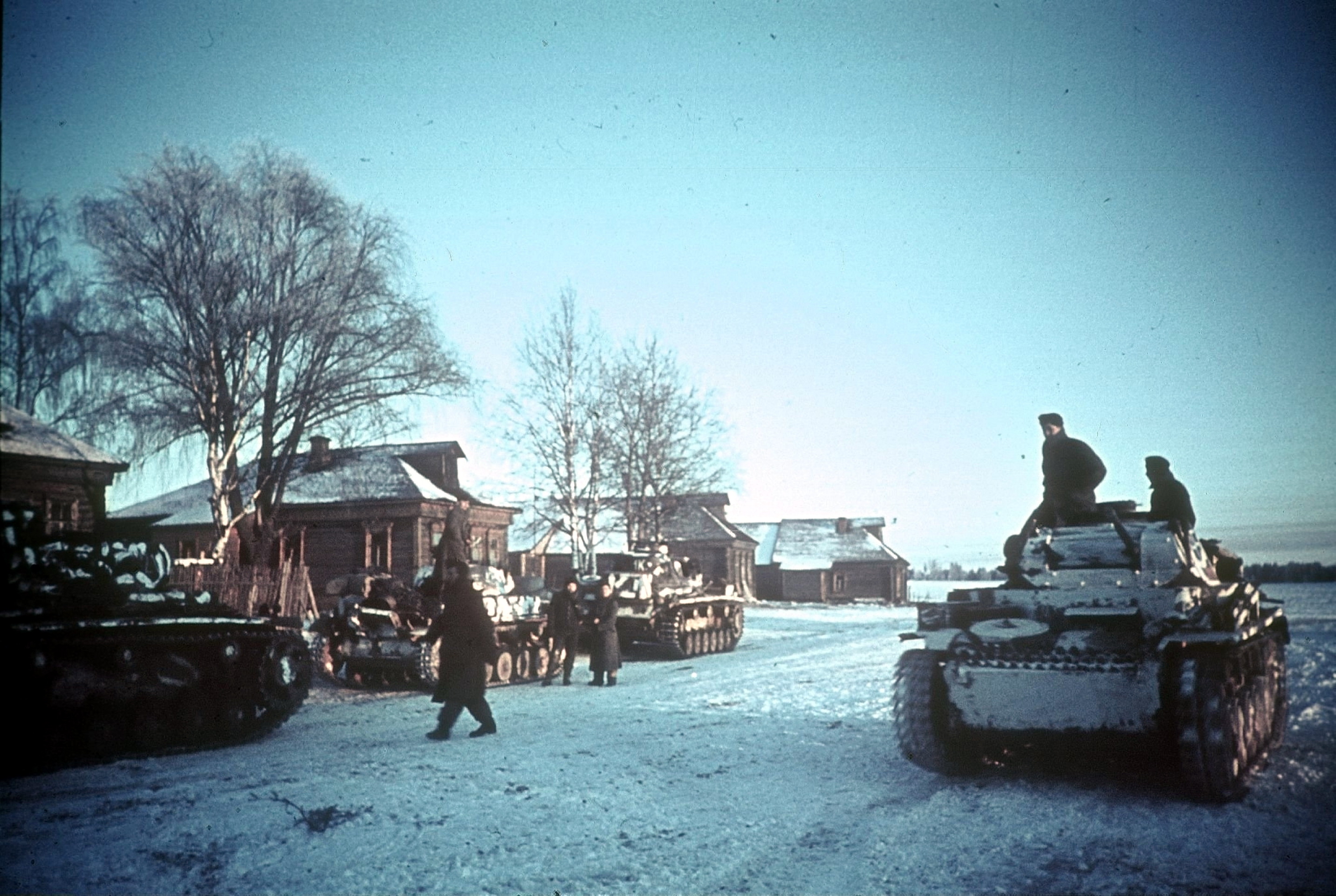 White winter camouflaged tanks of the 11. Panzer-Division in the village of Matronino near Volokolamsk. On the left, the first and third are Panzer III tanks, while between them and on the right is Panzer II tanks. The picture was taken by Kriegsberichter Artur Grimm in Moscow area, November 1941. From 31 October to 13–15 November 1941, the Wehrmacht high command stood down while preparing to launch a second offensive towards Moscow. Although Heeresgruppe Mitte (Army Group Centre) still possessed considerable nominal strength, its fighting capabilities had thoroughly diminished because of wear and fatigue. While the Germans were aware of the continuous influx of Soviet reinforcements from the east as well as the presence of large reserves, given the tremendous Soviet casualties, they did not expect the Soviets to be able to mount a determined defense.
 Positioning of an 8.8 cm Flak gun of the Luftwaffe (German Air Force) at the Eastern Front during Unternehmen Barbarossa, summer 1941. Photographer: Artur Grimm. For the invasion of the Soviet Union, Germany deployed the 8.8 cm Flak in 51 mixed Anti-Aircraft battalions. They were mostly Luftwaffe-subordinated units attached to the Heer at corps or army level, with approximately one battalion per corps. The weapon saw continuous use on the eastern front. The appearance of the outstanding T-34 and the later KV tanks shocked the German panzer crews and anti-tank teams, who could only penetrate the Soviet tanks' armor at extremely close range on the order of 200 yards when using the standard 37 mm and 50 mm guns, while the Russian 76 mm gun was effective out to 1000 yards.


Source :
https://www.jchb.org/neveragain-eastern-front-map/
https://twitter.com/dhkriegbericher?lang=en
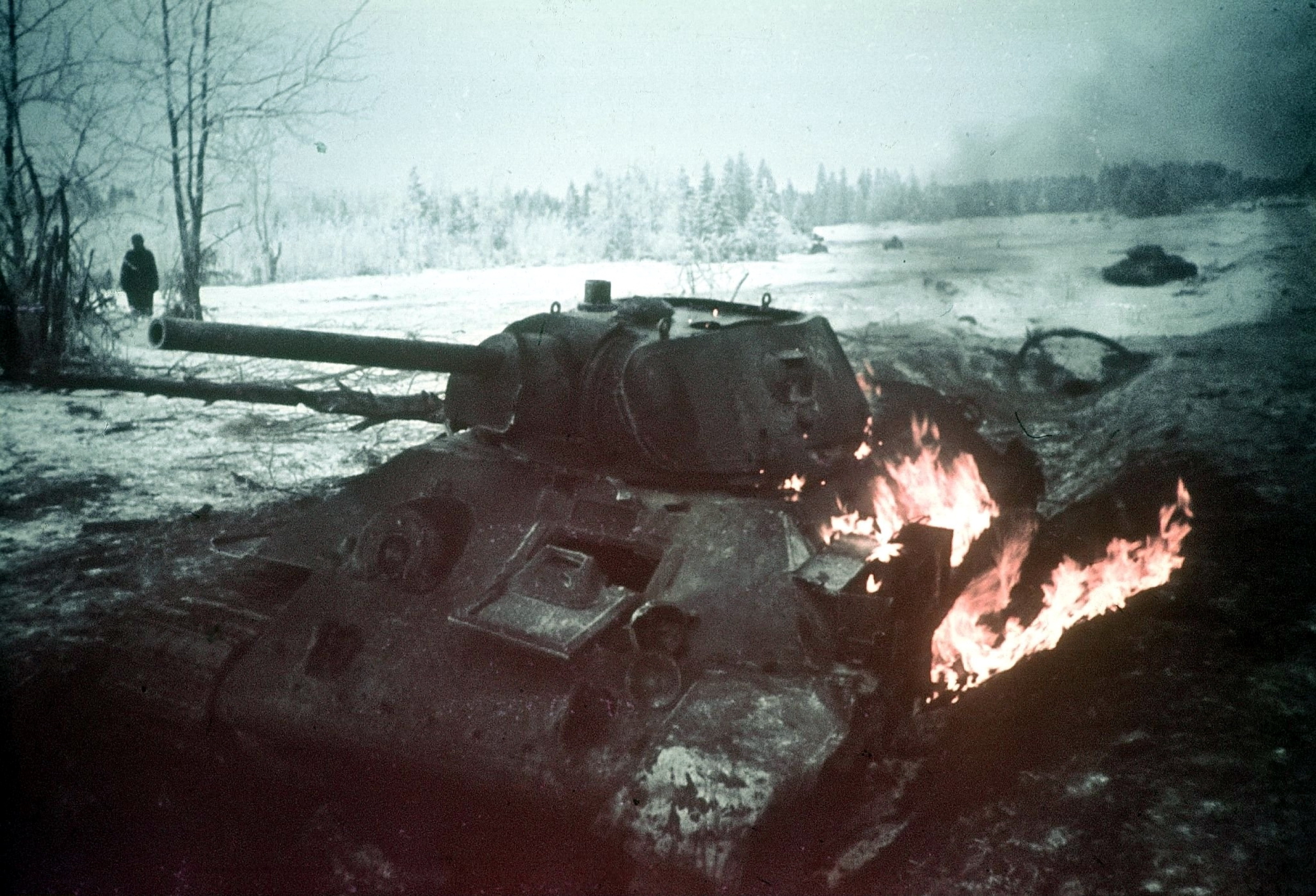 Aftermath of the repel of a Soviet tank attack by German forces in the Eastern Front: a hit, burning T 34 tank. The picture was taken by Kriegsberichter Artur Grimm, early or late 1943 (winter). The T-34 seemed impervious to German weapons and able to destroy German tanks with ease. Panzer commander General Heinz Guderian saw the heavy losses inflicted by the T-34 and realized what a game-changer it was, outclassing his own Panzer IIIs and IVs: “Up to this time we had enjoyed tank superiority, but now the situation was reversed,” Guderian wrote. “The prospect of rapid, decisive victories was fading in consequence."


%20viewing%20the%20victory%20parade%20in%20Warsaw%20after%20the%20German%20invasion%20of%20Poland.jpg)
%20viewing%20the%20victory%20parade%20in%20Warsaw%20after%20the%20German%20invasion%20of%20Poland.jpg)
%20viewing%20the%20victory%20parade%20in%20Warsaw%20after%20the%20German%20invasion%20of%20Poland.jpg)


 This photo was taken by Hugo Jaeger and shows the Siegesparade (Victory Parade) of the German troops from 8. Armee in Warsaw, Poland, which were held on October 5, 1939. The Einheits-PKW (standard passenger car) marching past Adolf Hitler and other dignitaries of the Wehrmacht, standing on the podium . The vehicle on the left is the Stoewer Typ M 12 RW, while the one in the center and right is the Horch 830 R Kübelwagen. Those standing in the podium is, from left to right: General der Kavallerie Erich Hoepner (Kommandierender General XVI. Armeekorps [motorisiert]), Generaloberst Walther von Brauchitsch (Oberbefehlshaber des Heeres), Adolf Hitler (Führer und Oberster Befehlshaber der Wehrmacht), Generaloberst Gerd von Rundstedt (Oberbefehlshaber Heeresgruppe Süd), General der Infanterie Werner Kienitz (Kommandierender General XVII. Armeekorps), General der Kavallerie Maximilian Reichsfreiherr von Weichs (Kommandierender General XIII. Armeekorps), Generaloberst Walther von Reichenau (Oberbefehlshaber 10. Armee), Generaloberst Johannes Blaskowitz (Oberbefehlshaber 8. Armee), General der Flieger Alexander Löhr (Chef Luftflotte 4), General der Flieger Albert Kesselring (Chef Luftflotte 1), and SA-Obergruppenführer Wilhelm Brückner (Chefadjutant des Führers und Reichskanzler). The aides are watching below the podium and - in this photo - they can be seen at far right.
 This photo was taken by Hugo Jaeger and shows the Siegesparade (Victory Parade) of the German troops from 8. Armee in Warsaw, Poland, which were held on October 5, 1939. A line of military trucks passes Adolf Hitler and other high-ranking Wehrmacht officials, followed by the Einheits-PKW (standard passenger cars). It seems that these vehicles have been added with a two-tone gray-brown camouflage paint, and they also have a glossy shine as if they were fresh from the factory (the order to use all-grey camouflage only came into effect after the end of French campaign in 1940). Here, too, we can see that the generals around Hitler changing according to their unit's turn to parade. From left to right: Generaloberst Walther von Brauchitsch (Oberbefehlshaber des Heeres), Adolf Hitler (Führer und Oberster Befehlshaber der Wehrmacht), Generaloberst Gerd von Rundstedt (Oberbefehlshaber Heeresgruppe Süd), General der Infanterie Werner Kienitz (Kommandierender General XVII. Armeekorps), and General der Kavallerie Maximilian Reichsfreiherr von Weichs (Kommandierender General XIII. Armeekorps)

Maximilian Maria Joseph Karl Gabriel Lamoral Reichsfreiherr von Weichs zu Glon (12 November 1881 – 27 September 1954) was a German Generalfeldmarschall during World War II. He was born into a noble family at Dessau in Anhalt, a son of an Army colonel. Following his graduation from the Wilhelmsgymnasium in Munich, he entered the Bavarian Cavalry in 1900 and fought with them in World War I. From 1915 until 1918 he served with the General Staff of the 3rd Bavarian Army Corps. After the war he remained in the newly created Reichswehr where he worked at a number of General Staff positions and later served as an instructor. Transferred from the 3rd Cavalry Division to command Germany's 1st Panzer Division upon its formation in October 1935, he led the unit in maneuvers that impressed Army Commander in Chief Werner von Fritsch. Weichs' aristocratic and cavalry credentials demonstrated the continuing influence of these military elites in Germany's modernizing force.
In October 1937 he became the commander of the 13th Army Corps, that later served in the 1938 German annexation of the Sudetenland.
For the German invasion of Poland beginning World War II in 1939, Weichs was appointed head of his own Army Corps "Weichs". After the Polish surrender, and in preparation for the invasion of France, he was made Commander-in-Chief of the 2nd Army, a part of Rundstedt’s Army Group A in the West. For his successes in the French campaign he was awarded the Knight's Cross of the Iron Cross and promoted to colonel-general. Leading his corps, Weichs later took part in the Balkans Campaign, and in preparation for Operation Barbarossa, the German invasion of the Soviet Union, he was assigned to lead the 2nd Army as a part of Fedor von Bock’s Army Group Centre. He led the 2nd Army in 1941 through the Battle of Kiev, the Battle of Smolensk, and then on to Vyazma and Bryansk.
In 1942, for Fall Blau, Weichs was assigned to lead the newly created Army Group B. Army Group B was composed of Hans von Salmuth's 2nd Army, Hermann Hoth’s 4th Panzer Army, and Friedrich Paulus' 6th Army. In addition to the German armies, Army Group B included the 2nd Hungarian Army, 8th Italian Army, the Third and the Fourth Romanian Army. The 6th Army was assigned to take the city of Stalingrad and cover approximately 800 km of front.
Weichs warned about his lines being stretched too thinly, but Adolf Hitler ignored his warnings. Weichs' fears were realised when Operation Uranus smashed the Romanian armies on his flanks, cutting off the 6th Army inside Stalingrad. Suggesting retreat, Weichs fell out of Hitler’s favor. Consequently, parts of Army Group B were taken away from Weichs' command and incorporated into a new Army Group Don, led by Erich von Manstein. Later in February the remaining part merged with the Don Group into a newly reinstated Army Group South, also led by Manstein. Weichs was put in leader reserve.
Weichs was promoted to Generalfeldmarschall on 1 February 1943. As the German situation was starting to become more dire, in August 1943 Weichs was appointed Commander of Army Group F in the Balkans defending against possible Allied invasion in what was seen as Germany’s weak underbelly and fighting off local partisan groups that were gaining strength. In late 1944, he oversaw the German retreat from Greece and most of Yugoslavia.
As Nazi Germany fell apart, Weichs was finally retired on March 25, 1945, and was arrested by American troops in May. During the Nuremberg Trials, Weichs was implicated in war crimes committed while suppressing the partisans, however, he was removed from the Hostages Trial due to medical reasons without having been judged or sentenced.
Weichs died at Burg Rösberg near Bonn.
Medals and decorations
Knight's Cross on 29 June 1940 as General der Kavallerie and commander-in-chief of the 2. Armee
731st Oak Leaves on 5 February 1945 as Generalfeldmarschall and commander-in-chief of Heeresgruppe F, at the same time OB Südost (commander-in-chief south east)
Iron Cross of 1914, 1st and 2nd Class
Clasp to the Iron Cross of 1939, 1st and 2nd Class
Bavarian Military Merit Order, Fourth Class with Swords
Eastern Front Medal
Sudetenland Medal with Prague Castle Bar
Jubilee Medal for the Bavarian Army
Bavarian Military Long Service Award 2nd Class
Wehrmacht Military Long Service Award 1st Class
Order of Franz Joseph, Knight's Cross
Source :
http://alifrafikkhan.blogspot.com/2011/07/album-foto-berwarna-jenderal-heer.html
https://military-history.fandom.com/wiki/Maximilian_von_Weichs

 Maintenance of a Junkers Ju 88 bomber at a German air force base in Northern France, autumn 1940 (or spring 1941). Photographer: Artur Grimm. The Ju 88 sported a rather ungainly appearance but was consistent with the German bomber design trend of the period. The heavily-framed cockpit was held in a stepped arrangement overlooking a short, glazed nose section. The fuselage was expectedly tubular and terminated in a single rounded vertical tail fin at rear. The wing mainplanes were low-mounted along the forward section of the aircraft with the engine nacelles installed at each wing leading edge. The engines sported large spinners and drove three-bladed propeller units. Most Ju 88 versions held a belly gondola for a defensive machine gun position. The undercarriage arrangement was of the typical tail-dragger configuration featuring two main legs.
  Funeral
of Generalleutnant Hans Kamecke, the second commander of 137.
Infanterie-Division, who was severely wounded in the battle against the
Red Army at Ostrowy / Lojew, Belarus, on 15 October 1943. He then died
because of his wounds in the field hospital near Kolpen the next day, 16
October 1943. Kamecke would posthumously awarded the Ritterkreuz des
Eisernen Kreuzes on 27 October 1943.
Funeral
of Generalleutnant Hans Kamecke, the second commander of 137.
Infanterie-Division, who was severely wounded in the battle against the
Red Army at Ostrowy / Lojew, Belarus, on 15 October 1943. He then died
because of his wounds in the field hospital near Kolpen the next day, 16
October 1943. Kamecke would posthumously awarded the Ritterkreuz des
Eisernen Kreuzes on 27 October 1943. German
victory parade at Place de la Concorde, Paris, June 14, 1940. Front row
from left to right: General der Kavallerie Georg Stumme
(Kommandierender General XXXX. Panzerkorps), General der Artillerie
Georg von Küchler (Oberbefehlshaber 18. Armee), and Generaloberst Fedor
von Bock (Oberbefehlshaber Heeresgruppe B). Far left is Generalmajor
Erich Marcks (Chef des Generalstabes 18.Armee), while closest to the
camera is Generalleutnant Hans von Salmuth (Chef des Generalstabes
Heeresgruppe B). Photo by Hugo Jaeger.
German
victory parade at Place de la Concorde, Paris, June 14, 1940. Front row
from left to right: General der Kavallerie Georg Stumme
(Kommandierender General XXXX. Panzerkorps), General der Artillerie
Georg von Küchler (Oberbefehlshaber 18. Armee), and Generaloberst Fedor
von Bock (Oberbefehlshaber Heeresgruppe B). Far left is Generalmajor
Erich Marcks (Chef des Generalstabes 18.Armee), while closest to the
camera is Generalleutnant Hans von Salmuth (Chef des Generalstabes
Heeresgruppe B). Photo by Hugo Jaeger.